
There is a sentence every television anchor has learned to say with a straight face: “This is unverified, but…” The word that follows that “but” is the whole problem. In the modern newsroom, the compulsion to be first has quietly overtaken the duty to be right. A clip arrives, the ticker turns red, the anchor’s voice climbs an octave, and a claim that no one has checked is beamed into millions of homes before a single phone call has been made to confirm it. The race for the scoop has become a race to the bottom, and the casualty is the one thing journalism is supposed to protect: public trust.
This essay is part of our series on media ethics in the age of virality, and it begins with the engine that powers most of the damage – the “quickest-first” reflex. When being early is rewarded more than being accurate, a newsroom stops being a filter for falsehood and becomes an amplifier of it.
When the war on screen was not the war on the ground
The clearest recent illustration came during Operation Sindoor in May 2025, India’s military response after the Pahalgam terror attack. As real missiles crossed the border on the night of 8 May, an imaginary war played out on Indian television – and the imaginary one was louder.
Several mainstream channels reported that the Indian Navy had reduced Karachi port to rubble. The footage they ran to prove it was, in fact, a clip of a January 2025 plane crash in Philadelphia – three months old and thousands of kilometres away. Fact-checkers at Alt News documented the spread: ABP Ananda aired the Philadelphia footage as damage from INS Vikrant; Aaj Tak ran sirens and an anchor declaring the Navy had “surrounded Pakistan from all sides”; India Today, Zee News and TV9 Bharatvarsh carried near-identical claims of explosions at the port. The Karachi Port Trust confirmed it was functioning normally. No attack had taken place.
The recycled visuals did not stop there. A video circulated as proof of “the power of Indian defence systems over Jaisalmer” was, on reverse-image search, footage of Israel’s Iron Dome that had been online since at least 2021 – a four-year-old clip of a different country’s air defence, presented as live combat. Full Fact and BOOM traced the original and debunked the misattribution.
None of this required malice on every desk. It required only the structural incentive that now governs breaking news: get it on air before the competitor does, and verify – if at all – on the way down. The International Federation of Journalists called it, aptly, two wars – one real and one imagined – and noted that the imagined one was manufactured in studios.
The synthetic layer: deepfakes that “admit defeat”
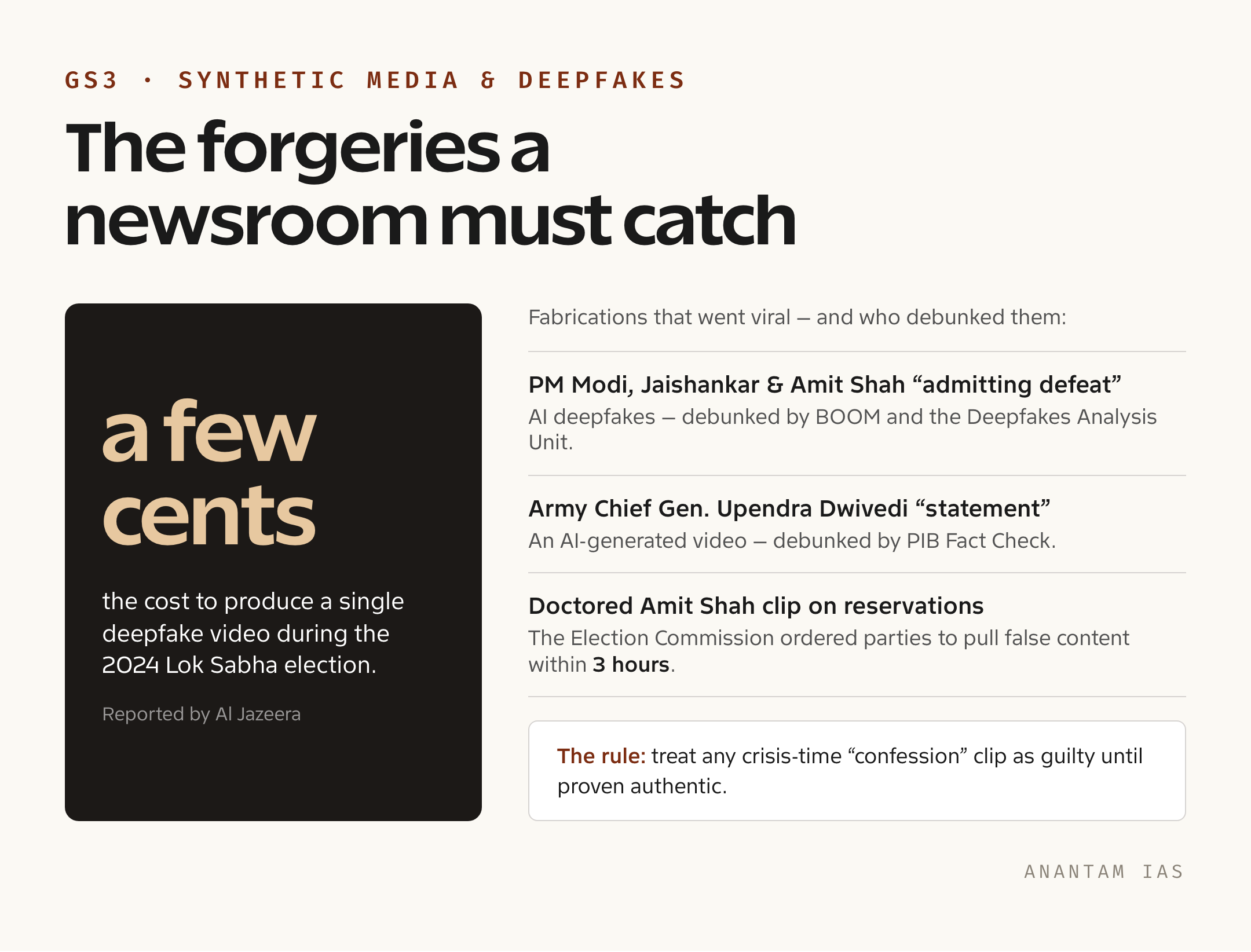
If old footage is the first failure, synthetic media is the more dangerous second. During the same period, videos went viral showing Prime Minister Narendra Modi, External Affairs Minister S. Jaishankar and Home Minister Amit Shah apparently apologising to the world and admitting India had “lost the battle.” The BOOM fact-check and the Deepfakes Analysis Unit confirmed all three were AI-generated deepfakes – cloned voices, misaligned lip movements, facial distortions. No such statements were ever made.
The government’s own PIB Fact Check unit had to step in to debunk an AI-generated video that falsely put words in the mouth of Army Chief General Upendra Dwivedi, fabricating a claim that the PM had called off a Navy strike. PIB confirmed the General had made no such statement and urged the public to verify before forwarding, particularly on matters touching national security.
This synthetic layer is not a wartime aberration. It is now baked into routine democratic life. Through the 2024 Lok Sabha election, deepfakes and voice clones of political figures circulated on an industrial scale – some produced for as little as a few cents per video, according to Al Jazeera. A doctored clip of Amit Shah, altered to suggest the government would scrap reservations, spread widely enough that the Election Commission ordered parties to pull false content within three hours. A newsroom that broadcasts a synthetic clip without forensic checking is not reporting the news. It is laundering a forgery into fact.
The wrong name, the premature report
The quickest-first reflex does its quietest damage in the hours after a blast or an attack. Pressure to name a suspect, identify a cause, or confirm a casualty count produces a recognisable pattern: a face is splashed across screens as the “accused,” a death toll is announced and then revised, a motive is asserted before any investigation has begun. When the correction comes – and corrections almost always come – it arrives smaller, later and to a fraction of the original audience.
A wrongly named individual cannot un-ring that bell. The reputational harm of being broadcast as a suspect, then quietly cleared, is rarely repaired in proportion to the damage done. This is where speed stops being a competitive vice and becomes an ethical one. Reporting the wrong name is not a smaller error than reporting no name – it is a larger one.
The governance puzzle: regulate the harm, not the speech
Here the story turns from ethics to governance – and to a misconception worth correcting precisely. India does not currently have an operative government “Fact Check Unit” with the power to flag online content about the State as false.
The government had tried to create one through the IT (Intermediary Guidelines) Amendment Rules, 2023, empowering a state Fact Check Unit (FCU) to identify “fake, false or misleading” information about government business. On 26 September 2024, in Kunal Kamra v. Union of India, the Bombay High Court struck it down, holding Rule 3(1)(b)(v) unconstitutional for violating Articles 14, 19(1)(a) and 19(1)(g). The court’s reasoning is the crux of the whole debate: a government cannot be the sole arbiter of truth about itself without chilling the speech the Constitution protects. The Centre’s appeal is now before the Supreme Court, so the rule remains inoperative.
What does function is the advisory PIB Fact Check Unit – which debunks claims but holds no takedown power over critics of the State – alongside independent fact-checkers like Alt News, BOOM, Factly and Newschecker, and platform-level analysis bodies. The gap is glaring: there is still no robust mandatory labelling regime for AI-generated and synthetic media, the very category causing the most harm. A draft framework requiring visible “synthetically generated” labels has been discussed, but the deepfake of an Army Chief travels faster than the rule meant to catch it.
What truthful journalism owes the public
The remedy is neither censorship nor a state ministry of truth. It is the recovery of verification as a non-negotiable professional duty – the discipline that separates a journalist from a forwarding contact on a messaging app.
- Verify before you publish, not after. A reverse-image search takes thirty seconds. It would have stopped the Philadelphia clip, the Iron Dome footage, and the 2023 naval-drill photo at the studio door.
- Treat synthetic media as guilty until proven authentic. Any clip of a public figure “confessing,” “apologising” or “admitting defeat” during a crisis deserves forensic scrutiny before it touches the air.
- Make corrections as loud as the error. A retraction buried in a tweet does not undo a falsehood broadcast in prime time.
- Name no suspect the police have not named. The cost of being slow is an empty minute; the cost of being wrong is a ruined life.
- Label provenance. Where footage comes from, when it was shot, and whether it is AI-generated are facts the audience is owed.
For the UPSC aspirant, this is not a current-affairs footnote – it sits at the heart of two papers. In GS Paper 4 (Ethics), the case study writes itself: truth, objectivity and verification are professional duties, not optional virtues, and the conflict between the journalist’s commercial incentive to be first and their ethical obligation to be accurate is a textbook clash of values. In GS Papers 2 and 3 (Governance, Internal Security), the question is how a democracy regulates misinformation and synthetic media without weaponising that regulation against legitimate dissent – exactly the line the Bombay High Court drew. Aspirants tracking these debates through our daily current affairs coverage will see the same tension recur in every fresh case, and our governance resources map the regulatory architecture in detail.
Breaking news will always be tempting because speed sells. But a newsroom that trades its credibility for a head start is spending the only capital it cannot earn back. Trust is built slowly, in the unglamorous minutes between a claim and its confirmation – and it is broken in the single second it takes to put an unverified clip on air.
Frequently Asked Questions
What does “speed over accuracy” mean in the context of newsrooms?
It describes the structural incentive in competitive breaking-news coverage to publish or broadcast a claim before verifying it, in order to be first. The reflex turns newsrooms into amplifiers of misinformation, because unchecked footage, premature suspect names and synthetic clips reach the audience before any confirmation – and corrections, when they come, reach far fewer people.
What misinformation did Indian TV channels broadcast during Operation Sindoor in May 2025?
Fact-checkers including Alt News, BOOM and Full Fact documented several false reports. Channels aired a January 2025 Philadelphia plane-crash clip as a supposed Indian naval attack on Karachi port, and a four-year-old Israeli Iron Dome video as live Indian air defence. The Karachi Port Trust confirmed normal operations and no attack had occurred. Viral deepfakes also falsely showed Indian leaders “admitting defeat.”
Does India have a government “Fact Check Unit” to police online content?
No operative one. The IT Amendment Rules, 2023 had empowered a government Fact Check Unit to flag content about the State as false, but the Bombay High Court struck the rule down on 26 September 2024 in Kunal Kamra v. Union of India as unconstitutional. The Centre’s appeal is pending in the Supreme Court, so the rule is not currently in force. The separate PIB Fact Check unit issues advisories but holds no takedown power over government critics.
Why are deepfakes especially dangerous for journalism and democracy?
Deepfakes and voice clones fabricate convincing audio-visual “evidence” of statements that were never made – as seen with the AI videos of PM Modi, Amit Shah, S. Jaishankar and Army Chief General Upendra Dwivedi debunked by BOOM, the Deepfakes Analysis Unit and PIB Fact Check. During the 2024 Lok Sabha election they circulated at industrial scale. A newsroom that airs such clips without forensic verification effectively launders a forgery into accepted fact, and there is still no robust mandatory labelling regime for synthetic media.
How is this topic relevant for the UPSC examination?
It maps directly onto GS Paper 4 (Ethics), where truth, objectivity and verification are professional duties and the first-versus-accurate conflict is a classic clash of values. It also features in GS Papers 2 and 3 (Governance, Internal Security), which examine how a democracy can regulate misinformation and synthetic media without chilling free speech – the precise balance the Bombay High Court addressed in striking down the IT Rules Fact Check Unit.
Practice Questions
Prelims MCQs
1. During Operation Sindoor (May 2025), several channels aired misattributed footage. Which of the following was actually broadcast as evidence of an Indian strike on Karachi port?
- (a) Live drone footage from the Arabian Sea
- (b) A January 2025 plane-crash clip from Philadelphia
- (c) Satellite imagery released by ISRO
- (d) A Navy press briefing
Answer: (b) Fact-checkers documented that a three-month-old Philadelphia plane-crash clip was aired as a supposed naval attack; the Karachi Port Trust confirmed normal operations.
2. With reference to the PIB Fact Check unit, consider the following statements: 1) It is an advisory body that debunks false claims. 2) It has statutory power to order takedowns of content critical of the government. 3) It urges the public to verify before forwarding. Which are correct?
- (a) 1 and 2 only
- (b) 1 and 3 only
- (c) 2 and 3 only
- (d) 1, 2 and 3
Answer: (b) PIB Fact Check issues advisories and debunks claims but holds no takedown power over critics of the State.
3. The government’s attempt to empower a state Fact Check Unit under the IT (Intermediary Guidelines) Amendment Rules, 2023 was struck down by the Bombay High Court in which case?
- (a) Shreya Singhal v. Union of India
- (b) Kunal Kamra v. Union of India
- (c) Anuradha Bhasin v. Union of India
- (d) Faheema Shirin v. State of Kerala
Answer: (b) In Kunal Kamra v. Union of India (26 September 2024), the court held Rule 3(1)(b)(v) unconstitutional.
4. A “deepfake” is best defined as:
- (a) Any blurry or low-resolution video
- (b) Synthetic audio-visual media that fabricates a convincing but false depiction of a person
- (c) A leaked classified recording
- (d) A satirical cartoon
Answer: (b) Deepfakes use AI to clone voices and faces, fabricating statements never made — as with the viral clips of Indian leaders “admitting defeat” debunked during Operation Sindoor.
5. Which single, simple practice would have prevented the broadcast of the recycled Iron Dome and Philadelphia clips?
- (a) A government licence to broadcast
- (b) A reverse-image search before airing
- (c) A higher TRP target
- (d) A faster news ticker
Answer: (b) A thirty-second reverse-image search would have exposed the footage as old and unrelated before it reached air.
Mains Practice Questions
- “When being early is rewarded more than being accurate, a newsroom stops being a filter for falsehood and becomes an amplifier of it.” Examine the ‘quickest-first’ reflex in breaking-news journalism with suitable examples. (15 marks, 250 words)
- Synthetic media and deepfakes pose a qualitatively new threat to truthful journalism and democracy. Discuss, and suggest a framework for labelling AI-generated content. (15 marks, 250 words)
- “Reporting the wrong name is not a smaller error than reporting no name — it is a larger one.” Critically analyse this statement in the context of crime and terror reporting. (10 marks, 150 words)
- Distinguish between the advisory PIB Fact Check unit and the struck-down statutory Fact Check Unit under the IT Rules. What does this distinction reveal about regulating misinformation in a democracy? (15 marks, 250 words)
- Verification is the discipline that separates a journalist from a forwarding contact on a messaging app. Discuss the professional duties that truthful journalism owes the public. (10 marks, 150 words)
Tell Google you want more of this.
Add Anantam IAS as a preferred sourceOne tap, and this site shows up more often in your own Top Stories, AI Overviews and AI Mode. Remove it any time.