

"The CAG is the most important officer under the Constitution of India. His duties are far more important than the duties even of the judiciary." — Dr B.R. Ambedkar, Constituent Assembly debates
The Comptroller and Auditor General of India (CAG) is the constitutional auditor of all receipts and expenditure of the Union and the States. Created under Article 148, the CAG is the head of the Indian Audit and Accounts Department (IAAD), the principal guardian of the public purse, and the institution that supplies Parliament — through the Public Accounts Committee (PAC) — with the audit reports it needs to hold the executive to account. From the 2G spectrum and coal block reports of the early 2010s to the Dwarka Expressway, Ayushman Bharat and GST refund audits of 2023–25, the CAG sits at the intersection of accountability journalism, judicial review and parliamentary oversight. For UPSC, this is a recurring GS II topic.
Constitutional Provisions: Articles 148–151
| Article | Subject |
|---|---|
| 148 | Appointment, oath and conditions of service of the CAG |
| 149 | Duties and powers of the CAG |
| 150 | Form of accounts of the Union and the States — to be prescribed by President on CAG's advice |
| 151 | Audit reports — submitted to President (Union) or Governor (State), then laid before Parliament/Legislature |
The CAG's authority is fleshed out by the Comptroller and Auditor General's (Duties, Powers and Conditions of Service) Act, 1971, with major amendments in 1976 (separation of accounts from audit at the Union) and 1984.
Appointment and Tenure
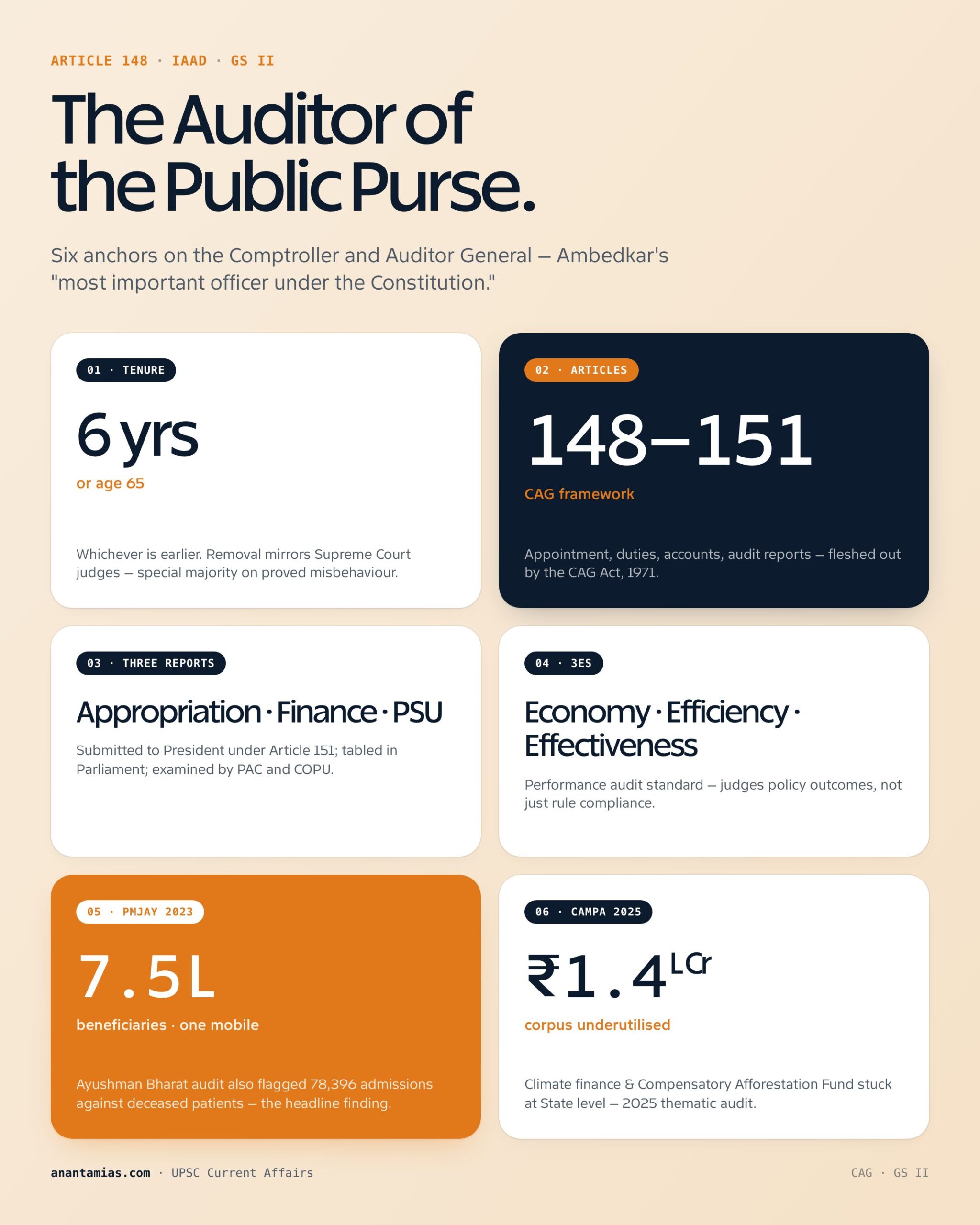
- Appointment: The CAG is appointed by the President of India by warrant under his hand and seal.
- Oath: Before entering office, the CAG takes an oath before the President.
- Tenure: 6 years or until age 65, whichever is earlier.
- Removal: Same procedure as a Supreme Court judge — by an order of the President after an address by both Houses of Parliament with special majority on grounds of proved misbehaviour or incapacity (Article 124(4) procedure read with Article 148).
- Salary and conditions: As prescribed by Parliament; cannot be varied to the disadvantage of the CAG after appointment.
- Bar: After demitting office, the CAG is ineligible for any further office under the Government of India or any State.
- Salary, allowances and pension are charged on the Consolidated Fund of India — non-votable.
Independence: How the Constitution Insulates the CAG
To protect the CAG from executive pressure, the Constitution provides:
- Security of tenure — removable only on proved misbehaviour or incapacity.
- Service conditions cannot be varied to the CAG's disadvantage.
- Disqualification from further public office post-retirement.
- Salary and administrative expenses charged on the Consolidated Fund — outside the vote of Parliament.
- Conditions of service of staff prescribed by the President in consultation with the CAG.
These mirror, almost line-for-line, the protections given to Supreme Court judges.
Duties and Powers (Article 149 + 1971 Act)
The CAG audits:
- All expenditure from the Consolidated Fund of India and of each State and UT with a legislature;
- All expenditure from the Contingency Fund and Public Account;
- Trading, manufacturing, profit and loss accounts kept by any department;
- All receipts and expenditure of bodies and authorities substantially financed from Union or State revenues;
- Government companies under Section 143(5) of the Companies Act, 2013;
- Other corporations / authorities as required by an Act (e.g., FCI, ONGC, AIIMS, IITs);
- External grants and loans to the Government, including international borrowings.
The CAG submits three audit reports for the Union annually to the President under Article 151:
- Audit Report on Appropriation Accounts (does the executive spend within the grants voted?)
- Audit Report on Finance Accounts (revenue and capital position)
- Audit Report on Public Sector Undertakings
These are then laid before Parliament and examined by the Public Accounts Committee (PAC) and the Committee on Public Undertakings (COPU).
"Comptroller" or Only "Auditor"? The Title Question
Despite the title, the Indian CAG is only an auditor, not a true comptroller in the British sense. The British CAG controls the issue of money from the Consolidated Fund — no expenditure can occur without his sanction. The Indian CAG controls only the post-audit: money has already left the Consolidated Fund before audit begins.
This post-audit, not pre-audit model has been criticised by successive committees. Reform proposals consistently include assigning a real comptroller function so that audit becomes preventive, not just diagnostic.
Types of Audit
CAG audits have steadily expanded from compliance to performance to thematic.
| Type | What it checks |
|---|---|
| Compliance / Regularity Audit | Are funds spent within budgetary provisions and applicable rules? |
| Financial Audit | Are accounts true and fair? |
| Performance Audit | Have public funds delivered the 3 Es — Economy, Efficiency, Effectiveness? |
| Propriety Audit | Was the expenditure wise and prudent, beyond the technical legality? |
| Environmental Audit | Compliance with environmental clearances and outcomes |
| IT / Cyber Audit | Audit of digital systems (GSTN, IRCTC, e-NAM) |
| Thematic Audit | Cross-departmental themes (e.g., disaster management, climate finance) |
The performance audit is the CAG's most powerful and most contested instrument — it judges policy outcomes, not just rule compliance.
Expanding Audit Frontier (And Its Limits)
The CAG's reach has widened over time, but the boundaries remain contested.
- 2014 Supreme Court ruling — Association of Unified Telecom Service Providers v. UoI held that the CAG can audit private companies in revenue-share contracts (e.g., telecom operators) where public revenue is at stake.
- Lodha Committee and subsequent SC rulings extended CAG audit to bodies like the BCCI when they discharge public functions.
- The CAG has audited the 2010 Commonwealth Games, 2G spectrum allocation, coal block allocation, Air India, National Rural Health Mission (NRHM), PM-CARES Fund (audit limited), and the 2021 Central Vista project.
- International auditing — the CAG has audited the United Nations Headquarters, WHO, IAEA and other UN bodies, raising India's audit standing globally.
Where CAG Cannot (Yet) Audit
- PPP infrastructure — concession agreements often exclude CAG audit; reform proposals demand mandatory audit clauses.
- DISCOMs and private utilities — limited audit despite cross-subsidies from public funds.
- Cooperative societies — outside CAG remit even when receiving public funds.
- Religious endowments and political party finances — audit remains a recurring demand, never legislated.
Recent CAG Reports (2024–2025)
| Year | Report | Headline finding |
|---|---|---|
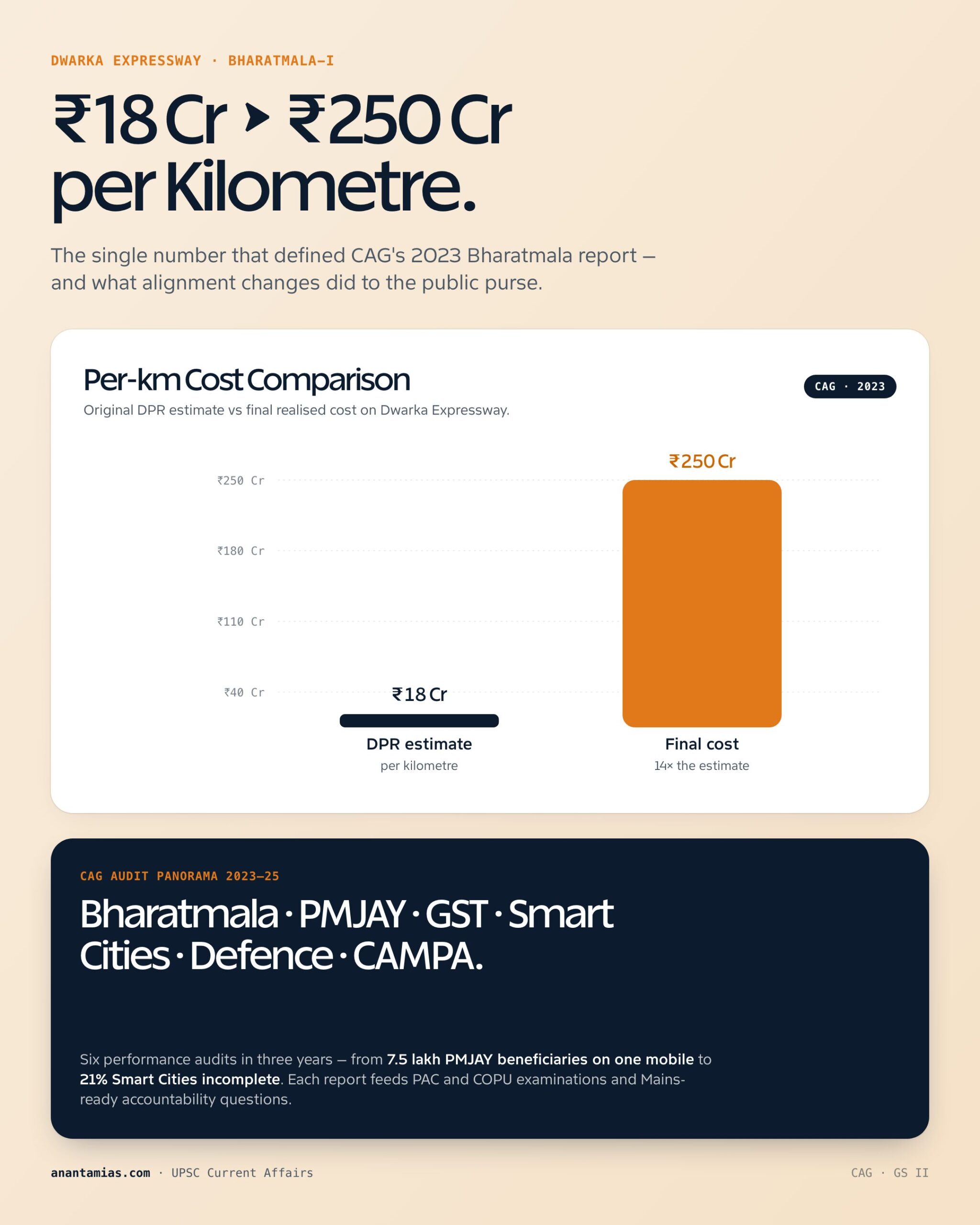
| 2023 | Bharatmala Phase-I performance audit | Cost overruns; alignment changes inflated land cost on Dwarka Expressway from ₹18 cr/km to ₹250 cr/km |
| 2023 | Ayushman Bharat — PMJAY | 7.5 lakh beneficiaries linked to a single mobile number; 78,396 hospital admissions recorded against deceased patients |
| 2024 | GST refunds and IGST settlement | Systemic mismatch between IGST collected and apportioned; refund processing delays |
| 2024 | Smart Cities Mission | 21% of projects incomplete; convergence with State infra plans weak |
| 2024 | Performance audit of Eastern Dedicated Freight Corridor | Time and cost overruns; under-utilised capacity |
| 2025 | Defence procurement and indigenisation under DAP-2020 | Pace of import substitution slower than targets; capital procurement delays |
| 2025 | Climate finance and Compensatory Afforestation Fund (CAMPA) | ₹1.4 lakh crore CAMPA corpus underutilised at State level |
These reports translate directly into PAC and COPU examinations and feed mains questions on accountability, public finance, and welfare delivery.
CAG and Parliament: The PAC Loop
The CAG is the eyes and ears of Parliament in matters of public finance. The institutional chain:
- CAG submits report to President / Governor.
- President / Governor causes it to be laid before Parliament / Legislature.
- Public Accounts Committee (chaired by an Opposition member) scrutinises Union Government audit reports; COPU scrutinises PSU reports; Estimates Committee examines budgets.
- PAC issues recommendations; the executive is required to submit Action Taken Reports.
The CAG has been described, after Ambedkar, as a "friend, philosopher and guide" of the PAC.
Criticism of CAG
Even within the audit fraternity, the CAG faces five recurring critiques.
- Politicisation of appointment — opaque executive appointment without consultation; the post-retirement bar is the only safeguard.
- Post-mortem nature of audit — findings often emerge years after expenditure; deterrence is limited.
- Performance audit overreach — the 2G and coal "presumptive loss" estimates were criticised by some economists as policy second-guessing.
- Capacity gaps — the IAAD remains short on economists, IT auditors, and forensic accountants.
- Coverage gaps — PPPs, DISCOMs, religious trusts and political parties remain outside.
Way Forward: Reform Agenda
| Reform | What it would do |
|---|---|
| Collegium-based appointment | A panel of PM, Leader of Opposition and CJI, on the model of Anoop Baranwal v. UoI (2023) for ECs |
| Statutory backing for performance audit | Codify standards to insulate the CAG from "policy critique" charges |
| Real comptroller function | Pre-audit power for high-value contracts and PPPs |
| Strengthen economic and IT expertise | Recruit lateral economists, data analysts, and forensic auditors into IAAD |
| CAG answerable to Parliament | Direct reporting line to PAC, with a parliamentary budget for IAAD |
| Mandatory PPP audit clause | Audit access in every concession agreement |
| Audit of political party finances | Bring electoral funding under CAG / ECI joint audit |
These align with the 2nd ARC's 10th Report, the NK Singh-led 15th FC observations, and the Anoop Baranwal principle that constitutional offices must be insulated from executive monopoly over appointments.
Anoop Baranwal Parallel (2023)
In Anoop Baranwal v. Union of India (2023), a Constitution Bench held that Election Commissioners must be appointed by a collegium of the Prime Minister, the Leader of the Opposition and the Chief Justice of India until Parliament legislates. Although Parliament passed a separate law in December 2023 replacing the CJI with a Cabinet Minister, the constitutional principle — that purely executive appointment of constitutional functionaries is suspect — remains. The same logic is now urged for the CAG.
CAG in the UPSC Syllabus
- GS Paper II — Statutory, regulatory and quasi-judicial bodies; constitutional bodies; accountability.
- GS II — Important aspects of governance, transparency and accountability.
- GS III — Government budgeting; mobilisation of resources.
- Prelims — Article numbers (148–151), tenure, removal procedure, scope of audit, recent reports.
- Essay — "Audit without consequence is theatre."
Conclusion
The CAG is, in Ambedkar's words, "the most important officer under the Constitution" — the institution that translates parliamentary supremacy over the public purse into a working reality. Articles 148–151, the 1971 Act, and a body of judicial rulings have built a robust framework. But the CAG today operates in a public-finance landscape that the Constituent Assembly could not have foreseen — PPPs, GST, climate finance, opaque political funding, cross-border digital procurement. The reforms most often pressed — a collegium for appointment, a real comptroller function, PPP and political-party audit — would together pull the CAG from a 20th-century post-mortem auditor into a 21st-century accountability institution. UPSC answers that combine the constitutional text, the 2014 expansion ruling, the Anoop Baranwal parallel, and 2024–25 audit reports will read as both grounded and current.
Tell Google you want more of this.
Add Anantam IAS as a preferred sourceOne tap, and this site shows up more often in your own Top Stories, AI Overviews and AI Mode. Remove it any time.






