The Carnatic Wars were three armed conflicts fought between the English East India Company and the French East India Company in southern India between 1744 and 1763. The wars were reflections of European power struggles — the War of Austrian Succession and the Seven Years' War — transplanted onto Indian soil. Their significance is disproportionate to their casualty figures: by the time the Treaty of Paris (1763) was signed, the French had been reduced to a minor commercial presence and the British had the clear path to territorial empire. The wars made Robert Clive, broke Dupleix, and taught Indian powers that European companies could fight — and win — against Indian armies.
Context — European Rivals on the Coromandel Coast

By the 1740s, three major European trading companies operated on India's south-eastern Coromandel Coast: the English (Madras/Fort St. George), the French (Pondicherry), and the Dutch (declining). All three trafficked in spices, textiles, indigo, and saltpetre.
| Company | Headquarters | Key South India possessions |
|---|---|---|
| English EIC | Madras (Fort St. George) | Madras, Cuddalore, later Arcot |
| French EIC | Pondicherry | Pondicherry, Mahé, Karaikal, Chandernagore |
| Dutch VOC | Pulicat/Batavia | Negapatam, Pulicat |
Political weakness after Aurangzeb's death (1707) had split the Deccan. The Nizam of Hyderabad and the Nawab of Carnatic (a tributary of the Nizam) were the principal regional powers. Succession disputes in both offered European companies openings to install clients — and fight proxy wars.
First Carnatic War (1744–48)
The first war was a spill-over of the War of Austrian Succession (1740–48) in Europe.
| Item | Detail |
|---|---|
| Trigger | Outbreak of war between Britain and France in Europe |
| Main Indian flashpoint | French La Bourdonnais captures Madras (1746) |
| Battle of St. Thomé (1746) | Small French force defeats large Carnatic army — a demonstration of European discipline |
| End | Treaty of Aix-la-Chapelle (1748) — Madras returned to the English in exchange for Louisbourg (Canada) |
The First War produced no territorial change in India but revealed two decisive lessons:
- A trained European-style infantry, using musket and bayonet, could overwhelm numerically larger Indian cavalry armies
- European private companies could play kingmaker in Indian succession politics
Joseph François Dupleix, French Governor-General at Pondicherry, understood both lessons fastest.
Second Carnatic War (1749–54)
The Second War was not a reflection of European war — in fact, Britain and France were formally at peace. It was Dupleix's attempt to use succession disputes in the Deccan to make the French the paramount European power in south India.
Twin Succession Disputes
Dupleix backed parallel claimants in Hyderabad and in the Carnatic.
| Territory | French client | English client |
|---|---|---|
| Hyderabad (Nizam) | Muzaffar Jung | Nasir Jung |
| Carnatic (Nawab) | Chanda Sahib | Muhammad Ali |
Initial French successes were spectacular. Nasir Jung was killed; Muzaffar Jung became Nizam and recognised French suzerainty over territories south of the Krishna. Chanda Sahib was installed at Arcot with French military backing. By 1750, Dupleix was the effective arbiter of southern India.
Robert Clive and the Siege of Arcot (1751)
The English response came from an unexpected quarter — a 26-year-old clerk-turned-soldier named Robert Clive.
- With 500 men, Clive seized Arcot, the Carnatic capital
- Withstood a 53-day siege by a combined French–Chanda Sahib force
- The siege broke the siege of Muhammad Ali at Trichinopoly
- Muhammad Ali was confirmed as Nawab of Carnatic
The Siege of Arcot transformed British fortunes and destroyed Dupleix's credibility with the French Company directors, who worried about the cost of his ambitions.
Treaty of Pondicherry (1754)
Dupleix was recalled in 1754. The new French governor, Godeheu, signed the Treaty of Pondicherry with the English:
- Both sides agreed not to interfere in Indian political disputes
- French territorial gains in the Northern Circars were returned
- Muhammad Ali recognised as Nawab of Carnatic
The Second War ended inconclusively on paper, but Dupleix's grand design was finished.
Third Carnatic War (1756–63)
The Third War was, again, an extension of a European conflict — the Seven Years' War (1756–63). This time, there was no ambiguity about the outcome.
Key Engagements
| Battle | Date | Result |
|---|---|---|
| Capture of Chandernagore | 1757 | English under Clive seize French Bengal settlement |
| Battle of Plassey | 23 Jun 1757 | English defeat Siraj-ud-daulah; French ally weakened |
| Count de Lally's arrival | 1758 | Ambitious French commander lands at Pondicherry |
| Siege of Madras | 1758–59 | French besiege Fort St. George; fail |
| Battle of Wandiwash | 22 Jan 1760 | Sir Eyre Coote decisively defeats Lally — turning point |
| Siege of Pondicherry | 1760–61 | French headquarters falls; razed to the ground |
The Battle of Wandiwash (22 January 1760) is the most important engagement of the Carnatic Wars. Eyre Coote's British and sepoy force inflicted a catastrophic defeat on the French. Pondicherry fell a year later, and French ambitions in India were ended.
Treaty of Paris (1763)
The global Seven Years' War ended with the Treaty of Paris (10 February 1763).
- France retained its settlements — Pondicherry, Chandernagore, Mahé, Karaikal, Yanam
- But could not fortify them
- Could not maintain armies in Bengal
- Effectively reduced to commercial outposts
The French were present in India until 1954, but never again as a military or political power.
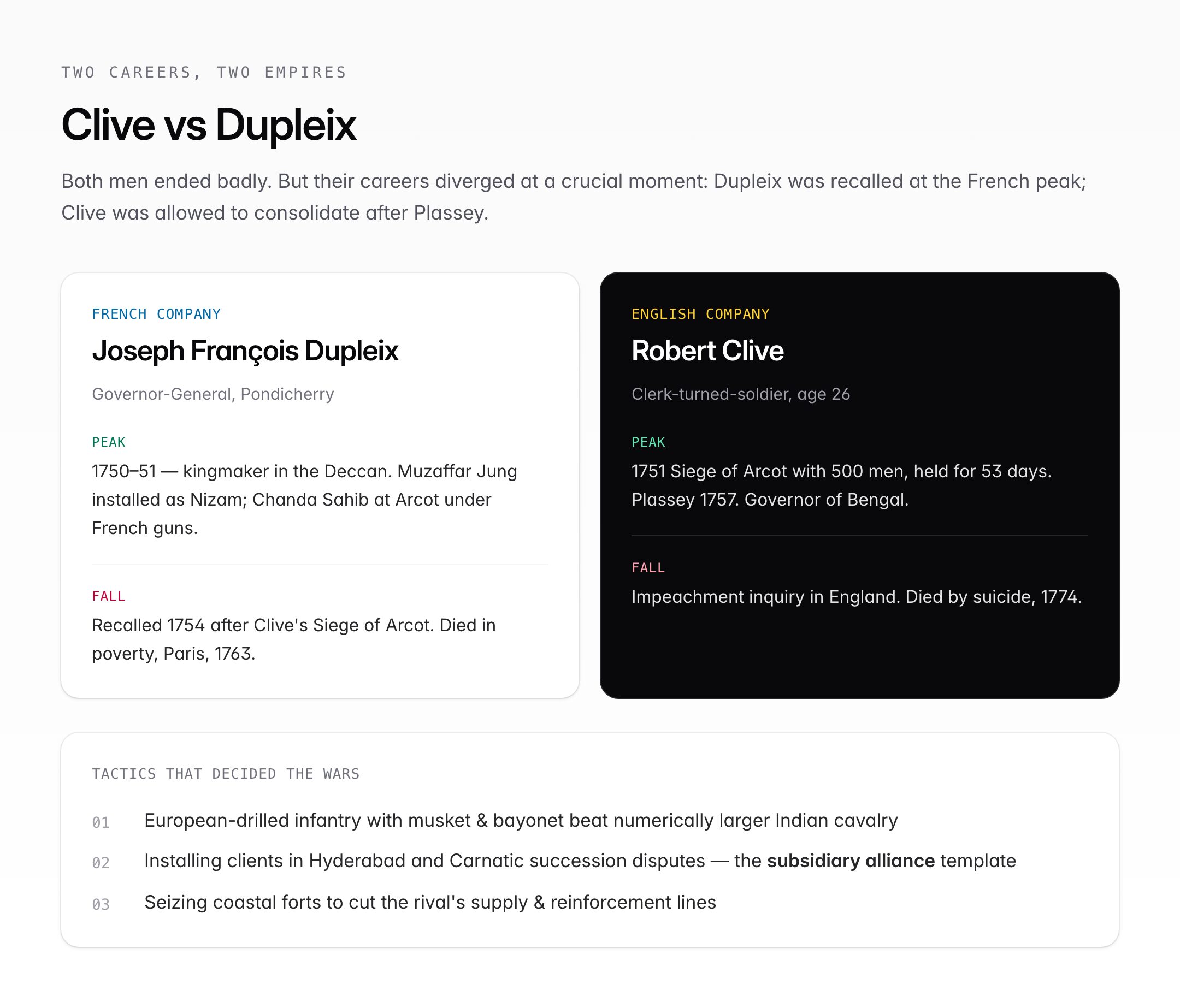
Clive vs Dupleix — A Tale of Two Careers
| Figure | Peak | Fall |
|---|---|---|
| Joseph François Dupleix | French Governor-General (1742–54); kingmaker in Deccan 1750–51 | Recalled 1754; died in poverty in Paris, 1763 |
| Robert Clive | Victor of Arcot (1751) and Plassey (1757); Governor of Bengal | Returned to England; impeachment inquiry; suicide, 1774 |
Both men ended badly. But their careers diverged at a crucial moment: Dupleix was recalled at the peak of French success; Clive was allowed to consolidate after Plassey.
Significance for British Establishment in India
The Carnatic Wars mattered far beyond southern India.
- Ended French challenge — from 1763 onwards, the EIC had no European military rival on the subcontinent
- Demonstrated military superiority of European-drilled infantry over traditional Indian armies
- Produced the “subsidiary alliance” template — a European power protects an Indian prince in return for cession of territory or revenue
- Trained a generation of British officers — Clive, Eyre Coote, Stringer Lawrence — who would go on to Plassey, Buxar, and the conquest of Bengal
- Bankrupted Indian treasuries — each succession war drained the resources of Hyderabad and Carnatic
- Revealed Mughal decline — the wars were fought with nominal Mughal permission but zero Mughal effective authority
The Wars in a Single Table
| War | Years | European parallel | Indian flashpoint | Outcome |
|---|---|---|---|---|
| First | 1744–48 | War of Austrian Succession | Madras (captured by La Bourdonnais) | Status quo ante, Treaty of Aix-la-Chapelle |
| Second | 1749–54 | None (European peace) | Succession in Hyderabad and Carnatic | English ally (Muhammad Ali) confirmed; Dupleix recalled |
| Third | 1756–63 | Seven Years' War | Madras, Wandiwash, Pondicherry | Decisive English victory; Treaty of Paris (1763) |
UPSC Relevance
The Carnatic Wars are standard fare in Modern History for Prelims and GS Paper I.
- Prelims: Dates of each war, Battle of Arcot (1751) and Wandiwash (1760), Treaty of Aix-la-Chapelle (1748), Treaty of Pondicherry (1754), Treaty of Paris (1763), key personalities (Dupleix, Clive, Eyre Coote, Count de Lally, Muhammad Ali, Chanda Sahib)
- Mains GS Paper I: Factors behind British success in the Anglo-French struggle, transition from trade to territory, role of Indian allies
- Essay: "Why the English, and not the French, conquered India" — a classic prompt
- Linkages: Carnatic Wars → Battle of Plassey (1757) → Battle of Buxar (1764) → Diwani of Bengal (1765) chain
- Comparative question: Role of the subsidiary alliance concept, first deployed by Dupleix and later perfected by Wellesley
Candidates should note that while Plassey is often treated as the moment of British founding in India, the three Carnatic Wars had already decided the larger question of which European power would become the successor to Mughal authority.
Tell Google you want more of this.
Add Anantam IAS as a preferred sourceOne tap, and this site shows up more often in your own Top Stories, AI Overviews and AI Mode. Remove it any time.