
Fundamental Rights (Maulik Adhikar): Part III of Indian Constitution
UPSC guide to Fundamental Rights — Articles 12-35, six categories, writs under Article 32, exceptions during Emergency, and key case laws.

Category
Everything published under Study Notes on Anantam IAS, newest first.
3454 articles
UPSC guide to Fundamental Rights — Articles 12-35, six categories, writs under Article 32, exceptions during Emergency, and key case laws.

UPSC guide to First Information Report — BNSS Section 173, Zero FIR, e-FIR, Lalita Kumari ruling, rights of complainants, and remedies on refusal.

Complete UPSC guide to FDI — full form, meaning, automatic vs government routes, sector caps, FDI vs FPI, FEMA framework, and India's recent inflows…

UPSC guide to Dadabhai Naoroji — biography, Drain of Wealth theory, Poverty and Un-British Rule in India, first Indian MP in Britain, and his…

UPSC guide to the Cripps Mission 1942 — Stafford Cripps proposals, dominion status, Gandhi's 'post-dated cheque' remark, reasons for failure, and the road to…

UPSC guide to Chenab Rail Bridge — world's highest railway arch bridge (359 m), Reasi J&K, USBRL project, Vande Bharat Katra-Srinagar and strategic importance.
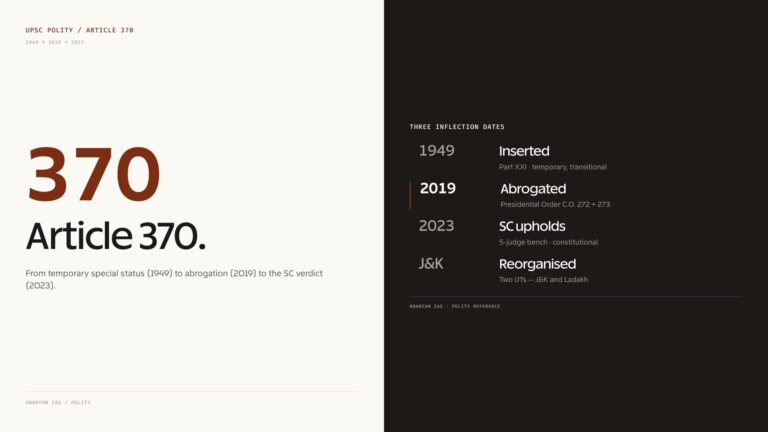
You searched for Article 370 of Indian Constitution because you want one place that ties together the 1949 origin, the 2019 abrogation, and the…

UPSC guide to APAAR ID — full form, One Nation One Student ID, registration, DigiLocker and ABC integration, NEP 2020 context, benefits, and privacy…

World Heritage Day 2026 is observed on 18 April. Know its ICOMOS/UNESCO origin, annual themes, and India's 43 UNESCO World Heritage Sites list.

Vadhavan Port in Palghar, Maharashtra — India's upcoming deep-sea greenfield mega port. Features, capacity, cost, controversies and UPSC analysis.

Complete UPSC guide to the Simla Agreement 1972 — India-Pakistan peace pact, LoC conversion, bilateralism on Kashmir, 93,000 POWs, and Pakistan's 2025 suspension.
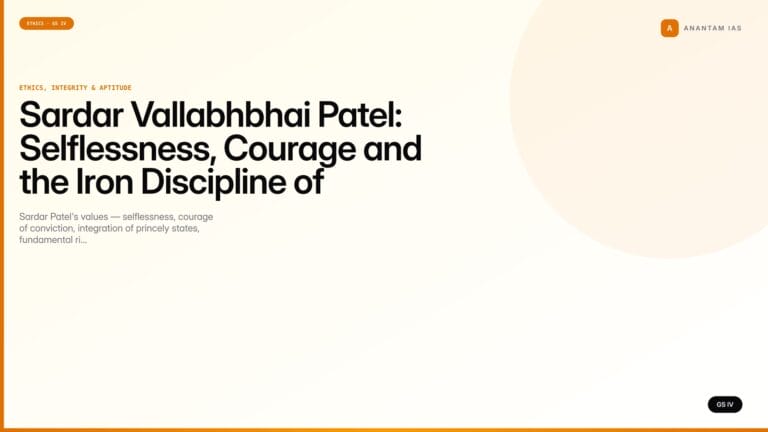
Sardar Patel's values — selflessness, courage of conviction, integration of princely states, fundamental rights, nationalism — as an ethical model for UPSC GS IV.