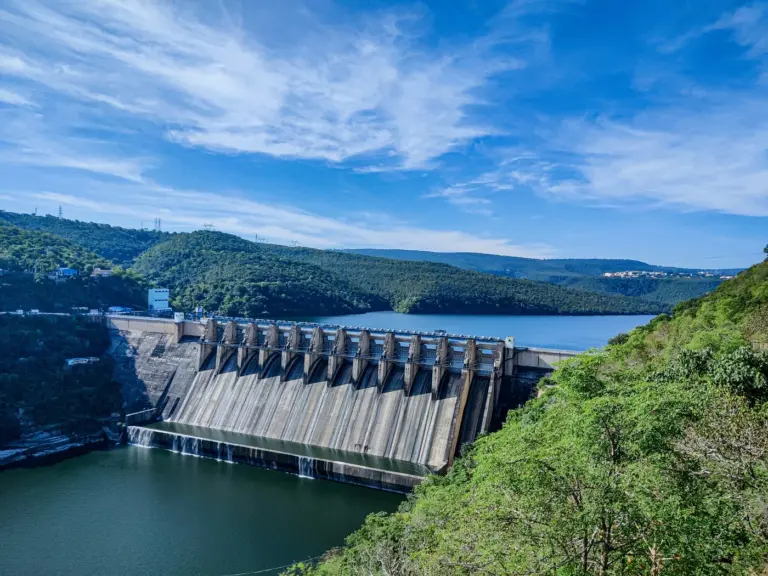
The Chenab Rail Bridge — popularly called the "Engineering Marvel of India" — is the world's highest railway arch bridge, soaring 359 metres above the Chenab riverbed in the Reasi district of the Union Territory of Jammu & Kashmir. Taller than the Eiffel Tower by 35 metres, the bridge is the most complex segment of the Udhampur–Srinagar–Baramulla Rail Link (USBRL) — the national project that, for the first time in independent India's history, connects the Kashmir Valley by rail to the rest of the country.
Inaugurated for rail traffic on 6 June 2025 with the flag-off of the Vande Bharat Express from Shri Mata Vaishno Devi Katra to Srinagar by Prime Minister Narendra Modi, the Chenab bridge represents over two decades of engineering persistence in one of the most hostile geological zones on earth.
For UPSC, this topic maps onto GS Paper 3 (Infrastructure, Science & Technology), GS Paper 1 (Geography of J&K) and GS Paper 2 (Strategic and Internal Security).
Key Facts at a Glance
| Parameter | Details |
|---|---|
| Type | Steel and concrete single-arch railway bridge |
| River | Chenab (tributary of the Indus) |
| Location | Bakkal–Kauri section, Reasi district, J&K |
| Height above riverbed | 359 m (35 m taller than the Eiffel Tower) |
| Total length | 1,315 m |
| Main arch span | 467 m — world's longest single-arch railway bridge span |
| Design life | 120 years |
| Steel used | ~28,660 tonnes |
| Concrete used | ~66,000 cubic metres |
| Wind tolerance | Up to 266 km/h |
| Seismic design | Zone V (highest seismic zone) |
| Project cost | ~Rs. 1,486 crore |
| Commissioned | 6 June 2025 (Vande Bharat Katra–Srinagar flag-off) |
Engineering Highlights
1. A Bridge Atop a Seismic Deep Gorge
The Chenab gorge at Bakkal is one of the most tectonically active zones in India, lying in Seismic Zone V. Any rail link had to survive earthquakes measuring up to 8.0 on the Richter scale, combined with landslides, rockfalls and high wind loads.
2. Blast-Resistant Construction
A first-of-its-kind feature for an Indian railway bridge — the arch has been designed to withstand explosive loads equivalent to 40-kg TNT detonations, addressing internal security concerns in the region.
3. Material and Weld Quality
- Weldable structural steel (IRSM-44 grade and Corten steel) supplied by SAIL, Jindal Steel & Power and Bhilai.
- Ultrasonic weld inspection and corrosion-resistant paint system with 15-year touch-up cycle.
- Self-weathering steel that forms a protective oxide layer — reducing maintenance.
4. The Arch Segmental Launching
The 467-metre central arch was erected using an overhead cable-crane system with cables spanning 915 metres between the two gorge rims — a technique deployed for the first time on this scale in India. The golden joint closing the arch was completed in April 2021.
5. Wind and Seismic Instrumentation
Real-time monitoring via sensors on the bridge feeds into a central structural health monitoring (SHM) system, detecting any deformation, vibration or thermal movement.
The USBRL Project
The Chenab bridge is the technical centrepiece of the Udhampur–Srinagar–Baramulla Rail Link (USBRL), declared a Project of National Importance in 2002.
USBRL Snapshot
| Attribute | Details |
|---|---|
| Total route length | 272 km |
| Sections | Udhampur–Katra; Katra–Banihal; Banihal–Baramulla |
| Tunnels | 38 (total length ~119 km) |
| Major tunnel | T-50 (Pir Panjal tunnel) — 11.2 km, India's then-longest rail tunnel |
| Major bridges | 927 (including Chenab and Anji Khad cable-stayed bridge) |
| Final section commissioned | Katra–Banihal (with Chenab bridge) — June 2025 |
Anji Khad Bridge
A separate landmark — the Anji Khad Bridge, India's first cable-stayed railway bridge — was completed on the same USBRL corridor, 7 km from the Chenab bridge, over a tributary of the Chenab.
Who Built It
The Chenab bridge is the outcome of a four-way engineering consortium coordinated by Konkan Railway Corporation Limited (KRCL) — the agency mandated by the Ministry of Railways to execute USBRL.
| Role | Agency |
|---|---|
| Executing agency | Konkan Railway Corporation Limited (KRCL) |
| Lead contractor | AFCONS Infrastructure Ltd (Shapoorji Pallonji Group) |
| Arch design and steel fabrication | Ultra Construction & Engineering (South Korea) and Leonhardt, Andrä und Partner (Germany) |
| Cable-crane supplier | VSL International (Austria) |
| Technical consultant | WSP Finland |
| Design review | Indian Institutes of Technology (Delhi, Roorkee) and IISc Bengaluru |
| Owner | Indian Railways (Ministry of Railways) |
Project Timeline
| Year | Milestone |
|---|---|
| 2002 | USBRL declared Project of National Importance |
| 2003 | Bridge design conceived |
| 2004 | Construction began |
| 2008–2009 | Work halted over safety concerns |
| 2010 | Restart after redesign review |
| April 2021 | Golden joint of the 467-m arch closed |
| Aug 2022 | Overarch deck completed |
| Aug 2023 | Track-laying completed |
| June 2024 | Successful trial runs |
| 6 June 2025 | Vande Bharat flag-off by PM Modi — commercial service begins |
Strategic and Economic Significance
1. First Rail Connectivity to Kashmir Valley
For the first time since independence, the Kashmir Valley is integrated into the Indian Railways network via the Jammu Tawi–Srinagar route, reducing dependence on the landslide-prone NH-44 (Jammu–Srinagar highway).
2. Strategic Military Logistics
- Faster and all-weather troop and equipment movement to the Line of Control.
- Reduces dependence on air-bridging during winter closures of NH-44.
3. Boost to Tourism
- Vande Bharat Katra–Srinagar reduces travel time from ~12 hours (road) to 3 hours 10 minutes (rail).
- Expected to boost Valley tourism beyond the pre-2019 benchmark.
4. Horticulture and Trade
- J&K's apple and saffron economy benefits from faster, temperature-controlled freight.
- Reduces transit losses and pilferage.
5. Symbol of National Integration
- Political and psychological integration of Kashmir with the Indian mainland.
- Follow-up project to the abrogation of Article 370 (2019) in terms of Valley–mainland connectivity.
Challenges Overcome
- Access roads: Over 26 km of approach roads had to be cut into the mountains.
- Blast zones: Rock blasting required to stabilise abutments on both banks.
- Worker safety: High-altitude, extreme-weather labour conditions — zero fatal accidents during arch erection.
- Cross-border weather: Sudden Chenab floods and landslides during construction.
Comparison — Key Railway Bridges
| Bridge | Country | Type | Height | Note |
|---|---|---|---|---|
| Chenab Bridge | India | Steel arch | 359 m | World's highest rail bridge |
| Beipanjiang Rail Bridge | China | Arch | ~275 m | Earlier highest rail arch |
| Najehe Rail Bridge | China | — | ~310 m | Earlier highest rail |
| Fades Viaduct | France | — | 133 m | Historical record |
| Eiffel Tower (for scale) | France | — | 324 m | Chenab is 35 m taller |
UPSC Relevance
GS Paper 3 (Infrastructure, Science & Technology):
- Civil engineering feats in seismic Zone V.
- Project of National Importance; role of Konkan Railway Corporation.
- Vande Bharat trains and high-speed infrastructure rollout.
GS Paper 1 (Geography):
- Chenab river — tributary of the Indus, originates in Himachal (Chandra + Bhaga at Tandi).
- Pir Panjal range and tectonic activity.
GS Paper 2 (Internal Security & Governance): Connectivity to Kashmir Valley; post-Article 370 integration.
Key Prelims Facts:
- River: Chenab (tributary of Indus, originates at Tandi, HP — confluence of Chandra + Bhaga)
- District / UT: Reasi, Jammu & Kashmir
- Height above riverbed: 359 m
- Total length: 1,315 m
- Main arch span: 467 m (world's longest for a rail bridge)
- Commissioned: 6 June 2025 (Vande Bharat Katra–Srinagar flag-off)
- Executing agency: Konkan Railway Corporation Ltd (KRCL)
- Lead contractor: AFCONS Infrastructure
- Seismic zone: V
- Wind tolerance: 266 km/h
- Design life: 120 years
- Adjacent bridge: Anji Khad — India's first cable-stayed rail bridge
- Pir Panjal (T-50) Tunnel: 11.2 km (USBRL)
Prelims Tip: The Chenab bridge is taller than the Eiffel Tower (324 m) by 35 metres — a popular MCQ framing.
Mains Angle: Assess how USBRL (and the Chenab bridge in particular) exemplify India's capacity for mega infrastructure in difficult terrain and analyse its implications for strategic connectivity, regional economy and political integration of Jammu & Kashmir.
Tell Google you want more of this.
Add Anantam IAS as a preferred sourceOne tap, and this site shows up more often in your own Top Stories, AI Overviews and AI Mode. Remove it any time.