


The Central Administrative Tribunal (CAT) is a specialised judicial body established to adjudicate disputes relating to the service conditions of persons appointed to public services and posts in connection with the affairs of the Union. It represents India’s commitment to providing speedy and inexpensive justice to government employees. For UPSC aspirants, the CAT is a high-yield topic in Indian Polity, regularly appearing in Prelims and Mains questions on tribunals, judicial review, and administrative law.
Constitutional Basis — Article 323A
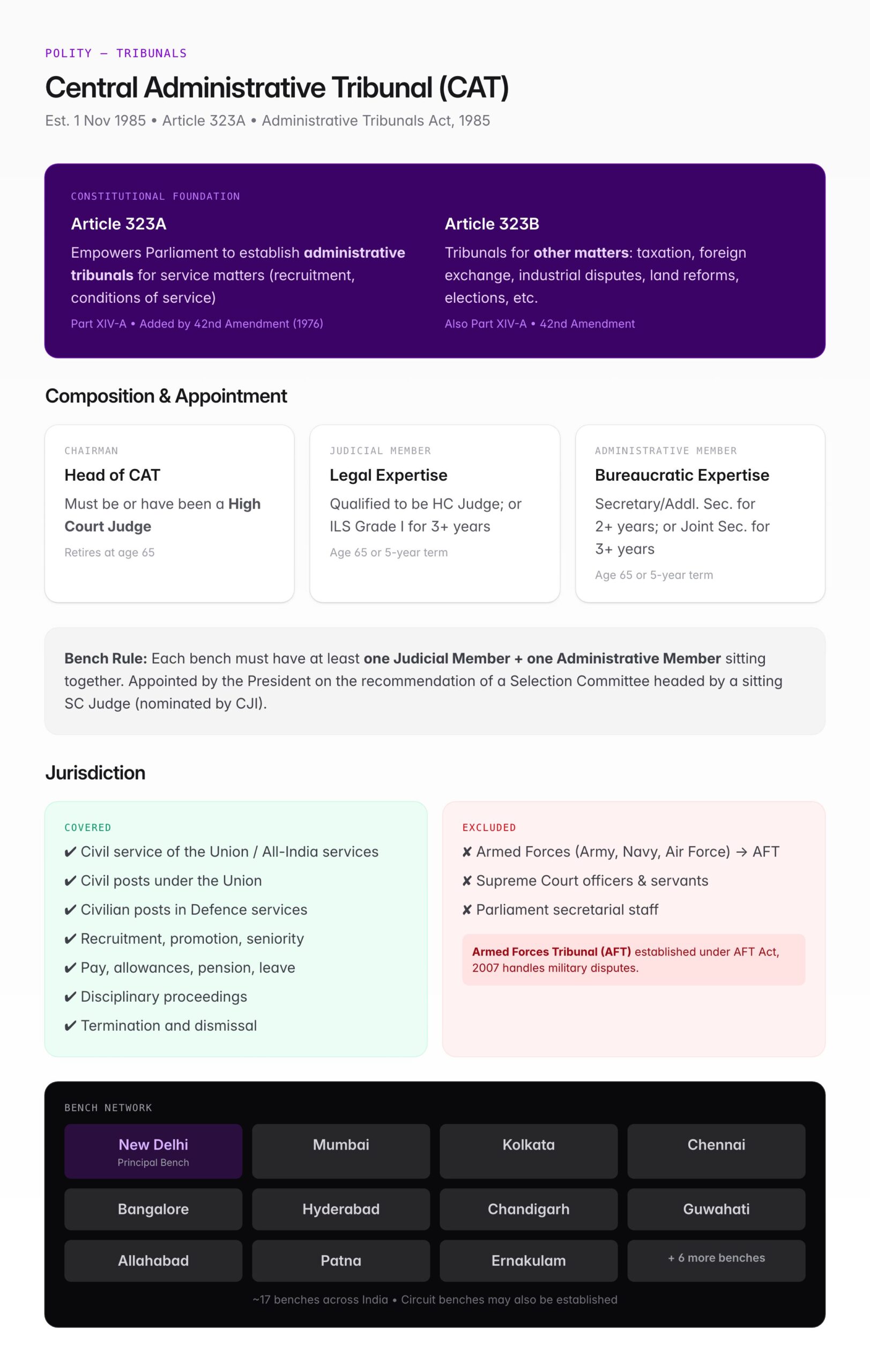
The constitutional foundation for the CAT lies in Article 323A, inserted by the 42nd Constitutional Amendment Act, 1976. This article empowers Parliament to provide, by law, for the adjudication or trial of disputes and complaints with respect to:
- Recruitment and conditions of service of persons appointed to public services and posts under the Union, any State, any local or other authority within India, or any corporation owned or controlled by the Government.
Key constitutional points:
- Article 323A is located in Part XIV-A of the Constitution, titled "Tribunals."
- It enables Parliament to establish administrative tribunals for both the Centre and the States.
- Article 323A deals specifically with service matters (public employment disputes).
- Article 323B (also added by the 42nd Amendment) deals with tribunals for other matters such as taxation, foreign exchange, industrial disputes, land reforms, food, ceiling on urban property, elections, etc.
Important distinction: Article 323A covers tribunals for service matters (administrative tribunals), while Article 323B covers tribunals for other specified subjects.
Administrative Tribunals Act, 1985
Exercising its power under Article 323A, Parliament enacted the Administrative Tribunals Act, 1985. This Act:
- Established the Central Administrative Tribunal (CAT) for Union government employees.
- Provided for the establishment of State Administrative Tribunals (SATs) for state government employees (at the request of the concerned state).
- Provided for Joint Administrative Tribunals serving two or more states.
The CAT came into existence on 1 November 1985, with its principal bench in New Delhi.
Jurisdiction of the CAT
Subject-Matter Jurisdiction
The CAT has original jurisdiction over service matters of persons appointed to:
- Any civil service of the Union or an all-India service.
- Any civil post under the Union.
- A civilian post in the Defence services (not members of the armed forces — military personnel are excluded from CAT jurisdiction).
Service matters include:
- Recruitment and appointment.
- Seniority and promotion.
- Conditions of service (pay, allowances, leave, pension).
- Disciplinary proceedings and penalties.
- Termination and dismissal.
Persons Excluded
The following are not covered by the CAT:
- Members of the armed forces (Army, Navy, Air Force) — they are governed by the Armed Forces Tribunal (AFT), established under the Armed Forces Tribunal Act, 2007.
- Officers and servants of the Supreme Court (governed by rules made by the Chief Justice under Article 146).
- Secretarial staff of Parliament (governed by rules under Articles 98 and 187).
Territorial Jurisdiction
The CAT has its principal bench in New Delhi and additional benches across the country. As of recent years, the CAT has benches in approximately 17 locations, including:
| Bench Location | States/UTs Covered |
|---|---|
| New Delhi (Principal Bench) | Delhi, Haryana, parts of other northern states |
| Mumbai | Maharashtra, Goa |
| Kolkata | West Bengal, Sikkim, Andaman & Nicobar |
| Chennai | Tamil Nadu, Puducherry |
| Bangalore | Karnataka |
| Hyderabad | Telangana, Andhra Pradesh |
| Allahabad | Uttar Pradesh |
| Lucknow | Parts of Uttar Pradesh |
| Chandigarh | Punjab, Haryana, Himachal Pradesh, J&K, Ladakh |
| Guwahati | Northeastern states |
| Patna | Bihar, Jharkhand |
| Jodhpur | Rajasthan |
| Cuttack | Odisha |
| Ernakulam | Kerala, Lakshadweep |
| Jabalpur | Madhya Pradesh, Chhattisgarh |
| Jaipur | Parts of Rajasthan |
| Ahmedabad | Gujarat |
Circuit benches may also be established at places where regular benches are not located.
Composition
Chairman
The CAT is headed by a Chairman who is appointed by the President of India. The Chairman must be or must have been a Judge of a High Court.
Members
The CAT consists of Vice-Chairman(s) and Members, who are of two types:
| Type | Qualification |
|---|---|
| Judicial Member | Has been or is qualified to be a Judge of a High Court; or has been a member of the Indian Legal Service (Grade I) for at least 3 years |
| Administrative Member | Has held the post of Secretary or Additional Secretary to the Government of India or equivalent for at least 2 years; or has held the post of Joint Secretary for at least 3 years |
Benches are constituted with at least one Judicial Member and one Administrative Member sitting together.
Appointment and Tenure
- The Chairman and Members are appointed by the President on the recommendation of a Selection Committee headed by a sitting Judge of the Supreme Court nominated by the Chief Justice of India.
- Term: The Chairman holds office until the age of 65 years. Vice-Chairman and Members hold office until the age of 65 years (or for a term of 5 years, whichever is earlier).
- They are not eligible for reappointment (except for those below the prescribed age limit for a fresh term).
Procedure and Powers
- The CAT is not bound by the procedure laid down in the Code of Civil Procedure, 1908, but is guided by the principles of natural justice.
- It has the power to regulate its own procedure (Section 22 of the Act).
- It has the same powers as a civil court in respect of: summoning witnesses, requiring production of documents, receiving evidence on affidavits, issuing commissions for examination of witnesses, and reviewing its own decisions.
- The CAT may grant interim relief, including stay orders on transfers, dismissals, or other administrative actions.
- A party may appear before the CAT in person or through a legal practitioner (lawyer).
Exclusion of High Court Jurisdiction — The L. Chandra Kumar Debate
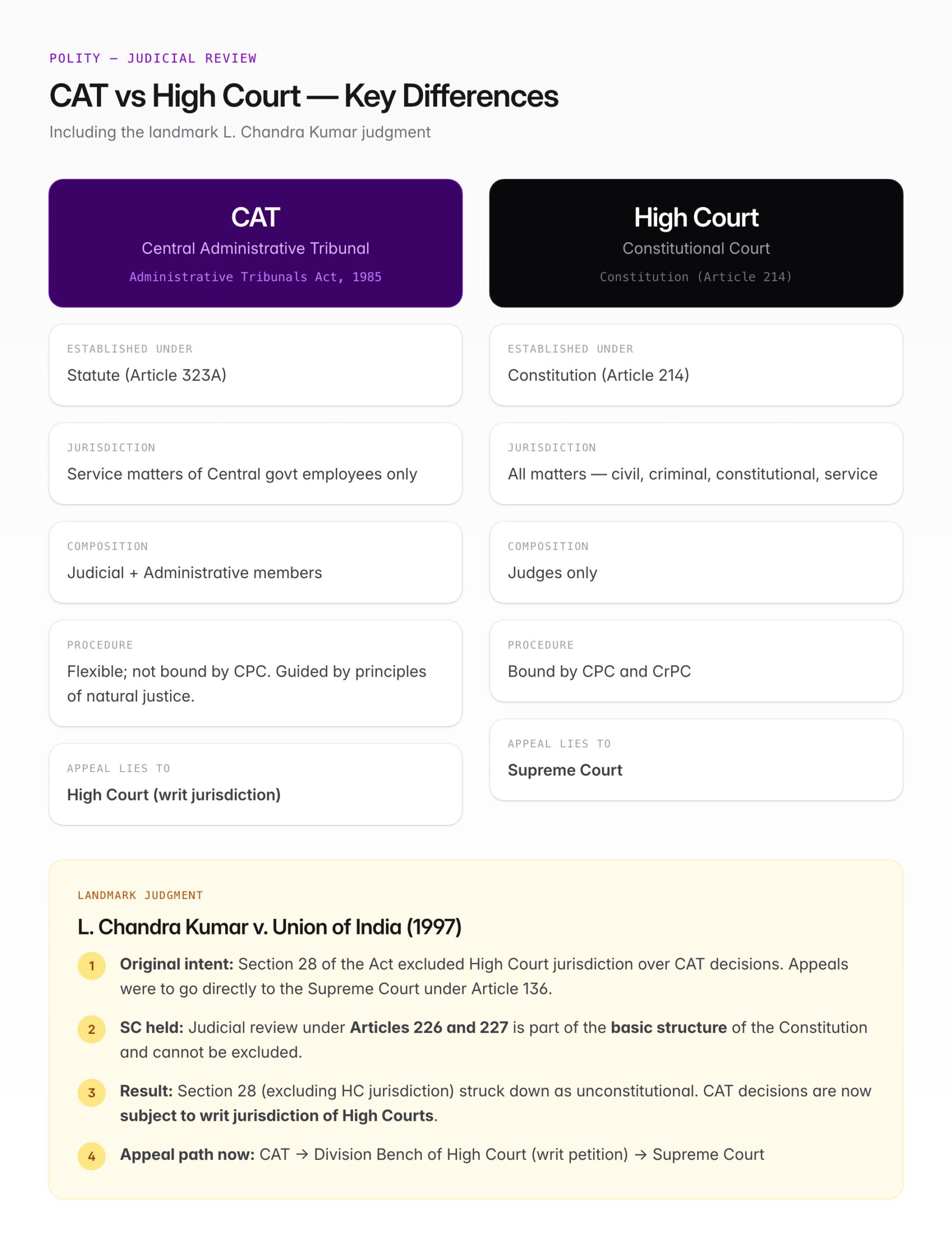
Original intention: Section 28 of the Administrative Tribunals Act sought to exclude the jurisdiction of all courts (including High Courts) in respect of service matters falling within the CAT's jurisdiction. The idea was that the CAT would be the sole forum for such disputes, with appeals going directly to the Supreme Court under Article 136.
L. Chandra Kumar v. Union of India (1997): In this landmark judgment, the Supreme Court held that:
- Judicial review under Articles 226 and 227 of the Constitution is part of the basic structure of the Constitution and cannot be excluded.
- Therefore, the decisions of the CAT (and all tribunals under Articles 323A and 323B) are subject to the writ jurisdiction of the High Courts.
- The relevant clause of Section 28 excluding High Court jurisdiction was struck down as unconstitutional.
Practical effect: After L. Chandra Kumar, an aggrieved party can challenge a CAT order before the Division Bench of the concerned High Court through a writ petition. Appeals thereafter lie to the Supreme Court.
This is one of the most important judgments for UPSC on the topic of tribunals and judicial review.
CAT vs High Court — Key Differences
| Feature | CAT | High Court |
|---|---|---|
| Established under | Administrative Tribunals Act, 1985 (Article 323A) | Constitution (Article 214) |
| Jurisdiction | Service matters of Central government employees only | All matters — civil, criminal, constitutional, service |
| Composition | Judicial + Administrative members | Judges only |
| Procedure | Flexible; not bound by CPC | Bound by CPC and CrPC |
| Appeal | High Court (writ jurisdiction) | Supreme Court |
| Binding nature | Binding on parties; subject to High Court review | Binding; constitutional court |
Significance and Criticism
Why the CAT matters:
- Provides speedy disposal of service disputes that would otherwise clog High Courts.
- Combines judicial and administrative expertise through the dual-member bench structure.
- Reduces the burden on the regular judiciary.
Criticisms:
- Pendency: Despite its purpose, the CAT faces significant backlog of cases.
- Vacancies: Persistent vacancies in Chairman and Member positions impair functioning.
- Quality of adjudication: Administrative members may lack judicial temperament and legal expertise.
- Subordination to High Courts: After L. Chandra Kumar, the CAT's decisions are reviewable by High Courts, effectively adding an extra layer rather than simplifying the process.
UPSC Relevance
GS Paper Mapping:
- Prelims: Article 323A, year of establishment, composition, jurisdiction, L. Chandra Kumar case.
- GS Paper II (Mains): Indian Polity — tribunals, separation of powers, judicial review, administrative law.
Key Prelims Facts:
- The CAT was established under the Administrative Tribunals Act, 1985, based on Article 323A.
- Article 323A was inserted by the 42nd Constitutional Amendment, 1976.
- The CAT's principal bench is in New Delhi; it has approximately 17 benches across India.
- The CAT handles service matters of Central government civil employees (armed forces personnel are excluded).
- Benches consist of one Judicial Member and one Administrative Member.
- The Chairman must be or have been a High Court judge.
- In L. Chandra Kumar v. Union of India (1997), the Supreme Court restored High Court jurisdiction over CAT decisions under Articles 226 and 227.
- Article 323A covers administrative tribunals (service matters); Article 323B covers tribunals for other matters.
- Members are appointed by the President on the recommendation of a committee headed by a Supreme Court judge.
- The Armed Forces Tribunal (AFT), not the CAT, handles disputes of military personnel.
Tell Google you want more of this.
Add Anantam IAS as a preferred sourceOne tap, and this site shows up more often in your own Top Stories, AI Overviews and AI Mode. Remove it any time.






