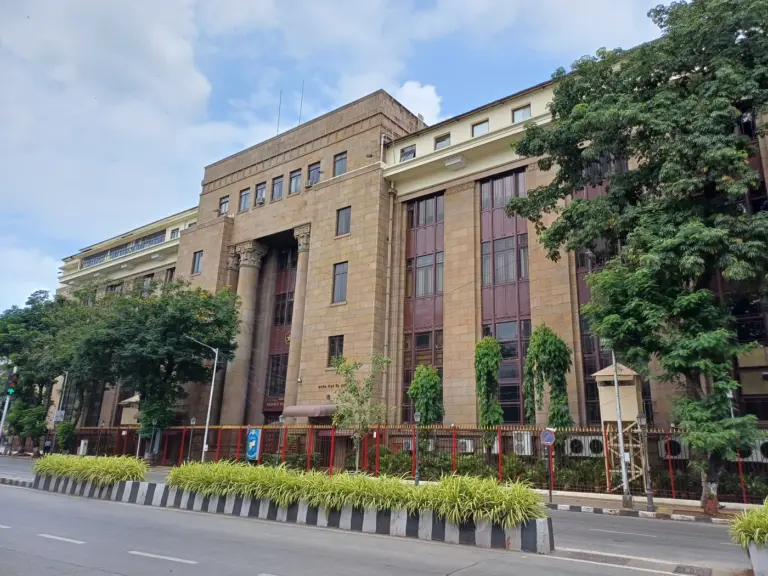
The Central Vigilance Commission (CVC) is India's apex integrity institution for tackling corruption in the Central Government. Established on the recommendations of the Santhanam Committee on Prevention of Corruption (1962-64), the CVC was given statutory status through the Central Vigilance Commission Act, 2003. For UPSC Polity, CVC is a frequently examined topic covering composition, functions, appointment procedure, and its relationship with the CBI and Lokpal.
Historical Background
Santhanam Committee (1962-64)
In 1962, the Government of India appointed a Committee on Prevention of Corruption, chaired by K. Santhanam, to examine the scale of corruption in government and recommend remedial measures. The Committee submitted its report in 1964.
Key Recommendations
- Establish a Central Vigilance Commission as an apex body to supervise vigilance administration.
- Appoint a Chief Vigilance Officer (CVO) in every ministry and department.
- Strengthen the Prevention of Corruption Act, 1947 (later replaced by the 1988 Act).
- Create separate vigilance units in public sector undertakings.
Based on these recommendations, the CVC was established through a Government Resolution on 11 February 1964. For nearly four decades, it functioned as a non-statutory body.
Vineet Narain Case (1997)
In Vineet Narain v. Union of India (1997), the Supreme Court directed that the CVC be given statutory status and made the supervising authority for the CBI's investigations in corruption cases. This judgment transformed CVC into a constitutional-functional body.
CVC Act, 2003
Following the Supreme Court's direction, Parliament enacted the Central Vigilance Commission Act, 2003, giving CVC statutory status. It became a multi-member body (earlier it was headed by a single Chief Vigilance Commissioner).
Composition of CVC
| Position | Number | Tenure |
|---|---|---|
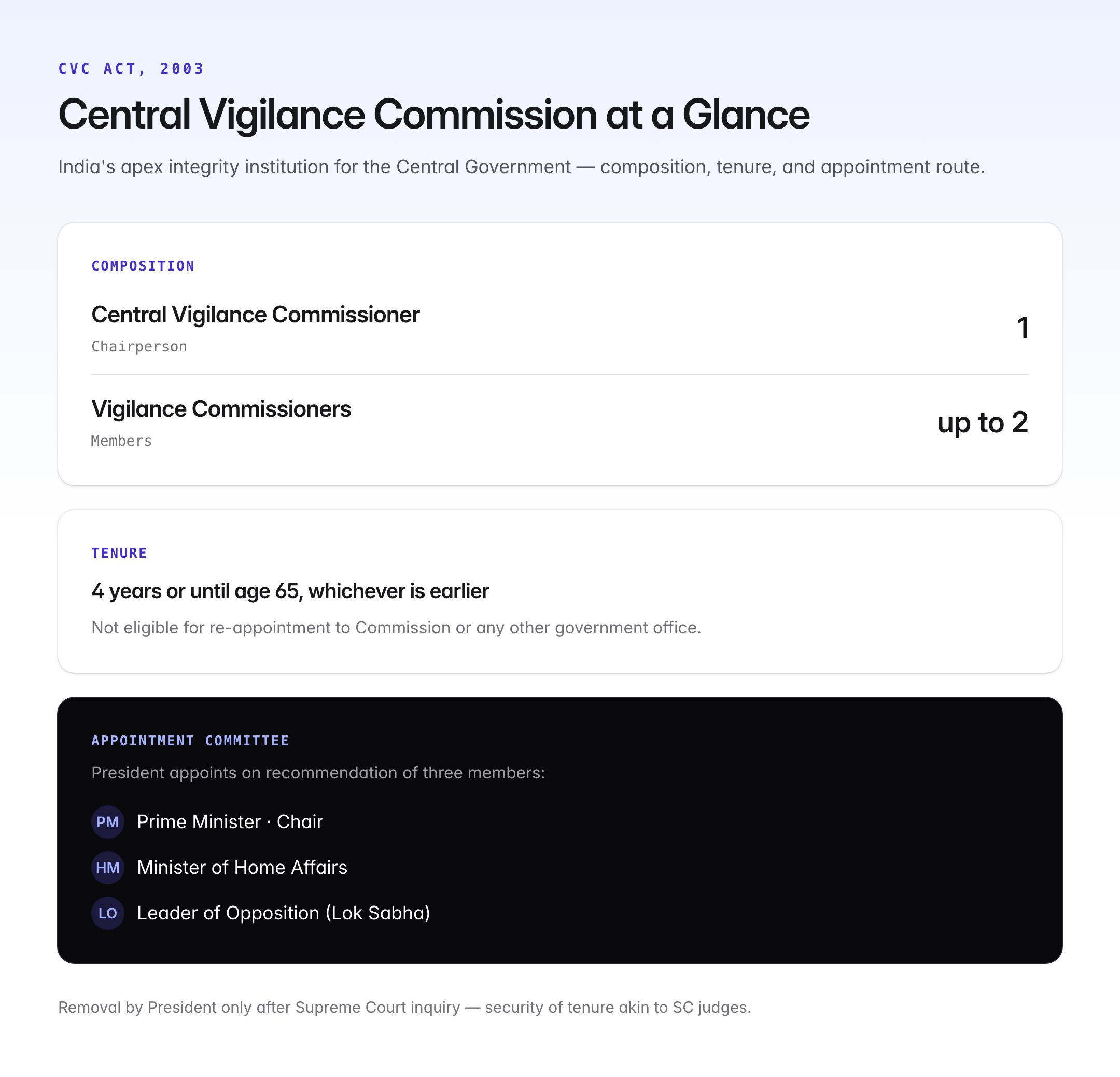
| Central Vigilance Commissioner (Chairperson) | 1 | 4 years or until the age of 65 years, whichever is earlier |
| Vigilance Commissioners | Up to 2 | 4 years or until the age of 65 years, whichever is earlier |
Re-appointment: Not eligible for re-appointment to the Commission or any other office under the Government of India or State Government.
Appointment Procedure
The Central Vigilance Commissioner and Vigilance Commissioners are appointed by the President of India on the recommendation of a three-member committee comprising:
| Member | Role |
|---|---|
| Prime Minister | Chairperson |
| Minister of Home Affairs | Member |
| Leader of the Opposition in Lok Sabha (or Leader of the Single Largest Opposition Party if no recognised LoP) | Member |
Removal Procedure
The Central Vigilance Commissioner or any Vigilance Commissioner can be removed from office only by the President on the grounds of:
- Proved misbehaviour or incapacity after an inquiry by the Supreme Court that finds the charges established.
- Insolvency, conviction involving moral turpitude, engaging in paid employment outside office, or being of such infirmity of mind or body that renders them unfit.
This procedure provides security of tenure similar to that of Supreme Court judges.
Functions and Powers
The CVC Act, 2003 and subsequent amendments have expanded the Commission's role.
Core Functions
| Function | Scope |
|---|---|
| Supervise CBI's functioning | In respect of investigations under the Prevention of Corruption Act, 1988, and review progress of investigations |
| Inquire/cause inquiry | Into offences committed by officials of the Central Government, PSUs, and other autonomous bodies under the Central Government |
| Tender advice | To the Central Government on vigilance matters |
| Exercise superintendence | Over vigilance administration of central ministries and departments |
| Review of anti-corruption measures | Suggest improvements to procedures and practices |
| Chief Vigilance Officers (CVOs) | Advise on their appointment, transfers, and postings |
| Whistleblower complaints | Designated agency under the Public Interest Disclosure and Protection of Informers (PIDPI) Resolution, 2004 |
| Lokpal assistance | Assist the Lokpal in preliminary inquiries |
Jurisdiction
| Category | Coverage |
|---|---|
| All-India Services officers | Serving in the Central Government |
| Group 'A' officers | Of the Central Government |
| Officers of Scheduled A & B PSUs | Board-level and above |
| Officers of Scheduled C & D PSUs | Officers drawing specified salary and above |
| Officers of public sector banks | Scale V and above |
| Officers of autonomous bodies | Where the Centre has ownership or majority interest |
Limitation: CVC's jurisdiction does not extend to state government officials or to central government officers below certain grades.
Powers of the CVC
| Power | Detail |
|---|---|
| Powers of a civil court | Summoning witnesses, requiring the discovery and production of documents, receiving evidence on affidavit, requisitioning public records |
| Investigation directions | Can direct CBI or Chief Vigilance Officers to investigate matters |
| Advice on disciplinary action | First-stage (at the initiation of disciplinary proceedings) and second-stage advice (on final action) |
| Annual report | Submits annual report to the President, who lays it before both Houses of Parliament |
Chief Vigilance Officers (CVOs)
Every Central Government Ministry/Department, PSU, and autonomous body has a Chief Vigilance Officer who functions as the extended arm of the CVC.
| CVO Function | Description |
|---|---|
| Preventive vigilance | Review systems to reduce scope for corruption |
| Investigative vigilance | Examine complaints; refer appropriate cases for investigation |
| Disciplinary action | Advise the disciplinary authority |
| Punitive vigilance | Ensure action against corrupt officials |
CVC vs CBI vs Lokpal
| Aspect | CVC | CBI | Lokpal |
|---|---|---|---|
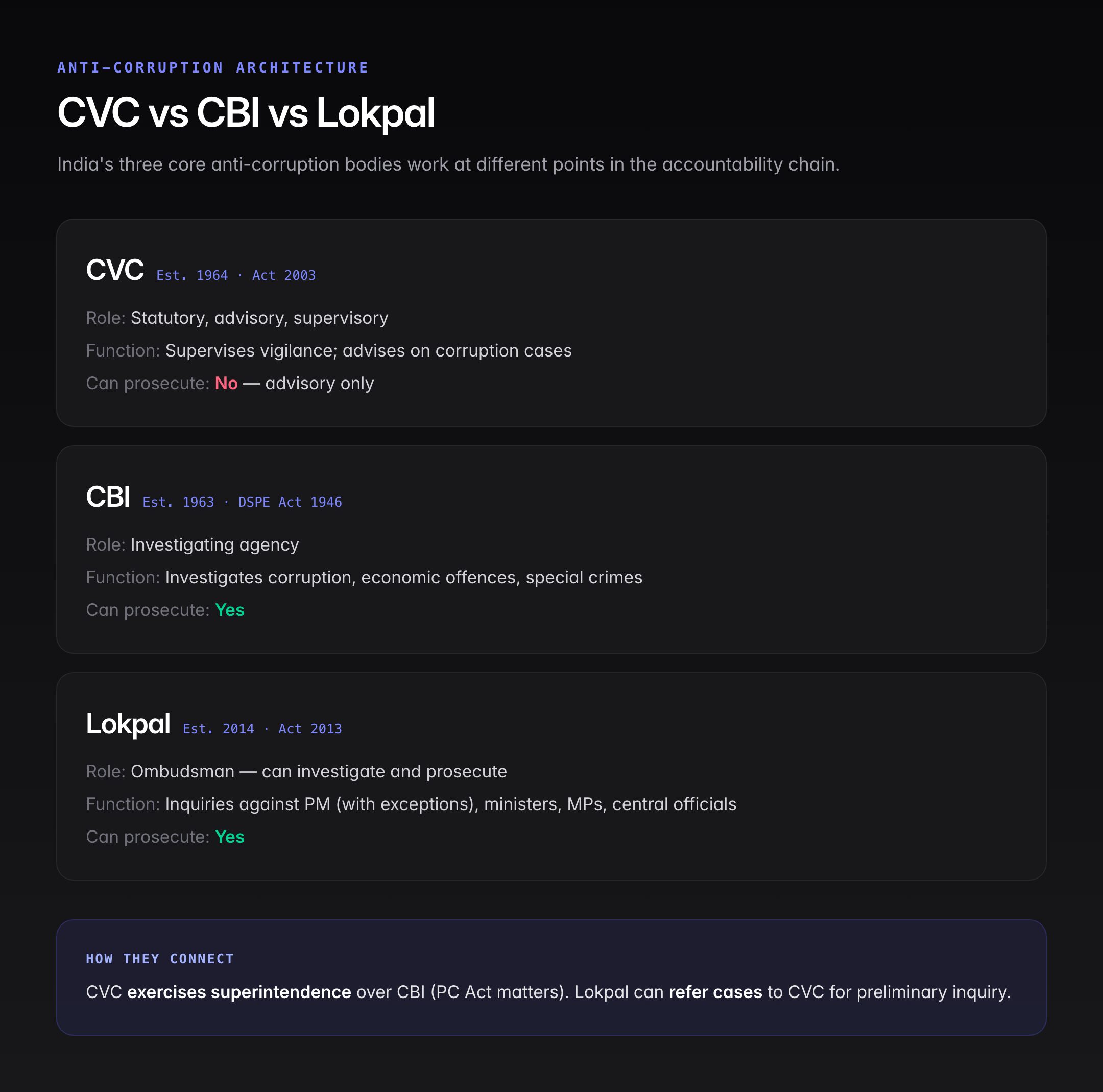
| Established | 1964 (Resolution); 2003 (Act) | 1963 (Resolution under DSPE Act 1946) | 2014 (Lokpal and Lokayuktas Act, 2013) |
| Nature | Statutory, advisory, supervisory | Investigating agency | Ombudsman; can investigate and prosecute |
| Primary role | Supervises vigilance, advises on corruption | Investigates corruption, economic offences, special crimes | Inquires into complaints against public functionaries including the PM (with exceptions) |
| Composition | 1 Chairperson + up to 2 Vigilance Commissioners | Director + officers | Chairperson + up to 8 members (50% judicial) |
| Appointment | President on recommendation of PM, HM, LoP | President on recommendation of PM, CJI (or SC judge), LoP | President on recommendation of PM, Speaker, LoP, CJI, eminent jurist |
| Jurisdiction | Central govt officials (senior levels) | Central government, Union Territories, and at state request | PM (with exceptions), ministers, MPs, Group A-D central officials |
| Can prosecute? | No (advisory) | Yes | Yes |
| Powers of civil court | Yes | Yes (during investigation) | Yes |
Key Relationship
- CVC exercises superintendence over CBI in matters related to the Prevention of Corruption Act.
- CVC's advice is advisory, not binding, on the Central Government.
- The Lokpal can refer cases to CVC for preliminary inquiry against Group A, B, C, and D officials.
Limitations of CVC
| Limitation | Description |
|---|---|
| Advisory role | Recommendations are not binding on the government |
| No suo motu powers | Until recently, required specific complaints to initiate action (has been strengthened over time) |
| Limited jurisdiction | Does not cover state government employees or private sector |
| Dependence on CBI | Investigation capacity depends on CBI resources |
| Delay in action | Slow pace of vigilance clearances and advice |
| Political influence | Appointment process has been criticised for lack of transparency (e.g., Thomas case) |
Landmark Cases
Centre for PIL v. Union of India (2011) — The Thomas Case
The Supreme Court quashed the appointment of P. J. Thomas as Central Vigilance Commissioner, holding that:
- Institutional integrity is paramount in appointments to such posts.
- The High-Powered Committee must consider all relevant material, including pending criminal cases against a candidate.
- Appointment cannot be based on majority view alone if serious objections exist.
This judgment significantly shaped CVC's appointment norms.
UPSC Relevance
| Paper | How It Appears |
|---|---|
| Prelims (GS) | CVC composition, appointment procedure, CVC Act 2003, Santhanam Committee, tenure, removal |
| Mains GS-II (Polity) | Role of statutory bodies in governance, accountability institutions, separation of powers |
| Mains GS-IV (Ethics) | Integrity in public administration, corruption and its impact on governance |
| Essay | Anti-corruption framework, institutional accountability |
Key terms to remember: CVC, Santhanam Committee, CVC Act 2003, Vineet Narain case, Chief Vigilance Officer, Prevention of Corruption Act 1988, PIDPI 2004, Thomas case, Lokpal and Lokayuktas Act 2013.
Previous Year Questions (Themes)
- Discuss the composition and functions of the Central Vigilance Commission. (GS-II)
- Examine the relationship between CVC, CBI, and Lokpal in India's anti-corruption architecture. (GS-II)
- "The effectiveness of anti-corruption bodies in India is limited by structural and operational constraints." Discuss. (GS-IV)
The CVC remains a cornerstone of India's anti-corruption architecture. While its advisory status and jurisdictional limits have drawn criticism, the statutory framework under the CVC Act 2003 has strengthened its autonomy and functional effectiveness considerably.
Tell Google you want more of this.
Add Anantam IAS as a preferred sourceOne tap, and this site shows up more often in your own Top Stories, AI Overviews and AI Mode. Remove it any time.