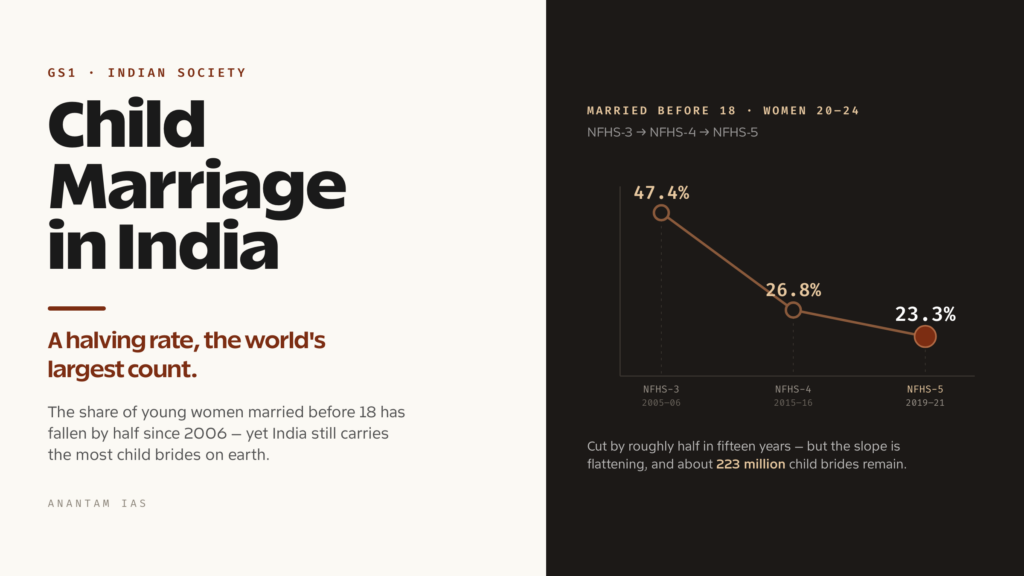
A child marriage is a marriage where at least one partner is below the legal age — under 18 for a woman, under 21 for a man. Put plainly, it is a wedding signed off by adults for someone who is still legally a child. India has spent two decades pushing the number down, and the line has genuinely fallen: the share of young women married before 18 has more than halved since 2006. And yet the country still carries the largest absolute number of child brides on earth.
That gap — real progress sitting next to a stubborn baseline — is what makes the subject worth getting right. It is not a story of a law that failed, nor of a problem already solved. It is a story about how slowly social practice shifts even when the statute book is clear, the data is improving, and the courts have spoken. For an Indian Society paper, child marriage is one of the cleanest case studies you will find of the distance between formal law and lived custom.
What Child Marriage Means, and Why It Sits at the Centre of Indian Society
The working definition comes from the law itself. The Prohibition of Child Marriage Act, 2006 sets the floor at 18 for women and 21 for men, and treats anyone below those ages as a “child” for the purposes of marriage. So “child marriage” is not loose shorthand for a young couple; it is a precise legal category, and the under-18 figure for girls is the one most surveys track.
It helps to separate two ideas that often get blurred. Child marriage is the formal union. Early or adolescent pregnancy is what frequently follows. They travel together, but they are not the same thing, and good answers keep them distinct. The first is a legal and social event; the second is the health consequence that flows from it.
Why does this belong at the centre of an Indian Society discussion rather than off in a corner of welfare policy? Because child marriage is both a symptom and a cause. It is a symptom of older forces — son preference, the dowry economy, anxiety about a daughter’s safety and sexuality, the treatment of girls as a cost to be transferred rather than a person to be invested in. And it is a cause in its own right, because a girl married at 15 or 16 is pulled out of school, out of paid work, and into childbearing before her body or her bargaining power is ready. So the practice does not just reflect gender inequality; it manufactures the next generation of it. That circularity is the analytical heart of the topic.
The Data: A Real Decline, an Unfinished Job
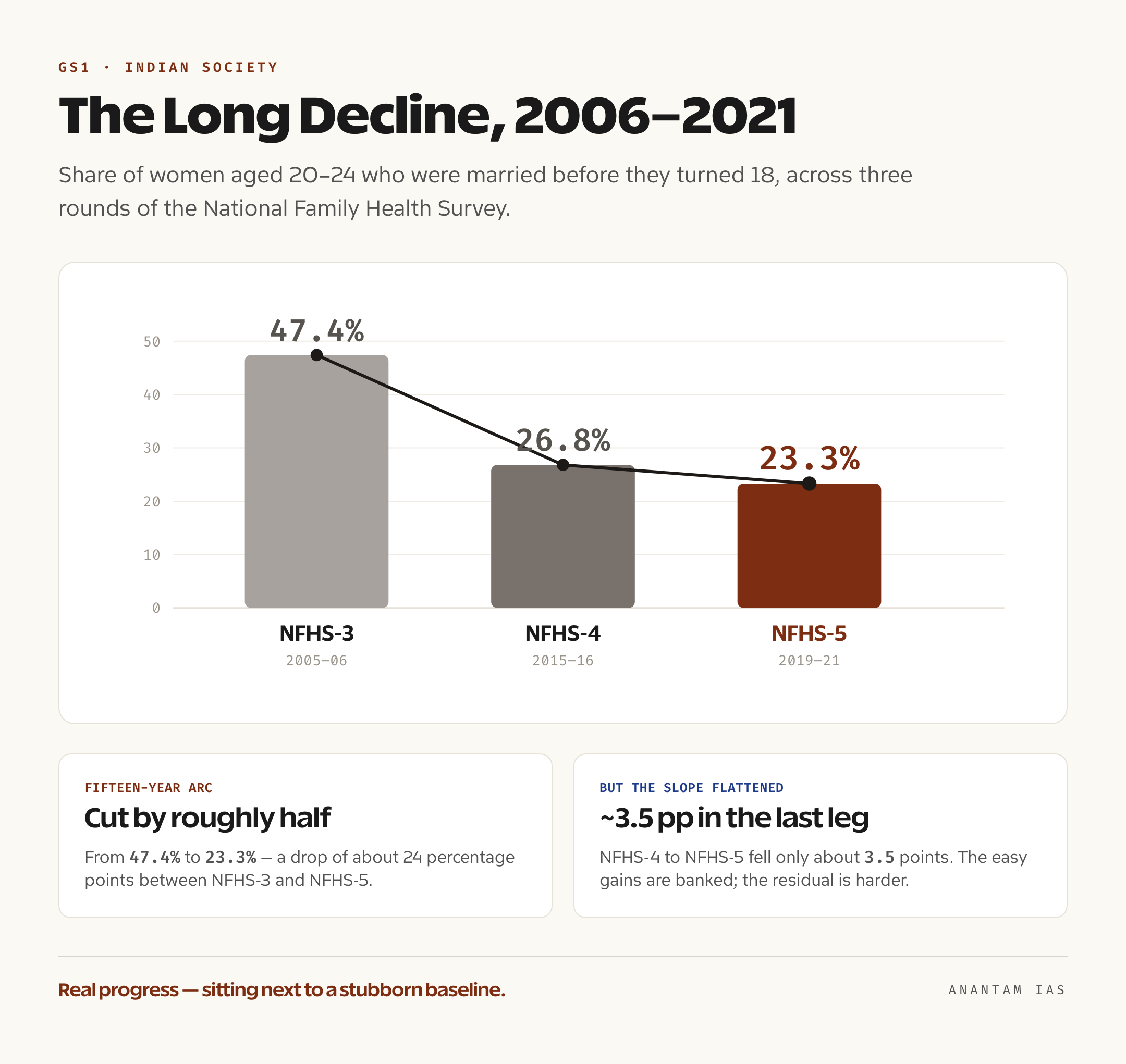
Start with the headline number, because it anchors everything. The National Family Health Survey-5, conducted in 2019-21, found that 23.3% of women aged 20-24 were married before they turned 18. That is the standard yardstick — it asks recently grown women whether they married as children, which captures the practice as it actually was a few years earlier.
Now place that figure on a trend line, because a single number tells you little. The same measure stood at 47.4% in NFHS-3 (2005-06) and 26.8% in NFHS-4 (2015-16). So the long arc is unmistakable: child marriage among young women has fallen by roughly half in fifteen years. But the recent slope is gentler — a drop of about 3.5 percentage points between NFHS-4 and NFHS-5, against the much steeper fall before it. The easy gains have been banked; the residual is harder.
The other number that gives the topic its weight is global. UNICEF estimates that India is home to around 223 million child brides — women alive today who were married as girls — which is roughly one in three of the world’s total. India has cut its rate faster than many peers, yet because the population is so large, the absolute count stays enormous. Both facts are true at once, and an examiner respects a candidate who holds them together rather than picking the more dramatic one.
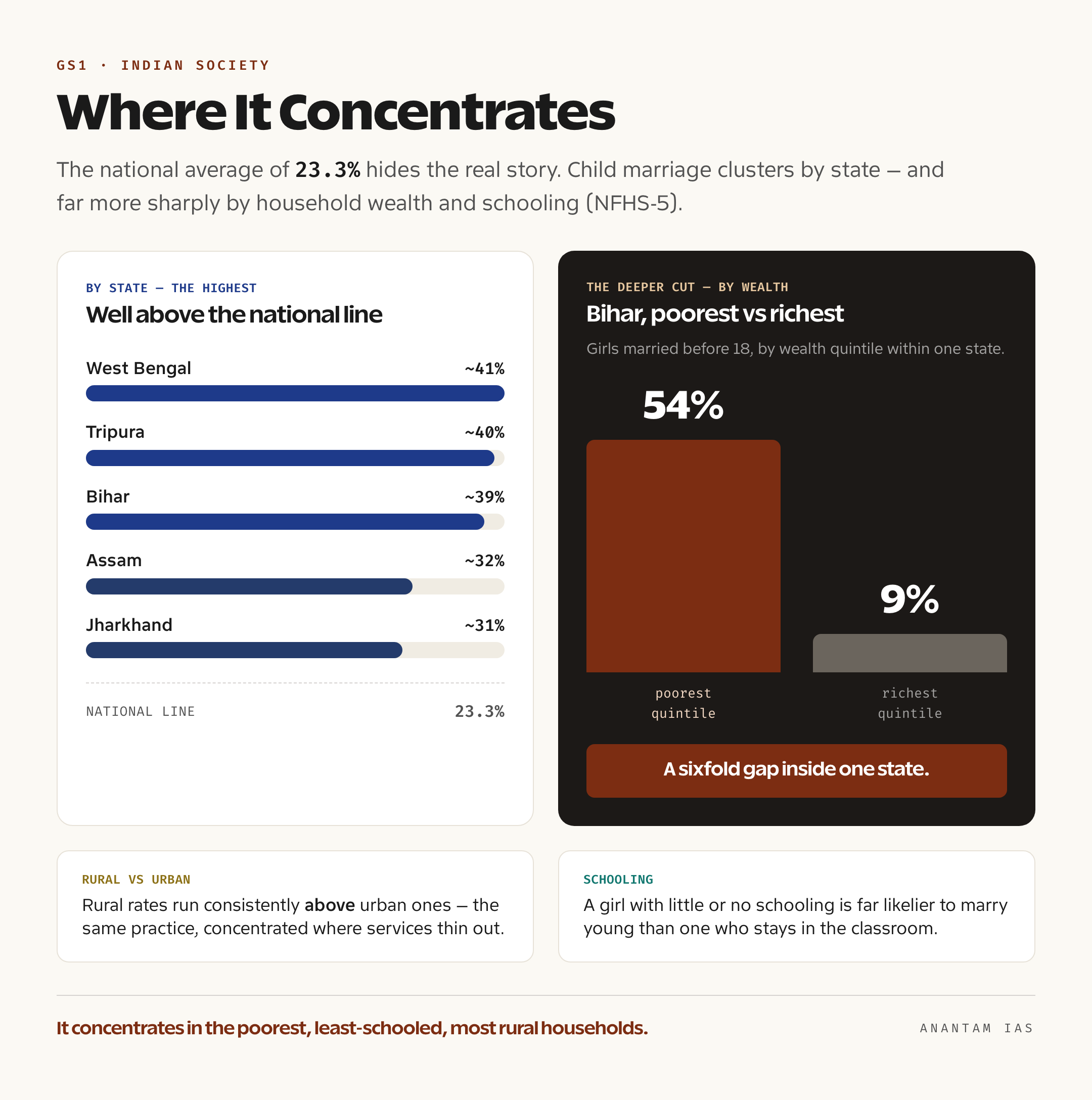
The national average also hides sharp variation, and that variation is where policy actually bites. By NFHS-5, West Bengal sat near 41%, Tripura around 40%, Bihar close to 39%, with Assam near 32% and Jharkhand around 31% — all well above the national line, while several southern and northern states sat well below it. The fastest reductions, meanwhile, showed up in Rajasthan, Madhya Pradesh and Haryana, states that once led the tables. So the map is not frozen; it moves.
The deeper cut is not geography but household. Child marriage tracks poverty and schooling almost mechanically. In Bihar, NFHS-5 analysis found that about 54% of girls in the poorest wealth quintile married before 18, against roughly 9% in the richest — a sixfold gap inside a single state. The pattern repeats nationally: rural rates run above urban, and a girl with little or no schooling is far likelier to be married young than one who stays in the classroom. So the average woman’s experience and the poorest woman’s experience are different problems wearing the same name.
Why It Persists: The Drivers Behind the Number
No family decides to harm a daughter. That is the uncomfortable starting point. Child marriage survives because, inside the logic of a poor and anxious household, it can look like the rational choice. Unpacking that logic is more useful than condemning it.
Money sits underneath most of it. Where a daughter is seen as an economic cost rather than an earner, marriage becomes a way to transfer that cost to another household sooner rather than later. The dowry system sharpens the nudge, because in many communities a younger bride is thought to command a smaller dowry, so families economise by marrying daughters early. Poverty does not create the custom, but it makes the custom feel affordable in a way that delay does not.
Schooling is the second lever, and it cuts both ways. When a girl drops out — because the secondary school is far, or unsafe, or charges costs the family cannot meet — marriage rushes in to fill the vacuum, since an unschooled adolescent daughter at home is exactly the situation early marriage is meant to “resolve.” The reverse is just as true: every additional year a girl stays in school pushes the likely age of marriage up. That is why the schooling-marriage link is the single most reliable finding in the literature.
Then there is the bundle of social norms. Anxiety about a daughter’s safety and sexuality leads parents to see marriage as protection — against harassment, against a caste-crossing romance, against gossip. Son preference means families want daughters settled quickly so resources can flow to sons. And in some communities the older belief that marriage should precede or closely follow puberty still carries weight, reinforced by extended-family and caste networks that treat early marriage as respectable rather than illegal. None of these forces is decisive alone. Together they explain why a practice the law banned in 2006 has taken twenty years to halve rather than vanish.
Where the Response Falls Short
The state’s response is not absent — it is uneven, and it stumbles on some hard internal contradictions. Three are worth naming.
The first is built into the law. The Prohibition of Child Marriage Act, 2006 makes a child marriage voidable, not void. A void marriage never legally existed; a voidable one stands until someone actively asks a court to annul it. By making child marriages merely voidable, the Act leaves the burden of escape on the very person least able to carry it — a girl who must, within a tight window after turning 18, take her own family to court to undo a marriage they arranged. In practice almost no one does, so most child marriages quietly become permanent. The law disapproves of them without dissolving them.
The second is a clash between statutes. The Protection of Children from Sexual Offences Act, 2012 (POCSO) sets the age of consent at 18 and treats any sexual activity below it as an offence, with no exception for marriage. So a child marriage that is merely voidable under one law can simultaneously be a serious crime under another. The Supreme Court has been hearing arguments on whether the age of consent should be revisited, but the Centre has told the court that 18 is non-negotiable. The result is a legal grey zone that enforcement agencies navigate inconsistently.
The third is the friction with personal laws. Marriage in India is also governed by community-specific personal laws, and some have historically permitted marriage at puberty. The question of whether a secular prohibition can override a personal-law permission has dogged courts for years. In its 2024 ruling the Supreme Court took a firm line, holding that the Prohibition of Child Marriage Act cannot be undercut by personal laws — but the underlying tension between a uniform legal floor and plural family law has not gone away.
There is also a quieter enforcement failure beneath all this. The Act provides for Child Marriage Prohibition Officers, yet for years many districts either left the post unfilled or stacked it on an official already running three other jobs. A law with no dedicated officer on the ground is a law that exists mainly on paper.
The Way Forward
The honest lesson of the last fifteen years is that prosecution alone moves the number slowly; prevention and incentives move it faster. A workable package leans on the second without abandoning the first.
- Treat schooling as the primary intervention. Keeping girls in school past 16 does more to delay marriage than any single deterrent. That means secondary schools within safe reach, transport or residential options in vulnerable districts, and conditional support that rewards continued attendance rather than just enrolment. Schemes such as West Bengal’s Kanyashree and Karnataka’s Bhagyalakshmi work on exactly this logic, and the evidence broadly backs them.
- Fix the law’s softest joint. Reformers have long argued that child marriages should be void rather than voidable, so the union carries no legal weight from the start and the girl is not asked to litigate her own rescue. At a minimum, the voidability window should be far easier to use, with legal aid built in.
- Staff and train the front line. The 2024 Supreme Court guidelines push precisely here — dedicated Child Marriage Prohibition Officers at the district level, with mandatory training, periodic review, and support staff, alongside training for police, teachers, judges and community health workers. A right exists only as well as the official meant to enforce it.
- Make prevention community-driven, not raid-driven. The Court explicitly favoured preventive, community-anchored strategies over a sole focus on prosecution. ASHAs, Anganwadi workers and panchayats sit closest to the families making these decisions and can intervene before a wedding rather than punish after it.
- Target the hotspots with the data we now have. Because prevalence concentrates so sharply by district, caste and wealth quintile, blanket campaigns waste effort. Pointing resources at the poorest quintiles in the highest-prevalence districts is where the marginal rupee does the most.
- Settle the age-of-marriage question carefully. The Jaya Jaitly task force recommended raising the legal age of marriage for women from 18 to 21, and the Prohibition of Child Marriage (Amendment) Bill, 2021 — referred to a parliamentary standing committee in December 2021 and still under deliberation — would do exactly that. Whether parity at 21 actually reduces child marriage or merely relabels more unions as illegal is a genuinely open question, and a phased, consultation-led rollout is the prudent path.
On enforcement, Assam is the live test case. Its government ran an aggressive crackdown from 2023, with more than 8,600 arrests under POCSO and the Prohibition of Child Marriage Act and, by the state’s own account, over 3,000 planned child marriages prevented in 2023-24. The state reports falling prevalence in its hotspot districts; critics counter that mass arrests of husbands can leave young wives and children without support and that the approach is as much political theatre as social policy. Both readings can be cited — and a mature answer treats Assam as evidence that enforcement helps but cannot stand alone.
For Your Mains Answer
Child marriage maps cleanly onto GS Paper 1 (Indian society — the role of women, social empowerment, the persistence of social practices) and GS Paper 2 (welfare legislation, mechanisms for vulnerable sections, the gap between law and implementation). It feeds GS Paper 3 through the demographic-dividend and human-capital angle, and it is a reliable Essay theme on educating the girl child, women’s agency, or the distance between law and custom.
How to Build the Answer
Open with the paradox, not a definition dump: a halving of the rate sitting beside the world’s largest count of child brides. Then define the term precisely (the Prohibition of Child Marriage Act floor of 18 and 21), lay out the NFHS trend, and pivot to the variation that the average hides. Spend your middle on the why — money, schooling, social norms — because that is where analysis lives. Bring in the legal architecture (voidable-versus-void, POCSO, personal laws), the 2024 Supreme Court guidelines, and the age-21 Bill as the policy frame. Close on a balanced way forward that leads with education and prevention. The arc — paradox, data, drivers, law, response, way forward — fits almost any prompt on the subject.
Common Mistakes to Avoid
Don’t moralise; explain the household logic instead, because that is what the rubric rewards. Don’t quote only the falling rate or only the 223-million figure — use both, deliberately, to show you grasp rate versus absolute number. Don’t present child marriage as purely a legal problem when the binding constraints are economic and educational. And don’t claim the 2021 Bill is law; it is still before a standing committee.
A Compact Answer Spine
Definition (PCMA floor: 18 / 21) → trend (47.4% → 26.8% → 23.3%, NFHS-3 to NFHS-5) → scale (~223 million, largest globally) → variation (state, rural-urban, wealth quintile) → drivers (poverty and dowry, school dropout, social norms, son preference) → law and its gaps (voidable not void, POCSO clash, personal laws) → 2024 Supreme Court guidelines and CMPOs → the age-21 Bill → way forward led by schooling and community prevention.
Diagram or Flowchart Idea
Draw a simple vicious-circle loop: poverty → girl pulled from school → early marriage → adolescent pregnancy and lost earning years → low household income → poverty. Then add one outward arrow labelled “extra year of schooling” breaking the loop. A single self-reinforcing cycle with one intervention point reads as analysis and is quick to sketch.
A Balanced-Conclusion Line
Something like: “Child marriage in India is retreating but not yet defeated — and the last stretch will be won less in the courtroom than in the classroom, by making it ordinary for a poor girl to stay in school past sixteen.”
How to Use Data Without Cramming
Carry three numbers, not ten: 23.3% (NFHS-5), the 26.8% it fell from, and ~223 million (the global count). Anchor one institutional fact — the October 2024 Supreme Court guidelines on enforcement — and one policy fact — the age-21 Bill pending before a standing committee. Five precise points, deployed in the right place, beat a paragraph of half-remembered figures.
FAQ
What counts as child marriage in India, and what is the legal age? Under the Prohibition of Child Marriage Act, 2006, the legal minimum age of marriage is 18 for women and 21 for men. A marriage where either partner is below that age is a child marriage, and the under-18 figure for girls is the one most surveys track.
How common is child marriage in India now? NFHS-5 (2019-21) found that 23.3% of women aged 20-24 were married before 18, down from 26.8% in NFHS-4 (2015-16) and 47.4% in NFHS-3 (2005-06). The rate has roughly halved in fifteen years, but India still has around 223 million child brides — the largest number of any country.
Has the law raising the marriage age for women to 21 been passed? Not yet. The Jaya Jaitly task force recommended raising the legal age for women from 18 to 21, and the Prohibition of Child Marriage (Amendment) Bill, 2021 proposes exactly that. It was referred to a parliamentary standing committee in December 2021 and remains under deliberation rather than enacted.
What did the Supreme Court say about child marriage in 2024? In Society for Enlightenment and Voluntary Action v. Union of India (October 2024), the Supreme Court issued comprehensive guidelines for enforcing the 2006 Act: states must appoint and properly train dedicated Child Marriage Prohibition Officers, prioritise community-driven prevention over prosecution alone, and treat the law as overriding personal laws. The Court framed child marriage as a violation of the constitutional rights of the child.
Practice Questions
Prelims MCQs
- As per NFHS-5 (2019-21), the share of women aged 20-24 who were married before the age of 18 was closest to which figure?
(a) 47.4%
(b) 26.8%
(c) 23.3%
(d) 9%
Answer: (c) — NFHS-5 recorded 23.3%, down from 26.8% in NFHS-4 and 47.4% in NFHS-3, the standard yardstick for the practice. - Under the Prohibition of Child Marriage Act, 2006, the minimum legal age of marriage is:
(a) 18 for both women and men
(b) 18 for women and 21 for men
(c) 21 for both women and men
(d) 16 for women and 18 for men
Answer: (b) — the Act sets the floor at 18 for women and 21 for men, defining anyone below those ages as a child for marriage. - With reference to the legal status of a child marriage under the Prohibition of Child Marriage Act, 2006, which statement is correct?
(a) It is void from the start
(b) It is voidable, standing until a court annuls it on the affected party’s petition
(c) It is automatically dissolved when the girl turns 18
(d) It is fully valid with no legal disability
Answer: (b) — the Act makes a child marriage voidable, not void, placing the burden of annulment on the affected party within a limited window. - Which statute sets the age of consent at 18 with no exception for marriage, creating a tension with the merely voidable status of child marriage?
(a) Indian Majority Act, 1875
(b) Juvenile Justice Act, 2015
(c) Protection of Children from Sexual Offences Act, 2012
(d) Domestic Violence Act, 2005
Answer: (c) — POCSO, 2012 treats any sexual activity below 18 as an offence with no marital exception, clashing with the voidable child marriage. - The Prohibition of Child Marriage (Amendment) Bill, 2021, which proposes raising the legal age of marriage for women to 21, is based on the recommendation of which task force?
(a) Jaya Jaitly task force
(b) Justice Verma Committee
(c) Lakshmi Task Force
(d) Mukherjee Commission
Answer: (a) — the Jaya Jaitly task force recommended raising the age to 21; the Bill was referred to a parliamentary standing committee in December 2021 and remains under deliberation.
Mains Practice Questions
- “Child marriage in India is both a symptom and a cause of gender inequality.” Examine this statement with reference to its social and economic drivers. (15 marks, 250 words)
- Despite a halving of the prevalence rate since 2006, India still records the largest absolute number of child brides in the world. Discuss the factors behind this paradox and the limits of a law-centred response. (15 marks, 250 words)
- The Prohibition of Child Marriage Act, 2006 makes a child marriage voidable rather than void, and sits uneasily alongside POCSO and personal laws. Critically analyse these legal tensions and the significance of the 2024 Supreme Court guidelines. (15 marks, 250 words)
- “The last stretch against child marriage will be won less in the courtroom than in the classroom.” Discuss the role of girls’ education and community-driven prevention in delaying the age of marriage. (10 marks, 150 words)
- The national average for child marriage conceals sharp variation across states, wealth quintiles and schooling levels. Examine how this evidence should shape a targeted policy response. (15 marks, 250 words)
Tell Google you want more of this.
Add Anantam IAS as a preferred sourceOne tap, and this site shows up more often in your own Top Stories, AI Overviews and AI Mode. Remove it any time.