When the first Tuvaluans stepped off a plane in Australia in December 2025, holding permanent-residence visas granted because their homeland is slipping under the sea, they turned an abstract fear into a documented fact. For years, “climate migration” sounded like a forecast — something that might happen to coastal cities and low islands somewhere down the century. The Falepili Union, the world’s first treaty written specifically to move people out of a country threatened by rising water, made it present tense. A sovereign state had effectively conceded that part of its population would have to live somewhere else, and another state had agreed to take them in. That is what a warming world does to the map of where people can live.
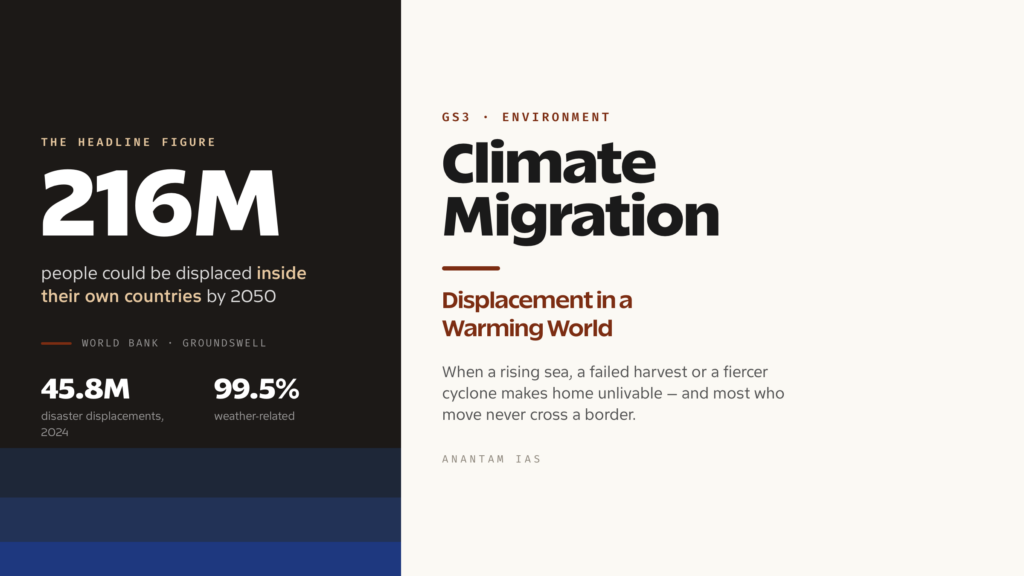
And the scale of it is far larger and far closer to home than any island story suggests. Most people moved by climate are not crossing oceans or borders at all — they are shifting within their own countries, from a flooded village to a city slum, from an eroding coast to higher ground a district away. The World Bank’s Groundswell modelling warns that climate change could push as many as 216 million people to migrate inside their own borders by 2050, with South Asia alone accounting for around 40 million of them. For a UPSC aspirant, climate migration sits at a rare crossroads — it is at once an Environment topic, a Disaster Management topic, an International Relations topic and a Society topic — and it rewards anyone who can explain it as a single chain of cause and effect rather than a list of scary numbers.
What Climate Migration Is and What Drives It
Start with the word, because the word is contested. Climate migration is the movement of people driven, wholly or partly, by the impacts of a changing climate on the places they live. It is rarely caused by climate alone — a failed harvest pushes a family out only because they were already poor, or landless, or without insurance — so analysts prefer to call climate a “threat multiplier” rather than a single trigger. It sharpens pressures that were already there, until staying becomes harder than leaving.
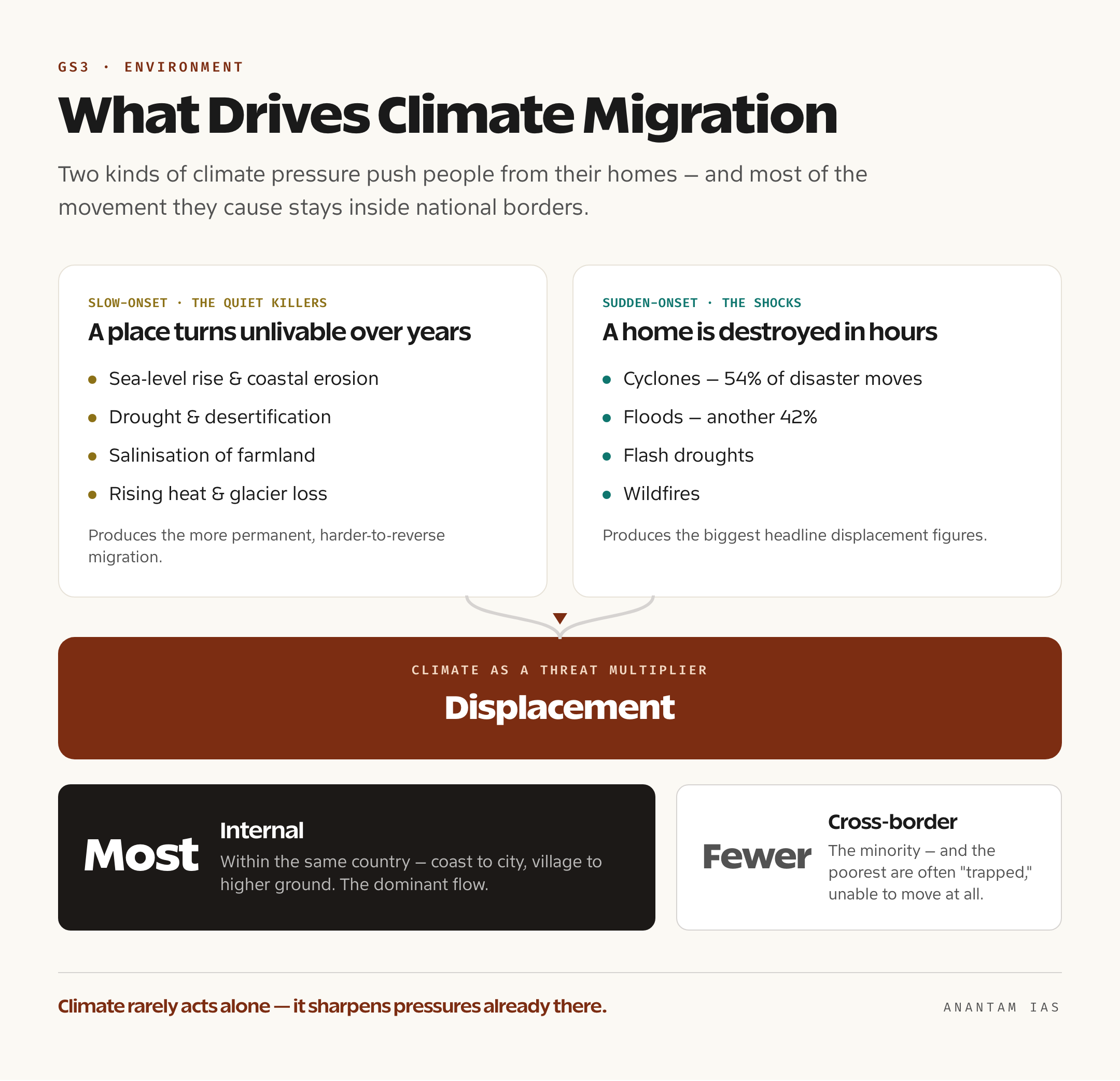
The drivers split cleanly into two kinds, and getting this distinction right is the first mark of a good answer. Sudden-onset events are the dramatic ones — cyclones, floods, flash droughts, wildfires — that destroy homes in hours and force people to flee immediately, usually nearby and often temporarily. Slow-onset processes are the quiet killers — sea-level rise, coastal erosion, desertification, salinisation of farmland, glacier loss, rising heat — that make a place gradually unlivable over years until people give up on it for good. Sudden disasters produce the biggest headline displacement figures; slow-onset change produces the more permanent, harder-to-reverse migration. Both are intensifying as the planet warms.
There is a second split that matters just as much: internal versus cross-border. The overwhelming majority of climate-related movement is internal — people stay inside their own country, which is why the legal and policy debate about “refugees crossing borders” can miss the real picture. And there is a third, uncomfortable layer the literature insists on: the poorest are often not the ones who move, but the ones who can’t. Migration costs money, contacts and health; the most vulnerable can become “trapped populations,” left behind in a place that is failing precisely because they lack the means to leave. So climate migration is not simply a flood of people heading for richer countries. It is mostly local, mostly internal, deeply shaped by who can afford to move at all — and that nuance is what separates a mature answer from a panicked one.
The Scale: How Many People, and Moving Where
Now the numbers, because this is where examiners and editorials both live, and the figures here are genuinely staggering. The clearest annual measure comes from the Internal Displacement Monitoring Centre, whose 2025 Global Report found that disasters triggered 45.8 million internal displacements in 2024 — the highest figure since its records began in 2008, and more than double the average of the previous decade. The detail that lands the point: weather-related events, many intensified by climate change, accounted for 99.5 per cent of those disaster displacements, with cyclones driving about 54 per cent and floods another 42 per cent. By the end of 2024, a record 83.4 million people were living in internal displacement worldwide from all causes combined.
These are flows, not forecasts — real movements counted in a single year. The forecast number is the one that gets quoted most, and it comes from the World Bank’s Groundswell work: under a pessimistic, high-emissions pathway, slow-onset climate change could drive up to 216 million internal climate migrants across six world regions by 2050. The regional breakdown is worth carrying into an answer because it shows where the weight falls — Sub-Saharan Africa as many as 86 million, East Asia and the Pacific 49 million, South Asia 40 million, North Africa 19 million, Latin America 17 million, and Eastern Europe and Central Asia 5 million. The same report makes a hopeful point that examiners love: cutting global emissions and pursuing green, inclusive, resilient development could shrink that 216 million by as much as 80 per cent. The future is a policy choice, not a fixed sentence.
Two cautions keep these numbers honest. First, most of this movement is internal and regional — South Asians moving within South Asia, Africans within Africa — not a wave heading for Europe or North America. Second, single-cause headline figures oversimplify a messy reality where climate, poverty, conflict and economics tangle together, which is exactly why agencies like the International Organization for Migration prefer the careful term “environmental migration” to the dramatic “climate refugee.” The honest framing is that climate is now a large and rising contributor to human movement — and that the trend line, on every reliable measure, is pointing steeply upward.
The Protection Gap: Why There Is No “Climate Refugee”
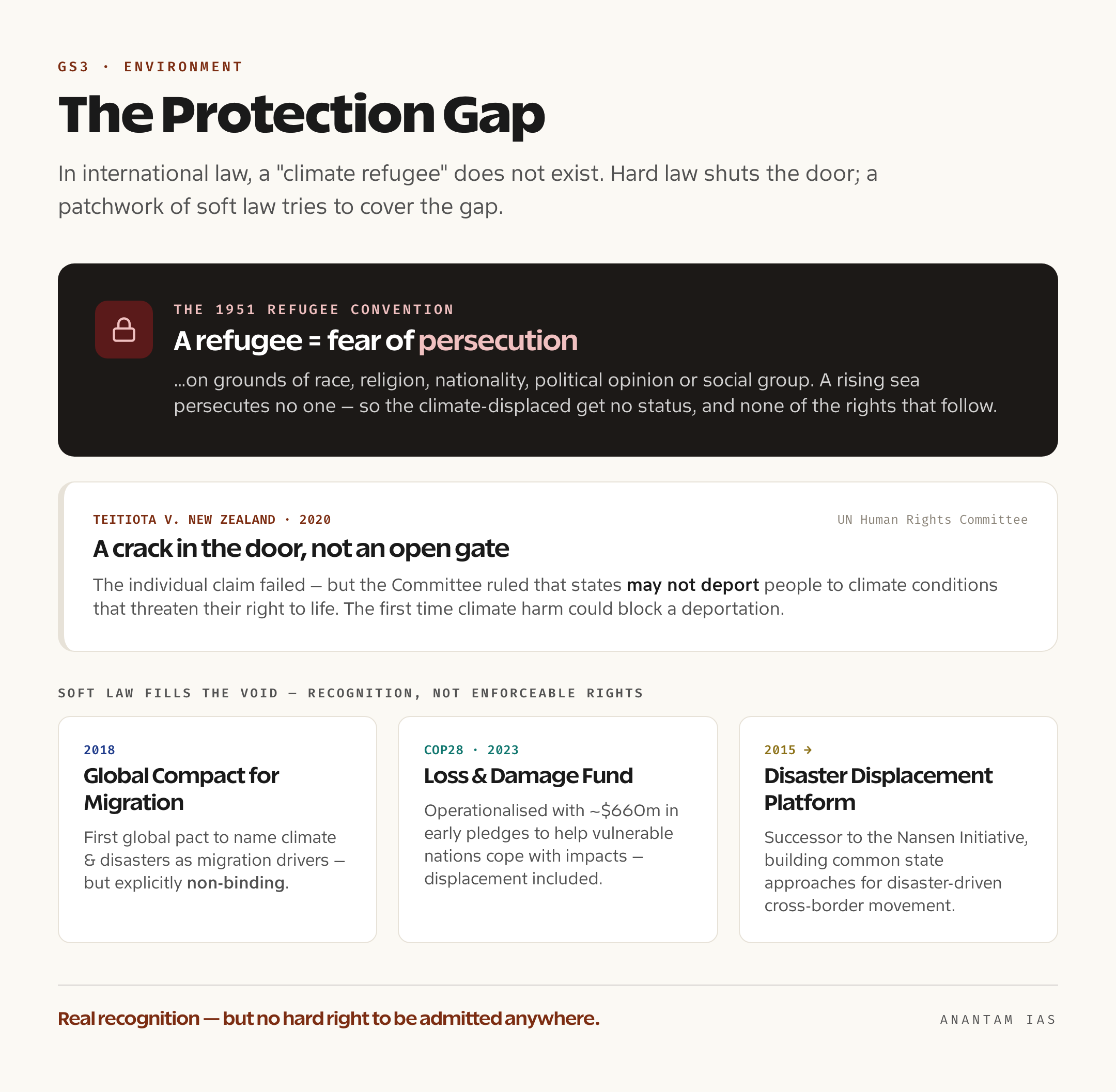
Here is the legal fact that surprises most people: in international law, a “climate refugee” does not exist. The 1951 Refugee Convention, the bedrock of refugee protection, defines a refugee narrowly as someone with a well-founded fear of persecution on grounds of race, religion, nationality, political opinion or membership of a particular social group. A rising sea is not a persecutor; a cyclone holds no political opinion about its victims. So someone forced across a border by a flood or a vanishing coastline simply does not fit the definition, and gets none of the rights that flow from it. Both the United Nations refugee agency and the International Organization for Migration actively discourage the phrase “climate refugee” for this reason — not to deny the suffering, but because the word promises a legal status that does not, in fact, exist.
The closest international law has come to bridging that gap is a single landmark ruling. In the Teitiota case, decided by the UN Human Rights Committee in early 2020, a man from the low-lying Pacific nation of Kiribati had sought asylum in New Zealand, arguing that sea-level rise, land disputes and the loss of safe drinking water made his home unlivable. The Committee rejected his specific claim, finding he did not face an immediate threat to life. But it said something far more important in passing: that countries may not deport people to places where climate-change conditions expose them to a real risk to the right to life. It was the first time an international body accepted that climate harm could, in principle, block a deportation — a crack in the door rather than an open gate, but a precedent that protection lawyers have built on ever since.
Outside the courts, the world has reached for soft law — frameworks that set out good intentions without binding anyone. The 2018 Global Compact for Safe, Orderly and Regular Migration was the first global agreement to formally name climate change, disasters and environmental degradation as drivers of migration and to ask states to plan for them, but it is explicitly non-binding. The 2022 breakthrough at the climate negotiations on a “loss and damage” fund — operationalised at the COP28 summit in Dubai in 2023, with early pledges of around $660 million — created, for the first time, a pot of money meant to help vulnerable countries cope with climate impacts they did nothing to cause, displacement among them. Earlier efforts like the Nansen Initiative and its successor, the Platform on Disaster Displacement, have pushed states toward common approaches for people forced across borders by disasters. The pattern is consistent: real recognition, real frameworks, but no hard, enforceable right to be admitted anywhere. The protection gap is the defining feature of this entire field.
Sinking Nations: The Front Line of Cross-Border Climate Movement
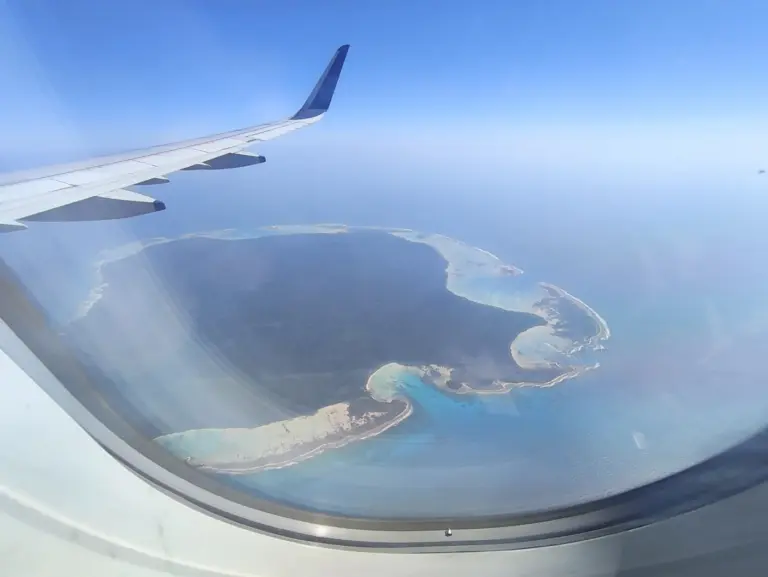
If the protection gap is an abstraction, the small-island states make it concrete, because for them it is not a future risk but an arithmetic certainty. Tuvalu, Kiribati, the Maldives and the Marshall Islands are low-lying atoll nations where the highest natural ground is only a few metres above the waves. Tuvalu sits, on average, barely two metres above sea level; scientists warn that much of its land could be regularly under water well within this century. These countries face a question no nation has ever had to answer before: what happens to a state — its citizenship, its seat at the United Nations, its ownership of the surrounding ocean — when the territory itself disappears?
Tuvalu and Australia produced the world’s first real answer in the Falepili Union, a bilateral treaty signed in late 2023 and now in force. Under it, Australia did two remarkable things. It recognised, in a legally binding instrument, that Tuvalu’s statehood and sovereignty will continue even if sea-level rise swallows its land — a deliberate move to keep a country legally alive after its territory is gone. And it created the Falepili Mobility Pathway, a special visa offering up to 280 Tuvaluans a year permanent residence in Australia, with full work rights and a route to citizenship. When applications first opened in 2025, more than a third of all Tuvaluans registered within days, and the first arrivals landed in December 2025. It is being studied worldwide as the prototype for “climate mobility” — planned, dignified, treaty-based migration agreed in advance, rather than a chaotic flight once disaster strikes.
But the Falepili model also exposes the limits of the whole approach. A cap of 280 people a year is generous for a nation of barely 11,000, yet it would be a rounding error for a delta of tens of millions. The treaty depends on one wealthy neighbour choosing to act; there is no obligation on anyone else to follow. And it raises hard questions of justice — critics note the unequal bargain in which a vulnerable nation trades a measure of autonomy for safety, and worry about the loss of culture, language and identity when a people is scattered. For UPSC, the small-island story is the sharpest possible illustration of the core dilemma: the people least responsible for warming the planet are the first to lose their homes to it, and the legal system offers them generosity from individual states rather than a guaranteed right. That is the moral heart of the loss-and-damage and climate-justice debate, told through a few thousand people on a sinking atoll.
India’s Climate Migration Story
India belongs at the centre of this picture, not the margins, because it combines almost every driver in one country. It has a 7,500-kilometre coastline exposed to rising seas and intensifying cyclones, the vast Indo-Gangetic floodplain, the drought-prone Deccan, Himalayan communities watching their glaciers retreat, and hundreds of millions of people whose livelihoods depend directly on a stable monsoon. South Asia is one of the Groundswell report’s biggest hotspots, with up to 40 million projected internal climate migrants by 2050, and India’s own annual disaster-displacement counts already run into the millions in bad cyclone-and-flood years. As you can read in our explainer on India’s efforts for combating climate change, the country’s adaptation challenge and its displacement challenge are two faces of the same problem.
The Sundarbans, the great mangrove delta straddling West Bengal, is India’s most-cited case and a textbook of slow-onset displacement. Islands there are being eaten away by a combination of sea-level rise, erosion and disrupted river sediment — Ghoramara island has shrunk to a fraction of its former size, and thousands of its residents have already been resettled on neighbouring Sagar island or have drifted to cities like Kolkata and Delhi in search of work. These are environmental and humanitarian migrants in the truest sense: people whose land is literally vanishing beneath them, moving as a form of survival and adaptation. Cyclones like Aila and Amphan accelerated the exodus, turning a slow erosion into sudden flight. Much of India’s climate movement, though, is quieter still — distress migration from rain-failed farms in Maharashtra or Bundelkhand into the construction sites and informal economies of the big cities, a flow so blended with ordinary economic migration that it is rarely counted as “climate” at all.
The honest assessment is that India lacks a dedicated climate-migration policy. Climate-displaced people are not a recognised legal category in Indian law; they fall between the cracks of disaster relief, which handles the immediate emergency, and urban and labour policy, which absorbs the migrants afterward without acknowledging why they came. India’s strong disaster-management architecture — explained in our piece on the Disaster Management Act and its 2024 amendment — is built to save lives in a cyclone, not to manage the planned, long-term relocation of communities whose home will not exist in twenty years. The shared challenge of the wider Bengal delta, which India and Bangladesh both inhabit, is best understood the way the science frames it — as a common environmental and humanitarian problem of a sinking, eroding landscape that affects people on both sides of the line. The way forward most experts urge is the same vocabulary the Tuvalu story introduced: anticipatory planning, “managed retreat” and resettlement designed in advance, climate-resilient housing and livelihoods so people can stay where they are, and recognition of the climate-displaced as a category deserving of rehabilitation rather than treating each arrival as an anonymous economic migrant.
For Your Mains Answer
This is a high-value, multi-paper topic. It fits GS Paper 3 under environment, climate change, and disaster management; GS Paper 2 under international institutions, agreements and refugee/migration governance; and GS Paper 1 under the distribution of population and the effects of geography on human settlement. It is also a ready-made Essay theme on climate justice, sustainability and human security. The skill examiners reward is the one this article uses: pair a few exact figures with a clear chain of cause and effect, and always connect the local Indian case to the global frame.
How to Build the Answer
Move in a logical chain rather than a list. Define climate migration and name climate as a threat multiplier → split the drivers into sudden-onset and slow-onset, and the movement into internal versus cross-border, stressing that most is internal → give the scale with two or three hard figures (45.8 million disaster displacements in 2024; up to 216 million internal migrants by 2050) → explain the protection gap and why no “climate refugee” status exists → illustrate with the sinking-island and Falepili case → land it in India with the Sundarbans → close with the way forward. That arc — define, drive, scale, law, illustrate, localise, evaluate — fits almost any question on the theme.
Common Mistakes to Avoid
Don’t call displaced people “climate refugees” without flagging that the term has no legal standing — that caveat is itself examinable. Don’t imply the main flow is poor countries flooding into rich ones; the dominant pattern is internal and regional, and the poorest are often “trapped” rather than mobile. Don’t treat climate as the sole cause; frame it as a multiplier of poverty, conflict and weak governance. And for the India section, keep the delta framing strictly environmental and humanitarian — the marks lie in the displacement-and-adaptation analysis, not in any other lens.
A Compact Answer Spine
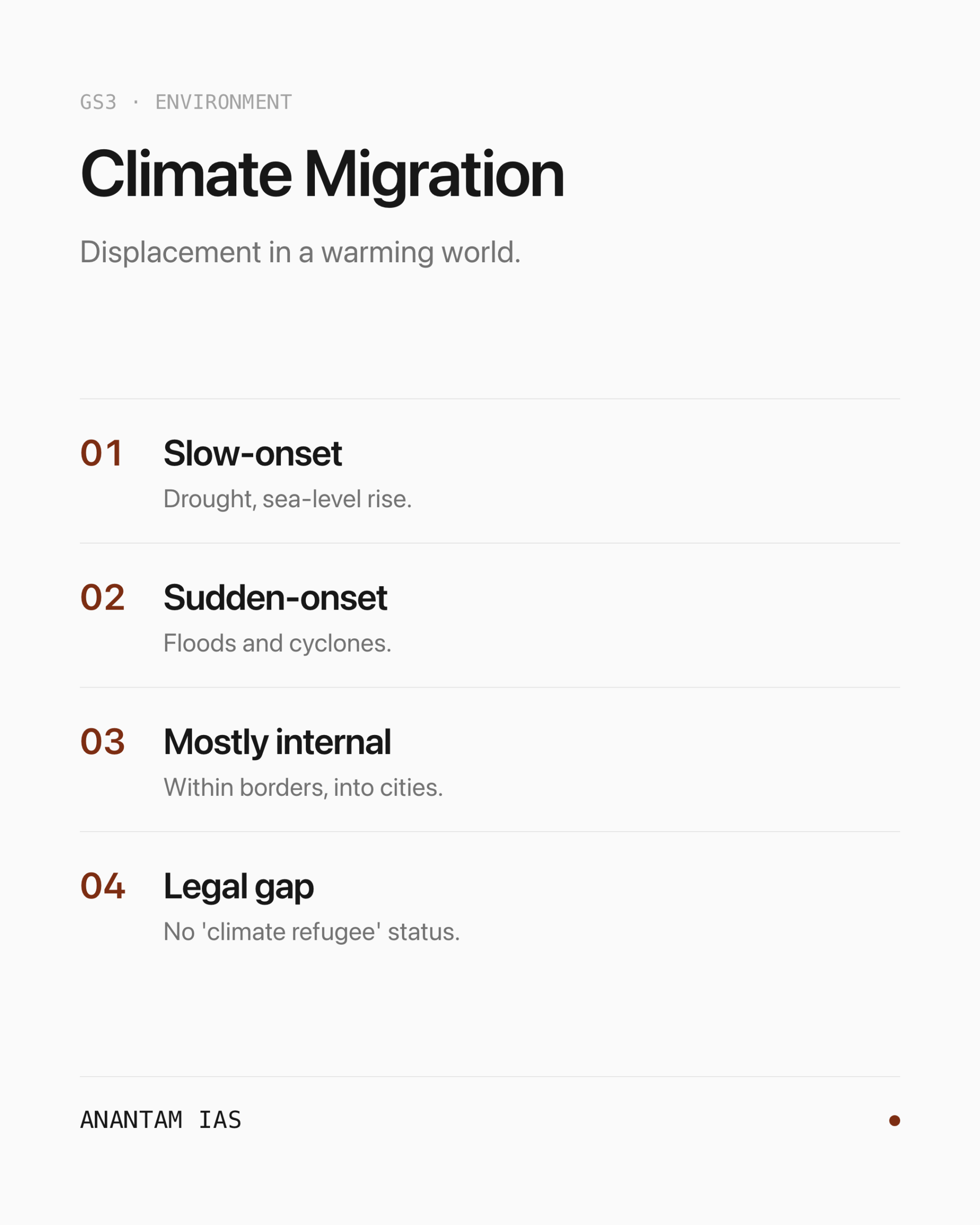
Climate migration = movement driven by climate impacts, with climate as a threat multiplier → drivers: sudden-onset (cyclones, floods) + slow-onset (sea-level rise, erosion, desertification); movement mostly internal, poorest often trapped → scale: 45.8 mn disaster displacements in 2024 (99.5% weather-related); up to 216 mn internal climate migrants by 2050, South Asia ~40 mn → legal gap: no “climate refugee” under the 1951 Convention; Teitiota (2020) bars deportation to life-threatening climate conditions; Global Compact (2018) and loss-and-damage fund (COP28) are soft law → sinking islands: Tuvalu-Australia Falepili Union, first climate-mobility treaty, up to 280 visas/year → India: Sundarbans/Ghoramara erosion, distress migration to cities, no dedicated policy → way forward: managed retreat, anticipatory planning, recognition as a category.
Diagram or Flowchart Idea
Draw a two-column funnel: left column lists slow-onset drivers, right column lists sudden-onset drivers, both arrows converging into a single box labelled “displacement,” which then splits into a large arrow marked “internal (majority)” and a small one marked “cross-border.” A clean cause-to-consequence flow like this communicates the whole driver-and-direction argument at a glance and is quick to sketch.
A Balanced-Conclusion Line
A line that lands the marks: “Climate migration is less a future crisis than a present and largely internal reality — and the real test is whether the world builds anticipatory, just systems of managed movement and resilient livelihoods, or leaves the least responsible to face displacement with the least protection.”
How to Use Data Without Cramming
You need only a handful of anchors, not a spreadsheet: 45.8 million (disaster displacements in 2024), 99.5 per cent (weather-related share), up to 216 million (internal climate migrants by 2050), 40 million (South Asia’s share), and 280 (annual Falepili visas). Drop those into the right sentences and attribute them plainly — “the World Bank’s Groundswell report projects” — rather than scattering numbers without a source.
Frequently Asked Questions
Is “climate refugee” a real legal status?
No. The term has no standing in international law. The 1951 Refugee Convention protects people fleeing persecution on grounds like race, religion or political opinion, and a flood or rising sea does not meet that test. Both the UN refugee agency and the International Organization for Migration discourage the phrase, preferring “climate migrant” or “environmental migrant.” The 2020 Teitiota ruling went furthest by saying countries may not deport people to climate conditions that threaten their right to life — but that bars a deportation; it does not grant refugee status.
How many people are displaced by climate, and where do they go?
In 2024 alone, disasters triggered 45.8 million internal displacements, the highest on record, with weather-related events accounting for 99.5 per cent of them. Looking ahead, the World Bank’s Groundswell report projects up to 216 million internal climate migrants across six regions by 2050, around 40 million of them in South Asia. The crucial point is that the great majority of this movement is internal — people relocating within their own country, often from rural or coastal areas to cities — rather than crossing international borders.
What is the Falepili Union, and why does it matter?
It is a 2023 treaty between Australia and Tuvalu — the world’s first agreement built specifically around climate-driven migration. Australia legally recognised that Tuvalu remains a sovereign state even if rising seas submerge its land, and created a special visa giving up to 280 Tuvaluans a year permanent residence, with the first arrivals landing in December 2025. It matters as a prototype for “climate mobility”: planned, treaty-based, dignified relocation agreed before disaster forces it, rather than chaotic flight afterward.
What is India’s situation, and does it have a climate-migration policy?
India faces climate displacement on many fronts — coastal erosion in the Sundarbans, intensifying cyclones, river flooding, and distress migration from drought-hit farms to cities. The Sundarbans, where Ghoramara island has shrunk dramatically and thousands have been resettled, is the most-cited case. But India has no dedicated climate-migration policy: the climate-displaced are not a recognised legal category and fall between disaster relief and ordinary urban and labour policy. Experts urge anticipatory planning, managed retreat, resilient livelihoods and formal recognition of climate-displaced people as a group needing rehabilitation.
Practice Questions
Prelims MCQs
- With reference to climate migration, consider the following statements:
1. The majority of people displaced by climate impacts move within their own countries.
2. The 1951 Refugee Convention grants refugee status to people displaced by sea-level rise. Which is/are correct?
(a) 1 only
(b) 2 only
(c) Both 1 and 2
(d) Neither 1 nor 2
Answer: (a) Most climate-related movement is internal; the 1951 Convention covers persecution, not environmental displacement, so it grants no status to those displaced by sea-level rise. - The Groundswell report, which projects up to 216 million internal climate migrants by 2050, is associated with which organisation?
(a) The United Nations High Commissioner for Refugees
(b) The World Bank
(c) The Internal Displacement Monitoring Centre
(d) The Intergovernmental Panel on Climate Change
Answer: (b) Groundswell is the World Bank’s modelling study of internal climate migration across six world regions. - The Falepili Union, the world’s first treaty centred on climate-driven migration, was signed between which two countries?
(a) New Zealand and Kiribati
(b) Australia and Tuvalu
(c) Fiji and the Maldives
(d) Australia and the Marshall Islands
Answer: (b) The 2023 Falepili Union between Australia and Tuvalu offers up to 280 Tuvaluans a year permanent residence and recognises Tuvalu’s continuing statehood. - In the Teitiota case (2020), the UN Human Rights Committee held that:
(a) Climate-displaced persons automatically qualify as refugees
(b) States may not deport people to climate conditions that threaten their right to life
(c) The 1951 Refugee Convention must be amended to add climate grounds
(d) Sea-level rise is not a valid ground for any asylum claim
Answer: (b) The Committee rejected the individual claim but established that climate conditions threatening the right to life can bar a deportation. - The “loss and damage” fund, relevant to climate-displaced communities, was operationalised at which climate summit?
(a) COP21 in Paris
(b) COP26 in Glasgow
(c) COP28 in Dubai
(d) COP15 in Copenhagen
Answer: (c) The fund, agreed in principle in 2022, was operationalised at COP28 in Dubai in 2023 with early pledges of around $660 million.
Mains Practice Questions
- “Climate change acts as a threat multiplier for human migration rather than a single cause.” Examine this statement with reference to the drivers and patterns of climate-induced displacement. (15 marks, 250 words)
- Discuss the legal protection gap faced by people displaced across borders by climate change. How have instruments such as the Teitiota ruling and the Global Compact for Migration attempted to address it? (15 marks, 250 words)
- The Australia-Tuvalu Falepili Union has been called a prototype for “climate mobility.” Critically analyse its significance and its limitations as a model for managing climate displacement. (15 marks, 250 words)
- Most climate-related displacement is internal rather than cross-border. Analyse the implications of this fact for India, with reference to the Sundarbans and distress migration to cities. (10 marks, 150 words)
- India lacks a dedicated policy for climate-displaced persons. Suggest a framework for managing internal climate migration that balances disaster response, urban planning and the rehabilitation of affected communities. (15 marks, 250 words)
Tell Google you want more of this.
Add Anantam IAS as a preferred sourceOne tap, and this site shows up more often in your own Top Stories, AI Overviews and AI Mode. Remove it any time.