
Introduction
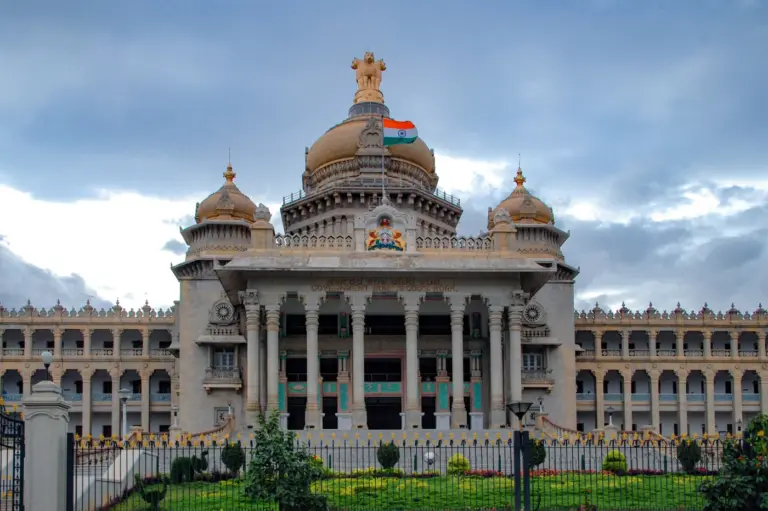
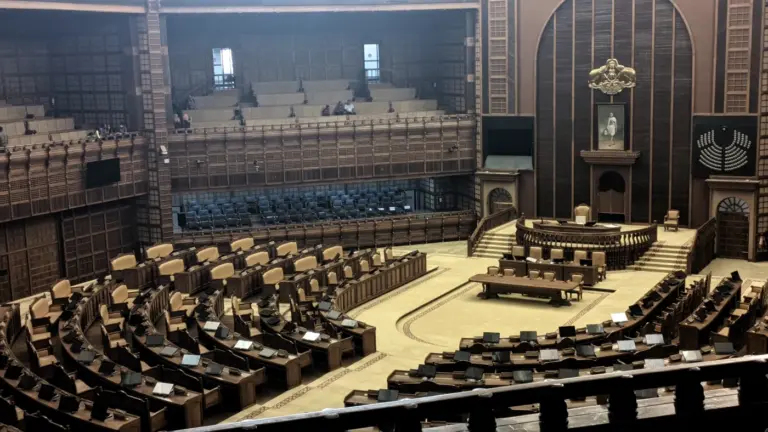
Constitution Day of India, or Samvidhan Divas, is observed every year on 26 November to commemorate the adoption of the Constitution of India by the Constituent Assembly in 1949. The day honours the framers of the Constitution, celebrates democratic values, and recommits the nation to the ideals enshrined in the Preamble — Justice, Liberty, Equality, and Fraternity.
This guide covers the history of the day, its formal declaration, constitutional timeline, key figures, celebrations, and UPSC relevance.
Why 26 November
The date marks a specific constitutional milestone:
- 26 November 1949 — the Constituent Assembly adopted the Constitution of India.
- 26 January 1950 — the Constitution came into force, giving birth to the Republic.
The adoption date was chosen to honour the long drafting process that culminated on this day, while 26 January was separately chosen as Republic Day to honour the Purna Swaraj declaration of 1930.
Official Declaration as Constitution Day
Though the date was long remembered as Law Day or National Law Day by the Bar Council of India since 1979, it became a formal national observance only in 2015.
- On 19 November 2015, the Ministry of Social Justice and Empowerment issued a gazette notification declaring 26 November as Constitution Day.
- The declaration coincided with the 125th birth anniversary year of Dr B.R. Ambedkar, Chairman of the Drafting Committee.
- The first Constitution Day was celebrated on 26 November 2015.
- Prior to this, 26 November had been observed informally as Law Day.
The Making of the Constitution — Key Dates
| Date | Event |
|---|---|
| 9 December 1946 | First session of Constituent Assembly |
| 13 December 1946 | Nehru moved Objectives Resolution |
| 29 August 1947 | Drafting Committee formed under Dr B.R. Ambedkar |
| 4 November 1948 | Draft Constitution presented to the Assembly |
| 26 November 1949 | Constitution adopted and signed |
| 26 January 1950 | Constitution came into force |
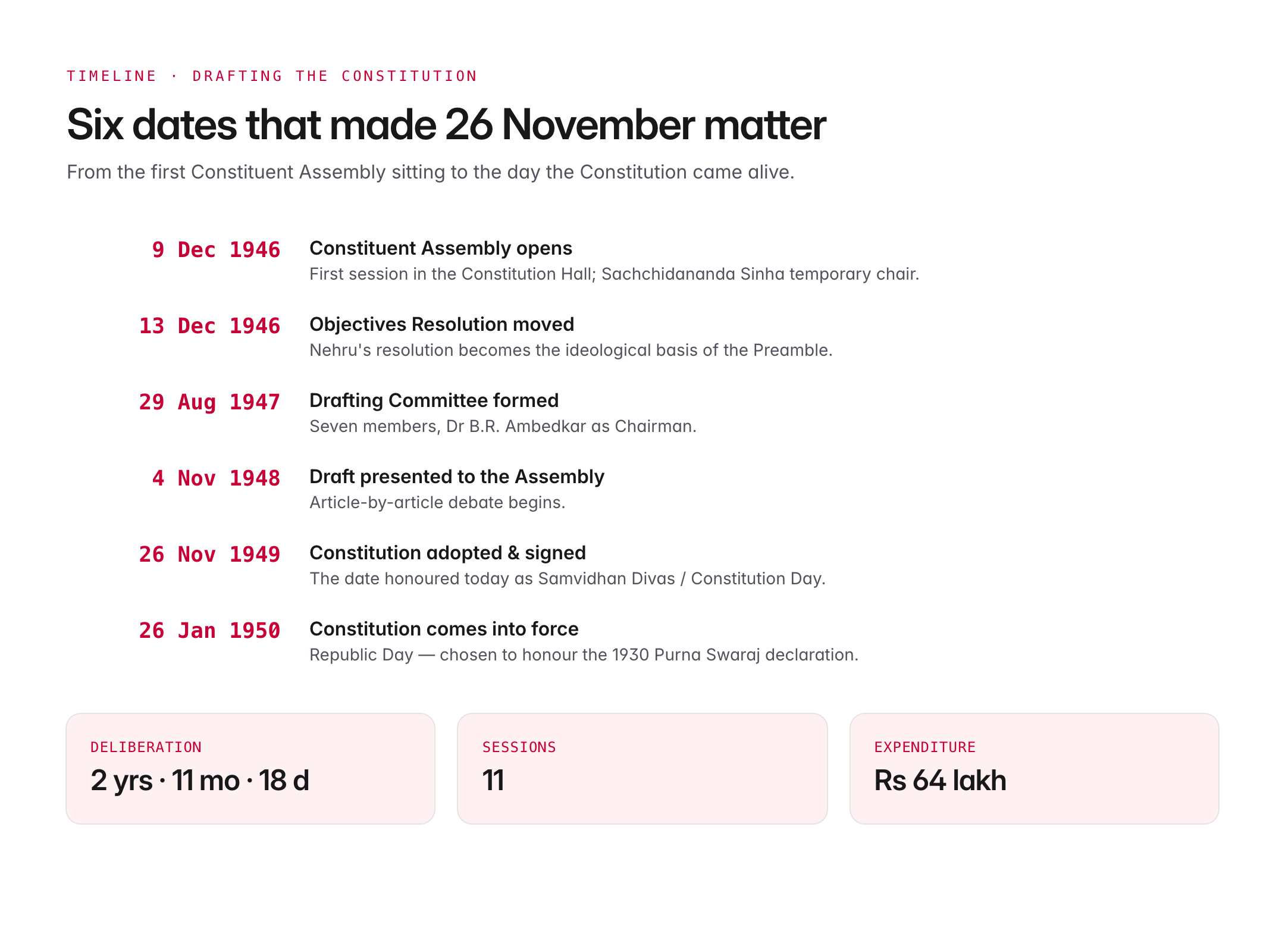
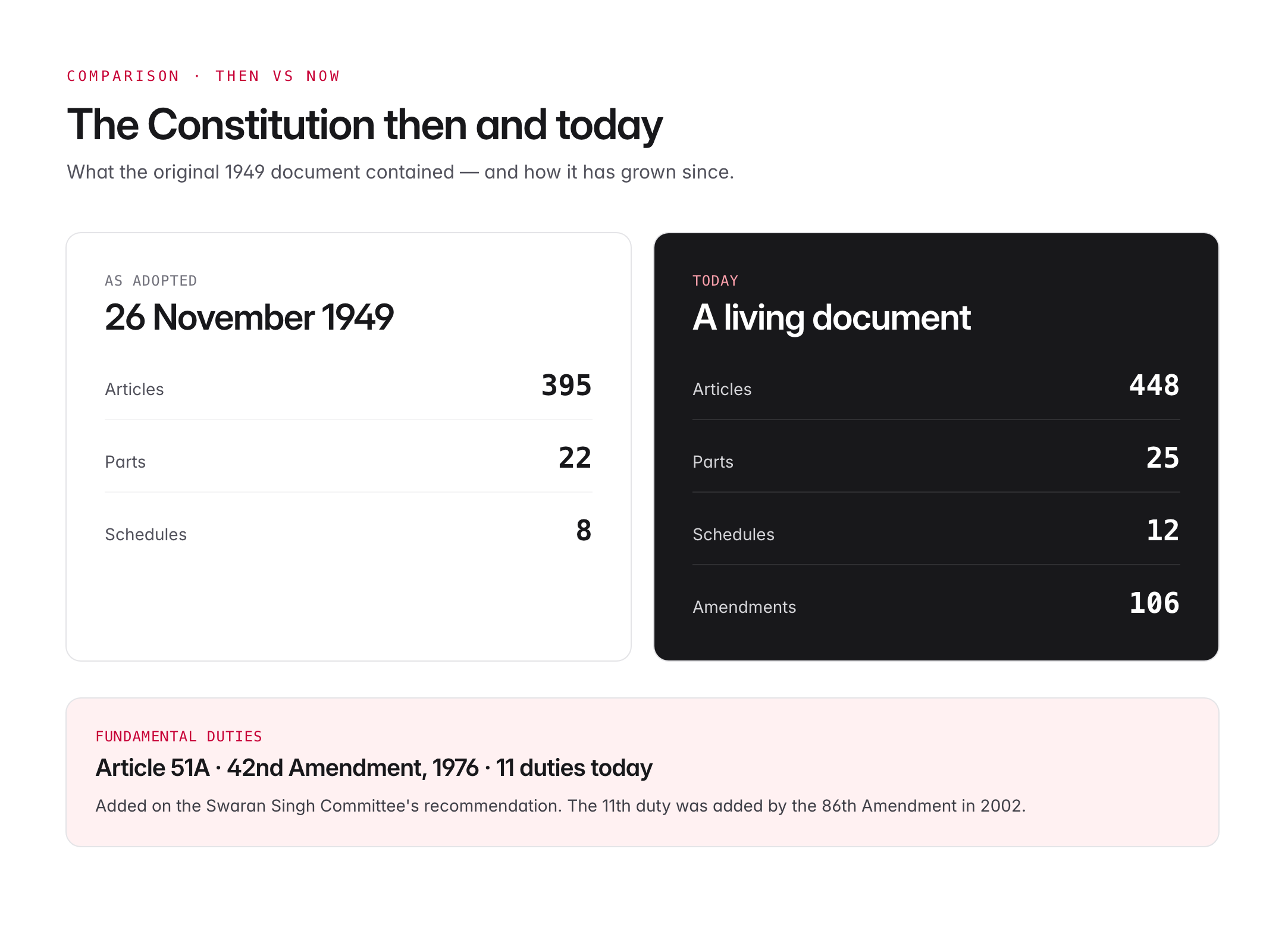
The Constituent Assembly held 11 sessions over 2 years, 11 months, and 18 days, spending approximately Rs 64 lakh in drafting. The final document originally contained 395 articles in 22 parts and 8 schedules and today has 448 articles across 25 parts and 12 schedules after amendments.
Key Figures
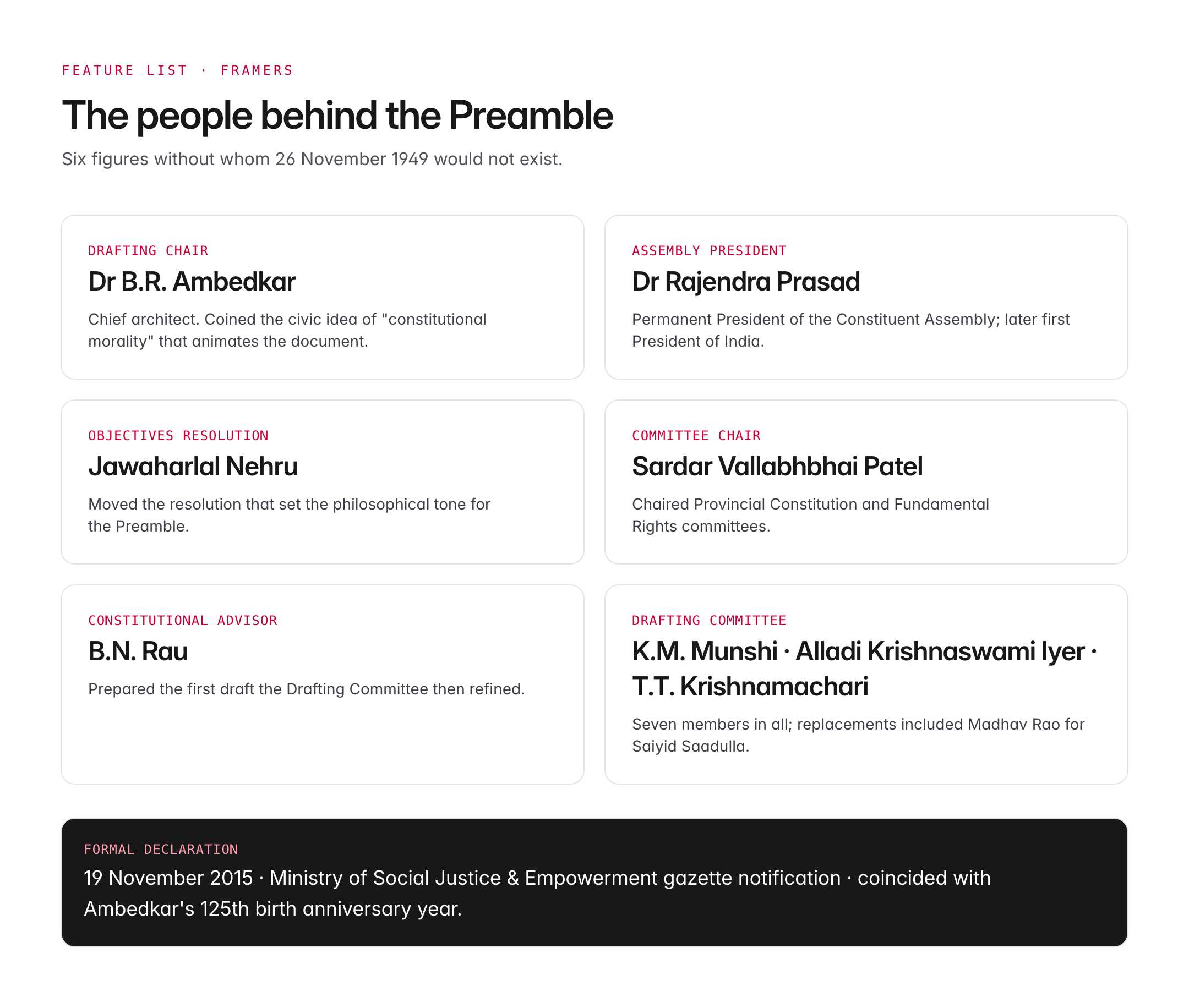
- Dr B.R. Ambedkar — Chairman of the Drafting Committee; widely regarded as the chief architect of the Constitution.
- Dr Rajendra Prasad — President of the Constituent Assembly; later first President of India.
- Jawaharlal Nehru — Moved the Objectives Resolution that became the basis of the Preamble.
- Sardar Vallabhbhai Patel — Chaired key committees including Provincial Constitution and Fundamental Rights.
- B.N. Rau — Constitutional Advisor; prepared the first draft.
- H.V. Kamath, Frank Anthony, K.M. Munshi, Alladi Krishnaswami Iyer, T.T. Krishnamachari — other prominent drafters.
The Drafting Committee had seven members in total. Notable is that one — B.L. Mitter — resigned early, and members like Madhav Rao replaced Saiyid Mohammad Saadulla, illustrating the ongoing composition of the committee.
Objectives of Constitution Day
As per the Ministry of Social Justice's notification, Constitution Day aims to:
- Create awareness of the constitutional values.
- Spread knowledge about the role of the Constitution in citizens' lives.
- Honour the contributions of the framers, especially Dr B.R. Ambedkar.
- Promote the fundamental duties under Article 51A.
- Strengthen democratic culture and constitutional morality.
How Constitution Day Is Celebrated
Typical observances across the country include:
- Reading of the Preamble in schools, colleges, courts, and government offices.
- Joint session addresses by the President and special sittings in Parliament.
- Online quizzes on the Constitution by MyGov and related platforms.
- Essay, debate, and moot court competitions by universities and Bar Councils.
- Special Supreme Court events and release of commemorative publications.
- Reaffirmation of Fundamental Duties by civil servants and students.
In 2020, Prime Minister Narendra Modi launched the Digital Sansad app on Constitution Day. In 2024, during the 75th year celebrations, a special joint session of Parliament was held commemorating three quarters of a century since adoption.
Constitution Day and Fundamental Duties
Constitution Day is closely linked to Article 51A — Fundamental Duties, added by the 42nd Amendment in 1976 on the recommendation of the Swaran Singh Committee. One of the 11 Fundamental Duties (the 11th added by the 86th Amendment in 2002) is "to abide by the Constitution and respect its ideals and institutions, the National Flag and the National Anthem."
Recent Themes and Events
- 2020: Parliamentary event marking 70 years of the Republic in the shadow of the pandemic.
- 2022: PM inaugurated the Constitution Day celebrations at the Supreme Court, urging a citizens' duties movement.
- 2024: Opening of 75-year commemorations (Amrit Mahotsav of Samvidhan) with a commemorative coin and special joint session of Parliament.
- 2025: Continued focus on constitutional literacy and regional language translations of the Constitution.
Significance for Citizens
Constitution Day is not just ceremonial. It reminds citizens that:
- The Constitution is a living document — amended 106 times so far.
- Rights come paired with duties.
- Constitutional morality — a phrase Ambedkar used — is a civic virtue beyond mere legality.
- Democracy's survival depends on public engagement with constitutional values.
UPSC Relevance
Prelims angle: Know the exact date the Constitution was adopted (26 November 1949) and came into force (26 January 1950). Remember that Constitution Day was declared in 2015 by the Ministry of Social Justice and Empowerment. Know the Drafting Committee Chairman (Ambedkar), Constituent Assembly President (Rajendra Prasad), and the length of deliberations (2 years, 11 months, 18 days).
Mains GS II angle: Use Constitution Day as an anchor for answers on constitutional morality, Ambedkar's vision, Fundamental Duties, the Preamble's values, and evolving constitutional amendments. Link to debates on basic structure, judicial activism, and citizen participation in governance.
PYQ angle:
- "What was the exact constitutional status of India on 26 January 1950?" (Mains 2021)
- "How have the recommendations of the 14th Finance Commission of India enabled the states to improve their fiscal position?" — broader constitutional context.
- Prelims MCQs frequently test Constituent Assembly committees, chairmen, and key dates.
Constitution Day content blends factual recall with value-based analytical writing — master both.
Tell Google you want more of this.
Add Anantam IAS as a preferred sourceOne tap, and this site shows up more often in your own Top Stories, AI Overviews and AI Mode. Remove it any time.