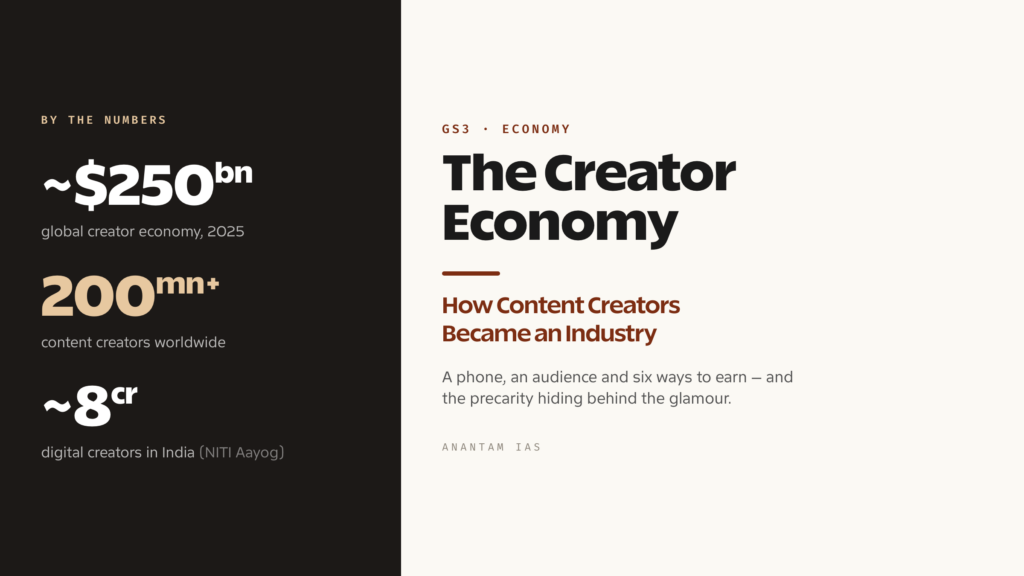
A few years ago, “what do you want to be when you grow up?” started getting a new answer in Indian homes — not doctor or engineer, but YouTuber. It was easy to laugh off. It is much harder to laugh off now. The thing those children are pointing at has quietly hardened into an industry worth roughly a quarter of a trillion dollars worldwide, employing or part-employing more than 200 million people who make a living, or part of one, by filming, writing, drawing, singing and talking into a camera. In May 2025, when the Prime Minister stood on a stage in Mumbai and called this the dawn of India’s “Orange Economy,” he was not flattering a hobby. He was naming a sector.
For a UPSC aspirant, the creator economy is one of those modern topics that sits across half the syllabus at once. It is a question of the economy and employment in GS Paper 3, of society and changing aspirations in GS1, of consumer protection and regulation in GS2, and of technology and platforms throughout. The trouble is that most aspirants know it only as a vibe — phones, reels, influencers — without the figures, the business models or the policy debate that turn a vibe into an answer. So here is the whole thing laid out: what the creator economy actually is, how the money flows, why the work is far shakier than it looks, how India is trying to govern it, and why the government has suddenly decided it is strategic.
What the Creator Economy Is and How Big It Has Grown
Start with a clean definition, because examiners reward one. The creator economy is the set of individuals who earn an income by making content — video, audio, writing, art, photography — and building a direct audience on digital platforms, and the businesses that have grown up to serve them. The key word is direct. A creator does not need a film studio, a newspaper or a record label standing between them and the public. A phone, an internet connection and a platform are enough to reach millions, and that collapse of the old gatekeepers is the whole revolution in a sentence.
The scale is genuinely hard to picture. Estimates from research firms put the global creator economy somewhere around $250 billion in 2025 — Precedence Research pegs it at about $254 billion, others a little lower — and almost everyone expects it to keep compounding at over 20 per cent a year toward the trillions within a decade. The headcount is just as striking: more than 200 million people worldwide now describe themselves as content creators, though only a small fraction earn a full-time living from it. Most are part-timers, hobbyists and side-hustlers, which is itself an important fact about the shape of this economy.
India sits near the centre of the story, not the edge. By NITI Aayog’s own reckoning, the country had around 8 crore — 80 million — digital creators as of 2024, one of the largest such populations on earth, powered by cheap data, a mobile-first internet and the short-video boom that followed. Narrow that to people doing it with real intent, and industry reports like the Kofluence Influencer Marketing Report 2025 count roughly 3.5 to 4.5 million active content creators. They feed an influencer-marketing market estimated at around ₹3,000 to ₹3,500 crore and growing at about 25 per cent a year — small against the overall economy, but expanding faster than almost anything around it, and disproportionately influential over what Indians buy, watch and believe.
How Creators Actually Make Money
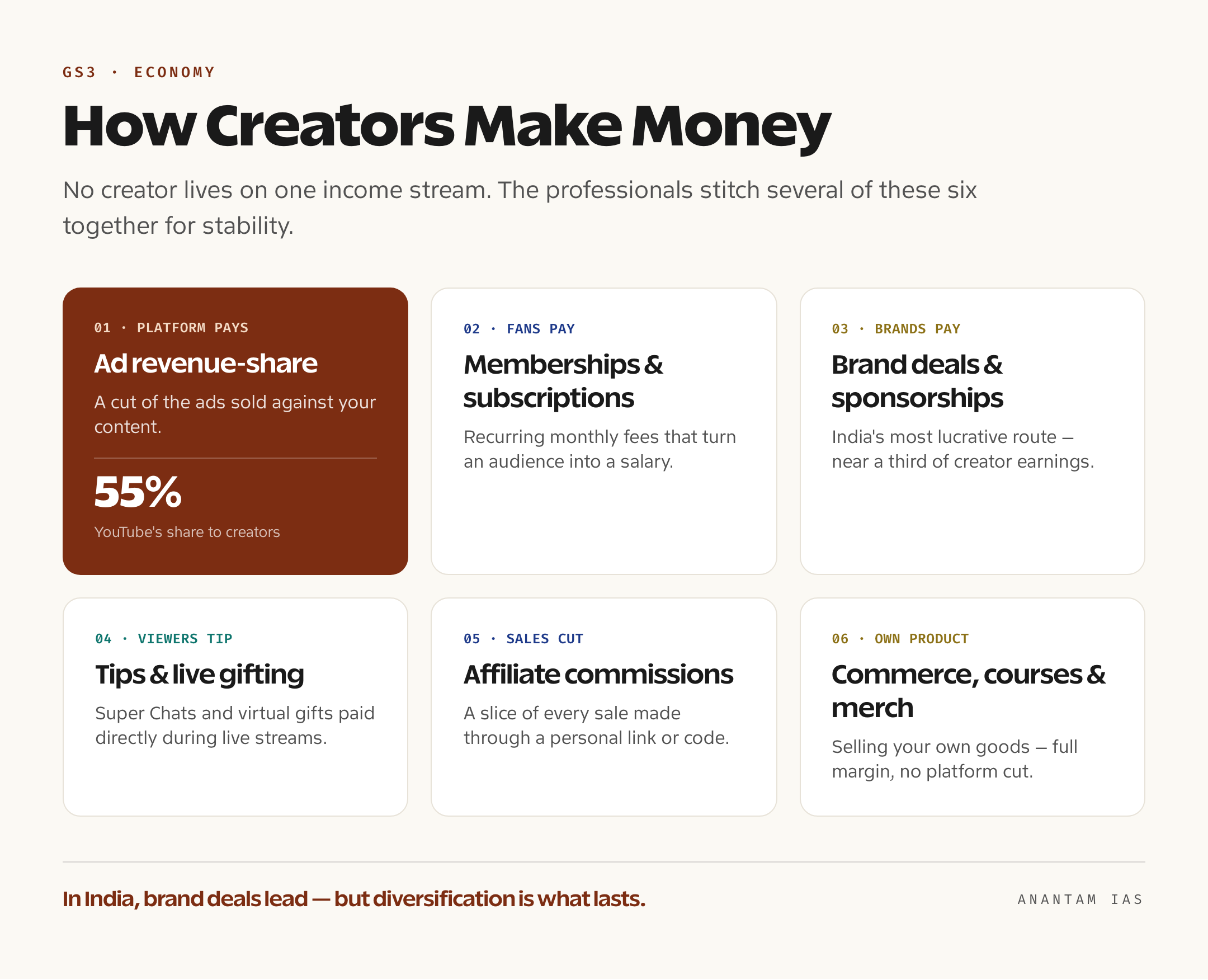
This is where most coverage goes vague and a good answer gets specific. Creators do not have one income stream; the successful ones stitch together several, and knowing the menu is what separates an informed answer from a hand-wave. There are roughly six ways the money arrives.
The oldest is advertising revenue-share. A platform sells ads against a creator’s content and hands back a cut — YouTube’s Partner Programme, for instance, gives creators a 55 per cent share of the ad revenue on standard videos. This is measured in RPM, the revenue per thousand views, and in India it is sobering: long-form video typically earns somewhere between ₹50 and a few hundred rupees per thousand views, with only high-value niches like finance and technology reaching the upper end. Second come memberships and subscriptions — fans paying a recurring monthly fee for exclusive content or community access, the model that turns an audience into a predictable salary. Third are brand deals and sponsorships, where a company pays a creator to feature its product; in India this is the single most lucrative route, estimated at nearly a third of creator earnings, which is exactly why “influencer marketing” and “creator economy” are so often used as synonyms here.
The remaining three round out the picture. Tips and live gifting — Super Chats, Super Thanks, virtual gifts during live streams — let viewers pay creators directly in real time. Affiliate commissions pay a creator a slice of every sale made through their personal link or discount code. And commerce, courses and merchandise let creators sell their own products outright — a cookbook, an online class, a clothing line, a paid newsletter — capturing the full margin instead of a platform’s cut. Behind all of this has grown a whole layer of infrastructure: creator funds that pay out cash, talent agencies and influencer-marketing platforms that match brands to creators, and a new wave of fintech built specifically to lend to, insure and pay people whose income is lumpy and platform-dependent. The creator is now a small business, with all the plumbing a small business needs.
The Labour Reality: Precarity Behind the Glamour
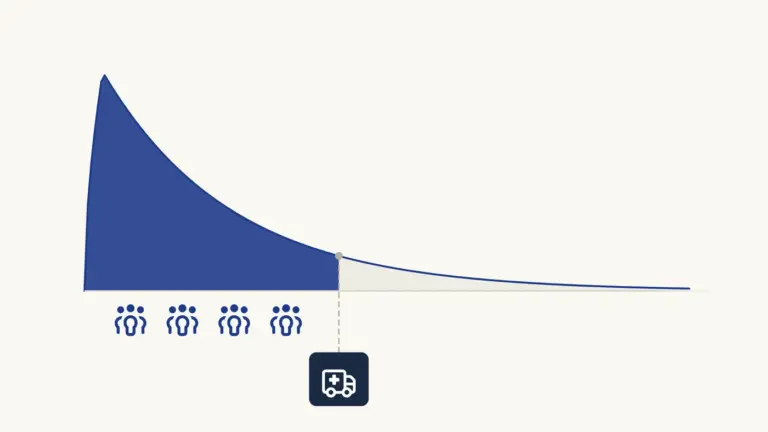
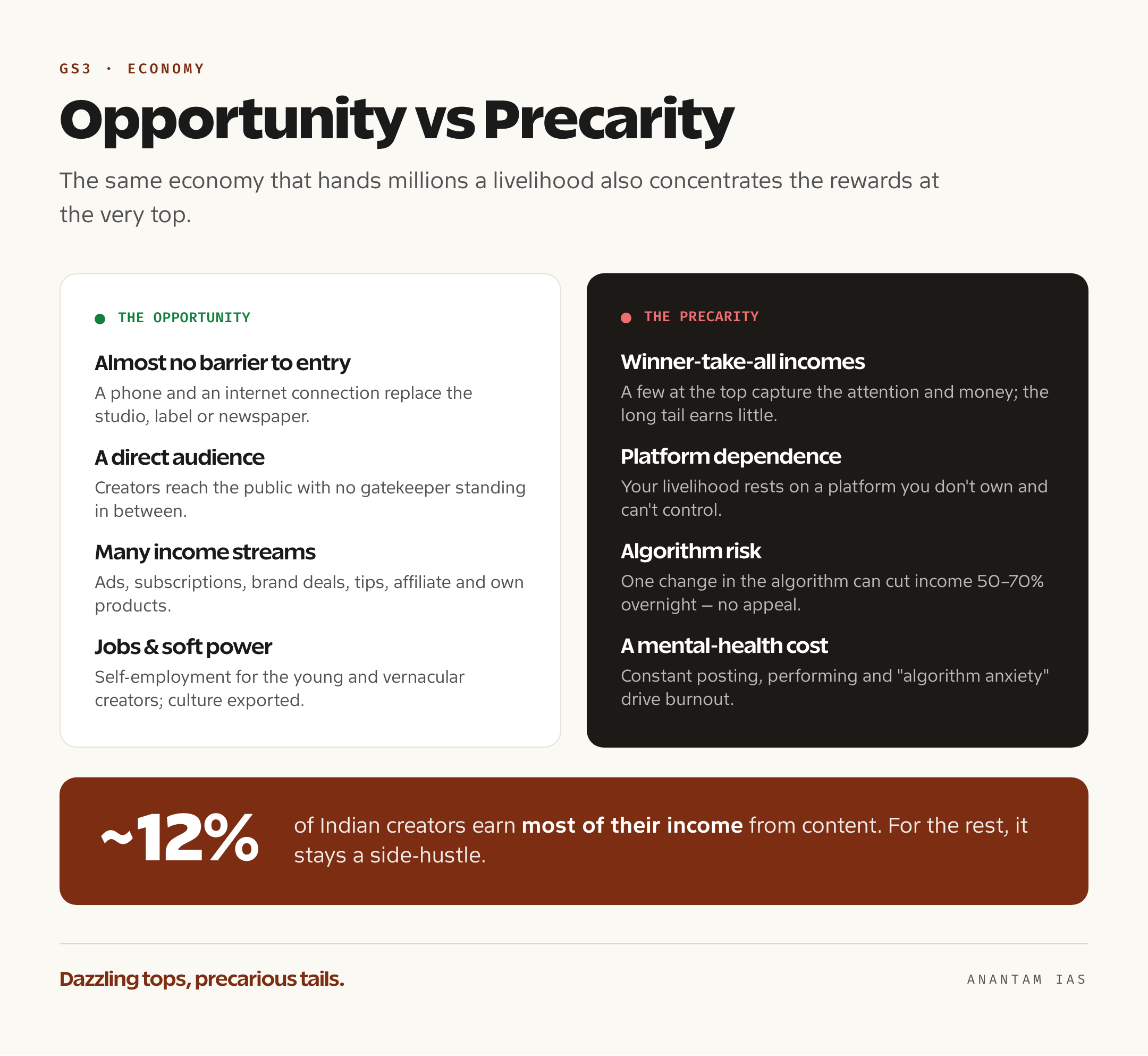
For all the talk of empowerment, the creator economy hides a hard labour story, and the candidate who sees it writes the more mature answer. Begin with the income distribution, because it is brutally uneven. This is a winner-take-all — or winner-take-most — market, in which a tiny fraction of creators at the top capture the overwhelming share of attention and money, while the long tail earns very little. Industry surveys repeatedly find that only around 12 per cent of Indian creators earn most of their income from content, and globally a large majority of even mid-sized creators make below a living wage once costs are counted. The dream is sold as middle-class self-employment; the maths often delivers a hobby that doesn’t pay rent.
The deeper problem is platform dependence. A creator’s entire livelihood usually rests on a single platform they do not own and cannot control. When that platform tweaks its algorithm, changes its payout rates or shifts its policies, a creator’s income can swing 50 to 70 per cent overnight, with no warning, no negotiation and no appeal. This is sometimes called “algorithm anxiety” — the constant, exhausting uncertainty of working for an invisible boss whose rules can change at any moment. It echoes the central complaint of the wider gig economy in India: the worker carries all the risk while the platform sets all the terms. The creator is, in the language of labour studies, a platform-dependent entrepreneur — free in name, dependent in practice.
Then there is the human cost, which is no longer anecdotal. The pressure to post constantly, to chase the algorithm, to perform a curated life and to absorb public criticism takes a measurable toll on mental health; burnout is now one of the most discussed problems among creators themselves. Against this bleak picture, the writer Kevin Kelly’s idea of “1,000 true fans” offers the constructive counter-argument and is worth keeping ready: a creator does not need to go viral or please millions, the theory runs, but only to find a thousand genuine fans willing to pay meaningfully each year — a deliberately small, loyal, paying audience that frees the creator from the tyranny of mass reach. It is the most quoted prescription for building a sustainable creator business rather than a fragile viral one, and it maps neatly onto the wider shift toward skill-and-output-based work that the no-collar economy describes. The creator economy, in other words, is where the new world of flexible, individualised, platform-mediated work shows both its promise and its sharpest edges at once.
Regulating the Creator Economy: Disclosure, Finfluencers and “De-Influencing”
As money and influence have flowed into creators, so has the attention of the regulator — and India has moved faster than most. The core problem regulation tries to fix is simple: when a creator recommends a product, viewers often cannot tell whether it is honest enthusiasm or paid promotion. So the first pillar is disclosure. The Advertising Standards Council of India, ASCI, issued influencer-advertising guidelines requiring any creator posting a paid or material-connection promotion to clearly label it as an advertisement — and the label must be prominent and hard to miss, not buried in hashtags. The rules are specific: in a short video the disclosure must stay on screen for a set minimum, and in longer videos it must remain visible for the duration the brand is discussed. These guidelines have teeth because they sit alongside the Consumer Protection Act, 2019 and its rules against misleading advertising and unfair trade practices, under which the Central Consumer Protection Authority can act against deceptive endorsements.
The second, sharper front is financial influencers — “finfluencers.” When creators began handing out stock tips and investment advice to millions of followers, the market regulator stepped in. Through 2024 and into 2025, SEBI tightened the screws: in FAQs issued on 29 January 2025 it barred its regulated entities — brokers, mutual funds, registered advisers — from associating with unregistered finfluencers, cutting off the money pipeline that funded unlicensed stock advice. ASCI, for its part, updated its guidelines in April 2025 to draw a careful line for health and finance creators: sharing general information needs no licence, but offering specific technical advice does — a finfluencer giving investment advice must be SEBI-registered and disclose that registration number. The principle is that influence carrying real financial risk demands real accountability.
A third dynamic is cultural rather than legal: “de-influencing,” a creator-led backlash in which influencers tell their audiences not to buy overhyped products — a sign that the audience’s trust, once endlessly exploited, has become a resource creators must now protect to survive. Taken together, these threads point to the broad direction of travel: an economy that grew up ungoverned is being pulled, sector by sector, under the ordinary rules of advertising, consumer protection and financial regulation.
India’s Strategic Bet: The Orange Economy
The most telling recent development is that the Indian state has stopped treating the creator economy as a curiosity and started treating it as strategy. The turning point was the World Audio Visual and Entertainment Summit — WAVES — held in Mumbai and concluding on 4 May 2025, where the government formally embraced the “Orange Economy”: the umbrella term for creative industries built on culture, content and intellectual property, spanning film, music, gaming, design and digital media. The Prime Minister framed WAVES as the dawn of that Orange Economy and pitched India as a global creative hub, with the summit drawing over 10,000 delegates, 1,000 creators and participants from more than 90 countries.
The intent came with institutions and money, which is what makes it serious rather than ceremonial. The government announced a Creative Economy fund reported at around $1 billion to back the sector, set up the Indian Institute of Creative Technology as a national centre of excellence, launched the “Create in India” challenge to surface new talent, and floated a broader All India Initiative on Creative Economy. This builds on an earlier symbolic move: the first-ever National Creators Award, presented by the Prime Minister on 8 March 2024 across 20 categories — covering storytelling, education, social change, the environment and more — which drew about 1.5 lakh nominations and signalled that the state now saw creators as cultural and economic assets worth courting.
Why the sudden embrace? Because the creator economy hits several of India’s priorities at once. It is a fast-growing source of self-employment in a country desperate for jobs, especially for young people and for vernacular creators reaching audiences in dozens of Indian languages — the real engine of the short-video boom. It is soft power, projecting Indian culture, cinema and storytelling to the world. And it is a way to capture value from the country’s vast youthful, online population before global platforms capture it all instead. The strategic bet is that creativity can be an export industry — that the Orange Economy can do for the 2020s what software services did for India in the 2000s.
For Your Mains Answer
This is a high-value, multi-paper topic. It maps most directly onto GS Paper 3 — the Indian economy, employment, growth and development, and the role of technology and platforms. But it also serves GS Paper 2 through consumer protection and the regulation of advertising and financial advice (ASCI, the Consumer Protection Act, SEBI), and GS Paper 1 through changing social aspirations and the nature of work. It is, on top of that, a ready-made example for an Essay on technology, work, youth or the future of jobs. The marks come from doing what this article does: pairing a few exact figures with a clear-eyed balance of opportunity and precarity, and always landing the India angle.
How to Build the Answer
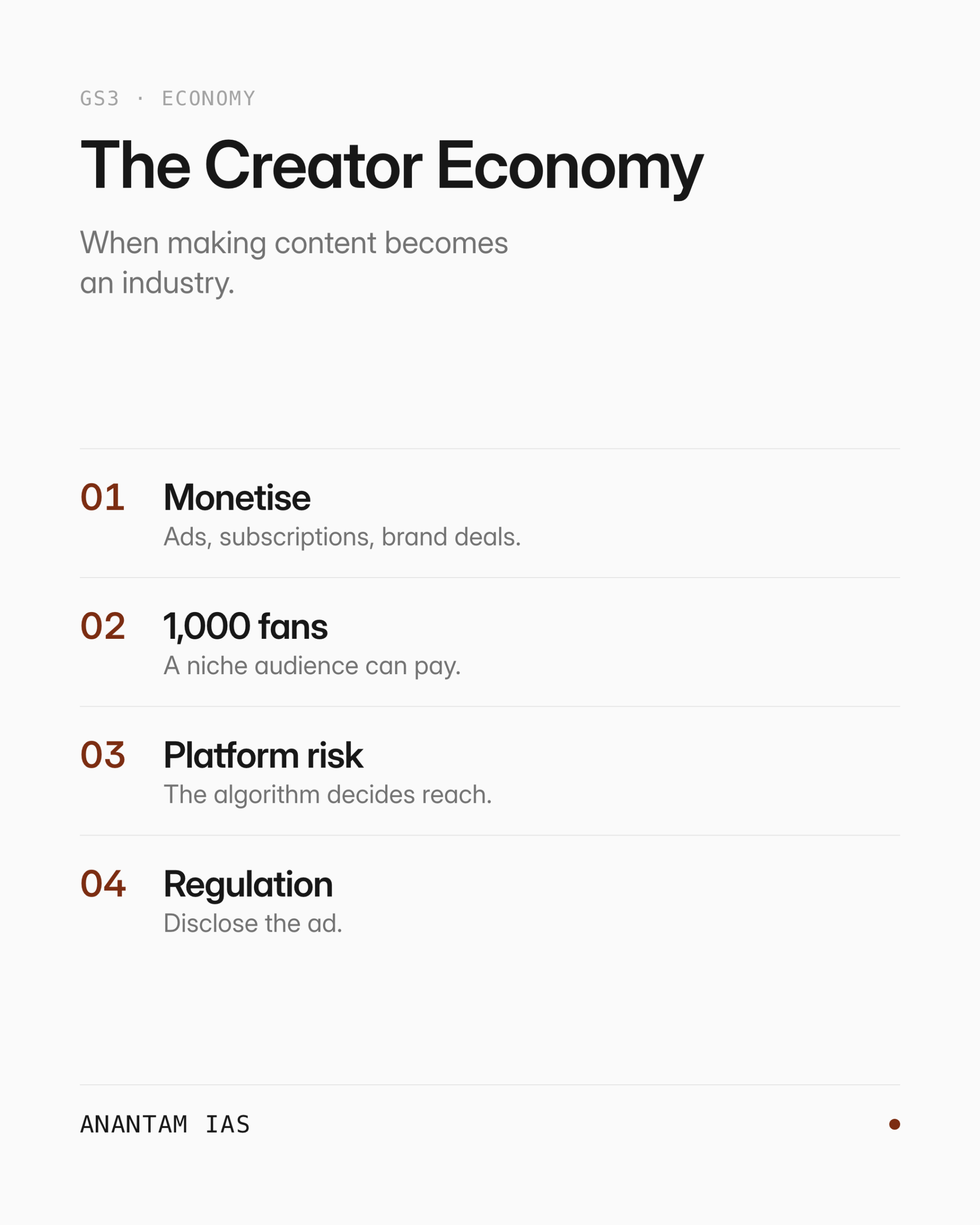
Move in a logical arc. Define the creator economy (direct creator-to-audience content as a livelihood) and size it (≈$250 billion globally, 200 million-plus creators; India among the largest with up to 4.5 million active creators and a ₹3,500-crore influencer market). Explain how the money flows (the six monetisation models). Then turn the coin over: the precarity — winner-take-all incomes, platform dependence, algorithm risk, mental-health cost. Bring in regulation (ASCI disclosure, the Consumer Protection Act, SEBI on finfluencers). Close on India’s strategic response (the Orange Economy, WAVES 2025, the National Creators Award) and a balanced verdict. Define, size, monetise, critique, regulate, position — that arc fits almost any version of the question.
Common Mistakes to Avoid
Don’t write it as a celebration — examiners reward the candidate who sees the precarity behind the glamour, so the winner-take-all and platform-dependence points are non-negotiable. Don’t confuse the 8-crore figure (anyone who posts) with the few million who earn from it; the gap is the analysis. Don’t treat “influencer marketing” as the whole creator economy — it is one revenue stream, the biggest in India, but not the definition. And don’t forget the regulatory and government-policy dimensions; an answer that stops at “phones and reels” leaves half the marks on the table.
A Compact Answer Spine
Creator economy = individuals earning by making content for a direct audience on platforms → global ≈$250 bn, 200 mn+ creators; India ≈8 cr digital creators (NITI Aayog), ~3.5-4.5 mn active, ₹3,500-cr influencer market growing ~25% → six income models (ad-share, subscriptions, brand deals, tips, affiliate, commerce) → but winner-take-all, platform-dependent, algorithm-risk, mental-health cost (only ~12% earn most income from it) → regulation: ASCI disclosure + Consumer Protection Act + SEBI on finfluencers (Jan 2025) → India’s strategic bet: the Orange Economy, WAVES 2025, ~$1 bn fund, National Creators Award → verdict: real opportunity and soft power, but needs worker-style protections and trust.
Diagram or Flowchart Idea
Draw a simple two-column box: on the left, “Opportunity” (low entry barrier, direct audience, multiple income streams, soft power, jobs); on the right, “Precarity” (winner-take-all, platform/algorithm dependence, income volatility, mental health). A single arrow at the bottom labelled “Regulation + Orange Economy policy” pointing toward “sustainable creator economy.” This one visual captures the whole balanced argument and is quick to sketch.
A Balanced-Conclusion Line
A line that lands the marks: “The creator economy has democratised who gets to be heard and seen, turning a phone into a livelihood for millions — but until platform dependence and winner-take-all incomes are matched by disclosure norms, worker-style protections and genuine diversification, it will remain an economy of dazzling tops and precarious tails. India’s Orange Economy push is the right instinct; its test will be whether it protects the many creators, not just celebrates the few.”
How to Use Data Without Cramming
You need only a handful of anchors, not a spreadsheet: ≈$250 billion (global size), 200 million-plus (global creators), ≈8 crore (India’s digital creators, NITI Aayog), ~3.5-4.5 million (India’s active creators) feeding a ~₹3,500-crore influencer market, 55 per cent (YouTube’s ad-revenue share), and the policy markers — WAVES 2025 and SEBI’s January 2025 finfluencer curbs. Attribute them plainly — “by NITI Aayog’s reckoning,” “the Kofluence 2025 report estimated” — rather than scattering numbers loose.
Frequently Asked Questions
What is the creator economy in simple terms?
It is the economy built around individuals who earn a living, or part of one, by making content — video, audio, writing, art, photography — and building a direct audience on digital platforms, plus the businesses that serve them. The defining feature is that creators reach the public directly, without a studio, newspaper or record label as gatekeeper. Globally it is worth roughly $250 billion and involves over 200 million creators; India has one of the largest creator bases in the world.
How do content creators actually make money?
Through roughly six streams, usually combined: advertising revenue-share (a platform pays a cut of ad money — YouTube gives creators 55 per cent on standard videos), memberships and subscriptions (recurring fan payments), brand deals and sponsorships (the most lucrative route in India), tips and live gifting (Super Chats and virtual gifts), affiliate commissions (a cut of sales via their links), and selling their own products — courses, merchandise, paid communities. The professionals diversify across several of these rather than depending on any single one.
Why is the creator economy considered precarious work?
Because income is hugely unequal — a winner-take-all market where a few at the top earn most while the long tail earns little; only around 12 per cent of Indian creators make most of their income from content. And because creators depend on platforms they don’t control: a change in the algorithm or payout rates can cut their income 50-70 per cent overnight, with no appeal. The constant pressure to post and perform also carries a real mental-health cost, which is why “algorithm anxiety” and burnout are now central concerns.
How is India regulating influencers and finfluencers?
On three fronts. ASCI’s influencer guidelines require any paid or sponsored post to carry a clear, prominent advertisement label, backed by the Consumer Protection Act, 2019 against misleading endorsements. For “finfluencers” giving financial advice, SEBI in January 2025 barred its regulated entities from associating with unregistered ones, and ASCI’s April 2025 update requires those giving specific financial advice to be SEBI-registered and disclose their registration number. Meanwhile the government has embraced the sector strategically as the “Orange Economy,” anchored by the WAVES summit in May 2025.
Practice Questions
Prelims MCQs
- The term “Orange Economy,” recently used by the Government of India, refers to which of the following?
(a) The economy built around agriculture and horticulture exports
(b) The creative economy — industries built on culture, content and intellectual property such as film, music, gaming and digital media
(c) The informal cash economy in semi-urban areas
(d) The economy of renewable solar energy
Answer: (b) The Orange Economy, also called the creative economy, covers creative and cultural industries built on intellectual property; the government framed it as central to the creator economy at the WAVES 2025 summit. - The WAVES Summit 2025, associated with India’s creative and creator economy, stands for which of the following?
(a) Web And Virtual Economy Standards
(b) World Audio Visual and Entertainment Summit
(c) Wireless Audio Video Education System
(d) World Arts, Vernacular and Education Society
Answer: (b) WAVES is the World Audio Visual and Entertainment Summit, held in Mumbai and concluding on 4 May 2025, where the government promoted the Orange Economy. - With reference to the regulation of “finfluencers” in India, which statement is correct?
(a) Finfluencers are entirely unregulated in India
(b) SEBI has barred its regulated entities from associating with unregistered finfluencers, and those giving specific financial advice must be SEBI-registered
(c) Only the RBI regulates finfluencers
(d) Finfluencers must register with the Election Commission
Answer: (b) In FAQs issued in January 2025, SEBI restricted its regulated entities from associating with unregistered finfluencers, and ASCI guidelines require those offering specific financial advice to be SEBI-registered and disclose their number. - Which body issues the influencer-advertising guidelines that require creators to clearly label paid promotions as advertisements in India?
(a) The Reserve Bank of India
(b) The Telecom Regulatory Authority of India
(c) The Advertising Standards Council of India (ASCI)
(d) The Press Council of India
Answer: (c) ASCI issues the influencer-advertising guidelines requiring prominent disclosure of paid or material-connection promotions, reinforced by the Consumer Protection Act, 2019. - The “winner-take-all” feature often cited as a problem in the creator economy refers to which of the following?
(a) A tax that takes most of a creator’s income
(b) The fact that a small fraction of top creators capture the overwhelming share of attention and earnings, while most earn very little
(c) A rule that only one creator can win a platform’s creator fund
(d) The dominance of a single platform over all others
Answer: (b) The creator economy is a winner-take-all (or winner-take-most) market where income is concentrated among a few top creators while the long tail earns little — only around 12 per cent of Indian creators earn most of their income from content.
Mains Practice Questions
- “The creator economy has democratised who gets to be heard, but not who gets to earn.” Critically examine this statement in the context of India’s growing creator base. (15 marks, 250 words)
- Discuss the major ways in which content creators monetise their work, and analyse why platform dependence makes the creator economy a precarious form of employment. (15 marks, 250 words)
- Examine the rationale and the key measures behind India’s regulation of influencers and “finfluencers.” How do consumer protection and financial-market integrity intersect in this domain? (15 marks, 250 words)
- What is the “Orange Economy,” and why has the Government of India chosen to back it strategically? Evaluate its potential as a source of employment and soft power. (10 marks, 150 words)
- The creator economy reflects the broader shift toward platform-mediated, individualised work. Discuss its opportunities and risks, and suggest measures to make it more secure and trustworthy. (15 marks, 250 words)
Tell Google you want more of this.
Add Anantam IAS as a preferred sourceOne tap, and this site shows up more often in your own Top Stories, AI Overviews and AI Mode. Remove it any time.