For most of the last century, you could place a worker by their collar. White collar meant an office, a desk and knowledge work; blue collar meant a factory floor, a tool and physical labour; and the line between them carried a whole hierarchy of pay, status and respect. That sorting system is now quietly falling apart. A software developer prompts an AI to write half her code while a delivery rider runs an algorithm-managed business from a two-wheeler, a welder reads a tablet schematic, and a college dropout out-earns graduates by editing video on a phone. The label that’s emerging for this messy new world is the no-collar economy — a model of work where the old collar divide blurs and a job is defined less by where you sit or what you wear, and more by the skills you have and the tasks you can do.
This isn’t just a Western buzzword for India to watch from the sidelines. It lands on the most important economic fact about this country — that India has the world’s largest working-age population and a closing window to put it to productive use. So the no-collar shift is really a question about whether India’s demographic dividend turns into jobs or into frustration. It sits at the crossroads of artificial intelligence, the gig economy, the skilling debate and the new labour codes, and for a UPSC aspirant it ties several scattered GS3 themes into one clean, current story.
What “No-Collar” Actually Means
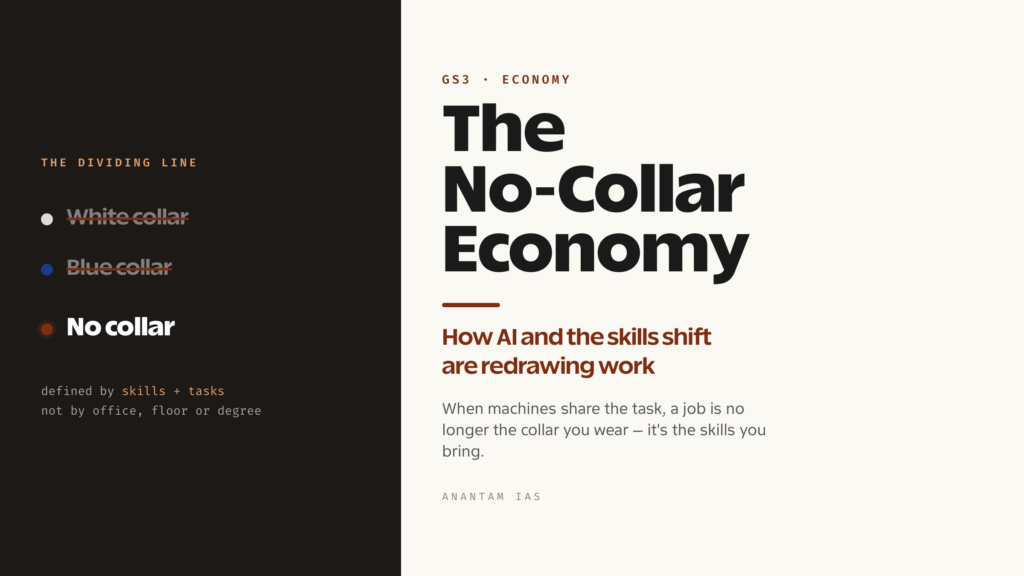
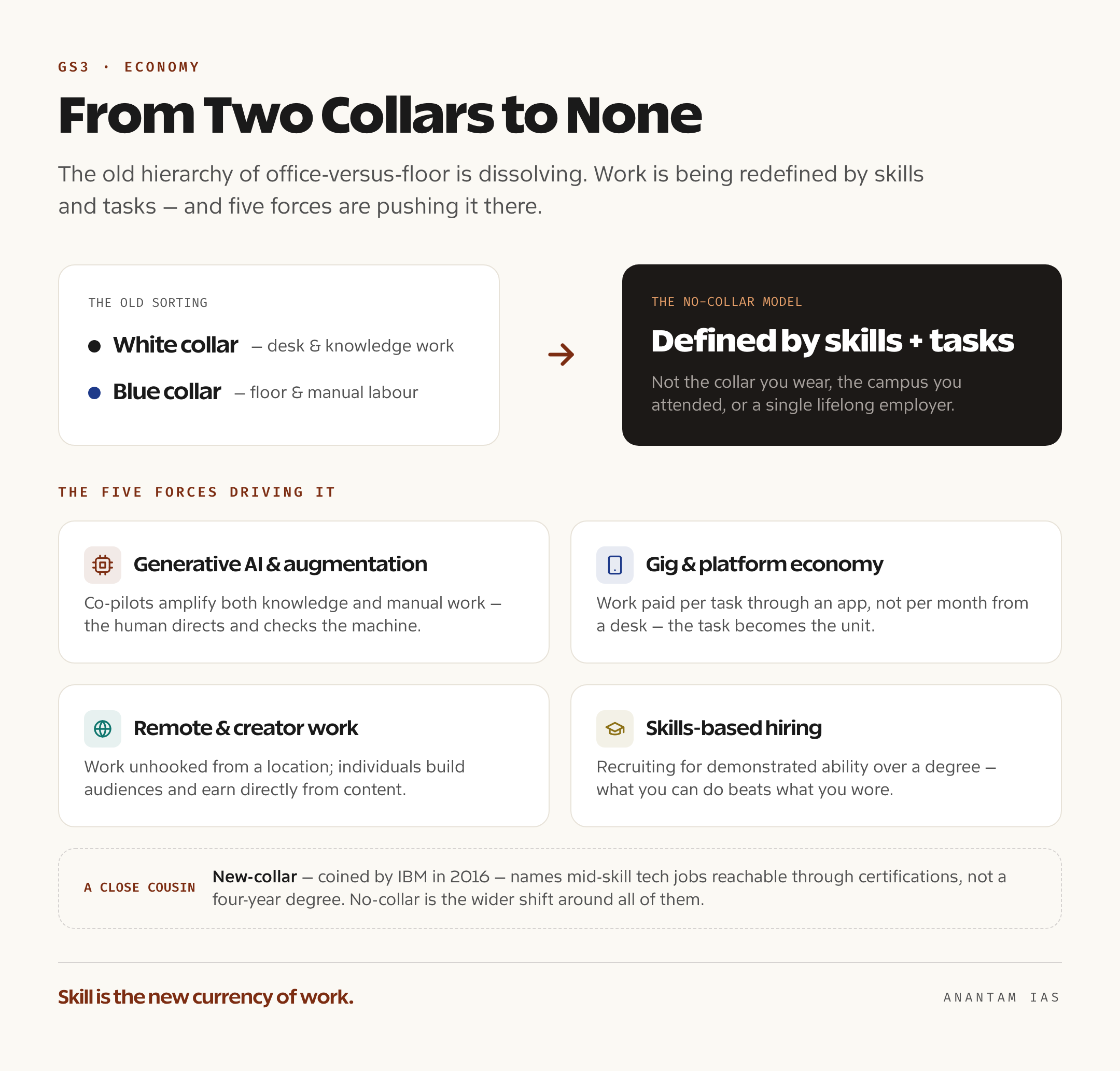
Start with the words, because the collar metaphor is older than people think. “White collar” and “blue collar” were coined in the early twentieth century to separate clerical and managerial workers — who wore white dress shirts — from manual workers in sturdy blue work clothes. For a hundred years that two-box system mostly held. “No-collar” is the claim that the boxes no longer describe how value is actually created. The idea is that automation and AI are pulling apart the bundle we used to call a “job” into a set of tasks, some done by humans and some by machines, and that the human’s worth now rests on a portfolio of skills rather than on a collar, a uniform or even a fixed employer.
A close cousin of the term is “new-collar,” and it’s worth keeping the two distinct because examiners love a clean distinction. “New-collar” was coined by IBM’s then-CEO Ginni Rometty back in November 2016, in an open letter that argued for mid-skill technology jobs — cybersecurity analysts, cloud-support technicians, application developers — that need real technical skill but not necessarily a four-year college degree. New-collar is about a specific tier of jobs reachable through certifications, apprenticeships and bootcamps instead of expensive degrees. No-collar is the broader cultural and economic shift around all of them: the dissolving of the collar hierarchy itself, where what you can do beats what you wore or which campus stamped your CV. IBM put its money where its mouth was — by the early 2020s, less than half of its US job openings required a degree, down from about 95 per cent a few years earlier.
So the no-collar economy is best understood as three changes happening at once. Work is being defined by tasks and skills rather than titles. The boundary between knowledge work and manual work is thinning, because AI tools now sit in both. And the link between a worker and a single, lifelong employer is loosening, as gig platforms, freelancing and the creator economy turn many people into one-person businesses. None of these is brand new on its own. What’s new is that they’ve fused into a single direction of travel.
The Forces Driving the Shift
The biggest engine is generative AI and the rise of human-AI collaboration. When a tool like a large language model — software trained to generate text, code and images that you can read about in this explainer on generative AI and LLMs — can draft an email, debug a program or summarise a report, the knowledge worker’s job stops being “produce the output” and becomes “direct, check and improve the machine’s output.” The same logic is reaching manual work through co-pilots: AI-guided diagnostics for a mechanic, computer-vision quality checks for a machine operator, route-optimisation for a driver. The technical word here is augmentation — the AI doesn’t replace the worker so much as amplify them, which is exactly why the collar between “thinking” jobs and “doing” jobs is fading. Both kinds of worker now sit next to a machine that does part of the task.
The second force is the gig and platform economy, the system of short, on-demand assignments mediated by an app rather than a salaried post. A driver on a ride-hailing app, a cook on a cloud-kitchen platform, a designer taking projects on a freelancing marketplace — all are paid per task, not per month. You can read the full India picture in this guide to the gig economy in India, but the core point for the no-collar story is that platforms make the task, not the title, the unit of work. Stacked on top are remote and hybrid work, which broke the link between a job and a location after the pandemic and let a coder in Indore serve a client in California, and the creator economy, where individuals build audiences and earn directly from content. India already has more than 100 million content creators by industry estimates, and consulting firm BCG projects the creator economy could influence over a trillion dollars of consumer spending in the country by 2030.
The fourth force ties them together: skills-based hiring, the practice of recruiting for demonstrated ability rather than for a degree on paper. As AI churns the skill mix faster than universities can update syllabi, employers increasingly test what you can actually do. Surveys in 2025 found a large share of companies dropping degree requirements for key roles and weighting proven skills and work samples more heavily than formal education. For a country where a degree has long been the gatekeeper to a “respectable” job, that’s a quietly radical change — and the heart of why “no-collar” is more than marketing. When the collar and the certificate both stop deciding who gets hired, skill becomes the real currency of work.
What It Means for India’s Demographic Dividend
Now bring it home, because this is where the topic earns its GS3 marks. India’s central economic bet is the demographic dividend — the growth boost a country gets when a large share of its population is of working age, with relatively few dependents to support. India has the youngest big workforce in the world and a median age under thirty. But a dividend only pays out if those young people find productive work, and that’s exactly where India’s long-running anxiety about “jobless growth” — an economy that expands in output without creating proportionate jobs — bites hardest. The no-collar economy is, in one reading, a fresh route to absorb that workforce: gig platforms and skilling can create earning opportunities far faster than traditional formal-sector hiring ever did.
But the same shift cuts the other way, and a balanced answer must hold both edges. The overwhelming majority of India’s workers are already in the informal sector — roughly nine in ten, by most estimates — without written contracts, paid leave or a pension. The risk is that the no-collar economy simply rebrands that old informality with an app, dressing up precarious, benefit-free work as “flexibility” and “being your own boss.” A gig rider with no minimum wage, no health cover and an algorithm that can deactivate them overnight is not obviously better off than a factory hand with a union. And AI displacement is a genuine threat at the bottom: if co-pilots automate the routine parts of clerical and customer-service jobs, the very entry-level rungs that young Indians use to climb into the middle class could thin out. So the no-collar economy is neither salvation nor catastrophe for the dividend. It’s a high-stakes fork, and which path India takes depends almost entirely on policy and skilling.
Policy, Governance and the Risks Ahead
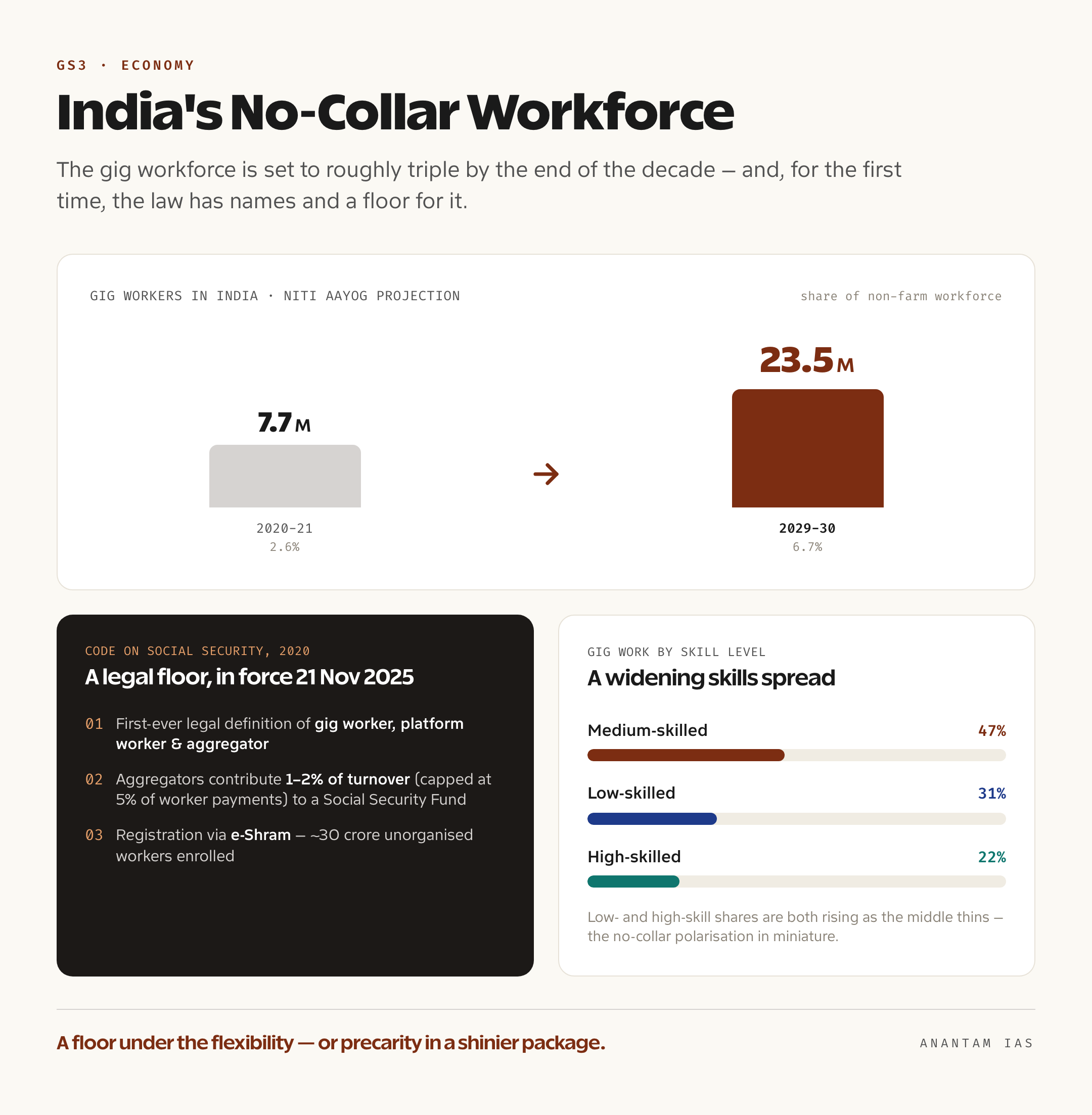
India’s policy machinery has, to its credit, started to catch up — and the centrepiece is the consolidation of twenty-nine old labour laws into four Labour Codes, which finally came into force on 21 November 2025. The most important of these for the no-collar story is the Code on Social Security, 2020, because it did something no Indian law had done before: it formally defined “gig worker,” “platform worker” and “aggregator.” A gig worker, in the Code’s language, is someone who earns outside the traditional employer-employee relationship; an aggregator is the digital marketplace — the app — that connects them to customers. By naming these workers in law, the Code drags them out of the legal grey zone and makes them eligible for state-backed protection for the first time. The other three codes — on Wages, on Industrial Relations, and on Occupational Safety, Health and Working Conditions — round out the framework, extending a statutory minimum wage and mandatory appointment letters to far more workers.
The Social Security Code’s signature mechanism is a funding rule: aggregators must contribute between 1 and 2 per cent of their annual turnover — capped at 5 per cent of what they pay gig workers — into a Social Security Fund for benefits like accident insurance, health cover and old-age protection. The delivery rail for all this is e-Shram, the national database of unorganised workers, which had crossed roughly 30 crore registrations by mid-2025 and added a dedicated aggregator module in December 2024 onto which a dozen major platforms — including Zomato, Swiggy, Uber, Ola, Amazon, Zepto and Urban Company — have been onboarded. You can read how this social-security architecture is meant to work in this deeper piece on social security for gig workers. Behind the protection sits the demand side: NITI Aayog’s landmark report, India’s Booming Gig and Platform Economy, projected the gig workforce would grow from about 7.7 million in 2020-21 to 23.5 million by 2029-30, roughly 6.7 per cent of the non-farm workforce — a near-tripling that makes getting the rules right urgent rather than academic.
The skilling response runs in parallel. Missions like Skill India and the NASSCOM-backed FutureSkills programme exist precisely to retrain workers for AI-era and new-collar roles, the certifications-and-apprenticeships path that lets someone reach a tech job without a four-year degree. But the risks are real and an honest answer names them. There’s precarity — income that swings week to week with no safety net. There are the gaps the new codes still have to plug, since defining a worker on paper isn’t the same as the contributions actually reaching them. There’s algorithmic management, where an opaque app sets your pay, your shifts and your fate with no human to appeal to — a new and barely regulated form of workplace power. There’s the inequality risk, that the no-collar economy rewards a small, highly skilled, AI-fluent elite while leaving low-skilled workers in a churn of insecure gigs. And there’s the displacement risk if reskilling can’t keep pace with automation. The no-collar economy, in short, is an opportunity India can only seize if it builds the floor of social security and skills underneath the flexibility — otherwise it just spreads informality in a shinier package.
For Your Mains Answer
This is a high-value, cross-cutting topic for GS Paper 3, which covers the Indian economy, employment, growth and development, the effects of technology on jobs, and the mobilisation of human resources. It also feeds GS Paper 2 on government policies and the welfare of vulnerable sections through the labour codes and social security, and it’s a ready-made Essay theme on technology and the future of work. The examiner reward here is the same skill this article uses: define the new term precisely, anchor it in India’s demographic and informality data, and judge it as an opportunity-and-risk fork rather than a one-sided cheer or lament.
How to Build the Answer
Open by defining the no-collar economy — work defined by skills and tasks, not collar or degree — and distinguish it from “new-collar” (the IBM mid-skill tier). Then lay out the forces in a chain: generative AI and augmentation, the gig and platform economy, remote and creator work, and skills-based hiring. Pivot to India: the demographic dividend, the jobless-growth and informality problem, and how no-collar work is both a route to absorb the workforce and a risk of rebranded precarity. Close with policy — the four Labour Codes and the Code on Social Security, 2020, e-Shram, NITI Aayog’s numbers, and skilling missions — and a verdict that the upside depends on building a social-security floor. That arc — define, distinguish, drivers, India stakes, policy, verdict — fits almost any framing of the question.
Common Mistakes to Avoid
Don’t treat “no-collar” and “new-collar” as the same thing — new-collar is a specific mid-skill tech tier (IBM, 2016); no-collar is the wider dissolving of the collar divide. Don’t frame AI as pure job destruction; the stronger point is augmentation reshaping both knowledge and manual work. Don’t celebrate gig flexibility without naming precarity, and don’t claim the labour codes have already solved social security — they define and enable it, but delivery is the open question. And don’t forget the informality backdrop: about 90 per cent of India’s workforce is already informal, which is what makes the precarity risk so sharp.
A Compact Answer Spine
No-collar economy = work defined by skills and tasks, not collar/degree → distinct from new-collar (IBM’s mid-skill tech jobs, 2016) → driven by generative AI/augmentation + gig platforms + remote/creator work + skills-based hiring → matters for India’s demographic dividend (youngest big workforce, median age under 30) but risks rebranding the ~90% informal economy as app-based precarity → policy: four Labour Codes (in force 21 Nov 2025), Code on Social Security 2020 defines gig/platform/aggregator, aggregators pay 1-2% of turnover into a Social Security Fund, e-Shram (~30 crore registered), NITI Aayog projects gig workers rising 7.7M → 23.5M by 2029-30 → verdict: opportunity only if the floor of social security and skilling is built under the flexibility.
Diagram or Flowchart Idea
Sketch the old two-box collar split (white-collar office, blue-collar floor) collapsing with an arrow into a single “no-collar” circle labelled skills + tasks, with five small inputs feeding it — AI, gig platforms, remote work, creator economy, skills hiring — and two outputs branching from it: “opportunity (jobs, flexibility)” and “risk (precarity, displacement).” This one visual carries the whole argument and is quick to draw.
A Balanced-Conclusion Line
A line that lands the marks: “The no-collar economy could turn India’s demographic dividend into its biggest asset — but only if the country builds a floor of social security and lifelong skilling under the new flexibility, so that work without a collar doesn’t quietly become work without protection.”
How to Use Data Without Cramming
You need only four anchors, not a spreadsheet: 7.7 million to 23.5 million gig workers by 2029-30 (NITI Aayog), the four Labour Codes in force from 21 November 2025, aggregators contributing 1-2 per cent of turnover to a Social Security Fund, and about 90 per cent of India’s workforce already informal. Attribute them plainly — “as NITI Aayog’s report projected” — and they read as authority, not clutter.
FAQ
What is the no-collar economy in simple terms? It’s an emerging model of work where the old divide between white-collar (office/knowledge) and blue-collar (manual) jobs blurs, and a person’s work is defined by their skills and the tasks they can do rather than by a dress code, a job title or even a single employer. It’s driven by AI that augments both kinds of work, by gig platforms that pay per task, by remote and creator work, and by employers hiring for skills instead of degrees.
How is “no-collar” different from “new-collar”? “New-collar” is a narrower term coined by IBM’s CEO Ginni Rometty in 2016 for mid-skill technology jobs — like cybersecurity or cloud roles — that need real skills but not a four-year degree, reachable through certifications and apprenticeships. “No-collar” is the broader shift around all such jobs: the dissolving of the collar hierarchy itself, where ability matters more than the collar or the credential.
Why does the no-collar economy matter for India specifically? Because India has the world’s largest working-age population and a closing window to employ it productively — its demographic dividend. No-collar work could absorb that workforce faster than traditional formal jobs, but it also risks rebranding India’s vast informal sector (about 90 per cent of workers) as app-based precarity. Whether it helps or hurts depends on social security and skilling.
What has India’s government done to protect no-collar and gig workers? The four Labour Codes came into force on 21 November 2025. The Code on Social Security, 2020 defined “gig worker,” “platform worker” and “aggregator” for the first time and requires aggregators to contribute 1-2 per cent of turnover to a Social Security Fund. Workers register on the e-Shram portal, which has crossed roughly 30 crore registrations, and skilling missions like Skill India and FutureSkills aim to retrain people for AI-era roles.
Practice Questions
Prelims MCQs
- The term “no-collar economy” is best described as which of the following?
(a) An economy with no formal employment laws
(b) A model of work defined by skills and tasks rather than the traditional white-collar versus blue-collar divide
(c) An economy dominated entirely by manual labour
(d) A sector where only AI systems are employed
Answer: (b) The no-collar economy refers to work defined by skills and tasks as the old collar hierarchy dissolves, driven by AI, gig platforms and skills-based hiring. - The term “new-collar jobs” was coined by which organisation, and what does it refer to?
(a) NITI Aayog, for informal-sector jobs
(b) The ILO, for remote-work roles
(c) IBM, for mid-skill technology jobs that need skills but not necessarily a four-year degree
(d) The World Bank, for green-economy jobs
Answer: (c) IBM’s CEO Ginni Rometty coined “new-collar” in 2016 for mid-skill tech roles reachable through certifications and apprenticeships rather than a college degree. - The Code on Social Security, 2020 is significant for gig and platform workers mainly because it
(a) bans the gig economy in India
(b) for the first time legally defines “gig worker,” “platform worker” and “aggregator” and provides for their social security
(c) guarantees every gig worker a government salary
(d) requires all gig workers to join trade unions
Answer: (b) The Code provided the first statutory definitions of gig and platform workers and aggregators, enabling state-backed social security for them. - Under the Code on Social Security, 2020, aggregators are required to contribute to a Social Security Fund at what rate?
(a) A flat 10 per cent of profits
(b) Between 1 and 2 per cent of annual turnover, capped at 5 per cent of payments to gig workers
(c) 25 per cent of each worker’s earnings
(d) No contribution is required
Answer: (b) Aggregators must contribute 1-2 per cent of annual turnover, capped at 5 per cent of the amount paid or payable to gig and platform workers. - According to NITI Aayog’s report on the gig and platform economy, the number of gig workers in India is projected to reach roughly what figure by 2029-30?
(a) 7.7 million
(b) 12 million
(c) 23.5 million
(d) 50 million
Answer: (c) NITI Aayog projected the gig workforce would rise from about 7.7 million in 2020-21 to 23.5 million by 2029-30, around 6.7 per cent of the non-farm workforce.
Mains Practice Questions
- “The no-collar economy redraws work around skills and tasks rather than collar or credential.” Discuss the forces driving this shift and examine what it means for India’s demographic dividend. (15 marks, 250 words)
- Generative AI is reshaping both knowledge work and manual work through augmentation rather than outright replacement. Critically analyse this claim with reference to the changing nature of jobs in India. (15 marks, 250 words)
- Examine how India’s four Labour Codes, particularly the Code on Social Security, 2020, attempt to extend protection to gig and platform workers. What gaps remain in delivering that protection on the ground? (15 marks, 250 words)
- Distinguish between “new-collar” and “no-collar” work, and discuss the role of skills-based hiring and skilling missions in preparing India’s youth for an AI-era labour market. (10 marks, 150 words)
- The no-collar economy risks rebranding India’s vast informal-sector precarity as digital flexibility. Evaluate this concern and suggest a way forward that balances flexibility with social security. (15 marks, 250 words)
Tell Google you want more of this.
Add Anantam IAS as a preferred sourceOne tap, and this site shows up more often in your own Top Stories, AI Overviews and AI Mode. Remove it any time.