Opens in a new tab
Join Anantam IAS Channel on Telegram

Daily Digest · Sunday

11 January 2026 Current Affairs for UPSC

2 current affairs published on Sunday, 11 January 2026

11 January 2026 Current Affairs for UPSC — every Why-in-News article AnantamIAS published on Sunday, 11 January 2026, broken down with Why in News?, the exact GS paper it feeds, sub-topic mapping, MCQ-ready facts and a UPSC-style practice question. 2 articles in total, covering Polity, Economy, Environment, S&T, IR, Geography, History, Society and Internal Security — the same Why-in-News + GS-paper-mapping + practice-question format the Compass uses across every daily digest on the site.

Daily current affairs for UPSC is where new material enters your prep stream. Read this 11 January 2026 digest end-to-end in 25–35 minutes, attempt the practice question at the foot of each article (it's MCQ for some, 10/15-marker for others), then bookmark the entries that fall inside your active revision window. Everything stays cross-linked: tap any subject pill to jump to that subject's hub, or use the table of contents above to skip straight to a specific story.

Use this page three ways. Read sequentially for a one-sitting scan of everything that mattered on 11 January 2026. Download the 11 January 2026 PDF below for offline study or print revision. Or use the January 2026 Current Affairs compilation to see this day in the month's full context. For the previous day's reading, see 10 January 2026 Current Affairs; the next day's is 12 January 2026 Current Affairs.

Why we publish daily current affairs separately from the monthly compilation: daily is learning, monthly is revision. Use the daily page to add fresh material to your notes the day it breaks; come back to the January 2026 compilation 60 days before Prelims when the noise has settled and only the lasting takeaway is worth re-reading.

India’s First Deep-Tech Startup Push: Funding the Hard-Technology Frontier

Open article →Download PDF

Why in News?

India’s deep-tech ecosystem is in focus as the National Deep Tech Startup Policy (NDTSP) framework — first proposed by a working group under the office of the Principal Scientific Adviser — moves toward implementation, and Tamil Nadu in January 2026 unveiled a state-first dedicated deep-tech startup policy.

The push targets startups built on hard science and engineering — artificial intelligence, quantum, biotech, space, semiconductors and advanced materials — that need long gestation periods, deep intellectual property (IP) and patient capital the regular venture market rarely supplies.

  • Deep-tech ventures commercialise frontier research and engineering, with R&D-heavy products, long timelines and defensible patents, unlike consumer-app or services startups.
  • The NDTSP framework proposes patient capital, shared R&D infrastructure, IP facilitation and stronger academia-industry linkages.
  • Tamil Nadu’s January 2026 policy is the first state-level deep-tech blueprint, with sector funds, lab access and incubation support.
  • It complements Startup India (2016) and the Anusandhan National Research Foundation (ANRF), the new apex body for funding research.
  • Anchored in the goal of technology sovereignty — owning, not just importing, critical frontier technologies.

The development matters in the context of:

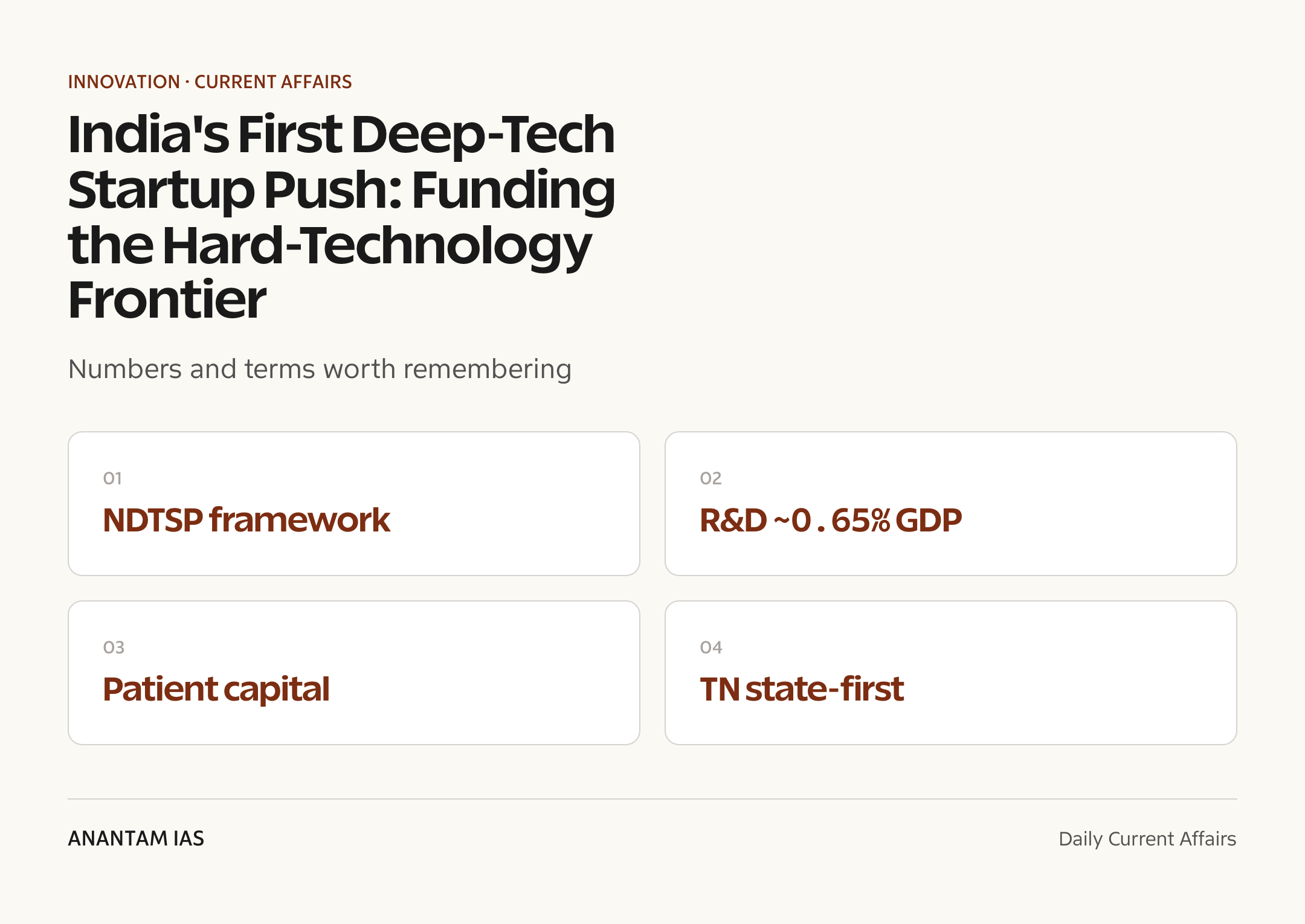
  • India’s gross expenditure on R&D is low at about 0.65% of GDP, well below peers like China, South Korea and the US.
  • Most Indian startup capital chases quick-return consumer and fintech models, leaving a funding gap for slow, capital-intensive deep tech.

Stylised rocket and lightbulb rising from a circuit board ringed by atom, DNA, microchip and satellite icons
Funding the hard-technology frontier — from lab science to frontier ventures Illustration: AI-generated (Freepik)
India's First Deep-Tech Startup Push: Funding the Hard-Technology Frontier — quick facts

UPSC Relevance

Prelims Relevance

  • NDTSP originated from a working group under the Principal Scientific Adviser, not the RBI or NITI Aayog
  • Deep-tech domains: AI, quantum, biotech, space, semiconductors, advanced materials, robotics
  • ANRF created by the Anusandhan National Research Foundation Act, 2023; subsumed the erstwhile SERB
  • Startup India launched 2016; DPIIT recognises eligible startups
  • India’s R&D spend is roughly 0.65% of GDP (GERD); private-sector share is comparatively low
  • Patient capital — long-horizon funding that tolerates delayed returns
  • India AI Mission, National Quantum Mission and India Semiconductor Mission as enabling sectoral programmes
  • Tamil Nadu’s 2026 deep-tech policy is the first sub-national dedicated framework

Mains Relevance

GS Paper 3

  • Why deep tech needs a distinct policy from a generic startup push — long gestation, IP intensity and patient-capital gap.
  • How NDTSP, ANRF, Startup India and sectoral missions fit together to build an innovation ecosystem.
  • R&D financing in India — the structural reasons GERD stays near 0.65% of GDP and how to lift private-sector spend.

GS Paper 2

  • Cooperative federalism in innovation policy — the role of state-led blueprints like Tamil Nadu’s deep-tech policy.

Essay

  • Technology sovereignty and the cost of importing the future.
  • Can patient capital be engineered, or must it be cultivated?

Background and Context

What deep tech means

Deep tech is defined by what it is built on, not by the app it ships.

  • Ventures that commercialise frontier science and engineering rather than business-model innovation.
  • Core domains span artificial intelligence, quantum technologies, biotech, space, semiconductors, advanced materials and robotics.
  • Marked by long gestation from lab to market, high upfront R&D cost and heavy reliance on patents and proprietary IP.
  • Products solve fundamental technical problems, so the moat is the technology itself, not just scale or marketing.
  • This profile makes deep tech high-risk for ordinary venture capital, which prefers faster, lighter returns.
India's First Deep-Tech Startup Push: Funding the Hard-Technology Frontier — exam lens

Why a dedicated policy was needed

India’s broader startup boom did not naturally fund the hard-technology frontier.

  • Startup India (2016) seeded a large startup base, but capital concentrated in consumer, e-commerce and fintech ventures.
  • Deep-tech founders face a funding gap — no revenue for years while the science matures, which deters short-horizon investors.
  • They also lack affordable access to expensive R&D infrastructure such as fabrication labs, testing rigs and compute.
  • Weak academia-industry translation leaves much publicly funded research stranded in journals rather than products.
  • A generic startup framework cannot fix these structural gaps, so a deep-tech-specific policy was proposed.

What the NDTSP framework proposes

The National Deep Tech Startup Policy is built around the bottlenecks unique to frontier ventures.

  • A patient-capital pool — long-horizon, risk-tolerant funding through dedicated funds and fund-of-funds support.
  • Shared R&D infrastructure — open access to national labs, testing facilities and prototyping centres so founders skip heavy capex.
  • IP facilitation — faster, cheaper patent filing and support so startups can protect and license their inventions.
  • Stronger academia-industry linkages and technology-transfer offices to move research from campus to company.
  • Sectoral focus areas, skilling support and a single-window approach to align the many existing schemes.

Where it sits in the ecosystem

NDTSP is an integrating layer over a set of existing programmes and bodies.

  • Startup India and DPIIT — the recognition, tax and ease-of-doing-business base for all startups.
  • Anusandhan National Research Foundation (ANRF) — the apex research-funding body created in 2023, which subsumed the Science and Engineering Research Board (SERB).
  • Sectoral missions — the India AI Mission, the National Quantum Mission and the India Semiconductor Mission supply demand and capability in specific frontiers.
  • Atal Innovation Mission incubators and academic tech-transfer cells feed the early-stage pipeline.
  • NDTSP tries to stitch these into one innovation ecosystem rather than scattered, overlapping schemes.

The Tamil Nadu first-mover

A state has moved ahead of the national rollout with its own deep-tech blueprint.

  • Tamil Nadu in January 2026 unveiled the first state-level deep-tech startup policy.
  • It proposes dedicated sector funds and co-investment to crowd in private patient capital.
  • It offers access to state and academic laboratories, prototyping facilities and incubation space.
  • It leverages the state’s strong manufacturing and engineering-talent base to anchor hardware deep tech.
  • It is a test of cooperative federalism — states tailoring innovation policy to local strengths ahead of a national template.

The R&D-financing backdrop

Deep-tech ambition runs into India’s long-standing under-investment in research.

  • India’s gross expenditure on R&D (GERD) is about 0.65% of GDP, far below China, South Korea, Israel and the US.
  • The private sector contributes a smaller share of R&D in India than in those economies, where firms drive most spending.
  • Public funding has historically dominated, channelled through agencies the ANRF now seeks to coordinate and scale.
  • Patient capital and shared infrastructure are partly an attempt to de-risk private R&D so corporates and funds invest more.
  • Without lifting overall R&D intensity, even a strong policy may struggle to sustain a deep-tech pipeline.

Significance and the critique

The stakes are strategic, but design and execution risks are real.

  • Deep tech underpins technology sovereignty — owning critical capabilities in AI, chips and quantum rather than importing them.
  • Domestic frontier ventures create high-skill jobs and reduce dependence on foreign IP and hardware.
  • But patient capital is hard to mandate; if funds chase faster exits, public money may end up carrying most of the risk.
  • Shared infrastructure and IP support can stall on bureaucratic access rules and slow patent processing.
  • Success needs sustained funding, real academia-industry translation and a rise in overall R&D intensity, not a one-time scheme.

Way Forward

Engineer genuine patient capital

  • Use blended finance and fund-of-funds support to crowd in private long-horizon money, not just public grants.
  • Tie incentives to deep-tech outcomes — patents, prototypes and revenue from frontier products.

Open the R&D base

  • Make access to national labs, fabs and compute simple, time-bound and affordable for startups.
  • Fund and staff technology-transfer offices so campus research reaches companies.

Lift R&D intensity

  • Push GERD decisively above the long-stuck 0.65% of GDP, with stronger private-sector spend.
  • Sequence NDTSP with ANRF and the sectoral missions so funding, research and demand reinforce one another.

Conclusion

India’s deep-tech turn recognises a hard truth — the startup boom that produced unicorns rarely funded the slow, IP-heavy science that decides technology sovereignty. The NDTSP framework and Tamil Nadu’s state-first policy go after the specific bottlenecks of frontier ventures: patient capital, shared R&D infrastructure, IP support and academia-industry translation.

The test will be whether the country can engineer genuine long-horizon capital and lift its R&D intensity above the long-stuck 0.65% of GDP. If it can, deep tech can move India from a buyer of frontier technology to a builder of it. If patient capital stays scarce and labs stay closed, the policy risks remaining ambition without a pipeline.

UPSC Practice Questions

Prelims MCQ 1

With reference to deep-tech startups and India’s innovation ecosystem, consider the following statements:

  1. Deep-tech ventures are typically characterised by long gestation periods and heavy intellectual-property intensity.
  2. The Anusandhan National Research Foundation (ANRF) was set up to coordinate and fund research and subsumed the Science and Engineering Research Board.
  3. The National Deep Tech Startup Policy is administered by the Reserve Bank of India.

How many of the above statements are correct?

(a) Only one (b) Only two (c) All three (d) None

Answer: (b) Only two

Explanation:

Statements 1 and 2 are correct. Statement 3 is wrong — the deep-tech policy framework emerged from a working group under the Principal Scientific Adviser and the startup-policy apparatus (DPIIT/Startup India), not the RBI.

Prelims MCQ 2

Which one of the following is NOT typically classified as a deep-tech domain?

(a) Quantum computing (b) Advanced materials (c) Food-delivery aggregation (d) Semiconductors

Answer: (c) Food-delivery aggregation

Explanation:

Food-delivery aggregation is a consumer business-model innovation, not deep tech. Quantum computing, advanced materials and semiconductors are frontier hard-technology domains built on deep science and engineering.

UPSC Mains Questions

  1. India’s startup boom produced scale but little frontier science. Examine why deep-tech ventures need a policy distinct from a generic startup push, and discuss how the National Deep Tech Startup Policy seeks to address their specific bottlenecks.
  2. Discuss how the National Deep Tech Startup Policy, the Anusandhan National Research Foundation and India’s sectoral technology missions can together build an innovation ecosystem. What role can state-led blueprints play in this effort?
  3. Technology sovereignty requires building, not buying, critical capabilities. Critically analyse this statement with reference to India’s low R&D intensity and its deep-tech financing challenge.

Sources: Department for Promotion of Industry and Internal Trade (DPIIT) and Press Information Bureau.

Frequently Asked Questions

What is a deep-tech startup?

A deep-tech startup commercialises frontier science and engineering rather than a new business model. Its products are built on hard technologies such as artificial intelligence, quantum, biotech, space, semiconductors or advanced materials. These ventures are defined by long gestation periods, high upfront R&D cost and heavy reliance on patents and proprietary intellectual property, which makes them harder to fund than consumer or services startups.

What is the National Deep Tech Startup Policy?

The National Deep Tech Startup Policy (NDTSP) is a framework, first proposed by a working group under the office of the Principal Scientific Adviser, to support hard-technology ventures. It focuses on the bottlenecks unique to deep tech — patient long-horizon capital, shared R&D infrastructure, faster intellectual-property facilitation and stronger academia-industry linkages — and seeks to align the many existing startup and research schemes into one ecosystem.

How is deep tech different from a normal startup?

A normal startup usually innovates on the business model — how a service is delivered or priced — and can reach the market quickly. Deep tech innovates on the underlying science and engineering, so its products take years to mature, demand expensive R&D infrastructure and depend on defensible patents. This profile creates a funding gap because ordinary venture capital prefers faster, lighter returns.

What is patient capital and why does deep tech need it?

Patient capital is long-horizon, risk-tolerant funding that accepts delayed returns while a technology matures. Deep-tech ventures may earn no revenue for years as the science is proven and prototypes are built. Without patient capital they cannot survive that gap, so the deep-tech policy push tries to engineer such funding through dedicated funds, fund-of-funds support and blended finance that crowds in private money.

How does the deep-tech push relate to ANRF and Startup India?

Startup India and DPIIT provide the recognition, tax and ease-of-business base for all startups. The Anusandhan National Research Foundation, created in 2023, is the apex body for funding and coordinating research and subsumed the earlier Science and Engineering Research Board. The deep-tech policy tries to integrate these with sectoral missions in AI, quantum and semiconductors so funding, research and demand reinforce one another.

Why is India’s R&D spending considered low?

India’s gross expenditure on research and development is about 0.65% of GDP, far below peers such as China, South Korea, Israel and the United States. A large share is public, with the private sector contributing less than in those economies, where firms drive most spending. This low R&D intensity is a core reason deep-tech ventures struggle for funding and why patient capital and shared infrastructure are seen as ways to de-risk private investment.
India-Fiji Agriculture Cooperation: Deepening Ties in the Pacific

Open article →Download PDF

Why in News?

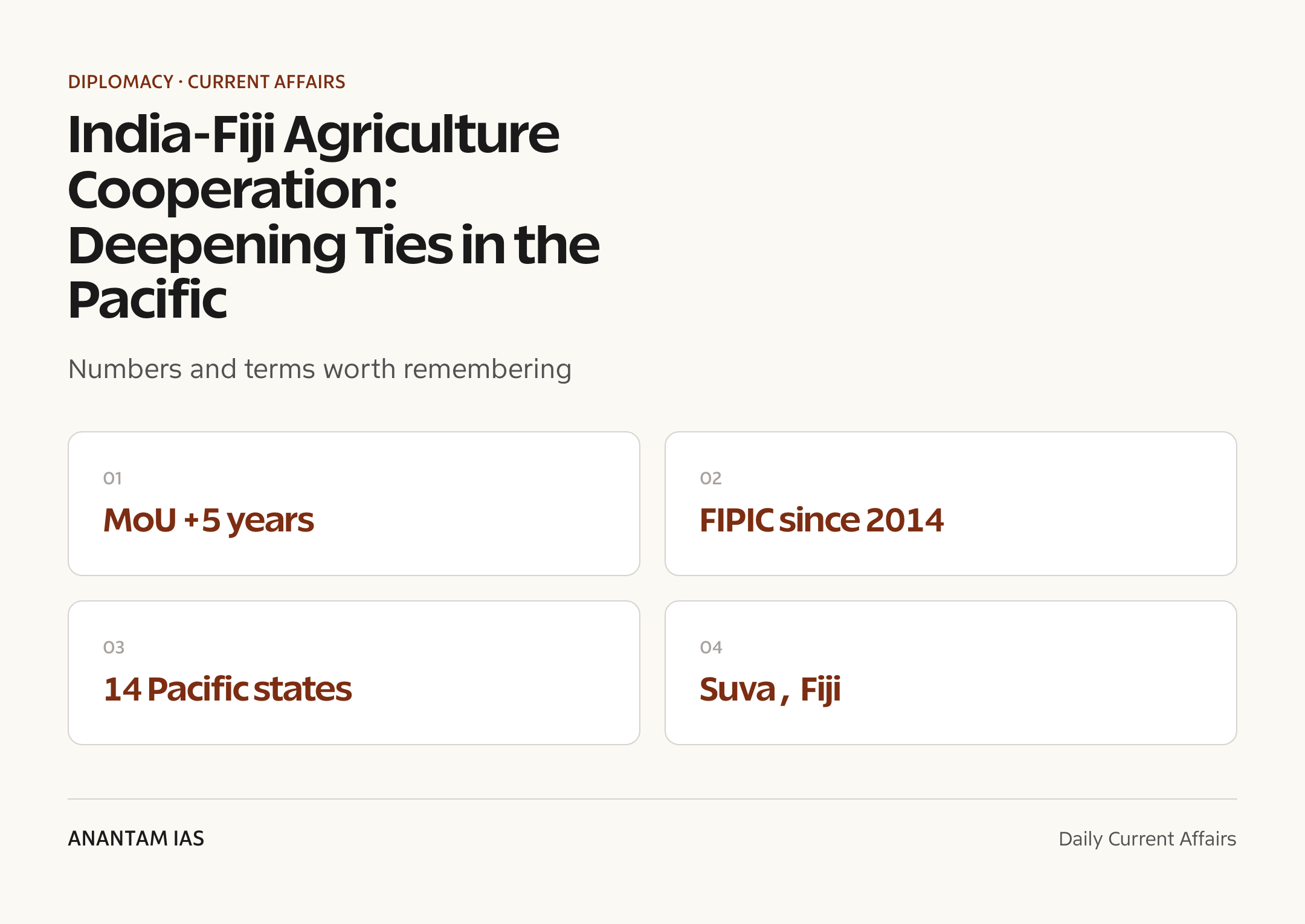
India and Fiji agreed to extend their existing agriculture-cooperation Memorandum of Understanding (MoU) for a further five years, renewing a partnership built around capacity building, crop diversification and farm mechanisation.

The renewal sits within the Forum for India-Pacific Islands Cooperation (FIPIC) and India’s wider Act East and Indo-Pacific outreach, where Pacific microstates and a large Indo-Fijian diaspora anchor a steadily warming relationship.

  • The two countries renewed an agriculture MoU for five years, covering capacity building, crop diversification and mechanisation.
  • Cooperation flows through the FIPIC platform that India launched in 2014 to engage 14 Pacific Island states collectively.
  • Fiji is the most populous Pacific Island nation and home to a sizeable Indo-Fijian community descended from indentured labour, giving the tie deep diaspora roots.
  • The partnership advances India’s development-partnership model — sharing low-cost, replicable agri-technology rather than extractive financing.
  • It signals solidarity with the Global South and Small Island Developing States (SIDS) facing food-security and climate stress.

The development matters in the context of:

  • Pacific Island states are courted by major powers, so India’s capacity-first approach is a quiet contrast to debt-heavy alternatives.
  • Agriculture is central to Fiji’s economy and food security, making the MoU a high-impact, low-cost lever of influence.
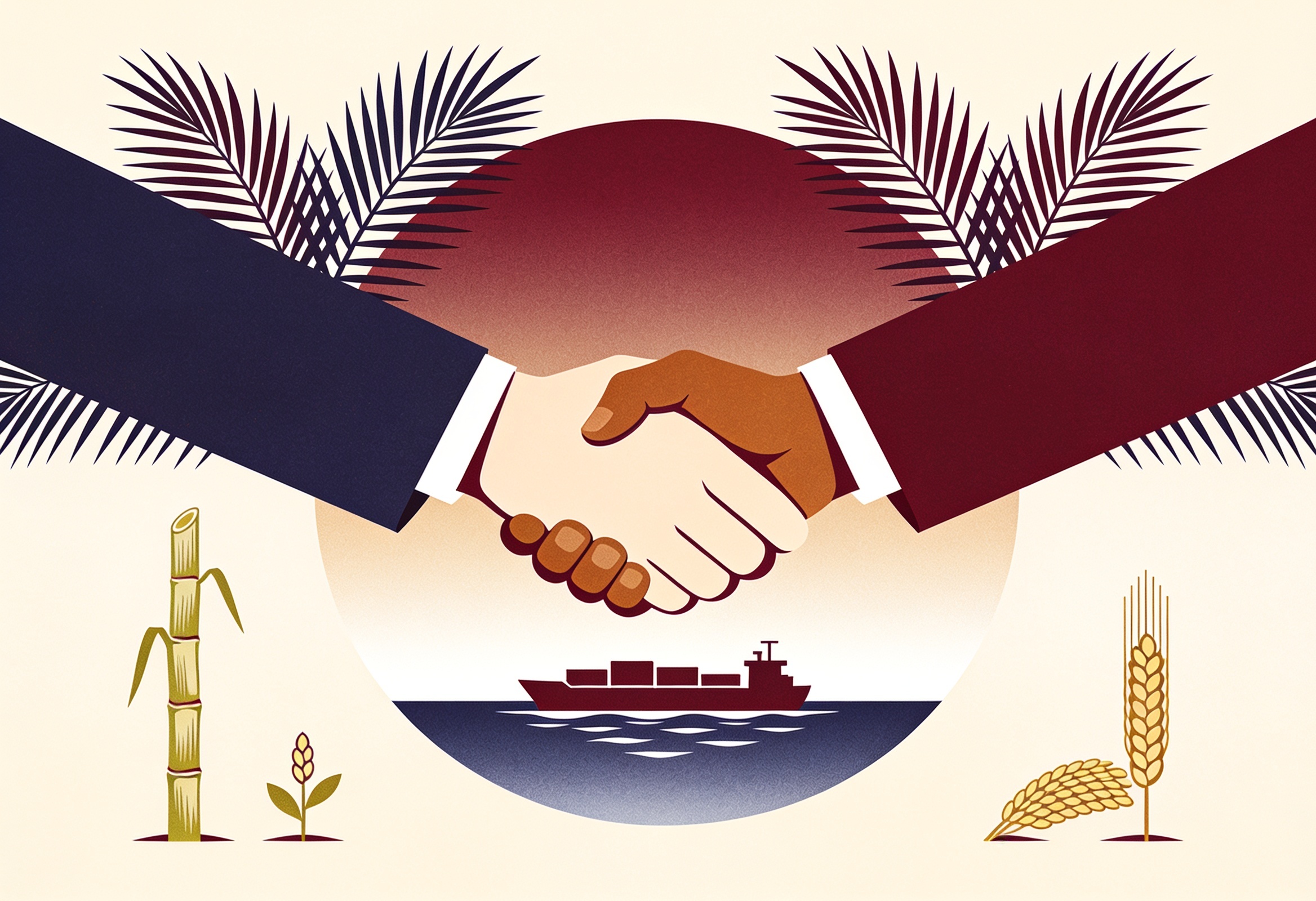
Two hands clasped over a stylised ocean ringed by palm fronds, sugarcane, crop icons and a small ship
Deepening India-Fiji agricultural cooperation across the Pacific Illustration: AI-generated (Freepik)
India-Fiji Agriculture Cooperation: Deepening Ties in the Pacific — quick facts

UPSC Relevance

Prelims Relevance

  • FIPIC — Forum for India-Pacific Islands Cooperation, launched in 2014 at Suva, Fiji; covers 14 Pacific Island countries
  • Fiji — Melanesian archipelago in the South Pacific; capital Suva; largest islands Viti Levu and Vanua Levu
  • The Indo-Fijian community traces to indentured labour (‘Girmitiyas’) brought under British rule from 1879
  • Act East Policy extends India’s eastern engagement to the Pacific, not just ASEAN
  • Indo-Pacific — India’s strategic theatre stretching from the African coast to the western Pacific
  • Small Island Developing States (SIDS) — a UN-recognised grouping vulnerable to climate change and external shocks
  • MoUs are non-binding instruments of intent, distinct from binding treaties
  • Fiji hosts the Pacific Islands Forum (PIF) secretariat at Suva

Mains Relevance

GS Paper 2

  • India’s bilateral and regional engagement with Pacific Island states through FIPIC, and its place in Act East and Indo-Pacific strategy.
  • Development partnership and capacity building as instruments of Indian soft power and South-South cooperation.
  • The role of the diaspora — here the Indo-Fijian community — in shaping bilateral relations.

GS Paper 3

  • Agricultural diplomacy — sharing crop diversification, mechanisation and capacity building with food-stressed island economies.

Essay

  • Small states, large stakes — the geopolitics of the Pacific.
  • Diplomacy as solidarity — India and the Global South.

Background and Context

Fiji and the Pacific Island states

Fiji is the hub of a region of small, scattered, climate-vulnerable island economies.

  • Fiji is a Melanesian archipelago in the South Pacific, with capital Suva and main islands Viti Levu and Vanua Levu.
  • It is the most populous and connected of the Pacific Island states and hosts the Pacific Islands Forum secretariat.
  • These states are classed as Small Island Developing States (SIDS) — tiny landmasses, narrow economies and acute exposure to sea-level rise and cyclones.
  • Agriculture, fisheries and tourism dominate their economies, so farm productivity is central to both incomes and food security.
  • Their dispersed geography and small markets make low-cost, replicable technology far more useful than capital-heavy projects.
India-Fiji Agriculture Cooperation: Deepening Ties in the Pacific — exam lens

The Indo-Fijian diaspora link

A shared history of migration gives the relationship unusual human depth.

  • Indo-Fijians descend from indentured labourers (‘Girmitiyas’) brought from India under British rule from 1879 to work sugarcane plantations.
  • They form a large share of Fiji’s population and have shaped its economy, politics and culture.
  • This diaspora creates enduring linguistic, cultural and family ties that outlast any single government.
  • Sugarcane — the crop the Girmitiyas were brought to cultivate — remains symbolically and economically central to Fiji.
  • Diaspora goodwill gives India a reservoir of soft power that purely transactional partners cannot match.

FIPIC and the regional architecture

India engages the Pacific collectively, not just bilaterally, through a dedicated forum.

  • The Forum for India-Pacific Islands Cooperation (FIPIC) was launched in 2014 at Suva during Prime Minister Modi’s visit.
  • It brings together India and 14 Pacific Island countries for cooperation on development, climate, health and capacity building.
  • FIPIC summits have pledged support in renewable energy, telemedicine, disaster resilience and small-grant community projects.
  • It complements India’s Act East Policy, which extends engagement beyond ASEAN to the far Pacific.
  • The forum lets India offer a collective partnership that respects the autonomy of very small states.

What the agriculture MoU covers

The renewed MoU targets the practical bottlenecks of island farming.

  • Capacity building — training Fijian officials and farmers, scholarships and knowledge exchange in agricultural science.
  • Crop diversification — moving beyond a narrow sugarcane base toward varied, resilient and nutrition-rich crops.
  • Farm mechanisation — affordable, scale-appropriate machinery and tools suited to small island holdings.
  • Sharing India’s experience in research, seeds, soil management and post-harvest handling adapted to local conditions.
  • A five-year renewal gives the cooperation continuity and a planning horizon for joint projects.

India's development-partnership model

The MoU exemplifies how India distinguishes its outreach from that of larger powers.

  • India frames its engagement as partnership, not aid — demand-driven, capacity-first and respectful of sovereignty.
  • It favours low-cost, replicable technology and human-resource development over large debt-financed infrastructure.
  • This is the logic of South-South cooperation — one developing country sharing solutions it has road-tested at home.
  • It contrasts implicitly with debt-heavy external financing that can strain small economies.
  • Agriculture, health and digital tools are India’s signature offerings because they are cheap to scale and visibly useful.

Why the Pacific matters strategically

Tiny states sit on a contested maritime map, raising the stakes of even modest cooperation.

  • The Pacific is part of India’s Indo-Pacific theatre, where freedom of navigation and a rules-based order are core interests.
  • Major powers are competing for influence among Pacific microstates, each of which carries an equal UN vote.
  • Goodwill built through agriculture and disaster relief translates into diplomatic support in multilateral forums.
  • Climate-vulnerable island states are natural partners in India’s climate diplomacy and Global-South coalition-building.
  • Reliable, non-coercive cooperation positions India as a trusted partner of choice in a crowded field.

Significance and the critique

The MoU is high-symbolism and low-cost, but its real test is delivery.

  • It deepens a tie rooted in diaspora, history and shared developing-country experience.
  • It strengthens India’s standing in the Pacific at modest financial outlay relative to rival offers.
  • But an MoU is non-binding — outcomes depend on funding, follow-through and on-the-ground execution.
  • Sustained impact needs project monitoring, not one-off training, so gains are not lost between renewals.
  • India’s distance and limited resources mean it must pick focused, high-impact sectors like agriculture rather than spread thin.

Way Forward

Turn intent into delivery

  • Move from the MoU to time-bound, monitored projects with clear targets in diversification and mechanisation.
  • Build local institutions and trainers so capacity outlasts each five-year cycle.

Leverage diaspora and climate links

  • Channel Indo-Fijian goodwill into people-to-people, educational and agri-business ties.
  • Pair agriculture with climate-resilience support, the priority shared by all Pacific island states.

Scale through FIPIC

  • Use the Act East and FIPIC platforms to replicate the Fiji template across other Pacific partners.
  • Coordinate agriculture with health, renewable energy and disaster-relief offers for a fuller partnership.

Conclusion

The five-year renewal of the India-Fiji agriculture MoU is modest in money but meaningful in intent. It deepens a relationship anchored in a shared history of indentured migration, a large Indo-Fijian diaspora and India’s preference for capacity-building partnership over debt-financed aid. Within FIPIC and the wider Act East and Indo-Pacific framework, agriculture is a low-cost, high-trust lever in a region courted by far larger powers.

The decisive question is delivery. An MoU signals goodwill; monitored projects, lasting local institutions and climate-linked follow-through turn that goodwill into resilient food systems and durable diplomatic capital. If India can convert intent into outcomes here, the Fiji partnership becomes a template for its solidarity with the Global South and the small island states of the Pacific.

UPSC Practice Questions

Prelims MCQ 1

With reference to the Forum for India-Pacific Islands Cooperation (FIPIC) and India-Fiji relations, consider the following statements:

  1. FIPIC was launched in 2014 and brings together India and a group of Pacific Island countries.
  2. Fiji hosts a large Indo-Fijian community descended from indentured labourers brought during the colonial period.
  3. Fiji is located in the Atlantic Ocean off the western coast of Africa.

How many of the above statements are correct?

(a) Only one (b) Only two (c) All three (d) None

Answer: (b) Only two

Explanation:

Statements 1 and 2 are correct. Statement 3 is wrong — Fiji is a Melanesian archipelago in the South Pacific Ocean, not the Atlantic. FIPIC was launched at Suva, Fiji, in 2014, and the Indo-Fijian community traces to indentured ‘Girmitiya’ labour from 1879.

Prelims MCQ 2

India’s approach to the Pacific Island states, exemplified by the agriculture MoU with Fiji, is best described as:

(a) Large debt-financed infrastructure lending (b) Capacity building and development partnership (c) Military basing and security guarantees (d) Tariff-free market integration

Answer: (b) Capacity building and development partnership

Explanation:

India frames its Pacific engagement as demand-driven development partnership — capacity building, crop diversification, mechanisation and low-cost replicable technology — rather than debt-heavy financing, basing or trade integration.

UPSC Mains Questions

  1. The renewal of the India-Fiji agriculture MoU reflects India’s distinctive model of engagement in the Pacific. Discuss how capacity building and development partnership serve as instruments of Indian soft power and South-South cooperation.
  2. Examine the place of the Pacific Island states in India’s Act East Policy and Indo-Pacific strategy. How does the Forum for India-Pacific Islands Cooperation (FIPIC) advance India’s regional objectives?
  3. Diaspora ties shape foreign policy. With reference to the Indo-Fijian community, analyse how historical migration and people-to-people links influence the India-Fiji relationship.

Sources: Ministry of External Affairs, Government of India and Press Information Bureau.

Frequently Asked Questions

What is the India-Fiji agriculture MoU?

It is a Memorandum of Understanding between India and Fiji for cooperation in agriculture, focused on capacity building, crop diversification and farm mechanisation. In January 2026 the two countries agreed to extend this existing MoU for a further five years. The arrangement lets India share low-cost, replicable agricultural technology and training suited to Fiji’s small-island farming, deepening a partnership built on development cooperation rather than aid.

What is FIPIC?

FIPIC is the Forum for India-Pacific Islands Cooperation, launched in 2014 at Suva, Fiji, during Prime Minister Modi’s visit. It brings together India and 14 Pacific Island countries for collective cooperation on development, climate resilience, health, renewable energy and capacity building. FIPIC is the main platform through which India engages the Pacific region as a whole, complementing bilateral ties like the one with Fiji and supporting India’s Act East Policy.

Why is the Indo-Fijian community important to this relationship?

The Indo-Fijian community descends from indentured labourers, known as Girmitiyas, brought from India to Fiji under British rule from 1879 to work on sugarcane plantations. They form a large share of Fiji’s population and have shaped its economy and culture. This shared history creates deep linguistic, cultural and family ties that give India enduring soft power and a human anchor for the bilateral relationship.

How does India’s Pacific approach differ from that of larger powers?

India frames its engagement as partnership rather than aid — demand-driven, capacity-first and respectful of each state’s sovereignty. It favours low-cost, replicable technology and human-resource development in fields like agriculture, health and digital tools over large debt-financed infrastructure. This South-South cooperation model contrasts with debt-heavy external financing that can strain the small economies of the Pacific island states.

Where is Fiji and why does it matter strategically?

Fiji is a Melanesian archipelago in the South Pacific Ocean, with capital Suva and main islands Viti Levu and Vanua Levu. It is the most populous and connected Pacific Island state and hosts the Pacific Islands Forum secretariat. The Pacific lies within India’s Indo-Pacific theatre, where freedom of navigation and a rules-based order matter, and each island state carries an equal UN vote, raising the stakes of even modest cooperation.

Is an MoU legally binding?

No. A Memorandum of Understanding is a non-binding instrument that records a shared intent to cooperate, unlike a treaty, which creates binding legal obligations. Its value lies in signalling commitment and framing joint work. That is why the renewal’s real test is delivery — monitored projects, lasting local institutions and follow-through that turn the stated intent into actual gains in Fiji’s agriculture.