3 current affairs published on Saturday, 14 March 2026
14 March 2026 Current Affairs for UPSC — every
Why-in-News article AnantamIAS published on Saturday, 14 March 2026, broken down with
Why in News?, the exact GS paper it feeds, sub-topic mapping, MCQ-ready facts and a
UPSC-style practice question. 3 articles in total, covering Polity, Economy, Environment, S&T, IR, Geography, History, Society and Internal
Security — the same Why-in-News + GS-paper-mapping + practice-question format the Compass uses across
every daily digest on the site.
Daily current affairs for UPSC is where new material enters your prep stream. Read this
14 March 2026 digest end-to-end in 25–35 minutes, attempt the practice question
at the foot of each article (it's MCQ for some, 10/15-marker for others), then bookmark the entries
that fall inside your active revision window. Everything stays cross-linked: tap any subject pill to jump
to that subject's hub, or use the table of contents above to skip straight to a specific story.
Use this page three ways. Read sequentially for a one-sitting scan of everything that
mattered on 14 March 2026. Download the
14 March 2026 PDF below for offline study or print revision. Or use
the March 2026 Current Affairs compilation
to see this day in the month's full context. For the previous day's reading, see
13 March 2026 Current Affairs;
the next day's is 15 March 2026 Current Affairs.
Why we publish daily current affairs separately from the monthly compilation: daily is learning,
monthly is revision. Use the daily page to add fresh material to your notes the day it breaks;
come back to the March 2026 compilation 60 days before Prelims when the
noise has settled and only the lasting takeaway is worth re-reading.
On 14 March 2026, Ministry of Power put Captive Power Rule Amendment Aims to Ease Industrial Energy Access in the spotlight through an official communication. The development is relevant because it speaks directly to themes that UPSC regularly tests in both factual and analytical form.
The official source, titled Government amends Electricity Rules to strengthen captive power framework and support industrial competitiveness, helps place the issue in a wider policy context. For aspirants, the topic is useful not only for remembering the headline event but also for connecting it to governance, economy, diplomacy, infrastructure, environment, or social policy as required.
UPSC Relevance
Prelims: indices, institutions, agreements, sectors, and key data points
Mains: GS III on growth, trade, inflation, energy, and economic policy
What Happened?
Government of India has notified the Electricity (Amendment) Rules, 2026 , amending Rule 3 of the Electricity Rules, 2005 relating to Captive Generating Plants (CGPs) . The amendments aim to remove interpretational ambiguities, improve ease of doing business for industry, and align the captive generation framework with India’s energy transition and industrial growth objectives.
Captive power generation has been a key enabling provision under the Electricity Act, 2003. The National Electricity Policy, 2005 recognised captive generation as an important mechanism for ensuring reliable and cost-effective electricity supply to industry.
Prelims Focus
Event date: 14 March 2026
Primary source: Ministry of Power
Ministry of Power
Government amends Electricity Rules to strengthen captive power framework and support industrial competitiveness
Industrial power supply reforms
Energy cost competitiveness
Mains Focus
The development shows how policy, regulation, and macro data shape growth prospects and state capacity.
It can be used in GS III answers on economic management, infrastructure finance, or sectoral reforms.
The issue also helps connect headline announcements with implementation challenges on the ground.
A balanced answer should mention both opportunity creation and the need for institutional follow-through.
Why it Matters
For UPSC, the larger value lies in understanding how the announcement affects growth, investment, markets, production systems, or the broader policy environment rather than treating it as a stand-alone news event. In exam terms, this topic can strengthen both short factual notes and longer answer-writing examples.
Exam Takeaways
The event belongs to 14 March 2026 and should be linked to that day's current-affairs revision.
The official source was Ministry of Power.
Industrial power supply reforms
Energy cost competitiveness
Electricity regulation relevance
Bottom Line
Captive Power Rule Amendment Aims to Ease Industrial Energy Access is relevant because it combines immediate current-affairs value with wider exam utility. For UPSC, the larger value lies in understanding how the announcement affects growth, investment, markets, production systems, or the broader policy environment rather than treating it as a stand-alone news event.
Exam Oriented Questions
Why is this topic in the news?
It is in the news because an official development linked to captive power rule amendment aims to ease industrial energy access was recorded on 14 March 2026.
Which official source is associated with this development?
The primary official source is Ministry of Power, and aspirants should revise the linked release or official document.
What is the core issue involved in this topic?
The core issue involves industrial power supply reforms and its policy significance.
How is this topic relevant for UPSC Prelims?
It is useful for Prelims because it involves factual details such as institutions, initiatives, locations, or technical terms that can be directly asked.
How is this topic relevant for UPSC Mains?
It is useful for Mains because it can be linked to broader themes such as governance, economy, foreign policy, infrastructure, environment, or social inclusion.
Which broader policy area does this topic touch?
It touches the economic policy area, especially growth, trade, inflation, energy, or sectoral competitiveness.
What should aspirants remember first from this topic?
Aspirants should first remember the event date, the official institution involved, and the headline takeaway from captive power rule amendment aims to ease industrial energy access.
How can this topic be used in answer writing?
It can be used as a recent example to support analytical points in GS answers, especially when explaining implementation, strategic relevance, or policy direction.
What factual areas should be revised from this topic?
Revise the institution involved, the exact development, and these quick points: Industrial power supply reforms, Energy cost competitiveness, Electricity regulation relevance.
What is the one-line exam takeaway?
Captive Power Rule Amendment Aims to Ease Industrial Energy Access shows how a current event can combine factual recall with wider analytical value for both Prelims and Mains.
Political participation refers to the involvement of citizens in political processes such as voting, contesting elections, joining political parties, influencing public policy, and participating in governance. In a democracy like India, equal political participation of women is essential for inclusive governance and gender equality.
Why in News?
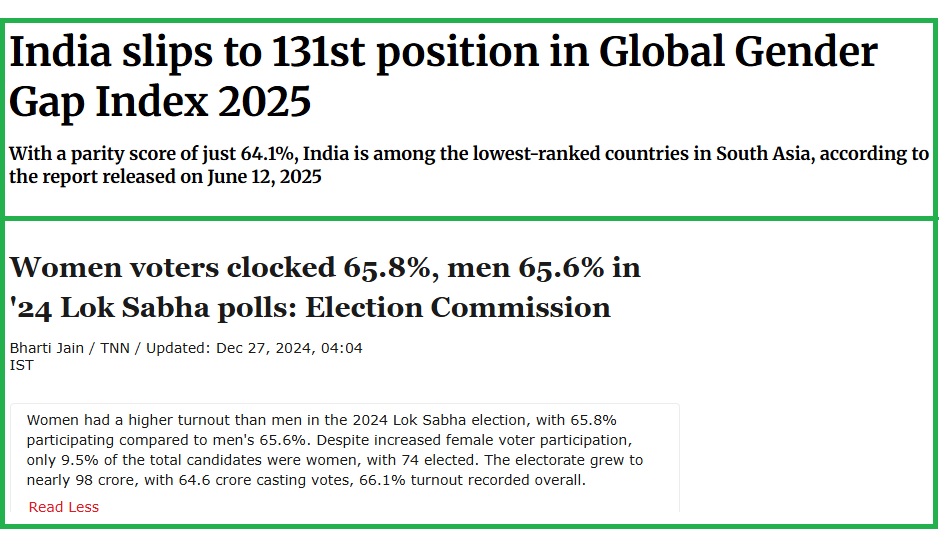
Women’s political participation in India has recently come into focus due to debates on low representation of women in legislative bodies despite high voter participation. Reports and discussions around International Women’s Day and political reforms have highlighted that women constitute only around 10% of MPs and MLAs in India, indicating a major gender gap in political representation.
UPSC Relevance:
GS I: Indian Society, GS II: Social Justice, Women Empowerment, Governance
Current Status of women in political participation:
The Paradox of Progress: India presents a striking paradox — it is the world’s largest democracy and has had women in the highest offices (President, Prime Minister, Chief Ministers), yet it ranks poorly on gender representation.
Women constitute nearly half of India’s population, yet their representation in political institutions remains limited. For example:
Women constitute around 14% of Members of Parliament in Lok Sabha.
The average representation in State Legislative Assemblies is around 9%.
Overall, only about 10% of MPs and MLAs are women in India.
Reservation in Panchayati Raj institutions has significantly increased women’s participation, with many states providing 33–50% reservation.
However, in terms of voter participation, women have made significant progress. In the 2024 Lok Sabha elections, women voter turnout slightly exceeded men, indicating growing political awareness and engagement.
Thus, while women participate actively as voters, they remain underrepresented in political leadership and decision-making positions.
Global Context India slipped to 131st position in the Global Gender Gap Index 2025, with a parity score of just 64.1%, making it among the lowest-ranked countries even within South Asia. Bangladesh, by contrast, jumped 75 ranks to rank 24 globally
What are the Reasons for Low Representation?
1. Patriarchal Social Structure Traditional gender norms restrict women’s participation in leadership roles.
2. Political Party Bias Political parties often field fewer women candidates, limiting their opportunities.
3. Economic Constraints Campaigning requires significant financial resources, which many women lack.
4. Lack of Political Networks Women often have limited access to political mentorship and networks.
5. Violence and Safety Concerns Harassment and violence in politics discourage women from contesting elections. Cyber-harassment and political violence deter women from public life.
6. Criminalization of Politics: The prevalence of muscle and money power in elections discourages women from contesting.
Although women’s voter participation is rising, structural barriers still limit their representation in decision-making institutions. Comprehensive reforms are needed to achieve gender-balanced governance.
What are the Measures to Improve Participation?
1. Constitutional and Legal Measures
The Constitution guarantees equality and non-discrimination on the basis of sex.
The 73rd and 74th Constitutional Amendments introduced 33% reservation for women in Panchayats and Municipalities, which has significantly increased grassroots political participation.
2. Women’s Reservation in Parliament
The 106th Constitutional Amendment (2023) provides 33% reservation for women in the Lok Sabha and State Legislative Assemblies. This is expected to increase women’s representation in higher political institutions.
3. Capacity Building
Training programmes for women leaders
Support for women’s political wings in parties
Greater media visibility
Why Women’s Political Participation is important?
Greater representation of women can:
1. Democratic Equality Women constitute nearly half of India’s population; their representation is necessary for a truly representative democracy.
2. Better Policy Outcomes Studies show that women leaders prioritize issues such as healthcare, education, and social welfare.
3. Gender-sensitive Governance Women representatives are more likely to address gender-based discrimination and social issues.
4. Socio-economic Empowerment Political participation enhances women’s status and decision-making power in society.
Way forward:
1. Implement 106th Constitutional Amendment:
Expedite implementation of the 106th Constitutional Amendment (Nari Shakti Vandan Adhiniyam, 2023) for 33% reservation in Parliament. Aligns with India’s international commitments under CEDAW (Convention on the Elimination of All Forms of Discrimination against Women) and the Beijing Declaration (1995), and with SDG 5 on gender equality.
Limitations: Implementation is deferred until after the next census and delimitation exercise, effectively pushing it to 2029 or later.
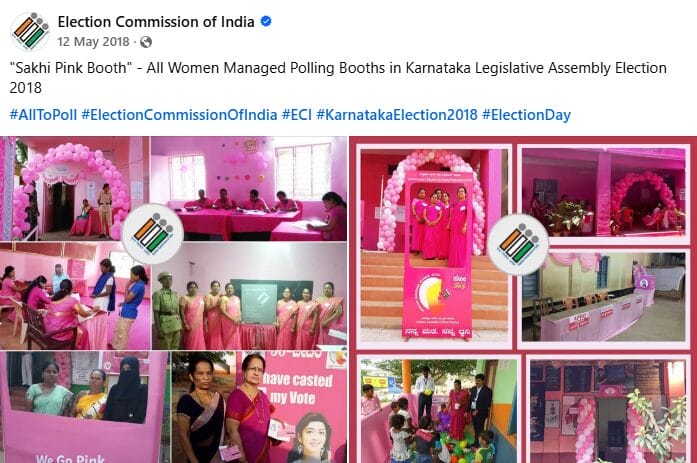
Expand Election Commission initiatives like SVEEP (Systematic Voters’ Education and Electoral Participation) and Pink Booths (also known as Sakhi Polling Booths)to create safer electoral environments.
4. Political Party Reforms
Parties should allocate a minimum percentage of tickets to women candidates. Mandate political parties to field women in at least 33% of tickets through law.
5. Financial Support
Public funding mechanisms to support women candidates.
6. Social Awareness
Campaigns to challenge patriarchal attitudes and promote gender equality.
Conclusion
Despite constitutional guarantees and increasing voter participation, women remain significantly underrepresented in Indian politics. Effective implementation of reservation policies, political party reforms, and social transformation are necessary to ensure substantive political empowerment of women in India.
Practice Mains Questions
Despite increasing voter turnout among women in India, their representation in political institutions remains low. Examine the reasons and suggest measures to improve women’s political participation.
Women’s political participation is essential for inclusive and representative democracy. Discuss the importance of women’s representation in politics in the Indian context.
Evaluate the role of constitutional provisions and reservation policies in promoting women’s political participation in India.
India’s Ministry of Statistics and Programme Implementation (MoSPI) released a new national accounts series with 2022–23 as the base year, replacing the earlier 2011–12 base year. The new series introduces updated data sources and improved statistical methods to measure economic growth more accurately.
UPSC Relevance:
GS III: Economy
What is GDP and Base Year?
GDP
Gross Domestic Product (GDP) is the total value of all final goods and services produced within a country during a given period.
Base Year
The base year is the reference year used to calculate real GDP (GDP at constant prices) by removing the effect of inflation.
Example If base year = 2022-23, prices of that year are used to compare output in other years.
Why is base year revision done?
The base year is revised periodically to reflect structural shifts in the economy and to improve the accuracy of economic estimates. Such updates allow for methodological refinements and the integration of more comprehensive and reliable data sources.
The United Nations System of National Accounts (SNA 1993) recommends base-year updates every five years. India, which had historically revised roughly once per decade, is now committing to a more regular five-year cycle — a significant step towards aligning with global statistical best practices.
The last base year change was from 2004–05 to 2011–12 done in 2015.
Why was 2022–23 specifically chosen?
The year 2022–23 was chosen as the anchor because it represents the first stable post-COVID economic year — after the sharp contractions of 2019–21 and the recovery bounce of 2021–22. A stable, non-shock year is always preferred as the base.
Timeline of GDP Base Year in India
Series
Base Year
Key Feature
Old series
2004-05
First major modern update
Previous series
2011-12
Introduced MCA-21 corporate database
New series
2022-23
Uses GST, digital data and improved methods
Key methodological changes
1. Double deflation (biggest change)
The most important methodological change is the shift from the “single-deflator” method to the “double-deflation” method for calculating real Gross Value Added (GVA). In the old method, only output was adjusted for prices. Now, both output and intermediate inputs are separately deflated — making the measurement of real value addition far more precise.
Double deflation is being applied in sectors like manufacturing and agriculture. In other sectors, single extrapolation is being used. Deflators are being applied at a more detailed, granular level. These changes are expected to improve the accuracy and reliability of GDP deflators in the new series.
Real Value Added = Real Output – Real Intermediate Inputs
This improves accuracy especially in manufacturing where input prices and output prices move differently.
2. New data sources integrated
The revised series incorporates administrative datasets such as GST Network data and Public Financial Management System (PFMS) records.
Data Source
Purpose
GST data
Business activity and value addition
e-Vahan
Automobile sector output
PFMS
Government expenditure
Corporate filings
Corporate sector performance
Household surveys
Consumption estimates
These improve the coverage of the formal and informal economy.
3. Supply and Use Tables (SUT) framework
The new series provides a more accurate, consistent framework through the SUT structure, improving transparency and internal consistency across sectors.
Supply Side
Use Side
Domestic production
Consumption
Imports
Investment
Exports
This reduces statistical discrepancies.
4. Improved Measurement of the Informal Sector
Earlier approach
Benchmarks from older surveys
New approach–New surveys incorporated
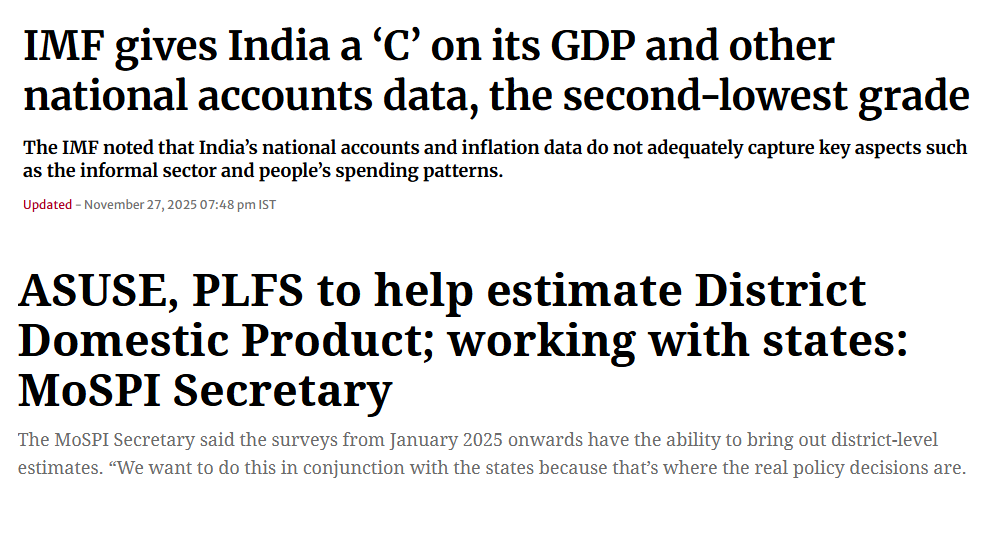
Uses Annual Survey of Unincorporated Sector Enterprises (ASUSE)
Combined with Periodic Labour Force Survey (PLFS) data
This allows annual estimates of the unorganised sector, instead of extrapolating old benchmarks.
5. Segregation of multi-activity enterprises
Enterprises engaged in multiple sectors are now separately classified, improving sectoral attribution.
Earlier method
Entire company output assigned to dominant sector
New method
Output allocated activity-wise based on revenue shares
Example A company involved in manufacturing and services will now contribute to both sectors appropriately.
6. Improved Price Deflators
The new GDP estimates use more granular price indices (around 500–600 items from CPI and WPI) compared with around 180 earlier.
This improves inflation adjustment accuracy.
What do the new numbers say?
Absolute Size and Nominal Growth
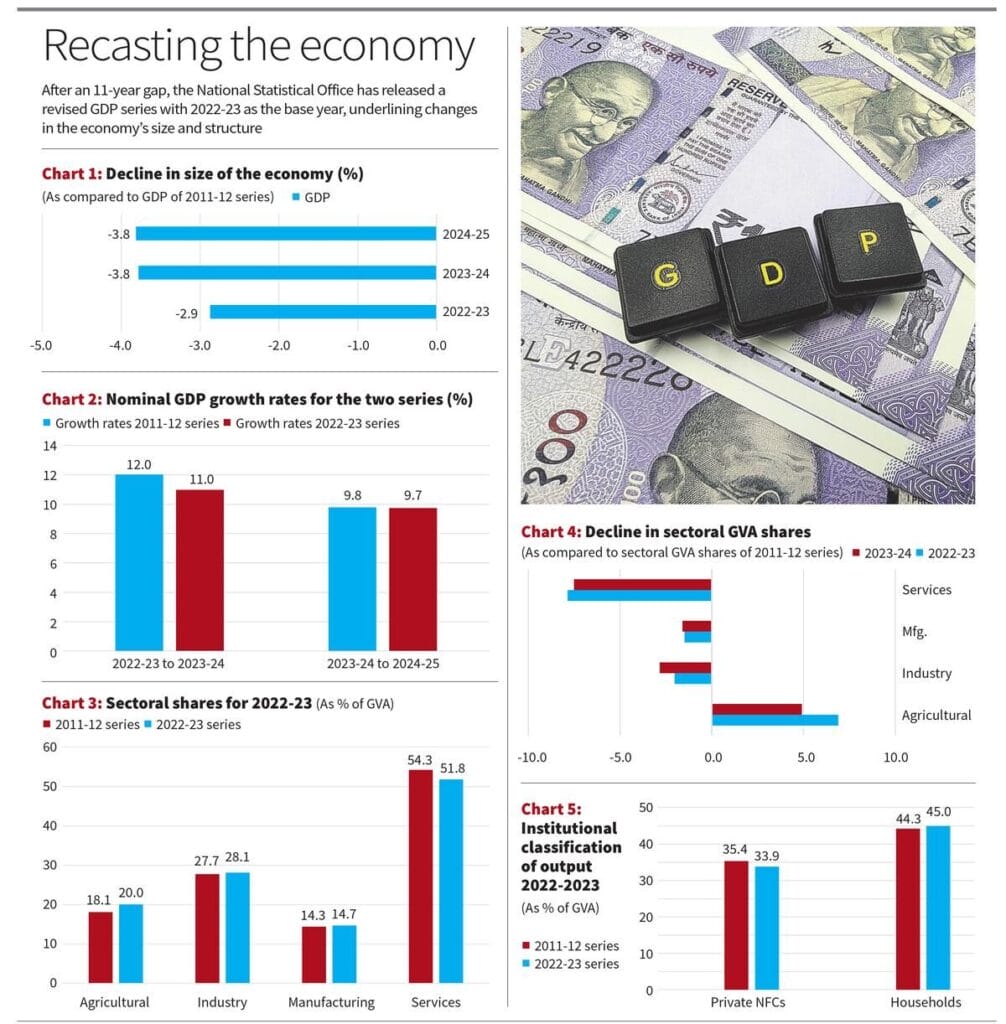
Smaller Denominator: The absolute nominal GDP for FY26 is now estimated at ₹345 lakh crore, roughly 3.3% lower than the previous estimate of ₹357 lakh crore.
Historical Downward Revision: Nominal GDP levels for the past three years (FY24–FY26) were reduced by 3% to 4% compared to the old series.
Nominal Growth Rate: Despite the lower base, nominal growth for FY26 is projected at 8.6%.
Real GDP Growth Revisions
The new series, based on 2022-23 prices, changed the growth trajectory as follows:
FY24: Revised down to 7.2% from the earlier estimate of 9.2%.
FY25: Revised up to 7.1% from the earlier 6.5%.
FY26: Projected at 7.6%, higher than the 7.4% estimated under the old series.
The 2022–23 GDP has been revised to ₹261 lakh crore (from the previously reported ₹269 lakh crore), and FY 2025–26 GDP is estimated at ₹345 lakh crore (earlier ₹357 lakh crore). Per capita annual income is now ₹2,43,180 (earlier ₹2,51,393).
What are the Fiscal implications of these changes?
Nominal GDP is now lower by 3–4%, even though real growth is higher. This creates a paradox with fiscal ratios:
The fiscal deficit for FY26 is now estimated at 4.51% of GDP instead of 4.36%, even though the absolute deficit amount remains unchanged. Similarly, the debt-to-GDP ratio for FY27 is pegged at 57.5%, compared to the earlier target of 55.6%. This makes the government’s debt consolidation path toward its FY2031 target of reducing debt to 50% of GDP steeper.
To achieve the targeted 4.3% fiscal deficit for 2026–27, the economy will now require a massive nominal growth rate of 13–14%, notably higher than the 10% assumption in Union Budget 2026–27, indicating the government may need to aggressively recalibrate its borrowing strategies.
On the $5 trillion goal: GDP in FY 2025–26 stands at about $3.9 trillion at ₹88 per USD (earlier $4 trillion), indicating India is further from the $5 trillion target. India is expected to comfortably cross the $4 trillion mark during FY 2026–27.
IMF context:
In November 2025, the IMF awarded India’s national accounts data a ‘C’ grade in its Data Adequacy for Surveillance (DAS) assessment. While India scored an ‘A’ for timeliness of data releases and a ‘B’ for granularity, its coverage quality — especially of the informal sector and use of outdated base-year data — drew sharp criticism. The new series directly addresses these concerns.
For how many year will the Back-series data be provided?
Back-series data is expected to be released by December 2026. As per the practice, in India, back-series estimates are recalculated using revised methodology of the new GDP series up to the previous base year. After that, the data is linked at a disaggregated level and extended back to 1950-51. However, the final method for preparing the back-series will be decided in consultation with the Advisory Committee set up to guide MoSPI.
Comparison with the international statistical standards:
India prepares GDP estimates according to the 2008 System of National Accounts (SNA 2008). The UN is now moving toward SNA 2025, and countries are expected to adopt it around 2029–30. India plans to adopt SNA 2025 in its next base year revision.
What are the Criticisms and Challenges?
Heavy reliance on Ministry of Corporate Affairs data may overstate large firms’ performance while underestimating MSMEs that do not file timely returns.
The WPI base year revision must also be completed swiftly to ensure that deflators used across all sectors represent current market realities.
Administrative data (GST, corporate filings) may have reporting errors.
Despite improvements, the unorganised sector is still difficult to measure accurately.
New methodology makes comparison with older data difficult.
Conclusion
The new GDP series represents an important step toward modernising India’s statistical system, improving reliability of economic measurement and enabling better policy making, though continued improvements in data quality and transparency remain essential.
Practice MCQs:
With reference to the revised GDP series with 2022-23 as the base year, consider the following statements:
The base year is used to remove the effect of inflation while calculating real GDP.
India revises the GDP base year periodically to reflect structural changes in the economy.
The base year revision directly changes the size of the population used for GDP calculation.
Which of the statements given above are correct?
A. 1 only B. 1 and 2 only C. 2 and 3 only D. 1, 2 and 3
Answer: B
Which of the following data sources are used in the new GDP series with base year 2022-23?
GST data
Corporate filings database
Periodic Labour Force Survey
e-Vahan vehicle registration data
Select the correct answer using the code below.
A. 1 and 2 only B. 1, 2 and 3 only C. 1, 2 and 4 only D. 1, 2, 3 and 4
Answer: D
Consider the following statements regarding Supply-Use Tables (SUT) used in national accounts:
They help reduce statistical discrepancies in GDP estimation.
They are used only for calculating agricultural GDP.
They match production data with expenditure data in the economy.
Which of the statements given above are correct?
A. 1 only B. 1 and 2 only C. 2 and 3 only D. 1, 2 and 3
Answer: C
The concept of double deflation, recently introduced in India’s revised GDP series, refers to:
A. Adjusting GDP for inflation using two different price indices B. Separately deflating output and intermediate inputs to estimate real value added C. Using both CPI and WPI simultaneously to estimate GDP D. Removing inflation from both nominal GDP and per capita GDP
Answer: B
Which of the following indicators may be affected when nominal GDP estimates are revised?
Fiscal deficit-to-GDP ratio
Debt-to-GDP ratio
Tax-to-GDP ratio
Select the correct answer using the code below.
A. 1 only B. 1 and 2 only C. 1, 2 and 3 D. 2 and 3 only
Answer: C
Which of the following best describes Gross Value Added (GVA)?
A. Total value of all goods produced in the economy B. Value of output minus the value of intermediate inputs C. GDP minus government expenditure D. GDP adjusted for population