Opens in a new tab
Join Anantam IAS Channel on Telegram

Daily Digest · Thursday

15 October 2026 Current Affairs for UPSC

7 current affairs published on Thursday, 15 October 2026

15 October 2026 Current Affairs for UPSC — every Why-in-News article AnantamIAS published on Thursday, 15 October 2026, broken down with Why in News?, the exact GS paper it feeds, sub-topic mapping, MCQ-ready facts and a UPSC-style practice question. 7 articles in total, covering Polity, Economy, Environment, S&T, IR, Geography, History, Society and Internal Security — the same Why-in-News + GS-paper-mapping + practice-question format the Compass uses across every daily digest on the site.

Daily current affairs for UPSC is where new material enters your prep stream. Read this 15 October 2026 digest end-to-end in 25–35 minutes, attempt the practice question at the foot of each article (it's MCQ for some, 10/15-marker for others), then bookmark the entries that fall inside your active revision window. Everything stays cross-linked: tap any subject pill to jump to that subject's hub, or use the table of contents above to skip straight to a specific story.

Use this page three ways. Read sequentially for a one-sitting scan of everything that mattered on 15 October 2026. Download the 15 October 2026 PDF below for offline study or print revision. Or use the October 2026 Current Affairs compilation to see this day in the month's full context. For the previous day's reading, see 14 October 2026 Current Affairs.

Why we publish daily current affairs separately from the monthly compilation: daily is learning, monthly is revision. Use the daily page to add fresh material to your notes the day it breaks; come back to the October 2026 compilation 60 days before Prelims when the noise has settled and only the lasting takeaway is worth re-reading.

District Court Pendency: Diagnosing Delay Before Choosing Remedies

Open article →Download PDF

Why in News?

On 14 October 2026, the Ministry of Law and Justice announced a research mission involving National Law Universities to diagnose district court pendency in 100 hotspot judicial districts.

  • The PIB release says the selected districts account for over half of district-court pendency; concentrating research there is intended to identify locally significant causes of delay.
  • National Law Universities were asked to involve researchers, students and pro bono clubs in ground-level analysis and recommend feasible responses.
  • The meeting discussed case profiling, adjournments and alternative procedures; it did not announce blanket authority to settle or summarily dispose of criminal cases.
  • A pending case count identifies workload but cannot, by itself, explain whether delay arises from procedure, missing evidence, scheduling or another bottleneck.
  • The initiative’s value depends on converting district-specific findings into lawful administrative improvements while protecting fair hearings and judicial independence.

UPSC Relevance

Prelims Relevance

  • District and subordinate judiciary
  • Case profiling and stage-wise pendency
  • National Law Universities as research partners
  • Adjournment management
  • Distinction between research recommendations and judicial decisions

Mains Relevance

GS Paper 2

  • Evidence-based judicial administration and district-specific diagnosis
  • Balancing timely disposal, procedural fairness and judicial independence

Essay

  • Institutions improve when they diagnose the causes behind their performance indicators.

Background and Context

What a Pendency Count Cannot Explain

Pendency is a stock of unresolved cases; diagnosis asks which cases are waiting, at what stage, and for what reason.

  • A district’s pending total reflects both cases entering the system and cases leaving it. A rising total does not alone establish that judges have become less productive or identify the responsible institution.
  • Case age and procedural stage answer different questions: an older case signals prolonged waiting, while its current stage helps identify the next required action. Reading both is more useful than ranking districts alone.
  • For example, waiting for service of process differs from waiting for evidence or final arguments. These are diagnostic illustrations, not findings already established by the announced mission across its selected districts.
  • Case profiling can group records by case type, age, stage and recorded reasons for adjournment. The resulting pattern helps researchers frame questions that a single district-wide aggregate cannot answer reliably on its own.
  • A hotspot approach concentrates investigation where a large backlog exists. It does not prove that every selected district has the same problem, nor that districts outside the exercise face no serious delays.

How Research Can Inform Court Administration

The announced role of National Law Universities is to investigate causes and recommend feasible responses, rather than exercise judicial powers.

  • The ministry asked NLU teams to conduct ground-level analysis through researchers, students and pro bono clubs. This describes a research contribution; it does not appoint students to decide cases or direct judges.
  • A useful study should distinguish a recorded reason from an inferred cause. An adjournment entry may describe the immediate event without explaining the recurring institutional obstacle behind it; recommendations should acknowledge that difference.
  • Researchers should examine repeated waiting points rather than treat each adjournment as misconduct. Some postponements protect a meaningful hearing; the relevant question is which avoidable delays recur and why those delays persist.
  • A district-specific recommendation should identify the bottleneck, the institution able to address it and the evidence supporting the change. Otherwise, additional research risks becoming another general list of familiar judicial-reform proposals.
  • Research also needs confidentiality and careful interpretation: case files can contain sensitive allegations. Findings should support institutional improvement without publicly labelling litigants or treating an unresolved allegation as an established fact about them.

Why Remedies Must Follow the Diagnosis

The meeting discussed several options; discussion is neither a legal amendment nor proof that every option fits every pending case.

  • Adjournment management concerns the conduct and scheduling of proceedings. It cannot substitute for resolving an underlying evidentiary or procedural obstacle; simply reducing listed adjournments may leave the actual source of delay untouched.
  • Plea bargaining, mediation-assisted settlements and summary trials were among the alternatives discussed. Their mention does not make criminal cases universally negotiable or remove applicable legal restrictions, safeguards and the role of competent authorities.
  • Identifying potentially infructuous cases means investigating whether the dispute or requested relief has lost practical relevance. A research team’s classification cannot itself close a proceeding; the appropriate legal decision remains a separate step.
  • The useful comparison is diagnosis-led reform versus a disposal target alone. The first asks what prevents lawful progress; the second can reward a headline count without revealing fairness or durable improvement for litigants.
  • Measure success through less avoidable waiting with fair process, not merely a smaller register. The announcement supplies a research direction, while implementation choices and demonstrated outcomes still require further evidence from the exercise.

Way Forward

Make Recommendations Actionable

  • Publish an aggregated diagnostic method that separates observed records, hypotheses and confirmed causes while protecting case-level confidentiality.
  • Require each proposed remedy to name its legal basis, responsible institution and safeguards before recommending adoption.
  • Evaluate whether changes reduce avoidable waiting without compromising participation, reasoned decisions or the ability to contest a case.

Conclusion

  • District court pendency requires explanations, not only totals: the same backlog figure can conceal different procedural and institutional obstacles that need different responses.
  • Use this development to argue for evidence-based judicial administration: universities can inform reform, while lawful decisions and procedural safeguards remain essential to legitimate disposal.

UPSC Practice Questions

Prelims MCQ 1

With reference to the district pendency research initiative announced in October 2026, consider the following statements:

  1. National Law Universities were asked to diagnose district-specific causes of delay.
  2. The initiative authorises university researchers to dispose of criminal cases.
  3. The meeting discussed case profiling and management of adjournments.

How many of the above statements are correct?

(a) Only one (b) Only two (c) All three (d) None

Answer: (b) Only two

Explanation:

Statements 1 and 3 match the PIB announcement. Researchers were asked to analyse and recommend, not given judicial disposal powers.

Prelims MCQ 2

Which finding would best support a district-specific diagnosis of judicial delay?

(a) A pending total without case-stage information (b) A uniform disposal target for every case category (c) Repeated delays at an identified procedural stage, supported by case-record analysis (d) An assumption that every adjournment is unnecessary

Answer: (c) Repeated delays at an identified procedural stage, supported by case-record analysis

Explanation:

Stage-specific evidence identifies a possible bottleneck for investigation. Aggregate totals or unsupported assumptions do not establish its cause.

UPSC Mains Questions

  1. How can district-specific case profiling improve judicial administration? Discuss the limits of research-led interventions in pending proceedings.
  2. Reducing court pendency requires more than increasing disposal counts. Examine with reference to procedural bottlenecks and fair process.

Source: PIB, Ministry of Law and Justice.

Frequently Asked Questions

What is the new district pendency initiative?

The Ministry of Law and Justice announced a research mission focused on 100 hotspot judicial districts. National Law Universities were asked to examine district-specific causes of delay and recommend feasible responses.

Can National Law Universities dispose of pending cases?

The announcement assigns universities a research and recommendation role. It does not give their researchers or students authority to adjudicate disputes, close proceedings or direct judges to decide individual cases.

Does the initiative allow settlement of every criminal case?

No. Plea bargaining, mediation-assisted settlements and summary trials were discussed as alternatives. The announcement does not remove applicable legal restrictions or make every criminal proceeding eligible for these approaches.

Why is case profiling more useful than a pending total alone?

A total shows unresolved workload. Profiling adds information about case type, age, stage and recorded delays, helping distinguish bottlenecks that may require different lawful administrative or procedural responses in each district.


IDBI Strategic Sale: Valuation and Regulatory Completion

Open article →Download PDF

Why in News?

On 14 October 2026, the Cabinet Committee on Economic Affairs approved a Fairfax subsidiary as the strategic buyer for IDBI Bank, with further RBI compliance requirements still to be fulfilled.

  • The approved buyer is 10955230 Canada Inc., whose parent is Fairfax Financial Holdings Ltd.; the transaction covers a controlling 60.72% equity stake.
  • The winning offer of Rs.81 per share exceeded the independent valuation benchmark of Rs.75.99 per share and both underlying valuation estimates.
  • The buyer must present its credentials to RBI and provide a roadmap for complying with the prescribed regulatory conditions; approval should not be reported as completed transfer.
  • The case connects public asset valuation with banking supervision: accepting a commercially reasonable bid and satisfying regulatory conditions answer different questions.
  • Expected improvements in capital access and management are prospective benefits, not demonstrated outcomes of an ownership change that has yet to be completed.

UPSC Relevance

Prelims Relevance

  • Strategic sale and transfer of control.
  • Market Multiple Method and Asset Valuation Method.
  • RBI Fit and Proper assessment.
  • Cabinet Committee on Economic Affairs.
  • Residual shareholding and board representation.

Mains Relevance

GS Paper 3

  • Public asset valuation under volatile market conditions.
  • Bank restructuring, private capital and prudential oversight.

GS Paper 2

  • Accountability across approval, valuation and regulatory completion.

Essay

  • Changing ownership does not remove the need for institutional oversight.

Background and Context

What Changes in a Strategic Sale?

A strategic transaction concerns the buyer’s ability to direct the enterprise, while a residual shareholding preserves an economic interest without the same governance role.

  • Here, the Government of India and LIC are selling shares together to one strategic buyer. The agreed majority stake makes this a control transaction rather than a small reduction in either seller’s portfolio.
  • The Finance Ministry’s FAQ says both sellers will withdraw their board nominees and become public shareholders. Retaining shares after the transaction does not mean retaining their previous role in directing the bank’s affairs.
  • The government’s residual holding will be 15%, while LIC will retain 19%. These are holdings left after the proposed transaction, not additional stakes included in the majority block being sold to the buyer.
  • The bank previously needed repeated capital support from the government and then LIC. This history explains the restructuring rationale, but past financial weakness alone does not establish that every proposed sale price is reasonable.
  • The government expects private capital, technology and better management to improve the bank’s business. Treat these as expected gains: a change in ownership creates an opportunity for improvement, not proof that improvement has occurred.

Why the Share Price Was Not the Valuation Benchmark

The official explanation distinguishes a fluctuating traded price from an independently assessed value of the enterprise being sold.

  • The release describes IDBI’s stock as narrowly traded and volatile during the valuation period. Sale expectations affected its quoted price, making that price an unreliable standalone guide to the underlying enterprise in this transaction.
  • The Market Multiple Method used relative valuation based on public sector banks’ closing accounts. It provided a peer-based assessment rather than simply adopting the latest IDBI stock-market quote as the enterprise’s fair value.
  • The Asset Valuation Method considered tangible and intangible assets together with liabilities, using IDBI’s audited accounts. Land and property were included, but adding their gross value alone would ignore obligations that reduce net value.
  • Two independent professional agencies supplied valuations through these different methods. Their average became the benchmark for assessing qualified bids, separating the bidder’s commercial offer from the independent comparator used to judge its reasonableness.
  • The winning offer exceeded the average and each underlying estimate. This supports the government’s stated reasonableness assessment; it does not establish that market prices are always irrelevant or that valuation eliminates uncertainty about future performance.

Why Buyer Approval Is Not Transaction Completion

Commercial selection and regulatory compliance remain separate stages because acquiring control of a bank carries responsibilities beyond paying for shares.

  • Only parties assessed as Fit and Proper by RBI and given security clearance could enter the bidding stage. These entry conditions screened prospective participants before the government compared the final technical and financial offers.
  • After CCEA’s selection, the successful bidder must still present its credentials and a regulatory compliance roadmap to RBI. An earlier assessment is not a reason to omit the further requirements explicitly stated in the release.
  • IDBI remains a scheduled commercial bank regulated by RBI. The change concerns ownership and governance; it should not be read as an exemption from banking supervision or a transfer of regulatory authority to the buyer.
  • The government has authorised a separate mechanism for future minority sales of its residual holding through the open market. That authorisation does not mean those later sales have already occurred alongside approval of the strategic buyer.
  • For answer writing, distinguish announcement, approval and completion. The official release establishes the approved buyer and valuation basis, but its own forward-looking compliance language prevents treating the transaction as an already completed ownership transfer.

Way Forward

Track Compliance and Outcomes Separately

  • Require a clear completion record before describing the transaction as closed; distinguish satisfaction of regulatory conditions from the announcement accepting the winning bid.
  • Assess valuation accountability through the disclosed methods and their limitations, without substituting a single volatile market quote for an enterprise-level appraisal.
  • Judge the promised operational improvements through subsequent evidence on management and banking performance, rather than assuming that the ownership decision itself delivers those outcomes.

Conclusion

  • The IDBI case shows why a strategic sale needs both a defensible valuation and continuing regulatory scrutiny. A higher accepted bid answers a pricing question; it does not automatically settle the conditions for acquiring control.
  • In a Mains answer, separate commercial value, governance change and prudential oversight. This avoids equating residual public shareholding with continued board control, or presenting a government-approved transaction as completed before its remaining requirements are fulfilled.

UPSC Practice Questions

Prelims MCQ 1

With reference to the approved IDBI Bank strategic transaction, consider the following statements:

  1. The valuation benchmark was the average of two independent valuations.
  2. The successful bidder still has to submit a regulatory compliance roadmap to RBI.
  3. The government and LIC will retain their board nominees because they retain residual shares.

How many of the above statements are correct?

(a) Only one (b) Only two (c) All three (d) None

Answer: (b) Only two

Explanation:

Statements 1 and 2 are correct. The Finance Ministry FAQ states that both sellers will withdraw their board nominees and become public shareholders, so statement 3 is incorrect.

Prelims MCQ 2

Which approach best describes the Asset Valuation Method used for the IDBI transaction?

(a) Using only the latest quoted share price (b) Adding land values without considering obligations (c) Considering tangible and intangible assets together with liabilities (d) Treating the highest historical share price as fair value

Answer: (c) Considering tangible and intangible assets together with liabilities

Explanation:

The official explanation says the method considered tangible and intangible assets, including land and properties, alongside liabilities to determine fair net asset value.

UPSC Mains Questions

  1. Why can a volatile market price be an inadequate standalone benchmark for a strategic disinvestment? Discuss using the IDBI Bank transaction. (150 words)
  2. Distinguish commercial approval from regulatory completion in the strategic sale of a bank. Explain why residual government shareholding need not imply continued control. (150 words)

Sources: PIB, Cabinet and PIB, Ministry of Finance FAQs.

Frequently Asked Questions

Has the IDBI strategic sale been completed?

The 14 October release announces approval of the strategic buyer, not completion. It states that the bidder must present credentials to RBI and submit a roadmap for compliance with prescribed regulatory conditions.

How was the IDBI valuation benchmark determined?

Two independent professional agencies used the Market Multiple Method and Asset Valuation Method. The average of their estimates became the benchmark against which the qualified bids were assessed for reasonableness.

Why was the quoted stock price disregarded?

The government described IDBI stock as narrowly traded and volatile, with its price influenced by transaction expectations. It used independent valuation methods instead of treating that fluctuating quote as the enterprise’s intrinsic value.

Will the government and LIC retain board control?

The Finance Ministry FAQ says both will withdraw their board nominees and become public shareholders after the transaction. Their residual economic interests should not be confused with retaining their previous governance role.

MSCARO: Turning Cooperative Audits Into Risk-Based Supervision

Open article →Download PDF

Why in News?

On 14 October, the Ministry of Cooperation announced MSCARO, a mandated audit-reporting framework for multi-state cooperative societies, with phased implementation and risk-based regulatory supervision.

  • MSCARO means the Multi-State Co-operative Societies (Auditor’s Report) Order, 2026; it establishes a structured statutory reporting format.
  • Auditors must provide Yes/No responses with remarks on financial, administrative, governance and statutory compliance parameters.
  • The Central Registrar of Cooperative Societies will use audit observations to identify higher-risk societies for focused supervision.
  • Phased implementation begins with larger societies; the announcement envisages automated scrutiny and AI analytics rather than demonstrating an operational AI system.
  • Member protection depends on identifying misuse of funds and emerging repayment problems before losses become difficult to contain.
  • Comparable reporting can help supervisors prioritise attention, but reliable underlying records and independent audit judgments remain essential.

UPSC Relevance

Prelims Relevance

  • MSCARO and multi-state cooperative societies
  • Section 73(6) and central auditing standards
  • Central Registrar of Cooperative Societies
  • Non-performing assets, overdue loans and liquidity
  • Structured audit reporting versus regulatory intervention

Mains Relevance

GS Paper 2

  • Accountability and democratic governance in cooperative institutions
  • Risk-based oversight with reasoned regulatory decisions

GS Paper 3

  • Financial discipline, early stress detection and protection of members’ funds

Essay

  • Trust in institutions requires both participation and verifiable accountability.

Background and Context

What MSCARO Changes in Audit Reporting

The reform makes audit observations easier to compare without making every cooperative subject to the same regulatory framework.

  • Legal anchor: The Ministry links the framework to Section 73(6), which empowers the Central Government to prescribe auditing and accounting standards for multi-state cooperative societies following the amendment of the governing law.
  • Scope matters: The announcement concerns multi-state cooperative societies. It should not be read as a common audit order automatically covering every state cooperative, company or other member-based organisation operating in the economy.
  • Structured responses: A common format asks auditors to answer specific questions and provide relevant remarks. The remarks remain important because a binary response alone cannot explain the seriousness, context or implications of an irregularity.
  • Corporate comparison: MSCARO is modelled on the Companies (Auditor’s Report) Order. The parallel is standardised reporting; it does not turn cooperative societies into companies or make corporate CARO the governing order for these societies.
  • Member funds: Audit verification covers investments, use of funds, share capital, membership records and statutory approvals. These checks connect reported financial positions with the legitimacy of transactions and the interests of cooperative members.

How Audit Findings Can Guide Supervision

The central mechanism is a sequence: comparable observations reveal risk, and identified risk helps focus regulatory attention.

  • Financial stress: Reporting covers non-performing assets, overdue loans, liquidity, deposits, advances, repayment defaults and borrowings. These indicators illuminate different weaknesses, so a society’s condition cannot be assessed from a single headline balance alone.
  • Risk-based supervision: The Central Registrar can identify societies displaying higher financial or governance risks from audit observations. Focused inspections, inquiries and interventions can then direct scarce supervisory capacity toward matters needing closer examination.
  • Governance scrutiny: Reports examine board composition, directors’ eligibility, meetings, statutory committees and related-party transactions. Financial soundness and democratic functioning are connected: weak internal oversight can allow conflicts of interest to escape timely challenge.
  • Early warning: Identifying overdue obligations or inadequate liquidity is intended to prompt corrective action before vulnerabilities deepen. An audit observation signals a concern for examination; it is not automatically a final finding of wrongdoing.
  • Technology pathway: Integration of standardised information could support dashboards, automated scrutiny, risk scores and AI analytics. The Ministry describes these capabilities as envisaged possibilities, so operational deployment or proven detection performance cannot be assumed.

Implementation Limits and Accountability Safeguards

A structured report improves the information available to regulators; the quality of scrutiny still depends on how that information is produced and used.

  • Phased coverage: Larger societies enter first, allowing others time to strengthen systems and processes. Institutions must check the applicable financial criteria and reporting requirements before assuming that the framework already covers their operations.
  • Applicable compliance: Audit-level checks extend to cybersecurity and anti-money-laundering requirements wherever applicable. That qualification matters: the release does not establish identical obligations for every society regardless of its activities or legal coverage.
  • Data quality: Standardisation cannot correct inaccurate books by itself. As a practical implementation requirement, auditors need traceable records and adequate explanations; otherwise consistently formatted reports may still conceal materially different underlying financial conditions.
  • Human judgment: A risk score can help select cases for examination, but should not substitute for evidence and reasoned decisions. A high-risk classification needs contextual review rather than an automatic presumption of misconduct.
  • Accountability loop: The useful outcome is action on verified weaknesses, not simply completed reporting. Societies should document corrective measures, while supervisors assess whether identified deficiencies have actually been remedied and member interests better protected.

Way Forward

Make Audit Findings Actionable

  • Publish clear coverage and reporting guidance, including definitions of the relevant financial parameters, so societies can determine their obligations without guessing.
  • Build record quality and audit capacity during phased implementation; require remarks that explain exceptions rather than mechanically repeating a checklist.
  • Pair risk prioritisation with documented human review and follow-up on corrective action, particularly where automated tools flag unusual financial or governance patterns.

Conclusion

  • MSCARO’s core contribution is to connect comparable statutory audit observations with targeted supervision of multi-state cooperatives. Protection of members depends on the quality of evidence and the corrective action that follows.
  • For an analytical answer, distinguish reporting, risk identification and regulatory response. Standardised information enables better oversight, while phased implementation and envisaged technology must not be mistaken for complete coverage or proven automated enforcement.

UPSC Practice Questions

Prelims MCQ 1

With reference to MSCARO, consider the following statements:

  1. It concerns statutory audit reporting for multi-state cooperative societies.
  2. Its structured reporting includes Yes/No responses along with relevant remarks.
  3. The announcement establishes that AI-based supervision is already operational for every cooperative society.

How many of the above statements are correct?

(a) Only one (b) Only two (c) All three (d) None

Answer: (b) Only two

Explanation:

Statements 1 and 2 are correct. Technology integration and AI analytics are envisaged; neither universal coverage nor an operational AI system is established by the announcement.

Prelims MCQ 2

What best describes risk-based supervision under MSCARO?

(a) Treating every audit qualification as a final finding of fraud (b) Replacing statutory audit with automated credit ratings (c) Using audit observations to focus inspections and inquiries on higher-risk societies (d) Applying corporate CARO directly to every cooperative society

Answer: (c) Using audit observations to focus inspections and inquiries on higher-risk societies

Explanation:

Risk-based supervision enables the Central Registrar to identify higher-risk societies from audit observations and focus inspections, inquiries and other regulatory interventions.

UPSC Mains Questions

  1. How can standardised statutory audit reporting improve oversight of multi-state cooperative societies? Discuss the limits of relying on automated risk scores.
  2. Explain why protection of cooperative members’ funds requires attention to both financial indicators and internal governance.

Source: PIB, Ministry of Cooperation.

Frequently Asked Questions

What is MSCARO?

MSCARO is the Multi-State Co-operative Societies (Auditor’s Report) Order, 2026. It provides a uniform, structured and risk-based statutory audit reporting framework for multi-state cooperative societies, with phased implementation.

Does MSCARO cover every cooperative society?

The announcement concerns multi-state cooperative societies and specifies phased implementation. It should not be interpreted as an immediate, universal audit framework for every cooperative society registered under different legal arrangements.

How does it support risk-based supervision?

Standardised audit observations help the Central Registrar identify societies with higher financial or governance risks. Supervisory attention can then focus on inspections, inquiries and timely corrective measures in those institutions.

Is AI already supervising societies under MSCARO?

The Ministry envisages integrating standardised information with technology to support automated scrutiny and AI analytics. The announcement does not demonstrate that these capabilities are operational or establish their accuracy in detecting risks.

Disability Pension Revision: Eligibility Before Delivery

Open article →Download PDF

Why in News?

On 14 October 2026, the Union Cabinet approved a disability pension revision under the National Social Assistance Programme, widening disability and age eligibility while directing implementation through forthcoming guidelines.

  • The disability threshold falls to 40% from 80%, bringing the pension criterion into line with benchmark disability.
  • The minimum age becomes since birth; approved central assistance is Rs.375 for ages 0–79 and Rs.625 for ages 80 and above.
  • Guidelines covering eligibility, beneficiary numbers and assistance rates are to be issued and implemented within three months.
  • Old-age pension, widow pension and family benefit schemes continue in their existing form; the decision does not announce matching revisions across those benefits.
  • A wider eligibility rule can reduce exclusion, but certification, enrolment and payment must work before households receive the benefit.
  • The announcement changes specified disability and age conditions; it does not establish an unconditional pension for every person with a disability.

UPSC Relevance

Prelims Relevance

  • NSAP: social assistance administered through the Department of Rural Development.
  • Benchmark disability: a certified legal category under the Rights of Persons with Disabilities Act.
  • Article 41: public assistance within the State’s economic capacity and development.
  • Central assistance and state supplements are distinct from the total pension received.
  • Cabinet approval, implementing guidelines and actual payment are separate stages.

Mains Relevance

GS Paper 2

  • Disability inclusion through social assistance and accessible administration.
  • Distinguishing formal eligibility from effective receipt of welfare benefits.

Essay

  • Equal dignity requires public systems that accommodate different support needs.

Background and Context

What the Eligibility Revision Changes

The central change concerns who can enter the disability pension scheme, rather than a general revision of every social assistance benefit.

  • The earlier disability threshold confined access to a narrower group with more severe assessed disability. Lowering it admits an additional category, subject to the scheme’s other applicable conditions and the forthcoming implementation guidelines.
  • An age rule beginning at birth removes the minimum-age barrier for children meeting the disability criteria. It recognises that disability-related household support needs can arise well before adulthood or entry into paid employment.
  • The benchmark disability category is established by the Rights of Persons with Disabilities Act, not by a household’s own declaration. Assessment and certification remain relevant; the pension announcement does not abolish that evidentiary requirement.
  • The Cabinet release describes assistance for poor households but does not announce removal of poverty-related conditions. A lower disability threshold cannot be interpreted as a universal entitlement independent of the final scheme rules.
  • The scheme’s approved renaming is an administrative identifier, not the mechanism of inclusion. For an answer, explain the changed eligibility boundary and implementation duties instead of treating a new name as a new benefit.

The Rights Framework Behind Social Assistance

Constitutional social assistance and disability legislation explain the policy direction, while scheme rules determine how an applicant is assessed and paid.

  • Article 41 places public assistance within the Directive Principles and expressly recognises limits of economic capacity and development. Its policy commitment should not be confused with an automatic payment order to every individual applicant.
  • The Rights of Persons with Disabilities Act provides a social-security framework for adequate living standards and independent or community living. Pension support is one instrument within that broader framework, alongside other measures addressing exclusion.
  • The Act’s social-security provision requires assistance for persons with disabilities to be higher than comparable schemes for others. The policy rationale is recognition of additional support needs, rather than identical nominal treatment of unlike circumstances.
  • Disability certification and financial eligibility answer different questions: whether a person meets the specified disability condition and whether they qualify under the pension scheme. Satisfying one test should not be presented as satisfying every test.
  • A cash pension supports household resources but does not itself provide accessible transport, schooling or rehabilitation. Treating income support as a substitute for those services would overlook the different barriers that disability policy must address.

Why Approval Is Not Yet Delivery

Implementation must connect an eligible person to an approved beneficiary record and a successful payment, without obscuring the remaining administrative conditions.

  • The three-month implementation direction is prospective. The Cabinet announcement is evidence of approval, not evidence that every state has already applied the revised rules or credited the higher assistance to beneficiaries.
  • Central assistance must be distinguished from the total pension a household receives. States can add their own support; the revised central amounts do not establish a single identical final payment across every state.
  • Certification access can become a practical barrier even after eligibility broadens. Repeated travel, inaccessible offices or unclear documentation can prevent applicants from proving eligibility; this is an implementation risk, not a reported outcome of the revision.
  • Children’s inclusion makes clear procedures for applications and authorised receipt especially important. The announcement does not specify those procedures, so claims about guardianship documents or mandatory payment arrangements should await the actual guidelines.
  • Delivery assessment should distinguish eligible applicants, approved beneficiaries and payments successfully received. Counting approvals alone cannot reveal whether a rejected application was explained, a failed transfer was corrected or an eligible household remained outside the system.

Way Forward

Make the Revised Boundary Usable

  • Publish plain-language eligibility guidance separating disability, age and financial conditions, with accessible formats and clear commencement arrangements.
  • Provide assisted certification and enrolment for applicants facing mobility, communication or digital barriers; make grievance routes usable without repeated office visits.
  • Track payment completion alongside enrolment and publish reasons for unresolved cases, while protecting sensitive disability and financial information.

Conclusion

  • The revision broadens a disability pension eligibility boundary, but inclusion depends on translating that boundary into accessible assessment, enrolment and reliable payment. Approval is the starting point for implementation, not proof that delivery is complete.
  • For a welfare-governance answer, distinguish legal recognition, scheme eligibility and actual receipt. This avoids both understating the reform and overstating it as universal income protection or a replacement for accessible public services.

UPSC Practice Questions

Prelims MCQ 1

With reference to the approved disability pension revision, consider the following statements:

  1. The minimum age criterion is to begin at birth.
  2. The announcement automatically removes all poverty-related eligibility conditions.
  3. The old-age and widow pension schemes are to continue in their existing form.

How many of the above statements are correct?

(a) Only one (b) Only two (c) All three (d) None

Answer: (b) Only two

Explanation:

Statements 1 and 3 reflect the Cabinet decision. The release does not announce abolition of poverty-related conditions; wider disability eligibility is not universal entitlement.

Prelims MCQ 2

Which distinction is most important when evaluating the announced pension amounts?

(a) Central assistance and the total pension including state support (b) Disability certification and voter registration (c) Pension assistance and compulsory employee contributions (d) Cabinet approval and a constitutional amendment

Answer: (a) Central assistance and the total pension including state support

Explanation:

The central assistance component need not equal the final amount received where states provide additional support. The announcement should not be read as a uniform total payment everywhere.

UPSC Mains Questions

  1. How can a disability pension reform widen formal eligibility without ensuring effective inclusion? Suggest administrative measures to close the gap.
  2. Explain the relationship between constitutional social assistance, disability rights and the design of targeted pension schemes.

Sources: PIB, Cabinet and India Code, Rights of Persons with Disabilities Act.

Frequently Asked Questions

What is the main change in disability pension eligibility?

The approved revision lowers the disability threshold to benchmark disability and makes the minimum age begin at birth. Other applicable scheme conditions and the implementing guidelines remain important when assessing individual eligibility.

Has every beneficiary already received the revised payment?

The Cabinet release directs issuance and implementation of guidelines within three months. It does not establish that all states have completed enrolment changes or that every beneficiary has received the revised assistance.

Does the revision create a universal disability pension?

No universal entitlement is announced. The release changes disability and age conditions within a social assistance programme; it does not announce removal of all financial or other scheme eligibility requirements.

Are the announced amounts the total pension in every state?

They should be understood as central assistance under the programme. State support may add to that component, so a beneficiary’s total pension must be checked against the applicable state arrangements.

SIOFA Accession: Rights and Duties in High-Seas Fisheries

Open article →Download PDF

Why in News?

On 14 October 2026, the Central Government approved India’s accession to the Southern Indian Ocean Fisheries Agreement (SIOFA), seeking fuller participation in regional fisheries governance and authorised high-seas harvesting.

  • The fisheries ministry identifies India as a Cooperating Non-Contracting Party; approval to accede should not be confused with confirmation that treaty accession is complete.
  • The announcement identifies squid, toothfish and alfonsino among resources that Indian vessels could harvest under SIOFA’s authorisation framework.
  • Contracting participation would strengthen India’s engagement in the Scientific Committee and Compliance Committee, linking fishing opportunities with research and conservation responsibilities.
  • The ministry describes the High Seas Boarding and Inspection Scheme as adopted and set to be implemented; the announcement does not establish completed Indian operational participation.
  • The policy question is whether fleet expansion can occur alongside enforceable conservation rules, rather than treating distant waters as an unlimited source of catch.
  • Scientific participation matters because resource assessments influence sustainable harvest decisions; access without reliable evidence can damage the stocks on which future livelihoods depend.

UPSC Relevance

Prelims Relevance

  • SIOFA and its fishery-resource scope.
  • Cooperating Non-Contracting Party versus Contracting Party.
  • Indian Ocean Tuna Commission and highly migratory species.
  • Illegal, unreported and unregulated fishing.
  • Scientific advice, conservation measures and compliance oversight.

Mains Relevance

GS Paper 2

  • Regional cooperation in governing shared marine resources.
  • International participation and domestic implementation responsibilities.

GS Paper 3

  • Sustainable fisheries, biodiversity and the blue economy.
  • Balancing fishing opportunities with scientific and compliance capacity.

Essay

  • Shared resources require shared rules.

Background and Context

What Accession Would Change

The immediate development concerns India’s place in a regional decision-making framework, rather than the launch of an unrestricted new fishery.

  • Government approval permits the accession initiative to proceed. The release does not establish that the treaty process is complete, so the proposed change in international participation must remain distinct from its domestic approval.
  • India’s existing cooperating non-contracting status already connects it to SIOFA. The proposed move is towards fuller participation, not the creation of a fisheries relationship with an entirely unfamiliar institution.
  • The ministry links contracting status to fuller participation in scientific and compliance bodies. This matters because fishing states influence a common management framework while remaining accountable to its conservation objectives.
  • Access to research programmes and stock assessments can improve understanding of covered resources. It does not establish that every stock is abundant, that a particular catch is sustainable, or that commercial success is assured.
  • For Indian enterprises, the opportunity is authorised fishing within the framework. A government announcement is not a vessel-specific permission, and it should not be read as a guaranteed allocation of fish.

SIOFA and IOTC Have Different Mandates

The useful comparison is the resource each arrangement manages, rather than treating every Indian Ocean fishery as one regulatory category.

  • SIOFA covers fishery resources within its agreement area, including fish, molluscs and crustaceans, subject to exclusions. Its scope is broader than a single commercial species, but it is not universal marine jurisdiction.
  • Highly migratory species listed under UNCLOS are excluded from SIOFA’s resource definition. The Indian Ocean Tuna Commission addresses tuna and tuna-like species, making it the relevant comparison for understanding the division of mandates.
  • The agreement also excludes sedentary species under coastal-state fishery jurisdiction. This qualification prevents an overly broad reading of its resource list: a regional arrangement does not erase coastal states’ existing jurisdiction.
  • The ministry’s examples of squid, toothfish and alfonsino illustrate the kinds of opportunities being considered. They are not an announcement of an unlimited harvest, a uniform fishing method, or a guaranteed export market.
  • For examination answers, identify the resource and regulatory scope before naming the institution. SIOFA participation cannot be substituted for all Indian Ocean fisheries arrangements merely because vessels operate in the same ocean.

Why Fishing Access Requires Conservation

A shared management arrangement must connect scientific understanding with fishing controls and credible checks on conduct at sea.

  • Scientific assessments help determine whether fishing pressure is compatible with maintaining resources. The ministry places research cooperation alongside harvesting opportunities, making conservation part of the accession rationale rather than an optional later addition.
  • The agreement’s conservation principles include an ecosystem approach and reliance on scientific evidence. Sustainable fishing considers the wider marine system, rather than judging success only by the quantity brought back to port.
  • The precautionary approach means incomplete scientific information should not justify delaying protective measures. Uncertainty about a resource is a reason for caution, not proof that additional fishing will have no ecological consequences.
  • Preventing illegal, unreported and unregulated fishing is an explicit cooperation objective. Rules lose practical value if activity remains concealed or escapes oversight; conservation and legitimate commercial participation depend on credible compliance.
  • Boarding and inspection is a regulated enforcement mechanism, not permission for unrestricted intervention at sea. SIOFA maintains an authorisation register; Indian involvement must be distinguished from the ministry’s announcement of intended participation.

Way Forward

Build Capacity Around Conditions of Access

  • Clarify the accession and implementation milestones before communicating new opportunities to vessel operators, so approval, international participation and operational permission remain distinguishable.
  • Pair fleet development with scientific reporting and compliance capacity; expansion should follow credible evidence about resources and applicable conservation requirements.
  • Train operators on authorisation and inspection procedures, with clear responsibilities for documentation and cooperation rather than assuming that membership alone settles operational obligations.

Conclusion

  • SIOFA accession approval is significant because it connects economic access with participation in regional fisheries governance. Its value depends on translating that opportunity into sustainable, authorised activity.
  • An effective answer should separate approval from completion, distinguish SIOFA from IOTC, and explain why scientific cooperation and compliance are conditions of a credible blue economy.

UPSC Practice Questions

Prelims MCQ 1

With reference to the Southern Indian Ocean Fisheries Agreement, consider the following statements:

  1. Its resource definition excludes highly migratory species listed under UNCLOS.
  2. It excludes sedentary species subject to coastal-state fishery jurisdiction.
  3. Government approval of accession automatically authorises every Indian fishing vessel to harvest without restrictions.

How many of the above statements are correct?

(a) Only one (b) Only two (c) All three (d) None

Answer: (b) Only two

Explanation:

The first two statements reflect SIOFA scope exclusions. The third is incorrect: accession approval is not blanket vessel authorisation or unrestricted fishing access.

Prelims MCQ 2

Which statement best distinguishes SIOFA from the Indian Ocean Tuna Commission?

(a) SIOFA regulates every marine species, while IOTC regulates only coastal fishing. (b) SIOFA grants coastal sovereignty, while IOTC grants fishing licences. (c) SIOFA excludes highly migratory species, while IOTC addresses tuna and tuna-like species. (d) Both arrangements are limited to marine pollution control.

Answer: (c) SIOFA excludes highly migratory species, while IOTC addresses tuna and tuna-like species.

Explanation:

The important distinction is resource scope. Neither institution creates unrestricted fishing rights or replaces the jurisdiction of coastal states.

UPSC Mains Questions

  1. How can participation in regional fisheries arrangements advance India’s blue economy while strengthening marine conservation?
  2. Distinguish access to high-seas fisheries from unrestricted harvesting rights. Discuss the roles of scientific cooperation and compliance.

Sources: PIB, Ministry of Fisheries, Animal Husbandry and Dairying and SIOFA Secretariat.

Frequently Asked Questions

Has India completed SIOFA accession?

The 14 October announcement confirms government approval of accession and describes India as a Cooperating Non-Contracting Party. It does not establish completed treaty accession or unrestricted operational rights for Indian fishing vessels.

How does SIOFA differ from IOTC?

SIOFA covers specified fishery resources while excluding highly migratory species and certain sedentary species under coastal-state jurisdiction. IOTC addresses tuna and tuna-like species. Their mandates should not be treated as interchangeable.

Does accession guarantee unlimited fishing?

No. The announcement concerns authorised and sustainable harvesting within a regional framework. Government approval does not itself provide every vessel with permission, guarantee catches, or remove conservation and compliance requirements.

Why is scientific cooperation important?

Resource assessments help align fishing pressure with sustainability. Participation in scientific work can improve management decisions, but access to data does not establish that a stock is abundant or that additional fishing is harmless.

Sugarcane Payments: Why Recovery and Weighment Matter

Open article →Download PDF

Why in News?

On 14 October 2026, the government constituted a committee to examine sugarcane farmers’ concerns, including remunerative returns, sugar recovery verification, weighment practices and deductions for mechanically harvested cane.

  • The committee will examine cultivation costs and demands for better returns to sugarcane farmers.
  • It will separately consider revision of the ex-mill Minimum Selling Price of sugar against production costs and mill viability.
  • Its measurement review covers recovery testing, weighing calibration, inspections and verification.
  • The inquiry includes mechanical-harvest deductions and their financial effect on the cane price payable; recommendations remain pending.
  • A higher announced price cannot settle a dispute over the quantity accepted or the recovery recorded for payment.
  • Transparent measurement protects farmers while giving mills a defensible record of procurement, processing and deductions.

UPSC Relevance

Prelims Relevance

  • Fair and Remunerative Price: sugarcane pricing.
  • Ex-mill Minimum Selling Price: sugar sales pricing.
  • Sugar recovery: sugar obtained relative to cane crushed.
  • Calibration and verification of weighing equipment.
  • Difference between an advisory inquiry and an adopted policy.

Mains Relevance

GS Paper 3

  • Agricultural price policy and the measurement of farm produce.
  • Farmer returns, processing viability and information asymmetry.

GS Paper 2

  • Accountability through transparent verification and stakeholder consultation.

Essay

  • A fair price needs a trustworthy measure.

Background and Context

Separate the Cane Price From the Sugar Selling Price

The committee is examining both sides of a processing business: what mills pay for cane and what they realise from selling sugar.

  • Fair and Remunerative Price, or FRP, concerns sugarcane purchased by mills from farmers. It is a cane-pricing mechanism, not the price at which the resulting sugar is sold to a wholesale buyer.
  • The existing seasonal FRP decision links cane pricing to a basic recovery rate, with adjustments for recovery differences and protection at low recovery; the new inquiry does not replace that decision.
  • The ex-mill Minimum Selling Price concerns sugar leaving the mill. Here, MSP means Minimum Selling Price, not Minimum Support Price; confusing the terms mixes the processed product with the agricultural input.
  • The economic connection is mill realisation: revenue from sugar helps sustain processing and cane payments. A sugar selling-price decision and a farmer payment obligation still concern different transactions and require separate scrutiny.
  • The announced committee will examine costs and financial viability alongside farmer returns. Its constitution is neither an approved increase in either price nor a finding that a particular payment practice is unlawful.

Why Weighment and Recovery Need Separate Checks

Quantity and recovery answer different questions, so checking one cannot substitute for checking the other when a payment is contested.

  • Weighment establishes the quantity of cane recorded for procurement. If that record understates the accepted supply, a correct price can still produce a disputed payment; the scale and transaction record both matter.
  • Calibration examines measuring accuracy, while inspection and verification help establish whether the weighing arrangements remain reliable in use. The committee will assess the adequacy of these mechanisms, rather than assume equipment alone ensures trust.
  • Sugar recovery describes sugar obtained relative to cane crushed. Since the FRP framework is recovery-linked, the reliability of testing and reporting matters separately from whether the incoming cane was weighed accurately.
  • A recovery record should not be casually presented as a laboratory result for every individual farmer’s load. The announcement asks for transparent verification but does not prescribe a new farmer-level testing protocol.
  • The policy problem is information asymmetry: farmers need intelligible evidence for figures that affect their returns. Clear weighing records and explainable recovery reporting make disputes assessable without presuming either side is at fault.

Mechanical Harvesting Deductions Need Evidence

The inquiry must distinguish measurable effects of harvesting from routine deductions whose basis cannot be explained to the farmer supplying cane.

  • The committee will examine prevailing deductions from mechanically harvested cane weight. It must also assess actual losses, if any, associated with mechanisation; the announcement does not establish that every deduction reflects a real loss.
  • A deduction changes the quantity credited, whereas recovery-linked pricing concerns the applicable cane rate. Combining these into one unexplained reduction makes it harder to identify which measurement or assumption a farmer should challenge.
  • Mechanised harvesting is not itself proof of poor-quality supply. A defensible inquiry needs to establish what is being deducted, why it affects payable weight and whether the adjustment matches observed conditions.
  • Stakeholder consultation includes farmer representatives, mill associations, states and relevant experts. Comparing their evidence can expose disagreements about measurement methods, rather than reduce the dispute to competing demands for a higher price.
  • The committee will submit findings and specific recommendations for consideration by the competent authority. Until decisions follow, neither a uniform deduction rule nor a new recovery-verification system should be described as implemented.

Way Forward

Make Payment Components Traceable

  • Provide a readable transaction record separating accepted weight, applicable rate, each deduction and the final amount payable.
  • Pair periodic equipment checks with accessible complaint records so discrepancies can be investigated against evidence.
  • Require proposed harvesting deductions to state their factual basis and provide a practical route for farmers to contest errors.

Conclusion

  • Fair remuneration depends on more than a headline price: accepted quantity, recovery information and deductions must be credible and understandable to the farmer.
  • Use this inquiry to connect agricultural pricing with measurement governance, while keeping its pending recommendations separate from existing cane-pricing rules and the distinct ex-mill sugar price.

UPSC Practice Questions

Prelims MCQ 1

With reference to sugar-sector pricing and measurement, consider the following statements:

  1. Fair and Remunerative Price concerns sugarcane purchased from farmers.
  2. Ex-mill MSP means Minimum Support Price of sugarcane.
  3. Weighment and recovery verification address different measurement questions.

How many of the above statements are correct?

(a) Only one (b) Only two (c) All three (d) None

Answer: (b) Only two

Explanation:

Statements 1 and 3 are correct. Ex-mill MSP means Minimum Selling Price of sugar, a processed product; it is distinct from the FRP payable for cane.

Prelims MCQ 2

What does the October 2026 sugar-sector committee announcement establish?

(a) An immediate increase in the cane FRP (b) A uniform mandatory deduction for mechanically harvested cane (c) An inquiry into farmer concerns, measurement practices and sugar-sector pricing (d) Replacement of sugar recovery testing by weighment alone

Answer: (c) An inquiry into farmer concerns, measurement practices and sugar-sector pricing

Explanation:

The committee will examine the issues and recommend measures. The announcement does not adopt revised prices, a uniform deduction or a replacement testing method.

UPSC Mains Questions

  1. Explain why transparent weighment and recovery verification are necessary for fair sugarcane payments, even when a price framework exists.
  2. Distinguish farmer remuneration from ex-mill sugar pricing. How should a committee evaluate harvesting deductions without prejudging legitimate costs or farmer grievances?

Sources: PIB, Ministry of Consumer Affairs, Food and Public Distribution and PIB, Cabinet Committee on Economic Affairs.

Frequently Asked Questions

Has the committee increased sugarcane prices?

No. It has been constituted to examine farmer concerns and recommend measures. The announcement does not itself revise the cane price, sugar selling price or harvesting-deduction rules.

How does cane FRP differ from sugar MSP?

FRP concerns sugarcane purchased by mills from farmers. Ex-mill MSP means Minimum Selling Price of sugar sold by mills. The two prices relate to different products and transactions.

Why does sugar recovery matter to farmers?

The existing cane FRP framework is linked to sugar recovery. Reliable testing and reporting matter because recovery-related adjustments affect pricing; this is a different issue from weighing the cane supplied.

Are all mechanical-harvest deductions justified?

The announcement does not reach that conclusion. The committee will examine prevailing deductions, assess actual losses if any, and evaluate their financial impact on the cane price payable to farmers.

YETI Cargo UAV: Combining Vertical Lift With Wing-Borne Flight

Open article →Download PDF

Why in News?

On 14 October 2026, the Technology Development Board signed an agreement with ideaForge to support development of YETI, an autonomous cargo aircraft combining vertical take-off and fixed-wing flight.

  • YETI is proposed as a heavy-lift, long-range unmanned aerial vehicle for logistics where conventional transport faces difficult terrain or limited infrastructure.
  • The announced design targets include payloads up to 200 kg and range up to 200 km; these are development objectives, not demonstrated simultaneous capabilities.
  • The PIB release identifies distributed, redundant propulsion and power, with proposed navigation capability when satellite-navigation signals are unavailable.
  • Further engineering, integration, testing and validation remain necessary; the agreement does not establish certification, operational deployment or unrestricted autonomous flight.
  • Remote logistics needs both access at the destination and reliable transport between locations; solving only the runway problem leaves the mission incomplete.
  • Flight transition connects two different lift regimes, making control and safety as important as headline payload or range.

UPSC Relevance

Prelims Relevance

  • VTOL: vertical take-off and landing.
  • UAV: unmanned aerial vehicle.
  • Wing-borne flight: aerodynamic lift supports the aircraft during forward motion.
  • GNSS: global navigation satellite systems, distinct from communication links.
  • Redundancy: alternate capability intended to preserve essential functions after specified failures.

Mains Relevance

GS Paper 3

  • Indigenous unmanned aviation and difficult-terrain supply chains.
  • Flight-control reliability, navigation resilience and operational safety.

Essay

  • Access depends on reliable systems, not merely ambitious machines.

Background and Context

Why Combine Vertical Lift and Fixed Wings?

The design brings together access without a runway and a different way of sustaining flight over the journey.

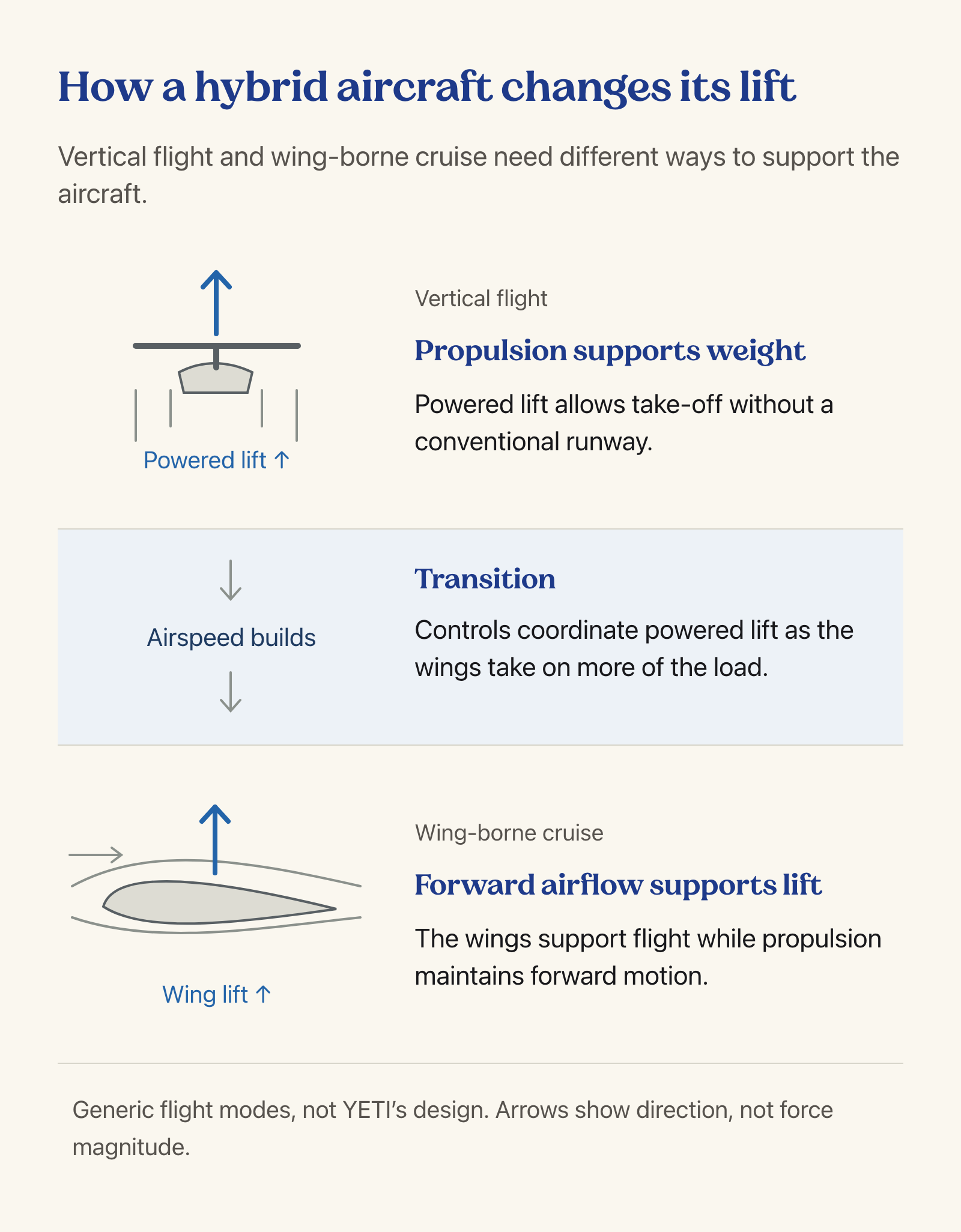
  • Vertical take-off uses powered lift to leave the ground without a conventional runway. For a cargo mission, this can reduce dependence on long prepared strips near the receiving location.
  • Wing-borne cruise relies on airflow over wings to support the aircraft while propulsion maintains forward motion. It changes how lift is produced during travel rather than eliminating the need for power.
  • Unlike a rotor-only aircraft, a VTOL fixed-wing hybrid seeks to use wings during cruise. The useful comparison is its flight mechanism, not an unsupported claim that every hybrid carries more cargo.
  • The term hybrid here describes the combination of vertical-lift and fixed-wing flight capabilities. The release does not establish a particular fuel-battery arrangement, rotor count or detailed geometry for the vehicle.
  • Runway independence does not mean landing anywhere. A logistics assessment must still examine clear approaches, stable landing surfaces, nearby people and safe loading; these remain operating questions rather than proven YETI capabilities.

Transition Is a Control Problem

The aircraft must change how it supports its weight while keeping its motion controlled; adding wings alone cannot solve that task.

  • During transition, an aircraft moves between powered vertical lift and wing-borne flight. Control commands must coordinate the changing contribution of propulsion and aerodynamics, rather than treat take-off and cruise as disconnected events.
  • NASA transition research describes the need for specialised trajectories and commands between rotor-borne and wing-borne flight. This explains the general engineering challenge; it does not validate any YETI control system.
  • NASA’s lift equation relates lift to air density, airspeed, wing area and lift coefficient. Wing shape and inclination affect the coefficient, so forward speed alone does not determine available lift.
  • Distributed propulsion spreads propulsion functions across multiple units. Redundant power and propulsion can improve fault tolerance, but the exact failures a design tolerates must be established through its architecture and testing.
  • Redundancy also creates a coordination problem: several actuators may contribute to the same movement. NASA research examines this allocation challenge; its findings are background principles, not evidence of YETI’s specific implementation.
Diagram showing powered vertical lift, coordinated transition and wing-borne cruise in a generic VTOL fixed-wing aircraft
Generic lift mechanisms across flight modes; the diagram does not depict YETI’s actual design or measured performance.

Read Mission Targets as Conditional Claims

A useful aerial supply system must complete a defined mission safely; a list of maximum specifications cannot establish that result.

  • Payload and range need a stated mission profile. The announcement does not show that maximum cargo, maximum range and the most demanding environment can all be achieved together on one flight.
  • High-altitude operation changes the aerodynamic problem because lift depends partly on air density. A claimed operating ceiling cannot, by itself, establish how much cargo can be carried from a particular landing site.
  • GNSS-denied navigation means navigating when satellite-positioning signals are unavailable. It is distinct from maintaining a communications link: knowing position and exchanging commands are separate functions with potentially different failure modes.
  • Weather resistance is a design intention, not an all-weather guarantee. Evaluating the intended environment requires explicit operating limits and evidence, especially before describing a developmental aircraft as dependable for essential supplies.
  • Autonomous describes proposed control capability, not exemption from oversight. The official announcement expressly leaves development subject to technical, safety and regulatory requirements; prospective applications should not be reported as already authorised services.

Way Forward

Validate the Complete Logistics Mission

  • Publish mission-specific performance with cargo, route, weather and operating conditions identified, instead of presenting separate maxima as a single capability.
  • Test transition and failure responses across representative conditions, with clear limits on what redundancy can protect.
  • Define ground procedures and contingency actions alongside aircraft performance, including loading, landing-site safety and interrupted missions.

Conclusion

  • YETI’s central idea is to combine vertical access with wing-borne transport; the difficult link is safe, controlled transition between those flight regimes.
  • For policy analysis, connect remote access to demonstrated mission reliability. A development agreement and proposed specifications are the starting point for evaluation, not proof of deployment.

UPSC Practice Questions

Prelims MCQ 1

With reference to VTOL fixed-wing unmanned aerial vehicles, consider the following statements:

  1. They combine vertical take-off capability with wing-borne flight.
  2. Their wing lift is independent of air density.
  3. The word hybrid necessarily means diesel-electric propulsion.

How many of the above statements are correct?

(a) Only one (b) Only two (c) All three (d) None

Answer: (a) Only one

Explanation:

Only statement 1 is correct. Lift depends partly on air density. VTOL fixed-wing hybrid describes flight capabilities and does not necessarily specify an energy arrangement.

Prelims MCQ 2

Which best describes the transition-control challenge in a VTOL fixed-wing aircraft?

(a) Replacing all navigation functions with a communication link (b) Coordinating powered lift and aerodynamic forces as flight mode changes (c) Ensuring every maximum specification is achieved simultaneously (d) Removing the need for safety oversight

Answer: (b) Coordinating powered lift and aerodynamic forces as flight mode changes

Explanation:

Transition requires coordinated commands while the contributions of powered lift and wing aerodynamics change. It is not simply the addition of a wing to a rotorcraft.

UPSC Mains Questions

  1. Explain how combining vertical take-off with wing-borne flight can address difficult-terrain logistics. Examine the importance of transition control.
  2. Distinguish a developmental autonomous cargo aircraft’s advertised capabilities from evidence of operational reliability. Suggest priorities for evaluation.

Sources: PIB, Ministry of Science and Technology and NASA, flight transition research.

Frequently Asked Questions

What is YETI?

YETI is a proposed autonomous cargo UAV being developed by ideaForge with Technology Development Board support. It combines vertical take-off and landing with fixed-wing flight for difficult-terrain logistics.

Has YETI entered operational service?

The cited announcement concerns a development agreement. It describes proposed capabilities and further engineering, integration, testing and validation, subject to technical, safety and regulatory requirements; it does not establish operational deployment.

Why is transition important?

Transition changes the balance between powered lift and wing aerodynamics. The control system must coordinate propulsion and aircraft motion during that change; successful vertical take-off alone does not demonstrate safe transition.

Does hybrid describe YETI’s fuel system?

In this announcement, hybrid refers to vertical-lift and fixed-wing flight capabilities. It does not establish a particular fuel-battery arrangement or justify inferring the exact aircraft geometry from the term alone.