Join Anantam IAS Channel on Telegram

Daily Digest · Wednesday

14 October 2026 Current Affairs for UPSC

16 current affairs published on Wednesday, 14 October 2026

14 October 2026 Current Affairs for UPSC — every Why-in-News article AnantamIAS published on Wednesday, 14 October 2026, broken down with Why in News?, the exact GS paper it feeds, sub-topic mapping, MCQ-ready facts and a UPSC-style practice question. 16 articles in total, covering Polity, Economy, Environment, S&T, IR, Geography, History, Society and Internal Security — the same Why-in-News + GS-paper-mapping + practice-question format the Compass uses across every daily digest on the site.

Daily current affairs for UPSC is where new material enters your prep stream. Read this 14 October 2026 digest end-to-end in 25–35 minutes, attempt the practice question at the foot of each article (it's MCQ for some, 10/15-marker for others), then bookmark the entries that fall inside your active revision window. Everything stays cross-linked: tap any subject pill to jump to that subject's hub, or use the table of contents above to skip straight to a specific story.

Use this page three ways. Read sequentially for a one-sitting scan of everything that mattered on 14 October 2026. Download the 14 October 2026 PDF below for offline study or print revision. Or use the October 2026 Current Affairs compilation to see this day in the month's full context. For the previous day's reading, see 13 October 2026 Current Affairs; the next day's is 15 October 2026 Current Affairs.

Why we publish daily current affairs separately from the monthly compilation: daily is learning, monthly is revision. Use the daily page to add fresh material to your notes the day it breaks; come back to the October 2026 compilation 60 days before Prelims when the noise has settled and only the lasting takeaway is worth re-reading.

Ayush Treatment Guidelines: Standardisation and Evidence Limits

Open article →Download PDF

Why in News?

On 13 October, the Ministry of Ayush reported issuing system-specific standard treatment guidelines for skin disorders, prepared by the Ayush Vertical of the Directorate General of Health Services.

  • The four systems covered are Ayurveda, Siddha, Unani and Homoeopathy, with the inclusion of Yoga.
  • The guidelines address prevention, diagnosis, treatment, follow-up and rehabilitation for common dermatological conditions.
  • Medical Officers in Delhi provided feedback on operational usability in primary and secondary healthcare settings.
  • The governance question is whether consistent procedures can improve accountability while making the limits of supporting evidence clear.
  • The announcement describes standardisation; it does not establish equal effectiveness across systems or prove every recommended intervention.

UPSC Relevance

Prelims Relevance

  • Standard Treatment Guidelines: recommendations intended to guide clinical practice.
  • Ayush Vertical: located within DGHS, Ministry of Health & Family Welfare.
  • Ministry of Ayush: ministry reporting the system-specific dermatology guidelines.
  • Operational usability: whether a protocol can be understood and applied in practice.
  • Clinical effectiveness: patient benefit requiring suitable outcome evidence.

Mains Relevance

GS Paper 2

  • Quality assurance and accountability in healthcare delivery.
  • Evidence appraisal and institutional coordination in health policy.

Essay

  • Public trust depends on institutions distinguishing an intention from a demonstrated result.

Background and Context

What Standardisation Can Change

A common reference can organise clinical decisions, but its publication alone does not demonstrate better patient outcomes or settle disagreements about evidence.

  • The institutional arrangement crosses administrative boundaries: the Ministry of Ayush reported guidelines prepared by the Ayush Vertical within DGHS, which belongs to the Ministry of Health & Family Welfare, rather than Ayush alone.
  • The documents retain system-specific approaches while covering a common dermatology domain. This means a shared policy objective of consistency, rather than one identical treatment protocol applied across every system or clinical situation.
  • Conditions named include psoriasis, dermatitis and vitiligo, alongside urticaria and dermatophytosis. Their inclusion describes the scope of the guidelines; listing a disorder is not evidence that a particular intervention cures it reliably.
  • The stated scope follows a care pathway from prevention and diagnosis through treatment, follow-up and rehabilitation. For administration, this offers a reference around which practitioner training and service review can be organised.
  • The ministry presents quality assurance and rational decision-making as expected benefits. A careful policy answer should retain that forward-looking status instead of describing reduced disease burden or improved recovery as already measured achievements.

How the Guidelines Were Developed

The reported process brought several professional perspectives together, then sought feedback from practitioners using the protocols in routine services.

  • Research councils and academic specialists from the four systems participated alongside Yoga experts and specialists in modern medicine. This describes multidisciplinary participation; it does not establish that all participants endorsed every intervention as equally effective.
  • The preparation combined classical-text review, contemporary scientific evidence and expert consultation, followed by consensus deliberations. These inputs serve different purposes; their presence should not be collapsed into a single claim of conclusive clinical proof.
  • The Delhi Directorate of Ayush partnered in field-level validation involving Medical Officers working in primary and secondary care. The release identifies their feedback as addressing operational usability, helping refine the final documents for practice.
  • Usability feedback asks whether a protocol works as a practical guide for its users. It can inform clearer instructions and feasible workflows without independently answering whether the intervention improves a patient’s condition.
  • The release describes the documents as resources for practitioners, teachers, researchers and policymakers. Their research role matters: a guideline can organise questions that still need investigation, rather than close scientific inquiry after publication.

The Evidence Test for Health Policy

The key comparison is between making practice consistent and establishing that an intervention produces reliable clinical benefit.

  • Standardisation reduces variation in how a process is described or followed; effectiveness concerns what happens to patients. A consistently followed protocol can still need stronger evidence on its benefits and harms.
  • The WHO guideline-development framework emphasises systematic evidence search, synthesis and quality assessment. This provides an appraisal benchmark; it is not a WHO endorsement of these Ayush documents or their individual recommendations.
  • WHO also highlights conflict-of-interest management and transparent decisions considering potential benefits, harms and user preferences. For governance, these safeguards help readers examine how recommendations were reached rather than relying only on institutional authority.
  • The reported field validation should not be relabelled a randomised efficacy trial. The PIB account supplies no such trial results; it cannot establish treatment equivalence, a proven cure or superiority over established care.
  • For a policy answer, treat evidence transparency as a continuing requirement: distinguish what a document recommends, what studies demonstrate and what remains uncertain. Administrative integration should not blur these separate claims for the public.

Way Forward

Make Recommendations Auditable

  • Publish accessible evidence summaries and the basis for each recommendation, making uncertainty visible alongside intended benefits.
  • Build practitioner training around appropriate use, documentation and referral responsibilities; assess service quality beyond the number of documents distributed.
  • Track patient outcomes and adverse events, and specify when new evidence should trigger revision of a recommendation.

Conclusion

  • The Ayush guidelines are a clinical-governance development, with standardisation as their stated purpose. Their policy value must be assessed through transparent recommendations, workable implementation and measured outcomes, rather than the act of publication alone.
  • Keep operational usability separate from clinical proof. This distinction allows an answer to recognise institutional coordination while remaining precise about what the reported field exercise does, and does not, establish for patients.

UPSC Practice Questions

Prelims MCQ 1

With reference to the reported Ayush dermatology guidelines, consider the following statements:

  1. They cover Ayurveda, Siddha, Unani and Homoeopathy, with Yoga included.
  2. They were prepared by the Ayush Vertical of DGHS.
  3. The reported usability exercise establishes equal clinical effectiveness across all four systems.

How many of the above statements are correct?

(a) Only one (b) Only two (c) All three (d) None

Answer: (b) Only two

Explanation:

The first two statements match the official release. Feedback on operational usability cannot establish equal clinical effectiveness.

Prelims MCQ 2

Which question is most directly addressed by operational usability testing of a treatment guideline?

(a) Does every intervention cure the relevant disorder? (b) Are all systems clinically equivalent? (c) Can practitioners understand and apply the protocol in their service setting? (d) Is further clinical research unnecessary?

Answer: (c) Can practitioners understand and apply the protocol in their service setting?

Explanation:

Usability concerns practical application. Establishing clinical benefit needs appropriate outcome evidence, and usability feedback cannot replace it.

UPSC Mains Questions

  1. Distinguish standardisation of clinical practice from evidence of clinical effectiveness. Discuss this distinction using the recently reported Ayush dermatology guidelines.
  2. How can transparency in guideline development improve accountability in healthcare? Explain the roles of evidence appraisal, practitioner feedback and periodic revision.

Sources: PIB, Ministry of Ayush and WHO Guidelines Review Committee.

Frequently Asked Questions

What are the new Ayush dermatology guidelines?

They are system-specific standard treatment guidelines covering common skin disorders in Ayurveda, Siddha, Unani and Homoeopathy, with Yoga included. Their stated purpose is greater consistency and quality assurance in clinical practice.

Which institution prepared the guidelines?

The Ayush Vertical of the Directorate General of Health Services, within the Ministry of Health & Family Welfare, prepared them through a multidisciplinary process. The Ministry of Ayush reported their issuance.

What did field validation assess?

Medical Officers working in primary and secondary healthcare provided feedback on operational usability through a partnership with Delhi’s Directorate of Ayush. This concerns practical use of protocols and should not be described as proof of clinical efficacy.

Do these guidelines prove that all covered treatments work equally well?

No. Issuing guidelines or collecting usability feedback does not establish treatment equivalence or a proven cure. Such claims require appropriate clinical evidence; the official announcement does not provide that comparative proof.


BIMSTEC Delhi Declaration: Cooperation Against Forced Criminality

Open article →Download PDF

Why in News?

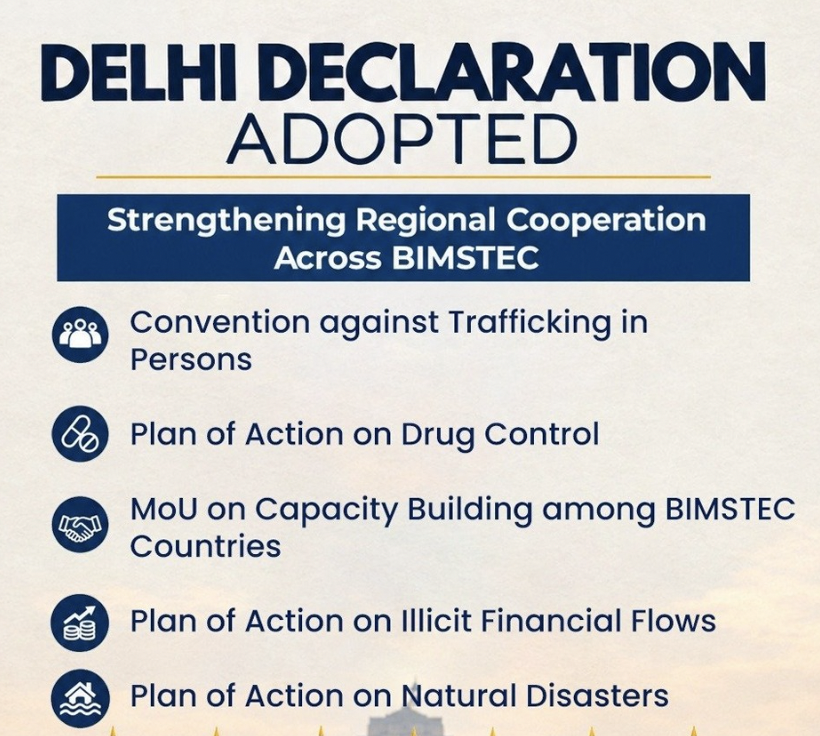
The first BIMSTEC Home Ministers’ Meeting adopted the Delhi Declaration in New Delhi on 13 October 2026, calling for regional security cooperation against trafficking, terrorism and transnational crime.

  • The declaration specifically recognises forced criminality: trafficked people compelled to conduct online fraud and scam operations.
  • It calls for a victim-centred approach involving countries of origin, transit and destination, alongside countries hosting scam centres and defrauded individuals.
  • It seeks implementation of existing cooperation instruments while urging early finalisation of unfinished conventions and victim-rescue procedures.
  • A scam operation can connect human trafficking and financial fraud across borders; a purely domestic investigation may capture only one part of that chain.
  • Regional cooperation must connect victim protection with evidence gathering without treating an international declaration as permission to bypass national law.

UPSC Relevance

Prelims Relevance

  • BIMSTEC: Bay of Bengal Initiative for Multi-Sectoral Technical and Economic Cooperation.
  • Members: Bangladesh, Bhutan, India, Myanmar, Nepal, Sri Lanka and Thailand.
  • Forced criminality: exploiting trafficked victims by compelling criminal activity.
  • Distinction between mutual legal assistance and extradition.
  • Delhi Declaration: victim-centred cooperation within domestic laws and applicable international obligations.

Mains Relevance

GS Paper 2

  • Regional institutions and sovereign equality in cross-border cooperation.
  • Rights-based responses to trafficking and victim rehabilitation.

GS Paper 3

  • Cyber-enabled organised crime, human trafficking and financial investigation.

Essay

  • Security cooperation is strongest when protection of people accompanies prosecution of crime.

Background and Context

What Forced Criminality Changes

The declaration connects online fraud with exploitation of the people made to carry it out.

  • Forced criminality describes the exploitation identified here: organised groups compel trafficked victims to perpetrate online scams. The person communicating with a fraud victim may also be under coercion, debt bondage or other abuse.
  • Two forms of harm can coexist in the same operation: exploitation of trafficked workers and financial loss suffered by those deceived. Investigations should examine both without assuming everyone performing a scam has the same role.
  • Victim identification matters before assigning responsibility. A victim-centred response examines coercion and exploitation, rather than reading a person’s presence in a scam centre as sufficient evidence of freely chosen participation in an organised criminal enterprise.
  • Technology helps criminal groups facilitate trafficking and exploit victims in online fraud, according to the declaration. This joins human-security and cybercrime concerns; treating them as unrelated problems can leave the underlying exploitation insufficiently examined.
  • Rescue alone is an incomplete policy response. The declaration also seeks procedures for repatriation and reintegration, recognising that returning a person across a border does not itself settle their protection and recovery needs.

Why Several Countries Must Cooperate

The relevant jurisdictions are defined by the trafficking and fraud chain, rather than by the location of one arrested suspect.

  • Origin, transit and destination countries have different connections to the movement and exploitation of victims. The declaration explicitly asks them to cooperate rather than leaving responsibility solely to the country where a victim is found.
  • Scam-centre locations and countries where individuals are defrauded also belong in this response. That distinction matters because the place of exploitation and the place of financial harm need not be the same jurisdiction.
  • Domestic law remains the operating framework: cooperation is required within respective jurisdictions and across borders, subject to applicable international obligations. The declaration does not grant a member’s police unrestricted authority inside another member’s territory.
  • Sovereign equality, territorial integrity and non-interference frame BIMSTEC security cooperation. Its work complements bilateral and other regional arrangements; it does not replace those channels or create a single regional criminal-justice jurisdiction.
  • Implementation depends on institutions after the meeting. The declaration directs the Joint Working Group on Counter-Terrorism and Transnational Crime and its subgroups to follow up, while encouraging specialised training across member states.

Separate Commitments From Completed Legal Instruments

The official declaration distinguishes existing instruments from texts still needing agreement.

  • The Delhi Declaration records agreed political directions. Adoption should not be described as enactment of a common criminal law, creation of a regional police force or an automatic right to extradite suspects.
  • The counter-terrorism convention, covering international terrorism, transnational organised crime and illicit drug trafficking, entered into force in March 2021. The declaration calls for full implementation of this existing instrument rather than announcing its first adoption.
  • Mutual legal assistance concerns cooperation in criminal matters; extradition concerns surrender of a person. The declaration refers to a signed assistance convention while separately asking members to finish the extradition convention’s text.
  • Trafficking and prisoner-transfer conventions also require early finalisation, alongside rescue, repatriation and reintegration procedures. These requests identify unfinished work; they are not evidence that all the proposed instruments are already operational across member states.
  • Information sharing is another pending step: members are asked to consult further on a proposed mechanism covering trafficking and migrant smuggling. Its future operation must follow national legal frameworks, rather than unrestricted cross-border data exchange.

Way Forward

Make Cooperation Usable in Individual Cases

  • Develop victim-referral procedures linking rescue, interpreters, safe return and reintegration, with clear responsibilities for the countries involved.
  • Use lawful evidence requests and financial investigation alongside rescue, so action reaches organisers and proceeds rather than stopping at people found inside scam centres.
  • Assess progress through implemented procedures, case cooperation and victim protection; do not equate another declaration with completed enforcement arrangements.

Conclusion

  • The Delhi Declaration’s useful contribution is to connect forced criminality with victim-centred regional cooperation. It recognises that online fraud can involve both exploitation of workers and harm to people deceived across borders.
  • For analysis, separate political commitment, existing legal instruments and unfinished negotiations. Effective cooperation requires protection of victims and coordination between jurisdictions, with domestic law remaining central to how individual cases are handled.

UPSC Practice Questions

Prelims MCQ 1

With reference to the BIMSTEC Delhi Declaration adopted in October 2026, consider the following statements:

  1. It recognises that trafficking victims may be forced to carry out online scams.
  2. It makes regional security cooperation a substitute for bilateral cooperation.
  3. It calls for early finalisation of the convention on extradition.

How many of the above statements are correct?

(a) Only one (b) Only two (c) All three (d) None

Answer: (b) Only two

Explanation:

Statements 1 and 3 are correct. The declaration expressly makes BIMSTEC cooperation complementary to, rather than a substitute for, bilateral and other cooperation.

Prelims MCQ 2

Which approach best reflects the declaration’s response to scam-centre trafficking?

(a) Treat every person conducting an online scam as acting voluntarily (b) Limit cooperation to the country where the scam centre operates (c) Coordinate relevant jurisdictions while respecting victims’ rights and domestic laws (d) Allow foreign police to operate anywhere in the region without legal procedures

Answer: (c) Coordinate relevant jurisdictions while respecting victims’ rights and domestic laws

Explanation:

The declaration includes origin, transit and destination countries as well as locations of scam centres and defrauded individuals, with a victim-centred approach and legal safeguards.

UPSC Mains Questions

  1. How does trafficking for forced criminality complicate the distinction between offenders and victims? Discuss the requirements of a victim-centred regional response.
  2. Evaluate the potential and limitations of BIMSTEC cooperation against transnational organised crime, with reference to the Delhi Declaration.

Source: PIB, Ministry of Home Affairs.

Frequently Asked Questions

What is the BIMSTEC Delhi Declaration?

It is the declaration adopted at the first BIMSTEC Home Ministers’ Meeting on 13 October 2026. It sets directions for regional security cooperation, including action against trafficking, terrorism and transnational organised crime.

What does forced criminality mean here?

It refers to trafficked people being compelled to carry out criminal activity, particularly online fraud and scam operations. The declaration links this exploitation with debt bondage and other abusive practices.

Does the declaration create automatic extradition?

No. It calls for early finalisation of the extradition convention’s text. A political declaration should not be read as automatically authorising surrender of suspects or overriding applicable domestic legal procedures.

Why are countries where people are defrauded included?

Fraud victims may be in a different country from the scam centre or trafficked workers. Including their jurisdictions connects the financial harm with the wider trafficking and exploitation investigation.

Keralam Elder-Care Bill: Registration and Rights-Based Oversight

Open article →Download PDF

Why in News?

The Keralam government introduced the Senior Citizens’ (Care and Protection of Rights) Bill, 2026, on October 13, proposing registration and rights-based oversight of elder-care services, The Indian Express reported.

  • The Bill remains a legislative proposal; its proposed registration duties and enforcement powers must not be described as already operational law.
  • Its coverage extends beyond residential homes to day care, home-care agencies and caregiver-training centres, subject to exclusions in the draft.
  • A proposed Registrar and district institutions would connect registration decisions, inspection reports and complaint handling.
  • The draft pairs service regulation with dignity, supported decision-making and ageing in place, rather than treating shelter alone as adequate care.
  • An older person may depend on a provider for everyday assistance while finding it difficult to complain; independent oversight addresses this unequal relationship.
  • The governance test is whether registration leads to continuing accountability, while protecting autonomy and keeping essential services accessible.

UPSC Relevance

Prelims Relevance

  • Ageing in place: living safely and independently at home or in a chosen community.
  • Registrar: the proposed designation of the Director, Department of Senior Citizens.
  • District Protection Unit: the proposed executing and inquiry institution.
  • District Protection Forum: the proposed supervisory and complaint-direction institution.
  • Supported decision-making: assistance that prioritises the older person’s own choices.

Mains Relevance

GS Paper 2

  • Regulation of welfare-service providers and accountability for vulnerable groups.
  • Balancing protection from abuse with autonomy, accessibility and procedural fairness.

Essay

  • Care preserves dignity when assistance strengthens choice rather than replacing it.

Background and Context

What Services Would the Bill Regulate?

The proposal treats elder care as a range of services, with registration intended to make providers identifiable and accountable.

  • The definition of a senior citizen care centre covers paid and unpaid facilities, including residential homes, day-care centres, respite care, hospices, home-care agencies and caregiver-training establishments serving older people.
  • Coverage is not unlimited: the definition excludes government old-age homes established under the central maintenance law and long-term care homes or units within the Mental Healthcare Act’s purview.
  • The proposed Registrar would maintain separate registers for different categories of care centres and develop a searchable public registry, while preventing disclosure of personal data held within the registration system.
  • Minimum standards would cover facilities, care coordination, referral and continuity arrangements; separate category-specific guidelines recognise that a residential home and a home-care agency do not deliver identical forms of care.
  • The definition of a home-care service agency includes paid digital intermediaries connecting caregivers with families; the draft would require accessible pricing, grievance arrangements and safeguards for sensitive personal information.

How Would Registration and Complaints Work?

The proposed structure separates field inquiry, supervisory directions and registration decisions, giving each institution a different responsibility in provider oversight.

  • A provider would apply to the Registrar through the district Protection Unit; the Unit would inquire into the application and forward its findings and recommendation, rather than grant registration itself.
  • The Registrar would decide whether to register the centre or reject its application with recorded reasons; an aggrieved applicant could appeal through the route specified in the Bill.
  • The district Protection Unit would inspect suspected unregistered facilities, check infrastructure and investigate complaints; its reports would supply evidence for further action, rather than make every allegation an automatic closure order.
  • The district Protection Forum, chaired by the District Collector, would supervise the Unit and issue complaint-redress directions; continued non-compliance could trigger closure action coupled with arrangements to rehabilitate residents.
  • Procedural safeguards include an opportunity to respond before registration revocation; timely renewal applications would keep certificates effective pending disposal, distinguishing accountable regulation from abrupt disruption of ongoing care.

Why Do Resident Rights Matter Alongside Registration?

A registered building can still deliver coercive or inaccessible care; the proposal also addresses how older people experience services and exercise choices.

  • Ageing in place favours remaining safely at home or in a chosen community, with institutional care as a last resort; it does not mean that families need no service support.
  • The draft prioritises supported decision-making and permits substitute decisions only when support is not possible; its independence principle also recognises privacy, beliefs and choices about care and quality of life.
  • Accessibility includes senior-friendly public spaces and usable digital services, alongside non-digital alternatives; this combination matters because an online-only complaint or application route can exclude the people regulation is intended to protect.
  • Abuse extends beyond physical harm to economic exploitation, coercive control and neglect; registered medical practitioners and care centres would have reporting duties when they reasonably suspect abuse, neglect or exploitation.
  • The contrast is between provider compliance and resident protection: registration identifies who supplies care, while complaints, independent inquiry and respect for individual choices address how that care is actually delivered.

Way Forward

Make Oversight Usable for Residents

  • Define inspection standards around actual care, privacy and safe access, rather than treating paperwork as sufficient evidence of quality.
  • Provide assisted and offline complaint channels, with clear responsibility for follow-up and protection against retaliation by providers.
  • Link any closure action to continuity of care, so residents retain shelter, support and access to their records.
  • Scrutinise delegated rules and implementation capacity before assuming the proposed institutional structure will produce effective protection.

Conclusion

  • The Bill’s central contribution is a proposed chain of provider registration, district scrutiny and rights-based care; its value depends on whether residents can use that chain when services fail.
  • For governance answers, distinguish a proposed legal framework from implemented protection: institutional design creates responsibilities, but accessible complaints, reasoned decisions and continuity of care determine whether those responsibilities help older people.

UPSC Practice Questions

Prelims MCQ 1

With reference to the proposed Keralam Senior Citizens’ Bill, consider the following statements:

  1. Home-care agencies operating through paid digital platforms fall within its regulatory scope.
  2. The district Protection Unit would itself grant every registration certificate.
  3. Ageing in place gives preference to care at home or in the chosen community.

How many of the above statements are correct?

(a) Only one (b) Only two (c) All three (d) None

Answer: (b) Only two

Explanation:

Statements 1 and 3 are correct. The district Unit would inquire and recommend; the Registrar would decide registration applications.

Prelims MCQ 2

Which arrangement best reflects supported decision-making in elder care?

(a) Replacing every older person’s choice with the provider’s choice (b) Treating admission to a care home as loss of privacy (c) Helping an older person understand options and express a choice (d) Restricting complaints to relatives alone

Answer: (c) Helping an older person understand options and express a choice

Explanation:

The Bill prioritises supported decision-making. Substitute decisions are envisaged only when supported decision-making is not possible.

UPSC Mains Questions

  1. Registration of elder-care providers is necessary but insufficient to protect residents. Discuss with reference to complaint handling, autonomy and continuity of care.
  2. How can a rights-based elder-care framework reconcile ageing in place with the regulation of institutional and home-based services?

Sources: Keralam Legislature, Bill No. 15 and The Indian Express.

Frequently Asked Questions

Is the Keralam elder-care Bill already an operational law?

The verified development is its introduction in the Legislative Assembly. The registration duties, institutions and enforcement arrangements discussed here are proposals in the Bill, not confirmed operational provisions.

Would the proposal cover only residential care homes?

No. Its definition includes day-care centres, respite care, hospices, home-care service agencies and caregiver-training centres. It also specifies exclusions, so coverage should not be described as universal across every existing institution.

Who would decide registration applications?

The proposed Registrar would decide applications after examining the district Protection Unit’s inquiry report and relevant records. The Unit would undertake field scrutiny and make recommendations rather than independently grant registration.

What does ageing in place mean?

It means living safely and independently in one’s home or chosen community. The Bill treats institutional care as a last resort while recognising the importance of family, community and service support.

Why are non-digital alternatives relevant to elder care?

Older people with limited digital literacy may struggle to use online services. The Bill recognises accessible digital services alongside non-digital alternatives, helping prevent technology requirements from becoming barriers to rights and support.

MSDC Port Rules: Coordinating Coastal States and Common Processes

Open article →Download PDF

Why in News?

On 13 October 2026, the Maritime State Development Council concluded its first meeting since receiving statutory recognition, approving draft instruments and a shared programme for port coordination.

  • The Council approved draft regulations and guidelines covering its functioning, port data and tariff transparency.
  • It resolved to implement One Nation One Port Process reforms and single-window integration across ports by March 2027.
  • Electronic publication of port tariffs was mandated to improve transparency for port users.
  • States were urged to align port master plans and connectivity projects with a national perspective.
  • A port expansion can underperform when land transport links, cargo-handling capacity and regulatory processes develop separately.
  • Cooperative federalism matters because coordinated infrastructure planning requires central institutions, coastal governments and port bodies to work together.

UPSC Relevance

Prelims Relevance

  • MSDC: a statutory consultative body under the Indian Ports Act, 2025.
  • Other Than Major Ports: included in the coordinated planning agenda alongside Major Ports.
  • ONOP: common documentation, port-process redesign and inter-ministerial reforms.
  • Tariff transparency: publication of charges, distinct from uniform charges.
  • Multimodal connectivity: integrating ports with different freight transport modes.

Mains Relevance

GS Paper 2

  • Centre–State coordination through a statutory consultative institution.
  • Distinguishing policy resolutions from enforceable rules and completed implementation.

GS Paper 3

  • Port-led development, logistics bottlenecks and transparent user charges.

Essay

  • Institutions create economic value when they coordinate interdependent public decisions.

Background and Context

What Statutory Port Coordination Changes

The Council provides a formal meeting point for institutions whose decisions shape the same maritime economy, even when their administrative responsibilities differ.

  • The Indian Ports Act, 2025 gives MSDC a statutory consultative basis. According to the ministry, its mandate covers coordinated policy formulation, integrated maritime growth and planned infrastructure development across the sector.
  • Consultation brings coastal governments, State Maritime Boards, Major Ports and central ministries into a shared planning forum. This helps reveal dependencies that an individual port authority may not be able to resolve alone.
  • A statutory foundation establishes the institutional basis for coordination. It does not mean every Council announcement automatically becomes an operational rule, or that all agreed measures already apply uniformly to port users.
  • The meeting approved draft regulations and guidelines and called for subordinate rule-making by States and Union Territories. Draft approval, formal notification and practical enforcement are separate stages when assessing a reform’s legal effect.
  • The announcement describes joint Centre–State action, including State-led port planning. It does not announce a takeover of all state ports by the Centre; cooperation should not be confused with a transfer of ownership.

Common Processes and Visible Tariffs

Process harmonisation aims to make port procedures more consistent, while tariff transparency makes the charges associated with those services easier to examine.

  • One Nation One Port Process includes common documentation, port-process re-engineering and inter-ministerial changes. The practical issue is whether traders encounter repeated information requests and inconsistent procedures when cargo moves through different ports.
  • The Council set March 2027 for nationwide implementation and single-window integration. This is a future implementation commitment; the release does not establish that every port already operates under a fully harmonised system.
  • A single-window arrangement can provide a common digital interface for port-related processes. Its value depends on participating agencies coordinating requirements behind that interface, rather than merely moving existing forms onto a screen.
  • Electronic tariff publication lets users inspect the charges a port advertises before choosing services. Better visibility can help firms compare costs and question discrepancies, but publication by itself does not guarantee lower charges.
  • Transparent tariffs and identical tariffs are different concepts. The Council’s publication decision concerns access to pricing information; it should not be read as imposing one nationally uniform price for every port service.

Why Connectivity Must Accompany Port Expansion

The planning agenda connects harbour capacity with the transport links and industrial locations that generate cargo and carry it inland.

  • States were urged to prepare Port Master Plans for Other Than Major Ports using a standardised template. A common planning framework can make proposals easier to compare while retaining their local infrastructure context.
  • Multimodal connectivity links ports with road, rail, inland waterways, pipelines and conveyors. Each mode serves different cargo needs; choosing connections requires matching the transport system to cargo characteristics and the surrounding industrial geography.
  • The Council sought port-linked industrial clusters with land, ready infrastructure and coordinated approvals. Linking industrial locations to port expansion can help align expected cargo demand with the capacity being planned to handle it.
  • A larger berth cannot by itself resolve an inland freight bottleneck. If road or rail access remains constrained, cargo can accumulate beyond the waterfront; assessing the complete journey is essential to diagnosing delays.
  • Implementation quality should be judged through actual process changes, accessible tariff information and completed connectivity links. A shared plan is a starting point for coordination, rather than evidence that congestion or compliance burdens have disappeared.

Way Forward

Measure Implementation Across the Cargo Journey

  • Publish clear implementation responsibilities for each agreed measure, distinguishing draft instruments from notified rules and operational processes.
  • Check whether port users can find current tariffs, identify applicable charges and resolve discrepancies through a usable grievance route.
  • Sequence connectivity investments alongside port capacity so that unfinished inland links do not become the next bottleneck.
  • Track duplicate documentation and processing delays before and after reforms to assess benefits beyond the availability of a digital interface.

Conclusion

  • The MSDC decisions illustrate cooperative federalism applied to interdependent infrastructure: common processes and information standards require coordinated action across institutions, while port development must remain connected to inland freight needs.
  • For analysis, separate the statutory institution, the Council’s decisions and completed implementation. Transparent charges, coordinated planning and a future deadline are meaningful developments, but do not prove nationwide operational uniformity.

UPSC Practice Questions

Prelims MCQ 1

With reference to the October 2026 MSDC decisions, consider the following statements:

  1. MSDC functions as a statutory consultative body under the Indian Ports Act, 2025.
  2. Electronic publication of port tariffs necessarily establishes identical tariffs at every port.
  3. The Council set a future deadline for nationwide ONOP implementation.

How many of the above statements are correct?

(a) Only one (b) Only two (c) All three (d) None

Answer: (b) Only two

Explanation:

Statements 1 and 3 are correct. Publication makes tariffs visible; the release does not prescribe identical charges across ports.

Prelims MCQ 2

Which situation best illustrates the need for integrated port connectivity planning?

(a) A new berth opens while its inland rail connection remains a cargo bottleneck. (b) A port publishes a clear list of service charges. (c) A trader compares the published charges of two ports. (d) A port replaces one redundant form with a common document.

Answer: (a) A new berth opens while its inland rail connection remains a cargo bottleneck.

Explanation:

Port capacity and inland evacuation capacity are interdependent. Expanding the waterfront alone cannot remove a bottleneck elsewhere in the freight journey.

UPSC Mains Questions

  1. Explain how a statutory consultative institution can strengthen cooperative federalism in port development without centralising every operational responsibility.
  2. Common digital processes cannot substitute for physical connectivity in port-led development. Discuss with reference to the MSDC reform agenda.

Source: PIB, Ministry of Ports, Shipping and Waterways.

Frequently Asked Questions

What is the Maritime State Development Council?

MSDC is a statutory consultative body under the Indian Ports Act, 2025. It brings central and coastal-state institutions together for coordinated maritime policy and planned infrastructure development.

Have common port processes already been implemented nationwide?

The October meeting resolved to implement ONOP reforms and single-window integration across ports by March 2027. That is an implementation commitment, not confirmation that harmonisation is already complete at every port.

Does electronic tariff publication mean identical port charges?

No. Publication improves access to information about charges. Uniform tariffs would require a separate pricing decision; the Council’s transparency announcement should not be interpreted as establishing identical charges for every port service.

Did the Council announce a takeover of state ports?

No such takeover is announced in the release. Its focus is coordinated planning involving States, State Maritime Boards, Major Ports and central ministries, including State preparation of port master plans.

Why does port reform require inland connectivity?

Cargo must move between the waterfront and inland producers or users. Berth expansion can deliver limited benefits if road, rail or other freight connections remain constrained, making coordinated investment essential.

Samarthak: A Multipurpose Platform for Naval Trials

Open article →Download PDF

Why in News?

The Ministry of Defence announced on 13 October that the Indian Navy is scheduled to commission Samarthak, a multipurpose vessel, at Karwar on 16 October 2026.

  • Larsen and Toubro built the vessel; the announcement describes maritime surveillance and patrol as its primary design roles.
  • Announced additional roles include a target deployment and trials platform and an unmanned or autonomous system mothership.
  • The release also lists humanitarian assistance and disaster relief and possible conversion to a limited hospital ship; it does not establish that such a conversion has occurred.
  • The trials focus differs from fleet replenishment and shallow-water anti-submarine craft: supporting equipment evaluation is a distinct contribution to naval capability.
  • The useful distinction is between an announced role, successful trials and a demonstrated operational capability; they are not interchangeable stages.

UPSC Relevance

Prelims Relevance

  • Samarthak: multipurpose vessel built by Larsen and Toubro.
  • Commissioning announced for 16 October 2026 at Naval Base, Karwar.
  • Target deployment and trials platform: one of its stated roles.
  • Unmanned does not necessarily mean autonomous.
  • Hospital conversion is a stated possibility, not confirmed completed conversion.

Mains Relevance

GS Paper 3

  • Role of support and trials infrastructure in indigenous defence technology.
  • Human oversight, verification and operational limits of unmanned maritime systems.

Essay

  • Technological self-reliance depends on testing capacity as well as manufacturing.

Background and Context

What Has Been Announced About Samarthak?

The announcement identifies a versatile naval vessel, but a list of intended roles is not evidence of every role being operationally demonstrated.

  • The Ministry of Defence release describes surveillance and patrol as primary design purposes. These concern maintaining awareness and presence at sea, rather than proving that the ship possesses every specialised combat capability.
  • The trials-platform role is particularly relevant to defence innovation. A vessel used for evaluating equipment provides a maritime setting for testing; the announcement alone does not disclose test protocols, results or acceptance standards.
  • The stated mothership role concerns supporting unmanned or autonomous systems. Read this as an assigned utility function, not confirmation of particular onboard vehicles, their operating range, endurance, payloads or an already deployed autonomous fleet.
  • The release mentions an integrated combat suite combining indigenous sensors, weapons and electronic systems. It does not name those systems, so specific radar models, weapon types or performance figures cannot be inferred from this description.
  • Commissioning is scheduled for 16 October at Karwar. The announcement sets out the intended induction and utility roles; it does not report completed commissioning or provide results from operational deployments.

How Does a Mothership Support Unmanned Systems?

Mothership, unmanned and autonomous describe different concepts: the supporting platform, the absence of onboard crew and the degree of independent operation.

  • A mothership, in general maritime usage, supports smaller craft or systems away from shore. Possible support functions depend on its design; the label by itself does not verify which facilities Samarthak actually carries.
  • An unmanned system operates without a person aboard the vehicle itself. Human operators may still direct it remotely, making the absence of onboard personnel different from the absence of human involvement in a mission.
  • An autonomous system can perform specified functions with some independence from continuous commands. Autonomy is task-dependent; describing a platform this way does not establish independent decision-making across all navigation, sensing or other operational functions.
  • A trials platform can help examine how equipment behaves in realistic maritime conditions. Conceptually, testing links a design claim to observations, enabling engineers to identify limitations before treating a prototype as dependable operational equipment.
  • Target deployment and system testing are connected but distinct functions. Deploying a target creates a test condition; evaluating the resulting observations determines what was demonstrated, under which conditions, and what still requires further examination.

Why Utility Platforms Need Careful Capability Claims

A multipurpose vessel offers flexibility, but flexibility is not unlimited capability: each additional mission requires suitable equipment, personnel and validated procedures.

  • Multipurpose describes the breadth of possible assignments. It should not be interpreted as the ability to perform every listed mission simultaneously, because equipment arrangements, trained personnel and operating conditions can constrain practical mission choices.
  • The announcement lists humanitarian assistance and disaster relief among the vessel’s roles. That supports discussing utility beyond combat, but does not justify inventing relief cargo capacities, evacuation numbers or particular onboard medical facilities.
  • Possible conversion to a limited hospital ship is conditional language. It signals an adaptation envisaged in the announcement, not evidence that hospital facilities have been installed, staffed, certified or used in an actual response.
  • Manufacturing and verification address different questions. Domestic construction identifies where a platform is built; trials examine whether equipment performs as intended. Neither fact alone establishes complete technological independence or readiness for every assigned operational task.
  • For unmanned maritime technology, human oversight remains an important analytical question. An assessment should ask who authorises tasks, monitors performance and intervenes during failure, rather than assuming “autonomous” means that responsibility disappears from naval operations.

Way Forward

Assess Roles Against Demonstrated Performance

  • Publish appropriate non-sensitive trial outcomes so announced functions can be distinguished from tested and accepted capabilities.
  • Evaluate mission-specific readiness, including trained crews and support arrangements, before treating a flexible platform as ready for every listed role.
  • Build human oversight and failure procedures into evaluation of unmanned systems, alongside their technical performance.

Conclusion

  • Samarthak’s significance lies in the announced combination of patrol, trials and unmanned-system support functions; the important current development is its planned commissioning, not proof that every listed role has already been demonstrated.
  • Use the example to explain that defence self-reliance involves platforms for testing and supporting technology as well as building it, while keeping design intentions, verified performance and operational employment clearly separated.

UPSC Practice Questions

Prelims MCQ 1

With reference to Samarthak and unmanned maritime systems, consider the following statements:

  1. The Ministry of Defence lists a target deployment and trials platform among Samarthak’s roles.
  2. An unmanned vehicle must necessarily operate without any remote human control.
  3. As of 14 October 2026, Samarthak’s commissioning was scheduled for 16 October.

How many of the above statements are correct?

(a) Only one (b) Only two (c) All three (d) None

Answer: (b) Only two

Explanation:

Statements 1 and 3 match the announcement. Unmanned means no person aboard the vehicle; it does not exclude remote human control.

Prelims MCQ 2

Which interpretation of an announced multipurpose naval vessel is most accurate?

(a) Every listed role has already been demonstrated in operations. (b) The vessel can necessarily perform every role simultaneously. (c) Each listed role requires assessment of suitable equipment, personnel and procedures. (d) A mothership is necessarily itself an unmanned vessel.

Answer: (c) Each listed role requires assessment of suitable equipment, personnel and procedures.

Explanation:

A broad list of roles describes utility; it does not demonstrate simultaneous readiness or remove mission-specific requirements.

UPSC Mains Questions

  1. Explain how naval trials and support platforms contribute to indigenous defence technology development. Distinguish manufacturing capability from demonstrated operational performance.
  2. Differentiate unmanned and autonomous maritime systems. Discuss why human oversight and mission-specific evaluation matter in their naval use.

Source: PIB, Ministry of Defence.

Frequently Asked Questions

Has Samarthak already been commissioned?

As of 14 October 2026, no completed commissioning is established by the cited announcement. The Ministry of Defence said on 13 October that commissioning was scheduled at Karwar for 16 October.

What are Samarthak’s announced roles?

The release identifies surveillance and patrol as primary design roles, alongside functions including target deployment, trials, unmanned-system support and disaster relief. These statements should be distinguished from verified operational results.

Is an unmanned system always autonomous?

No. Unmanned means there is no person aboard the vehicle itself. It may still be remotely controlled. Autonomy concerns the degree to which specified functions can proceed without continuous commands.

Does the announcement confirm an operational hospital ship?

No. The release lists conversion to a limited hospital ship as a possibility. It does not establish that medical facilities have been installed or that a hospital conversion has already occurred.

Soybean Trials: From Harvest Results to Reliable Yield Evidence

Open article →Download PDF

Why in News?

On 13 October, PIB reported promising preliminary soybean yields from NRC 268 and NRC 270, assessed during the ICAR–National Soybean Research Institute’s Harvest Day on 9 October.

  • Preliminary yields were approximately 20 quintals per hectare; the release placed national average productivity at approximately 10–11 quintals per hectare.
  • The Indore institute reported encouraging performance despite adverse weather, while stating that the harvested data would undergo further scientific analysis.
  • The report emphasised multi-year data across regions, varieties and production conditions to assess productivity gains and guide agricultural extension.
  • Varietal improvement can raise production from existing cultivated land, but the observed outcome also depends on management and environmental conditions.
  • Extension advice needs locally relevant evidence: a promising research observation should become a testable recommendation, rather than a guaranteed yield claim.

UPSC Relevance

Prelims Relevance

  • NRC 268 and NRC 270: soybean varieties assessed by ICAR–National Soybean Research Institute, Indore.
  • Yield per hectare measures productivity; total production also depends on cultivated area.
  • Genotype, management and environment jointly influence realised crop yield.
  • A national average is not a matched experimental control.

Mains Relevance

GS Paper 3

  • Agricultural research, extension and the gap between experimental results and farm outcomes.
  • Evidence requirements for assessing crop performance under variable weather.

Essay

  • Scientific progress depends on testing whether promising results remain reliable outside their original setting.

Background and Context

What the Soybean Harvest Actually Shows

The harvest provides a promising observation about particular varieties under particular conditions; it does not yet establish an outcome for every soybean farmer.

  • NRC 268 and NRC 270 were developed by the ICAR institute at Indore. The release describes their harvest results as preliminary, making further analysis part of the finding rather than an optional qualification.
  • The reported 20 quintals per hectare is an area-normalised yield measure. It describes harvested output relative to land area, not the quantity that every participating field necessarily produced in total.
  • The national average offers a useful productivity benchmark, but combines farms with different soils, weather and management. Comparing the harvest with that average cannot isolate the contribution made by the new varieties alone.
  • Adverse-weather performance is relevant because farmers face variable conditions. The release does not establish which specific stress each variety tolerates, or quantify how much yield loss it avoided against a comparable alternative.
  • Promising and proven across farming conditions describe different evidence levels. The announcement supports further investigation; it does not establish guaranteed doubling of farm yields, specific genetic traits or an assured commercial return.

Why Varieties Perform Differently Across Fields

Realised yield emerges from the interaction between the plant, its growing conditions and the practices used to manage it throughout the season.

  • Genotype refers to the plant’s genetic constitution. A variety’s productive potential is expressed within an environment, so good performance at one location does not automatically establish equally good performance in another region.
  • Management includes practical decisions about sowing and crop care. When management differs between fields, an observed yield difference cannot safely be attributed only to the variety; the production package must also be considered.
  • Weather and soil conditions influence the growing environment. A useful assessment records these conditions alongside yields, allowing researchers to distinguish a broadly repeatable advantage from a result tied to one favourable combination.
  • Multi-environment trials examine performance across locations and seasons. They help identify whether a variety performs consistently or mainly suits particular conditions, making recommendations more informative than a single highest-yield observation.
  • Fair comparison requires suitable alternatives grown under comparable conditions. Without that comparison, a successful harvest shows what happened, but provides weaker evidence about why it happened or which change caused the improvement.

From Research Results to Farm Recommendations

The policy challenge is to turn an encouraging result into advice farmers can trust, with its benefits, costs and limits clearly stated.

  • Repeated measurement can show whether an apparent advantage persists. The institute explicitly highlighted systematic data collection over several years as a basis for assessing productivity changes and the effectiveness of research dissemination.
  • Farm-level validation should examine performance under practical production conditions. A result achieved with close supervision may not transfer unchanged where farmers face different access to inputs, timely operations, information or labour.
  • Yield stability and peak yield answer different questions. Farmers need to know whether performance is dependable, while researchers also need to understand the conditions associated with both stronger results and disappointing harvests.
  • Economic assessment should accompany productivity evidence. Additional output is useful, but its value depends on the costs and constraints of achieving it; yield alone is insufficient to establish a farmer’s net benefit.
  • Transparent extension should separate the observed result from the recommendation. Reports should explain the comparison used, applicable conditions and remaining uncertainty, enabling farmers and public agencies to assess the evidence behind adoption advice.

Way Forward

Build Recommendations Around Comparable Evidence

  • Publish analysed trial findings with suitable comparisons and production conditions, preserving the distinction between an initial harvest observation and a validated recommendation.
  • Connect research with local extension feedback so evidence reflects practical constraints; the broader farmer-policy debate also requires attention to viability.
  • Keep performance evidence separate from other seed-policy questions, including benefit-sharing in the seed sector; neither substitutes for reliable agronomic testing.

Conclusion

  • The soybean harvest is an evidence-building opportunity: encouraging preliminary yields justify deeper assessment, while the national average provides context rather than proof that the varieties alone caused the difference.
  • Use the example to connect research with extension: reliable agricultural innovation requires repeatable performance, suitable local comparisons and clear communication of uncertainty before promising farmers a particular outcome.

UPSC Practice Questions

Prelims MCQ 1

With reference to evaluating a new crop variety, consider the following statements:

  1. A national average yield is necessarily a matched control for a research harvest.
  2. Performance across different seasons and locations helps assess the reliability of a variety’s yield.
  3. An encouraging harvest in adverse weather alone proves tolerance to every climatic stress.

How many of the above statements are correct?

(a) Only one (b) Only two (c) All three (d) None

Answer: (a) Only one

Explanation:

Only statement 2 is correct. National averages combine different conditions; a preliminary adverse-weather observation cannot establish tolerance to every stress.

Prelims MCQ 2

Which approach best helps isolate a new variety’s contribution to yield?

(a) Comparing its highest harvest only with a national average (b) Comparing suitable varieties under comparable production conditions (c) Inferring performance from the variety’s name (d) Treating one successful harvest as a nationwide guarantee

Answer: (b) Comparing suitable varieties under comparable production conditions

Explanation:

Comparable conditions and suitable alternatives reduce the risk of attributing management or environmental effects solely to the variety.

UPSC Mains Questions

  1. Why should promising research-station yields be distinguished from reliable farm-level outcomes? Discuss using recent soybean harvest observations.
  2. Explain how multi-environment testing and agricultural extension can strengthen evidence-based recommendations for improved crop varieties.

Source: PIB, Ministry of Agriculture & Farmers Welfare.

Frequently Asked Questions

What did the recent soybean harvest report find?

PIB reported preliminary yields of approximately 20 quintals per hectare for NRC 268 and NRC 270. The institute described the observations as encouraging and said the data would undergo further scientific analysis.

Do these results prove that farmer yields will double?

No. The national average combines farms with different growing conditions. Comparing it with a preliminary harvest cannot establish a guaranteed farm outcome or isolate the effect of the varieties from management and weather.

Why are several seasons of crop data useful?

Observations across seasons help assess whether performance persists when growing conditions change. They provide a stronger basis for identifying suitable production conditions and communicating a variety’s limits than a single successful harvest.

Does performance in adverse weather establish climate resilience?

It is a useful observation, but not sufficient proof of broad climate resilience. Researchers need clearer evidence about the stress involved, comparable alternatives and repeated performance under relevant conditions before making that claim.

Wastewater Nanofibres: Combining Light and Vibration

Open article →Download PDF

Why in News?

On 13 October 2026, the science ministry reported an INST Mohali membrane that combines light and mechanical vibration to treat dye-contaminated wastewater.

  • The PLA–ZnO membrane embeds zinc oxide nanoparticles in porous polylactic acid nanofibres, keeping the catalyst within a recoverable structure.
  • Laboratory tests reported 98.6% MB and 96.7% CR decolorisation within 120 minutes under combined light and ultrasonic excitation.
  • Machine learning predicted dye-decolorisation behaviour from experimental conditions; it did not replace the physical treatment mechanism.
  • Persistent industrial dyes can resist natural degradation, making pollutant destruction different from simply separating coloured material from water.
  • This is research-stage evidence, not proof of safe drinking water, complete pollutant mineralisation or commercial-scale performance.

UPSC Relevance

Prelims Relevance

  • Photocatalysis: light activates a catalyst and generates charge carriers.
  • Piezoelectric polarisation: mechanical stress produces electrical polarisation in a suitable material.
  • Immobilisation: fixing catalyst particles within a supporting structure.
  • Electrospinning: fabrication route used for the porous PLA–ZnO nanofibres.
  • Decolorisation: loss of colour, distinct from proof of complete mineralisation.

Mains Relevance

GS Paper 3

  • Nanomaterials and combined-energy approaches to industrial wastewater treatment.
  • Evidence requirements for translating laboratory results into environmentally safe treatment systems.

Essay

  • An environmental innovation must be judged by its entire treatment outcome, not its most impressive laboratory metric.

Background and Context

Why Embed Zinc Oxide in a Fibrous Membrane?

The new design changes how the catalyst contacts polluted water and how it can be handled after treatment, rather than merely adding another filter layer.

  • Zinc oxide supplies the catalytic component, while polylactic acid forms the fibrous support. Their combination creates a treatment membrane whose role extends beyond physically trapping suspended matter at a barrier.
  • Immobilisation addresses a practical weakness of freely dispersed nanoparticle powders: separating the catalyst from treated water. Holding particles in a membrane supports recovery, although actual particle release still requires measurement during repeated operation.
  • Electrospinning produced porous nanofibres with high surface area and mechanical stability, according to the release. The open structure provides contact between pollutants and catalytic surfaces, a requirement for reactions to occur efficiently.
  • Turmeric extract supplied compounds used during nanoparticle synthesis as reducing and stabilising agents. This describes the preparation route; it does not, by itself, establish that the finished composite is harmless in every environment.
  • The relevant distinction is separation versus degradation: adsorption transfers a pollutant onto a surface, whereas catalytic treatment seeks chemical breakdown. A treatment train may still need both functions rather than treating them as interchangeable.

How Light and Vibration Work Together

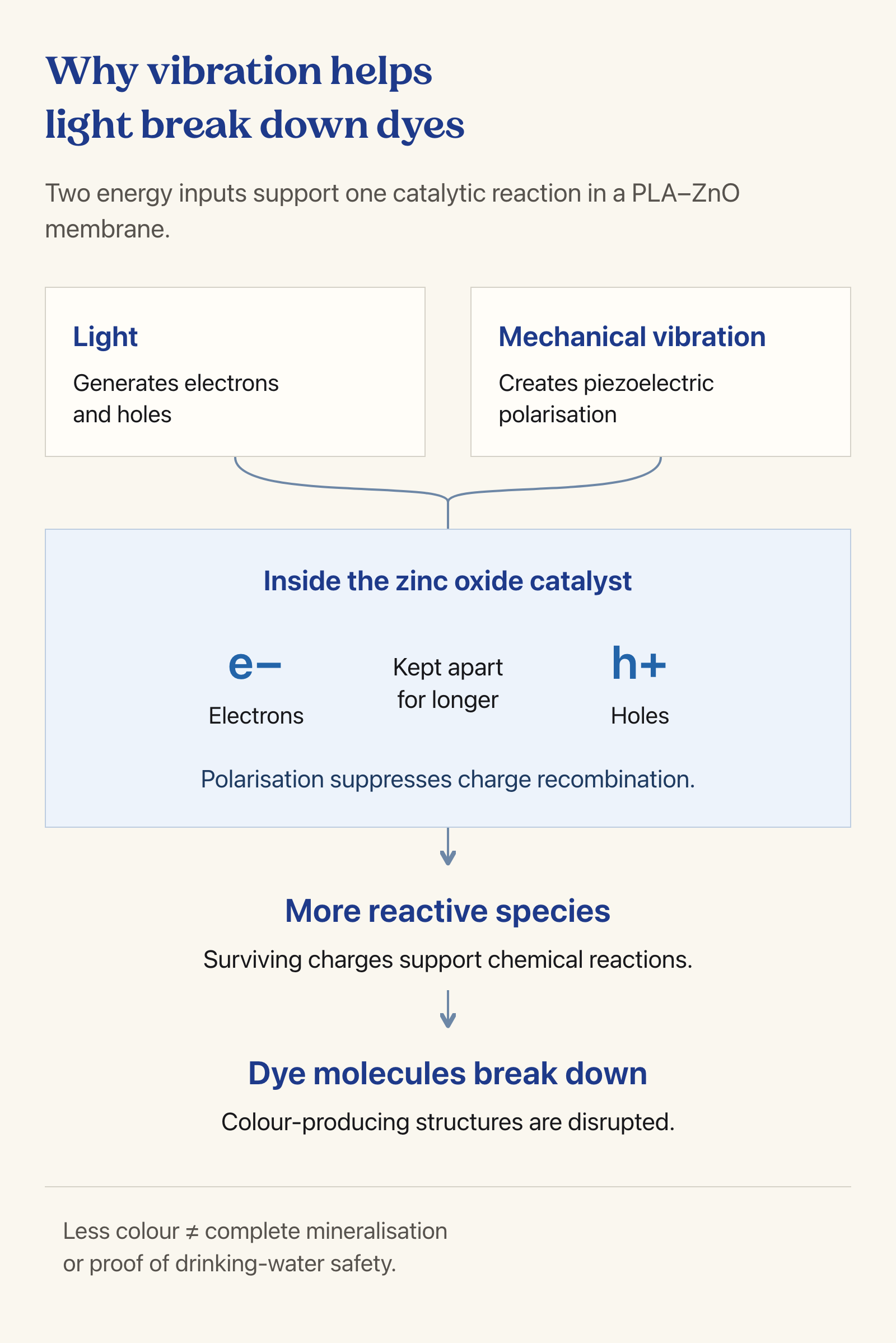
The reported advantage comes from preserving useful electrical charges long enough to drive chemical reactions, with two energy inputs supporting the same catalytic process.

  • Under light excitation, the catalyst generates electrons and holes. These charge carriers can participate in reactions that form reactive species, but their usefulness falls when they recombine before contributing to pollutant breakdown.
  • Mechanical vibration produces piezoelectric polarisation in the material. The reported experiments used ultrasonic excitation alongside light; ordinary water flow should not be assumed to reproduce the same controlled laboratory energy input.
  • The resulting polarisation suppresses electron–hole recombination, according to the researchers. More surviving charges support reactive-species formation, explaining why combining the inputs can improve the catalytic response rather than merely shaking the water.
  • Reactive species attack dye molecules and can disrupt the structures responsible for their colour. The mechanism explains the decolorisation result, but identifying every reaction product requires separate chemical analysis of the treated liquid.
  • Machine learning connected conditions such as illumination, treatment time, catalyst amount and dye concentration with experimental decolorisation behaviour. Its role was prediction within the study, not an autonomous system that physically removes pollutants.
Diagram showing light and mechanical vibration supporting charge separation in zinc oxide, reactive-species formation and dye breakdown
Light generates charge carriers; vibration-induced polarisation suppresses recombination and supports dye-degrading reactions. Colour removal alone does not establish drinking-water safety.

What the Results Establish and What They Leave Open

The strongest reading is a promising laboratory mechanism with clear next tests, not a claim that visibly clearer water has become safe for unrestricted use.

  • Decolorisation measures the disappearance of colour. Mineralisation means much more extensive conversion of organic pollutants into simple inorganic end products; high colour removal alone cannot demonstrate that this endpoint has been reached.
  • Toxicity can depend on transformation products as well as the original dye. Assessing treated effluent requires examining residual compounds and biological effects, rather than using transparency or a colour-removal percentage as a safety certificate.
  • Real industrial effluent contains mixtures that differ from controlled dye solutions. Competing substances, changing concentrations and operating conditions can alter performance, so laboratory results should not be presented as guaranteed outcomes at textile facilities.
  • Energy demand matters because the experiment combines light with ultrasound. Practical assessment must compare treatment benefits with the electricity required, while testing catalyst durability, membrane fouling and performance across repeated treatment cycles.
  • PLA biodegradability is not a licence to discharge the composite into waterways. End-of-life assessment must consider disposal conditions and the embedded zinc oxide separately, including potential release during use and after the membrane is discarded.

Way Forward

Test the Whole Treatment Outcome

  • Measure transformation products and residual toxicity alongside colour removal before making water-quality claims.
  • Run real-effluent trials with repeated cycles, particle-release measurements and membrane-fouling checks.
  • Compare energy use and treatment cost against established processes at equivalent effluent-quality endpoints.

Conclusion

  • The study illustrates how material design and complementary energy inputs can address charge recombination and catalyst recovery together. Its educational value lies in the mechanism, not in treating one laboratory metric as universal success.
  • In an answer on environmental nanotechnology, connect the innovation to its verification burden: dye decolorisation, pollutant destruction, toxicity reduction and practical deployment are related but separate claims requiring their own evidence.

UPSC Practice Questions

Prelims MCQ 1

With reference to the PLA–ZnO membrane research, consider the following statements:

  1. Mechanical excitation can generate piezoelectric polarisation.
  2. Immobilising a catalyst can assist its recovery from treated water.
  3. High dye decolorisation necessarily proves complete mineralisation.

How many of the above statements are correct?

(a) Only one (b) Only two (c) All three (d) None

Answer: (b) Only two

Explanation:

The first two statements describe the reported mechanism and design. Colour removal alone does not prove complete mineralisation.

Prelims MCQ 2

What was the role of machine learning in the reported study?

(a) Replacing the zinc oxide catalyst (b) Certifying drinking-water safety (c) Predicting dye-decolorisation behaviour from experimental parameters (d) Generating ultrasonic energy without electricity

Answer: (c) Predicting dye-decolorisation behaviour from experimental parameters

Explanation:

Machine learning predicted experimental behaviour; the physical treatment relied on the membrane, light and mechanical excitation.

UPSC Mains Questions

  1. Explain how combining photocatalysis and piezoelectric effects can improve pollutant treatment. What separates a laboratory result from a viable wastewater-treatment technology?
  2. Why is decolorisation insufficient to establish the environmental safety of treated industrial effluent? Discuss appropriate evidence for evaluating catalytic membranes.

Source: PIB, Ministry of Science & Technology.

Frequently Asked Questions

What is the PLA–ZnO membrane?

It is a porous nanofibre membrane combining polylactic acid with zinc oxide nanoparticles. INST Mohali researchers used it to study dye treatment under combined light and mechanical excitation.

Why add mechanical vibration to light?

Mechanical excitation generates piezoelectric polarisation that suppresses electron–hole recombination. This supports reactive-species formation, allowing more of the light-generated charges to contribute to the catalytic reaction in the reported study.

Does removing dye colour make water safe to drink?

No. Decolorisation is a specific experimental result, not a drinking-water safety test. Residual pollutants, transformation products, toxicity and other water-quality requirements need separate assessment before any such claim is justified.

Did artificial intelligence treat the water?

No. Machine learning predicted decolorisation behaviour from experimental parameters. The treatment mechanism remained physical and chemical, involving the composite membrane, illumination, mechanical excitation and the resulting reactive species.

Sound and fiery: Green crackers do little to curb air and noise pollution

Open article →Download PDF

Why in news?

Supreme Court’s latest order permitting next-generation green crackers in Delhi-NCR has revived debate over their effectiveness.

UPSC Relevance 

Prelims: Green crackers, CSIR-NEERI, chemicals in fireworks, noise standards. 

Mains: GS3 – Environmental pollution and degradation. 

What is a Green Cracker?

  • Meaning: A firecracker with a changed chemical composition that produces less air and noise pollution than a conventional cracker.
  • Key features:
    • At least 30% lower particulate matter (PM) emissions than conventional crackers; next-generation versions claim 45-60% cut in PM10.
    • Reduced or no use of harmful chemicals like barium nitrate, and lower sulphur dioxide and nitrogen oxide emissions.
    • Lower sound levels, roughly 110-125 decibels, compared with up to 160 decibels for some conventional crackers.
    • Some release water vapour or dust suppressants that help settle the dust produced.
  • Identification: Carry a green logo and a QR code, which can be scanned to check whether the cracker is certified.
  • Developer: CSIR-National Environmental Engineering Research Institute (CSIR-NEERI), Nagpur, along with other CSIR laboratories. They were launched in 2019 after the Supreme Court’s 2018 order.
  • Formulation and certification: NEERI develops the formulations and shares them with manufacturers through agreements; it also tests and certifies the products.
  • Licensing: The Petroleum and Explosives Safety Organisation (PESO), Nagpur, under the Ministry of Commerce and Industry (DPIIT), licenses manufacturers under the Explosives Act, 1884.

Types of Green Crackers

  • SWAS (Safe Water Releaser): Releases water vapour that suppresses dust. Does not use potassium nitrate and sulphur. Claims about 30% reduction in particulate matter.
  • STAR (Safe Thermite Cracker): Does not use potassium nitrate and sulphur; produces less particulate matter and less sound.
  • SAFAL (Safe Minimal Aluminium): Uses very little aluminium and replaces it partly with magnesium. Lower particulate matter and sound.
  • Next-generation crackers: Newer formulations, including specified joined crackers now allowed by the Court, claim a bigger cut in PM10.

Are Green Crackers Actually Green?

  • Lab vs real world: NEERI’s figures come from controlled tests and may not hold in real outdoor conditions.
  • Rebound effect: When ‘cleaner’ crackers are burst in larger numbers, the per-cracker savings get cancelled out.
  • Data from Delhi: In 2025, the first Deepavali after green crackers were allowed, Delhi’s post-Deepavali PM2.5 average reached 488 µg/m³ (highest since 2021). The 24-hour national standard is only 60 µg/m³.
  • Noise ignored: Green crackers reduce sound only slightly; noise pollution affects the elderly, infants, patients and animals.
  • They are ‘less polluting’ crackers, not a solution. The editorial calls them a ‘pyrrhic green’.  (Pyrrhic- win that comes at such a catastrophic cost to the victor that it is practically a defeat)

Limitations of Green Crackers 

  • Weak enforcement: The Commission for Air Quality Management (CAQM) found that QR codes were sold to unregistered makers, allowing fake crackers to pass as certified green crackers. The police could not tell green crackers apart from conventional ones.
  • No testing facility: PESO, the explosives regulator, had no testing facility in Delhi.
  • Informal industry: Much of the fireworks industry is small and informal, making quality control and compliance difficult.
  • Higher cost: Green crackers cost more, so cheaper illegal crackers continue to be sold.
  • Timing: Crackers are burst in winter, when cold, still air traps pollutants and adds to existing pollution from vehicles, construction dust and stubble burning.

Way Forward

  • Formalise the fireworks industry with support for Sivakasi workers to shift to cleaner production.
  • Independent testing labs in major cities and tamper-proof certification instead of easily copied QR codes.
  • Promote community fireworks displays and laser or light shows in place of individual bursting.
  • Public awareness on health effects, especially for children, the elderly and people with asthma.
  • Tackle the bigger sources of winter pollution: vehicles, construction dust, stubble burning and industry.

Practice MCQ 

Q1. With reference to green crackers in India, consider the following statements:

  1. They were developed by CSIR-National Environmental Engineering Research Institute (CSIR-NEERI).
  2. They do not emit any particulate matter.
  3. SWAS, STAR and SAFAL are varieties of green crackers.

How many of the statements given above are correct?

(a) Only one     (b) Only two     (c) All three     (d) None

Answer: (b)

Explanation: Statement 2 is incorrect. Green crackers reduce particulate emissions by about 30% or more, but do not eliminate them.

Mains Practice Question

Q. “Green crackers offer a technological fix to what is essentially a regulatory and behavioural problem.” Critically examine this statement in the context of air and noise pollution in Indian cities. (15 marks, 250 words)

Legal aid cuts jail time for undertrials, but help often arrives late

Open article →Download PDF

Why in news?

A study of 22,000 undertrials in Maharashtra shows legal aid sharply improves bail outcomes, but reaches prisoners months after arrest.

UPSC Relevance

Prelims – Article 39A, Legal Services Authorities Act 1987, NALSA, Lok Adalats, BNSS bail provisions. 

Mains – GS2: Structure and functioning of the Judiciary, statutory bodies, welfare mechanisms for vulnerable sections, issues of justice delivery

What is legal aid?

  • Meaning – Free legal services to those who cannot afford a lawyer or cannot navigate the legal system – advice, drafting, representation in court, bail help and settlement of disputes.
  • Why it matters – Equality before law means little if one side has a lawyer and the other does not. Legal aid makes access to justice real for the poor.
  • Who are undertrials – Persons in jail whose trial is not yet complete – they are presumed innocent in law.

Constitutional provisions

  • Article 39A – Directs the State to ensure equal justice and provide free legal aid so that no citizen is denied justice due to economic or other disabilities. It was added by the 42nd Amendment, 1976. It is a Directive Principle, but courts have read it with Article 21.
  • Article 14 – Equality before law and equal protection of laws.
  • Article 21 – Right to life and personal liberty includes the right to free legal aid and to a speedy trial.
  • Article 22(1) – An arrested person has the right to consult and be defended by a lawyer of their choice.

Legal framework

Legal Services Authorities Act, 1987 –  Came into force on 9 November 1995, which is observed as National Legal Services Day.

  • Eligibility (Section 12) – 
    • Women and children, 
    • SCs and STs, 
    • persons with disability, 
    • victims of trafficking or begar, 
    • victims of mass disaster or ethnic violence, 
    • industrial workmen, 
    • persons in custody, 
    • and those below a prescribed income limit. 
  • Multi-tier structure – Authorities and committees from the national to the taluk level.  
LevelBodyHeaded by
NationalNational Legal Services Authority (NALSA)Chief Justice of India (Patron-in-Chief); senior-most SC judge after CJI as Executive Chairman
Supreme CourtSupreme Court Legal Services CommitteeA sitting Supreme Court judge
StateState Legal Services Authority (SLSA)Chief Justice of the High Court (Patron-in-Chief); a sitting/retired HC judge as Executive Chairman
High CourtHigh Court Legal Services CommitteeA sitting High Court judge
DistrictDistrict Legal Services Authority (DLSA)District Judge; a full-time Secretary runs it day to day
TalukTaluk Legal Services CommitteeSenior-most judicial officer of the taluk

Criminal law provisions

  • Section 341, BNSS (earlier Section 304 CrPC) – Court must provide a lawyer at State expense to an accused who cannot afford one.
  • Section 479, BNSS (earlier Section 436A CrPC) – An undertrial who has spent half the maximum sentence must be released on bail; a first-time offender is eligible after one-third. The jail superintendent must move the court. Offences punishable with death or life imprisonment are excluded.

Landmark judgments

  • Hussainara Khatoon vs State of Bihar (1979) – Thousands of undertrials in Bihar jails had spent more time than the maximum sentence. The Court held speedy trial and free legal aid are essential parts of Article 21.
  • Khatri vs State of Bihar (1981) – The duty to provide legal aid begins when the accused is first produced before the magistrate, and the magistrate must inform the accused of this right.
  • Satender Kumar Antil vs CBI (2022) – Laid down bail guidelines, said ‘bail is the rule, jail the exception’, and suggested a separate Bail Act.
  • In Re Policy Strategy for Grant of Bail (2023) – Directions to help undertrials who get bail but stay in jail because they cannot furnish surety or bail bonds.

Key schemes and initiatives

  • Legal Aid Defence Counsel System (LADCS) – NALSA’s public defender-style model (from 2022) with full-time lawyers handling criminal legal aid cases in districts.
  • Jail legal aid clinics and Para-Legal Volunteers – Clinics inside prisons; trained volunteers (including convicts) help prisoners with bail and documents.
  • Undertrial Review Committees (URCs) – District-level committees chaired by the District Judge that review undertrial cases every quarter to recommend release.
  • Support to Poor Prisoners scheme (MHA, 2023) – Financial help to poor prisoners who cannot pay fines or bail amounts.
  • DISHA scheme (Department of Justice) – Includes Tele-Law (legal advice through Common Service Centres), Nyaya Bandhu (pro bono lawyers) and legal literacy.

The undertrial problem – the numbers

  • Low incarceration, high undertrials – India jails only about 41 people per lakh of population, but more than three-fourths of prisoners in 2022 were undertrials. India ranks fourth in the world on the share of undertrials.
  • Overcrowding – Prison Statistics India 2022 showed jails running at about 131% of capacity.
  • Who they are – Mostly poor, less educated and from marginalised groups. Many stay in jail not because they are guilty but because they cannot afford a lawyer or a surety.

Limitations of legal aid in India

  • Late arrival – Help often reaches months after arrest; the first production before the magistrate, when bail matters most, is often missed.
  • Low awareness – Many prisoners and their families do not know free legal aid exists or how to ask for it.
  • Quality and trust – Panel lawyers are poorly paid and often overburdened; legal aid is seen as ‘second-class’ help, so even eligible people prefer private lawyers.
  • Bail without release – Even after getting bail, many stay in jail as they cannot arrange surety or a bail bond.
  • Weak follow-up – Lawyers rarely help gather documents, contact families or meet release conditions – the tasks the Maharashtra programme focused on.
  • Uneven implementation – URCs do not meet regularly in many districts; para-legal volunteer networks are thin.
  • Poor data – No regular, public data on the outcomes of legal aid cases or on the social profile of undertrials.

Way forward 

  • Mulla Committee on Jail Reforms (1983) – Reduce undertrials to the minimum, keep them separate from convicts, and set up a National Prison Commission.
  • Malimath Committee (2003) – Criminal justice reforms with focus on speedy trials.
  • Law Commission 268th Report (2017) – Bail reforms – easier bail for minor offences and release on personal bond for the poor.
  • Justice Amitava Roy Committee (2018) – Set up by the Supreme Court on prison reforms; recommended one lawyer for every 30 prisoners, speedy trials and special fast-track courts for petty offences.
  • Reach early – Legal aid desks at police stations and courts so that lawyers meet the accused at arrest or first production, not months later.
  • Lawyer plus social worker model – As shown in Maharashtra, combine legal help with support for documents, family contact and meeting bail conditions.
  • Better data and evaluation – Collect data on caste, income and migration of undertrials; track people after release to assess real impact.
  • Technology – Link e-Prisons, e-Courts and legal aid records to flag eligible undertrials automatically.

Free legal aid is a constitutional promise, but a late promise is a broken one. If help reaches undertrials soon after arrest, India can protect liberty, reduce overcrowding and save poor families from losses they can never recover.

Practice MCQ

Q1. Consider the following statements:

  1. Article 39A, providing for free legal aid, was inserted by the 42nd Constitutional Amendment Act, 1976.
  2. Article 39A is a Fundamental Right directly enforceable in a court of law.
  3. Under the Legal Services Authorities Act, 1987, a person in custody is entitled to free legal services.

How many of the statements given above are correct?

(a) Only one

(b) Only two

(c) All three

(d) None

Answer: (b). Statement 2 is incorrect. Article 39A is a Directive Principle of State Policy; the Supreme Court has made legal aid enforceable by reading it into Article 21.

Mains Practice Question

Q. “Free legal aid is not only a constitutional right but also an economic intervention.” In the light of the high share of undertrials in Indian prisons, examine the effectiveness of India’s legal aid framework and suggest measures to make it more timely and effective. (15 marks, 250 words)

China says ‘never recognised’ U.T. of Ladakh; India hits back

Open article →Download PDF

Why in news?

China rejected India’s standardisation of 28 feature names in Ladakh, saying it never recognised the UT; India rejected the claim.

UPSC Relevance

Prelims – LAC sectors, McMahon, Johnson, Radcliffe and Durand lines, border lengths, border guarding forces, Survey of India

Mains

GS2: India and its neighbourhood relations 

GS3: Security challenges and their management in border areas

India-China Boundary 

  • India and China share a 3,488 km boundary, the third longest land border of India. 
  • It is not a settled international boundary. In most parts, the two sides are separated by the Line of Actual Control (LAC).
SectorStates / UTLengthKey disputed areas / flashpoints
WesternLadakh~1,597 kmAksai Chin (~38,000 sq km under Chinese occupation); Shaksgam valley (5,180 sq km ceded by Pakistan to China in 1963); Galwan, Depsang, Demchok, Pangong Tso, Gogra-Hot Springs (PP-15, PP-17A)
MiddleHimachal Pradesh, Uttarakhand~545 kmBarahoti (Uttarakhand), Kaurik and Shipki La area; least contentious – only sector where maps were exchanged (2002)
EasternSikkim, Arunachal Pradesh~1,346 kmChina claims about 90,000 sq km of Arunachal as “Zangnan” or South Tibet, especially Tawang; Yangtse clash (2022); Naku La (Sikkim, 2020); Doklam tri-junction with Bhutan (2017)

Important Boundary Lines

LineYear / Drawn byBetweenPresent status
Johnson Line1865, W.H. Johnson (Survey of India)Ladakh (J&K) and XinjiangPlaces Aksai Chin in India; basis of India’s claim. China rejects it.
Macartney-MacDonald Line1899, proposed by British to Qing ChinaLadakh and XinjiangPlaced most of Aksai Chin in China; China never formally replied. Close to China’s present claim.
McMahon Line1914, Henry McMahon at Simla ConventionBritish India and Tibet (eastern sector)India treats it as the boundary; China rejects it, saying Tibet could not sign treaties.
Radcliffe Line1947, Sir Cyril RadcliffeIndia-Pakistan and India-Bangladesh (then East Pakistan)International Boundary; announced on 17 August 1947.
Durand Line1893, Mortimer Durand and Amir Abdur RahmanAfghanistan and British India (now Pakistan)Not recognised by Afghanistan; India is not a party but its 106 km Afghan border lies in PoK.
Line of Control (LoC)Ceasefire line of 1949 (Karachi Agreement); renamed LoC by Simla Agreement 1972India and Pakistan in J&KMilitary control line, about 740 km; not an international border.
Actual Ground Position Line (AGPL)After Operation Meghdoot, 1984India and Pakistan in SiachenAbout 110 km from NJ9842 northwards; India holds Saltoro Ridge.
Line of Actual Control (LAC)Term used by Zhou Enlai in 1959; agreed in 1993 agreementIndia and ChinaNeither delineated nor demarcated; both sides perceive it differently.
  • Sir Creek – A 96 km tidal estuary in the Rann of Kutch between Gujarat and Sindh. Pakistan claims the whole creek based on a 1914 map; India relies on the Thalweg principle (mid-channel). The dispute affects the maritime boundary and EEZ.

India’s Land Borders – Legal Status and Guarding Force

India has a land border of about 15,106.7 km with seven countries. 

CountryLengthLegal basis / statusMain issuesGuarded by
Bangladesh4,096.7 kmRadcliffe Award; Land Boundary Agreement 1974, implemented by 100th Constitutional Amendment Act, 2015. SettledIllegal migration, cattle and drug smuggling, riverine gaps in fencingBSF
China3,488 kmNo agreed boundary; LAC in Ladakh and Arunachal. Sikkim boundary settled by Anglo-Chinese Convention, 1890Aksai Chin, Arunachal, LAC transgressions, infrastructure raceITBP (with Army)
Pakistan3,323 kmIB (Radcliffe Line) in Gujarat, Rajasthan, Punjab and Jammu; LoC and AGPL in J&KJ&K and PoK, Siachen, Sir Creek, cross-border terrorismBSF on IB; Army on LoC and AGPL
Nepal1,751 kmTreaty of Sugauli, 1816; open border under 1950 Treaty of Peace and FriendshipKalapani-Lipulekh-Limpiyadhura; Susta (river shift); misuse of open borderSSB
Myanmar1,643 km1967 Boundary Agreement. SettledInsurgents, drugs, arms; Free Movement Regime decided to be scrapped and border fenced (2024)Assam Rifles
Bhutan699 kmDemarcated; 1949 Treaty revised in 2007. SettledNo dispute with India; China’s claims near Doklam affect IndiaSSB
Afghanistan106 kmLies in Gilgit-Baltistan (PoK) along Wakhan corridorNot under India’s physical control–

Practice MCQ

Q1. Consider the following pairs:

Boundary Line  :  Between

  1. McMahon Line  :  India and China (eastern sector)
  2. Durand Line  :  Afghanistan and Pakistan
  3. Johnson Line  :  India and Nepal
  4. Radcliffe Line  :  India and Bangladesh

How many of the pairs given above are correctly matched?

(a) Only one

(b) Only two

(c) Only three

(d) All four

Answer: (c)

Explanation: Pair 3 is incorrect. The Johnson Line (1865) relates to the boundary between Ladakh and Xinjiang and places Aksai Chin in India. The Radcliffe Line divides India from both Pakistan and Bangladesh.

Q2. With reference to the guarding of India’s borders, consider the following statements:

  1. The Indo-Tibetan Border Police was raised in 1962 and guards the India-China border.
  2. The Sashastra Seema Bal guards India’s borders with Nepal and Bhutan.
  3. The Border Security Force alone guards the Line of Control, without any role of the Indian Army.

How many of the statements given above are correct?

(a) Only one

(b) Only two

(c) All three

(d) None

Answer: (b)

Explanation: Statement 3 is incorrect. The LoC is manned by the Indian Army; BSF units deployed there work under the Army’s operational control.

BIMSTEC adopts ‘Delhi Declaration’ on Terrorism

Open article →Download PDF

Why in News?

The First BIMSTEC Home Ministers’ Meeting concluded in New Delhi with the adoption of the Delhi Declaration. In the declaration, the BIMSTEC Nations have strongly condemned terrorism and violent extremism in all their forms and manifestations, including cross-border terrorism.

UPSC Relevance: GS-2 International Relations: International Agreements, Regional groupings, Terrorism 

Prelims: About BIMSTEC, Delhi Declaration on Terrorism 
Mains: BIMSTEC: Key Achievements and Significance  

Key Features of the Delhi Declaration:

  • Strong condemnation of Terrorism: The declaration condemns terrorism, including cross-border terrorism, and calls for implementation of relevant UN Security Council sanctions, including the 1267 sanctions regime. It also addresses terrorist financing, recruitment, radicalisation and misuse of emerging technologies.
  • Shared Regional Security approach: It recognises that terrorism, trafficking, cybercrime and illicit finance cross national boundaries. Cooperation must respect sovereignty, territorial integrity and non-interference, while complementing existing arrangements.
  • Protection of trafficking victims in scam centres: It recognises forced criminality, where trafficked persons are compelled to conduct online fraud. It seeks cooperation among origin, transit and destination countries through a victim-centred approach.
  • Stronger legal cooperation: It seeks progress on extradition, transfer of sentenced persons and procedures for rescuing and reintegrating trafficking victims.

The Delhi Declaration also called for effective implementation of the finalised Plans of Action in areas of Human Trafficking, Narcotic Drugs and Precursor Chemicals and Anti-Money Laundering, as well as finalisation of the Plan of Action by the Sub-Group on Cooperation in Countering Radicalisation and Terrorism.

image 21
The UN 1267 regime: The current 1267/1989/2253 Committee oversees sanctions against ISIL/Da’esh, Al-Qaida and associated listed individuals and entities. 

About Bay of Bengal Initiative for Multi-Sectoral Technical and Economic Cooperation (BIMSTEC): 

The Bay of Bengal Initiative for Multi-Sectoral Technical and Economic Cooperation (BIMSTEC) has emerged as an important bridge between South and Southeast Asia. 

Genesis and Evolution: 

  • Origin & Establishment: 1997 through the Bangkok Declaration as BIST-EC (Bangladesh, India, Sri Lanka, and Thailand Economic Cooperation). Renamed BIMST-EC upon Myanmar’s accession in 1997, and renamed BIMSTEC in 2004 following the entry of Nepal and Bhutan. 
  • Members: BIMSTEC constitutes a unique link between South and South-East Asia with:
    • 5 members from South Asia (Bangladesh, Bhutan, India, Nepal and Sri Lanka) 
    • 2 from South-East Asia (Myanmar and Thailand).
  • BIMSTEC Charter: Adopted at the 5th Summit (Colombo 2022); entered into force in 2024, conferring international legal standing and the capacity to conclude external partnerships.
  • 6th Summit (Bangkok, 2025): The summit adopted the organisation’s first long-term vision: Bangkok Vision 2030 under the theme “Prosperous, Resilient and Open BIMSTEC”, endorsed the Agreement on Maritime Transport Cooperation, and established standardised Rules of Procedure.  
  • Headquarters: Dhaka, Bangladesh  

Socio-Demographic and Economic Footprint:

  • Population: ~1.8 billion people (~22% of the global population).
  • Economic Footprint: Combined GDP of ~$4.5 trillion.
  • Geopolitical Role: Serves as a primary littoral bridge between South Asia, Southeast Asia, and the broader Indian Ocean region.

Core Objectives: 

  • Accelerate regional economic growth, trade integration, and multidimensional connectivity.
  • Enhance joint capabilities in counterterrorism, maritime security, and disaster management.
  • Promote sustainable resource usage across the Bay of Bengal, focusing on climate resilience and the blue economy. 

The BIMSTEC nations also reaffirmed the principle that cooperation within BIMSTEC in the security sector is based on respect for the principle of sovereign equality, territorial integrity, political independence, non-interference in internal affairs, non-aggression, peaceful coexistence, and mutual respect.

Satellite Internet: Why is Musk taking on Mukesh Ambani over Starlink in India?

Open article →Download PDF

Why in News?

Elon Musk’s allegations that Mukesh Ambani is obstructing Starlink’s entry into India have renewed debate over competition, satellite-spectrum allocation and national-security requirements. The government has rejected allegations of discrimination.

Starlink has already secured a Global Mobile Personal Communications by Satellite (GMPCS) licence. However, commercial operations require completion of security compliance and spectrum assignment. A licence alone does not mean that services can immediately begin.

UPSC Relevance: GS-3 Science and Technology: Space Technology; Internet and Communications Technology  

Prelims & Mains: Satellite Internet: Applications, Challenges, Policy Regulations  

The Core Issue & Current Licensing Status: 

The conflict between foreign satellite operators (E.g., SpaceX’s Starlink) and domestic telecom service providers (E.g., Reliance Jio, Bharti Airtel) centres around market access, spectrum assignment mechanisms, and national security clearances. 

Has a license been given? Yes. Starlink, along with domestic competitors Reliance Jio Satcom and Bharti-backed Eutelsat OneWeb, has received a Global Mobile Personal Communications by Satellite (GMPCS) authorisation.

Who provides the license and clearances?

  • Department of Telecommunications (DoT): Under the Ministry of Communications, the DoT issues the primary unified telecom and satcom authorisation (GMPCS licence).
  • IN-SPACe (Indian National Space Promotion and Authorisation Centre): Acts as the single-window nodal agency under the Department of Space to authorise commercial space activities and foreign satellite constellations operating within Indian territory.
  • Ministry of Home Affairs (MHA) & Security Agencies: Responsible for conducting comprehensive security vetting, checking data localisation, lawful interception capabilities, and terminal trackability.

What comes next after the license?
Holding a GMPCS licence alone does not permit commercial launch. An operator must complete the following sequence:

  • Final Security Clearances: Demonstrating real-time terminal tracking, setting up local terrestrial gateway earth stations, and ensuring domestic data localisation.
  • Pricing Framework Formulation: TRAI must recommend pricing, terms, and conditions for satellite broadband spectrum.
  • Spectrum Assignment: The Central Government officially assigns frequencies (provisional/trial spectrum followed by commercial spectrum).
  • Commercial Launch: Commercial deployment through enterprise or retail partner channels. 

Relevant Regulatory Laws and Frameworks

  • The Telecommunications Act, 2023:
    • Replaced the colonial Indian Telegraph Act, 1885 and the Indian Wireless Telegraphy Act, 1933.
    • Section 4 & First Schedule: Defines spectrum assignment. While auctions remain the default route for terrestrial telecom spectrum, satellite-based services (GMPCS, MSS, FSS) are assigned through an administrative process (non-auction), aligning India with International Telecommunication Union (ITU) standards. 
  • Indian Space Policy, 2023:
    • Opened India’s space economy to non-government entities (NGEs) and private investments.
    • Formalised the role of IN-SPACe to regulate and coordinate non-state space operations, ground stations, and orbital slots.
  • Digital Personal Data Protection (DPDP) Act, 2023: Requires stringent adherence to user data protection and mandates strict guidelines on processing critical communications data within Indian borders. 
image 22

Understanding Satellite Internet: LEO vs. GEO

Satellite internet transmits digital data between end-user terminals on the ground, orbital satellites, and connected ground gateway stations. Modern satellite broadband is driven by Low Earth Orbit (LEO) constellations: 

ParameterLow Earth Orbit (LEO) (e.g., Starlink, OneWeb)Geostationary Orbit (GEO) (Traditional Satcom)Terrestrial Broadband (4G/5G, Fibre)
Orbital Altitude300- 1200 km above Earth~35,786 km above EarthGround-based (Towers, Undersea/underground cables)
LatencyLow (20- 60 ms)High (500- 700 ms)Very Low (1- 30 ms)
Bandwidth / ThroughputHigh throughput (25- 220+ Mbps)Moderate to LowVery High (up to 1+ Gbps)
Real-time UsabilitySuitable for VoIP, video conferencing, and live enterprise systemsUnsuitable for real-time interactions due to signal delaysBest suited for heavy mass-market data consumption

Applications and Benefits of Satellite Internet: 

  • Bridging the Digital Divide: Satellite internet can reach areas where laying fibre or building towers is expensive or difficult. E.g., Himalayas, islands, deserts, forests and border villages.
  • Disaster Resilience: It can maintain connectivity during floods, cyclones, earthquakes or landslides when ground networks fail.
  • Defence and Border Connectivity: It can support secure communication in high-altitude posts, maritime zones and forward areas.
  • Education and Health: Remote schools and health centres can access online classes, telemedicine and digital services.
  • Maritime and Aviation Connectivity: Ships, aircraft and offshore platforms can get broadband access.
  • Support for 5G/6G and IoT: Satellite networks can complement terrestrial 5G/6G for non-terrestrial connectivity and the Internet of Things.
  • Enterprise & Critical Infrastructure Backhaul: Provides high-reliability, redundant backhaul for offshore oil rigs, border security outposts, remote railway signalling, and automated weather stations.

Key Challenges and Concerns: 

  • Affordability: User terminals, installation and monthly plans may remain costlier than fibre or mobile broadband.
  • Latency: GEO satellites have higher latency, affecting gaming, video calls and real-time services. LEO reduces this but needs large constellations.
  • Spectrum and Regulation: Spectrum pricing, licensing, security clearance and coordination with terrestrial operators remain complex.
  • Line-of-Sight Requirement: The dish needs a clear view of the sky; dense buildings, mountains, trees or bad weather may affect service.
  • Space Debris and Orbital Congestion: LEO mega-constellations contribute thousands of active satellites, accelerating orbital debris risks (Kessler Syndrome) and causing optical and radio interference for ground-based astronomical research. 
  • Cybersecurity Risks: Satellite links can face jamming, spoofing, hacking and signal interception.
  • National Security & Digital Sovereignty:
    • Command & Control Risks: A foreign-controlled LEO constellation can remotely turn signals on or off over a territory. During geopolitical crises, foreign-owned critical communications infrastructure creates vulnerabilities.
    • Lawful Interception: Domestic agencies require all internet traffic originating from or terminating in India to route through physical earth stations located within India to enable lawful interception and monitoring. 
  • Fair Competition & Level Playing Field: Domestic telcos argue that satcom operators catering to retail segments should be subject to identical licensing, regulatory burdens, and universal service obligations as terrestrial players to avoid regulatory arbitrage. 

Way Forward: 

  • Institutional Uniformity: The government must maintain a transparent, non-discriminatory security-clearing pipeline under the Telecommunications Act, 2023, to ensure fair market competition while enforcing national security norms.
  • Indigenous Satcom Ecosystem: Under the Indian Space Policy, 2023, ISRO and private Indian space startups should be incentivised to build domestic LEO capabilities, reducing dependence on foreign constellations.
  • Universal Service Subsidisation: The Universal Service Obligation Fund (now the Digital Bharat Nidhi) can be leveraged to subsidise terminal equipment for public institutions such as primary health centres, rural schools, and border posts, making satellite broadband economically viable where it is needed most.

Mains Practice Question

Q. While satellite communication holds the potential to bridge India’s last-mile digital divide, it presents intricate trade-offs between open market competition, economic viability, and digital sovereignty. Critically examine.

What is Preventive Detention?

Open article →Download PDF

Why in News?

Recent detentions during protests in Delhi have renewed debate over the limits of preventive police powers. On October 11, 2026, the Supreme Court directed authorities to ensure that peaceful protesters were not illegally detained and that movement and essential transport services were not unnecessarily obstructed, subject to lawful public-order requirements. 

UPSC Relevance: GS-2 Polity and Governance: Fundamental Rights 

Prelims: Preventive Detention
Mains: Preventive Detention: Constitutional Provisions, Challenges, Judicial rulings, Balance between individual liberty and public order. 

What is Preventive Detention?

Preventive detention means detaining a person without trial or conviction by an executive order to prevent them from committing future prejudicial acts, rather than punishing an act already committed. Key Characteristics:

  • Pre-emptive vs. Punitive: Aims to prevent a threat, not penalise a proven crime.
  • Subjective Satisfaction: Based on the executive’s assessment of “material facts” rather than proof beyond reasonable doubt in a court of law.
  • Non-Punitive Nature: The detainee is kept in detention conditions distinct from hard-core convicts. 

Major Preventive Detention Laws in India:

  • National Security Act (NSA), 1980: Targets acts prejudicial to the defence of India, relations with foreign powers, or public order.
  • Conservation of Foreign Exchange and Prevention of Smuggling Activities Act (COFEPOSA), 1974: Curbs economic offences and smuggling.
  • State-Specific Public Order Laws: E.g., Goondas Acts enacted by various states.

Preventive Detention vs. Preventive Arrest vs. Prohibitory Orders

FeaturePreventive Detention (E.g., NSA)Preventive Arrest (Section 170 BNSS)Prohibitory Orders (Section 163 BNSS)
Old EquivalentSpecial statute executive orderSection 151 CrPCSection 144 CrPC
Primary AuthorityCentral or State Home Department / ExecutivePolice Officer (sub-inspector or above)Executive Magistrate
ObjectiveStop future prejudicial/security threatsPrevent commission of a cognizable offenceRestrict gatherings, movement, or conduct
Maximum DurationUp to 12 months (subject to Advisory Board)24 hours max (unless converted under another law)Up to 2 months ordinarily; extendable by State up to 6 months
Trial/Magistrate RoleNo trial; post-detention Advisory Board reviewMust be produced or released within 24 hoursRegulatory order subject to judicial scrutiny

Constitutional Framework & Safeguards:

(i) Legislative Competence (Seventh Schedule):

  • Union List (List I, Entry 9): Detention connected with defence, foreign affairs, or the security of India.
  • Concurrent List (List III, Entry 3): Detention connected with the security of a State, maintenance of public order, or maintenance of supplies and services essential to the community.

(ii) Safeguards under Article 22:

  • Article 22(4): Detention cannot exceed 3 months unless an Advisory Board (comprising High Court judges or qualified members) reports sufficient cause for extension. (Note: The 44th Constitutional Amendment Act, 1978 sought to reduce this 3-month threshold to 2 months, but this specific provision was never notified/brought into force).
  • Article 22(5): The grounds of detention must be communicated to the detainee as soon as possible, and they must be afforded the earliest opportunity to make a representation against the order.
  • Article 22(6): Allows authorities to withhold facts if disclosing them is against the public interest.
  • Article 22(7): Parliament can prescribe the maximum period of detention and the procedure of Advisory Boards.

(iii) Exclusion of Regular Criminal Safeguards:

  • Under Article 22(3)(b), the standard protections of Article 22(1) and 22(2), including production before a magistrate within 24 hours and the right to consult a lawyer of one’s choice, do not apply to preventive detainees.
  • However, constitutional remedy remains alive through Article 32 (Supreme Court) and Article 226 (High Courts) via the writ of Habeas Corpus.

National Security Act (NSA), 1980: Timelines & Safeguards

  • Communication of Grounds: Must be done ordinarily within 5 days (extendable up to 10 days in exceptional circumstances, with written reasons).
  • Reference to Advisory Board: Must occur within 3 weeks from the date of detention.
  • Advisory Board Report: Must be submitted within 7 weeks from the date of detention.
  • Consequence of Adverse Finding: If the Advisory Board reports there is no sufficient cause for detention, the government must revoke the order and release the person immediately.
  • Ceiling Limit: Maximum detention under a confirmed NSA order is 12 months from the date of detention.

Judicial Doctrines & Landmark Judgments:

(i) Law and Order vs. Public Order Distinction (Dr Ram Manohar Lohia Doctrine)

The Supreme Court established concentric circles of public disturbance:

  • Law and Order: Broadest circle; covers minor, localised breaches of peace (e.g., a roadside brawl).
  • Public Order: Middle circle; affects community tranquillity, safety, and normal public life on a broader scale (e.g., communal rioting or paralysing a city core).
  • Security of the State: Narrowest and gravest circle; threatens the very existence or sovereignty of the State (e.g., waging war, armed rebellion).

(ii) Procedural Safeguards & Transparency:

  • Khudiram Das v. State of West Bengal (1975): The Supreme Court held that the mandatory communication of the grounds of detention is the primary institutional check against executive arbitrariness. An authority cannot lock away a citizen at its “sweet will”. Providing detailed grounds ensures the detainee can meaningfully invoke judicial review and exercise their constitutional right to representation.
  • Ameena Begum v. State of Telangana (2023): The Court expanded the constitutional umbrella, ruling that to “unchain the shackles of preventive detention,” courts must aggressively enforce the Golden Triangle of the Constitution (Articles 14, 19, and 21). It reinforced that preventive powers cannot be deployed as a routine shortcut to bypass regular criminal investigation.

(iii) Defining Proportionality & Prohibitory Boundaries:

  • Babulal Parate v. State of Maharashtra (1961): While upholding the constitutional validity of Section 144 CrPC (now Section 163 BNSS), the Court explicitly stated that the executive’s power is not “unlimited or untrammelled”. It must strictly be reserved for urgent emergencies to combat verifiable threats to public order.
  • Ramlila Maidan Incident Case (2012): Criticising a midnight police crackdown on a sleeping assembly, the Court observed that emergency powers require a sudden, grave provocation. The state cannot invoke emergency clauses for routine crowd-management without immediate, high-consequence threats to public peace.
  • Mazdoor Kisan Shakti Sangathan v. Union of India (2018): Overturning an absolute ban on demonstrations at Jantar Mantar, the Supreme Court declared that complete prohibition is excessive. The state’s duty is to regulate and facilitate democratic assembly through orderly systems, not to annihilate the right to protest under the guise of maintaining order.
  • Shaik Naznen v. State of Telangana (2022): The Court emphasised the “exceptional” status of preventive legislation. Because it directly infringes upon an individual’s core bodily liberty without an open trial, routine use by local police administrations constitutes a gross violation of constitutional intent.

Preventive detention orders are subject to judicial review. Courts can examine whether the authorities followed the law, considered relevant material and complied with constitutional safeguards. 

What are the core concerns?

Historical Trajectory: Rooted in colonial legislation like the Rowlatt Act (1919), carried into independent India via the Preventive Detention Act (1950), MISA (1971) (notoriously misused during the 1975 Emergency, later repealed in 1978), and eventually codified under the NSA. Its retention raises several concerns:

  • Chilling Effect on Dissent: The statutory parameters (“acting in any manner prejudicial to the maintenance of public order”) are vague. This lack of precision grants local enforcement agencies the power to interpret non-violent political dissent, civil protests, and anti-government critique as national security infractions. This has a chilling effect on dissent. 
  • Executive Usurpation of Judicial Function: By allowing the executive to determine guilt based on “subjective satisfaction” rather than objective evidence, the process bypasses the adversarial system. This destabilises the Separation of Powers under Article 50, turning the executive into investigator, prosecutor, and judge.
  • Structural deficiencies of Advisory Boards: Although Advisory Boards serve as the primary constitutional check under Article 22(4), they frequently operate under structural limitations. Their proceedings are held in camera, detainees are expressly denied legal representation under Article 22(3)(b), and the boards often validate executive orders by relying strictly on state intelligence dossiers without cross-examination.
  • Punishment Before Trial: Even when High Courts issue writs of Habeas Corpus to quash detention orders due to procedural defects, the remedy is entirely post-facto. The citizen has already endured prolonged incarceration, intense social stigma, and professional ruin. The system lacks statutory provisions for state compensation or administrative accountability for malicious detentions.
  • Asymmetry of Legal Resources: The execution of safeguards under Article 22(5) (furnishing grounds of detention) is often compromised by systemic inequality. Detainees from socio-economically marginalised backgrounds face significant hurdles, including:
    • Receiving illegible or untranslated copies of detention dossiers.
    • Lacking immediate access to legal networks to file complex writ petitions.
    • Delays in the bureaucratic processing of representations by Home Departments.

Way Forward: 

  • Strict Proportionality: Detention orders must state why ordinary criminal law remedies are insufficient to counter the threat.
  • Mandatory Procedural Adherence: Strict compliance with Article 22(5) timelines, ensuring prompt service of readable grounds and speedy disposal of representations.
  • Notify 44th Amendment Safeguards: Parliament should review and bring into force pending constitutional protections (such as shortening the initial Advisory Board review period).
  • Data Transparency: Union and State governments must publish annual, district-wise anonymised data on preventive detentions, average duration of custody, and the percentage of orders quashed by Advisory Boards and High Courts.
  • Balancing Test: Re-anchor executive discretion so that public order enforcement never silences legitimate constitutional dissent.

While the state possesses a legitimate duty to pre-empt existential threats to public order and national sovereignty, this power must not morph into an executive shortcut to bypass the rigour of standard criminal jurisprudence. As the Supreme Court has repeatedly affirmed, individual liberty is the rule, and preventive detention is a strictly guarded exception.

Prelims Practice MCQ:

Q. Consider the following statements:

1. Under Article 22, the grounds of preventive detention must be communicated to the detenu at least 48 hours before the arrest.

2. The Supreme Court in the Dr Ram Manohar Lohia case held that minor infractions of law and order automatically constitute a threat to the security of the State.

Which of the statements given above is/are correct?

(a) 1 only

(b) 2 only

(c) Both 1 and 2

(d) Neither 1 nor 2 

Answer: (d)

Explanation:

  • Statement 1 is incorrect: Article 22(5) states grounds must be communicated “as soon as possible”, not within a strict 48-hour prior window. Under the NSA, this is ordinarily within 5 to 10 days after detention.
  • Statement 2 is incorrect: The judgment established that ‘law and order’ and ‘security of the State’ are distinct concentric circles; a minor law-and-order issue does not automatically threaten state security.

UPSC PYQ 2023

Q. Consider the following statements:

  1. According to the Constitution of India, the Central Government has a duty to protect States from internal disturbances.
  2. The Constitution of India exempts the States from providing legal counsel to a person being held for preventive detention.
  3. According to the Prevention of Terrorism Act, 2002, confession of the accused before the police cannot be used as evidence.

How many of the above statements are correct?

(a) Only one

(b) Only two

(c) All three 

(d) None

Answer: (b) (Statements 1 & 2 are correct)

Mains practice question:

Q. “Preventive detention laws and emergency prohibitory orders in India are exceptional state powers that risk becoming routine administrative shortcuts.” In light of recent judicial pronouncements, critically evaluate the constitutional and procedural safeguards available against the misuse of these powers.  

Nobel Prize in Economics 2026

Open article →Download PDF

Why in News?

The 2026 Sveriges Riksbank Prize in Economic Sciences in Memory of Alfred Nobel was awarded jointly to Robert E. Hall (Stanford University) and Michael Woodford (Columbia University) for their groundbreaking research on the “microeconomic foundations of macroeconomic stabilisation”.

Their research explains how household and business decisions shape the wider economy, helping governments and central banks design more effective fiscal and monetary policies.

UPSC Relevance: GS-3 Economy: Nobel Prize 

Prelims: Nobel Prize in Economics
image 25

What is Economic Stabilisation?

Stabilisation policy refers to government and central-bank measures intended to moderate economic fluctuations and prevent prolonged unemployment or excessive inflation.

  • Fiscal Policy: Utilises government expenditure, public borrowing, and taxation to directly manage aggregate demand.
  • Monetary Policy: Manipulates policy rates (e.g., Repo Rate), reserve ratios, and systemic liquidity to regulate credit availability, borrowing costs, and inflation.

While demand-driven shocks are easily corrected by standard expansions or contractions, supply-side shocks (E.g., geopolitical oil price spikes) trigger stagflation, simultaneously raising inflation and depressing output.

What are Microeconomic Foundations?

Microeconomic foundations explain economy-wide outcomes through the decisions and interactions of individual households and firms, taking account of their preferences, expectations and constraints. Microfounded models explain:

  • Household choices: How households allocate resources between present consumption and saving for future needs, considering expected income, wealth, interest rates and borrowing constraints.
  • Firm decisions: How firms determine prices, production and investment in response to demand and costs..
  • Role of expectations: How anticipated changes in taxation, government spending or interest rates influence consumption, saving and investment today.
image 24

Contributions of Nobel laureates: 

(i) Robert Hall’s Contribution: 

  • Permanent Income / Random Walk Hypothesis: Hall proved that household consumption depends on lifetime wealth and expected future income, not just current income. Because people adjust spending based on new information, changes in consumption behave like a “random walk”— making it hard to predict from past trends alone. 
  • Labour-Market Search Frictions: He studied why unemployment remains sticky and slow to drop even after a recession officially ends (matching workers to jobs takes time and cost). 

Significance: This explains why tax cuts or short-term cash transfers often fail to trigger an immediate surge in consumption if households expect future economic distress.

(ii) Michael Woodford’s Contribution: 

  • Microeconomic Foundations: Shifted macroeconomics away from top-down aggregate models to models built on how individual households and firms rationalise choices. 
  • Forward Guidance as a Policy Tool: Showed that what a Central Bank says it will do in the future matters just as much as what it does with the repo rate today. Managing public expectations anchors future inflation. 
  • Natural Rate of Interest: Emphasised the theoretical benchmark rate where the economy grows at potential with stable inflation. 

Significance: Provides a theoretical basis for understanding how the RBI’s Monetary Policy Committee (MPC) can influence borrowing, spending and inflation expectations through interest-rate decisions, policy communication and credible commitments. 

Relevance for India’s Monetary and Fiscal Policy:

The insights of Hall and Woodford offer crucial lessons to the Reserve Bank of India (RBI). 

  • Inflation Expectations and RBI Credibility: India’s flexible inflation-targeting framework, adopted in 2016, targets 4% CPI inflation with a ±2 percentage-point tolerance band. Woodford’s work highlights how credible communication, backed by appropriate policy action, can anchor inflation expectations and reduce the risk of temporary food or fuel shocks spreading into broader price and wage increases. 
  • Uneven Monetary-Policy Transmission: Repo-rate changes do not translate immediately or uniformly into lending rates because of differences in funding costs, loan-reset periods and borrower risk. External benchmarking can improve transmission, but a repo-rate cut alone cannot guarantee cheaper credit for all borrowers. 
  • Credit Constraints and Targeted Fiscal Support: Hall’s work highlights the role of household expectations in consumption decisions. Credit-constrained households may instead spend a larger share of additional current income. Consequently, well-targeted transfers and timely wage payments can support consumption during downturns. Tax cuts also have differing effects depending on their design and beneficiaries. 
  • Complementary Responses to Supply Shocks: Interest-rate increases cannot directly reverse crop losses or expand oil supply, although they can contain demand pressures and second-round inflation. India therefore needs monetary policy supported by timely buffer-stock releases, efficient agricultural markets and carefully calibrated trade or fuel-tax measures. Excessive tightening can weaken growth, while ignoring persistent inflation can undermine price stability.

Thus, the work of Hall and Woodford has helped transform how Central Banks understand and manage economic fluctuations. By accounting for how households and businesses form expectations and respond to policy decisions, their research has helped policymakers better anticipate the effects of interest-rate changes, communicate policy intentions and stabilise economies. 

Living Planet Report 2026

Open article →Download PDF

Why in News?

The World Wide Fund for Nature (WWF) released its biennial Living Planet Report 2026, titled “The Science of Hope”. The report reveals a 73% average decline in monitored vertebrate population sizes globally between 1970 and 2022.

UPSC Relevance: GS-3 Environment & Biodiversity: Conservation

Prelims:  Living Planet Index (LPI), World Wide Fund for Nature (WWF), Kunming-Montreal Global Biodiversity Framework (KMGBF).

About the Living Planet Report and Index: 

  • Living Planet Report (LPR): A flagship biennial assessment published by WWF evaluating global ecological trends, pressures, and systemic solutions.
  • Living Planet Index (LPI): A crucial indicator developed by the Zoological Society of London (ZSL) in partnership with WWF, forming the central quantitative component of the report.
  • Metric Measured: Tracks the average proportional change in the abundance of monitored populations of vertebrates (mammals, birds, fish, reptiles, and amphibians) over time.
  • What the 73% Figure Represents: It indicates the geometric mean of the rates of change across 35,803 studied populations of across 5790 vertebrate species (mammals, birds, reptiles, amphibians, and fish) spanning the period 1970-2022.
  • Scope Limitation: The headline global index excludes plants, fungi, and invertebrates (e.g., insects, corals), focusing strictly on vertebrate datasets.
  • Baseline Comparison: The aggregated trend is indexed relative to the baseline year 1970 (set at a starting value of 1). 

Species vs. Population Concept: A biological species often comprises multiple geographically isolated populations. E.g., Royal Bengal Tiger in the Western Ghats and the Sundarbans belong to the same species but constitute two distinct monitored populations in the LPI.

Major Findings of the Living Planet Report 2026: 

1. Overall Decline vs. Differing Population Trends

The global index registers an average decline of 73%, but the distribution of individual monitored population trends is heterogeneous:

  • 50% of monitored populations are declining.
  • 43% of monitored populations are increasing.
  • 7% of monitored populations remain stable.

2. Regional Variation

The average decline in monitored vertebrate population sizes varies sharply by geographic region:

  • Latin America and the Caribbean: 95% average decline
  • Africa: 80% average decline
  • Asia-Pacific: 49% average decline
  • North America: 28% average decline
  • Europe and Central Asia: 23% average decline

3. Freshwater Ecosystems Face the Steepest Decline

When broken down by primary ecosystem type, the average declines are:

  • Freshwater Ecosystems: 85% decline (driven by dams, habitat fragmentation, pollution, and water extraction)
  • Terrestrial Ecosystems: 69% decline
  • Marine Ecosystems: 59% decline

Note: The LPI is an indicator of population abundance trends; it is not a global wildlife census or an extinction tracker.

image 26

Major Drivers of Wildlife Decline:

  • Habitat Loss and Degradation: Primarily driven by land-use change, unsustainable agricultural expansion, and infrastructure fragmentation. 
  • Overexploitation: Driven by unsustainable hunting, poaching, wildlife trafficking, and commercial overfishing.
  • Climate Change: Causes shifts in thermal niches, alters migration timing, and accelerates ecosystem tipping points via extreme weather events.
  • Pollution: Includes chemical runoff, plastics, agricultural pesticides, and heavy metal contamination of terrestrial and aquatic food webs.
  • Invasive Alien Species and Disease: Introduces novel competition, predation, and pathogens to vulnerable native populations. 

Important Limitations in Interpretation:

  • Incomplete Representation of Biodiversity: The headline index tracks only monitored vertebrates. It cannot serve as a proxy for trends across plants, fungi, insects, or marine invertebrates, which form the structural baseline of ecosystems.
  • Uneven Monitoring (Data Biases): Wildlife records are unevenly distributed. Data-rich regions (North America, Europe) and high-profile taxonomic groups (birds, mammals) are heavily over-represented compared to tropical, data-poor regions.
  • The 1970 Baseline excludes Earlier Ecological Losses: A lower post-1970 decline in Europe (-23%) or North America (-28%) does not imply healthier ecosystems. These regions underwent massive habitat destruction, industrialisation, and resource exploitation long before 1970.
  • Population Growth is not Complete Recovery: A population showing an upward trend may still be profoundly depleted or ecologically non-functional compared to its historical baseline. 

Conservation Implications and Relevance for India:

  • Prioritise Threatened Populations and Habitats: Conservation resources must shift toward localised, evidence-based interventions targeting regions with severe abundance collapses (such as freshwater biomes), rather than relying solely on global aggregations.
  • Sustain Successful Conservation Models: Stable or growing populations require sustained regulatory protection. India’s success with flagship species such as the Project Tiger expansions, Project Elephant, and the recovery of the Greater One-Horned Rhinoceros provides institutional models that can be adapted for other threatened species.
  • Strengthen Freshwater Conservation: India’s inland aquatic ecosystems face immense pressure. Policy focus must expand from terrestrial forest reserves to ensuring environmental flows (E-flows) in rivers, restoring wetland connectivity (under the Ramsar Convention and Amrit Dharohar), controlling industrial effluent, and regulating unsustainable inland fisheries.
  • Improve Monitoring Beyond Flagship Species: India needs to scale up systematic, long-term monitoring of non-flagship vertebrates (E.g., small mammals, amphibians, nocturnal reptiles). Concurrently, independent monitoring programs must be developed for tracking plants and insects.
  • Combine Composite Biodiversity Indicators: The LPI should not be used in isolation. Indian policymakers must synthesise abundance trends alongside extinction-risk metrics (like the IUCN Red List Index) and habitat intactness indicators (such as the Biodiversity Intactness Index).

The findings of the LPI serve as a key tracking mechanism for monitoring progress toward the 2030 targets under the Kunming-Montreal Global Biodiversity Framework (KMGBF). 

Prelims Practice MCQ:

Q. Consider the following statements regarding the findings and methodology of the Living Planet Report 2026:

  1. A global Living Planet Index (LPI) decline of 73% mathematically implies that every individual monitored vertebrate population has shrunk by approximately three-quarters of its 1970 baseline size.
  2. The index calculation is restricted entirely to monitored populations of vertebrate species, completely excluding plants and invertebrates.

Which of the statements given above is/are correct?

(a) 1 only

(b) 2 only

(c) Both 1 and 2

(d) Neither 1 nor 2 

Answer: (b)

Explanation: 

  • Statement 1 is incorrect: The 73% figure is an aggregated average of proportional changes, not a uniform reduction across the board. In reality, 43% of tracked populations are actively increasing, and 7% are stable. Extreme, catastrophic collapses in a subset of heavily impacted populations pull the geometric mean down drastically.
  • Statement 2 is correct: The headline global index focuses strictly on vertebrate data (mammals, birds, fish, reptiles, and amphibians). It excludes plants, fungi, and invertebrates (such as insects or corals), which is a key structural limitation of the indicator.

Retail Inflation rises to a 2-year high of 5.5% 

Open article →Download PDF

Why in News?

Retail inflation in India surged to 5.54% in September 2026 (up from 4.83% in August), driven primarily by continued acceleration in food and fuel inflation. 

UPSC Relevance: GS-3 Economy: Inflation 

Prelims: Consumer Price Index (CPI), Retail Inflation, Flexible Inflation-Targeting Framework

What is Retail Inflation?

  • Retail inflation is the rate at which the average prices of retail goods and services such as food, clothing, housing, and healthcare rise over time, reflecting changes in household cost of living and purchasing power. 
  • Measurement Index: Tracked via the Consumer Price Index (CPI)- Combined (covering both rural and urban areas). 
  • Policy Benchmark: Used by the Reserve Bank of India (RBI) as the primary gauge for monetary policy decisions like the repo rate, with an inflation target centred around 4%.

Retail Inflation in India- Key Trends: 

  • Food Inflation Pressure: The Consumer Food Price Index (CFPI) inflation rose sharply to 7.74%.
  • Rural vs. Urban Divergence: Rural inflation stood at 6.08%, significantly outstripping urban inflation at 4.88%.

Consumer Price Index (CPI): 

  • Compiled by: National Statistical Office (NSO), Ministry of Statistics and Programme Implementation (MoSPI).
  • Base Year: 2024. India updated its CPI base year and basket weights (shifting from a 2012 base to a 2024 base), reducing the weight of food and beverages while giving more representation to services, housing, and digital goods. 
  • Weight of Food & Beverages: Structural reduction to 36.75% in CPI-Combined to reflect shifting modern consumption patterns (E.g., inclusion of streaming services, rural housing).

India’s Flexible Inflation-Targeting Framework:

  • Statutory Basis: Established in 2016 via amendments to the RBI Act, 1934.
  • Target Setting: The Central Government, in consultation with the RBI, sets the target once every five years.
  • Current Mandate (April 2026- March 2031): 4% with a tolerance band of +/- 2% (Minimum 2%, Maximum 6%).
  • Definition of Accountability Failure: Triggered only if the average inflation breaches the 2–6% band for three consecutive quarters (not a single monthly breach).
  • Remedial Action: Upon failure, the RBI must submit a report to the Centre detailing:
    1. Reasons for failure.
    2. Proposed remedial actions.
    3. Estimated time frame to achieve the target.

Structural Challenges in Controlling Food-Led Inflation:

  • Inefficacy of Monetary Policy: Higher interest rates (monetary tightening) cannot fix supply-side disruptions like erratic monsoons, pest attacks, or crop damage.
  • Imported Cost & Rupee Depreciation: Global crude oil shocks inflate domestic transport costs, cascading into food supply chains.
  • Second-Round Spillovers: Persistent food inflation risks de-anchoring inflation expectations, spilling over into wages, core services, and manufacturing costs.
  • Regressive Impact: Unequally hurts poorer households who spend a disproportionate share of income on food staples.

Policy Matrix to Manage Inflation:

Monetary Measures (RBI)Administrative/Fiscal Measures (Govt)Long-Term Structural Fixes
• Policy Rate Hikes: Calibrating the Repo rate to temper aggregate demand.

• Liquidity Management: Absorbing excess system liquidity to prevent inflation from becoming entrenched.
• Supply Interventions: Open Market Sale Scheme (OMSS), distribution of subsidised Bharat Atta/Rice.

• Trade Policy: Reducing import duties on pulses; extension of free imports for tur and urad till March 2027.

• Anti-Hoarding: Imposing stock disclosure limits on wholesalers and retailers.
• Infrastructure: Scaling up cold chains, mega food parks, and modern warehousing.

• Climate Resilience: Investing in micro-irrigation, climate-smart seeds, and crop diversification away from water-intensive staples.

UPSC PYQ 2020

Q. Consider the following statements:

1. The weightage of food in the Consumer Price Index (CPI) is higher than that in the Wholesale Price Index (WPI).

2. The WPI does not capture changes in the prices of services, which CPI does.

3. The Reserve Bank of India has now adopted WPI as its key measure of inflation and to decide on changing the key policy rates.

Which of the statements given above is/are correct?

(a) 1 and 2 only

(b) 2 only

(c) 3 only

(d) 1, 2 and 3

Answer: (a)    

UPSC PYQ 2015

Q. With reference to inflation in India, which of the following statements is correct?

(a) Controlling the inflation in India is the responsibility of the Government of India only

(b) The Reserve Bank of India has no role in controlling the inflation

(c) Decreased money circulation helps in controlling the inflation

(d) Increased money circulation helps in controlling the inflation

Answer: (c)