Opens in a new tab
Join Anantam IAS Channel on Telegram

Daily Digest · Saturday

17 October 2026 Current Affairs for UPSC

7 current affairs published on Saturday, 17 October 2026

17 October 2026 Current Affairs for UPSC — every Why-in-News article AnantamIAS published on Saturday, 17 October 2026, broken down with Why in News?, the exact GS paper it feeds, sub-topic mapping, MCQ-ready facts and a UPSC-style practice question. 7 articles in total, covering Polity, Economy, Environment, S&T, IR, Geography, History, Society and Internal Security — the same Why-in-News + GS-paper-mapping + practice-question format the Compass uses across every daily digest on the site.

Daily current affairs for UPSC is where new material enters your prep stream. Read this 17 October 2026 digest end-to-end in 25–35 minutes, attempt the practice question at the foot of each article (it's MCQ for some, 10/15-marker for others), then bookmark the entries that fall inside your active revision window. Everything stays cross-linked: tap any subject pill to jump to that subject's hub, or use the table of contents above to skip straight to a specific story.

Use this page three ways. Read sequentially for a one-sitting scan of everything that mattered on 17 October 2026. Download the 17 October 2026 PDF below for offline study or print revision. Or use the October 2026 Current Affairs compilation to see this day in the month's full context. For the previous day's reading, see 16 October 2026 Current Affairs.

Why we publish daily current affairs separately from the monthly compilation: daily is learning, monthly is revision. Use the daily page to add fresh material to your notes the day it breaks; come back to the October 2026 compilation 60 days before Prelims when the noise has settled and only the lasting takeaway is worth re-reading.

Karela Lake: Reconstructing Monsoon and Farming Adaptation

Open article →Download PDF

Why in News?

On 16 October, the Department of Science and Technology reported a Birbal Sahni Institute of Palaeosciences study reconstructing 4,600 years of monsoon, environmental and human history from Karela Lake sediments.

  • Karela Lake is an oxbow lake near the Hulas Khera archaeological site, close to Lucknow in the Central Ganga Plain.
  • Researchers combined radiocarbon chronology, carbon and nitrogen isotopes, grain-size analysis, end-member modelling and palynology.
  • The reconstruction identifies four major environmental phases and examines links between hydrology, vegetation and early farming adaptation.
  • The study appeared in the Journal of Asian Earth Sciences; the official release reports its findings, rather than announcing a new forecasting service.
  • The Central Ganga Plain allows environmental records to be studied alongside evidence of agricultural and cultural development.
  • A long record helps distinguish historical variability from assumptions based only on recent observations.

UPSC Relevance

Prelims Relevance

  • Oxbow lakes and river meanders
  • Accelerator mass spectrometry and radiocarbon chronology
  • Palynology and fossil pollen
  • Stable carbon and nitrogen isotopes
  • Indian Summer Monsoon and westerly moisture

Mains Relevance

GS Paper 1

  • Monsoon variability and human adaptation in the Ganga Plain.
  • Combining geographical and archaeological evidence without climatic determinism.

GS Paper 3

  • Wetlands as environmental archives and sources of adaptation evidence.

Essay

  • Environmental constraints influence societies, but do not mechanically determine their choices.

Background and Context

Why Karela Connects Climate With Farming

The study joins a natural archive with a nearby archaeological setting, allowing climate and human activity to be examined together.

  • Oxbow lakes form when a river meander becomes separated from the main channel. Their sediment accumulation can retain environmental information that would otherwise disappear from the active floodplain as channels shift.
  • Karela Lake preserves Late Holocene sediments near Hulas Khera. This proximity offers a way to compare environmental change with evidence of agricultural communities, rather than treating a lake record as an isolated rainfall history.
  • Monsoon fluctuations influence lake water conditions and the movement of sediment into the basin. Changing transport and deposition affect what becomes preserved, linking regional climate with the local archive that researchers eventually examine.
  • Vegetation and organic matter add another layer of information: changes in surrounding plants, material reaching the lake and microbial activity can accompany hydrological change, rather than leaving only a simple wet-or-dry signal.
  • Farming adaptation is the human dimension of the reconstruction. The reported record includes manure-based agricultural practices and herbivore evidence, helping researchers explore how land use interacted with changing conditions around the lake.

Dating the Record and Reading Its Signals

A chronology answers when change occurred; environmental proxies help explain what changed, while archaeology supplies the human context.

  • AMS radiocarbon dating anchors the sediment chronology through measurements of radiocarbon. Its role is to constrain timing; it does not directly measure ancient monsoon rainfall or independently identify the cause of agricultural change.
  • Stable carbon and nitrogen isotopes contribute evidence about sedimentary organic matter and environmental processes. Their interpretation belongs within the combined reconstruction, rather than equating a single isotope measurement with a precise rainfall amount.
  • Grain-size analysis describes sediment particles, while end-member modelling helps distinguish components within their distributions. Together, these approaches support interpretation of sediment transport and deposition, which must be considered alongside changes in lake conditions.
  • Palynology examines pollen and related biological remains to investigate vegetation history. The integrated study also reconstructs shifts between C₃ and C₄ vegetation, connecting plant responses with the wider environmental record preserved in sediments.
  • Converging evidence strengthens an interpretation when different indicators support a consistent account within the dated sequence. Archaeological context then helps relate environmental conditions to human activity without substituting climate evidence for direct social evidence.
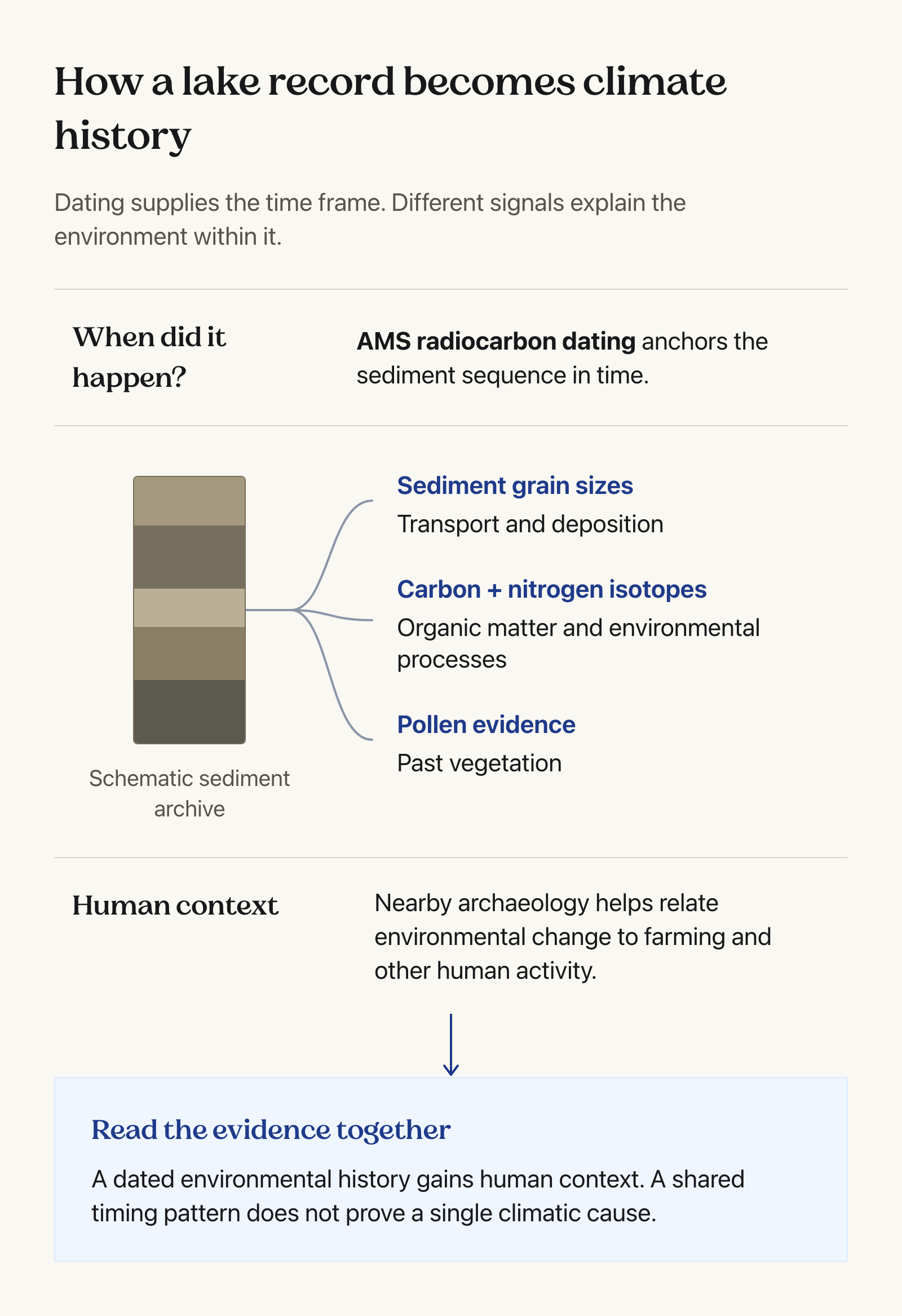
Diagram separating radiocarbon chronology, sediment grain sizes, stable isotopes, pollen evidence and archaeological context in reconstructing lake environmental history
Dating constrains the sequence in time; environmental proxies and archaeological context answer different questions. Sediment layers are schematic.

What the Reconstruction Can and Cannot Establish

The findings support long-term environmental understanding, but the interpretation must retain uncertainty about timing, mechanisms and human choices.

  • Named climatic episodes discussed in the study include the 4.2 ka arid event, Roman Warm Period and Little Ice Age. The release does not supply exact boundaries for all four reconstructed phases.
  • Westerly moisture also matters: the reported Little Ice Age record links moisture delivered by westerly winds with flooding during its colder phase. Not every wet signal should automatically be attributed to a stronger summer monsoon.
  • Correlation is not a single cause: parallel environmental and archaeological changes can suggest relationships. They do not establish that one monsoon fluctuation alone caused migration, altered farming or determined the fate of an entire civilisation.
  • Local sensitivity makes small oxbow lakes valuable archives, but a reconstruction from one basin is not automatically a complete regional history. Comparing records helps separate broader climatic influences from conditions specific to that lake.
  • Reconstruction differs from prediction: this study investigates past conditions and provides baseline evidence. Its findings may inform adaptation and modelling, but do not constitute a forecast of the timing or intensity of future monsoons.

Way Forward

Use the Archive Without Overstating It

  • Protect wetland sediment archives alongside their present ecological functions; disturbance can erase evidence needed to understand environmental change.
  • Compare independently dated records across the region before generalising a local hydrological pattern.
  • Use historical variability as one input to water and agricultural planning, alongside current observations and locally tested adaptation options.

Conclusion

  • Karela Lake shows the value of combining chronology, environmental proxies and archaeological context: each contributes a different part of the explanation of changing monsoon conditions and human adaptation.
  • For analysis, keep evidence and inference separate. A dated environmental record can illuminate the pressures facing farming communities without reducing their history to climate alone or promising a forecast of future rainfall.

UPSC Practice Questions

Prelims MCQ 1

With reference to palaeoenvironmental reconstruction, consider the following statements:

  1. AMS radiocarbon dating helps establish a chronology.
  2. Palynology can provide evidence of past vegetation.
  3. An isotope measurement by itself necessarily establishes an exact historical rainfall amount.

How many of the above statements are correct?

(a) Only one (b) Only two (c) All three (d) None

Answer: (b) Only two

Explanation:

The first two statements are correct. Isotope evidence requires contextual interpretation and does not by itself establish an exact rainfall amount.

Prelims MCQ 2

Which inference is most consistent with the Karela Lake reconstruction?

(a) Every flood signal proves a stronger summer monsoon. (b) A local lake record establishes a precise forecast for future monsoons. (c) Climate and archaeological evidence can be compared without assuming a single climatic cause for social change. (d) Radiocarbon dating directly measures historical rainfall.

Answer: (c) Climate and archaeological evidence can be compared without assuming a single climatic cause for social change.

Explanation:

The study integrates different evidence streams. Its past-environment reconstruction neither supplies a rainfall forecast nor proves that climate alone determined social outcomes.

UPSC Mains Questions

  1. How can lake sediments and archaeological evidence be combined to understand human adaptation to monsoon variability? Discuss the limits of such inference.
  2. Explain the relevance of long-term palaeoenvironmental records for wetland conservation and agricultural adaptation in the Ganga Plain.

Source: PIB, Ministry of Science & Technology.

Frequently Asked Questions

Where is Karela Lake?

Karela is an oxbow lake near Hulas Khera, close to Lucknow in the Central Ganga Plain. Its proximity to an archaeological site helps connect environmental reconstruction with evidence of past communities.

Why combine several environmental proxies?

Different proxies illuminate different processes, including sediment transport, vegetation and organic matter. Comparing them within a dated sequence strengthens interpretation and reduces dependence on an ambiguous signal from a single indicator.

Is radiocarbon dating a monsoon proxy?

Radiocarbon dating primarily provides chronological constraints. It helps researchers place environmental changes in time; other evidence, including sediment characteristics and biological or geochemical indicators, supports interpretation of the conditions associated with those changes.

Does the study predict future monsoons?

No. It reconstructs past environmental conditions and supplies a long-term baseline that may support further modelling and adaptation research. It does not forecast when a future monsoon will occur or how strong it will be.
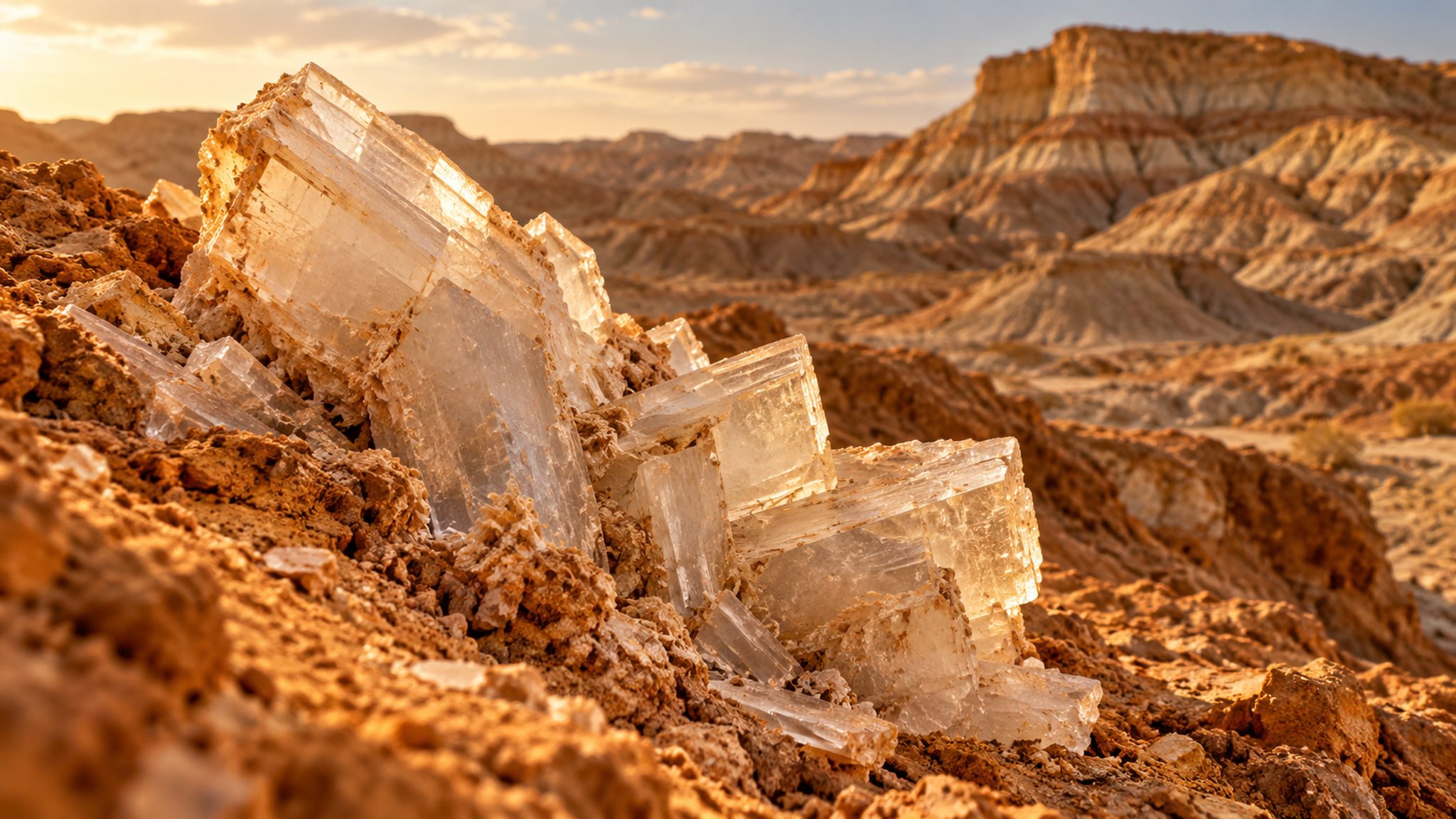

Mars Analogues: Reading Water–Rock History in Hydrous Sulphates

Open article →Download PDF

Why in News?

On 16 October 2026, the Department of Science and Technology reported Indian research identifying terrestrial hydrous sulphates that help interpret past water–rock interactions on Mars.

  • The University of Kerala team identified melanterite at Neyveli in Tamil Nadu and gypsum in Chile’s Atacama Desert and the Tiruchirappalli Badlands.
  • A DST-FIST-supported laser Raman spectrometer identified distinctive mineral fingerprints, providing laboratory evidence for comparisons with Martian environments.
  • The release describes two papers in Journal of Geophysical Research: Planets; its announcement date should not be treated as either paper’s publication date.
  • Terrestrial analogues let scientists examine samples and processes directly, helping interpret distant observations without assuming that Earth and Mars are identical.
  • Mineral evidence can reconstruct water activity and guide exploration, but identifying a potentially habitable environment does not establish that organisms lived there.

UPSC Relevance

Prelims Relevance

  • Hydrous sulphates: sulphate minerals containing water within their crystalline structure.
  • Melanterite: associated here with sulphide oxidation and short-lived wet, acidic conditions.
  • Gypsum: records past aqueous activity and may preserve biosignatures.
  • Raman spectroscopy: identifies materials using characteristic spectral fingerprints.
  • Analogue site: a terrestrial setting comparable to selected conditions or processes on another planetary body.

Mains Relevance

GS Paper 3

  • Laboratory infrastructure and terrestrial fieldwork strengthen planetary exploration.
  • Distinguishing mineral identification, environmental reconstruction and biological interpretation prevents scientific overclaiming.

GS Paper 1

  • Weathering and mineral formation preserve evidence of past environmental conditions.

Essay

  • Scientific progress depends on asking what evidence establishes, and what it leaves unresolved.

Background and Context

What Makes an Earth Site a Mars Analogue?

An analogue is a useful comparison for a defined scientific question, rather than a miniature version of an entire planet.

  • A terrestrial analogue shares selected geological, chemical or physical features with the environment being investigated. Researchers use that resemblance to study processes that cannot be observed directly and repeatedly on distant Mars.
  • The relevant connection here is water–rock interaction, recorded by hydrous sulphates. These minerals offer evidence about aqueous conditions even when liquid water is no longer present at the sampled surface today.
  • Neyveli contributes melanterite associated with its lignite-bearing setting, while the Atacama Desert and Tiruchirappalli Badlands contribute gypsum. The sites provide different geological examples rather than interchangeable replicas of the Martian surface.
  • Field samples allow researchers to connect mineral identity with geological context. Knowing where a mineral occurs and how it formed makes the comparison more informative than matching a mineral name alone.
  • The comparison remains process-specific: a mineral-forming pathway may be relevant to Mars without establishing identical climate, duration of wet conditions or biological history. Each additional inference needs its own supporting evidence and explanation.

What Melanterite and Gypsum Tell Scientists

Both minerals record aqueous activity, but the reported interpretations differ in the conditions and preservation questions they help researchers examine.

  • Melanterite provides evidence of short-lived wet conditions associated with sulphide oxidation. The release connects the Neyveli mineral to wet, acidic and oxidizing conditions, making this pathway relevant to interpreting Martian sulphate formation.
  • Gypsum records past aqueous environments and can preserve biosignatures within its mineral matrix. This preservation potential makes it useful for selecting promising material for examination, without implying that a biological signal is already present.
  • The central distinction is between formation evidence and preservation potential. A mineral can help reconstruct the environment in which it developed; its ability to retain other signals is a separate scientific question.
  • Laser Raman spectroscopy supplies distinctive spectral fingerprints for mineral identification. In this research, the instrument helped confirm which minerals were present, strengthening the material basis for subsequent comparisons between terrestrial and Martian environments.
  • Laboratory measurements complement orbital observations by supporting more detailed mineral characterization. The release says orbital data alone cannot fully characterize Martian minerals; this is an argument for combining evidence, not dismissing remote sensing.

Why Water Evidence Is Not Life Detection

Minerals can narrow a search for past habitable environments, but each step from water to life requires a different evidentiary claim.

  • Past water activity means a geological record supports interaction with water. It does not by itself establish how long conditions lasted, whether they supported organisms, or whether life actually developed at that location.
  • Habitability concerns whether an environment could support life; life detection requires evidence that organisms existed. Treating those terms as equivalent converts a useful geological finding into a conclusion the research has not demonstrated.
  • A potential biosignature requires careful evaluation of its origin. The ability of gypsum to preserve such signals cannot substitute for finding and establishing a biological signal within a particular mineral sample under investigation.
  • The reported work identifies analogue minerals and environments; it does not announce life on Mars. Its immediate contribution is better interpretation of mineral evidence and more informed choices about where future investigations might look.
  • For an examination answer, separate observation, interpretation and implication: identified sulphates are the observation, water-related formation is the interpretation, and guiding future exploration is the implication. Keep uncertainty attached to each subsequent inference.

Way Forward

Link Mineral Fingerprints With Geological Context

  • Build reference measurements from well-characterized terrestrial samples so planetary observations can be compared with known mineral properties.
  • Examine formation conditions and preservation separately; promising mineral chemistry should guide further investigation rather than become a shortcut to claims about life.
  • Report analogue limits alongside similarities, making clear which process a terrestrial site can illuminate and which planetary conditions it cannot reproduce.

Conclusion

  • Hydrous sulphates are geological evidence of water–rock history, not automatic biological evidence. Their value lies in connecting identifiable minerals with plausible environmental processes while retaining the limits of terrestrial comparisons.
  • The exam-ready distinction is water activity → possible habitability → evidence of life: these are separate questions, and answering the first does not settle the next two.

UPSC Practice Questions

Prelims MCQ 1

With reference to the reported Martian analogue research, consider the following statements:

  1. Melanterite was identified at Neyveli in Tamil Nadu.
  2. Gypsum can preserve biosignatures within its mineral matrix.
  3. The identification of a hydrous sulphate necessarily establishes past life.

How many of the above statements are correct?

(a) Only one (b) Only two (c) All three (d) None

Answer: (b) Only two

Explanation:

The first two statements follow the reported findings. Hydrous sulphates record water-related processes; their identification alone does not establish past life.

Prelims MCQ 2

What was the principal role of laser Raman spectroscopy in this research?

(a) Establishing that organisms currently live on Mars (b) Measuring the duration of every Martian wet period (c) Identifying minerals through distinctive spectral fingerprints (d) Reproducing the entire Martian environment on Earth

Answer: (c) Identifying minerals through distinctive spectral fingerprints

Explanation:

The instrument detected characteristic mineral fingerprints and supported identification. It did not independently demonstrate life or recreate all Martian conditions.

UPSC Mains Questions

  1. How do terrestrial analogue sites strengthen planetary exploration? Discuss with reference to hydrous sulphates and the limits of Earth–Mars comparisons.
  2. Distinguish evidence of past water activity, habitability and life detection. Why does this distinction matter in interpreting planetary science findings?

Source: PIB, Ministry of Science & Technology.

Frequently Asked Questions

What is a Martian analogue site?

It is a terrestrial site sharing selected geological, chemical or physical features with Mars. Scientists use the comparison to investigate specific processes; it does not imply that all planetary conditions are identical.

Which Indian sites feature in this research?

The report identifies melanterite from Neyveli and gypsum from the Tiruchirappalli Badlands, both in Tamil Nadu. Gypsum from Chile’s Atacama Desert provides another terrestrial comparison for interpreting past aqueous environments.

Why are hydrous sulphates useful in planetary science?

They record water-related mineral formation and help scientists reconstruct past aqueous conditions. Their geological context and laboratory characteristics can support interpretation of planetary observations and inform the selection of future investigation sites.

Did this research find life on Mars?

No. The reported work concerns terrestrial mineral analogues and water–rock history. Gypsum’s potential to preserve biosignatures makes it scientifically interesting, but preservation potential is not an observed or verified biological signal.

Sports Assistance Guidelines: Funding Training and Institutional Capacity

Open article →Download PDF

Why in News?

On 16 October 2026, the Ministry of Youth Affairs and Sports issued operational guidelines for the revised Scheme of Assistance to National Sports Federations.

  • The guidelines revise assistance norms and add support for specialised training, indigenous sports outreach and international sports cooperation.
  • Olympic Training Centres are planned as facilities dedicated to individual sports; the announcement does not establish that they are already operational.
  • The scheme supports preparation for major international competitions, including Olympic, Paralympic, Asian and Commonwealth Games and World Championships.
  • Sports governance concerns the continuity of coaching, technical expertise and athlete services, as well as the organisation of competitions.
  • Public funding can strengthen institutional capacity, but an approved funding channel must be distinguished from a delivered service or measurable sporting improvement.

UPSC Relevance

Prelims Relevance

  • ANSF: Scheme of Assistance to National Sports Federations.
  • NCOEs: National Centres of Excellence, among existing training locations.
  • OTCs: planned sport-specific Olympic Training Centres.
  • TSR: Timing, Scoring and Result services for competitions.
  • Proposal scrutiny: designated committee headed by Secretary (Sports).

Mains Relevance

GS Paper 2

  • Public expenditure, institutional accountability and athlete-centred sports governance.
  • Sports cooperation with Global South countries and outreach for indigenous games.

Essay

  • Sporting excellence depends on institutions that make sustained preparation possible.

Background and Context

What Sports Assistance Finances

The scheme treats athlete preparation as a continuing institutional task, combining coaching and support services with access to competition at different levels.

  • Training support includes national coaching camps and training in academies. Boarding, lodging, sports kits and insurance address practical requirements that accompany preparation, rather than treating competitive performance as an isolated event.
  • Specialist personnel include foreign coaches, High Performance Directors, physiotherapists, sports scientists and doctors. This recognises that technical instruction and physical preparation require different professional inputs within the wider athlete support system.
  • Foreign exposure covers international training and competition. Its purpose within the scheme is preparation for demanding sporting environments; assistance for travel should not be confused with proof of improved performance after participation.
  • National championships at senior, junior and sub-junior levels receive support alongside grassroots and junior athlete development. The scheme consequently connects elite preparation with lower competitive levels, rather than funding only international appearances.
  • Administrative and governance support to federations is another recognised function. In policy analysis, assess whether organisational capacity makes coaching, competition schedules and athlete services dependable; expenditure on administration is not itself an outcome.

Planned Olympic Training Centres and Existing Facilities

The main training distinction is between facilities already used by athletes and a proposed network of specialised centres intended to strengthen domestic capability.

  • Existing preparation takes place at National Centres of Excellence, academies, private sports facilities and overseas locations. These are the current arrangements described in the release, not facilities newly created by this announcement.
  • Planned Olympic Training Centres would each be dedicated to one sport, with modern training facilities, experts and sports science equipment. Their stated purpose is high-standard specialised training and reduced reliance on overseas preparation.
  • Eligible athlete support at such centres would cover coaches, technical staff, sports science services, specialised equipment and technical support. These are connected operating inputs; a training venue without expertise cannot substitute for them.
  • Domestic capacity versus foreign exposure is the useful comparison: stronger centres may reduce dependence on overseas facilities, while international training and competitions remain supported. The release does not announce an end to foreign preparation.
  • Implementation status matters for examinations: the centres are planned, and India’s Olympic ambition is a bid. Neither language establishes completed facilities or confirmation of India as host of the Games in question.

How Funding Extends to Events and Cooperation

The revised approach also supports the institutions and relationships around sport, while retaining a role for proposal assessment rather than making every request automatically payable.

  • International event proposals from federations are assessed by a designated committee headed by Secretary (Sports). The nature and importance of an event, participating countries and athletes inform the assistance that can be provided.
  • National Games support covers sports equipment, Timing, Scoring and Result services, technical officials and technical conduct. These provisions concern running competitions; they should not be described as an unrestricted grant for every hosting expense.
  • Indigenous sports outreach includes efforts towards demonstration events at global competitions and establishing national federations abroad. Support for pursuing inclusion does not mean an indigenous game has already entered an Olympic competition programme.
  • Global South cooperation can use Indian high-performance centres and other facilities for athlete and coach training, including scholarships and subsidised access. This links existing domestic capacity with international exchange instead of merely hosting visiting delegations.
  • Institutional cooperation also includes sports activities for multilateral bodies and case-by-case support through NSF/NOC channels for recognised international or continental bodies in India. Funding eligibility should be separated from evidence of completed cooperation activities.

Way Forward

Evaluate Services, Not Announcements

  • Publish clear proposal decisions and report whether approved support actually reaches coaching, competition and athlete services; this is a recommended accountability measure, not a stated new guideline requirement.
  • Assess proposed centres against staffing and usable equipment, alongside construction progress, so that completed infrastructure translates into sustained training capacity.
  • Evaluate international cooperation through training delivered and institutional partnerships sustained, while keeping demonstration-event ambitions separate from formal competition inclusion.

Conclusion

  • Sports assistance combines athlete preparation, competition services and federation capacity. Its policy significance lies in connecting these functions so that public support enables sustained training rather than ending with the announcement of a grant.
  • Separate authorisation from achievement in a Mains answer: revised guidelines create funding possibilities, but planned centres, international outreach and proposed cooperation require implementation before they can demonstrate sporting or institutional results.

UPSC Practice Questions

Prelims MCQ 1

With reference to the revised Scheme of Assistance to National Sports Federations, consider the following statements:

  1. It supports sports science services as part of athlete preparation.
  2. The announced Olympic Training Centres are planned as centres dedicated to individual sports.
  3. Support for indigenous sports outreach confirms their inclusion in the Olympic competition programme.

How many of the above statements are correct?

(a) Only one (b) Only two (c) All three (d) None

Answer: (b) Only two

Explanation:

The first two statements reflect the release. Assistance for efforts towards demonstration events is not confirmation of inclusion in the Olympic programme.

Prelims MCQ 2

Which distinction best captures the relationship between planned Olympic Training Centres and foreign exposure under the revised scheme?

(a) Domestic centres replace all international competition. (b) Foreign exposure is restricted to coaches alone. (c) Domestic specialisation aims to reduce overseas dependence while foreign exposure remains supported. (d) The scheme finances competition hosting but excludes training.

Answer: (c) Domestic specialisation aims to reduce overseas dependence while foreign exposure remains supported.

Explanation:

The planned centres are intended to strengthen specialised domestic training. The scheme continues to include international training and competition among its supported functions.

UPSC Mains Questions

  1. How can public assistance to sports federations strengthen athlete preparation without making expenditure the sole measure of success? Discuss.
  2. Examine the distinction between sports infrastructure, professional support services and international exposure in building a sustainable high-performance sports system.

Source: PIB, Ministry of Youth Affairs and Sports.

Frequently Asked Questions

What is the Scheme of Assistance to National Sports Federations?

It is a mechanism for supporting Indian athletes preparing for major international competitions. Assistance includes coaching, athlete services, competition exposure, national championships, junior development and administrative or governance support to federations.

Are the Olympic Training Centres already operational?

The ministry’s release describes Olympic Training Centres as planned facilities dedicated to individual sports. It does not establish that these centres have already been built, staffed or opened for athlete training.

Does stronger domestic training mean foreign exposure will stop?

No. Planned centres aim to reduce reliance on overseas training facilities, while the scheme continues to support international training and competitions. Domestic specialisation and competitive exposure abroad serve related but different purposes.

Does assistance give indigenous sports Olympic status?

No. The revised scheme supports outreach, including efforts towards demonstration events and federations abroad. Funding such efforts does not establish acceptance into the Olympic competition programme or guarantee future inclusion.

Who assesses proposals for hosting international events?

A designated committee headed by Secretary (Sports) assesses federation proposals. The release identifies the nature and importance of the event and participating countries and athletes as considerations in determining assistance.

Quantum Trust Systems: Securing Identity, Navigation and Time

Open article →Download PDF

Why in News?

On 16 October 2026, PIB reported a Technology Development Board agreement with QNu Labs to advance an indigenous quantum-security and sensing stack covering device identity, location, networks and time.

  • The programme aims to move technologies from TRL 4–5 towards TRL 9; the announcement describes research, engineering, integration and validation ahead.
  • Identity security includes proposed physical unclonable functions and trusted platform modules for hardware-based authentication.
  • Location integrity includes compact quantum magnetometers; time integrity includes atomic clocks and secure time synchronisation.
  • TDB support is structured as Optionally Convertible Debt. The agreement should not be described as a completed deployment or an unconditional grant.
  • Connected infrastructure needs to know which device it is communicating with, whether its position is trustworthy and whether its clock is reliable.
  • Protecting message confidentiality alone cannot establish the integrity of every input used by a mission-critical system.

UPSC Relevance

Prelims Relevance

  • Technology Development Board under the Department of Science & Technology.
  • Physical unclonable functions and hardware-based device identity.
  • Trusted platform modules and cryptographic security.
  • Quantum magnetometers and proposed GPS-denied navigation applications.
  • Atomic clocks and secure time synchronisation.

Mains Relevance

GS Paper 3

  • Indigenous technology development for critical infrastructure.
  • Device authenticity, navigation integrity and dependable timing as distinct security requirements.
  • Evidence-based procurement of emerging technologies.

Essay

  • Trustworthy infrastructure requires dependable inputs as well as protected communication.

Background and Context

Device Identity: Trust Starts at the Endpoint

Identity security asks whether a connected device is the genuine, authorised endpoint, rather than an impersonator presenting a copied identity.

  • The proposed physical unclonable functions, or PUFs, support hardware-based device identity. Their intended role concerns authenticating the device itself, rather than merely checking whether a message has arrived through an encrypted channel.
  • Trusted platform modules, or TPMs, support device-level cryptographic security. PIB describes quantum-safe TPMs as part of the proposed stack, without publishing the implementation, certification results or specific security properties of a finished product.
  • Authentication and confidentiality answer different questions: who is communicating, and who can read the content. Keeping a communication secret does not, by itself, prove that the device providing information is genuine or authorised.
  • The programme seeks to reduce vulnerabilities from compromised or replicated identities. This is a development objective, not evidence that every possible impersonation attack has already been prevented in a deployed system or operating network.
  • The earlier free-space QKD demonstration concerned secure communication. This agreement broadens the engineering task to device trust, navigation and timing; the earlier trial cannot establish the readiness of these additional proposed capabilities.

Location Integrity: Can the Position Be Trusted?

Location integrity concerns the reliability of positioning information, including detection of attempts to manipulate it, rather than merely producing a position estimate.

  • Position spoofing means misleading a system about its location. For a mission-critical platform, accepting a false position can undermine decisions even when the messages carrying that position remain confidential and arrive without interruption.
  • PIB identifies compact quantum magnetometers as proposed tools for electromagnetic tampering detection and GPS-denied navigation. Magnetometers measure magnetic fields; the release does not specify the complete navigation architecture or its tested performance.
  • GPS-denied navigation is an intended capability where satellite positioning cannot be relied upon. It must not be read as a demonstrated, universal replacement for GPS across every terrain, vehicle or operating condition.
  • The distinction is between detecting interference and maintaining usable navigation. These are related engineering tasks, but success at recognising a suspicious signal alone would not establish accurate, continuous positioning during the disturbance.
  • For assessment, ask what operating conditions were tested and how unreliable inputs are handled. These are questions for future validation; the announcement supplies neither accuracy measurements nor evidence of operational deployment on defence platforms.

Time Integrity: A Correct Clock Must Reach the System

Time integrity combines a dependable timing source with trustworthy delivery, so connected systems can rely on the time information they receive.

  • The proposed timing infrastructure includes atomic clock technology and secure synchronisation through QKD-authenticated distribution. PIB presents these as complementary components: generating reliable timing and protecting its distribution serve different functions within the intended architecture.
  • Telecommunications, financial systems and defence are identified as potential users of reliable synchronisation. A shared timing reference helps systems coordinate activity; the agreement does not establish that these sectors already use the proposed stack.
  • A highly precise clock does not automatically make the distribution path trustworthy. Equally, protecting a transmission does not establish the accuracy of its timing source: both aspects belong in the assessment of time integrity.
  • The four pillars form an integration programme, not four independently certified achievements. Device authentication, positioning, communications and timing must work together before the complete system can be relied upon for demanding infrastructure applications.
  • The stated progression towards TRL 9 is a readiness goal requiring further research and validation. An agreement to fund maturation must be distinguished from evidence that the intended capabilities have reached operational use.

Way Forward

Validate Each Trust Function Before Integration

  • Require separate evidence for device authentication, positioning integrity and timing reliability before accepting a broad quantum-security claim.
  • Test interference, compromised inputs and recovery under relevant operating conditions; report limitations alongside successful demonstrations.
  • Make procurement contingent on independent validation of the integrated system, rather than the announcement of a funding agreement.

Conclusion

  • The agreement extends quantum-technology development beyond protected messages to trusted devices, location and time. Its significance lies in that integrated research direction; deployment and performance remain matters for future evidence.
  • For UPSC, separate identity, confidentiality, location integrity and time integrity. They protect different functions, and progress in one cannot automatically demonstrate readiness across the entire infrastructure system.

UPSC Practice Questions

Prelims MCQ 1

With reference to the proposed quantum trust programme, consider the following statements:

  1. Physical unclonable functions are proposed for hardware-based device identity.
  2. The announcement establishes that the entire stack has already reached TRL 9.
  3. Atomic clock technology and secure time distribution are both included in the timing pillar.

How many of the above statements are correct?

(a) Only one (b) Only two (c) All three (d) None

Answer: (b) Only two

Explanation:

Statements 1 and 3 are correct. TRL 9 is a development target; the release describes further research, integration and validation.

Prelims MCQ 2

Which statement best distinguishes confidentiality from location integrity?

(a) Both mean that a device must use an atomic clock. (b) Confidentiality establishes the accuracy of every position estimate. (c) Confidentiality protects message content, while location integrity concerns the trustworthiness of positioning information. (d) Location integrity is achieved whenever a message is encrypted.

Answer: (c) Confidentiality protects message content, while location integrity concerns the trustworthiness of positioning information.

Explanation:

Encryption can protect the contents of a message without proving that the position reported in that message is trustworthy.

UPSC Mains Questions

  1. Why must critical infrastructure treat device identity, location integrity and time integrity as distinct security requirements? Discuss with reference to emerging quantum technologies. (150 words)
  2. A research funding agreement cannot substitute for evidence of deployment readiness. Examine the validation requirements for an integrated quantum-security and sensing system. (250 words)

Source: PIB, Ministry of Science & Technology.

Frequently Asked Questions

What is the quantum trust agreement about?

The TDB–QNu Labs agreement supports an indigenous security and sensing stack across device identity, location, networks and time. It concerns development and integration, not an announcement that the complete system is operational.

What are PUFs and TPMs intended to do?

Physical unclonable functions and trusted platform modules are proposed for hardware-based device identity, authentication and cryptographic security. Their role concerns trust at the endpoint, rather than only keeping transmitted messages confidential.

Will quantum magnetometers replace GPS?

The programme proposes quantum magnetometers for electromagnetic tampering detection and GPS-denied navigation capabilities. The release does not demonstrate a universal GPS replacement or publish navigation accuracy across different operating conditions.

Why does time integrity need more than an atomic clock?

Reliable time also needs trustworthy distribution to the systems using it. A precise source alone does not establish that the timing information reaches connected devices securely, without manipulation along the distribution path.

Has the programme reached TRL 9?

No such completion is reported. PIB describes a programme intended to advance technologies from TRL 4–5 towards TRL 9 through further research, engineering refinement, system integration and validation.

Sourashtra Text-to-Speech: Turning Written Characters Into Spoken Access

Open article →Download PDF

Why in News?

On 16 October 2026, MeitY reported that BHASHINI and IISc Bengaluru had developed text-to-speech models for Sourashtra, supporting two scripts and two speaker voices.

  • The four models combine male and female voices with Tamil-script and Sourashtra-script versions.
  • They use VITS, an end-to-end speech-synthesis architecture, to generate audio directly from character-level text without a separate phonemizer.
  • The announcement concerns developed models; it does not establish that every public service already offers Sourashtra audio.
  • Spoken access can make existing written information usable for people who prefer or depend on audio, provided the service integrates speech output effectively.
  • A low-resource language has limited digital language resources; this describes a technology gap, not the cultural worth or expressive capacity of its speakers.

UPSC Relevance

Prelims Relevance

  • Text-to-speech: written text to generated speech.
  • Automatic speech recognition: spoken audio to text.
  • Translation: transfer of meaning between languages.
  • Script: a writing system, distinct from the language written in it.
  • Sourashtra: an Indo-Aryan language spoken predominantly by its community in Tamil Nadu.

Mains Relevance

GS Paper 3

  • Distinguishing language-AI functions before assessing the capability of a digital service.

GS Paper 2

  • Making written public information available through usable spoken interfaces.

GS Paper 1

  • Supporting living language use across different scripts and digital formats.

Essay

  • Digital inclusion depends on whether information can be used, not simply whether it is online.

Background and Context

One Language Can Use More Than One Script

Sourashtra illustrates why the language of a message and the characters used to write it must be identified separately.

  • Sourashtra belongs to the Indo-Aryan language family and is spoken predominantly by the Sourashtra community in Tamil Nadu. Its location does not make it the same language as Tamil, or change its linguistic family.
  • A script supplies written symbols; a language supplies words, grammar and meaning. Sourashtra written using Tamil characters remains Sourashtra, just as changing the alphabet used for a message need not translate its meaning.
  • The announced system offers two script versions for each of two speaker voices. These combinations produce four models; they do not represent four different languages, four language families, or four independently represented speaking communities.
  • Transliteration changes the script used to represent language, whereas translation changes the language conveying the message. Script support can broaden input compatibility without promising that the system understands or translates every language using those characters.
  • For a user-facing service, matching the input script to the supported model is a practical requirement. A language label alone is insufficient if the written characters supplied are incompatible with that model’s expected input.

What Text-to-Speech Actually Does

The direction of information flow distinguishes synthesis from recognition and translation, even when one application combines these functions.

  • Text-to-speech starts with written content and produces an audio rendering. Reading a Sourashtra notice aloud is speech synthesis; it does not, by itself, convert an English notice into Sourashtra or interpret a spoken request.
  • Automatic speech recognition works in the opposite direction: incoming speech becomes written text. A voice-based question service may need recognition before processing the request, while speech synthesis provides the spoken response at the end.
  • Translation transfers meaning between languages and can operate on text. A spoken cross-language service may combine recognition, translation and synthesis; successful audio generation alone cannot establish whether the translated message preserves the original meaning.
  • The Sourashtra models use character-level input and do not require a separate phonemizer, which would ordinarily convert written forms into representations of speech sounds. This describes the processing arrangement, not freedom from pronunciation errors.
  • VITS is the reported end-to-end architecture connecting written input with generated speech. Here, end-to-end describes the synthesis model’s organisation; it does not mean that content preparation, application integration and user controls become unnecessary.

A Developed Model Is a Capability, Not a Complete Service

The announcement establishes a new speech-generation resource; its usefulness depends on the task and the way people encounter its output.

  • The immediate capability is reading Sourashtra text aloud. The ministry identifies language learning, accessibility and research as possible uses, but these applications should be described as opportunities rather than evidence of completed deployment everywhere.
  • Two speaker voices give users different output options, not proof of coverage of all accents or speaking styles. Claims of universal naturalness, pronunciation accuracy or community representativeness would require evidence beyond this announcement.
  • Audio access can help users who rely on spoken content, yet a speech model alone does not make an interface accessible. Playback, pausing, repetition and navigation remain application decisions that determine practical usability.
  • Content accuracy remains separate from speech fluency. A model can read an outdated or incorrect notice aloud; public information still needs an authoritative text, revision controls and a way for users to report problems.
  • This development adds a speech-output capability, distinct from the tribal-language corpus and classroom work discussed earlier. Assess what this model converts and delivers, rather than assuming it settles every language-preservation challenge.

Way Forward

Build Around the Listening Task

  • Trial short public notices with clear playback controls, recording whether listeners can identify the intended information and act on it.
  • Provide script-aware input selection and keep the original written content available alongside generated audio for checking unfamiliar names or terms.
  • Label synthetic speech transparently and avoid suggesting that a generated voice is a recording or endorsement by an actual official.

Conclusion

  • Sourashtra TTS extends the route from written content to spoken access. Its significance lies in a specific functioning capability across scripts, rather than a claim that one model resolves every digital-language barrier.
  • In an answer, separate language, script and processing direction, then connect the demonstrated capability to a realistic service task. Distinguish model development from deployment and spoken fluency from the correctness of the underlying information.

UPSC Practice Questions

Prelims MCQ 1

With reference to language technologies, consider the following statements:

  1. Text-to-speech converts written input into generated speech.
  2. Using Tamil script necessarily makes the written language Tamil.
  3. Automatic speech recognition converts spoken audio into text.

How many of the above statements are correct?

(a) Only one (b) Only two (c) All three (d) None

Answer: (b) Only two

Explanation:

Statements 1 and 3 are correct. A script can represent more than one language; Sourashtra can be written using Tamil characters.

Prelims MCQ 2

A service must turn an English written notice into spoken Sourashtra. Which combination directly addresses these two requirements?

(a) Speech recognition alone (b) Transliteration alone (c) Translation followed by text-to-speech (d) Text-to-speech followed by optical character recognition

Answer: (c) Translation followed by text-to-speech

Explanation:

Translation changes the language of the written notice; synthesis then generates spoken output. Reading English aloud would not translate it.

UPSC Mains Questions

  1. Distinguish language, script and speech-synthesis technology. Explain their relevance to inclusive digital public services.
  2. A working speech model is necessary but insufficient for usable spoken access. Discuss with reference to the newly developed Sourashtra text-to-speech models.

Source: PIB, Ministry of Electronics and Information Technology.

Frequently Asked Questions

What is the new Sourashtra text-to-speech development?

BHASHINI and IISc Bengaluru have developed speech-synthesis models for Sourashtra. The reported combinations cover male and female voices, each supporting text written in Tamil script or Sourashtra script.

Does Tamil-script support mean the models translate Tamil?

No. Script identifies the written characters, while language identifies the message. These versions accept Sourashtra written using Tamil characters; that capability is different from translating Tamil-language content into Sourashtra.

How does text-to-speech differ from speech recognition?

Text-to-speech turns written input into generated audio. Speech recognition turns incoming audio into written text. A voice-based service may combine both, but each performs a different conversion and needs separate checks.

What does working without a separate phonemizer mean?

The reported models take character-level text directly rather than requiring a separate component to convert writing into speech-sound representations. This architectural feature does not guarantee error-free pronunciation for every possible input.

Are these models already integrated into every government service?

The release reports model development and describes possible applications in accessibility, learning and research. It does not establish universal deployment, performance across all accents, or the accessibility of every application using the models.

WHO–INTERPOL Agreement: Connecting Health Alerts With Criminal Investigations

Open article →Download PDF

Why in News?

On 16 October 2026, WHO announced a cooperation agreement with INTERPOL to strengthen joint prevention, detection and response at the intersection of public health and security.

  • The cooperation framework covers exceptional situations involving suspected chemical or radioactive misuse and unusual biological events.
  • Other priorities include organ trafficking, falsified medical products, counterfeit protective equipment, unsafe food and illegally produced alcohol.
  • The organizations will coordinate preparedness for mass gatherings and support implementation of the WHO Framework Convention on Tobacco Control.
  • A dangerous product can trigger both patient-care needs and an investigation into its production and distribution network.
  • An unusual outbreak may be natural, accidental or deliberate; coordination must not turn uncertainty about its origin into an accusation.

UPSC Relevance

Prelims Relevance

  • WHO is the United Nations health agency.
  • INTERPOL enables international police cooperation.
  • The agreement covers health and security interfaces, not only infectious disease.
  • Unusual biological events may have natural, accidental or deliberate origins.
  • The WHO Framework Convention on Tobacco Control is included in the cooperation agenda.

Mains Relevance

GS Paper 2

  • International institutions and coordination in public-health emergencies.
  • Patient protection, privacy and access to care during criminal investigations.

GS Paper 3

  • Cross-border crime, hazardous materials and inter-agency preparedness.

Essay

  • Public trust is a practical resource in emergency response.

Background and Context

What the Agreement Connects

The central mechanism is cooperation between two sectors that encounter the same harm through different responsibilities and evidence.

  • WHO contributes public-health leadership, while INTERPOL contributes law-enforcement expertise. Combining these roles can connect medical warning signs with information about criminal networks without making clinicians responsible for proving who committed an offence.
  • INTERPOL supports police cooperation through information databases, forensic support, analysis and training. The announced framework concerns collaboration; it does not announce a new international police force or confer independent national arrest powers.
  • Health detection begins with signals such as unusual illness or unsafe products. Investigative agencies examine whether unlawful conduct occurred and who was responsible; a medical finding alone cannot settle that separate question.
  • Cross-border coordination matters when a harmful product is manufactured, transported and consumed in different countries. A response confined to treating affected patients may leave the supply network operating beyond the affected locality.
  • Implementation remains the test: the WHO announcement describes agreed areas for cooperation, not demonstrated results. It provides no basis for claiming completed joint investigations, arrests, a functioning universal alert system or reduced mortality.

How Health Protection and Investigation Differ

The useful distinction is between establishing a health hazard and establishing criminal responsibility; each may require the other sector’s assistance.

  • For falsified medical products, health authorities need to identify danger and protect patients. Investigators may need to trace illicit production and trade; neither function substitutes for the other when products move across borders.
  • For unusual biological events, the agreement explicitly includes natural, accidental and deliberate origins. An unexplained cluster warrants assessment and response, but its unusual character cannot establish deliberate release or identify a criminal actor.
  • For chemical or radioactive incidents, the announcement refers to suspected misuse requiring coordinated action. Suspicion is a reason to examine evidence carefully, not a conclusion that every hazardous exposure resulted from intentional wrongdoing.
  • For organ-related exploitation, the framework covers trafficking of persons for organ removal and illegal trade in organs, tissues and cells. Recognising these connected but distinct harms helps avoid reducing victim protection to commodity seizures.
  • For major gatherings, coordination is preventive as well as reactive: the organizations intend to help countries prepare for potential health threats. A gathering is a preparedness setting, not evidence of an impending attack.

Safeguards and the Indian Governance Lesson

For India, the analytical lesson is to coordinate specialist institutions while preserving the distinction between care, scientific assessment and lawful investigation.

  • As a policy implication, referral procedures should specify which signals require health assessment and when investigative consultation is appropriate. This would reduce delays without treating every clinical anomaly as a security incident.
  • Patient trust should remain central: people must not fear that seeking treatment automatically makes them suspects. Necessary information sharing should have a defined purpose, lawful basis and safeguards appropriate to sensitive health information.
  • Evidence quality requires distinguishing what was observed from what is inferred. A harmful substance, an unusual disease pattern and an allegation about intent answer different questions; reporting should preserve those distinctions throughout response.
  • Research governance is adjacent, not identical: dual-use research oversight addresses risks around scientific work. This agreement instead connects health protection with policing where hazards, illicit goods or exploitation cross institutional boundaries.
  • Regional cooperation is another layer: BIMSTEC’s trafficking cooperation concerns regional security coordination. The WHO–INTERPOL framework adds a health-sector interface rather than replacing domestic institutions or existing regional arrangements.

Way Forward

Build Clear Referral and Evidence Protocols

  • Define contact points and referral thresholds so that urgent treatment and public-health measures continue while relevant investigative expertise is consulted.
  • Use joint exercises to test information exchange, handling of sensitive evidence and communication under uncertainty before a real incident.
  • Assess cooperation through response quality and victim protection, rather than treating numbers of alerts or arrests alone as proof of health-security success.

Conclusion

  • Health security and criminal investigation overlap, but their questions remain different: what threatens people, how to protect them and whether an offence occurred must each be answered with appropriate evidence.
  • The agreement’s value lies in connecting expertise. In an answer, pair coordination with safeguards against premature attribution, loss of patient trust and claims of enforcement powers that the announcement does not establish.

UPSC Practice Questions

Prelims MCQ 1

With reference to the WHO–INTERPOL cooperation agreement, consider the following statements:

  1. It includes unusual biological events that may be natural, accidental or deliberate.
  2. Its scope includes illegal trade in human organs, tissues and cells.
  3. It establishes that every unusual outbreak is a criminal incident.

How many of the above statements are correct?

(a) Only one (b) Only two (c) All three (d) None

Answer: (b) Only two

Explanation:

The first two statements reflect the announced scope. Unusual biological events can be natural or accidental; an unusual outbreak does not itself establish crime.

Prelims MCQ 2

Which distinction best explains the WHO–INTERPOL cooperation framework?

(a) WHO determines criminal guilt and INTERPOL provides clinical treatment. (b) An unusual illness automatically establishes deliberate release. (c) Public-health assessment and criminal attribution are distinct functions that may require coordination. (d) Police cooperation removes the need for national institutions.

Answer: (c) Public-health assessment and criminal attribution are distinct functions that may require coordination.

Explanation:

The agreement combines complementary health and law-enforcement expertise. Identifying a hazard does not, by itself, prove criminal intent or responsibility.

UPSC Mains Questions

  1. Explain why coordination between public-health institutions and law-enforcement agencies is necessary to address falsified medical products and unusual hazardous events.
  2. How can health-security cooperation improve emergency response without undermining patient trust or prejudging criminal responsibility?

Source: World Health Organization.

Frequently Asked Questions

What did WHO and INTERPOL agree to do?

They established a cooperation framework combining public-health and law-enforcement expertise to prevent, detect and respond to threats involving hazardous events, illicit health-related products, organ trafficking and major gatherings.

Does the agreement create new arrest powers?

The WHO announcement describes a cooperation framework, not a grant of new national arrest powers or a new global police force. Its stated purpose is to connect complementary expertise and support countries.

Does an unusual biological event imply a crime?

No. The agreement explicitly covers events with natural, accidental or deliberate origins. Establishing the health hazard and establishing criminal intent are separate questions requiring evidence rather than assumptions.

Why are falsified medical products part of health security?

Such products can expose patients to harm while illicit production and trade involve criminal networks. Protecting consumers and tracing unlawful supply chains require different forms of expertise that can support one another.

World Heritage Climate Toolkit: Protecting the Attributes That Matter

Open article →Download PDF

Why in News?

On 16 October 2026, UNESCO reported that Santo Domingo’s Colonial City was piloting a Climate Action Toolkit to integrate climate risks into World Heritage management.

  • The 5–9 October workshop tested the toolkit’s Zero Draft through technical sessions, practical exercises and fieldwork in the historic centre.
  • Santo Domingo is the first cultural property and second World Heritage property in the pilot phase; it is not the first pilot overall.
  • The wider process runs from 17 September to 15 November 2026; participating institutions expect to move towards a Climate Action Plan, which is not yet reported complete.
  • The World Heritage Centre, ICCROM, ICOMOS and IUCN are developing the tool from the climate-action policy adopted in 2023.
  • Historic centres combine vulnerable physical fabric with inhabited streets and services, so conservation decisions also depend on urban planning and community knowledge.
  • The pilot asks how a hazard threatens specific heritage attributes, rather than treating every building or climate threat as equally important.

UPSC Relevance

Prelims Relevance

  • Outstanding Universal Value: the exceptional significance underpinning World Heritage recognition.
  • Attributes: features conveying a property’s heritage value.
  • ICCROM, ICOMOS and IUCN: the World Heritage Committee’s Advisory Bodies.
  • Hazard, exposure and vulnerability: distinct components of climate-risk assessment.
  • Zero Draft: a methodology under testing, not a final mandatory standard.

Mains Relevance

GS Paper 1

  • Conserving cultural heritage while retaining the functioning of living historic cities.

GS Paper 3

  • Linking climate projections, vulnerability assessment and adaptation to site-management decisions.

Essay

  • Protecting inherited places requires anticipating change, not only repairing past damage.

Background and Context

Begin With Heritage Value, Not Just a Weather Warning

The toolkit starts with what gives a property its significance, then examines how climate pressures could weaken the features carrying that significance.

  • Outstanding Universal Value is the central conservation reference. A risk assessment must identify the attributes conveying that value before deciding what deserves protection, rather than starting with an undifferentiated inventory of structures.
  • Attributes make an otherwise broad conservation objective concrete. In a historic city, relevant features might include historic fabric or spatial relationships; each example must be checked against the particular property’s recognised values.
  • Living heritage settings require attention to residents and institutions as well as buildings. UNESCO’s pilot explicitly combines heritage conservation, urban planning and climate expertise because these responsibilities intersect within the same historic centre.
  • Site-specific assessment avoids assuming identical consequences from the same storm. Materials, condition, drainage and location can change how damage occurs; these are illustrative assessment considerations, not findings measured for every Santo Domingo building.
  • The Ramappa heritage discussion offers an Indian comparison about heritage and its setting. This connection is analytical: UNESCO’s announcement does not establish an Indian application of the new toolkit.

Trace the Path From Hazard to Damage

Hazard, exposure and vulnerability explain different parts of risk; separating them helps managers choose an intervention that addresses the actual route to harm.

  • A hazard is a potentially damaging physical event or trend. UNESCO identifies hurricanes, heavy rainfall and flooding in the Dominican context; warming and sea-level rise also feature in the toolkit’s broader climate perspective.
  • Exposure asks which heritage attributes are situated where a hazard can act. Locating a threatened structure or landscape feature connects climate information with a conservation responsibility; a regional warning alone cannot complete that task.
  • Vulnerability concerns susceptibility to damage. As an illustration, deteriorated fabric and obstructed drainage may make rainfall more damaging, while maintenance can reduce susceptibility without eliminating rainfall or relocating the historic property itself.
  • Climate projections inform short-, medium- and long-term planning. They describe possible future conditions rather than the exact date of a future disaster; management choices should acknowledge uncertainty instead of treating one scenario as certainty.
  • Local knowledge can identify recurring water entry, past damage and maintenance constraints. Combined with scientific assessment, it helps explain how projected hazards may affect specific attributes rather than leaving climate information disconnected from conservation practice.

Turn the Assessment Into Management Choices

The practical test is whether risk information changes conservation decisions while preserving heritage values and involving the people responsible for the site.

  • Adaptation reduces harm from climate impacts, while mitigation addresses emissions. The pilot considers both, but improving drainage and reducing energy-related emissions solve different problems; neither should be presented as a substitute for the other.
  • Conservation compatibility matters when selecting responses. A protective intervention that damages the attributes it is meant to safeguard can defeat its purpose; this is a decision principle, not a reported evaluation of any completed pilot intervention.
  • Institutional mandates determine who can maintain structures, manage streets or act on warnings. UNESCO highlights clear responsibilities and participation by rights-holders and stakeholders, making coordination part of applying the methodology rather than an optional consultation.
  • Pilot feedback will refine the Zero Draft and identify knowledge, capacity and resource needs. A workshop demonstrating usefulness does not prove long-term effectiveness, announce a completed action plan or create a new binding conservation obligation.
  • The climate oversight discussion provides a complementary governance lens: implementation requires assigned responsibilities and follow-through. Here, the relevant operational destination is the property’s own planning and management instruments.

Way Forward

Make Each Response Traceable to a Risk

  • Identify the heritage attribute, hazard and vulnerability before choosing a response; record the evidence and uncertainty behind each decision.
  • Assign maintenance and monitoring responsibilities across conservation, urban and climate institutions, with residents contributing observations of recurring damage.
  • Use pilot feedback to improve the methodology before wider application, distinguishing training outcomes from demonstrated reductions in climate damage.

Conclusion

  • Climate-resilient conservation begins by linking a specific hazard to a specific heritage attribute and a defensible response, rather than treating heritage protection as emergency repair after every damaging event.
  • For an exam answer, connect risk assessment, institutional responsibility and community knowledge; keep the status clear: Santo Domingo is testing an unfinished methodology, not demonstrating a completed global or Indian rollout.

UPSC Practice Questions

Prelims MCQ 1

With reference to UNESCO’s Climate Action Toolkit pilot, consider the following statements:

  1. Santo Domingo is the first cultural property participating in the pilot phase.
  2. The Zero Draft is already a final mandatory standard for all World Heritage properties.
  3. The methodology links climate risks with attributes conveying Outstanding Universal Value.

How many of the above statements are correct?

(a) Only one (b) Only two (c) All three (d) None

Answer: (b) Only two

Explanation:

Statements 1 and 3 are correct. The toolkit remains under development and its Zero Draft is being tested; it is not a final mandatory standard.

Prelims MCQ 2

Which example best illustrates reducing vulnerability rather than removing a climate hazard?

(a) Assuming heavy rainfall will cease after restoration (b) Repairing drainage that allows rainwater to damage historic fabric (c) Declaring every exposed building equally susceptible to damage (d) Treating a regional rainfall projection as a precise disaster date

Answer: (b) Repairing drainage that allows rainwater to damage historic fabric

Explanation:

Drainage maintenance can reduce susceptibility to rainfall damage while rainfall remains a hazard. This is an illustrative distinction, not a reported completed action in the pilot.

UPSC Mains Questions

  1. How can climate-risk assessment be integrated into the management of living historic cities without weakening their heritage values? Discuss. (150 words)
  2. Distinguish hazard, exposure and vulnerability in heritage conservation. Explain how institutional coordination and local knowledge can turn risk assessment into adaptation decisions. (250 words)

Source: UNESCO.

Frequently Asked Questions

What is UNESCO’s Climate Action Toolkit intended to do?

It is being developed to help World Heritage managers assess how climate risks affect attributes conveying Outstanding Universal Value and integrate adaptation and mitigation into planning and management.

Is the toolkit final and mandatory?

No. Santo Domingo is testing the Zero Draft within an ongoing pilot process. Feedback will inform revisions, and UNESCO’s report does not announce a final mandatory toolkit or completed Climate Action Plan.

Why does the toolkit focus on heritage attributes?

Attributes connect a property’s recognised significance to concrete conservation decisions. Identifying them helps managers determine what a hazard could damage and whether a proposed protective response would preserve the value concerned.

Does the Santo Domingo pilot establish implementation in India?

No. The reported pilot concerns the Dominican Republic. Its approach can inform discussion of Indian heritage management, but that analytical relevance does not demonstrate adoption or implementation at an Indian property.