Opens in a new tab
Join Anantam IAS Channel on Telegram

Daily Digest · Friday

16 October 2026 Current Affairs for UPSC

16 current affairs published on Friday, 16 October 2026

16 October 2026 Current Affairs for UPSC — every Why-in-News article AnantamIAS published on Friday, 16 October 2026, broken down with Why in News?, the exact GS paper it feeds, sub-topic mapping, MCQ-ready facts and a UPSC-style practice question. 16 articles in total, covering Polity, Economy, Environment, S&T, IR, Geography, History, Society and Internal Security — the same Why-in-News + GS-paper-mapping + practice-question format the Compass uses across every daily digest on the site.

Daily current affairs for UPSC is where new material enters your prep stream. Read this 16 October 2026 digest end-to-end in 25–35 minutes, attempt the practice question at the foot of each article (it's MCQ for some, 10/15-marker for others), then bookmark the entries that fall inside your active revision window. Everything stays cross-linked: tap any subject pill to jump to that subject's hub, or use the table of contents above to skip straight to a specific story.

Use this page three ways. Read sequentially for a one-sitting scan of everything that mattered on 16 October 2026. Download the 16 October 2026 PDF below for offline study or print revision. Or use the October 2026 Current Affairs compilation to see this day in the month's full context. For the previous day's reading, see 15 October 2026 Current Affairs; the next day's is 17 October 2026 Current Affairs.

Why we publish daily current affairs separately from the monthly compilation: daily is learning, monthly is revision. Use the daily page to add fresh material to your notes the day it breaks; come back to the October 2026 compilation 60 days before Prelims when the noise has settled and only the lasting takeaway is worth re-reading.

Community Certificates: Conversion and Reservation Eligibility

Open article →Download PDF

Why in News?

On 15 October 2026, the Supreme Court upheld the invalidation of Tamil Nadu’s order allowing earlier backward-category status to support certificates for notified Backward Class Muslim communities after conversion.

  • The Court dismissed the State’s challenge in The Secretary to Government v. Sameer Ahamed N., leaving the impugned government order quashed.
  • The dispute concerned a Muslim Labbai community certificate, not merely recognition that the applicant had embraced Islam.
  • Tamil Nadu’s scheme recognises seven notified Muslim communities; conversion alone does not establish membership of any particular community.
  • The Court held that a private religious body cannot conclusively decide entitlement to statutory reservation.
  • Eligibility verification protects genuine beneficiaries while requiring the administration to explain the legal basis of rejection.
  • Unlike the separate dispute over local-body reservation ceilings, this case concerns membership of the eligible class.

UPSC Relevance

Prelims Relevance

  • Community certificates: declaratory status rather than creation of entitlement.
  • Article 16(4): reservation for backward classes in public employment.
  • Notified community membership versus religious affiliation.
  • Scheduled Castes Order, 1950: its specific religion condition.
  • Public authorities versus private religious testimonials in status verification.

Mains Relevance

GS Paper 2

  • Constitutional limits on executive instructions concerning reservation eligibility.
  • Accountable certification, evidence-based classification and protection against wrongful exclusion.

Essay

  • Substantive equality requires careful identification of disadvantage and fair access to public institutions.

Background and Context

Religious Identity and Notified Community Membership

The judgment separates adopting a faith from establishing the specific social identity to which a reservation benefit is attached.

  • Conversion establishes a change in religious affiliation. The Court held that this fact alone cannot demonstrate membership of a particular historically constituted Muslim community already recognised in Tamil Nadu’s backward-class framework.
  • The applicant sought recognition specifically as Muslim Labbai. His conversion testimonial and changed name established religious circumstances, but did not themselves supply the social and legal link required for that particular community certificate.
  • The State argued that its order preserved an existing backward-class entitlement. The Court rejected automatic transfer: prior disadvantage cannot, by itself, establish membership of a different notified class after a change of religion.
  • The seven notified communities are identified social groups, not a single category containing every Muslim. Their recognition cannot be reduced to adherence to a religious belief or acceptance of a theological denomination.
  • The Court acknowledged social stratification among Muslim communities, varying across regions and groups. An egalitarian religious doctrine does not prove that social disadvantage is absent; equally, disadvantage cannot be presumed uniformly across all adherents.

A Certificate Recognises Status; It Does Not Create It

A public certificate records eligibility under the governing legal framework; neither paperwork nor an executive shortcut can replace that framework.

  • A community certificate is declaratory: it recognises a status that must already satisfy the applicable requirements. Possession of the document cannot independently enlarge the class eligible for a reservation benefit under the law.
  • An executive instruction cannot dispense with substantive constitutional or statutory conditions. The defect identified here was the assumed movement into a notified community without establishing the necessary connection, rather than a clerical certification mistake.
  • A Jamath testimonial may provide evidence about conversion or matters within its knowledge. The Court did not exclude such evidence altogether; it rejected treating the private body’s conclusion as binding on revenue authorities.
  • The competent public authority must assess entitlement through an accountable process open to verification and scrutiny. Issuing a certificate on an unquestionable private determination would transfer a public-law responsibility outside its lawful institutional setting.
  • This distinction matters for both inclusion and exclusion. Reliable scrutiny protects entitled applicants from displacement by invalid claims, while reasons and an opportunity to respond help prevent the administration from rejecting genuine evidence mechanically.

Read the Holding Without Turning It Into a Blanket Ban

The relevant test is the legal basis of the particular claim, not a general assumption that one religion either guarantees or excludes reservation.

  • The Court expressly recognised that non-Hindu groups can constitute backward classes when constitutional requirements are independently met. The judgment does not establish that every Muslim, or every religious convert, is excluded from all reservation.
  • The Scheduled Castes Order, 1950 separately limits Scheduled Caste recognition to persons professing Hinduism, Sikhism or Buddhism. This specific rule must not be converted into an identical religion test for every OBC or ST claim.
  • For backward-class identification, the Court emphasised objective criteria and the social reality of the particular group. Neither religious doctrine nor a presumed hierarchy encompassing an entire religion can substitute for examination of that group.
  • For reconversion, the Court required an independent, fact-specific inquiry into genuine revival of the original caste or social identity and satisfaction of applicable conditions. Antecedent status alone is not an automatic entitlement certificate.
  • The gap between legal guarantees and social discrimination remains a separate policy concern. This case determines the legal route to a notified category; it does not establish that conversion eliminates every lived disadvantage.

Way Forward

Make Eligibility Decisions Explainable

  • Publish category-specific evidence requirements, clearly distinguishing proof of conversion from proof of notified-community membership.
  • Treat private testimonials as assessable evidence, while retaining the final statutory determination with the competent authority.
  • Give applicants reasoned decisions and a fair opportunity to address disputed facts, avoiding blanket conclusions based only on religious labels.

Conclusion

  • The judgment makes lawful class membership, rather than a certificate or conversion alone, decisive for the claim before it. Prior backward status cannot automatically become membership of a different notified community through executive instruction.
  • For an answer on substantive equality, distinguish social disadvantage, identification of the eligible class and administrative verification. These connected questions require evidence and lawful procedure; collapsing them produces either unsupported entitlement or unjustified blanket exclusion.

UPSC Practice Questions

Prelims MCQ 1

With reference to the Supreme Court’s ruling on community certificates, consider the following statements:

  1. A community certificate creates backward-class status even where statutory conditions are not satisfied.
  2. A private religious body may supply evidence concerning conversion without conclusively determining reservation eligibility.
  3. Conversion alone establishes membership of any notified backward community within the adopted religion.

How many of the above statements are correct?

(a) Only one (b) Only two (c) All three (d) None

Answer: (a) Only one

Explanation:

Only statement 2 is correct. Certificates recognise qualifying status; neither conversion alone nor a private testimonial conclusively creates membership of a notified backward community.

Prelims MCQ 2

Which statement best describes the religion condition in the Constitution (Scheduled Castes) Order, 1950?

(a) It applies identically to every OBC and ST claim. (b) It concerns Scheduled Caste status and specifies Hinduism, Sikhism and Buddhism. (c) It allows an executive certificate to waive its conditions. (d) It makes every Muslim community ineligible for backward-class recognition.

Answer: (b) It concerns Scheduled Caste status and specifies Hinduism, Sikhism and Buddhism.

Explanation:

The Order’s specific Scheduled Caste condition is distinct from determining whether a particular non-Hindu group independently qualifies as a backward class.

UPSC Mains Questions

  1. Distinguish the persistence of social disadvantage from membership of a legally notified backward class. Discuss with reference to community certification.
  2. Why must statutory reservation eligibility remain subject to accountable public verification? Examine the legitimate evidentiary role and limits of private community bodies.

Source: Supreme Court of India.

Frequently Asked Questions

What did the Supreme Court decide in the Tamil Nadu community certificate case?

The Court upheld the quashing of the government order and dismissed the State’s challenge. Conversion and earlier backward status could not automatically establish membership of a notified Backward Class Muslim community.

Does conversion automatically create Backward Class Muslim status?

No. The judgment distinguishes becoming Muslim from membership of a particular notified backward community. The relevant social and legal connection must be established; earlier status or conversion alone does not establish it.

Are all Muslims excluded from backward-class reservation?

No. The Court recognised that non-Hindu groups can qualify as backward classes when constitutional requirements are independently satisfied. Its reasoning rejects automatic transfer of status, not every Muslim community’s eligibility.

Can a religious body decide statutory reservation eligibility?

A religious body may furnish evidence concerning conversion or facts within its knowledge. It cannot conclusively determine statutory community status or bind the competent public authority to issue a reservation certificate.

Is the Scheduled Castes religion condition a general OBC rule?

No. The Constitution (Scheduled Castes) Order specifically addresses Scheduled Caste status. Its religion condition should not be mechanically treated as the same eligibility rule for every OBC or Scheduled Tribe claim.

CT Scanners: Reconstructing Images While Controlling Exposure

Open article →Download PDF

Why in News?

On 15 October 2026, the Technology Development Board announced an agreement with Panacea Medical Technologies to support development and commercialisation of an indigenous 32-slice computed tomography scanner.

  • TDB, under the Department of Science and Technology, is supporting the Karnataka-based manufacturer’s diagnostic imaging project.
  • The announcement concerns development and commercialisation; it does not establish completed deployment, clinical validation or regulatory clearance.
  • The project combines precision engineering, imaging components and calibration; no verified final selling price or patient-dose advantage was announced.
  • Domestic capability in medical equipment can reduce dependence on imported technologies, but manufacturing origin alone cannot establish diagnostic quality.
  • For public healthcare, access requires usable equipment, trained teams and reliable maintenance, alongside appropriate decisions about when imaging is necessary.

UPSC Relevance

Prelims Relevance

  • Computed tomography and cross-sectional imaging
  • X-rays as ionising radiation
  • Digital detectors and image reconstruction
  • CT versus MRI
  • TDB under the Department of Science and Technology

Mains Relevance

GS Paper 3

  • Indigenous medical technology and quality assurance
  • Engineering capability beyond final assembly

GS Paper 2

  • Diagnostic access and patient safety

Essay

  • Useful innovation must combine wider access with trustworthy performance.

Background and Context

What the Indigenous Scanner Project Establishes

The agreement creates a development opportunity; the clinically useful product must still be distinguished from the announcement that supports its creation.

  • The PIB announcement identifies an indigenous 32-slice CT scanner as the project objective. It describes planned design, development and deployment, rather than demonstrating that a finished scanner is already serving patients.
  • Commercialisation means taking technology towards practical market use. Support for this stage is different from evidence that the equipment has obtained every necessary permission or demonstrated safety and effectiveness in clinical operation.
  • Indigenous capability involves integrating imaging components with engineering and software. The relevant policy question is whether domestic expertise can sustain reliable equipment, rather than merely whether a machine carries an Indian manufacturer’s name.
  • The 32-slice label identifies the announced scanner category; it should not be read as a complete statement of image resolution. Assessment needs actual performance evidence, which the announcement does not supply.
  • Access is the intended public benefit, not an already measured result. Lower import dependence could strengthen equipment availability, but claims of cheaper scans or better outcomes require evidence beyond the signed development agreement.

How X-Ray Measurements Become Cross-Sectional Images

Computed tomography measures how X-rays pass through the body from different angles, then uses computation to reconstruct internal structures.

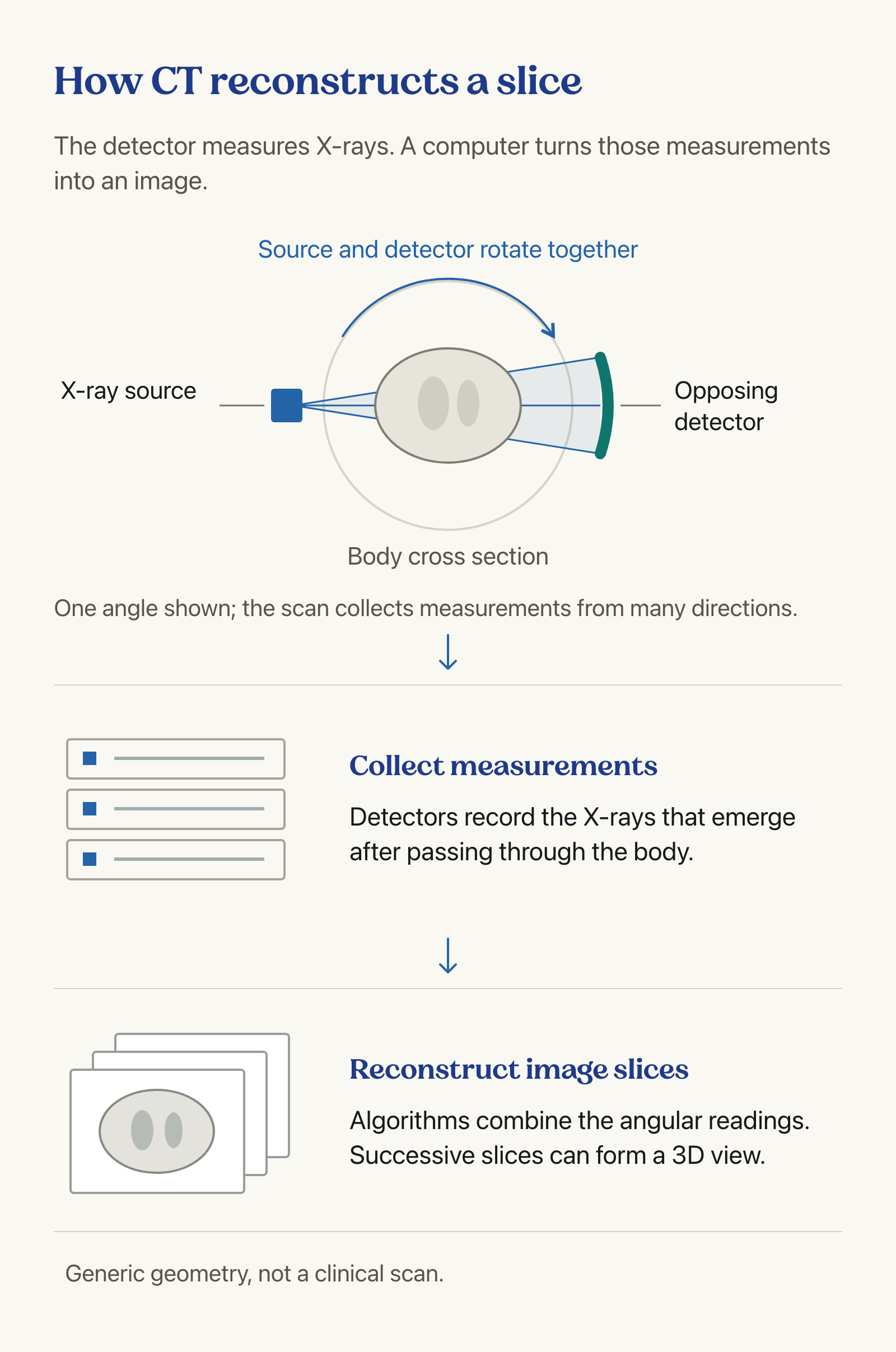
  • A rotating X-ray source sends beams through the body while the patient lies on a moving table. The circular gantry houses the imaging system; the external opening is not itself the detector.
  • Digital detectors register X-rays emerging from the body. Measurements collected at different angles provide information about internal structures; a single detector reading is not yet the cross-sectional picture that a clinician interprets.
  • Reconstruction algorithms combine the angular measurements into image slices. As the NIBIB explanation describes, these slices can also be stacked into three-dimensional views, making computation central to the imaging process.
  • Calibration connects precise engineering to trustworthy measurement. The development announcement specifically identifies rigorous calibration as necessary for imaging accuracy and patient safety; producing an image alone does not establish that the system performs reliably.
  • Diagnostic interpretation follows reconstruction: the scanner supplies images for clinical assessment, rather than an automatic verdict about disease. This distinction matters when discussing technology-led healthcare, where useful information still requires professional judgment and appropriate follow-up.
CT schematic showing a rotating X-ray source, opposing detector and reconstruction of measurements into image slices
CT detectors collect measurements from multiple angles; computer algorithms reconstruct cross-sectional images. Schematic, not a clinical scan.

Radiation Safety and the CT–MRI Distinction

The objective is an examination that answers a clinical question with appropriate exposure, rather than either avoiding all imaging or maximizing scanning.

  • CT uses ionising radiation, which can increase lifetime cancer risk. The FDA explains that benefits generally outweigh risks when the examination is medically necessary; risk awareness must not become blanket rejection of useful diagnosis.
  • Justification asks whether CT is needed to answer the clinical question. Reviewing earlier imaging and considering suitable alternatives can prevent unnecessary repeat examinations without treating every request for diagnostic information as equally urgent.
  • Optimization means selecting exposure that produces an image adequate for the diagnostic task. The lowest possible exposure is not automatically the best setting if the resulting image cannot answer the clinician’s question.
  • Children need appropriate exposure settings because their radiation risk differs from adults. Safety depends on the imaging team and examination protocol as well as the scanner’s hardware, making training part of responsible deployment.
  • MRI does not use ionising radiation, but this does not mean it is risk-free or interchangeable with CT. FDA guidance identifies implant-related hazards; modality choice must follow the clinical question and patient circumstances.

Way Forward

Evaluate Performance Before Scaling Access

  • Require documented performance and safety evidence before describing development support as a completed diagnostic breakthrough.
  • Build calibration and maintenance capability alongside manufacturing so hospitals can sustain reliable equipment throughout its working life.
  • Train imaging teams in justification and exposure optimization, including appropriate protocols for children and review of previous examinations.

Conclusion

  • CT combines physical measurement with mathematical reconstruction: rotating X-rays produce detector data, and computation converts that information into slices. Neither a development agreement nor a slice-count label substitutes for demonstrated diagnostic performance.
  • For healthcare policy, judge self-reliance by dependable equipment and useful access together. Manufacturing support becomes valuable when reliable imaging reaches patients through trained teams, appropriate examinations and sustained quality assurance.

UPSC Practice Questions

Prelims MCQ 1

With reference to computed tomography, consider the following statements:

  1. It uses ionising radiation.
  2. Its computers reconstruct cross-sectional images from measurements obtained at different angles.
  3. MRI and CT use the same physical imaging principle.

How many of the above statements are correct?

(a) Only one (b) Only two (c) All three (d) None

Answer: (b) Only two

Explanation:

CT uses X-rays and computational reconstruction. MRI does not use ionising radiation and has a different physical imaging principle.

Prelims MCQ 2

Which statement best describes exposure optimization in CT imaging?

(a) Using maximum exposure for every patient (b) Avoiding every medically necessary examination (c) Using exposure adequate for the diagnostic task while minimizing unnecessary radiation (d) Replacing clinical interpretation with slice count

Answer: (c) Using exposure adequate for the diagnostic task while minimizing unnecessary radiation

Explanation:

Optimization balances radiation exposure with sufficient image quality; justification separately addresses whether the examination is needed.

UPSC Mains Questions

  1. Explain how computed tomography converts X-ray measurements into images. Discuss the role of calibration and exposure optimization in patient safety.
  2. Indigenous medical-device manufacturing must be assessed beyond import substitution. Discuss with reference to diagnostic imaging equipment.

Sources: PIB, Ministry of Science and Technology and NIBIB, National Institutes of Health.

Frequently Asked Questions

What has TDB announced about the indigenous CT scanner?

TDB has announced support for development and commercialisation of a 32-slice CT scanner by Panacea Medical Technologies. This is not evidence of completed deployment, clinical validation or regulatory clearance.

How does a CT scanner create slices?

An X-ray source rotates around the body, and digital detectors collect measurements from multiple angles. A computer reconstructs these measurements into cross-sectional images that can be viewed individually or combined.

Does a 32-slice label prove higher image resolution?

No. The label alone does not provide a complete measure of diagnostic performance or resolution. The announced project needs performance evidence; the release does not establish numerical resolution or superiority.

How does CT differ from MRI?

CT uses X-rays and ionising radiation. MRI does not use ionising radiation, but has other safety considerations, including hazards involving some implants. They are not automatically interchangeable for every clinical question.

What does CT exposure optimization mean?

It means selecting exposure that provides image quality adequate for the diagnostic task while avoiding unnecessary radiation. Appropriate settings, trained teams and attention to patient characteristics are central to this approach.

Data Centre Planning: Matching Investment With Power and Water

Open article →Download PDF

Why in News?

NITI Aayog’s Frontier Tech Hub released the Data Centre Evaluation Framework on 14 October 2026, with PIB reporting it on 15 October, to guide sustainable state-level investment decisions.

  • The framework addresses power, water, siting, economic value and governance through five connected pillars.
  • It recommends assessing grid readiness, basin-level water stress and public-supply impacts before supporting projects.
  • It is a decision-support tool for states, not an additional regulatory layer or a substitute for existing approvals.
  • Data centres support AI, cloud computing and digital services, but depend on physical electricity, cooling, land and connectivity.
  • The policy question is whether local infrastructure can sustain an investment and whether public support produces measurable benefits.

UPSC Relevance

Prelims Relevance

  • Issuing institution: NITI Aayog’s Frontier Tech Hub.
  • Net grid draw: electricity a facility needs from the grid after accounting for its other supplies.
  • Basin-level water stress: resource pressure extending beyond an individual project boundary.
  • Colocation: hosting customers’ computing equipment in shared facility infrastructure.
  • Policy status: a decision-support framework for state governments.

Mains Relevance

GS Paper 3

  • Digital infrastructure planning under electricity and water constraints.
  • Evaluating investment incentives through resource sustainability and technological capability.

GS Paper 2

  • Coordination among state agencies, utilities and investors with clear accountability.

Essay

  • Digital growth depends on the stewardship of physical resources.

Background and Context

From Investment Attraction to Infrastructure Readiness

A project proposal becomes viable only when its physical requirements fit the location and the state can deliver its commitments.

  • A data centre houses computing equipment alongside power, cooling and connectivity systems. Its role in digital services does not remove its dependence on physical resources shared with other users in the surrounding economy.
  • The framework links five pillars: Power and Energy; Water and Cooling; Siting and Environmental Sustainability; Economic and Strategic Value; and Policy, Governance and Implementation. Their value lies in assessing interdependent requirements rather than isolated promises.
  • Investment readiness means checking infrastructure availability, resource requirements and implementation capacity before committing state support. An announced project can otherwise encounter delays when electricity connections, water supply or essential supporting facilities cannot arrive as expected.
  • Siting is a resource decision, not merely a land transaction. States should identify suitable zones by considering power, water, connectivity and environmental sustainability together, because a convenient plot can still impose difficult infrastructure demands.
  • The framework provides decision support, without creating another regulatory layer. Its recommendations help states evaluate proposals and anticipate constraints; they should not be described as a new law granting exemptions or automatically approving individual projects.

Why Power and Water Must Be Assessed Together

Computing consumes electricity and releases heat, making power supply and cooling choices central to both operating reliability and resource sustainability.

  • Grid readiness asks whether the electricity system can serve the proposed load. Net grid draw concerns the demand remaining on that system after other supplies are considered; renewable procurement alone does not establish local network readiness.
  • The framework recommends renewable energy and storage-backed power. For planning, states must examine how supply arrangements meet operating needs over time, rather than treating a renewable-energy commitment as proof that continuous demand is already covered.
  • Water and cooling require attention beyond the facility fence. A source that appears adequate for one project may face competing demands across its basin, so the framework calls for assessing water stress and public-supply impacts.
  • Rainwater harvesting, on-site treatment and storage are recommended resource measures. Their usefulness depends on local conditions and the operating design; listing them in a proposal does not demonstrate that the project avoids pressure on public supplies.
  • Lifecycle planning extends environmental assessment beyond daily operations to e-waste, batteries and other hazardous waste. Disposal responsibilities matter because investment readiness includes managing the material consequences of infrastructure, not just securing inputs at project commissioning.

Measuring Public Value Instead of Project Size

The framework asks states to connect facilitation with economic outcomes that can be assessed after a facility starts operating.

  • Colocation and active compute services represent different activities: hosting equipment is not identical to providing computing services. Distinguishing them helps states examine what a proposal delivers, rather than assuming every facility creates the same economic value.
  • State incentives should be linked to measurable outcomes, as the framework recommends. Public support can then be assessed against delivered commitments, rather than being justified only by the scale or visibility of the initial investment announcement.
  • Domestic capability is a separate policy objective from attracting buildings and equipment. The framework promotes Indian participation across IT and non-IT infrastructure, while the release highlights research collaboration, advanced cooling and resource-efficient computing as opportunities.
  • Time-bound approvals work best with clear accountability and monitoring of commitments. Predictability can reduce implementation risk, but faster processing should follow better preparation and coordination rather than conceal unresolved infrastructure requirements or resource constraints.
  • A useful policy comparison is investment attraction versus investment readiness: the former secures interest; the latter tests deliverability. The framework seeks both sustainable capacity and lasting economic value, rather than treating an announcement as completion.

Way Forward

Make Support Conditional on Deliverable Commitments

  • Require proposals to explain net grid demand, cooling choices and water sources, with the responsible utility or agency identified.
  • Tie incentives to measurable commitments and review delivery after operations begin, including resource management and domestic capability.
  • Coordinate power, water, environment and industry agencies around shared project milestones so unresolved dependencies surface before approvals or support are promised.

Conclusion

  • Data-centre growth should be judged by whether infrastructure and resources can support it over time. A credible proposal connects electricity, cooling, location and implementation commitments rather than presenting each as a separate assurance.
  • For analysis, distinguish public value from investment size: the framework’s contribution is structured evaluation, not a new regulatory mandate. States must translate its recommendations into location-specific decisions and monitor whether promised benefits actually follow.

UPSC Practice Questions

Prelims MCQ 1

With reference to the Data Centre Evaluation Framework, consider the following statements:

  1. It was released by NITI Aayog’s Frontier Tech Hub.
  2. It recommends evaluating basin-level water stress and public-supply impacts.
  3. It creates an additional statutory approval layer for every data centre.

How many of the above statements are correct?

(a) Only one (b) Only two (c) All three (d) None

Answer: (b) Only two

Explanation:

The first two statements are correct. The framework is a decision-support tool and is explicitly intended to avoid an additional regulatory layer.

Prelims MCQ 2

Which approach best reflects investment readiness for a proposed data centre?

(a) Granting incentives solely according to announced investment (b) Assuming renewable procurement establishes grid readiness (c) Assessing infrastructure, resource availability and implementation commitments before providing support (d) Treating land availability as sufficient for project viability

Answer: (c) Assessing infrastructure, resource availability and implementation commitments before providing support

Explanation:

Investment readiness tests whether a project can be supported sustainably, including electricity, water, siting and implementation requirements.

UPSC Mains Questions

  1. Why must states move from attracting data-centre investments to establishing investment readiness? Discuss with reference to power and water constraints.
  2. Explain how outcome-linked incentives and inter-agency coordination can improve the public value of data-centre investments.

Source: PIB, NITI Aayog.

Frequently Asked Questions

What is the Data Centre Evaluation Framework?

It is a decision-support framework released by NITI Aayog’s Frontier Tech Hub to help states assess data-centre proposals against infrastructure readiness, environmental sustainability, economic value and implementation requirements.

Does the framework create a new regulation?

No. The official release describes it as a decision-support tool intended to improve planning and project evaluation without adding a regulatory layer. It should not be presented as a new statutory approval regime.

Why is basin-level water stress relevant?

A facility shares water resources with other users beyond its immediate boundary. Basin-level assessment helps reveal competing demands and potential effects on public supplies that a project-level water commitment may miss.

Why distinguish colocation from active compute services?

Colocation provides facility infrastructure for customers’ equipment, while active compute services involve providing computing services. The distinction helps states evaluate the actual activity and benefits promised by a particular investment proposal.

GSAT-7C: Dedicated Communications for Distributed Air Assets

Open article →Download PDF

Why in News?

On 15 October 2026, the Ministry of Defence signed a contract with New Space India Limited for GSAT-7C, a dedicated communication satellite capability for the Indian Air Force.

  • The GSAT-7C contract is valued at Rs 2,563 crore; this is the satellite-specific figure, not the combined value of separate defence acquisitions announced together.
  • The Ministry describes the satellite as indigenously designed, developed and manufactured, intended to improve secure and resilient communication for Air Force assets.
  • The announced milestone is contract signing; the release does not establish that GSAT-7C has been launched, commissioned or accepted into operational service.
  • A communication capability must connect users and carry information reliably; acquiring a spacecraft is only part of that operational requirement.
  • The UPSC issue is space-enabled defence coordination, distinct from commercial satellite-service licensing or a claim about new surveillance imagery.

UPSC Relevance

Prelims Relevance

  • GSAT-7C: dedicated communication satellite capability contracted for the Indian Air Force.
  • NSIL: New Space India Limited, the contract counterparty named by the Ministry of Defence.
  • Relay: an intermediate communications node that passes information between endpoints.
  • Uplink and downlink: transmissions toward and from a satellite respectively.
  • Ground segment: antennas, terminals and supporting systems required to exchange information with spacecraft.

Mains Relevance

GS Paper 3

  • Space technology as enabling infrastructure for coordinated defence operations.
  • Operational resilience through integration of space assets, user terminals and secure network management.

Essay

  • Strategic autonomy depends on dependable systems, not ownership of isolated equipment.

Background and Context

What the Contract Establishes

The procurement announcement identifies a capability and its intended user; it does not certify an operational network or reveal its detailed architecture.

  • The Ministry of Defence has contracted with NSIL for dedicated satellite communication capability. This identifies the buyer, supplier and service purpose without proving that the eventual system has completed deployment or acceptance.
  • The intended beneficiary is the Indian Air Force. Reliable communication helps separated assets exchange information and coordinate activity; the announcement describes improved operational effectiveness as the expected benefit, rather than a demonstrated result.
  • Indigenous development is significant because communication infrastructure supports sensitive operations. The release describes domestic design, development and manufacture, but does not publish a component-level sourcing inventory or establish complete freedom from external dependencies.
  • A procurement contract and an operational capability are different milestones. Integration, testing and acceptance remain relevant questions when evaluating delivery; the public announcement supplies no basis for declaring those requirements already satisfied.
  • The published release does not specify orbital parameters, frequency bands or throughput. Features of another GSAT satellite cannot be transferred to GSAT-7C merely because both belong to the same broadly named satellite family.

How Satellite Communication Connects Users

The general relay principle explains the benefit, while the precise GSAT-7C network arrangement remains outside the information released with this contract.

  • A communication relay receives a signal and passes its information onward. NASA explains that relay satellites can provide an intermediate path between missions and ground facilities, instead of relying only on direct contact.
  • The uplink carries information toward a satellite; the downlink brings it back to receiving equipment. These terms describe transmission direction and do not, by themselves, identify a particular military frequency or security method.
  • ISRO explains that communication payloads contain transponders. This is a useful general concept, but their number, configuration and performance on GSAT-7C cannot be inferred from a generic payload description.
  • The ground segment gives the space link practical value through antennas, terminals and supporting electronics. A satellite overhead does not automatically make every aircraft or ground unit a compatible and authorised network participant.
  • Communication transports information; imaging observes a scene, while navigation helps determine position and time. Carrying a message containing coordinates or an image does not make the relay itself a navigation or imaging instrument.

Why Security and Resilience Need a Whole System

The operational test is whether authorised users can exchange dependable information when parts of their communication environment are disrupted.

  • Security asks whether information and access are protected; resilience asks whether useful service survives or recovers after disruption. A network can perform well in one respect while remaining weak in the other.
  • Encryption can protect message content, but does not guarantee that a signal arrives. Interference, equipment failure or loss of power create availability problems even when an adversary cannot read the information being transmitted.
  • Redundancy means having usable alternatives when a component or path fails. It should be assessed across terminals, power and communication routes, rather than assumed merely because a dedicated satellite has been procured.
  • Interoperability concerns whether intended users can exchange usable information through compatible systems. Network access, message handling and trained operators matter alongside the spacecraft; these are evaluation principles, not disclosed details of GSAT-7C equipment.
  • A credible readiness assessment would examine service under degraded conditions and restoration after failures. The contract announcement supports studying these questions, but cannot establish a measured resilience level or immunity to disruption.

Way Forward

Evaluate Delivery as a Communication Service

  • Assess integration and acceptance against the intended operational service, including compatible terminals and trained users, rather than treating spacecraft acquisition alone as completion.
  • Test degraded-operation and recovery procedures while protecting sensitive technical details; public accountability need not disclose military network architecture.
  • Track delivery milestones separately from announcements, with clear distinction between contracted capacity, launched hardware and an accepted operational capability.

Conclusion

  • GSAT-7C makes dedicated defence communication the central issue: its value lies in dependable information exchange among authorised users, supported by both space infrastructure and equipment on the ground.
  • For an examination answer, connect strategic autonomy with integration, security and resilience, while keeping the evidence boundary clear: a signed procurement contract is not proof of launch, commissioning or demonstrated performance.

UPSC Practice Questions

Prelims MCQ 1

With reference to the GSAT-7C announcement of October 2026, consider the following statements:

  1. The contract concerns dedicated communication capability for the Indian Air Force.
  2. New Space India Limited is the named satellite contract counterparty.
  3. The announcement confirms that GSAT-7C has been commissioned into operational service.

How many of the above statements are correct?

(a) Only one (b) Only two (c) All three (d) None

Answer: (b) Only two

Explanation:

The first two statements reflect the Ministry of Defence release. It announces contract signing, not commissioning.

Prelims MCQ 2

Which statement best distinguishes communication security from resilience?

(a) Encryption alone guarantees uninterrupted communication. (b) Resilience concerns only the secrecy of message content. (c) Security protects information and access, while resilience concerns maintaining or restoring useful service. (d) A dedicated satellite eliminates the need for ground terminals.

Answer: (c) Security protects information and access, while resilience concerns maintaining or restoring useful service.

Explanation:

Confidentiality does not ensure availability. Even protected messages need working links, equipment and recovery arrangements.

UPSC Mains Questions

  1. Explain how dedicated satellite communications can support defence coordination. Why must performance be assessed across both space and ground segments?
  2. Distinguish communication security from network resilience. Discuss their relevance when evaluating a newly contracted defence communication capability.

Sources: PIB, Ministry of Defence and NASA, Space Communications.

Frequently Asked Questions

What was announced about GSAT-7C?

The Ministry of Defence announced a contract with New Space India Limited for a dedicated communication satellite capability for the Indian Air Force. It described secure and resilient communications as intended benefits.

Has GSAT-7C been launched or commissioned?

The cited announcement establishes contract signing on 15 October 2026. It does not establish launch, commissioning or operational acceptance, so those milestones should not be inferred from the procurement announcement.

Is GSAT-7C an imaging satellite?

The announced purpose is dedicated communication capability. A communication satellite relays information; transporting an image supplied by another system does not mean its own payload takes that image or performs Earth observation.

Why are ground terminals important?

Ground antennas, terminals and supporting systems exchange information with spacecraft. A satellite link becomes useful only when intended users have compatible equipment and authorised access, alongside reliable operation of the wider network.

Does encryption make communication resilient?

Encryption can protect message content, but cannot alone ensure delivery. Resilience also concerns service continuity and recovery when equipment fails, power is lost or communication links are disrupted.

Bridge Design Checks: Independent Review Before Construction

Open article →Download PDF

Why in News?

On 15 October 2026, NHAI announced independent checking of major bridge and critical highway-structure designs, with the policy taking effect from 1 December 2026.

  • Coverage includes major river bridges with design discharge of at least 3,000 cubic metres per second, structures with individual effective spans of at least 40 metres, and other identified complex structures.
  • Independent checking will be undertaken by empanelled IITs, government technical institutions and experienced firms with relevant bridge-engineering and hydraulic expertise.
  • Applicability covers new EPC, HAM and BOT highway projects and projects where design verification or proof checking has not begun.
  • Pre-construction scrutiny can identify design problems before they become embedded in a completed structure.
  • River bridges require attention to the flowing river and supporting ground, alongside the strength of the bridge itself.

UPSC Relevance

Prelims Relevance

  • NHAI: National Highways Authority of India.
  • IRC: Indian Roads Congress; applicable codes form part of the checking framework.
  • Hydrology: assessment of water availability and flood flows.
  • Hydraulics: behaviour of flowing water through and around the bridge opening.
  • Scour: erosion of river-bed material that can threaten foundation support.

Mains Relevance

GS Paper 3

  • Infrastructure safety through independent design assurance.
  • Flood-related risk and bridge-foundation resilience.

GS Paper 2

  • Clear responsibilities between designers, independent reviewers and the approving authority.

Essay

  • Public infrastructure quality depends on checking assumptions before accepting completed assets.

Background and Context

What Independent Checking Adds

A second technical examination tests the design before construction decisions become difficult to reverse.

  • Design assurance means examining whether calculations, analysis and drawings satisfy applicable codes, specifications and contract requirements. A drawing can appear complete while still resting on an inadequate assumption about loads or site conditions.
  • Independent expertise brings another technical team into the checking process. The announced panel includes public institutions and experienced technical firms; the policy does not reserve every assignment exclusively for an IIT.
  • Scope extends beyond the visible bridge deck to the supporting analysis and, where applicable, water studies. A complete review must consider how these inputs work together rather than inspect isolated drawings.
  • Early correction is the central purpose: identifying a design issue before it is built allows the contractor to revise it. The announcement is a quality-assurance measure, not evidence that all current bridges are unsafe.
  • Project appraisal and design checking answer different questions. Integrated transport appraisal addresses broader planning decisions; this policy examines critical structures within NHAI projects against engineering and contractual requirements.

Why Water Studies Matter Alongside Structural Strength

A river bridge must carry loads while allowing water to pass without undermining its supports.

  • Structural calculations examine the bridge as a load-bearing system. Hydrological and hydraulic studies address the river conditions around it; passing one category of checks cannot establish that the other category is satisfactory.
  • Design discharge is the flow used for design assessment, expressed as volume per unit time. It is not the speed of water or the amount of rainfall recorded across the surrounding catchment.
  • Hydrological studies inform assessment of flows and floods. Hydraulic studies examine how that water passes through the bridge location, including flood levels and whether the available openings provide adequate passage.
  • Scour removes river-bed material around foundations as water flows past. This can reduce the support available below a bridge even when damage is not immediately visible in its deck or road surface.
  • Foundation safety must be assessed against river-bed erosion, not inferred from the apparent strength of the superstructure. The policy explicitly includes these water-related studies wherever applicable to the structure under examination.

Review Sequence and Limits of Coverage

The independent checker provides technical observations; the contractor and NHAI retain their distinct roles in the contractual process.

  • Submission begins with the contractor or concessionaire presenting designs and drawings for contractual review or approval. Relevant institutions or firms are then selected from the empanelled list according to the project requirements.
  • Verification produces observations and recommendations from the selected checker. The contractor or concessionaire considers these and makes necessary design changes; the review is intended to lead to corrections, not merely another certificate.
  • NHAI review follows under the applicable contract. Independent verification is a technical input to that process, not a transfer of the authority’s final contractual review or approval role to an outside institution.
  • Completed proof checking generally falls outside the new policy. Additional verification may still be undertaken for major bridges and complex or critical special structures; this is not blanket retrospective rechecking of every existing bridge.
  • Implementation starts on the announced effective date, not the press-release date. The measure concerns design quality; unlike a road-access impact study, it does not measure wider social outcomes after construction.

Way Forward

Make Review Findings Traceable

  • Record closure of each technical observation, linking the finding to the revised calculation or drawing and the contractual decision.
  • Match expertise to the site: river crossings need relevant hydraulic and foundation competence alongside structural analysis.
  • Preserve accountability by recording who designed, independently checked and reviewed each critical structure.

Conclusion

  • Bridge safety requires a coherent design for the structure, flowing water and foundations; an independent review can expose weaknesses before construction fixes them into the asset.
  • The exam distinction is between technical verification and contractual approval: the checker recommends, the contractor revises, and NHAI reviews or approves under the contract.

UPSC Practice Questions

Prelims MCQ 1

With reference to NHAI’s announced independent design-checking policy, consider the following statements:

  1. The policy takes effect from 1 December 2026.
  2. All projects with completed proof checking must automatically undergo fresh verification.
  3. Hydrological and hydraulic studies are included wherever applicable.

How many of the above statements are correct?

(a) Only one (b) Only two (c) All three (d) None

Answer: (b) Only two

Explanation:

Statements 1 and 3 are correct. Completed proof checking is generally excluded, although additional verification may be undertaken for major or critical structures.

Prelims MCQ 2

Which of the following best describes scour at a river bridge?

(a) Expansion of the bridge deck due to heat (b) Removal of river-bed material by flowing water (c) Accumulation of traffic load above the deck (d) Measurement of rainfall in the catchment

Answer: (b) Removal of river-bed material by flowing water

Explanation:

Scour is river-bed erosion that can threaten foundation support. It differs from structural loading and catchment rainfall measurement.

UPSC Mains Questions

  1. Explain why structural calculations alone cannot establish the safety of a major river bridge. Discuss the role of hydrological and hydraulic studies.
  2. How can independent design verification improve highway infrastructure quality without blurring contractual accountability?

Source: PIB, Ministry of Road Transport and Highways.

Frequently Asked Questions

When does the NHAI design-checking policy take effect?

The announced effective date is 1 December 2026. It covers new EPC, HAM and BOT projects and projects where design verification or proof checking has not commenced.

Does the policy order a fresh check of every existing bridge?

No. Projects with completed design verification or proof checking are generally excluded. Additional independent verification may still be undertaken for major bridges and complex or critical special structures.

How do hydraulic checks differ from structural checks?

Structural checks examine the load-bearing design. Hydraulic checks examine water movement, flood levels and passage through bridge openings. Foundation assessment must also account for erosion of the river bed.

Does the independent checker approve the final design?

The checker submits observations and recommendations. The contractor or concessionaire makes necessary changes, after which NHAI reviews or approves the design according to the applicable contractual provisions.

Tribal Language Corpora: From Recordings to Reliable Learning Tools

Open article →Download PDF

Why in News?

The Ministry of Tribal Affairs held its first Working Group meeting on tribal languages on 15 October 2026, with linguistic validation and classroom use central to the discussion.

  • IIT Delhi sought support for validating datasets, standardising spelling and orthography, and developing domain-specific vocabulary for planned pilots.
  • Adi Vaani, developed with the Ministry, already offers translation and speech-related features; expansion into a comprehensive repository remains a vision.
  • Experts proposed a language atlas, coordinated documentation and federated archives; the Ministry said it would prepare a roadmap.
  • Digitisation preserves material, but classroom usefulness also depends on accurate meaning, comprehensible vocabulary and locally familiar language.
  • Mother-tongue resources can connect home experience with school concepts when teachers and speakers help assess the material.

UPSC Relevance

Prelims Relevance

  • Corpus: an organised collection of language material; its plural is corpora.
  • Parallel corpus: corresponding content aligned across languages.
  • Orthography: conventions governing how a language is written.
  • OCR: optical character recognition, which converts printed or scanned text into machine-readable characters.
  • Domain vocabulary: terms used in a particular field, such as science or public administration.

Mains Relevance

GS Paper 1

  • Language diversity and the continuity of living cultural traditions.

GS Paper 2

  • Inclusive education through materials understandable to learners and teachers.

GS Paper 3

  • Human validation and dataset quality in language technology.

Essay

  • A language remains useful when it can express both inherited experience and new knowledge.

Background and Context

What Makes a Language Corpus Reliable?

A corpus becomes useful when recordings and texts are organised, checked and connected to their meaning, rather than merely stored together.

  • Speech recordings preserve pronunciation and expression, but an unclear recording can produce an inaccurate transcript. Checking the audio against written content helps prevent errors from becoming examples that later users treat as authoritative.
  • Linguistic validation asks whether an expression actually conveys the intended meaning. Fluent speakers and trained reviewers can identify a mistranslation that sounds plausible, especially when a word has different meanings in different situations.
  • Orthographic consistency helps readers search and compare written resources. However, choosing a common spelling should not silently erase legitimate pronunciation or dialect differences; those differences need to remain visible in the accompanying record.
  • Metadata describes the material: its language variety, context and recording conditions. Such information helps a teacher or researcher judge whether an example fits the intended audience instead of assuming all speakers use identical expressions.
  • Coverage matters alongside accuracy: a collection dominated by one locality or type of conversation may poorly represent other users. More stored material does not automatically mean better support for everyday communication or school learning.

How Parallel Corpora Support Language Tools

Different tools handle different parts of language, so their outputs need different checks before they can support dependable translation or teaching.

  • A parallel corpus pairs corresponding passages across languages. The important relationship is equivalent meaning, not identical word order; mechanically matching each word can lose the way a language expresses an action, condition or relationship.
  • Non-verbal prompts, suggested at the meeting, can encourage speakers to describe a shared scene or activity. Reviewers must check correspondence: two descriptions of the same picture may emphasise different details rather than translate each other.
  • Speech technology connects spoken language with digital processing. Experts offered work on tonal languages, where pitch can distinguish meaning; losing that distinction can make a recording or transcript unreliable even when individual sounds appear similar.
  • OCR extracts characters from an image of text; it does not establish that those characters form a correct translation. A scanned primer needs recognition checks before its contents are reused in searchable teaching material.
  • Translation then works across meanings and contexts, while subtitling also connects language to audiovisual material. Treating these as separate tasks helps locate errors instead of assuming that a readable final output proves every stage was correct.

When Does a Digital Resource Become Classroom Material?

The meeting linked language research with schools, but the suitability of particular resources must be demonstrated through classroom review and use.

  • Technical vocabulary is needed for school subjects because familiar conversational language may not supply a shared term for every concept. Teachers and speakers should assess whether a proposed term expresses the concept accurately and clearly.
  • A primer introduces reading and language skills; a general translation tool serves a different purpose. Classroom adaptation must consider the learner’s level, the sequence of concepts and the explanations a teacher can give.
  • Community-school-university collaboration was proposed to connect lived language knowledge, teaching experience and linguistic research. Each contributes a different check: natural usage, learner comprehension and systematic analysis should reinforce one another when resources are revised.
  • Stories and poems contributed by students, parents and teachers could enrich the repository. Their educational use should depend on context and suitability, rather than treating every contributed item as a ready-made lesson or assessed resource.
  • The national repository vision and proposed atlas are institutional directions, not proof of completed classroom deployment. The meeting’s immediate significance is its request for available resources and a roadmap, alongside support for planned linguistic pilots.

Way Forward

Test Meaning Before Expanding Use

  • Establish speaker and teacher review for transcripts, translations and school-subject terms, with a clear way to record disagreements.
  • Pilot selected resources in real learning tasks, checking whether pupils understand the concept rather than merely repeat the translated term.
  • Keep revision histories for corrected language examples so institutions do not unknowingly reuse superseded errors.

Conclusion

  • Reliable language technology depends on validated meaning, usable writing conventions and appropriate vocabulary; collecting recordings is the beginning of that work, not evidence that a teaching resource is ready.
  • For an education answer, connect linguistic quality with learner comprehension and teacher support. Assess proposed platforms through the usefulness of their materials, while clearly distinguishing existing functions from future institutional plans.

UPSC Practice Questions

Prelims MCQ 1

With reference to digital language resources, consider the following statements:

  1. A parallel corpus aligns corresponding content across languages.
  2. Optical character recognition establishes whether a translation conveys the correct meaning.
  3. Orthography concerns conventions for writing a language.

How many of the above statements are correct?

(a) Only one (b) Only two (c) All three (d) None

Answer: (b) Only two

Explanation:

Statements 1 and 3 are correct. OCR recognises characters in images; translation quality requires a separate assessment of meaning.

Prelims MCQ 2

Which approach best establishes whether a tribal-language science resource is suitable for classroom use?

(a) Counting the number of files uploaded (b) Replacing all local variants without review (c) Testing conceptual understanding with speakers, teachers and learners (d) Treating fluent machine output as proof of accuracy

Answer: (c) Testing conceptual understanding with speakers, teachers and learners

Explanation:

Classroom suitability depends on accurate concepts and learner comprehension, not just storage volume or fluent-looking output.

UPSC Mains Questions

  1. Explain how linguistic validation can improve the educational value of digital tribal-language resources.
  2. Distinguish the challenges of collecting a language corpus from those of adapting it for mother-tongue-based multilingual education.

Source: PIB, Ministry of Tribal Affairs.

Frequently Asked Questions

What is a tribal-language corpus?

It is an organised collection of language material, such as recorded speech or written texts. Its usefulness depends on accuracy, context, coverage and the information needed to interpret individual examples.

Why is orthography important for language technology?

Consistent writing conventions make text easier to search, compare and reuse. Standardisation still needs careful review so that legitimate dialect or pronunciation differences are documented rather than mistaken for errors.

How does a parallel corpus differ from a dictionary?

A dictionary explains words and their meanings. A parallel corpus aligns corresponding content across languages, helping users study how meaning is expressed within sentences and contexts rather than through isolated word pairs.

Did the working group complete a national language repository?

No. The meeting reviewed existing Adi Vaani capabilities and discussed a broader repository vision. It also considered proposals for an atlas and coordinated archives, with a roadmap still to be prepared.

YES Bank AT-1 Bonds: Loss Absorption Requires Lawful Authority

Open article →Download PDF

Why in News?

On 15 October 2026, the Supreme Court dismissed appeals against the Bombay High Court judgment setting aside the administrator’s write-down of YES Bank AT-1 bonds.

  • The Court upheld the finding that the administrator lacked authority to undertake the disputed write-down.
  • The final reconstruction scheme omitted the draft’s write-down clause; the administrator could not reverse that choice.
  • The Court directed that annual coupon payments remain governed by the Information Memoranda.
  • Bank rescue requires both credible loss absorption and predictable rules about who can impose losses.
  • The judgment concerns the legality of this action, not a declaration that all AT-1 investments are safe.

UPSC Relevance

Prelims Relevance

  • Additional Tier 1 capital and loss absorption
  • Common Equity Tier 1 and risk-weighted assets
  • Pre-specified trigger versus point of non-viability
  • Bank administrator versus RBI regulatory authority

Mains Relevance

GS Paper 3

  • Bank resolution, financial stability and loss-bearing capital.
  • Investor protection through accurate disclosure of capital-instrument risks.

GS Paper 2

  • Statutory competence, procedural legality and judicial review of economic administration.

Essay

  • A necessary policy objective does not excuse an unlawful exercise of power.

Background and Context

What AT-1 Capital Is Meant to Do

AT-1 instruments support a bank’s capital cushion, but their capacity to absorb losses makes them fundamentally different from an ordinary promise of repayment.

  • Additional Tier 1 forms part of a bank’s going-concern capital: it can absorb losses while the institution continues operating. The Court contrasted this with Tier 2 capital’s gone-concern role in liquidation.
  • Common Equity Tier 1 and AT-1 are separate components of Tier 1. AT-1 debt instruments can count as regulatory capital because their contractual and regulatory conditions allow losses to fall on investors.
  • A write-down reduces the claim represented by an instrument; conversion replaces the relevant claim with equity under applicable terms. Neither mechanism should be confused with an ordinary fixed-income product’s scheduled principal repayment.
  • The pre-specified trigger examined here depended on the bank’s CET1 ratio falling below a prescribed threshold. Its purpose was to activate loss absorption before insolvency, using the options contained in the Information Memoranda.
  • The point of non-viability involved a different regulatory stage. Under the framework considered, RBI determined the relevant intervention; identifying financial distress did not authorise every bank official to impose the resulting loss.

Why the Administrator’s Action Failed

The judgment connects the sequence of reconstruction with the identity of the authority legally entitled to act; the trigger alone did not settle either question.

  • The draft reconstruction scheme contained a write-down provision. After stakeholder representations, the final scheme omitted it; the Court treated that omission as a conscious decision rather than an unfinished administrative step awaiting implementation.
  • The final scheme took effect on 13 March 2020; the administrator wrote down the bonds the next day. This sequence mattered because the challenged action followed the scheme that had left them untouched.
  • A general clause preserving existing powers could not supply specific write-down authority. The Court required compliance with the applicable Master Circular, the Information Memoranda and the reconstruction scheme instead of relying on residual powers.
  • Under Section 36ACA of the Banking Regulation Act, the administrator substituted for the bank’s board. Appointment by RBI did not transfer RBI’s own regulatory role or permit the administrator to exercise its separate powers.
  • The Court distinguished the bank’s options at the pre-specified trigger from RBI’s role at non-viability. It held that the administrator could not assume the latter role merely because intervention was considered financially necessary.

What the Judgment Does and Does Not Establish

The ruling protects legal limits on resolution powers without removing the investment risk that gives AT-1 instruments their regulatory purpose.

  • The appeals’ dismissal upheld setting aside this write-down. The Court did not abolish loss absorption: it expressly recognised the bonds’ protective function and stressed that the authorities should have followed the prescribed route.
  • Financial necessity and legal competence answer different questions. A rescue may need investors to absorb losses, but that economic argument cannot replace the required decision-maker, conditions or procedure for imposing those losses.
  • The Court criticised sales to individual investors in the case and inadequate risk scrutiny. Read these observations within the instruments and regulatory framework examined, rather than treating them as a universal current retail-bond prohibition.
  • The operative direction preserves annual coupons under the Information Memoranda. It should not be rewritten as an unconditional promise of immediate principal repayment, a new deposit-compensation scheme or a guarantee against future investment losses.
  • The Court confined its observations to deciding these appeals and left pending proceedings to their own conclusions. For examination answers, separate the binding outcome here from broader allegations, unresolved claims and possible implementation steps.

Way Forward

Make Resolution Decisions Legally Traceable

  • Record the trigger, competent authority and applicable instrument terms before imposing a loss.
  • Explain how each action fits the final reconstruction scheme, especially where it differs from a published draft.
  • Use clear risk disclosures that distinguish bank capital instruments from deposits and ordinary repayment expectations.

Conclusion

  • AT-1 risk remains real, but accepting investment risk does not waive the right to lawful administration. The judgment turns on the authority and procedure used for this particular write-down.
  • In a banking-reform answer, connect financial stability with rule of law: effective resolution needs usable loss-absorption tools and decisions that remain within their statutory and contractual limits.

UPSC Practice Questions

Prelims MCQ 1

With reference to the AT-1 framework examined in the YES Bank judgment, consider the following statements:

  1. AT-1 instruments can absorb losses while a bank continues operating.
  2. An administrator appointed by RBI automatically acquires RBI’s regulatory powers.
  3. A pre-specified capital trigger and a point-of-non-viability trigger have distinct roles.

How many of the above statements are correct?

(a) Only one (b) Only two (c) All three (d) None

Answer: (b) Only two

Explanation:

Statements 1 and 3 are correct. The administrator substitutes for the board and cannot assume RBI’s separate regulatory powers.

Prelims MCQ 2

Which best captures the central principle of the Supreme Court’s YES Bank AT-1 ruling?

(a) AT-1 instruments cannot absorb losses. (b) Financial necessity cures every procedural defect. (c) A loss-absorption action must be taken by the lawful authority through the prescribed procedure. (d) All bondholders become depositors during reconstruction.

Answer: (c) A loss-absorption action must be taken by the lawful authority through the prescribed procedure.

Explanation:

The Court recognised the capital instruments’ loss-absorption purpose but rejected the administrator’s assumption of authority in the challenged action.

UPSC Mains Questions

  1. Bank resolution requires both financial credibility and legal certainty. Discuss with reference to the YES Bank AT-1 judgment.
  2. Distinguish a bank administrator’s managerial powers from the regulator’s intervention powers. Why does this distinction matter during a financial crisis?

Source: Supreme Court of India.

Frequently Asked Questions

What are AT-1 instruments?

Additional Tier 1 instruments form part of a bank’s regulatory capital. Their loss-absorption features can impose losses on investors while supporting the bank, subject to the applicable regulatory framework and instrument terms.

Why was the YES Bank write-down set aside?

The Supreme Court upheld the finding that the administrator could not override the final reconstruction scheme or assume RBI’s separate regulatory role. Financial distress did not cure the defects in authority and procedure.

Does the judgment make AT-1 bonds risk-free?

No. The Court recognised their loss-absorption function. Its ruling concerns the legality of the challenged write-down, not a general guarantee of principal, coupon payments or protection from future investment losses.

What did the Court say about coupons?

The Court said annual coupon payment would remain unaffected by the appeals’ outcome and must follow the Information Memoranda. This is not an unconditional direction promising immediate repayment of every investor’s principal.

A Contested UNSC Seat Poses a Test for India

Open article →Download PDF

Why in news?

India’s bid for a UNSC non-permanent seat for 2028-29 faces a contest from Tajikistan; UNGA voting is due in June 2027.

UPSC Relevance 

Prelims: UN Charter provisions on the Security Council, election of non-permanent members, voting and veto, India’s UNSC terms.

Mains: GS2 – Important international institutions, their structure and mandate.

UN Security Council 

  • One of the six principal organs of the UN, with primary responsibility for maintaining international peace and security (Article 24).
  • Legal basis: Chapter V of the UN Charter (Articles 23 to 32).
  • Binding power: Under Article 25, members agree to accept and carry out the Council’s decisions. It is the only UN organ whose decisions are binding on all member states.
  • Tools: Peaceful settlement of disputes (Chapter VI), sanctions and use of force (Chapter VII), peacekeeping missions, and referral of cases to the International Criminal Court.

Membership Structure

FeaturePermanent Members (P5)Non-permanent Members
Number5 – China, France, Russia, UK, USA10
How chosenNamed in Article 23 of the CharterElected by the UN General Assembly
TermPermanentTwo years; five elected every year
Re-electionNot applicableRetiring member not eligible for immediate re-election
Veto powerYes (on substantive matters)No
  • Expansion in 1965: The Council originally had 11 members (6 non-permanent). An amendment adopted in 1963 came into force in 1965 and raised the strength to 15. This is the only time the Council has been expanded.
  • Presidency: Rotates every month among all 15 members in English alphabetical order.
  • Non-members: Any UN member whose interests are affected may take part in discussions without a vote (Article 31). A party to a dispute is also invited (Article 32).

How Non-permanent Members are Elected

  • Criteria in the Charter (Article 23): Due regard to (i) contribution to international peace and security and to the other purposes of the UN, and (ii) equitable geographical distribution.
  • Majority needed: Two-thirds of members present and voting in the UNGA, through secret ballot. If all 193 members vote, a candidate needs at least 129 votes. This applies even when a candidate is unopposed.
  • Timing: Elections are held in June (shifted from October since 2016), and the new members take their seats on 1 January of the next year. This gives elected members more time to prepare.
  • Repeated rounds: If no candidate gets two-thirds, voting continues in rounds. In 1979, Cuba and Colombia were deadlocked for over 150 rounds before Mexico was chosen as a compromise.
  • Split terms: Sometimes two evenly matched candidates divide the two-year term, one year each. Italy and the Netherlands shared the 2017-18 term.
  • Role of regional groups: Seats are informally allotted to regional groups. Each group tries to agree on a ‘clean slate’ (as many candidates as seats). When consensus breaks down, the contest moves to the full Assembly, and every vote counts.

Distribution of the 10 non-permanent seats

Regional GroupSeats
African Group3
Asia-Pacific Group (55 members)2
Latin American and Caribbean Group (GRULAC)2
Western European and Others Group (WEOG)2
Eastern European Group1

India’s Eight Terms as a Non-permanent Member

TermNotes
1950-51First term, soon after independence; Korean War on the Council’s agenda
1967-68Second term
1972-73Shortly after the 1971 war and the creation of Bangladesh
1977-78Fourth term
1984-85Fifth term
1991-92End of the Cold War and the Gulf War period
2011-12Won 187 of 191 votes after Kazakhstan withdrew in India’s favour; India chaired the Counter-Terrorism Committee
2021-22Won 184 of 192 votes after Afghanistan stepped aside; Resolution 2593 on Afghanistan; chaired the Counter-Terrorism Committee in 2022
  • Two defeats: India lost when it had to contest – in 1975 against Pakistan and in 1996 against Japan.
  • Pattern: India has usually been the Asia-Pacific group’s consensus choice roughly once a decade, which made the elections almost a formality.
  • 2021-22 highlights: PM Modi chaired an open debate on maritime security in August 2021, the first Indian PM to do so. During its December 2022 presidency, India focused on reformed multilateralism and counter-terrorism. The Delhi Declaration (2022) addressed misuse of new technologies by terrorists.

Practice MCQ

Q1. Consider the following statements regarding non-permanent members of the UN Security Council:

1. They are elected by the UN General Assembly by a two-thirds majority of members present and voting.

2. A retiring non-permanent member is eligible for immediate re-election.

3. Five non-permanent members are elected every year for a two-year term.

How many of the statements given above are correct?

(a) Only one     (b) Only two     (c) All three     (d) None

Answer: (b). Statement 2 is incorrect. Article 23 bars immediate re-election of a retiring member.

Q2. Consider the following statements:

Statement I: The presidency of the UN Security Council rotates every month among its members in English alphabetical order.

Statement II: Under Article 27 of the UN Charter, decisions on procedural matters require the concurring votes of all permanent members.

Which one of the following is correct in respect of the above statements?

(a) Both Statement I and Statement II are correct and Statement II explains Statement I

(b) Both Statement I and Statement II are correct but Statement II does not explain Statement I

(c) Statement I is correct but Statement II is incorrect

(d) Statement I is incorrect but Statement II is correct

Answer: (c). Procedural matters need any 9 affirmative votes; the veto applies only to substantive matters.

Mains Practice Question

Q. “India has served eight terms as a non-permanent member of the UN Security Council, but its bid for 2028-29 is unlike its earlier ones.” Explain the process of electing non-permanent members and examine whether frequent non-permanent tenures help or hurt India’s claim to permanent membership. (15 Marks, 250 words)

The debate over immunity to CEC, ECs

Open article →Download PDF

Why in news?

The Supreme Court issued notice on ADR’s plea challenging Section 16 of 2023 law granting lifelong immunity to CEC, ECs.

UPSC Relevance

Prelims – Rule of Law, Article 14, Article 361, Articles 105 and 194, Article 324, CEC and Other ECs Act 2023, Judges (Protection) Act 1985, Vienna Convention

GS2 – Indian Constitution – significant provisions and basic structure

What is Rule of Law?

Rule of Law means that the country is governed by law and not by the will of any individual. Everyone, including the government and its officers, is subject to the same law. The idea was popularised by British jurist A.V. Dicey (1885), who gave three principles:

  • Supremacy of law – No one can be punished except for a clear breach of law decided by ordinary courts. There is no arbitrary power.
  • Equality before law – Every person, whatever their rank, is subject to the ordinary law and ordinary courts. No one is above the law.
  • Rights flow from court decisions – In Britain, individual rights came from judicial decisions. In India this principle does not apply, since rights flow from the written Constitution.

Rule of Law in India

  • Article 14 – The State shall not deny to any person equality before the law (British concept, negative) or the equal protection of the laws (American concept, positive) within the territory of India.
  • Basic structure – Rule of Law was held to be part of the basic structure in Indira Nehru Gandhi v. Raj Narain (1975).
  • Equality is not absolute – Article 14 allows reasonable classification. It must be based on an intelligible differentia and must have a rational nexus with the object of the law (State of West Bengal v. Anwar Ali Sarkar, 1952). Arbitrariness itself violates Article 14 (E.P. Royappa, 1974).
  • Meaning for this debate – Equals must be treated equally, but persons holding special offices can be treated differently if there is a sound reason linked to their functions.

Exceptions to equality before law – immunities and privileges in India

  • President and Governors (Article 361) – They are not answerable to any court for the exercise of their official powers. No criminal proceedings can be started or continued, and no arrest or imprisonment can take place, during their term. Civil proceedings for personal acts need two months’ advance notice.
  • Members of Parliament and State legislatures (Articles 105 and 194) – Freedom of speech in the House and immunity from court proceedings for anything said or any vote given in the House. Privileges have not yet been codified by law. In Sita Soren v. Union of India (2024), a seven-judge bench held that legislators have no immunity for taking bribes to vote or speak.
  • Proceedings of Parliament (Articles 122 and 212) – Courts cannot question the validity of proceedings in the legislature on the ground of irregular procedure.
  • Publication of proceedings (Article 361A) – Protection for publishing substantially true reports of proceedings of Parliament and State legislatures.
  • Judges – Under the Judges (Protection) Act, 1985, no court can entertain civil or criminal proceedings against a judge for acts done in judicial functions. Higher judiciary judges can be removed only by impeachment. Their conduct cannot be discussed in legislatures (Articles 121 and 211).
  • Public servants – Prior sanction is needed to prosecute public servants for acts done in official duty (Section 218 of BNSS, earlier Section 197 CrPC; Section 17A of Prevention of Corruption Act). This is a filter, not complete immunity.
  • Foreign diplomats – Immunity from civil and criminal jurisdiction under the Vienna Convention on Diplomatic Relations, 1961, applied in India through the Diplomatic Relations (Vienna Convention) Act, 1972.
  • Foreign States and rulers – Under Section 86 of the Civil Procedure Code, foreign States can be sued only with the consent of the Central Government.
  • Armed forces (Article 33) – Parliament can restrict fundamental rights of armed forces personnel; laws like AFSPA require prior Central sanction for prosecution.

Why are immunities needed?

  • Independence – High offices must take tough decisions without fear of revenge through litigation.
  • Dignity of the office – Constant court cases against the head of State or Governors could lower the dignity of these offices.
  • Protection from frivolous cases – Officials deciding politically sensitive matters may face a flood of motivated cases.
  • Smooth functioning – Legislators need free debate; judges need freedom to decide; diplomats need protection to carry out foreign relations (functional necessity and reciprocity).
  • Separation of powers – Each organ is protected from undue interference by the others.

Immunity of CEC and ECs under the 2023 Act

What does Section 16 say?

No court shall entertain or continue any civil or criminal proceedings against any current or former CEC or EC for any action, thing or words done or said by them while discharging official duty or function.

  • Lifelong – Protection continues even after the person leaves office.
  • Late addition – It was not part of the original Bill and was added as an amendment on the day the Bill was passed in Rajya Sabha. So the Statement of Objects and Reasons gives no reason for it.
  • Government’s reasoning – The Law Minister said it was meant to help the CEC and ECs work in an unhindered and independent manner.

Concerns raised by critics

  • Lifelong and absolute protection is wider than that given to the President, Governors and legislators.
  • Other independent authorities like the CAG, UPSC members, Lokpal and Information Commissioners have no such protection.
  • Even the earlier 1991 law had no such clause, and no reason was given for adding it.
  • A blanket bar may cover mala fide or illegal actions, weakening accountability.

Way Forward

  • Limit immunity to acts done in good faith, as in many statutes that protect officers.
  • Use a sanction model, where a court or independent body screens cases before they proceed, instead of a total bar.
  • Pair protection for the CEC and ECs with stronger appointment safeguards to build trust in the Commission.
  • Parliament should codify legislative privileges to bring clarity to all immunities.

Practice MCQ

Q1. With reference to immunities and privileges in India, consider the following statements:

1. No criminal proceedings can be instituted against a Governor during the term of office.

2. Civil proceedings for personal acts of the President can be started only after giving two months’ notice.

3. Parliament has enacted a law that fully codifies the privileges of its members.

How many of the statements given above are correct?

(a) Only one     (b) Only two     (c) All three     (d) None

Answer: (b). Statement 3 is incorrect. Parliamentary privileges under Article 105 have not yet been codified.

Q2. Consider the following statements:

Statement I: Section 16 of the CEC and Other ECs Act, 2023 has been challenged as violating Article 14 of the Constitution.

Statement II: Article 14 does not permit any classification between persons.

Which one of the following is correct in respect of the above statements?

(a) Both Statement I and Statement II are correct and Statement II explains Statement I

(b) Both Statement I and Statement II are correct but Statement II does not explain Statement I

(c) Statement I is correct but Statement II is incorrect

(d) Statement I is incorrect but Statement II is correct

Answer: (c). Article 14 allows reasonable classification based on intelligible differentia having a rational nexus with the object of the law.

Mains Practice Question

Q. “Immunities granted to certain offices are exceptions to the Rule of Law, but not necessarily violations of it.” Examine with reference to constitutional immunities in India and the lifelong immunity granted to the Chief Election Commissioner and Election Commissioners. (15 Marks, 250 words)

Advancing the Women-led Development Model

Open article →Download PDF

Why in news?

NCW’s consultation on women’s property rights and socio-economic justice has renewed the call to move towards women-led development.

UPSC Relevance 

Mains: GS1 – Role of women and women’s organisations, social empowerment; 

GS2 – Welfare schemes for vulnerable sections, mechanisms and laws for their protection. 

Women’s Development vs Women-led Development

For decades, Indian policy treated women mainly as a group to be protected and looked after. Schemes for nutrition, maternal health, safety and education were designed for women, but decisions about them were mostly taken by others. This is women’s development (or women-centric development).

Women-led development goes a step further. It sees women as decision-makers, asset owners, entrepreneurs and leaders who shape the direction of growth itself. The question changes from “what can the State give women?” to “what can women do if barriers are removed?”

BasisWomen’s DevelopmentWomen-led Development
View of womenPassive beneficiaries of welfareActive agents and drivers of change
Main focusHealth, nutrition, safety, literacyOwnership, credit, enterprise, leadership
Role of StateProvider and protectorEnabler and facilitator
Type of justiceMostly compensatoryMainly distributive
Measure of successNumber of beneficiaries coveredWomen’s income, assets and share in decision-making
ExampleMid-day meals, maternity benefitLakhpati Didi, women’s reservation in legislatures

Distributive vs Compensatory Justice – the main difference

  • Compensatory justice: Makes up for past or present harm. Examples – Article 17 (abolition of untouchability), Article 23 (ban on trafficking and forced labour). 
  • Distributive justice: Fair sharing of resources so that harm does not happen in the first place. It flows from Articles 38, 39 and 46 (Directive Principles).
  • Constitutional priority: The Constitution provides for both, but gives precedence to distributive justice. When women get equal access to resources, the need to compensate them later reduces.
  • Why it matters: Empowerment then becomes a matter of right and not a welfare measure, which is the essence of women-led development.

Property Rights – The Foundation of Women-led Development

  • Property gives social status, bargaining power at home and a safety net. It is also collateral for loans, which is crucial for enterprise.
  • Article 300-A: No person shall be deprived of property except by authority of law. It is a constitutional right (not a Fundamental Right since the 44th Amendment, 1978) and applies equally to men and women.
  • Hindu Succession (Amendment) Act, 2005: Gave daughters equal coparcenary rights in Hindu joint family property.
  • Vineeta Sharma v. Rakesh Sharma (2020): SC held that a daughter is a coparcener by birth, whether or not the father was alive when the 2005 amendment came into force.
  • Ground reality: Women hold only about 14% of operational land holdings (Agriculture Census 2015-16). Daughters often ‘give up’ their share under family pressure, and mutation of land records rarely reflects their claims.

How the Shift is Reflected in Recent Policies

1. Political leadership

  • Nari Shakti Vandan Adhiniyam, 2023 (106th Constitutional Amendment): One-third seats for women in Lok Sabha, State Assemblies and the Delhi Assembly, for 15 years. It will come into effect after delimitation based on the first Census after its commencement.
  • Local bodies: Around 46% of elected representatives in Panchayati Raj Institutions are women; many States have raised the reservation to 50%.

2. Asset ownership

  • PMAY (Gramin and Urban): Houses registered in the name of the woman or jointly with her.
  • PM Jan Dhan Yojana: Over half of the accounts are held by women, bringing them into the formal financial system.

3. Credit and enterprise

  • DAY-NRLM: Close to 10 crore rural women organised into about 90 lakh Self-Help Groups.
  • Lakhpati Didi: Target of 3 crore SHG women earning at least Rs 1 lakh a year on a sustainable basis.
  • Namo Drone Didi: Drones given to women SHGs for agricultural services like spraying fertilisers, turning them into technology service providers.
  • Mudra and Stand-Up India: A large majority of Mudra loans have gone to women; Stand-Up India supports women entrepreneurs with loans between Rs 10 lakh and Rs 1 crore.

4. Workforce and leadership in new sectors

  • Labour participation: Female LFPR rose from 23.3% (2017-18) to 41.7% (2023-24) as per PLFS.
  • Workplace reforms: Maternity benefit raised to 26 weeks (2017); Labour Codes allow women to work night shifts with consent and safeguards.
  • Defence and STEM: Permanent Commission for women officers (Babita Puniya case, 2020), entry of women into NDA, and schemes like Vigyan Jyoti for girls in science.

5. Institutional and fiscal support

  • Gender Budget: Allocation crossed Rs 4.4 lakh crore in 2025-26, close to 9% of the total Budget.
  • Mission Shakti: Combines safety (Sambal – One Stop Centres, Women Helpline) and empowerment (Samarthya – Palna creches, hostels for working women).
  • Global push: During its G20 Presidency, India made women-led development a priority, and it was adopted in the New Delhi Leaders’ Declaration.

Why Women are Still Not Empowered

  • Patriarchal mindset: The biggest barrier. Women are not yet seen as natural claimants to land, family wealth or leadership positions.
  • Proxy leadership: ‘Sarpanch-pati’ or ‘Pradhan-pati’ culture where husbands run the panchayat in the name of elected women.
  • Unpaid care burden: Time Use Survey 2024 shows women spend far more time than men on unpaid domestic and care work, which limits paid work.
  • Quality of work: Much of the recent rise in female LFPR is in self-employment and unpaid family work in agriculture, not regular salaried jobs.
  • Glass ceiling: Global Gender Gap Index 2026 places India at 131st of 145; parity among legislators, senior officials and managers is only 13.1%.
  • Weak legal awareness and access to justice: Many women do not know their inheritance rights or how to claim them.
  • Digital divide: Lower smartphone and internet use among women limits access to digital credit, markets and schemes.

Way Forward

  • Gender-sensitive land records: Digitisation, simple mutation and automatic recording of women’s shares to reduce dependence on middlemen.
  • Legal literacy: Campaigns through SHGs and better access to free legal aid under Legal Services Authorities.
  • Care infrastructure: Creches near workplaces and industrial clusters, so that women do not have to drop out after marriage or childbirth.
  • Move SHGs up the value chain: From microcredit to market linkages, branding, e-commerce and government procurement (e.g., GeM).
  • Real authority, not just presence: Training for women representatives, action against proxy leadership, and women heading key committees and ministries.
  • Outcome-based gender budgeting: Judge spending by women’s income, assets and leadership, not by money spent alone.
  • Role models: Women who have excelled should be placed in leadership roles to show they can run institutions as well as men.

Conclusion: Women’s development made women healthier and more literate. Women-led development must now make them owners, earners and decision-makers. Without this shift, the goal of Viksit Bharat@2047 will remain incomplete, since half the population cannot be left as beneficiaries of growth when they can be its drivers.

Mains Practice Question

Q. “Women-led development is not just an extension of women’s development; it reflects a change in how the State looks at women.” Discuss with reference to recent government initiatives and examine the challenges in making this shift a reality. (15 Marks, 250 words)

World Food Day 2026: Innovation for Food and Nutrition Security

Open article →Download PDF

Why in News?

World Food Day, observed on 16 October, carries the 2026 theme “Innovate today. Nourish tomorrow.” It highlights the need to make agricultural innovations accessible, affordable and scalable. 

According to FAO, 645 million people faced hunger in 2025, while approximately one-third of the global population could not afford a healthy diet. 

UPSC Relevance: GS-2 Social Justice: Hunger; GS-3 Economy: Food Security

Prelims: National Food Security Act 2013, International Fund for Agricultural Development, World Food Programme, Targeted Public Distribution System, Pradhan Mantri Garib Kalyan Anna Yojana
Mains: Hidden Hunger and Food Security 

India’s Journey: From Food Scarcity to Nutrition Security

  • Green Revolution and production gains: High-yielding varieties, irrigation, agricultural inputs and assured procurement increased cereal production, helping India overcome chronic shortages and build public food stocks.
  • Rights-based food security: The National Food Security Act (NFSA), 2013 provides foodgrain entitlements covering up to 75% of the rural population and 50% of the urban population, corresponding to approximately 81.35 crore beneficiaries.
    • Priority Households: 5 kg per person per month.
    • Antyodaya Anna Yojana households: 35 kg per household per month. 
  • Pradhan Mantri Garib Kalyan Anna Yojana: Regular NFSA foodgrain entitlements became free from 1 January 2023. The government subsequently extended free provision under PMGKAY for five years from January 2024 to December 2028. 
  • Technology-enabled distribution: Digitised ration cards, electronic distribution systems and One Nation One Ration Card portability strengthen delivery. Portability is particularly important for migrant workers who need to access their existing entitlements away from home.

Core challenge: India must translate foodgrain availability into affordable, diverse and nutritious diets, alongside adequate health, sanitation and care.

How International Institutions Support India?

1. Food and Agriculture Organisation: FAO supports technical knowledge, extension services and sustainable farming.

  • Digital agriculture: Advisory tools help translate weather, crop and livestock information into farm-level decisions.
  • Clean Milk Scorecard: A farmer-friendly assessment tool to improve milk hygiene and dairy-farm management.
  • Food-loss reduction: Measuring losses and improving handling, storage and processing can conserve resources and protect incomes. Unavoidable organic residues can be used for composting or bioenergy. 

2. International Fund for Agricultural Development: IFAD focuses on rural producers, particularly where investment risks are high and commercial finance is limited.

  • Financing plus approach: Combines finance with infrastructure, production support and market access.
  • Value-chain partnerships: Links producers with processors and buyers, helping convert productivity gains into better incomes.
  • Mobilising additional investment: Public and development finance can attract domestic investment into underserved rural areas.

3.  World Food Programme: supports the efficiency and nutritional effectiveness of India’s food safety nets.

  • Distribution innovations: Grain ATMs and supply-chain optimisation seek to improve access and delivery.
  • Research partnerships: The Public Systems Lab at IIT Delhi develops solutions for public-service delivery.
  • Nutrition-sensitive assistance: Better food baskets, dietary diversity and appropriate inclusion of millets and other nutrient-rich foods can strengthen nutritional outcomes.

Why does Hidden Hunger persist?

Hidden hunger refers to deficiencies of essential vitamins and minerals, such as iron, iodine, vitamin A and zinc. It can exist even when calorie intake is adequate and can coexist with overweight or obesity. 

  • Cereal sufficiency without dietary diversity: Cereal-heavy diets remain inadequate in several essential nutrients. Limited consumption of pulses, vegetables, fruits, dairy and other nutrient-rich foods leaves nutritional gaps.
  • Poverty: Low and unstable incomes constrain the ability to purchase nutritious foods.
  • Maternal undernutrition: Poor nutrition before and during pregnancy can increase the risk of low birth weight and impaired child growth, perpetuating an intergenerational cycle of disadvantage. 
  • Inappropriate child feeding practices: Delayed breastfeeding initiation and inadequate complementary feeding affect nutrition during early development. NFHS-6 reports that 50.1% of children under three years of age were breastfed within one hour of birth. 
  • Infection, unsafe water and poor sanitation: Repeated diarrhoeal infections and intestinal parasites can reduce nutrient absorption or increase nutrient losses.
  • Gaps in scheme design and implementation:
    • Limited dietary coverage: Central NFSA entitlement is primarily cereal-based; additional foods supplied by some States vary in coverage and composition.
    • Delivery barriers: Documentation difficulties, authentication failures and weak grievance redressal can interrupt access.
    • Early-childhood services: Irregular supplies, weak counselling and inadequate follow-up can undermine interventions during the first 1000 days.
  • Climate and Agricultural pressures: Droughts, floods and heat stress affect crop production, farm incomes and food prices. Perishable nutrient-rich foods are especially vulnerable to inadequate storage, transport and cold-chain facilities.

Way Forward:

  • Move from cereal sufficiency to dietary diversity: Complement cereal entitlements with stronger access to pulses, vegetables, fruits and other nutrient-rich foods. Assess programmes through nutrition outcomes as well as quantities distributed.
  • Build climate-resilient agriculture: Promote locally suitable stress-tolerant crops, diversified farming, water-efficient irrigation and timely weather advisories.
  • Expand biofortification with dietary diversity: Biofortification increases the nutrient content of crops through breeding or other agricultural approaches. It can address specific micronutrient gaps, but should complement a varied diet.
  • Make innovation accessible to smallholders and women: Use farmer-producer organisations, cooperatives and women’s self-help groups to improve access to technology, credit, training and markets. Local-language advice and shared equipment can reduce adoption costs.
  • Prioritise the first 1000 days: Integrate maternal nutrition, breastfeeding support, timely complementary feeding, growth monitoring and treatment of illness from pregnancy to the child’s second birthday. 
  • Measure outcomes beyond grain distribution: Track dietary diversity, child feeding, maternal nutrition and micronutrient status alongside foodgrain access. 

India’s next food-security transition must ensure that food reaches every household and adequate nutrition reaches every individual. Innovation will succeed when it improves diet quality, women’s agency, smallholder incomes and access to essential services. 

Mains Practice Question: 

Q. Despite achieving foodgrain sufficiency, India continues to face hidden hunger. Examine the reasons for this paradox and suggest measures to ensure nutrition security. 

Two-thirds of India’s Oil Imports from just 3 Nations

Open article →Download PDF

Why in News?

For the first time in India’s trade history, more than two-thirds of India’s crude oil imports originated from just three nations: Russia, the United States (US), and the United Arab Emirates (UAE). 

UPSC Relevance: GS-3 Economy: Infrastructure, Energy

Prelims: Key trends in Energy security, Location of Strategic Reserves 

Key Trends in Oil Imports by India:

  • Total Import Volume: India imported 191.2 lakh tonnes of crude oil in August 2026, marking a 10.3% month-on-month decline from July.
  • Surging Import Bill: Despite lower physical volumes, the monthly import bill stood at $12.2 billion (nearly 25% higher year-on-year) due to highly elevated global crude prices.
  • Supplier Specific Shares:
    • Russia (44%): Remains India’s largest single source, though it eased from a record high of 51% in July 2026.
    • United Arab Emirates (17.4%): Dispatched 33 lakh tonnes, navigating volatile Middle Eastern geopolitical corridors via alternate, war-resilient shipping ports.
    • United States (5.1%): Inflow surged to 9.7 lakh tonnes. However, US crude arrived at a massive economic premium.

Shift in India’s Oil Basket Strategy:

EraPrimary SourcesGeopolitical Drivers & Characteristics
Pre-2005 to 2015West Asia Dominant (Saudi Arabia, Iraq, Iran, Kuwait)Over 60-70% supply concentration in the Persian Gulf. Minimal diversification beyond minor African holdings.
Post-2022 to Early 2026Russia & West Asia (Iraq, Saudi Arabia, UAE)Strategic pivot towards heavily discounted Russian Urals following Western sanctions. Sourcing is dictated strictly by cost-efficiencies.
Current (Mid-2026)The Big Three (Russia, UAE, US) Hyper-concentration. Shift towards premium US crude and secure UAE maritime routes to mitigate regional warfare disruptions. 

Associated Challenges & Strategic Vulnerabilities

  • High Supply Concentration Risk: Relying on three nations for over 66% of a critical economic input means any sudden macro shock (political shift, diplomatic falling out, or local conflict) severely jeopardises domestic macro stability.
  • Geopolitical and Tariff Vulnerabilities: The US administration’s past policies underscored how third-party imports can trigger domestic export penalties. Continued heavy engagement with Russia leaves India exposed to secondary sanction adjustments or retaliatory trade tariffs.
  • Chokepoint & Maritime Logistics Risks: The ongoing conflict in West Asia threatens pivotal maritime corridors like the Strait of Hormuz, through which a significant portion of Indian oil transits.
  • Fiscal Strain from Premium Crude: Sourcing American oil at a steep premium hyper-inflates India’s current account deficit (CAD) and exerts deprecating pressure on the Indian Rupee.

Way Forward:

  • Aggressive Geographical Diversification: Re-engage with alternative supplier blocs in Africa (E.g., Nigeria, Angola) and South America (E.g., Guyana, Brazil) to dilute the “Big Three” concentration.
  • Expanding Strategic Petroleum Reserves (SPR): Phase II expansion of the SPR program must be fast-tracked past the existing 5.3 million tonnes baseline to insulate the economy from short-term global supply blockades.
  • Alternative Routing Infrastructure: Formalise long-term shipping agreements using bypass ports outside the immediate radar of the West Asian conflict zones.
  • Accelerating Energy Transition: Curb overall crude oil elasticity by scaling up Electric Vehicle (EV) ecosystems, green hydrogen mandates, and domestic biofuel blending targets.

Practice Prelims MCQ:

Q. With reference to India’s energy security, consider the following statements:

  1. India’s Phase-I Strategic Petroleum Reserve facilities are located at Visakhapatnam, Mangaluru and Padur.
  2. Strategic Petroleum Reserves primarily store refined petroleum products for retail distribution.
  3. The UAE’s pipeline to Fujairah provides an alternative route for transporting some crude oil without passing through the Strait of Hormuz.

Which of the statements given above are correct?

(a) 1 and 2 only
(b) 1 and 3 only
(c) 2 and 3 only
(d) 1, 2 and 3

Answer: (b)

Two new wetlands designated as Ramsar sites 

Open article →Download PDF

Why in News?

The Ramsar Convention has announced the inclusion of Sukhna Wetland in Chandigarh and Sauj Jheel in Uttar Pradesh in the List of Wetlands of International Importance. With the addition of Sukhna Wetland and Sauj Jheel, India’s tally of Ramsar Sites has risen to 103.

UPSC Relevance: GS-3 Environment & Biodiversity: Conservation

Prelims: Ramsar Sites, Sukhna Wetland, Sauj Jheel, Ramsar Convention 

Ramsar Convention: 

  • Ramsar sites are also called Wetlands of International Importance under the Ramsar Convention, an environmental treaty established in 1971. 
  • Ramsar Convention on Wetlands was adopted in 1971 at Ramsar, Iran, and entered into force in 1975.
  • Objective: Conservation and wise use of wetlands through national action and international cooperation.
  • Membership: 172 contracting parties. India became a party to the convention on February 1, 1982.
  • Wise use: Maintaining a wetland’s ecological character through ecosystem-based approaches within sustainable development. It allows compatible human use while safeguarding ecological functions.

Criteria for Ramsar site qualification:

  • A wetland can qualify for Ramsar status if it meets at least one of the nine criteria. These recognise representative or rare wetland types, threatened species, biodiversity and critical life-cycle habitats, among other ecological values. Quantitative criteria include regularly supporting 20,000 or more waterbirds, or 1% of the individuals in a population of a waterbird species or subspecies. 
image 30

About Sukhna Wetland:

  • Located at the foothills of the Outer Himalayas, Sukhna Wetland is a peri-urban reservoir that regulates water and sediment flows from its catchment. 
  • Sukhna Lake was created in 1958 by constructing an earthen dam across the seasonal Sukhna Choe, which drains the Shivalik hills. The notified wetland area is reported at around 493 to 565 acres, while Sukhna Lake covers around 3 sq km. 
  • It provides vital habitat and sediment flows from its catchment.
    • It provides vital habitats for resident and migratory birds along the Central Asian Flyway, including the vulnerable common pochard (Vulnerable) and the Pallas’s fish eagle (Endangered). 
    • Its shallow margins support black pond turtles (Endangered).
  • The wetland faces challenges from invasive plant species and sediment inflow. Sedimentation from the Shivalik slopes has long threatened the lake’s water-holding capacity.
  • Its management plan includes soil and moisture conservation to curb erosion, reduce sediment loads and periodically remove invasive vegetation. The Punjab and Haryana High Court has declared Sukhna Lake a legal entity for purposes of its protection and conservation, while designating Chandigarh’s residents as its guardians. 

About Sauj Jheel: 

  • Sauj Jheel is a shallow lake and wetland located in the Mainpuri district of Uttar Pradesh. Mainpuri has become the first district in India with two Ramsar sites. The other Ramsar site in the Mainpuri district is the Saman Bird Sanctuary.
  • Location: Situated near Sauj village, close to Saman and the Saman Bird Sanctuary in Mainpuri district. 
  • Ecology: A shallow depression surrounded by farmland in the Ganga floodplain. An agricultural runoff canal feeds the lake on its northern side, while another canal discharges excess water toward the Saman Bird Sanctuary. 
  • Biodiversity: The wetland provides vital habitats for a diverse range of resident and migratory waterbirds, including Black-necked Stork (Near Threatened), Sarus Crane (Vulnerable) and Greater Spotted Eagle (Vulnerable). 

Significance: The status is expected to strengthen conservation efforts and promote scientific cooperation and environmental education.

Practice Prelims MCQ:

Q. Consider the following statements regarding the Ramsar Convention on Wetlands:

  1. It is an intergovernmental treaty that provides the framework for national action and international cooperation for the conservation and wise use of wetlands.
  2. The designation of a site under the Ramsar Convention automatically brings it under the legal ownership and control of the United Nations.
  3. The Montreux Record is maintained as part of the Ramsar List to identify wetlands where ecological changes have occurred, are occurring, or are likely to occur as a result of technological developments or pollution.

Which of the statements given above are correct?

(a) 1 and 2 only

(b) 2 and 3 only

(c) 1 and 3 only

(d) 1, 2 and 3

Answer: (c) 1 and 3 only

Explanation:

  • Statement 1 is correct: The Ramsar Convention (signed in 1971 in Ramsar, Iran) is an independent intergovernmental treaty focused entirely on the conservation and sustainable “wise use” of wetlands.
  • Statement 2 is incorrect: A Ramsar designation does not alter the political or legal sovereignty of the site. The country in which the wetland is located retains full ownership, jurisdiction, and sovereign rights over the territory.
  • Statement 3 is correct: The Montreux Record is a register of wetland sites on the List of Wetlands of International Importance where changes in ecological character have occurred, are occurring, or are likely to occur as a result of technological developments, pollution or other human interference.

Pradhan Mantri Samajik Sahayata Yojana

Open article →Download PDF

Why in News?

The Union Cabinet approved the restructuring and continuation of the flagship National Social Assistance Programme (NSAP) as the Pradhan Mantri Samajik Sahayata Yojana, backed by a financial outlay of ₹53,428 crore for the period 2026-27 to 2030-31. 

The reform extends pension coverage to an estimated 3.20 crore beneficiaries across all 36 States and Union Territories, with a major emphasis on lowering the threshold for disability assistance.

UPSC Relevance: GS-2 Social Justice: Vulnerable Sections; Welfare Schemes 

Prelims: Pradhan Mantri Samajik Sahayata Yojana 

National Social Assistance Programme (NSAP):

  • Origin & Nodal Ministry: Launched on 15 August 1995 under the Ministry of Rural Development as a step towards a National Policy for Social Assistance.
  • Constitutional Anchor: Grounded in Article 41 (a Directive Principle of State Policy), which directs the State, within the limits of its economic capacity and development, to make effective provision for securing the right to work, to education, and to public assistance in cases of unemployment, old age, sickness, and disablement.
  • Fiscal Architecture: Central assistance for prescribed components is 100% funded by the Union Government. However, because States/UTs are expected to top up these amounts, actual payouts vary significantly across India.
image 31

Key Structural & Nomenclature Changes:

1. Renaming of Sub-Schemes:

To unify branding under national welfare nomenclature, the sub-schemes have been renamed:

Earlier Scheme Name (NSAP)Approved New Scheme Name (PMSSY)
Indira Gandhi National Old Age Pension SchemePradhan Mantri Vridhavastha Pension Yojana
Indira Gandhi National Widow Pension Scheme Pradhan Mantri Vidhawa Pension Yojana
Indira Gandhi National Disability Pension Scheme Pradhan Mantri Divyangjan Pension Yojana
National Family Benefit Scheme Pradhan Mantri Parivar Labh Yojana

2. Overhaul of the Disability Pension:

  • Disability Threshold Lowered: Reduced drastically from 80% to 40% severe/multiple disability, bringing central norms in sync with the RPWD Act, 2016.
  • Age Floor Removed: Eligibility now commences from birth, eliminating the previous discriminatory age restriction for children with disabilities.
  • Revised Assistance Tiers:
    • Ages 0-79: ₹375 per month 
    • Ages 80 and above: ₹625 per month 
  • Rollout Window: Detailed operational guidelines are mandated for rollout within three months; nationwide implementation is phased rather than immediate.

3. Status Quo for Other Components:

  • Old-Age Pension: Retained at ₹200/month (BPL, ages 60-79) and ₹500/month (ages 80+).
  • Widow Pension: Retained at ₹300/month (BPL, ages 40-79) and ₹500/month (ages 80+).
  • National Family Benefit: Retained at a one-time grant of ₹20,000 to a BPL household on the death of the primary breadwinner (ages 18-59).

Significance for Governance & Rights:

  • Legislative Harmonisation: Aligning the disability cutoff to 40% bridges a long-standing gap with Section 24 of the Rights of Persons with Disabilities (RPWD) Act, 2016, which mandates social security measures and a 25% higher assistance rate compared to general schemes.
  • Life-Cycle Approach to Disability: Removing the age floor acknowledges that families incur heavy caregiving, therapeutic, and assistive-device costs for infants and children with developmental or congenital disabilities.

Persistent Gaps & Bottlenecks:

  • Stagnant Core Pension Amounts:
    • Central old-age (₹200) and widow (₹300) rates have remained virtually frozen for decades. In real terms, they fail to buy basic nutritional security or cover out-of-pocket healthcare expenses.
    • Even the revised disability pension (₹375-₹625) falls short of actual rehabilitation and care costs.
  • Inflation Trap: Fixed nominal transfers without automatic indexation or cost-of-living adjustment (COLA) mean high inflation continuously erodes purchasing power over the 5-year plan cycle.
  • Federal Disparities and Operational Bottlenecks:
    • Because fiscal capacity varies, richer States provide generous top-ups while poorer States (where poverty density is highest) lag.
    • CAG audits and research highlights frequently flag delayed fund transfers, biometric authentication failures, and irregular disbursement schedules that break the “predictable income” promise of social assistance.

Way Forward:

  • Inflation Indexation & Baseline Revision: Link pension disbursements to the Consumer Price Index (CPI-Rural) and benchmark a realistic minimum floor aligned with ILO social protection floors.
  • Dynamic Ceiling Elimination: Replace artificial State-wise beneficiary quotas with a demand-driven, SECC/NSSO-updated dynamic registry (akin to MGNREGA principles).
  • De-bottlenecking the Disability Certification Ecosystem: Expand medical boards at the Block/PHC level to prevent corruption and long travel distances for rural Divyangjan seeking 40% certification.
  • Digitised, Timely DBT & Social Audits: Mandate real-time Aadhaar/e-KYC tracking with social audits under the Gram Sabha to eliminate ghost beneficiaries and payment backlogs.

Prelims Practice MCQ:

Q. Consider the following statements:

  1. Article 41 provides a Directive Principle concerning public assistance in cases including old age and disablement.
  2. The approved disability pension revision lowers the disability threshold to 40% and allows eligibility from birth.
  3. States/UTs cannot supplement the central pension assistance.

Which of the statements given above are correct?

(a) 1 and 2 only
(b) 2 and 3 only
(c) 1 and 3 only
(d) 1, 2 and 3

Answer: (a)

India’s Wholesale Inflation hits 49-Month High at 11.39%

Open article →Download PDF

Why in News?

India’s Wholesale Price Index (WPI)-based inflation surged to a series high of 11.39% in September, up from 9.92% in August, driven by rising prices of food, manufactured items, and fuel and power. 

image 33
UPSC Relevance: GS-3 Economy: Inflation, Monetary Policy 

Prelims: Wholesale Price Index (WPI), Consumer Price Index (CPI), Imported inflation, Base Effect 

What is the Wholesale Price Index?

The Wholesale Price Index (WPI) is a key economic indicator that tracks the average change in the price of goods and commodities at the bulk/producer level before they reach the retail or consumer market. 

  • Released by: Office of the Economic Adviser, Department for Promotion of Industry and Internal Trade (DPIIT), Ministry of Commerce and Industry. 
  • Frequency: Monthly
  • Updated base year: 2022-23, replacing 2011-12. The revised series was launched in June 2026.
  • Coverage: Goods only. Services are excluded.
  • WPI Food Index: Combines food articles under primary articles with manufactured food products. 
  • WPI reflects price movements of a basket of goods, including primary articles (food, oilseeds, minerals), fuel and power (petrol, diesel, LPG, electricity), and manufactured products (chemicals, textiles, metals and machinery). 

WPI is used to monitor supply-side inflation and is a critical input for industry pricing, taxation and policy-making. 

WPI vs. CPI:

BasisWPICPI- Combined
Price stageWholesale transactionsRetail purchases by households
CoverageGoodsGoods and services
Publishing authorityOffice of Economic Adviser, DPIITNational Statistical Office, MoSPI
Current base year2022-232024
Main relevanceCommodity prices and production-chain pressuresHousehold cost of living
Monetary policySupplementary indicatorBasis of RBI’s inflation target

Why is Wholesale Inflation Rising?

  • Global Energy Disruptions: The West Asia conflict and disruptions to energy supplies have increased international oil prices, raising India’s imported costs. The impact extends beyond petroleum products to freight, chemicals and other energy-intensive activities. 
  • Broadening Food-Price Pressures: Higher wholesale food inflation increases costs for food processors, traders and retailers. Agricultural input and transport costs can reinforce these pressures.
  • Higher Manufacturing Costs: Price pressures have spread across basic metals, chemicals, textiles, rubber and plastic products, and electrical equipment. This indicates inflation across several production chains. 
  • Adverse Base Effects: Year-on-year inflation depends on both current prices and prices a year earlier. A low comparison base can amplify the reported inflation rate.

Why does WPI matter when RBI targets CPI?

  • Signals cost pressures: It helps identify changes in commodity and industrial input prices.
  • Indicates potential retail pressures: Persistent wholesale price increases may eventually affect consumer prices.
  • Informs business decisions: Firms use price trends to assess procurement costs, inventories, margins and working-capital needs.
  • Supports economic measurement: Relevant wholesale price indices help distinguish changes in nominal output from changes in production volumes.

Related Development: 

  • India introduced an Output Producer Price Index, a trial Input Producer Price Index, and separate indices for seven services alongside the revised WPI. 
  • Output PPI tracks prices received by producers, while input PPI tracks prices paid for production inputs. These provide complementary perspectives on production costs and selling prices.

Rising wholesale inflation highlights how global commodity shocks can spread through domestic production chains. The policy response must combine supply-side measures, targeted fiscal support and monetary vigilance, while limiting damage to growth.

UPSC PYQ 2020:

Q. Consider the following statements:

1. The weightage of food in Consumer Price Index (CPI) is higher than that in Wholesale Price Index (WPI).

2. The WPI does not capture changes in the prices of services, which CPI does.

3. The Reserve Bank of India has now adopted WPI as its key measure of inflation and to decide on changing the key policy rates.

Which of the statements given above is/are correct?

(a) 1 and 2 only

(b) 2 only

(c) 3 only

(d) 1, 2 and 3

Answer: (a)

India’s exports to China grow 40%, deficit crosses $100 bn

Open article →Download PDF

Why in News?

India’s merchandise trade deficit with China reached $105.93 billion during January-September 2026, despite a 40.7% increase in Indian exports. The development highlights the persistent imbalance in bilateral trade and India’s dependence on Chinese industrial supplies.

image 34
UPSC Relevance: GS-3 Economy: External trade, Industrial Policy, Manufacturing sector 

Prelims:  Trade deficit, current account deficit, intermediate goods and non-tariff barriers. 

Key Trends: 

Total merchandise trade in FY 2025-26 stood at $151.10 billion (Exports: $19.47 billion; Imports: $131.63 billion), resulting in a deficit of $112.16 billion.

ParameterJanuary – September 2026
Total Bilateral Merchandise Trade$144.45 billion (↑ 25.4% YoY)
India’s Exports to China$19.26 billion (↑ 40.7%)
China’s Exports to India$125.19 billion (↑ 23.3%)
Bilateral Merchandise Trade Deficit$105.93 billion

Structural Drivers of the Asymmetry:

  • Dependence on Industrial Inputs & Capital Goods: India’s import basket is dominated by active pharmaceutical ingredients (APIs), electronics, integrated circuits, heavy industrial machinery, lithium-ion battery cells, and chemical fertilisers. This makes Indian manufacturing structurally reliant on Chinese upstream components.
  • Skimpy and Primary-Heavy Export Basket: India’s export profile to China remains skewed toward primary and low-value-added commodities such as iron ore, naphtha, petrochemicals, marine products (shrimp), and castor oil. Conversely, China exports high-technology, capital-intensive, and finished manufactured goods.
  • Non-Tariff Barriers (NTBs) and Market Access Hurdles:
    • Indian service-sector strengths, particularly IT, ITes, and digital services, do not figure into merchandise trade statistics.
    • In goods trade, Indian exports of pharmaceuticals and agricultural items routinely face protracted Chinese regulatory clearances, technical standards, and inspection regimes, a concern regularly flagged by the Embassy of India, Beijing.
  • Assembly vs. Component Trap:
    • Government-led flagship programs like Production Linked Incentive (PLI) schemes have accelerated domestic assembly (E.g., mobile phones), but deep-tier component manufacturing (display panels, semiconductor fabrication, precision engineering tooling) still lags, causing the import of intermediate inputs to spike alongside assembly growth.

Strategic and Economic Implications for India:

  • Supply Chain Vulnerability: High concentration in critical inputs exposes Indian industry to weaponised trade restrictions, maritime choke-point disruptions, or geopolitical flashpoints.
  • Squeezing the MSME Sector: Cheap, scaled-up Chinese imports exert deflationary/competitive pressure on domestic micro, small, and medium enterprises (MSMEs) that cannot match economies of scale.
  • The Productivity Paradox: A total ban or restriction on Chinese intermediate imports can backfire, crippling Indian export competitiveness in engineering and pharma (since Chinese inputs are often the cheapest and highest-grade available globally).

Way Forward: 

  • Deepen Domestic Value Addition (DVA): Move beyond “screwdriver assembly” under PLI schemes by building indigenous capability in Tier-2 and Tier-3 component ecosystems, capital goods, and speciality chemicals.
  • Strategic Sourcing Diversification: Map critical mineral and electronic supply chains to identify alternative hubs (ASEAN, Latin America, Eastern Europe, or domestic recycling/refining).
  • Bilateral & Plurilateral Market Access Advocacy: Leverage diplomatic channels and WTO dispute mechanisms to dismantle opaque phytosanitary, regulatory, and technical NTBs facing Indian pharma and agri-products.
  • Calibrated Trade Remedies: Utilise targeted Anti-Dumping Duties (ADD) and Countervailing Duties (CVD) strictly based on empirical DGTR (Directorate General of Trade Remedies) investigations rather than blanket protectionism that hurts downstream domestic users.
  • Boost Services and High-Value Integration: Push for formal bilateral frameworks that monetise India’s comparative advantage in IT, digital infrastructure, and professional services to balance the broader economic equation.

The $100+ billion trade deficit with China is a symptom of asymmetrical industrial depth rather than a mere failure of trade policy. The enduring solution lies in strengthening domestic manufacturing depth, moving up the global value chain, and negotiating reciprocal market access.

Prelims Practice MCQ:

Q. Consider the following statements:

  1. Even if India’s exports to China grow at a significantly faster percentage rate than its imports from China, the absolute trade deficit can still widen due to the asymmetry in the trade base.
  2. A severe merchandise trade deficit with a single large trading partner like China automatically leads to a corresponding net deficit in India’s overall global Current Account Balance.

Which of the statements given above is/are correct?

(a) 1 only

(b) 2 only

(c) Both 1 and 2

(d) Neither 1 nor 2 

Answer: (a) 

Explanation:

  • Statement 1 is correct: This is a classic demonstration of the base effect asymmetry. Because India’s import base from China is massive (~125+ billion) compared to its smaller export base (~19+ billion), a lower percentage growth rate in imports still translates to a much larger absolute dollar increase than a higher percentage growth rate in exports.
  • Statement 2 is incorrect: A bilateral merchandise trade deficit with one nation does not automatically dictate the country’s global Current Account Deficit (CAD). India’s overall current account balance depends on its net trade with all trading partners globally, as well as capital inflows and structural surpluses in “invisible” trade, such as software/IT service exports and foreign inward remittances (where India historically holds a massive global surplus).