UPSC CSE 2026 Essay Paper Discussion

Daily Digest · Wednesday

17 September 2025 Current Affairs for UPSC

2 current affairs published on Wednesday, 17 September 2025

17 September 2025 Current Affairs for UPSC — every Why-in-News article AnantamIAS published on Wednesday, 17 September 2025, broken down with Why in News?, the exact GS paper it feeds, sub-topic mapping, MCQ-ready facts and a UPSC-style practice question. 2 articles in total, covering Polity, Economy, Environment, S&T, IR, Geography, History, Society and Internal Security — the same Why-in-News + GS-paper-mapping + practice-question format the Compass uses across every daily digest on the site.

Daily current affairs for UPSC is where new material enters your prep stream. Read this 17 September 2025 digest end-to-end in 25–35 minutes, attempt the practice question at the foot of each article (it's MCQ for some, 10/15-marker for others), then bookmark the entries that fall inside your active revision window. Everything stays cross-linked: tap any subject pill to jump to that subject's hub, or use the table of contents above to skip straight to a specific story.

Use this page three ways. Read sequentially for a one-sitting scan of everything that mattered on 17 September 2025. Download the 17 September 2025 PDF below for offline study or print revision. Or use the September 2025 Current Affairs compilation to see this day in the month's full context. For the previous day's reading, see 16 September 2025 Current Affairs; the next day's is 18 September 2025 Current Affairs.

Why we publish daily current affairs separately from the monthly compilation: daily is learning, monthly is revision. Use the daily page to add fresh material to your notes the day it breaks; come back to the September 2025 compilation 60 days before Prelims when the noise has settled and only the lasting takeaway is worth re-reading.

UNHRC

Open article →Download PDF

Why in news:

India recently condemned Israel’s airstrike on Qatar at the UN Human Rights Council (UNHRC) session in Geneva.

UPSC Relevance:

Important International institutions, agencies and fora their structure, mandate.

UPSC PYQ:

The Security Council of UN consists of 5 permanent members, and the remaining 10 members are elected by the General Assembly for a term of

(a) 1 year

(b) 2 years

(c) 3 years

(d) 5 years

About UNHRC:

  • The Human Rights Council is an intergovernmental body(Established in 2006 by the General Assembly) within the United Nations system responsible for strengthening the promotion and protection of human rights around the globe.
  • It has the ability to discuss all thematic human rights issues and situations that require its attention throughout the year.
  • It meets at the United Nations Office at Geneva (UNOG).
  • The Human Rights Council replaced the former United Nations Commission on Human Rights.

Council membership and elections:

  • The Human Rights Council consists of 47 Member States elected directly and individually by a majority of the 193 states of the UN General Assembly. 
  • The Council’s Membership is based on equitable geographical distribution. Seats are distributed as follows:
    • African States: 13 seats
    • Asia-Pacific States: 13 seats
    • Latin American and Caribbean States: 8 seats
    • Western European and other States: 7 seats
    • Eastern European States: 6 seats
  • The Council has a bureau which consists of a president and four vice-presidents who represent each of the regional groups.

Members of the Council serve for a period of three years and are not eligible for immediate re-election after serving two consecutive terms.

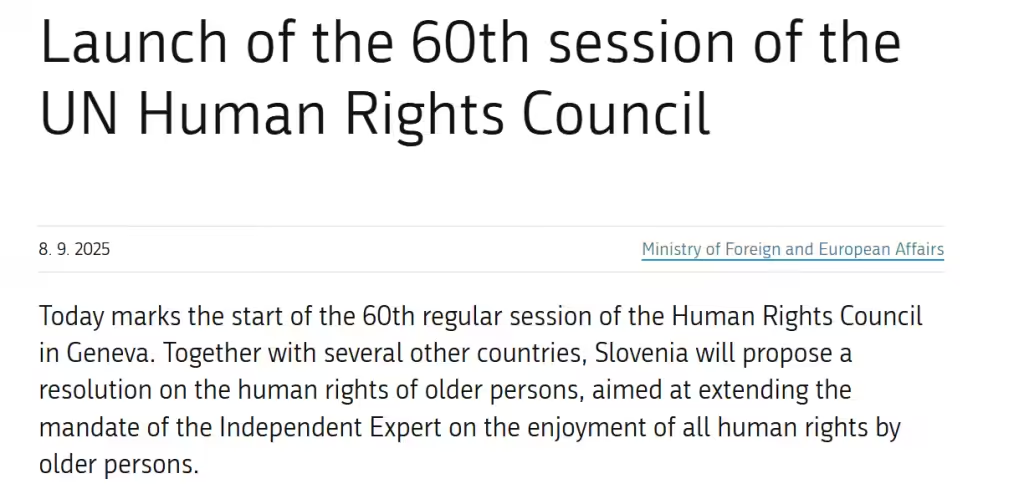
60th Session:
Membership

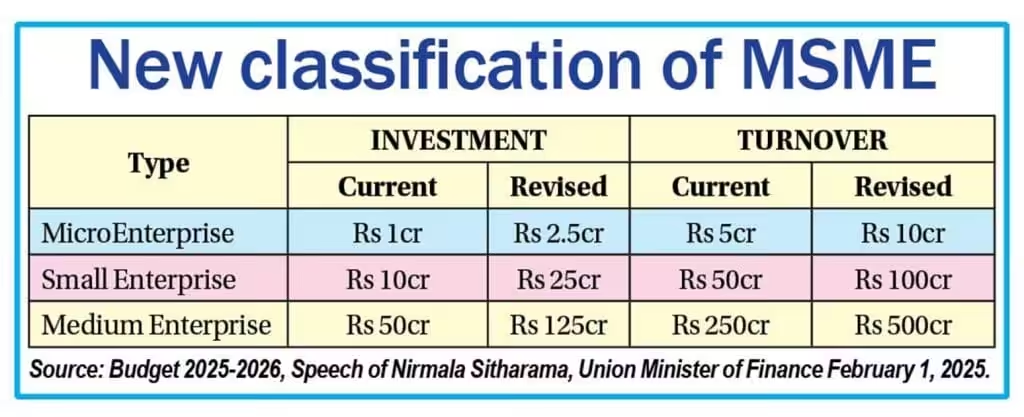
Micro Small Medium Enterprises(MSME)

Open article →Download PDF

Context:

In order to enhance the capacity building of domestic industry, particularly MSMEs and make them export-ready, government has increased engagement with Micro, small and Medium Enterprises so as to address the concerns regarding the implementation of Quality Control Orders.

UPSC Relevance:

Significance of MSMEs in India’s Growth trajectory and Related challenges.

PYQ:

Q: Faster economic growth requires increased share of the manufacturing sector in GDP, particularly of MSMEs. Comment on the present policies of the government in this regard. (2023).

What are MSMEs?

Current status:

  • The sector contributes almost 8% of the country’s GDP, around 45% of manufacturing production, and about 40% of exports.
  • > 99% of MSMEs are in ‘Micro’ sector, 94% of MSME are unregistered with the government, 55% of MSME in rural areas.

Significance of MSME sector in India:

  • Rural Development- MSMEs have contributed significantly to development of rural industries with minimal capital cost, leading to socio-economic growth of rural areas.
  • Economic growth and export promotion- With around 8% contribution to India’s GDP, 45% to manufacturing production and about 40% of exports, MSMEs hold immense potential to take Indian economy to new heights.
  • Employment intensive growth model- Many of the MSMEs are highly labour intensive such as the textiles, and MSMEs account for second highest employment generation after agriculture sector.
  • Inclusive growth- by growth of underdeveloped region and sections such women have higher labour force participation rate in MSMEs, also schedule castes and schedule tribes.
  • Growth of sunrise sectors such as electronics industry, chemicals, leather, textiles, food processing and others.
  • Strategic importance as MSMEs have significant role to play in success of Make in India scheme, start up India, stand up India, indigenous defence production, foreign trade policy.

Issues with MSME sector:

  • Financial issues: only around 16% of MSMEs have access to formal channels of finance.
  • Technological issues: MSMEs have struggled with outdated technologies and low productivity.
  • Dwarf firm issues whereby micro and small firms dominate presence in MSME sectors, with firms greater than ten years old but still in failing to transition in higher category of industries.
  • Informalization: Many MSMEs operate without a formal registration, with around 86% of manufacturing MSMEs remaining unregistered.
  • NPA issue: As per the Reserve Bank of India (RBI), bad loans of MSMEs account for 9.6% of gross advances, up from 8.2% in 2020.

Way forward:

  • Capacity building through enterprise development centres at the district level to provide handholding support.
  • Sinha committee recommendation for MSMEs:
    • Creating Institutional framework in the form of National Council for MSMEs for coordination.
    • GeM Portal, with mandatory procurement from MSMEs through the portal.
    • Addressing delays in payment to MSMEs such as through MSME Samadhan, increasing the number of facilitation councils at state level.
    • Improvement in ease of business by replacing multiple registrations by Unique Enterprise identifier (UEI).
    • Improving access to finance by strengthening TReDS platform, enhancing loan limit under MUDRA, specialised banks for PSL lending to MSMEs.
  • Economic survey 2018-19 has suggested for incentivising ‘infant’ firms rather than ‘small’ firms.