
Opens in a new tab
Join Anantam IAS Channel on Telegram

Daily Digest · Tuesday

18 November 2025 Current Affairs for UPSC

3 current affairs published on Tuesday, 18 November 2025

18 November 2025 Current Affairs for UPSC — every Why-in-News article AnantamIAS published on Tuesday, 18 November 2025, broken down with Why in News?, the exact GS paper it feeds, sub-topic mapping, MCQ-ready facts and a UPSC-style practice question. 3 articles in total, covering Polity, Economy, Environment, S&T, IR, Geography, History, Society and Internal Security — the same Why-in-News + GS-paper-mapping + practice-question format the Compass uses across every daily digest on the site.

Daily current affairs for UPSC is where new material enters your prep stream. Read this 18 November 2025 digest end-to-end in 25–35 minutes, attempt the practice question at the foot of each article (it's MCQ for some, 10/15-marker for others), then bookmark the entries that fall inside your active revision window. Everything stays cross-linked: tap any subject pill to jump to that subject's hub, or use the table of contents above to skip straight to a specific story.

Use this page three ways. Read sequentially for a one-sitting scan of everything that mattered on 18 November 2025. Download the 18 November 2025 PDF below for offline study or print revision. Or use the November 2025 Current Affairs compilation to see this day in the month's full context. For the previous day's reading, see 17 November 2025 Current Affairs; the next day's is 19 November 2025 Current Affairs.

Why we publish daily current affairs separately from the monthly compilation: daily is learning, monthly is revision. Use the daily page to add fresh material to your notes the day it breaks; come back to the November 2025 compilation 60 days before Prelims when the noise has settled and only the lasting takeaway is worth re-reading.

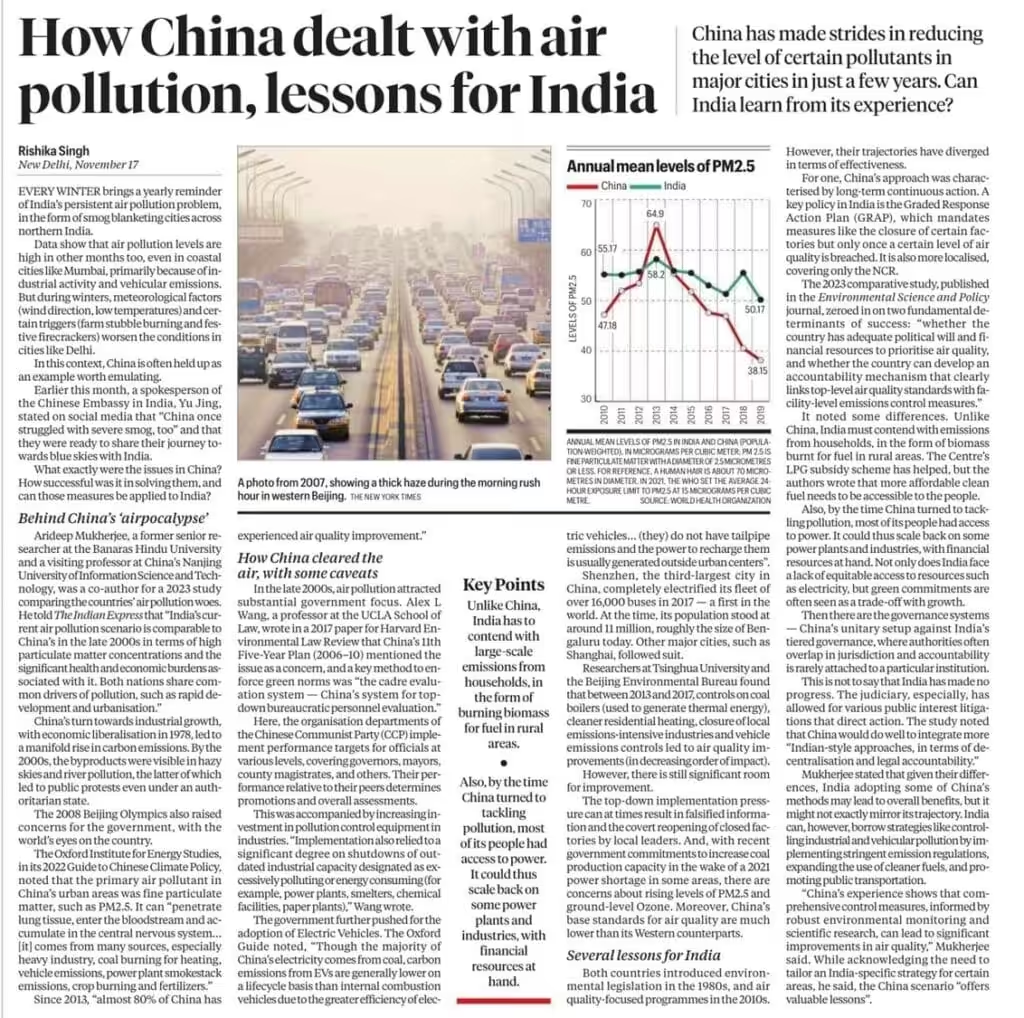
China Dealt with Air Pollution, lesson for India

Open article →Download PDF

image 36

image 36 4

Context:

Every winter, northern India—especially Delhi-NCR—faces severe air pollution. China faced a similar crisis in the early 2010s (“Airpocalypse”), but achieved 35–50% reduction in PM2.5 within a few years. The article examines what China did, and what India can learn.

UPSC Relevance:

Environment

UPSC PYQ:

Q: Mumbai, Delhi and Kolkata are the three mega cities of the country but the air pollution is much more serious problem in Delhi as compared to the other two. Why is this so? India is well endowed with fresh water resources. Critically examine why it still suffers from water scarcity.

China’s Air Pollution Crisis & Its Strategy:

China’s pollution drivers

  • Lack of early environmental regulation
  • Rapid industrialisation
  • Coal-based power and heating
  • Massive urbanisation
  • Increasing vehicle emissions

2013 Air Pollution Prevention and Control Action Plan:

China adopted a highly centralised, aggressive, and well-funded plan:

Massive coal reduction

  • Shut down small/inefficient coal plants, boilers and factories.
  • Switched residential heating from coal to electricity/gas.

Industrial emission crackdown

  • Strict norms + real-time monitoring.
  • Heavy fines for non-compliance.

Transportation reforms

  • Investment in public transport.
  • Strong push for electric vehicles.
  • Phase-out of polluting vehicles.

Clean energy transition

  • Rapid expansion of natural gas pipelines.
  • Large-scale shift to renewables.

Huge financial investment

  • Billions of dollars for clean air, monitoring networks, and industrial restructuring.

Outcomes:

Air quality improved rapidly, though still not fully at WHO standards. PM2.5 levels reduced by ~40% nationwide, ~50% in Beijing.

India–China Air Pollution: Key Differences

DimensionChinaIndia
1. Governance StructureHighly centralised authority; uniform implementation across provincesFragmented governance — Centre, States, Urban bodies; weak coordination
2. Major Sources of PollutionDominated by coal burning, industry, and coal-based heatingMultiple sources: biomass burning, vehicles, road dust, industries, crop-residue burning
3. Access to Clean FuelProvided cheap pipeline natural gas for heating and cookingLPG expanded through schemes, but refill affordability remains low
4. Accountability MechanismsStrong monitoring, heavy penalties, strict emission audits, full data transparencyOverlapping agencies (CPCB, SPCBs, DPCC, MCD), weak enforcement, slow judicial action
5. Financial CapacityInvested massive capital to shift industries and energy systemsHigher resource constraints limit large-scale industrial restructuring
Overall ApproachAggressive, well-funded, centralised clean air missionDecentralised efforts, inconsistent implementation, budget limitations

Key Lessons for India:

CategoryLessons for IndiaExplanation / Focus Areas
A. Short-Term Lessons1. Industrial pollution controlTackle India’s weakest enforcement area; strict norms and inspections for factories, boilers, construction sites.
2. Uniform clean air action plansStandardise policies across States/UTs instead of fragmented approaches.
3. Affordable clean fuel accessEnsure cheaper LPG/electric alternatives to reduce biomass burning in rural/urban poor households.
4. Strengthen real-time monitoringExpand continuous air quality monitoring stations (CAAQMS) in Tier-1, Tier-2 and industrial clusters.
5. Enforce emission standards strictlyEnforce thermal power plant norms, vehicular standards (BS-VI), and industrial stack monitoring.
B. Long-Term Lessons1. Empowered central authority for clean airA China-like central coordinating body for joint Centre–State action.
2. Urban planning reformsReduce dust, congestion; promote green buffers, transit-oriented development.
3. EV + public transport expansionScale metro, bus rapid transit, EV charging networks.
4. Judicial/environmental accountabilityTime-bound enforcement, penalties, and environmental courts’ efficiency.
5. Integrated cross-sector approachPollution policy must combine agriculture, energy, industry, transport, and urban development.

Prelims Nuggets

Open article →Download PDF

Payment Aggregator and Gateway

AD 4nXfmkqfn9lHnrI7Tgt4MqJHtR3EIrxEG9KbhqcrGfLc joKKb78m YduyZZhTV5H7r2s73eSIMUokc9CS2Qp5glRjhOaNhAY7rJVNgiDJzUwb0U
EntityDefinitionCategoriesInvolvement in Funds Handling
Payment Aggregator (PA)An entity that facilitates the aggregation of payments made by customers to merchants through one or more payment channels (physical/virtual) for the purchase of goods, services, or investment products, and subsequently settles the collected funds to the merchants. Prominent examples of authorised PAs in India include Amazon (Pay) India, Google India Digital Services, Razorpay, and Pine Labs. PA – Online (PAO): Facilitates transactions where the acceptance device and payment instrument are not in close physical proximity (e.g., e-commerce payments). PA – Physical (PAP): Facilitates transactions where both the acceptance device and payment instrument are physically present in close proximity (e.g., Point of Sale). PA – Cross Border (PA – CB): Facilitates aggregation of cross-border payments for current account transactions (inward/outward) that are not prohibited under FEMA. Involved (Receives, pools, and transfers payments). 
Payment Gateway (PG)An entity that provides technology infrastructure to route and facilitate the processing of a payment transaction.–Not involved (No involvement in handling of funds). 

Regulation of Payment Aggregators (PAs) 

  • The activities of non-bank PAs are regulated in entirety by the RBI under the Payment and Settlement Systems Act, 2007 (PSSA).
  • Authorisation: Non-bank PAs require authorisation from the RBI to operate under the PSSA. Banks do not require a separate authorisation to carry out PA business. 
  • A non-bank PA must be a company incorporated in India under the Companies Act, 2013.
  • Net-Worth Requirement:
    • PAs must have a minimum net-worth of ₹15 crore at the time of application for authorisation. 
    • They must attain a minimum net-worth of ₹25 crore by the end of the third financial year of the grant of authorisation and must be maintained on an ongoing basis thereafter. 
  • Foreign Investment: 100% FDI under automatic route. Entities having Foreign Direct Investment (FDI) must be guided by the Consolidated FDI Policy of the Government of India and relevant FEMA. 
  • Promoters and directors must satisfy the RBI’s ‘fit and proper’ criteria, which include having a record of fairness, integrity, and good reputation. 
  • Any takeover, acquisition of control, or change in the management of a non-bank PA must adhere to RBI’s prior approval requirements. 
  • PAs must undertake Customer Due Diligence (CDD) of their merchants in accordance with RBI’s Master Direction on KYC. 
  • Non-bank PAs must register with the Financial Intelligence Unit-India (FIU-IND) and meet all reporting requirements. 
  • PAs must undertake a background and antecedent check of the merchants to prevent malafide intentions, or selling prohibited products. 
  • Escrow Account: Non-bank PAs must maintain the funds collected on behalf of merchants in a separate escrow account with a Scheduled Commercial Bank (SCB) in India. 
  • Settlement Timelines: For domestic PAs where the merchant is responsible for delivery, the payment to the merchant shall be not later than on the day after the date of delivery confirmation (Td+1). 
  • PAs must put in place a Board-approved Information Security Policy and implement security measures. 
  • PAs shall not give an option for ATM PIN as a factor of authentication for card-not-present transactions. 
  • PAs shall not place limits on transaction amount for a particular payment mode; this responsibility lies with the issuing bank or entity (e.g., ₹1 lakh per day for some banks).
    • However, the maximum transaction value is capped at ₹25 lakh for both inward (incoming) and outward (outgoing) cross-border payments.

Regulations for Payment Gateways (PGs)

  • Regulatory Status: PGs are primarily considered ‘technology providers’ or ‘outsourcing partners’ of banks or non-banks and are not required to seek separate authorisation from the RBI under the PSSA. 
  • While PGs are not fully regulated like PAs, they are recommended (as a measure of good practice) to adhere to the baseline technology-related recommendations.
  • Outsourcing Guidelines: In the case of a bank PG, the RBI’s guidelines on ‘Managing Risks and Code of Conduct in Outsourcing of Financial Services by banks’ are applicable. 

Neurotechnology 

AD 4nXeDwty kQ5hsAnvxk2
  • Neurotechnology refers to any technology that interacts with the brain and nervous system to understand, monitor, record, stimulate, or influence neural activity. 
  • It acts as an interface between the biological nervous system and external devices or systems.  These technologies can range from completely non-invasive devices (like a skullcap worn on the head) to semi-invasive or fully invasive implants requiring surgery. 
  • Medical and Restorative Applications
    • Neural Prosthetics: Devices that replace or restore lost sensory, motor, or cognitive functions. 
      • Cochlear Implants: Restore hearing in individuals with profound hearing loss.
      • Brain-Computer Interfaces (BCIs) allow paralyzed patients to control robotic arms, cursors, or wheelchairs using only their thoughts. 
    • Neuromodulation/Neurostimulation: Technologies that deliverelectrical or magnetic pulses to regulate abnormal brain function.
      • Deep Brain Stimulation (DBS): Used to treat movement disorders like Parkinson’s disease and essential tremor, and is also being explored for mood disorders. 
    • Diagnostics and Research: Tools for recording and imaging brain activity.
      • Electroencephalography (EEG): Non-invasive measurement of the brain’s electrical activity. 
      • Functional Magnetic Resonance Imaging (fMRI): Maps brain activity by detecting changes in blood flow.
  • Non-Medical/Enhancement Applications
    • Cognitive Enhancement: Potential to improve focus, memory, and learning ability, often using non-invasive stimulation. 
    • Gaming & Entertainment: Creating more immersive and intuitive user experiences by allowing control of games with thoughts. 
    • Military & Defense: Improving decision-making speed, accuracy, and situational awareness for personnel. 

Concerns and Ethical Issues

  • It collects sensitive “brain data” (thoughts, emotions, cognitive states), which could be misused by companies for neuromarketing or by governments for surveillance. Hence, a push for the establishment of “Neuro-rights,” such as the right to mental privacy. 
  • Technologies that can “write” into the brain via stimulation or external influence could potentially modify a person’s thoughts, emotions, or decision-making processes, thus undermining their cognitive liberty, and sense of self. 
  • Advanced neurotechnologies (especially those for cognitive enhancement) could exacerbate social inequalities by only being accessible to the wealthy, creating a divide between augmented and non-augmented individuals. 
  • Invasive neurotechnologies could potentially be hacked, leading to unintended or malicious control of the device and, consequently, the user’s motor function or neural activity. 

Electoral Officers

AD 4nXdmplyme7udF LonKEsV2F3pH
  • Two deaths and multiple complaints from Booth Level Officer (BLOs) of “excessive workload and unreasonable demands and targets” have hit the Special Intensive Revision (SIR) of electoral rolls in at least three states Kerala, Tamil Nadu and Rajasthan. 

The Electoral Officers/Commissions in India 

Officer PositionJurisdiction / AreaKey Powers and Functions
Chief Election Commissioner and Election CommissionersAll of India (Constitutional post)Ultimate Authority: Superintendence, direction, and control of all elections (President, Vice-President, Parliament, State Legislatures). Sets election dates, model code of conduct, and resolves disputes.
Chief Electoral Officer (CEO)Note: Don’t equate it with State Election Commissioner. SEC is a separate constitutional post vested with power of superintendence of local government polls. It is not subordinate to Chief Election Commissioner.A specific State or Union TerritoryState Head: Appointed by the ECI in consultation with the State Government. Supervises and coordinates all work related to elections (e.g., E-rolls, conduct of polls) within the State/UT, subject to the ECI’s control.
District Election Officer (DEO)A specific DistrictDistrict Head: Usually the District Collector/Magistrate. Coordinates and supervises all election-related work in the district, including electoral roll preparation/revision and the conduct of all elections to Parliament and the State Legislature, under the CEO’s direction.
Electoral Registration Officer (ERO)An Assembly ConstituencyElectoral Roll Authority: Statutory authority responsible for the preparation, revision, and maintenance of the Electoral Roll for a specific Assembly Constituency. Disposes of claims and objections related to voter registration.
Returning Officer (RO)A specific Parliamentary or Assembly ConstituencyConduct of Poll Authority: Responsible for the actual conduct of the election in a constituency. Duties include receiving and scrutinizing nomination papers, allotting symbols, arranging the poll, overseeing counting of votes, and declaring the result.
Assistant Electoral Registration Officer (AERO)Part of an Assembly ConstituencyAssists the ERO in the preparation and revision of electoral rolls and is competent to perform all or any of the ERO’s functions.
Presiding Officer (PO)A specific Polling StationPolling Station Head: Responsible for ensuring the smooth and orderly conduct of the poll at a single polling station. Is in charge of the polling party, EVMs, and all materials on the day of the poll.
Booth Level Officer (BLO)A specific part/section of the Electoral Roll (usually a Polling Station area)Ground-level Contact: A local government/semi-government official (like a teacher or Anganwadi worker) who is a representative of the ECI at the grass-roots level. Responsible for house-to-house verification of voters and updating the electoral roll.

Aeronautical Message Handling System (AMHS)

  • A technical glitch was discovered in the Automatic Message Switching System (AMSS) at Delhi’s Indira Gandhi International Airport on November 6, forcing the Air Traffic Control (ATC) system to process flight plans manually for over a day.
  • In response, the Airport Authority of India (AAI) decided to fast-track the operationalisation of the new system, the Aeronautical Message Handling System (AMHS).
  • The AAI now plans to make the new system operational by January 2026 against the original timeline of April 2026.

Comparison of Systems: AMSS vs. AMHS

FeatureAutomatic Message Switching System (AMSS)Aeronautical Message Handling System (AMHS)
Data FormatTransmits messages only in text format.Can carry any kind of digital information, including text, graphics, images, files, databases, audio, and video.
Reliability/FunctionalityLess advanced.Has much higher functionality and high transmission reliability.
ArchitectureOperates in a hub-and-spoke model with 16 major airports (including Delhi, Mumbai, and Kolkata) acting as hubs.Requires the main server to be installed at one airport (Mumbai’s Chhatrapati Shivaji Maharaj International Airport), with all other airports connected to it (backup server at Delhi).

United Nations Convention against Cybercrime or Hanoi Convention

AD 4nXcqv2RZYt9WyZudgnpUhNhcsQDDiZbXwFRcAJqv7xzivoJg0wxTv59TxLLYXJVdFndZm22kcCP4gRh8aMa6nTxuzj54Cd2WDld ZOYgWf6mOQ1Oj9tTk0UE
  • The Supreme Court (SC) underlined the importance of international cooperation in combating cybercrimes.
  • The bench, hearing a ‘suo motu’ case on digital arrest fraud, directed the Centre to take a call on ratifying the United Nations Convention against Cybercrime.
  • India has not yet signed or ratified the treaty.
MilestoneDate / ConditionDetails
AdoptionDecember 24, 2024Adopted by consensus through General Assembly resolution 79/243.
Signing CeremonyOctober 25, 2025Opened for signature in Hanoi, Viet Nam, concluding with 72 signatories.
Signature PeriodUntil December 31, 2026Remains open for signature at United Nations Headquarters in New York.
RatificationVaries by StateStates complete internal domestic processes and deposit an instrument of ratification/acceptance/approval. Non-signatories may accede.
Entry into Force90 days after the 40th instrument is deposited.Requires 40 States to become Parties.
  • It is the first comprehensive global treaty addressing this issue.
  • The primary goal is to provide States with a comprehensive range of measures to prevent and combat cybercrime.
  • It also aims to strengthen international cooperation in the sharing of electronic evidence for serious crimes.
  • The Convention is organized into nine chapters, which offer a comprehensive approach to the problem of cybercrime.
  • The treaty includes essential human rights safeguards.
  • It resolves technical and legal challenges by adjusting traditional criminal investigation methods to the Information and Communication Technology (ICT) environment and enhancing international cooperation.
  • Conference of the States Parties (CoSP): This body will convene periodically after the Convention enters into force to improve cooperation, build capacity, and review its implementation.
  • Ad Hoc Committee (AHC): This committee approved the draft convention in August 2024 and is mandated to prepare the CoSP rules of procedure and negotiate a draft supplementary protocol addressing additional criminal offences.
  • The United Nations Office on Drugs and Crime (UNODC) serves as the secretariat for both the AHC and the future CoSP.
  • UNODC’s Global Programme on Cybercrime provides technical assistance and training to Member States to build capacity for the prevention, detection, investigation, and prosecution of cybercrime.

India-Africa Relations

Open article →Download PDF

image 37

image 37

Context:

India’s renewed diplomatic push towards Africa has triggered debate after experts highlighted the need to “connect, build and revive” India–Africa ties ahead of the next India-Africa Forum Summit (IAFS-IV).

UPSC Relevance:

International Relations

PYQ:

Q) India-Africa digital partnership is achieving mutual respect, co-development and long-term institutional partnerships. Elaborate.

Evolution of India–Africa Ties:

  • Civilisational Links: Centuries-old Indian Ocean trade in gold, spices and textiles built deep sociocultural links, reinforced by Gujarati merchant networks and shared experiences of colonial exploitation.
  • Political Solidarity: India championed African liberation movements through NAM, supported anti-apartheid struggles, and coordinated decolonisation diplomacy at the UN throughout the Cold War.
  • Post-1990s Phase: Economic reforms shifted India’s Africa policy toward investments, ITEC-driven capacity building, and joint positions in WTO, climate negotiations and UN Security Council reform efforts.
  • Contemporary Phase (2015–2025): IAFS-III united all 54 African nations; India opened 17 new embassies, scaled digital and development partnerships, and secured AU’s permanent membership in the G20 in 2023.

Areas of Cooperation:

  1. Trade & Investment:
    • Growing Economic ties: India–Africa trade crossed $100 billion (2024–25), making India the continent’s 3rd-largest trading partner, though still far behind China’s $280+ billion trade footprint.
    • Indian Investments: India’s cumulative FDI in Africa stands at $75 billion, focusing on telecom, hydrocarbons, pharma, infrastructure and digital services aligned with Africa’s growth priorities.
    • Duty-Free Tariff Preference: India’s DFTP scheme grants 98.2% tariff-free access to 38 African LDCs, significantly boosting African exports in textiles, agro-products and minerals.
  2. Development Partnership:
    • Lines of Credit (LoCs): India’s $10 billion LoC commitment supports 189 projects in 42 countries across power generation, irrigation, drinking water, rail connectivity and rural electrification.
    • Digital education & Tele-Medicine: The e-VBAB platform provides digital classrooms and medical consultations across Africa, reducing learning and healthcare gaps in remote regions.
  3. Capacity Building:
    • Training & Human Capital: 40,000+ Africans trained under ITEC, ICCR and the Pan-African e-Network now serve as ministers, policymakers and entrepreneurs, forming an enduring human bridge.
    • IIT-M Zanzibar Campus: India’s first overseas IIT campus in Zanzibar (2023) symbolises co-creation in higher education, offering advanced programmes in data science and AI.
  4. Maritime & Security Cooperation
    • Al-KEYME Naval Exercise: In 2025, India and nine African navies held AI-KEYME, strengthening interoperability in anti-piracy, humanitarian aid and Western Indian Ocean maritime security.
    • Peacekeeping Collaboration: India remains a major troop contributor to UN missions in Africa, especially in Congo, Sudan and South Sudan, enhancing its credibility as a security partner.
  5. Digital & FinTech Partnership:
    • Digital Public Infrastructure (DPI): African countries are exploring India’s UPI, Aadhaar-like identity solutions and digital stack to modernise payments, identity verification and public service delivery.
  6. Energy & Climate Cooperation
    • Solar & Green Energy: African nations partner with India under the International Solar Alliance, while collaborations in green hydrogen, EV ecosystems and blue economy corridors gain traction.

Challenges In India–Africa Relations:

  • Chinese Dominance: China–Africa trade exceeds $280+ billion and dominates ports, railways, mining and defence sectors, overshadowing India’s relatively smaller economic footprint.
  • Slow Execution of Indian Projects: LoC-funded projects face delays due to strict tendering norms, capacity constraints in African agencies and India’s cumbersome bureaucratic processes.
  • Loss of Diplomatic momentum: No IAFS meeting since 2015 has diluted institutional continuity, while Africa increasingly engages with actors offering faster financing and delivery.
  • Weak Financial Muscle of Indian Firms: Most Indian private companies lack the deep capital reserves required to match Chinese state-backed mega infrastructure investments.
  • Political & Security Volatility: Conflicts in Sudan, Sahel insurgencies and instability in Horn of Africa threaten Indian investments, supply chains and diaspora security.
  • Poor Connectivity: Lack of direct shipping lines, air connectivity and digital corridors elevates logistical costs and limits deeper integration in trade and data exchange.

Way Forward:

  • Revive IAFS-IV: Institutionalise IAFS as a regular summit, create a permanent Secretariat and renew political momentum for a unified India–Africa engagement roadmap.
  • Build an India–Africa Digital Corridor: Jointly develop DPI architecture—UPI–Afripay linkages, DigiLocker -style document systems and tele-health networks to serve the wider Global South.
  • Co-Invest in Strategic Future Sectors: Partner with Namibia/Morocco on green hydrogen, DRC/Zambia on EV battery minerals, and Kenya–Nigeria hubs on digital startups and AI innovation.
  • Accelerate LoC Delivery: Establish a single-window LoC monitoring dashboard, fix deadlines, and empower local project execution teams to reduce long-standing implementation delays.
  • Strengthen Maritime Security Architecture: Make AI-KEYME annual, enhance Western Indian Ocean coordination, and sign logistics support agreements with Kenya, Mauritius and Tanzania.
  • Deepen People-to-People Connect: Double ITEC and ICCR scholarships, expand India-linked institutions like IIT-M Zanzibar, and support African students and entrepreneurs in Indian ecosystems.

Conclusion: India–Africa ties stand at a pivotal moment, driven by shared demographics, development priorities, and a shifting global order. A decade after IAFS-III, the partnership now needs stronger institutions and co-created growth rather than