Opens in a new tab
Join Anantam IAS Channel on Telegram

Daily Digest · Monday

17 November 2025 Current Affairs for UPSC

4 current affairs published on Monday, 17 November 2025

17 November 2025 Current Affairs for UPSC — every Why-in-News article AnantamIAS published on Monday, 17 November 2025, broken down with Why in News?, the exact GS paper it feeds, sub-topic mapping, MCQ-ready facts and a UPSC-style practice question. 4 articles in total, covering Polity, Economy, Environment, S&T, IR, Geography, History, Society and Internal Security — the same Why-in-News + GS-paper-mapping + practice-question format the Compass uses across every daily digest on the site.

Daily current affairs for UPSC is where new material enters your prep stream. Read this 17 November 2025 digest end-to-end in 25–35 minutes, attempt the practice question at the foot of each article (it's MCQ for some, 10/15-marker for others), then bookmark the entries that fall inside your active revision window. Everything stays cross-linked: tap any subject pill to jump to that subject's hub, or use the table of contents above to skip straight to a specific story.

Use this page three ways. Read sequentially for a one-sitting scan of everything that mattered on 17 November 2025. Download the 17 November 2025 PDF below for offline study or print revision. Or use the November 2025 Current Affairs compilation to see this day in the month's full context. For the previous day's reading, see 16 November 2025 Current Affairs; the next day's is 18 November 2025 Current Affairs.

Why we publish daily current affairs separately from the monthly compilation: daily is learning, monthly is revision. Use the daily page to add fresh material to your notes the day it breaks; come back to the November 2025 compilation 60 days before Prelims when the noise has settled and only the lasting takeaway is worth re-reading.

Tier II Bonds

Open article →Download PDF

Screenshot 20251117 072842 Indian Express 1

Why in news?

Several Indian banks, particularly public sector lenders, are actively planning or in the process of raising funds through Tier II bonds, with the banking system expected to mobilize up to ₹25,000 crore via these instruments in the current financial year driven by favorable market conditions and the need to strengthen capital adequacy. 

UPSC Relevance 

Knowledge of Banking Sector is often tested in Prelims

What are Tier II Bonds?

  • Tier II bonds are subordinated debt instruments issued for a minimum of 5 years that form part of a bank’s supplementary capital.
    • Subordinated debt instruments are loans or bonds that rank lower than senior debt in terms of repayment priority, meaning they are paid back only after senior debt holders are fully compensated in the event of a company’s liquidation. 
    • Shareholders are paid last, if any funds are left after all debts are settled. 
  • Hence they are considered riskier than senior debt and they offer higher interest rates (coupon rates) to compensate investors for this risk. 
  • They are an attractive option for banks as they allow them to raise capital without diluting existing equity and also allow banks to add some extra buffers to their CRARs (capital to risk-weighted assets ratio),

What is Bank Capital?

  • A bank must keep some amount of its own money aside to absorb losses and protect depositors. Bank capital is divided into:
  1. Tier I Capital (Core Capital)
  2. Tier II Capital (Supplementary Capital) 
  • It includes Tier II bonds (subordinated debt), Revaluation reserves, General provisions, Hybrid debt instruments.
  • Both together form the CRAR (Capital to Risk-Weighted Assets Ratio) under Basel III norms.
  • The terms “capital adequacy ratio” (CAR) and “capital to risk-weighted assets ratio” (CRAR) are interchangeable; they are both measures of a bank’s financial strength. 
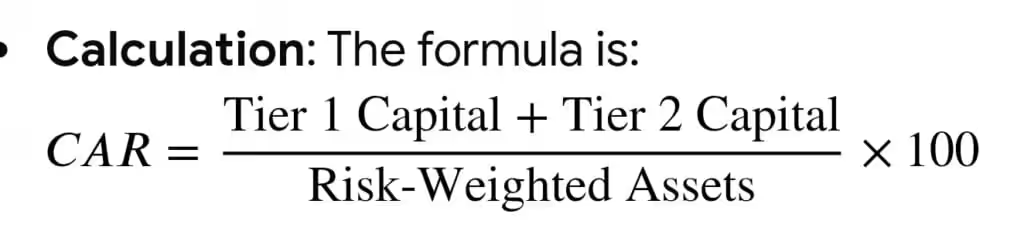
  • CRAR – This ratio compares a bank’s capital to its risk-weighted assets to gauge its ability to absorb losses and protect depositors. It is calculated by dividing a bank’s capital (Tier 1 plus Tier 2 capital) by its risk-weighted assets, and the result is expressed as a percentage. Calculation: The formula is:
Screenshot 20251117 111659 Google

  •  The ratio ensures a bank has enough capital to cover potential losses from its assets and other risks, such as credit, market, and operational risks. A higher ratio indicates a more financially stable bank that is better able to protect depositors’ funds.
  • Risk-Weighted Assets (RWA): These are the bank’s total assets, but each asset is assigned a risk weight based on its riskiness (e.g., a government bond is less risky than a corporate loan). This determines the minimum capital a bank must hold. 

Why Are Banks Issuing Tier II Bonds?

  • To Maintain Capital Adequacy (Basel III Norm)
    • Banks must maintain CRAR (Capital to Risk-Weighted Assets Ratio).
    • Tier II bonds form part of supplementary capital -> strengthens CRAR.

This helps banks absorb future credit losses.

  • Market Conditions: Softening bond yields (Interest rates (yields) on bonds in the market are falling) as RBI may cut interest rates in December and stable market conditions, make it a strategic time to lock in long-term funds at lower costs.
    • Market bond yields ↓ Investors accept lower returns ➡️ Banks can issue bonds at lower coupon rates (interest rates) ➡️ So banks get money more cheaply ➡️ Borrowing becomes cheaper for banks.
  • Long-term Investor Demand: There is strong demand for high-quality, long-duration papers, particularly from Provident and pension funds are expected to accelerate investments over the next couple of months to meet their regulatory investment quotas in corporate bonds. Long-term investors are now looking to deploy funds before the December monetary policy amid expectations of a 25-basis-point repo rate cut by the Reserve Bank of India, which is fueling demand for quality long-term instruments.
  • Refinancing: Banks are using this opportunity to refinance older, higher-cost debts with new cheaper bonds. 

Practice Questions:

With reference to the recent rise in Tier II bond issuances by Indian banks, consider the following statements:

  1. Softening long-term bond yields makes Tier II bonds more attractive for banks to issue.
  2. Tier II bonds help banks strengthen their CRAR under Basel III norms.
  3. Tier II bonds are used by banks mainly to refinance older long-term borrowings.
  4. Tier II bonds can be issued for a minimum maturity of three years.

How many of the above statements are correct?

(a) Only one
(b) Only two
(c) Only three
(d) All four

Correct Answer: (c) Only three


Consider the following statements regarding Tier II bonds issued by banks in India:

  1. Tier II bonds are typically purchased by long-term institutional investors such as provident funds and pension funds.
  2. Expectations of a repo rate cut by the RBI can increase demand for Tier II bonds in the market.
  3. Tier II bonds allow banks to raise capital without issuing additional equity shares.
  4. Tier II bonds are repaid before senior secured creditors during a liquidation process.

Which of the statements given above are correct?

(a) 1 and 2 only
(b) 1, 2 and 3 only
(c) 2, 3 and 4 only
(d) 1, 3 and 4 only

 Correct Answer: (b) 1, 2 and 3 only

Prelims Nuggets

Open article →Download PDF

State Election Commission

  • Following Supreme Court directions, Maharashtra will hold local body elections in three phases, starting December 2, with all elections to be completed by January 31, 2026.
  • Article 243 K & Article 243 ZA were inserted via the 73rd & 74th Amendments to establish a State Election Commission in every state as a constitutional body with powers of ‘superintendence, direction and control of the preparation of electoral rolls for, and the conduct of, all elections to the Panchayats and Municipalities in the State. 
  • State Election Commission consists of a State Election Commissioner, who is appointed by the Governor for a fixed tenure of 5 years and cannot be removed from his office except in like manner and on the like grounds as a Judge of a High Court.
  • The State Election Commission (SEC) cannot add or delete names from the voters’ lists.
  • The SEC uses the electoral rolls prepared by the Central Election Commission under the Representation of the People Act, 1950, and bifurcates them for the relevant wards of local bodies.
  • The SEC is responsible for the delimitation (division) of Assembly constituency voters into the respective local body wards.
  • The SEC invites objections and suggestions on the draft voters’ lists for municipal corporation elections. Types of Objections:
    • Name missing from the local body list but present in the Assembly list.
    • Voter’s name assigned to the wrong ward.
    • Duplicate entries.
    • Multiple voters registered at the same address.
  • Identification of Duplicates: The SEC will use a tool to identify duplicate names on the Assembly voters’ list using four filters: first name, middle name, last name, and gender.
  • Field Verification: The Chief Electoral Officers will receive the list of duplicate names, mark them with stars, and undertake a field verification.
  • Undertaking to Prevent Multiple Voting: Marked voters must provide an undertaking stating the single booth at which they will vote. This undertaking will be kept with the marked copies of the electoral rolls at that polling centre to ensure they do not vote in more than one place.

Precision Biotherapeutics

AD 4nXdqnoQ3W jsEbPzJO22 unZCF8raWxOAPA8v3QuMTucqTXm9RfhIqakfh8ijWTtVl24W3I1TI 97M2MzWmlmZ9HMkjtFLbZP8h3z84Pi2dJ4wKPkNZnIwkuZFLf w1l0P2w0uK3XA?key=BGtvF4 dERyAL C7TnY3aw
  • Precision biotherapeutics are medical interventions designed and optimized based on a patient’s unique genetic, molecular, or cellular profile.
  • Goal: To move beyond symptomatic management and identify and rectify the causative issue of an illness enabling a shift to predictive, preventive, and personalized healthcare.
  • By identifying genetic predispositions and molecular dysfunctions early, treatments can be customized to rectify the cause of the illness before it fully develops, rather than just managing symptoms.
  • Key Technologies Utilized:
    • Genomic and Proteomic Analysis: Decoding a person’s genetic and protein signatures to find disease-causing mutations or dysfunctions.
    • Gene Editing Therapies: Directly modifying genes to correct underlying problems (e.g., CRISPR for blood disorders).
    • mRNA and Nucleic Acid Therapeutics: Using RNA molecules to instruct cells to produce specific proteins or suppress harmful ones.
    • Monoclonal Antibodies and Biologics: Laboratory-engineered molecules that bind to precise disease targets (e.g., cancer cells).
    • AI-Driven Drug Discovery: Using big data and machine learning to predict molecular interactions.

India’s Current Landscape

  • Non-communicable diseases (e.g., diabetes, cardiovascular illness, cancers) account for nearly 65% of deaths in India.
  • India’s highly diverse population makes it a complex testing ground, where pharmaceuticals tested abroad may not work effectively locally.
  • Leveraging India’s growing genomic research base (like the IndiGen programme and Genome India) allows treatments to be customized for local genetic profiles.
  • Government Focus: The Department of Biotechnology has identified precision biotherapeutics as a focus area under the Biotechnology for Economy, Environment, and Employment policy.
  • Private Sector Involvement: Several biopharma companies are exploring precision therapies, including:
    • Investing in biosimilars and monoclonal antibodies.
    • ImmunoACT (India’s first to bring CAR-T technology).

Opportunities and Challenges

CategoryOpportunityChallenge
MarketGlobal market projected to exceed $22 billion by 2027.Cost of precision drugs remains prohibitive, restricting access.
WorkforceIndia’s skilled workforce, data analytics strength, and cost advantage position it as a potential hub.Limited local manufacturing capacity for biologics and advanced therapies.
RegulationPotential for affordable precision therapies.Lack of a clear regulatory framework for gene and cell therapies; scope of therapy is not defined.
EthicsUnresolved ethical and privacy concerns around genetic data misuse without strict protection and consent frameworks.

The Green Climate Fund (GCF)

  • The GCF was established in 2015 under the UNFCCC framework to fund projects in developing countries for climate change adaptation and clean energy investment and support the vision of the Paris Agreement.
  • Scale: It is the world’s largest institutional mechanism for climate finance, with commitments totaling $19 billion.
  • The GCF aims to ensure its funds are evenly split between adaptation and mitigation projects.
  • Criticism and Disbursal Issues:
    • Despite its size, only about a quarter of the committed funds were properly allocated as of 2024.
    • Developing countries criticize the GCF’s complex disbursal mechanisms and limited technical support for accessing the funds.
  • New ‘Country Platform’
    • India was among 13 countries and one regional alliance that announced plans to set up a national platform for “climate and nature finance” at the COP30 ministerial event in Belem, Brazil.
    • This platform will be coordinated through the Green Climate Fund (GCF).
  • Focus on Article 9.1: India is leading the developing countries’ push for a focused discussion and roadmap on Article 9.1 of the Paris Agreement, which mandates developed countries to provide mitigation and adaptation funds.
  • Global Goal on Adaptation (GGA): The announcement aligns with expectations that negotiators might finalize a list of indicators to measure progress towards the GGA. India, among other countries, is expected to announce National Adaptation Plans, showing greater vocal support for a concrete GGA outcome.
  • Current GCF Commitment to India: As of August 2024, the GCF has committed $782 million for 11 projects in India, including water, clean energy, coastal, livelihood, transport, medium and small enterprises, and climate start-ups.
  • Type of Financing: A bulk of this financing is in the form of concessional loans.
  • Nodal Authority: India’s Environment Ministry serves as the Nodal Designated Authority for GCF-linked funding.

Tier II Bonds

  • Tier II bonds are subordinated debt instruments issued for a minimum of 5 years that form part of a bank’s supplementary capital.
    • Subordinated debt instruments are loans or bonds that rank lower than senior debt in terms of repayment priority, meaning they are paid back only after senior debt holders are fully compensated in the event of a company’s liquidation. 
    • Shareholders are paid last, if any funds are left after all debts are settled. 
  • Hence they are considered riskier than senior debt and they offer higher interest rates (coupon rates) to compensate investors for this risk. 
  • They are an attractive option for banks as they allow them to raise capital without diluting existing equity and also allow banks to add some extra buffers to their CRARs (capital to risk-weighted assets ratio),
  • Bank Capital – A bank must keep some amount of its own money aside to absorb losses and protect depositors. Bank capital is divided into:
  1. Tier I Capital (Core Capital)
  2. Tier II Capital (Supplementary Capital) 
    • It includes Tier II bonds (subordinated debt), Revaluation reserves, General provisions, Hybrid debt instruments.
  • Both together form the CRAR (Capital to Risk-Weighted Assets Ratio) under Basel III norms.
  • CRAR – This ratio compares a bank’s capital to its risk-weighted assets to gauge its ability to absorb losses and protect depositors. 
AD 4nXe 5lZdh2MPQU6CxvrH980iZUbf6VZcto0HcCxcJu 8ZbJBvOTcsho9g25SbYd0EOQ6l4fpQ OpfZFiA01u 0 PifKArMAka IytqagF3KySQ PPgoWqKZybF77Jw7sefk9THM7Q?key=BGtvF4 dERyAL C7TnY3aw
  •  The ratio ensures a bank has enough capital to cover potential losses from its assets and other risks, such as credit, market, and operational risks. A higher ratio indicates a more financially stable bank that is better able to protect depositors’ funds.
  • Risk-Weighted Assets (RWA): These are the bank’s total assets, but each asset is assigned a risk weight based on its riskiness (e.g., a government bond is less risky than a corporate loan). This determines the minimum capital a bank must hold. 

Legal Status of Cannabis in India

AD 4nXfzTRpbyVNrDjf6AP297jOmYDrlQ3vi84Q5YRRQmhF2 JsmCK5kr3SfCGtdMOtxhUusM8 M9CrcnaOyoZaHH5bL7QoxKA 2hsXHrisv r4TjoJPGEpiLXEtn7NVZU5wK 6IqEr 2A?key=BGtvF4 dERyAL C7TnY3aw
  • The Narcotic Drugs and Psychotropic Substances (NDPS) Act, enacted in 1985, governs cannabis and related substances.
  • No Blanket Ban: The law does not impose a blanket ban on every part of the cannabis plant; it specifically defines the prohibited parts.
  • “Ganja” Defined: Section 2(iii) defines ganja as the “flowering or fruiting tops of the cannabis plant.” This is classified as a narcotic drug.
  • “Charas” Defined: Charas (including hashish oil) is defined as the “separated resin” obtained from the plant.
  • The definition of ganja excludes “the seeds and leaves [of the plant] when not accompanied by the tops.”
  • Bhaang, an edible preparation made from the leaves of the cannabis plant, is legal because the NDPS Act excludes leaves and seeds from the definition of “cannabis” (narcotic drug).
  • Bhaang is not unregulated; the National Policy on NDPS specifies that it is subject to State laws.
    • States like Uttar Pradesh and Rajasthan license authorized bhaang dealers, while others, like Assam, have banned it entirely.
  • Prohibition of Cultivation: Section 8(b) of the NDPS Act explicitly prohibits the cultivation of any cannabis plant except for authorized medical or scientific purposes.
  • Kerala High Court Ruling: A recent Kerala HC ruling dismissed a petition by a man seeking to quash proceedings for growing plants.
    • The Argument Rejected: The petitioner’s defense—that the plants had not developed “flowering or fruiting tops” (i.e., ganja)—was rejected.
    • Clear Distinction: The NDPS Act draws a clear line: it bans the product (ganja, defined by its flowering tops) and separately bans the source (the cultivation of the cannabis plant).

Senkaku/Diaoyu Islands

AD 4nXcHEYFDcTnePaawNYjlqn1AbiH yFIHLktb LD4UQi0H2zXprLsX0lqon8DS 6tEJNhWlh0mq28d0dsV71tmSImO5jvhE6vae04NgMEchjrQ8efAdL8lWh5A1uJ4luK9GEl6CcyZw?key=BGtvF4 dERyAL C7TnY3aw
  • Known as Senkaku Islands in Japan, Diaoyu Islands in China, and Diaoyutai Islands in Taiwan.
  • They are a group of eight uninhabited islets and rocks in the East China Sea.
  • They are located northeast of Taiwan, east of China, and west of Okinawa Island (Japan).
  • The islands are currently administered by Japan as part of Ishigaki City, Okinawa Prefecture.
  • The islands are the subject of a territorial dispute between Japan, China, and Taiwan, all of whom claim sovereignty.
  • The waters surrounding the islands are considered to contain potential oil and natural gas reserves (sparked renewed interest in the 1970s).
  • They are near strategically important shipping lanes and offer rich fishing grounds.
  • The increased tensions stem from a diplomatic spat following remarks by Japanese Prime Minister Sanae Takaichi.

Internationalisation of Rupee

Open article →Download PDF

image 36

WhatsApp Image 2025 11 17 at 07.33.49 19be8287

Context:

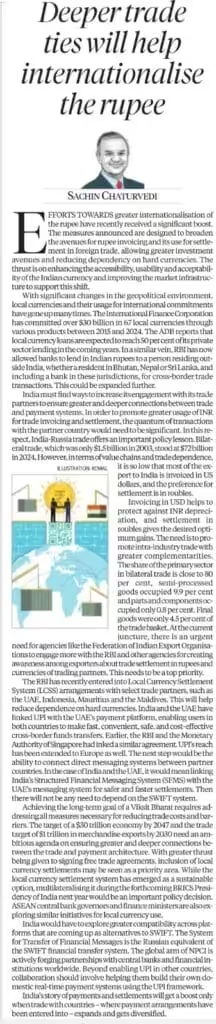
Global shifts in geopolitics, rising de-dollarisation efforts, and disruptions in dollar-dominated payment systems have pushed many countries — especially in the Global South — to explore trade settlement in local currencies. In this backdrop, India is trying to internationalise the rupee to reduce dependence on the US dollar, lower transaction risks, and strengthen its economic sovereignty. Recent RBI initiatives, growing bilateral trade, and expansion of systems like UPI/Open banking globally have revived the debate on how deeper trade ties and modern payment architecture can accelerate the global use of INR.

UPSC Relevance:

Economy

UPSC PYQ:

Q. Convertibility of rupee implies (2015)

(a) being able to convert rupee notes into gold  
(b) allowing the value of rupee to be fixed by market forces  
(c) freely permitting the conversion of rupee to other currencies and vice versa  
(d) developing an international market for currencies in India  

About Internationalisation of Rupee:

The Indian Rupee currently accounts for approximately 1% of global foreign exchange turnover. It has a smaller market size across most trading instruments when compared to the top 8 emerging market currencies.

Internationalization of Rupee refers to a process that involves increasing the use of the rupee in cross-border transactions. 

What is Internationalisation of currency:

According to Kenen (2011), an international currency is one that is used and held beyond the borders of the issuing country, not merely for transactions with that country’s residents but also, and importantly, for transactions between non-residents.

Kenen (2011) also enumerates the process of internationalisation of a currency including
the necessary preconditions. They are as follows:

  • The government must remove all restrictions on the freedom of any entity, domestic or foreign, to buy or sell its country’s currency, whether in the spot or forward market.
  • The currency may be included in the “currency baskets” of other countries, which they use in governing their own exchange rate policies
  • Domestic firms are able to invoice some, if not all, of their exports in their country’s currency, and foreign firms are likewise able to invoice their exports in that country’s currency, whether to the country itself or to third countries.
  • Foreign firms, financial institutions, official institutions and individuals are able to hold the country’s currency and financial instruments denominated in it, in amounts that they deem useful and prudent
  • Foreign firms and financial institutions, including official institutions, are able to issue marketable instruments in the country’s currency
  • The issuing country’s own financial institutions and non-financial firms are able to issue on foreign markets instruments denominated in their country’s own currency
  • International financial institutions, such as the World Bank and regional development banks, are able to issue debt instruments in a country’s market and to use its currency in their financial operations.

Benefits:

  • Lower Vulnerability: Reduces dependence on the dollar and protects the economy from sudden exchange-rate shocks and imported inflation.
  • Reduced Currency Risk: Minimises volatility-related losses, lowering business costs and supporting global expansion of Indian firms.
  • Lower Forex Reserve Pressure: Cuts the need to maintain very large foreign exchange reserves for external stability.
  • Easier Deficit Financing: If INR gains global acceptance, India can borrow abroad in its own currency, reducing fiscal and exchange-rate risks.
  • Stronger Financial Markets: Higher global demand for INR boosts foreign investment in Indian bonds and equity, deepening India’s financial markets.

Steps taken by GOI:

  • UPI is adopted in Singapore, France, UAE, Sri-Lanka, Bhutan, Mauritius, Nepal etc.
  • RBI has signed MoU with the central banks of the United Arab Emirates, Indonesia and Maldives to encourage cross-border transactions in local currencies, including Indian Rupee.
  • In its Annual Report for 2023-24, the RBI unveiled a Strategic Action Plan for 2024-25 aimed at promoting the internationalization of INR.
  • Rupee Dominated Masala Bond
  • Special Vostro Rupee Accounts
  • Currency Swap Agreements: Singed with more than 20 countries it facilitates liquidity support and trade settlement in local currencies.

    Cryptocurrency

    Open article →Download PDF

    image 36 1

    Context:

    Several firms have started accepting crypto payments. Millions of people, including in India, are in-vesting in crypto coins.

    UPSC relevance: 

    GS3, Prelims

    PYQ :

    Prelims 2016

    With reference to ‘Bitcoins’, sometimes seen in the news, which of the following statements is/are correct?

    1. Bitcoins are tracked by the Central Banks of the countries.
    2. Anyone with a Bitcoin address can send and receive Bitcoins from anyone else with a Bitcoin address.
    3. Online payments can be sent without either side knowing the identity of the other.

    Select the correct answer using the code given below:

    a) 1 and 2 only

    b) 2 and 3 only

    c) 3 only

    d) 1, 2 and 3

    Prelims 2024

    Consider the following statements in respect of the digital rupee:

    1. It is a sovereign currency issued by the Reserve Bank of India (RBI) in alignment with its monetary policy.
    2. It appears as a liability on the RBI’s balance sheet.
    3. It is insured against inflation by its very design.
    4. It is freely convertible against commercial bank money and cash.

    Which of the statements given above are correct?

    a) 1 and 2 only

    b) 1 and 3 only

    c) 2 and 4 only

    d) 1, 2 and 4

    Answer: D

    Cryptocurrencies

    Cryptocurrency, often called “crypto,” is a form of digital money that uses cryptography for security. Its name is derived from the Greek word “kryptos,” meaning “hidden” or “secret,” which reflects the use of encryption to secure transactions and conceal the identities of users.

    Key Characteristics of Cryptocurrency:

    • Digital: Cryptocurrencies are not physical coins you can see or touch.
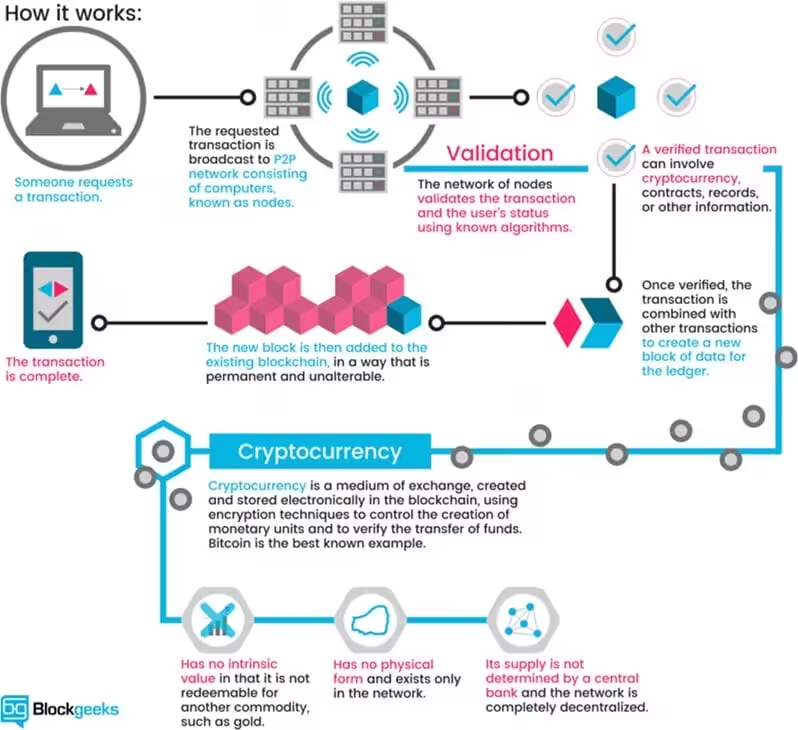
    • Transaction Process: Transactions happen without the need for a bank. Nodes on the network verify and record each transaction, ensuring transparency and security.
    • Decentralized: They are not controlled by any single institution, such as a central bank or government. Instead, they operate on a decentralized network of computers called nodes.
    • No intrinsic value : It is not backed by any commodity or valuable item that can be redeemed and has no inherent value of its own.
    • Cryptography: Transactions are secured through multiple layers of encryption, algorithms, and codes.

    image 36 2

    Understanding Blockchain:

    Blockchain is the digital ledger that records all cryptocurrency transactions. You can think of it as a combination of a traditional accountant’s notebook and a globally shared Google Sheet.

    • Blocks as Pages: In a blockchain, each “page” of transactions is called a block.
    • Chaining Blocks: Once a block is full of transactions, it’s permanently sealed with a timestamp and linked to the next block using a unique code called a hash. This process creates a continuous, chronological chain of blocks, which is why it’s called a blockchain.
    • Immutability: Once a block is sealed and added to the chain, its entries cannot be altered or erased. The transaction history is recorded forever, ensuring data integrity.
    • Transparency: Unlike a traditional ledger, which is only accessible to a few people, a blockchain is like a shared Google Sheet. Everyone in the network has access to it and can view the entries, but they can’t delete or tamper with past records.

    How a Blockchain Transaction Works?

    1. Transaction Creation: When someone sends crypto to another person (e.g., Ram sends a coin to Shyam), this transaction is added to a new, unsealed block.
    2. Block Filling: More transactions are added to this block until it’s full.
    3. Sealing the Block: Once full, the block is sealed and linked to the previous block in the chain using a unique hash code.
    4. Network-wide Visibility: Every time a new transaction is made, everyone in the decentralized network can see the updated record. This shared visibility ensures transparency, security, and trust without the need for a central authority or intermediary.

    Crypto mining

    • Crypto mining is the process of validating and adding new transactions to a blockchain ledger. It’s how new coins are released into circulation and how the network is secured.
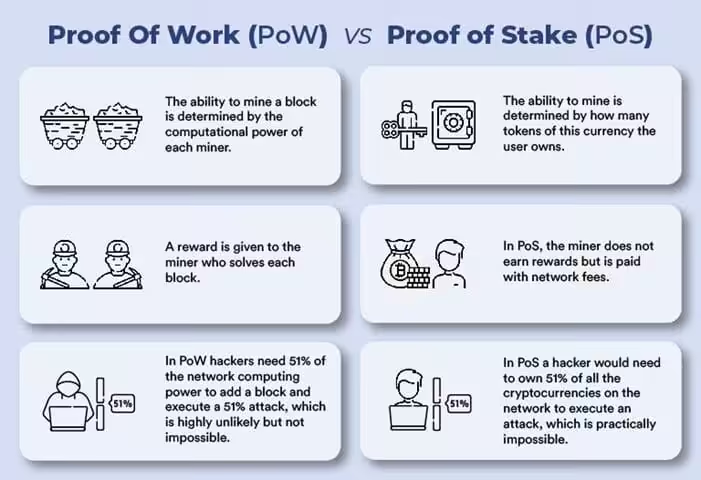
    • Crypto mining is a “Proof-of-Work” (PoW) system, where miners compete to solve a complex mathematical puzzle.
    • This requires a significant amount of computing power and electricity.
    • The first miner to find the correct solution is rewarded.
    • Proof-of-Stake (PoS) on the other hand, secures the network by requiring participants to stake a certain amount of cryptocurrency as collateral. It’s a “capital-based” system rather than an “energy-based” one and is thus more energy efficient.

    image 36 3

    Stablecoins:

    • Stablecoins are a class of cryptocurrencies, with their values linked to assets.
    • Unlike normal cryptocurrencies, whose values can wildly rise and fall due to investor sentiments and other factors, stablecoins are designed to maintain relatively steady prices. Hence, their name.
    • This stability is achieved through the process of “pegging” the stablecoin to an asset such as fiat currency (like U.S. Dollars, EU Euros, Hong Kong Dollars, etc.), a commodity (like gold), other cryptocurrencies (such as Bitcoin), by regulating their value via computer algorithms, or by mixing multiple strategies. While the price of Bitcoin might rise or fall in the coming years, a USD-pegged stablecoin should ideally remain around $1.
    • Stablecoins can also exhibit volatility. In response to both technical factors and world events, stablecoins sometimes come unpegged and their prices may rise or fall beyond the usual range, with sudden drops triggering panic amongst investors. Stablecoins have also collapsed entirely.
      • Example – In May 2022, Terra’s cryptocurrency LUNA and its linked algorithmic stablecoin UST both lost most of their value in a matter of hours. Panicking investors who no longer trusted these assets quickly sold them off to minimise losses, and the prices fell close to zero.

    Virtual Digital Assets

    • Virtual digital assets (VDAs) are broadly defined as any information, code, or token generated through cryptographic or other means, which can be used as a store of value or unit of account, and can be transferred, stored, or traded electronically.
    • Includes cryptos and non-fungible tokens.
    • Excludes CBDC or Digital Rupee.

    Non-fungible tokens (NFTs)

    • Non-fungible tokens (NFTs) are assets like artworks, digital content, or videos that have been tokenized via a blockchain.
    • NFTs cannot be replicated, divided or replaced. Cryptocurrencies are fungible, or interchangeable. While there’s no significant difference between one bitcoin and another, no two NFTs are identical.
    • NFTs can represent digital collectibles or real-world items like artwork, real estate, individuals’ identities, property rights, and more.
    • “Tokenizing” these real-world tangible assets makes buying, selling, and trading them more efficient and makes counterfeiting more difficult.

    Difference between Crypto, CBDC and Stablecoin:

    FeatureCryptocurrency (e.g., Bitcoin, Ethereum)Central Bank Digital Currency (CBDC)Stablecoins (e.g., Tether, USDC)
    IssuerDecentralized; not issued by any government or central bank.Central bank of a country.Private companies or entities.
    Regulation & ControlLargely unregulated and decentralized. No central authority controls the network or supply.Centralized and fully regulated by the issuing government/central bank.Privately issued but subject to increasing government oversight and regulation.
    Value & VolatilityHighly volatile; value is determined by market supply and demand. Not backed by any asset.Stable; its value is pegged 1:1 to the country’s fiat currency or other valuable assets.Designed to be stable; value is typically pegged to a fiat currency (e.g., USD) or other assets. Stability depends on the effectiveness of its backing.
    PurposeOften used for speculation, investment, and as a store of value. Also functions as a decentralized medium of exchange.A digital form of a country’s fiat currency, intended for everyday transactions and payments. Aims to complement the existing financial system.Serves as a bridge between the volatile cryptocurrency market and traditional fiat currencies, often used for trading and cross-border payments.
    TechnologyTypically built on public, permissionless blockchain technology.Can be built using blockchain or distributed ledger technology, but often on a private, permissioned system controlled by the central bank.Built on various blockchain technologies.
    LiabilityNo central liability. Users are not protected from price volatility or firm collapses.A direct liability of the central bank, just like physical cash. It is considered a safer form of digital money than commercial bank-issued digital money.A liability of the private issuer. The level of protection for users depends on the issuer’s reserves and regulatory framework.
    PrivacyTransactions can be pseudonymous, but all are recorded on a public ledger.Privacy features vary by design. Authorities may have a degree of access to monitor for financial crimes.Privacy varies depending on the specific stablecoin and the underlying blockchain.

    Status of Crypto currencies in India:

    • It is one of the largest markets globally, with an estimated 119 million users. Its market size was valued at $2.6 billion in 2024, according to a report by consulting firm IMARC Group. Another report, by investment advisory firm HDFCTru, estimated that the market size will reach $15 billion by 2035 – exhibiting a Compound Annual Growth Rate (CAGR) of over 17 per cent between 2024 and 2035.
    • According to a report released by Indian crypto exchange CoinSwitch, Gen Z (18-25) topped India’s crypto investor base for the first time with 37.6%, narrowly surpassing Millennials (26-35) at 37.3% and (36-45) at 17.8% in the third quarter of 2025. The study, drawing insights from 2.5 crore of the platform’s users, also showed that while metro cities dominate, led by Delhi (19.3%). Bengaluru (8.9%), and Mumbai (7%), cities like Jaipur, Lucknow and Patna are emerging as new centres of adoption.
    • Not legal tender: In India, cryptocurrencies or virtual digital assets are not recognized as legal tender unlike CBDC.
    • Legal to own and trade: Buying, selling, mining, and holding crypto or any virtual digital asset is legal.Regulatory bodies:
    • RBI (monetary and financial stability)
    • SEBI (if classified as securities)
    • FIU-IND (anti-money laundering compliance)
    • CBDT (taxation enforcement)
    • Union Budget 2022 has also clarified on following points:
    • The government officially categorised digital assets, including crypto assets, as “Virtual Digital Assets”.
    • Income from the transfer of virtual digital assets such as crypto and NFTs will be considered capital gain and taxed at 30%.
    • No deduction, except the cost of acquisition, will be allowed while reporting income from the transfer of digital assets.
    • Loss from digital assets cannot be set off or carried forward of loss against any other income.
    • Losses incurred from one virtual digital currency cannot be set off against income from another digital currency.
    • Gifting digital assets will attract tax in the receiver’s hands.
    • From 1 July 2022, 1% TDS will apply to all sell transactions of Virtual Digital Assets (VDAs), including cryptocurrencies and NFTs.
    • How do crypto scams happen?
    • Most crypto scams lure investors with promises of quick, guaranteed profits from new coins or trading platforms. Fraudsters often create fake websites or social media accounts that look like legitimate crypto exchanges or wallet services. Once users transfer their money or digital tokens, the scammers disappear.
    • Another common trick involves “pump and dump” schemes, where groups artificially inflate a coin’s price and then sell off their holdings, leaving others with losses.
    • Phishing attacks — where users are tricked into revealing private wallet keys or passwords – are also widespread.
    • Prevention of Money Laundering Act (PMLA): In 2023, the Ministry of Finance brought cryptocurrency-related businesses under the purview of the Prevention of Money Laundering Act (PMLA). This requires Virtual Asset Service Providers (VASPs) and exchanges to:
    • Comply with KYC norms: Perform “Know Your Customer” (KYC) procedures for all users.
    • Maintain Records: Keep transaction records for a period of at least five years.
    • Report Suspicious Activity: Report suspicious transactions to the Financial Intelligence Unit – India (FIU-IND).

    Regulatory bodies:

    • RBI (monetary and financial stability)
    • SEBI (if classified as securities)
    • FIU-IND (anti-money laundering compliance)
    • CBDT (taxation enforcement)

    Union Budget 2022 has also clarified on following points:

    • The government officially categorised digital assets, including crypto assets, as “Virtual Digital Assets”.
    • Income from the transfer of virtual digital assets such as crypto and NFTs will be considered capital gain and taxed at 30%.
    • No deduction, except the cost of acquisition, will be allowed while reporting income from the transfer of digital assets.
    • Loss from digital assets cannot be set off or carried forward of loss against any other income.
    • Losses incurred from one virtual digital currency cannot be set off against income from another digital currency.
    • Gifting digital assets will attract tax in the receiver’s hands.
    • From 1 July 2022, 1% TDS will apply to all sell transactions of Virtual Digital Assets (VDAs), including cryptocurrencies and NFTs.

    How do crypto scams happen?

    • Most crypto scams lure investors with promises of quick, guaranteed profits from new coins or trading platforms. Fraudsters often create fake websites or social media accounts that look like legitimate crypto exchanges or wallet services. Once users transfer their money or digital tokens, the scammers disappear.
    • Another common trick involves “pump and dump” schemes, where groups artificially inflate a coin’s price and then sell off their holdings, leaving others with losses.
    • Phishing attacks — where users are tricked into revealing private wallet keys or passwords – are also widespread.

    Prevention of Money Laundering Act (PMLA): In 2023, the Ministry of Finance brought cryptocurrency-related businesses under the purview of the Prevention of Money Laundering Act (PMLA). This requires Virtual Asset Service Providers (VASPs) and exchanges to:

    • Report Suspicious Activity: Report suspicious transactions to the Financial Intelligence Unit – India (FIU-IND).
    • Comply with KYC norms: Perform “Know Your Customer” (KYC) procedures for all users.
    • Maintain Records: Keep transaction records for a period of at least five years.