2 current affairs published on Sunday, 21 September 2025
21 September 2025 Current Affairs for UPSC — every
Why-in-News article AnantamIAS published on Sunday, 21 September 2025, broken down with
Why in News?, the exact GS paper it feeds, sub-topic mapping, MCQ-ready facts and a
UPSC-style practice question. 2 articles in total, covering Polity, Economy, Environment, S&T, IR, Geography, History, Society and Internal
Security — the same Why-in-News + GS-paper-mapping + practice-question format the Compass uses across
every daily digest on the site.
Daily current affairs for UPSC is where new material enters your prep stream. Read this
21 September 2025 digest end-to-end in 25–35 minutes, attempt the practice question
at the foot of each article (it's MCQ for some, 10/15-marker for others), then bookmark the entries
that fall inside your active revision window. Everything stays cross-linked: tap any subject pill to jump
to that subject's hub, or use the table of contents above to skip straight to a specific story.
Why we publish daily current affairs separately from the monthly compilation: daily is learning,
monthly is revision. Use the daily page to add fresh material to your notes the day it breaks;
come back to the September 2025 compilation 60 days before Prelims when the
noise has settled and only the lasting takeaway is worth re-reading.
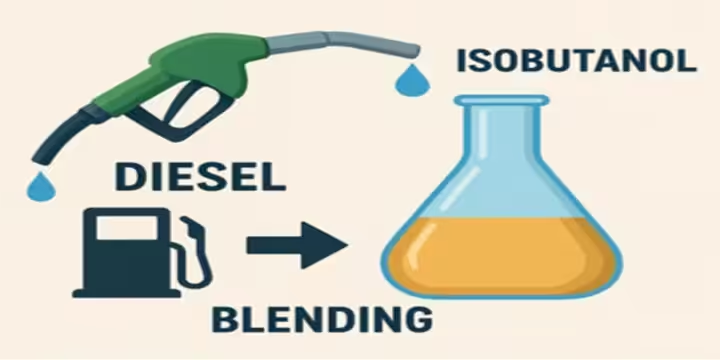
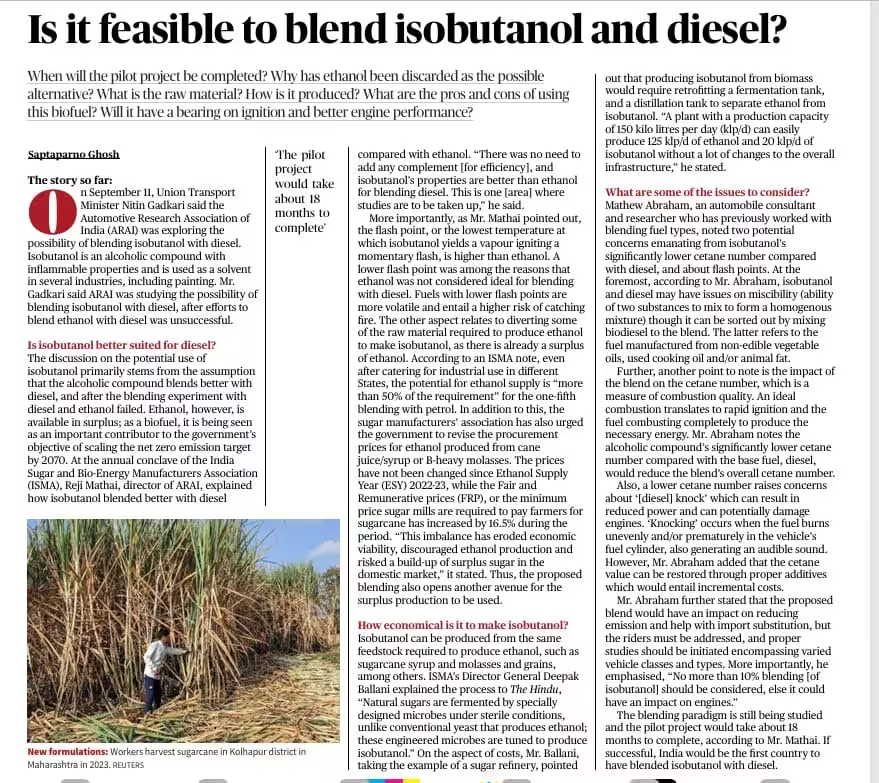
Union Transport Minister Nitin Gadkari recently announced that the Automotive Research Association of India (ARAI) is exploring the possibility of blending isobutanol with diesel. This comes after earlier attempts to blend ethanol with diesel were unsuccessful.
UPSC Relevance :
Fuel and Energy has been a recurrent theme in Prelims.
UPSC PYQ Prelims 2020:
Q: According to India’s National Policy on Biofuels, which of the following can be used as raw materials for the production of biofuels?
1. Cassava
2. Damaged wheat grains
3. Groundnut seeds
4. Horse grams
5. Rotten potatoes
6. Sugar beet
Select the correct answer using the code given below:
(a) 1, 2, 5 and 6 only
(b) 1, 3, 4 and 6 only
(c) 2, 3, 4 and 5 only
(d) 1, 2, 3, 4, 5 and 6
Prelims 2025:
Q. Consider the following statements:
Statement I: Of the two major ethanol producers in the world, i.e., Brazil and the United States of America, the former produces more ethanol than the latter.
Statement II: Unlike in the United States of America where corn is the principal feedstock for ethanol production, sugarcane is the principal feedstock for ethanol production in Brazil.
Which one of the following is correct in respect of the above statements?
[A] Both Statement I and Statement II are correct and Statement II explains Statement I
[B] Both Statement I and Statement II are correct but Statement II does not explain Statement
[C] Statement I is correct but Statement II is not correct
[D] Statement I is not correct but Statement II is correct
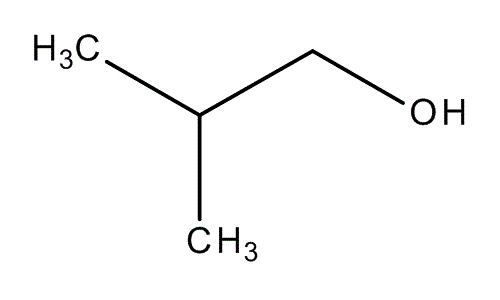
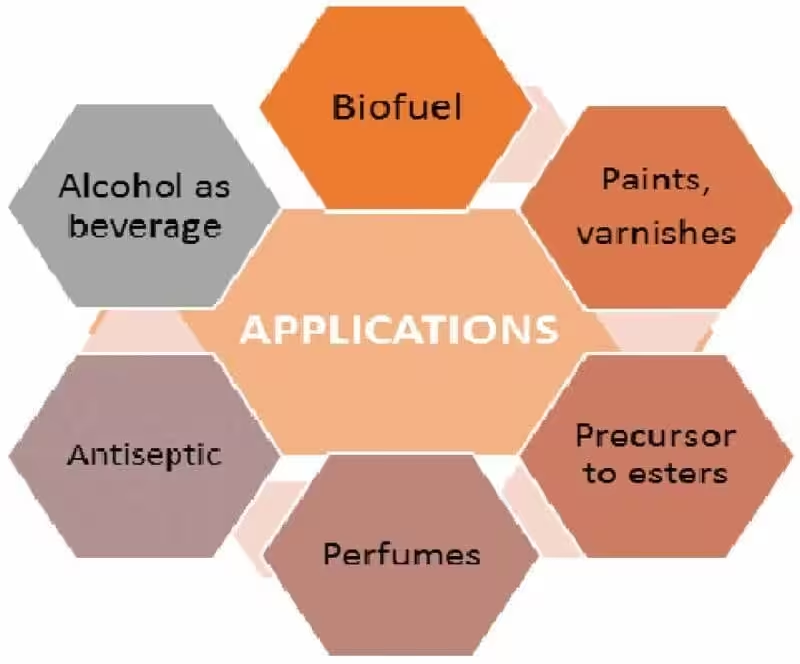
Isobutanol:
Description: Clear, colourless, flammable liquid with a characteristic odour
Soluble in water.
Why Isobutanol?
Higher flash point → safer compared to ethanol.
Can provide better ignition and engine performance.
More miscibility with diesel, forming a stable mixture.
Produce from biomass such as corn, sugarcane, or agricultural residues.
Why GOI want to Blend isobutanol:
Ethanol blending with diesel failed mainly due to lower flash point (higher volatility and fire risk). Isobutanol is an alcohol-based compound with inflammable properties, used as a solvent in industries and as a potential biofuel.
Why it matter?
It is being seen as an important contributor to the government’s objective of scaling the net zero emission target by 2070.
Isobutanol’s properties are better than ethanol for blending diesel.
Isobutanol can be produced from the same feedstock required to produce ethanol, such as sugarcane syrup and molasses and grains, among others.
“A plant with a production capacity of 150 kilo litres per day (klp/d) can easily produce 125 klp/d of ethanol and 20 klp/d of isobutanol without a lot of changes to the overall infrastructure,”
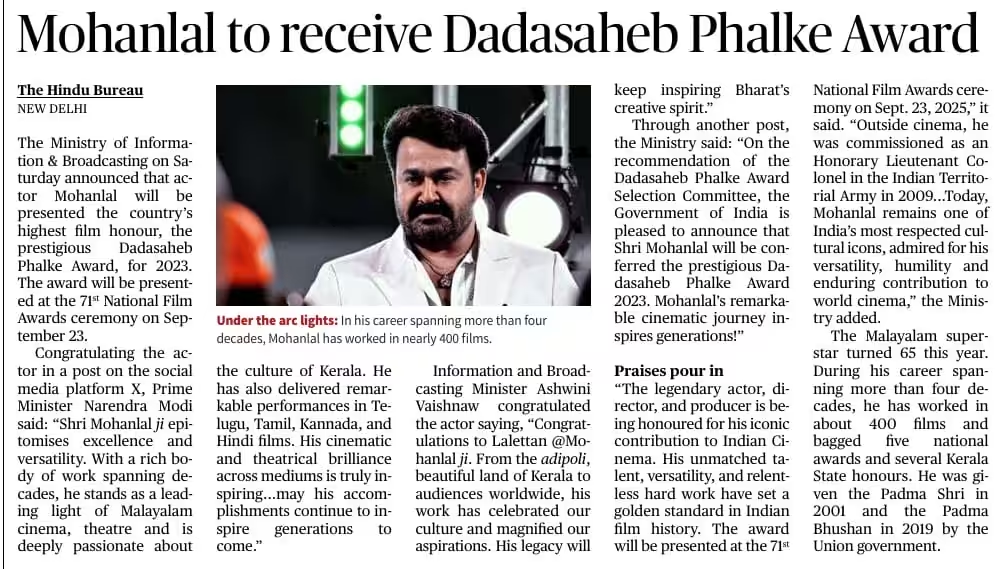
Renowned Malayalam actor Mohanlal has been selected for the Dadasaheb Phalke Award 2023, India’s highest film honour. The award will be conferred at the 71st National Film Awards ceremony.
Bharat Ratna and Padma Awards are titles under the Article 18(1) of the Constitution of India.
Padma Awards, which were instituted in the year 1954, were suspended only once.
The number of Bharat Ratna Awards is restricted to a maximum of five in a particular year.
Which of the above statements are not correct?
(a) 1 and 2 only
(b) 2 and 3 only
(c) 1 and 3 only
(d) 1, 2 and 3
Dadasaheb Phalke award:
This remarkable journey of Indian cinema began in 1913 when the father of Indian cinema, Dadasaheb Phalke, created the first indigenous film,Raja Harishchandra.
To honor this legacy and encourage the creation of high-quality storytelling, the Ministry of Information and Broadcasting confers the prestigious National Film Awards along with cinema’s highest honor, the Dadasaheb Phalke Award each year.
First time to Devika Rani, “the first lady of Indian cinema”.
It includes a ‘Swarna Kamal,’ a cash prize of INR 10 lakh, a certificate, a silk roll, and a shawl.
The Awards aim at encouraging the production of films of aesthetic & technical excellence and social relevance contributing to the understanding and appreciation of cultures of different regions of the country in cinematic form, thereby also promoting unity and integrity of the nation.
Key Sections of the Awards:
Dadasaheb Phalke Award: Awarded for lifetime contributions to Indian cinema.
Feature Film Awards: Recognizing outstanding feature films across various languages and genres.
Non-Feature Film Awards: Celebrating excellence in short films, documentaries, and animation.
Best Writing on Cinema: Honouring books and critics that explore and contribute to the discourse on Indian cinema.