Join Anantam IAS Channel on Telegram

Daily Digest · Monday

23 February 2026 Current Affairs for UPSC

5 current affairs published on Monday, 23 February 2026

23 February 2026 Current Affairs for UPSC — every Why-in-News article AnantamIAS published on Monday, 23 February 2026, broken down with Why in News?, the exact GS paper it feeds, sub-topic mapping, MCQ-ready facts and a UPSC-style practice question. 5 articles in total, covering Polity, Economy, Environment, S&T, IR, Geography, History, Society and Internal Security — the same Why-in-News + GS-paper-mapping + practice-question format the Compass uses across every daily digest on the site.

Daily current affairs for UPSC is where new material enters your prep stream. Read this 23 February 2026 digest end-to-end in 25–35 minutes, attempt the practice question at the foot of each article (it's MCQ for some, 10/15-marker for others), then bookmark the entries that fall inside your active revision window. Everything stays cross-linked: tap any subject pill to jump to that subject's hub, or use the table of contents above to skip straight to a specific story.

Use this page three ways. Read sequentially for a one-sitting scan of everything that mattered on 23 February 2026. Download the 23 February 2026 PDF below for offline study or print revision. Or use the February 2026 Current Affairs compilation to see this day in the month's full context. For the previous day's reading, see 22 February 2026 Current Affairs; the next day's is 24 February 2026 Current Affairs.

Why we publish daily current affairs separately from the monthly compilation: daily is learning, monthly is revision. Use the daily page to add fresh material to your notes the day it breaks; come back to the February 2026 compilation 60 days before Prelims when the noise has settled and only the lasting takeaway is worth re-reading.

National Monetisation Pipeline 2.0 Revives the Debate on Asset-Led Infrastructure Financing

Open article →Download PDF

Why in News?

On 23 February 2026, National Monetisation Pipeline 2.0 Revives the Debate on Asset-Led Infrastructure Financing emerged as an important current-affairs theme through an official communication linked to NITI Aayog. For UPSC aspirants, the topic is valuable not only because it marks a specific event, but because it opens a wider window into how policy, institutions, and development processes are evolving in India.

The official anchor for the topic is Union Finance Minister Smt. Nirmala Sitharaman launches National Monetisation Pipeline 2.0 (NMP 2.0). That matters because serious preparation requires moving beyond headlines and asking three connected questions: what happened, why now, and what deeper historical, economic, political, or governance trend this event reflects.

UPSC Relevance

  • Prelims: budgets, sectors, institutions, reports, trade and investment measures, and growth-linked facts
  • Mains: GS III on economic growth, industrial policy, public finance, and external sector issues
Easy to Remember
  • Union Minister for Finance and Corporate Affairs Smt.
  • Nirmala Sitharaman today launched the second phase of asset monetisation pipeline of
  • The second phase of the pipeline has been developed by NITI Aayog, in consultation with

What Happened?

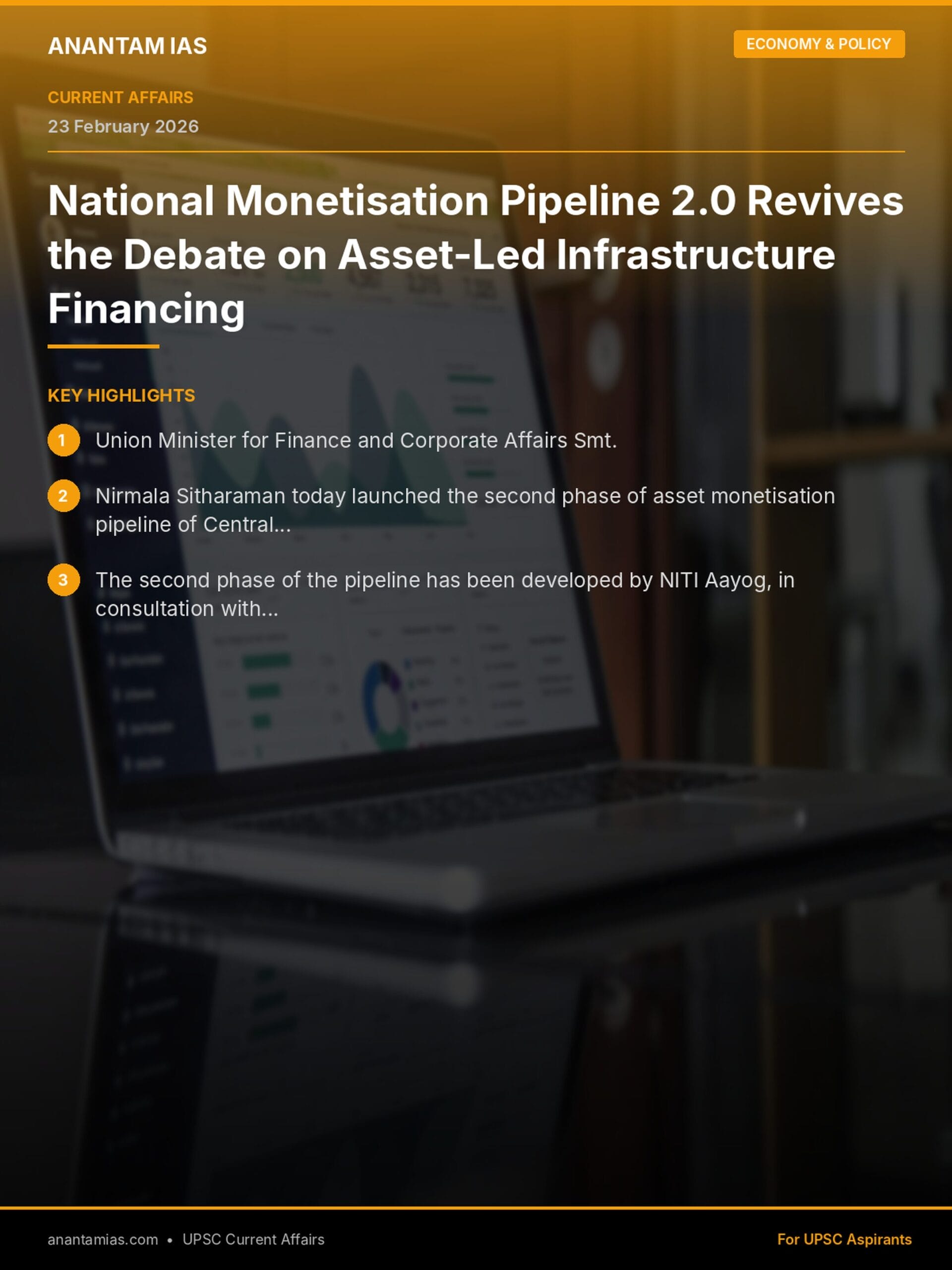
Union Minister for Finance and Corporate Affairs Smt. Nirmala Sitharaman today launched the second phase of asset monetisation pipeline of Central ministries and public sector entities – ‘National Monetisation Pipeline 2.0 (NMP 2.0)’.

The second phase of the pipeline has been developed by NITI Aayog, in consultation with infrastructure line ministries, based on the mandate for ‘Asset Monetisation Plan 2025-30’ as announced in the Union Budget 2025-26. The NMP 2.0 estimates aggregate monetisation potential of ₹16.72 lakh crore, including private sector investment of ₹5.8 lakh crore under asset monetisation pipeline of Central ministries and public sector entities, over the five-year period from FY 2026 to FY 2030.
National Monetisation Pipeline 2.0 Revives the Debate on Asset-Led Infrastructure Financing infographic

Read together, the event can be understood through three immediate takeaways: Union Minister for Finance and Corporate Affairs Smt., Nirmala Sitharaman today launched the second phase of asset monetisation pipeline of Central ministries and public sector entities – ‘National Monetisation Pipeline 2.0 (NMP 2.0)’., and The second phase of the pipeline has been developed by NITI Aayog, in consultation with infrastructure line ministries, based on the mandate for ‘Asset Monetisation Plan 2025-30’ as announced in the Union Budget 2025-26.. These are the factual anchors, but the real UPSC value lies in connecting those facts with the broader story behind them.

Why it Matters

For UPSC, the significance of this topic lies in the fact that it sits at the intersection of current developments and structural change. Whether one looks at it from the lens of governance, economy, diplomacy, social policy, or strategic planning, the topic shows how day-to-day announcements often reveal larger shifts in India's state capacity and developmental priorities.

In answer writing, this makes the topic especially useful. It can serve as a factual illustration in Prelims preparation and as a layered example in Mains where the examiner expects candidates to connect institutions, outcomes, and wider policy direction.

What You Must Learn

0/5 completed

Bottom Line

National Monetisation Pipeline 2.0 Revives the Debate on Asset-Led Infrastructure Financing is important because it allows aspirants to move from a narrow event-based reading of current affairs to a broader understanding of how history, institutions, economy, politics, and governance intersect in contemporary India.

Exam Strategy

Use the topic to show how policy announcements interact with production, investment, and macroeconomic structure.

Related Current Affairs

Exam Oriented Questions

Why is this topic in the news?

It is in the news because an official development related to **National Monetisation Pipeline 2.0 Revives the Debate on Asset-Led Infrastructure Financing** was recorded on 23 February 2026.

Which official institution or source is associated with this topic?

The topic is anchored in an official source associated with **NITI Aayog**, and aspirants should remember the source title **Union Finance Minister Smt. Nirmala Sitharaman launches National Monetisation Pipeline 2.0 (NMP 2.0)**.

What is the core issue involved here?

The core issue revolves around union minister for finance and corporate affairs smt, along with its wider institutional and policy implications.

How is this topic relevant for UPSC Prelims?

It is relevant for Prelims because it covers budgets, sectors, institutions, reports, trade and investment measures, and growth-linked facts.

How is this topic relevant for UPSC Mains?

It is relevant for Mains because it can be used in GS III on economic growth, industrial policy, public finance, and external sector issues.

What wider context should aspirants connect with this topic?

Aspirants should connect this event with the wider context of historically, india's policy debates have repeatedly turned on the relationship between state support, private investment, and productive capacity.

Does this topic have an economic, political, or social angle?

Yes. Economically, developments in this area matter because they influence competitiveness, jobs, fiscal space, and the wider investment climate. Politically and institutionally, such developments show how the state tries to balance growth ambition with regulation, inclusion, and long-term strategic autonomy.

How can this topic be used in answer writing?

It can be used as a recent example to strengthen analytical arguments, especially where the question asks how policy intent translates into institutional or developmental outcomes.

What factual points should be revised first?

Revise the event date, the official source, and these quick points: Union Minister for Finance and Corporate Affairs Smt., Nirmala Sitharaman today launched the second phase of asset monetisation pipeline of Central ministries and public sector entities – ‘National Monetisation Pipeline 2.0 (NMP 2.0)’., The second phase of the pipeline has been developed by NITI Aayog, in consultation with infrastructure line ministries, based on the mandate for ‘Asset Monetisation Plan 2025-30’ as announced in the Union Budget 2025-26..

What is the one-line exam takeaway?

National Monetisation Pipeline 2.0 Revives the Debate on Asset-Led Infrastructure Financing is important because it combines current relevance with a larger story about institutions, development, and public policy.
Penalty on Misleading Coaching Advertisement Keeps Consumer Protection in the Education Market in Focus

Open article →Download PDF

Why in News?

On 23 February 2026, Penalty on Misleading Coaching Advertisement Keeps Consumer Protection in the Education Market in Focus emerged as an important current-affairs theme through an official communication linked to Press Information Bureau. For UPSC aspirants, the topic is valuable not only because it marks a specific event, but because it opens a wider window into how policy, institutions, and development processes are evolving in India.

The official anchor for the topic is CCPA Imposes ?15 Lakh Penalty on Coaching Institute for Misleading Advertisement. That matters because serious preparation requires moving beyond headlines and asking three connected questions: what happened, why now, and what deeper historical, economic, political, or governance trend this event reflects.

UPSC Relevance

  • Prelims: institutions, administrative mechanisms, schemes, regulations, and delivery platforms
  • Mains: GS II on governance, reforms, public administration, and institutional capacity
Easy to Remember
  • The Central Consumer Protection Authority (CCPA) has passed a final order imposing a
  • The Authority observed that the Institute deliberately concealed important information
  • The Institute published the following claims on its official website, along with the

What Happened?

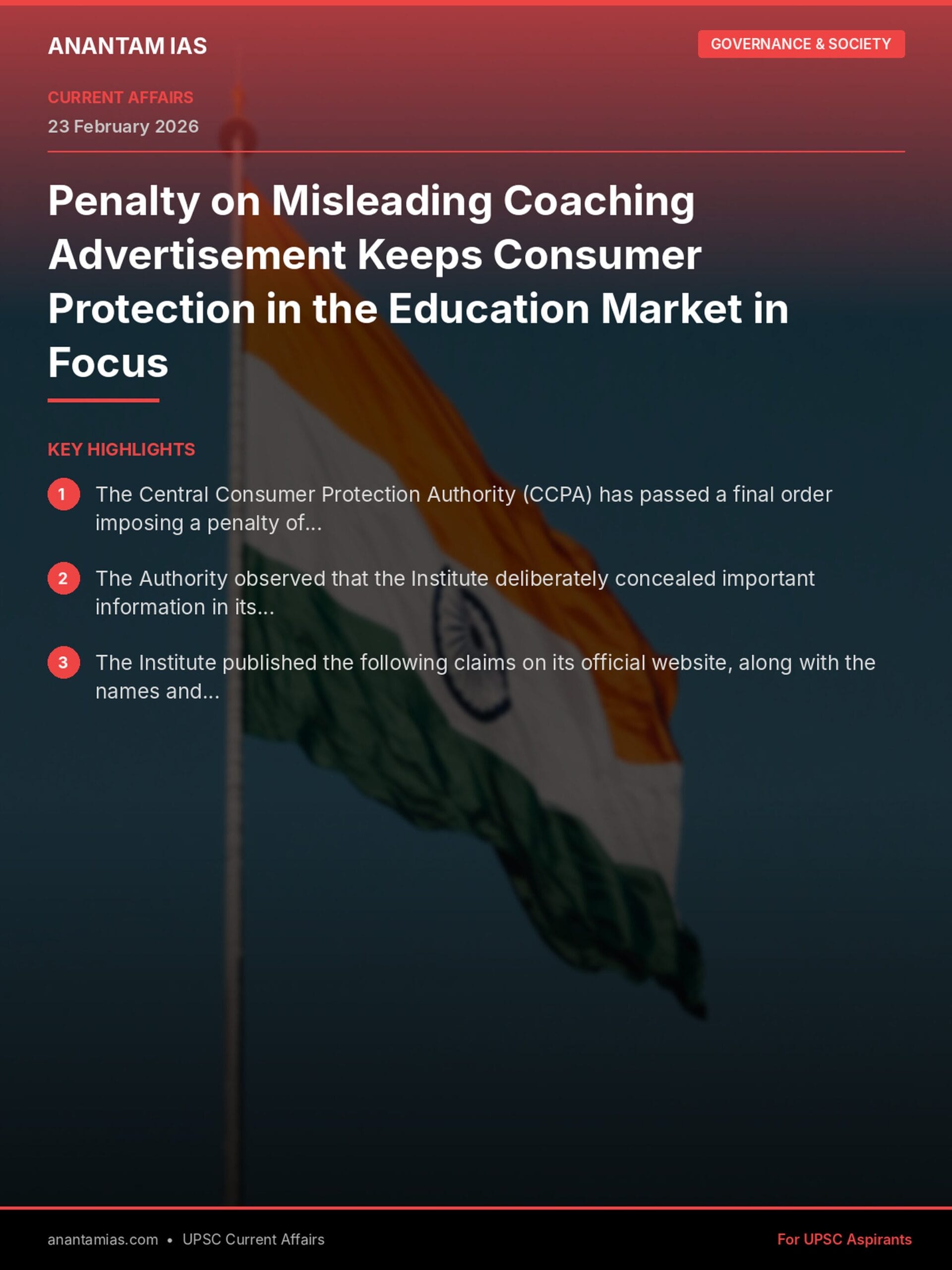
The Central Consumer Protection Authority (CCPA) has passed a final order imposing a penalty of ₹15 lakh on Vajirao and Reddy Institute for issuing misleading advertisements in relation to the Civil Services Examination (CSE), 2023. The Authority observed that the Institute deliberately concealed important information in its advertisements, namely, the specific course(s) opted for by the successful candidates.

The Institute published the following claims on its official website, along with the names and photographs of successful candidates of UPSC CSE 2023, soon after the declaration of the results on 16.04.2024: The CCPA noted that the Institute published the above claims while simultaneously advertising various courses offered by it on its official website, namely: GS/Complete Course/Foundation Course, Pre-Foundation Course, Weekend Course, Optional Subject Course, and GS Pre-cum-Mains Course. These representations created a misleading impression among consumers that all the successful candidates had enrolled in these regular courses advertised by the Institute.

Penalty on Misleading Coaching Advertisement Keeps Consumer Protection in the Education Market in Focus infographic

Read together, the event can be understood through three immediate takeaways: The Central Consumer Protection Authority (CCPA) has passed a final order imposing a penalty of ₹15 lakh on Vajirao and Reddy Institute for issuing misleading advertisements in relation to the Civil Services Examination (CSE), 2023., The Authority observed that the Institute deliberately concealed important information in its advertisements, namely, the specific course(s) opted for by the successful candidates., and The Institute published the following claims on its official website, along with the names and photographs of successful candidates of UPSC CSE 2023, soon after the declaration of the results on 16.04.2024: The CCPA noted that the Institute published the above claims while simultaneously advertising various courses offered by it on its official website, namely: GS/Complete Course/Foundation Course, Pre-Foundation Course, Weekend Course, Optional Subject Course, and GS Pre-cum-Mains Course.. These are the factual anchors, but the real UPSC value lies in connecting those facts with the broader story behind them.

Why it Matters

For UPSC, the significance of this topic lies in the fact that it sits at the intersection of current developments and structural change. Whether one looks at it from the lens of governance, economy, diplomacy, social policy, or strategic planning, the topic shows how day-to-day announcements often reveal larger shifts in India's state capacity and developmental priorities.

In answer writing, this makes the topic especially useful. It can serve as a factual illustration in Prelims preparation and as a layered example in Mains where the examiner expects candidates to connect institutions, outcomes, and wider policy direction.

What You Must Learn

0/5 completed

Bottom Line

Penalty on Misleading Coaching Advertisement Keeps Consumer Protection in the Education Market in Focus is important because it allows aspirants to move from a narrow event-based reading of current affairs to a broader understanding of how history, institutions, economy, politics, and governance intersect in contemporary India.

Exam Strategy

Use the topic to highlight the importance of institutions, procedural reform, and administrative accountability.

Related Current Affairs

Exam Oriented Questions

Why is this topic in the news?

It is in the news because an official development related to **Penalty on Misleading Coaching Advertisement Keeps Consumer Protection in the Education Market in Focus** was recorded on 23 February 2026.

Which official institution or source is associated with this topic?

The topic is anchored in an official source associated with **Press Information Bureau**, and aspirants should remember the source title **CCPA Imposes ?15 Lakh Penalty on Coaching Institute for Misleading Advertisement**.

What is the core issue involved here?

The core issue revolves around the central consumer protection authority (ccpa) has passed a final order imposing a penalty of ₹15 lakh on vajirao and reddy institute for issuing misleading advertisements in relation to the civil services examination (cse), 2023, along with its wider institutional and policy implications.

How is this topic relevant for UPSC Prelims?

It is relevant for Prelims because it covers institutions, administrative mechanisms, schemes, regulations, and delivery platforms.

How is this topic relevant for UPSC Mains?

It is relevant for Mains because it can be used in GS II on governance, reforms, public administration, and institutional capacity.

What wider context should aspirants connect with this topic?

Aspirants should connect this event with the wider context of historically, many of india's reform efforts have succeeded or failed depending on the quality of institutional design and administrative follow-through.

Does this topic have an economic, political, or social angle?

Yes. Economically and socially, governance reforms matter because they determine how effectively public resources translate into outcomes on the ground. Politically, such developments illustrate the constant negotiation between central direction, state-level implementation, and citizen expectations.

How can this topic be used in answer writing?

It can be used as a recent example to strengthen analytical arguments, especially where the question asks how policy intent translates into institutional or developmental outcomes.

What factual points should be revised first?

Revise the event date, the official source, and these quick points: The Central Consumer Protection Authority (CCPA) has passed a final order imposing a penalty of ₹15 lakh on Vajirao and Reddy Institute for issuing misleading advertisements in relation to the Civil Services Examination (CSE), 2023., The Authority observed that the Institute deliberately concealed important information in its advertisements, namely, the specific course(s) opted for by the successful candidates., The Institute published the following claims on its official website, along with the names and photographs of successful candidates of UPSC CSE 2023, soon after the declaration of the results on 16.04.2024: The CCPA noted that the Institute published the above claims while simultaneously advertising various courses offered by it on its official website, namely: GS/Complete Course/Foundation Course, Pre-Foundation Course, Weekend Course, Optional Subject Course, and GS Pre-cum-Mains Course..

What is the one-line exam takeaway?

Penalty on Misleading Coaching Advertisement Keeps Consumer Protection in the Education Market in Focus is important because it combines current relevance with a larger story about institutions, development, and public policy.

A temporary relief from bonded labour 

Open article →Download PDF

Why in News

Despite five decades since the enactment of the Bonded Labour System (Abolition) Act, 1976, recent reports from Odisha show that many rescued bonded labourers are slipping back into bondage. This is largely due to delays in rehabilitation assistance and the persistence of poverty and distress migration. The situation highlights gaps between legal abolition and ground realities.

UPSC Relevance: GS II: Governance, Social Justice & GS III: Economy

Context: Bonded Labour in Odisha

Western Odisha districts such as Nuapada, Bolangir and Kalahandi experience large-scale seasonal distress migration. Due to limited local employment and chronic poverty, workers migrate to brick kilns in southern Indian states like Telangana, Andhra Pradesh and Tamil Nadu.

What is Bonded Labour

Bonded labour refers to a system in which a person is forced to work to repay a debt or advance under coercive and exploitative conditions. The worker typically has restricted freedom, receives little or no wages and may remain trapped for long periods, sometimes across generations.

India legally abolished bonded labour through the Bonded Labour System (Abolition) Act, 1976. The Act:

  • Abolishes all forms of bonded labour
  • Cancels bonded debts
  • Makes enforcement of bonded labour a punishable offence
  • Automatically frees bonded labourers from obligations

Odisha Case Study

In western Odisha, migration to brick kilns follows a recurring pattern. Contractors provide advances to poor families, after which entire households migrate for seasonal work. Wages are adjusted against the debt, often leaving little cash income. Because local employment opportunities remain scarce, the debt-bondage cycle continues year after year.

Government interventions include rescue and repatriation of labourers, migration registration systems and awareness camps about rights. However, many workers return to bondage the next season because their livelihood insecurity remains unresolved. This demonstrates that bonded labour is a structural socio-economic issue rather than an isolated criminal practice.

The Odisha government has also introduced livelihood programmes such as the DALKHAI initiative to reduce distress migration by creating local employment and reducing dependence on brick-kiln work.

Judicial Activism & The “Interpreted” Definition

The Supreme Court has expanded the definition of Bonded Labour through landmark cases. You should cite these to gain extra marks:

  • PUDR vs. Union of India (Asiad Workers Case, 1982): The SC held that anyone forced to work for less than the Minimum Wage is technically a “bonded labourer,” as economic compulsion constitutes “force” under Article 23.
  • Bandhua Mukti Morcha vs. Union of India (1984): Directed the government to identify, release, and rehabilitate labourers, stating that “Right to Life” (Art. 21) includes the right to live with human dignity, free from bondage.

The Gender & Caste Intersectionality

Gender: Women in brick kilns face “double bondage”—laboring to pay off the family debt while being subjected to sexual exploitation and lack of menstrual hygiene/maternal health facilities

Caste: Over 80% of bonded labourers belong to SC/ST communities. It is not just an economic issue but a systemic social hierarchy issue.

Why Government Interventions Provide Only “Temporary Relief”

Rescue operations free workers from immediate exploitation and awareness campaigns inform them about rights. Migration registration helps authorities track vulnerable workers. However, these measures do not eliminate the economic compulsion to migrate. Workers often return to the same contractors in subsequent seasons due to lack of income sources.

Additionally, prosecution of employers remains weak, reducing deterrence. Rehabilitation funds and compensation are frequently delayed, leaving freed labourers without support. Since structural drivers like poverty, landlessness and debt remain unchanged, bonded labour reappears after rescue.

Constitutional and Legal Framework

Fundamental Rights

  • Article 21 guarantees the right to life with dignity.
  • Article 23 prohibits forced labour and human trafficking.
  • Article 24 prohibits child labour in hazardous occupations.

Major Laws

  • Bonded Labour System (Abolition) Act, 1976
  • Inter-State Migrant Workmen Act, 1979
  • Minimum Wages Act
  • Child Labour (Prohibition and Regulation) Act
  • SC/ST (Prevention of Atrocities) Act

Together, these laws aim to protect vulnerable workers from coercion and exploitation.

Government Schemes Relevant to Bonded Labour

Rehabilitation Scheme

The Central Sector Scheme for Rehabilitation of Bonded Labourers (2016) provides:

  • Rs 1–3 lakh compensation depending on vulnerability
  • Immediate relief of ₹20,000 after rescue
  • District Magistrate responsible for implementation

However, delays and inadequate livelihood support reduce its effectiveness.

Migration and Livelihood Schemes

  • MGNREGA for rural wage employment
  • National Rural Livelihood Mission (SHGs)
  • Skill India programmes
  • State migration support centres

The main challenge is poor convergence between these schemes and bonded labour rehabilitation.

International Framework

India is committed to eliminating forced labour under:

  • ILO Forced Labour Convention
  • ILO Abolition of Forced Labour Convention
  • Sustainable Development Goal 8.7 (ending modern slavery and forced labour)

Challenges Associated with Elimination of Bonded Labour

a) Identification Challenges

  • Bonded labour is often disguised within informal labour arrangements such as advances and seasonal contracts.
  • Workers themselves may not recognise their situation as illegal bondage.
  • Officials often lack training to identify coercive labour relations, especially when workers migrate outside their home districts.
  • As a result, many cases remain unreported.

b) Economic and Structural Challenges

  • Chronic poverty, landlessness and lack of rural employment push households into debt dependence.
  • Many bonded labourers belong to SC/ST communities with limited assets and social protection.
  • Agrarian distress and drought-prone regions intensify vulnerability.
  • The dominance of informal labour markets further enables exploitation.
  • These factors create a cycle: poverty leads to migration, migration leads to debt, and debt leads to bondage.

c) Migration-Related Challenges

  • Interstate migration complicates monitoring and rescue operations.
  • Workers often lack formal contracts or registration, and social protection benefits such as PDS or welfare schemes are not portable across states.
  • Recruitment through contractors obscures employer responsibility.
  • Language differences and unfamiliar legal systems further isolate migrant labourers.

d) Weak Law Enforcement

  • Conviction rates under bonded labour laws remain very low.
  • Employers and contractors may have local influence or political connections.
  • Cases are often registered under minor labour violations instead of bonded labour provisions.
  • Poor coordination between source and destination states weakens accountability.
  • Consequently, deterrence against bonded labour remains limited.

e) Rehabilitation Failures

  • Freed labourers frequently face delays in receiving compensation.
  • Rehabilitation often focuses on one-time cash assistance without long-term livelihood support.
  • Social stigma and exclusion hinder reintegration.
  • Without sustainable income, many rescued workers fall back into debt and bondage.
  • Thus, rehabilitation does not break the cycle.

f) Administrative and Governance Issues

  • District vigilance committees responsible for monitoring bonded labour are often inactive.
  • District Magistrates face multiple responsibilities and limited resources.
  • Reliable data on bonded labour is scarce, hindering targeted policy action.
  • Labour inspection capacity is inadequate, and schemes addressing migration, livelihoods and rehabilitation remain fragmented.

Solutions and Way Forward

a) Prevention (Addressing Root Causes)

  • Creating sustainable rural livelihoods through agriculture diversification, rural industries and skill development can reduce migration pressures.
  • Ensuring land and forest rights for tribal communities and improving access to institutional credit can reduce dependence on exploitative advances.
  • Strengthening MGNREGA and local employment programmes is essential.

b) Protection During Migration

  • Mandatory registration of migrant workers and interstate agreements between labour departments can improve monitoring.
  • Portability of PDS, health insurance and welfare benefits ensures social security in destination states.
  • Migration support centres and labour helplines can provide assistance and grievance redressal.

c) Enforcement Reforms

  • Strict prosecution of employers under the Bonded Labour Act is necessary to create deterrence.
  • Dedicated labour courts and stronger labour inspection systems can improve enforcement.
  • Regulation of labour contractors and better interstate coordination can reduce exploitation.

d) Rehabilitation Reform

  • Compensation must be timely and linked with livelihood packages such as skill training, land allotment, giving a cow or employment support.
  • Social reintegration programmes and long-term monitoring are needed to prevent re-bondage.
  • Rehabilitation should shift from one-time cash to sustainable economic empowerment.

e) Governance Reforms

  • District vigilance committees must be activated with community participation and NGO involvement.
  • Data systems mapping migration and bonded labour prevalence should be developed.
  • Convergence between rehabilitation, livelihood and migration schemes must be institutionalised.

f) Social Measures

  • Community vigilance groups, self-help groups and micro-credit networks can reduce dependence on contractors.
  • Education and skill development enhance labour mobility and bargaining power.
  • Awareness campaigns can change social acceptance of bonded labour.

g) The Technological Dimension (New Trend)

  • Digital Surveillance: Some contractors now use mobile-based tracking or retain Aadhaar cards/Bank passbooks of laborers to prevent them from fleeing, creating a “Digital Shackle.”
  • Solution: Use the e-Shram Portal for “One Nation One Ration Card” (ONORC) to ensure portability of benefits, reducing dependence on contractors for food.

h) Linkage with Organized Crime

  • Bonded labor is increasingly seen as a form of Human Trafficking. A major shift toward the Trafficking in Persons (Prevention, Care and Rehabilitation) Bill, which seeks to treat “forced labor” as a heinous crime.

i) Replicating Best Practices

  • Migration tracking systems in Odisha, NGO-led rescue networks in Tamil Nadu, community vigilance committees in Rajasthan and skill-based rehabilitation models across states provide replicable approaches for nationwide adoption.

Conclusion:

The continued existence of bonded labour in Odisha shows that legal abolition alone is insufficient when poverty, distress migration and weak rehabilitation persist. Despite the Bonded Labour System (Abolition) Act, 1976, delayed compensation, lack of livelihoods and poor enforcement push rescued workers back into bondage. Ending bonded labour therefore requires not only strict law enforcement but also sustainable rural employment, migrant protection and effective rehabilitation to address its structural causes.

Agni-III Missile Test: Strategic Significance for India

Open article →Download PDF

Why in News

India successfully test-fired the Agni-III intermediate-range ballistic missile from the Integrated Test Range, Chandipur (Odisha), under the supervision of the Strategic Forces Command (SFC) as part of a routine training exercise to validate operational readiness.

  • Strategic Forces Command (SFC) is the tri-services command of India responsible for the management, control and operational deployment of India’s nuclear weapons and strategic missile forces

UPSC Relevance: GS III Science and Technology, Indigenous Technology 

About Agni-III Missile:

  • Type: Intermediate-Range Ballistic Missile (IRBM)
  • Range: Over 3,000 km
  • Fuel: Two-stage, solid-fuelled
  • Payload: Capable of carrying conventional and nuclear warheads
  • Developer: Defence Research and Development Organisation (DRDO)
  • Operational Status: Inducted into Strategic Forces Command in 2011

Key Features

Solid-fuel propulsion:

  • Faster launch readiness

  • Lower maintenance

  • Higher survivability compared to liquid-fuel missiles

Two-stage configuration:

  • Enhances range and payload capability

High accuracy and reliability:

  • Suitable for strategic deterrence missions

Strategic Importance of the Test

1. Strengthening Credible Minimum Deterrence

  • Agni-III is a core pillar of India’s nuclear deterrence posture
  • Supports India’s doctrine of:
    • No First Use (NFU)
    • Credible Minimum Deterrence

Ensures ability to inflict unacceptable damage in case of nuclear aggression

2. Operational Readiness of Strategic Forces Command

  • Test conducted as a training exercise
  • Validates:
    • Missile handling procedures
    • Command-and-control systems
    • Coordination between DRDO and SFC

Enhances second-strike capability

3. Regional Strategic Balance

  • Range covers key strategic regions, contributing to deterrence stability
  • Acts as a counterbalance in a complex regional security environment

Reinforces India’s status as a responsible nuclear power

4. Indigenous Defence Capability

  • Highlights DRDO’s mastery in solid propulsion, guidance, re-entry technology, and composite materials.
  • Reduces import dependence; aligns with Make in India and self-reliance goals in strategic systems. Aligns with Atmanirbhar Bharat in defence manufacturing

Integrated Test Range (ITR), Chandipur

  • Located in Balasore district, Odisha (off the Bay of Bengal coast).
  • India’s primary facility for testing ballistic missiles, cruise missiles (e.g., BrahMos), anti-ballistic missile systems (e.g., Prithvi Air Defence), and other strategic weapons.
  • Equipped with advanced tracking radars, telemetry, electro-optical systems, and mission control centres → Essential for validating missile performance over long ranges.

Practice Question:

With reference to the Agni-III missile, consider the following statements:

  1. It is a two-stage, solid-fuelled ballistic missile.
  2. It has a strike range of more than 3,000 km.
  3. It is capable of carrying both conventional and nuclear warheads.
  4. It is operated by the Defence Research and Development Organisation (DRDO).

Which of the statements given above are correct?

(a) 1, 2 and 3 only
(b) 1 and 4 only
(c) 2 and 3 only
(d) 1, 2, 3 and 4

Answer: (a) 1, 2 and 3

PMAY-Urban 2.0 Review Shows the Continuing Centrality of Housing Policy

Open article →Download PDF

Why in News?

On 23 February 2026, PMAY-Urban 2.0 Review Shows the Continuing Centrality of Housing Policy emerged as an important current-affairs theme through an official communication linked to Press Information Bureau. For UPSC aspirants, the topic is valuable not only because it marks a specific event, but because it opens a wider window into how policy, institutions, and development processes are evolving in India.

The official anchor for the topic is Secretary, MoHUA chairs 6th meeting of Central Sanctioning and Monitoring Committee under PMAY-Urban 2.0. That matters because serious preparation requires moving beyond headlines and asking three connected questions: what happened, why now, and what deeper historical, economic, political, or governance trend this event reflects.

UPSC Relevance

  • Prelims: welfare programmes, social campaigns, education, employment, and target groups in policy
  • Mains: GS II on social justice, education, livelihoods, and human development
Easy to Remember
  • A total of 2.88 lakh houses has been sanctioned under the Pradhan Mantri Awas Yojana –
  • The meeting was attended by Shri Kuldip Narayan, Joint Secretary & Mission Director
  • With the latest approval of 2,87,618 houses under PMAY-U 2.0, the total number of

What Happened?

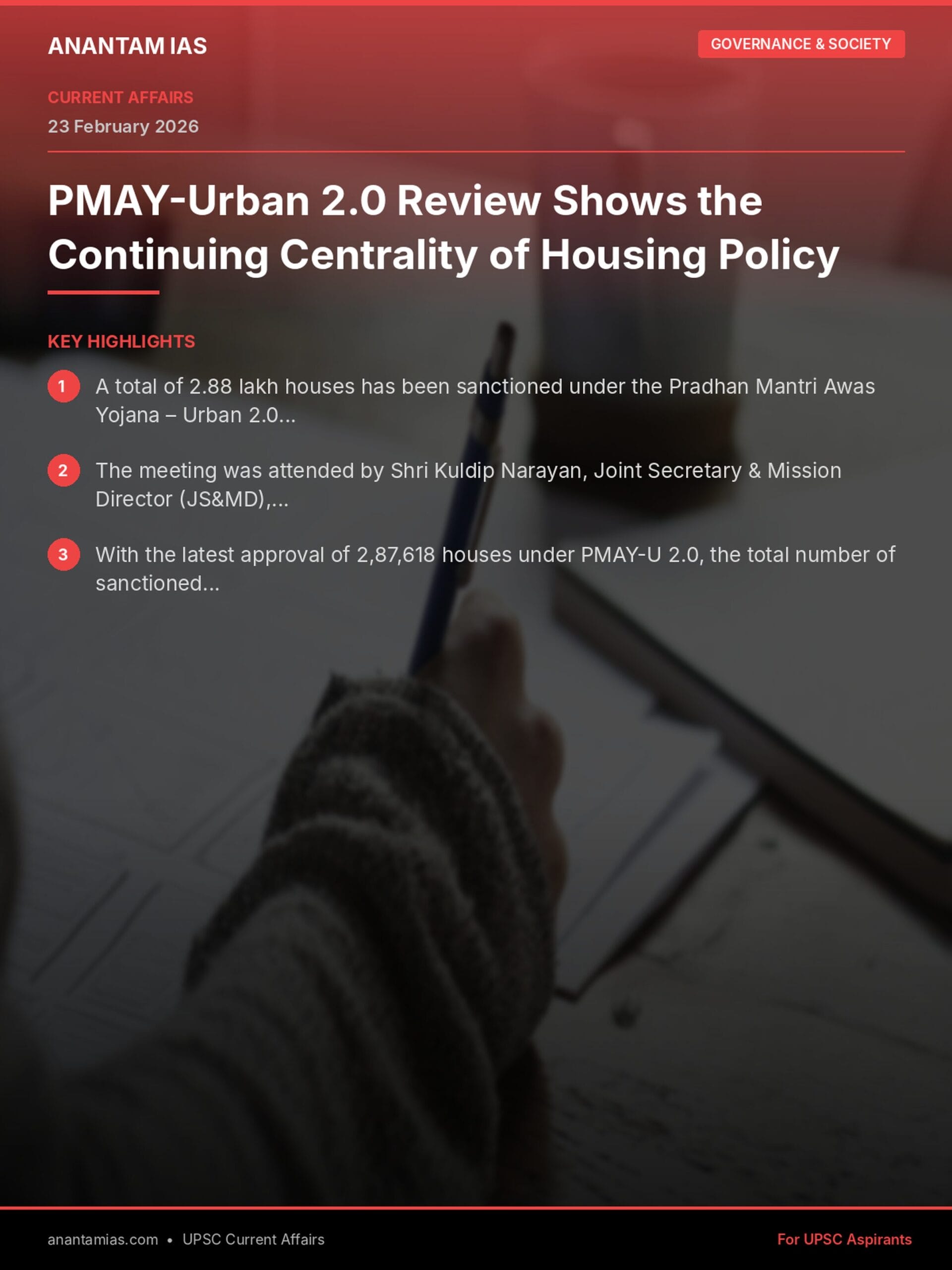
A total of 2.88 lakh houses has been sanctioned under the Pradhan Mantri Awas Yojana – Urban 2.0 (PMAY-U 2.0) during the 6 th meeting of Central Sanctioning and Monitoring Committee (CSMC), held on 23 rd February 2026 under the chairmanship of Shri Srinivas Katikithala, Secretary, Ministry of Housing and Urban Affairs (MoHUA), in New Delhi. The meeting was attended by Shri Kuldip Narayan, Joint Secretary & Mission Director (JS&MD), Housing for All (HFA) and senior officials from the Ministry, along with PMAY-U Mission Directors from different States/UTs.

With the latest approval of 2,87,618 houses under PMAY-U 2.0, the total number of sanctioned houses under the Scheme is now over 13.61 lakh, reflecting the Government’s continued commitment to ensure access to dignified and affordable housing for urban families belonging to Economically Weaker Section (EWS), Low Income Group (LIG) and Middle-Income Group (MIG). The newly sanctioned houses have been approved in 16 States/UTs, namely Andhra Pradesh, Arunachal Pradesh, Chhattisgarh, Gujarat, Jammu & Kashmir, Punjab, Puducherry, Rajasthan, Tamil Nadu, Telangana, Maharashtra, Madhya Pradesh, Nagaland, Odisha, Uttar Pradesh and West Bengal under different verticals of PMAY-U 2.0 such as the Beneficiary Led Construction (BLC) – 1.66 lakh houses, Affordable Housing in Partnership (AHP) – 1.09 lakh houses and Affordable Rental Housing (ARH) – 12,846 houses.

PMAY-Urban 2.0 Review Shows the Continuing Centrality of Housing Policy infographic

Read together, the event can be understood through three immediate takeaways: A total of 2.88 lakh houses has been sanctioned under the Pradhan Mantri Awas Yojana – Urban 2.0 (PMAY-U 2.0) during the 6 th meeting of Central Sanctioning and Monitoring Committee (CSMC), held on 23 rd February 2026 under the chairmanship of Shri Srinivas Katikithala, Secretary, Ministry of Housing and Urban Affairs (MoHUA), in New Delhi., The meeting was attended by Shri Kuldip Narayan, Joint Secretary & Mission Director (JS&MD), Housing for All (HFA) and senior officials from the Ministry, along with PMAY-U Mission Directors from different States/UTs., and With the latest approval of 2,87,618 houses under PMAY-U 2.0, the total number of sanctioned houses under the Scheme is now over 13.61 lakh, reflecting the Government’s continued commitment to ensure access to dignified and affordable housing for urban families belonging to Economically Weaker Section (EWS), Low Income Group (LIG) and Middle-Income Group (MIG).. These are the factual anchors, but the real UPSC value lies in connecting those facts with the broader story behind them.

Why it Matters

For UPSC, the significance of this topic lies in the fact that it sits at the intersection of current developments and structural change. Whether one looks at it from the lens of governance, economy, diplomacy, social policy, or strategic planning, the topic shows how day-to-day announcements often reveal larger shifts in India's state capacity and developmental priorities.

In answer writing, this makes the topic especially useful. It can serve as a factual illustration in Prelims preparation and as a layered example in Mains where the examiner expects candidates to connect institutions, outcomes, and wider policy direction.

What You Must Learn

0/5 completed

Bottom Line

PMAY-Urban 2.0 Review Shows the Continuing Centrality of Housing Policy is important because it allows aspirants to move from a narrow event-based reading of current affairs to a broader understanding of how history, institutions, economy, politics, and governance intersect in contemporary India.

Exam Strategy

Use the topic to connect welfare or education developments with long-term capability creation.

Related Current Affairs

Exam Oriented Questions

Why is this topic in the news?

It is in the news because an official development related to **PMAY-Urban 2.0 Review Shows the Continuing Centrality of Housing Policy** was recorded on 23 February 2026.

Which official institution or source is associated with this topic?

The topic is anchored in an official source associated with **Press Information Bureau**, and aspirants should remember the source title **Secretary, MoHUA chairs 6th meeting of Central Sanctioning and Monitoring Committee under PMAY-Urban 2.0**.

What is the core issue involved here?

The core issue revolves around a total of 2.88 lakh houses has been sanctioned under the pradhan mantri awas yojana – urban 2.0 (pmay-u 2.0) during the 6 th meeting of central sanctioning and monitoring committee (csmc), held on 23 rd february 2026 under the chairmanship of shri srinivas katikithala, secretary, ministry of housing and urban affairs (mohua), in new delhi, along with its wider institutional and policy implications.

How is this topic relevant for UPSC Prelims?

It is relevant for Prelims because it covers welfare programmes, social campaigns, education, employment, and target groups in policy.

How is this topic relevant for UPSC Mains?

It is relevant for Mains because it can be used in GS II on social justice, education, livelihoods, and human development.

What wider context should aspirants connect with this topic?

Aspirants should connect this event with the wider context of historically, india's social policy has expanded through a mix of welfare provision, institution-building, and behavioural change campaigns.

Does this topic have an economic, political, or social angle?

Yes. Economically, investments in education, livelihoods, and social protection affect productivity, labour force participation, and long-term human capital. Politically, social-sector measures matter because they shape legitimacy, inclusion, and the lived relationship between citizen and state.

How can this topic be used in answer writing?

It can be used as a recent example to strengthen analytical arguments, especially where the question asks how policy intent translates into institutional or developmental outcomes.

What factual points should be revised first?

Revise the event date, the official source, and these quick points: A total of 2.88 lakh houses has been sanctioned under the Pradhan Mantri Awas Yojana – Urban 2.0 (PMAY-U 2.0) during the 6 th meeting of Central Sanctioning and Monitoring Committee (CSMC), held on 23 rd February 2026 under the chairmanship of Shri Srinivas Katikithala, Secretary, Ministry of Housing and Urban Affairs (MoHUA), in New Delhi., The meeting was attended by Shri Kuldip Narayan, Joint Secretary & Mission Director (JS&MD), Housing for All (HFA) and senior officials from the Ministry, along with PMAY-U Mission Directors from different States/UTs., With the latest approval of 2,87,618 houses under PMAY-U 2.0, the total number of sanctioned houses under the Scheme is now over 13.61 lakh, reflecting the Government’s continued commitment to ensure access to dignified and affordable housing for urban families belonging to Economically Weaker Section (EWS), Low Income Group (LIG) and Middle-Income Group (MIG)..

What is the one-line exam takeaway?

PMAY-Urban 2.0 Review Shows the Continuing Centrality of Housing Policy is important because it combines current relevance with a larger story about institutions, development, and public policy.