UPSC CSE 2026 Essay Paper Discussion

Daily Digest · Tuesday

23 September 2025 Current Affairs for UPSC

2 current affairs published on Tuesday, 23 September 2025

23 September 2025 Current Affairs for UPSC — every Why-in-News article AnantamIAS published on Tuesday, 23 September 2025, broken down with Why in News?, the exact GS paper it feeds, sub-topic mapping, MCQ-ready facts and a UPSC-style practice question. 2 articles in total, covering Polity, Economy, Environment, S&T, IR, Geography, History, Society and Internal Security — the same Why-in-News + GS-paper-mapping + practice-question format the Compass uses across every daily digest on the site.

Daily current affairs for UPSC is where new material enters your prep stream. Read this 23 September 2025 digest end-to-end in 25–35 minutes, attempt the practice question at the foot of each article (it's MCQ for some, 10/15-marker for others), then bookmark the entries that fall inside your active revision window. Everything stays cross-linked: tap any subject pill to jump to that subject's hub, or use the table of contents above to skip straight to a specific story.

Use this page three ways. Read sequentially for a one-sitting scan of everything that mattered on 23 September 2025. Download the 23 September 2025 PDF below for offline study or print revision. Or use the September 2025 Current Affairs compilation to see this day in the month's full context. For the previous day's reading, see 22 September 2025 Current Affairs; the next day's is 24 September 2025 Current Affairs.

Why we publish daily current affairs separately from the monthly compilation: daily is learning, monthly is revision. Use the daily page to add fresh material to your notes the day it breaks; come back to the September 2025 compilation 60 days before Prelims when the noise has settled and only the lasting takeaway is worth re-reading.

Maize

Open article →Download PDF

Context:

The issue of U.S. demand for India to import corn has resurfaced in the context of ongoing trade disagreements between India and the United States.

USA want India, despite having 1.4 billion people, does not import even a “bushel” of U.S. corn on the other side India’s maize yield is lower than the world average but domestic production has been nearly self-sufficient, sometimes even surplus.

UPSC Relevance:

Major Crops

UPSC Prelims PYQ 2022

Consider the following States:

  1. Andhra Pradesh
  2. Kerala
  3. Himachal Pradesh
  4. Tripura

How many of the above are generally known as tea-producing States?

(a) Only one State

(b) Only two States

(c) Only three States

(d) All four States

About Maize:
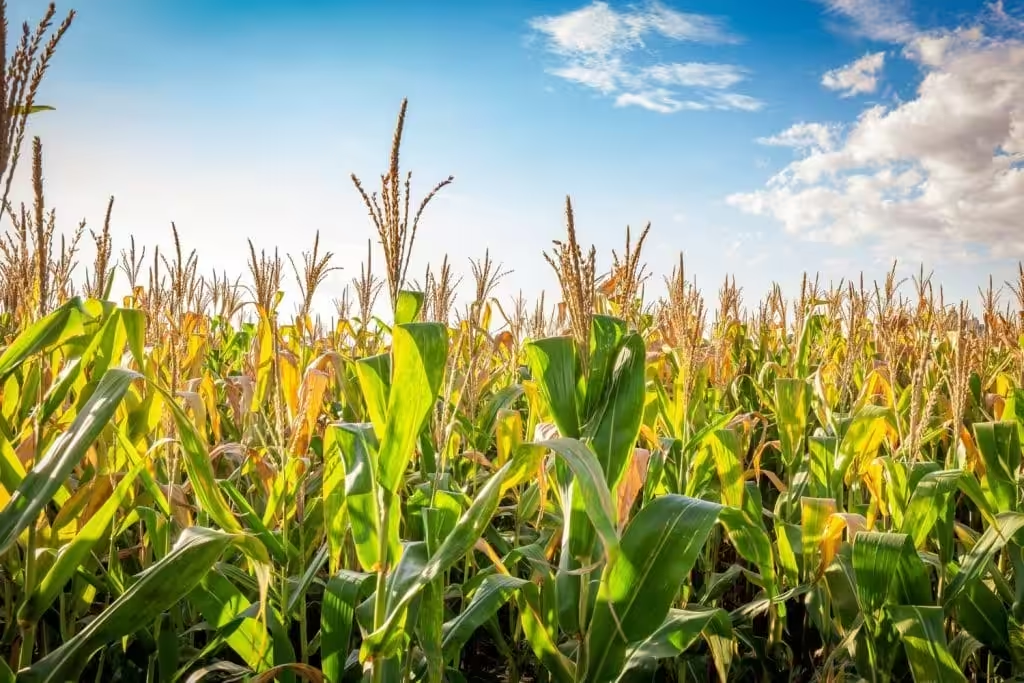
  • Maize (Zea Mays) originates in the Andean region of Central America. It is one of the most important cereals both for human and animal consumption and is grown for grain and forage. 
  • The crop is grown in climates ranging from temperate to tropic during the period when mean daily temperatures are above 15°C and frost-free. 
  • For maximum production a medium maturity grain crop requires between 500 and 800 mm of water depending on climate. 

India is the 5th Largest producer (Source: FAO) and 14th Largest exporter of Maize in the world.

Areas of Cultivation in India:

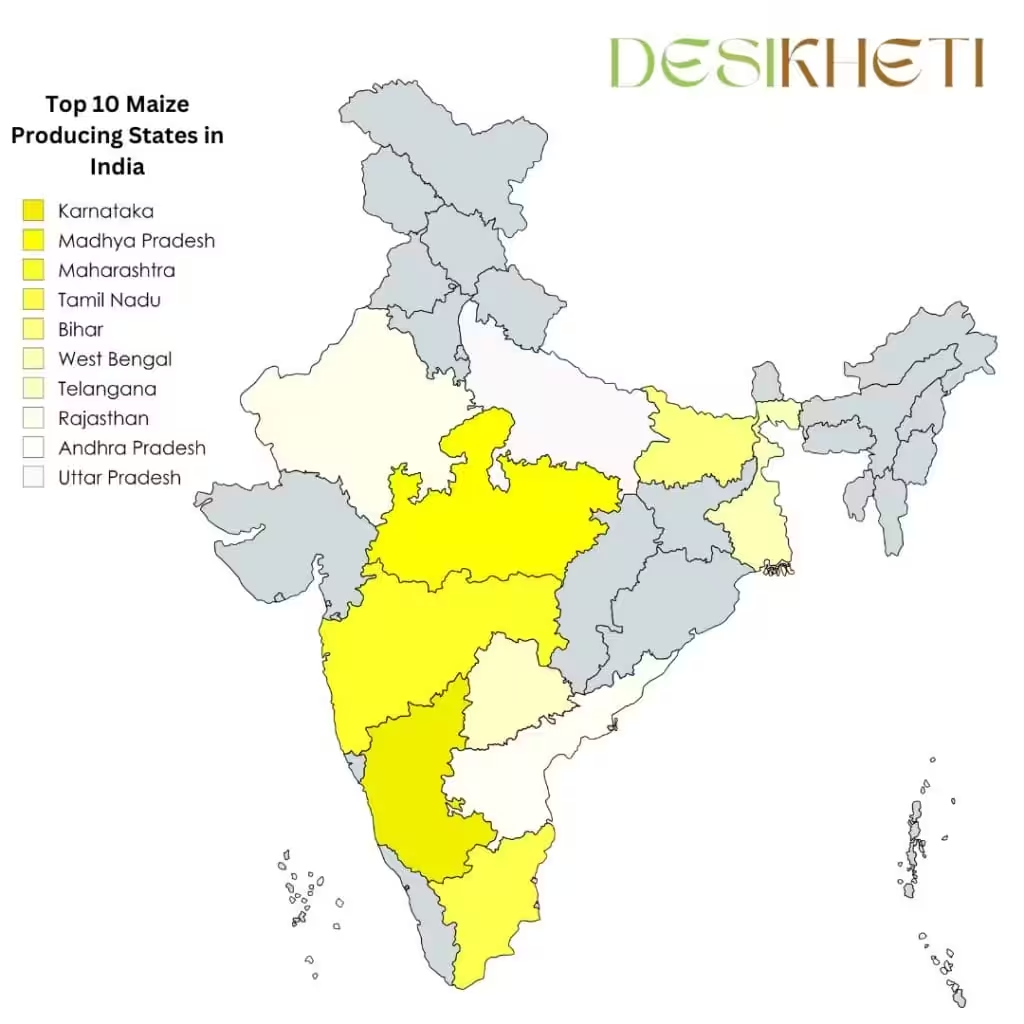
Major Maize-growing states in India are Karnataka, Madhya Pradesh, Bihar, Tamil Nadu, Telangana, Maharashtra and Andhra Pradesh.
Mini-Moons and Quasi-Moons

Open article →Download PDF

Context:

Recently, an asteroid by the nomenclature 2025 PN7 has been spotted, which is said to be a quasi-moon and could be smallest of its kind.

UPSC Relevance: Science and technology

PYQ:

Q) The group of small pieces of rock revolving round the sun between the orbits of Mars and Jupiter are called:

a) Meteors

b) comets

c) meteorites

d) asteroids

Q) Consider the following statements regarding asteroids:

1. Asteroids are rocky debris of varying size orbiting the sun

2. Most of the asteroids are small, but some have diameters as large and 1000 km

3. The orbit of asteroids lies between the orbits of Jupiter and Saturn

Which of these statements are correct:

a)1, 2 and 3 are correct

b)2 and 3 are correct

c)1 and 2 are correct

d)1 and 3 are correct

About Asteroids:

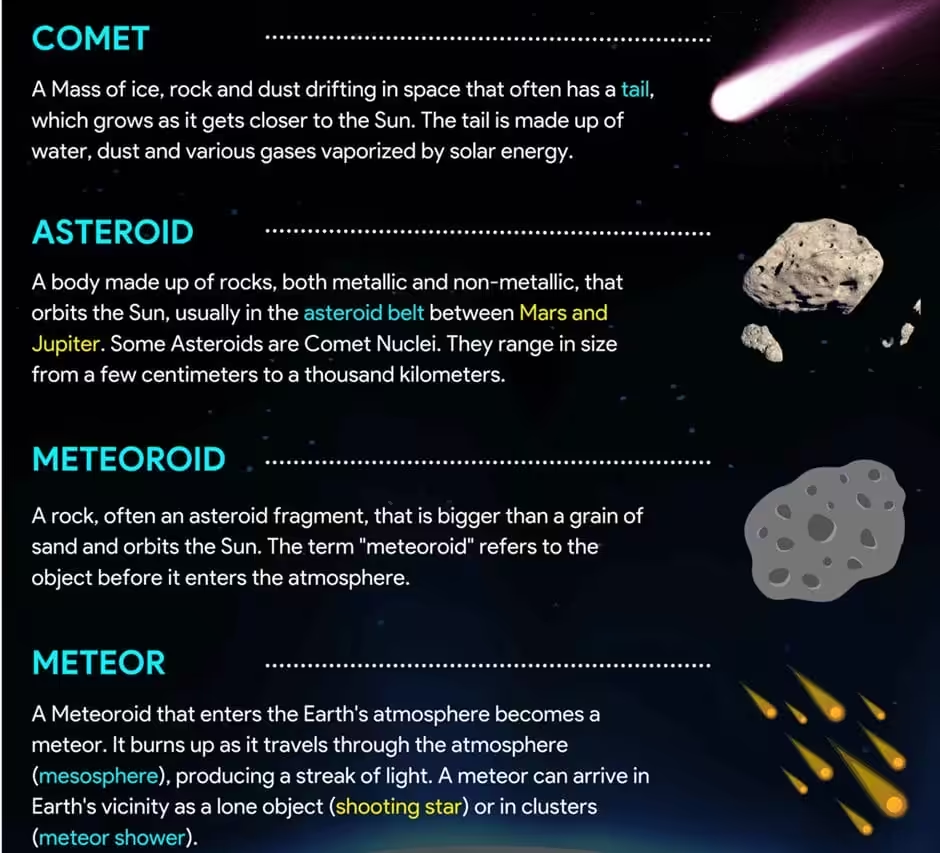
  • Asteroids are remnants of planetary formation that failed to coalesce because of the gravitational interference of Jupiter. They circle the Sun in a zone lying between Mars and Jupiter. The circular chain of asteroids is called the asteroid belt. It lies between 2.3 and 3.3 AU from the Sun.
  • Asteroids (planetoids ― another term for an asteroid) are composed mainly of refractory rocky and metallic minerals, with some ice. They range in size from hundreds of kilometres across to microscopic.
  • Ceres (2.77 AU) is the largest asteroid (946 km in diameter), a protoplanet, and a dwarf planet. It has a mass large enough for its own gravity to pull it into a spherical shape. All asteroids, except Ceres , are classified as small Solar System bodies.

Mini-moons and Quasi-moons:

Mini-Moons:

  • Mini-moons are asteroids that fail to escape Earth’s gravity and end up orbiting the planet for some time.
  • They are usually very small and hard to detect — only four mini-moons of Earth have ever been discovered, and none are still orbiting Earth.
  • These events are relatively frequent, with similar occurrences happening every few decades.

How does Earth capture Mini Moons?

  • Mini moons are captured from the Near-Earth Object (NEO) population, which consists of asteroids and other celestial bodies that pass close to Earth.
  • NASA classifies any space object that comes within 120 million miles (190 million kilometres) of our planet as a near-Earth object, while objects within 4.7 million miles (7.5 million kilometres) are considered potentially hazardous

Quasi-moons:

A quasi-moon is a term used to describe an asteroid or space rock that orbits the sun in a similar time frame as Earth but is only slightly influenced by Earth’s gravitational pull. It appears to accompany Earth during its yearly journey around the sun but is not a natural satellite like the moon.