UPSC CSE 2026 Essay Paper Discussion

Daily Digest · Wednesday

24 September 2025 Current Affairs for UPSC

2 current affairs published on Wednesday, 24 September 2025

24 September 2025 Current Affairs for UPSC — every Why-in-News article AnantamIAS published on Wednesday, 24 September 2025, broken down with Why in News?, the exact GS paper it feeds, sub-topic mapping, MCQ-ready facts and a UPSC-style practice question. 2 articles in total, covering Polity, Economy, Environment, S&T, IR, Geography, History, Society and Internal Security — the same Why-in-News + GS-paper-mapping + practice-question format the Compass uses across every daily digest on the site.

Daily current affairs for UPSC is where new material enters your prep stream. Read this 24 September 2025 digest end-to-end in 25–35 minutes, attempt the practice question at the foot of each article (it's MCQ for some, 10/15-marker for others), then bookmark the entries that fall inside your active revision window. Everything stays cross-linked: tap any subject pill to jump to that subject's hub, or use the table of contents above to skip straight to a specific story.

Use this page three ways. Read sequentially for a one-sitting scan of everything that mattered on 24 September 2025. Download the 24 September 2025 PDF below for offline study or print revision. Or use the September 2025 Current Affairs compilation to see this day in the month's full context. For the previous day's reading, see 23 September 2025 Current Affairs; the next day's is 25 September 2025 Current Affairs.

Why we publish daily current affairs separately from the monthly compilation: daily is learning, monthly is revision. Use the daily page to add fresh material to your notes the day it breaks; come back to the September 2025 compilation 60 days before Prelims when the noise has settled and only the lasting takeaway is worth re-reading.

Tea

Open article →Download PDF

Why in news:

The Executive Director of the International Tea Committee, James Suranga Perera, while speaking at the India International Tea Convention in Kochi, highlighted India’s potential to become a global superpower in the tea sector.

UPSC Relevance:

UPSC CSE in prelims examination has focused on different boards like Tea Board, Coffee Board and Turmeric Board etc. A case in point is a following PYQ.

UPSC Prelims PYQ 2022

Consider the following States:

  1. Andhra Pradesh
  2. Kerala
  3. Himachal Pradesh
  4. Tripura

How many of the above are generally known as tea-producing States?

(a) Only one State

(b) Only two States

(c) Only three States

(d) All four States

About Tea:
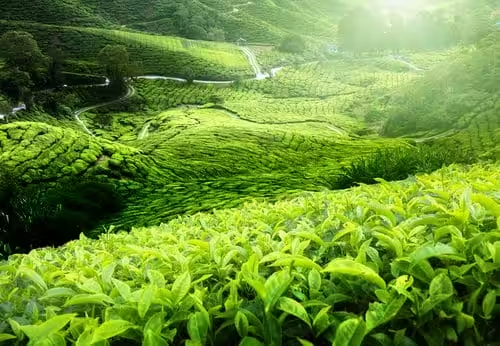
History:

  • Robert Bruce in 1823 discovered tea plants growing wild in upper Brahmaputra Valley.
  • A tea garden was started by the Government in 1833 in erstwhile Lakhimpur district.
  • China and Assam are the only two regions in the world with native tea plants.
  • The scientific name for the tea plant is Camellia sinensis.

Growing Conditions:

  • Tea requires a moderately hot and humid climate. 
  • The average annual rainfall in ranges from 2000-4000 mm.
  • In general, the ambient temperature within 13°C and 28-32°C is conducive for growth of tea.
  • Tea grows well on high land well drained soils having a good depth, acidic pH in the range 4.5 to 5.5 and more than 2% organic matter. 

Tea Growing States:
Tea production in other states are: Arunachal Pradesh(2.34 million kg), Nagaland (0.20 million kg), Sikkim(0.16 million kg), Manipur(0.11 million kg), Meghalaya(0.10 million kg) and Mizoram(0.07 million kg)

Current Position of India in Tea

  • 2nd largest producer of tea in the world.
  • 2nd largest consumer of tea.
  • 3rd largest exporter of tea.

Tea Board:

  • Tea is one of the industries, which by an Act of Parliament comes under the control of the Union Govt.
  • The genesis of the Tea Board India dates back to 1903 when the Indian Tea Cess Bill was passed.
  • The present Tea Board set up under section 4 of the Tea Act 1953 was constituted on 1st April 1954. 
  • Organisation of the Board: The present Tea Board is functioning as a statutory body of the Central Government under the Ministry of Commerce. 
  • The Board is constituted of 31 members (including Chairman) drawn from Members of Parliament, tea producers, tea traders, tea brokers, consumers, and representatives of Governments from the principal tea producing states, and trade unions .
  • The Board is reconstituted every three years.

Offices of Tea Board :

  • Offices in India: With Head Office located in Kolkata, West Bengal it has twenty three offices which include Zonal, Regional and Sub-Regional Offices.

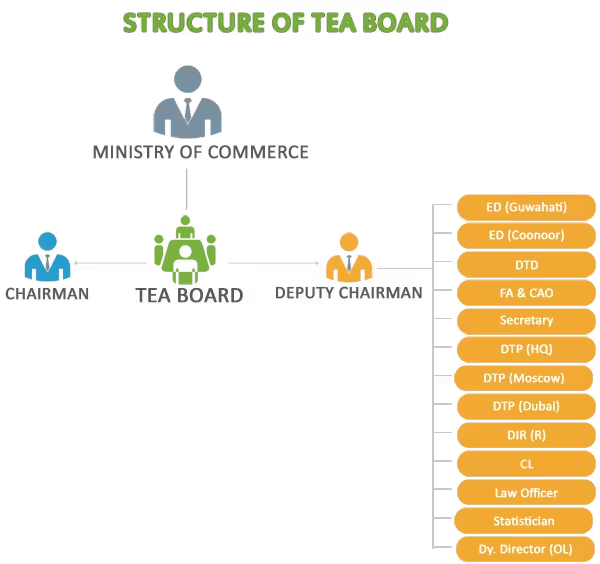
Functions: The Tea Board has wide functions and responsibilities under the direction of the Central Government. Briefly the primary functions of the Tea Board are as under :

a) Rendering financial and technical assistance for cultivation, manufacture and marketing of tea.

b) Export Promotion

c) Aiding Research and Development activities for augmentation of tea production and improvement of tea quality.

d) Extend financial assistance in a limited way to the plantation workers and their wards through labor welfare schemes.

e) To encourage and assist both financially and technically the unorganized small growers sector.

f) Collection and maintenance of Statistical data and publication

g) Such other activities as are assigned from time to time by the Central Government.

PYQ Practice Question:

Q1. With reference to the “Tea Board” in India, consider the following statements: (2022)

  1. The Tea Board is a statutory body.
  2. It is a regulatory body attached to the Ministry of Agriculture and Farmers Welfare.
  3. The Tea Board’s Head Office is situated in Bengaluru.
  4. The Board has overseas offices at Dubai and Moscow.

Which of the statements given above are correct?

(a) 1 and 3

(b) 2 and 4

(c) 3 and 4

(d) 1 and 4

NATO(North Atlantic Treaty Organisation)

Open article →Download PDF

Context:

NATO has recently issued warning to Russia to abstain from violating airspace of its members.

UPSC Relevance: Important International institutions.

UPSC PYQ:

Q) Consider the following countries: 
I. Austria 
II. Bulgaria 
III. Croatia 
IV. Serbia 
V. Sweden 
VI. North Macedonia 
How many of the above are members of the North Atlantic Treaty Organization? 

[A] Only three

[B] Only four

[C] Only five

[D] All the six

About NATO:

  • The North Atlantic Treaty Organisation is a political and military alliance created in the aftermath of World War II by 12 countries from Europe and North America. It was founded on April 4, 1949.
  • 12 founding members: Belgium, Canada, Denmark, France, Iceland, Italy, Luxembourg, the Netherlands, Norway, Portugal, the United Kingdom and the United States.
  • Since then, 20 more countries have joined NATO through 10 rounds of enlargement (in 1952, 1955, 1982, 1999, 2004, 2009, 2017, 2020, 2023 and 2024).
  • Headquarters: Brussels, Belgium, while the Allied Command Operations headquarters is near Mons, Belgium.
  • It was formed by the signing of the Washington Treaty, which is based on Article 51 of the United Nations Charter, “which reaffirms the right of individual or collective defence.”
  • The principle of collective defence (an attack against one Ally is an attack against all) is enshrined in Article 5 of the North Atlantic Treaty, which commits NATO members to mutual defence.
  • Open door policy (Article 10): Article 10 of the North Atlantic Treaty sets out how countries can join the Alliance. It states that membership is open to any “European State in a position to further the principles of this Treaty and to contribute to the security of the North Atlantic area”.
  • All European countries are eligible to join NATO.
  • Since 1949, the  alliance membership has increased from 12 to 32 countries through ten rounds of enlargement.
  • Sweden became the latest country to join the Alliance in 2024.
  • NATO makes its decisions by consensus. Hence, if a new country wants to join NATO, it must be supported by all other members. Any of its member countries can veto a new member. is a political and military alliance created in the aftermath of World War II by 12 countries from Europe and North America. It was founded on April 4, 1949.

Process of joining:

  • Accession talks: To obtain formal confirmation from the invitees.
  • Letters of intent: They are sent to NATO along with the timeline of reforms.
  • Accession protocols are signed and ratified by NATO countries with the consensus of all members.
  • Accession to the North Atlantic Treaty.
  • Submission of instruments of accession to the US State Department makes invitees NATO members.
  • Any decision to invite a country to join the Alliance is taken by the North Atlantic Council, NATO’s principal political decision-making body, on the basis of consensus among all Allies.

Functioning

  • North Atlantic Council is the principal political decision-making body.
  • Military Command Structure: It includes Strategic Commands (e.g., Allied Command Operations) responsible for operational planning and execution, as well as Regional Commands and Force Headquarters.
  • Integrated Military Forces: NATO maintains integrated military forces, allowing member countries to contribute personnel and assets to collective defence efforts under NATO command.
  • Funding: Every NATO country contributes to the costs of running the Alliance, based on a cost-share formula derived from Gross National Income.