4 current affairs published on Monday, 25 August 2025
25 August 2025 Current Affairs for UPSC — every
Why-in-News article AnantamIAS published on Monday, 25 August 2025, broken down with
Why in News?, the exact GS paper it feeds, sub-topic mapping, MCQ-ready facts and a
UPSC-style practice question. 4 articles in total, covering Polity, Economy, Environment, S&T, IR, Geography, History, Society and Internal
Security — the same Why-in-News + GS-paper-mapping + practice-question format the Compass uses across
every daily digest on the site.
Daily current affairs for UPSC is where new material enters your prep stream. Read this
25 August 2025 digest end-to-end in 25–35 minutes, attempt the practice question
at the foot of each article (it's MCQ for some, 10/15-marker for others), then bookmark the entries
that fall inside your active revision window. Everything stays cross-linked: tap any subject pill to jump
to that subject's hub, or use the table of contents above to skip straight to a specific story.
Use this page three ways. Read sequentially for a one-sitting scan of everything that
mattered on 25 August 2025. Download the
25 August 2025 PDF below for offline study or print revision. Or use
the August 2025 Current Affairs compilation
to see this day in the month's full context. For the previous day's reading, see
24 August 2025 Current Affairs;
the next day's is 26 August 2025 Current Affairs.
Why we publish daily current affairs separately from the monthly compilation: daily is learning,
monthly is revision. Use the daily page to add fresh material to your notes the day it breaks;
come back to the August 2025 compilation 60 days before Prelims when the
noise has settled and only the lasting takeaway is worth re-reading.
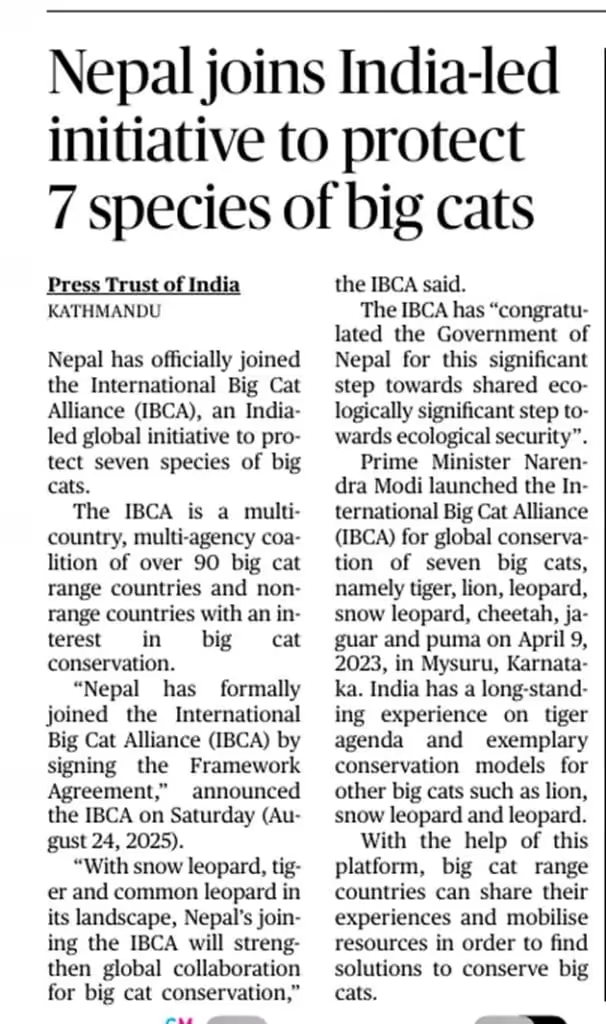
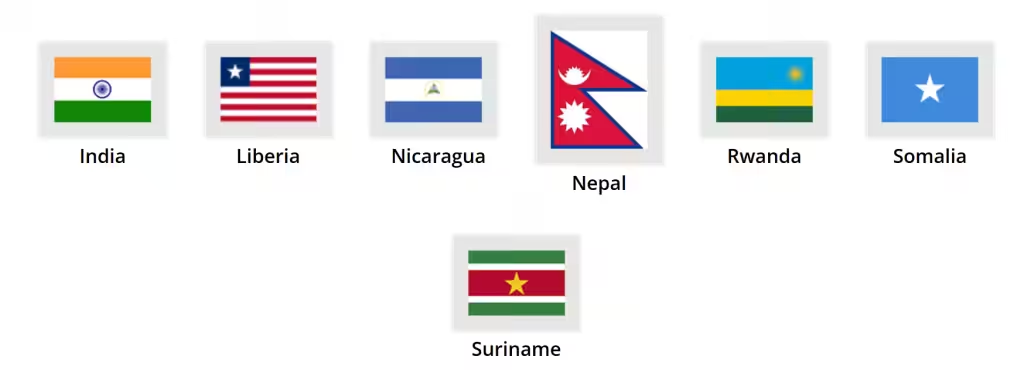
Nepal has officially joined the International Big Cat Alliance (IBCA) — a global conservation initiative launched by India to protect seven species of big cats.
UPSC Relevance:
UPSC CSE in prelims examination has focused on Species in news. Every year UPSC had asked at least one question related to species. A case in point is a following PYQ.
UPSC Prelims PYQ 2024:
Q. Consider the following statements:
Lions do not have a particular breeding season.
Unlike most other big cats, cheetahs do not roar.
Unlike male lions, male leopards do not proclaim their territory by scent marking.
Which of the statements given above are correct?
(a) 1 and 2 only (b) 2 and 3 only (c) 1 and 3 only (d) 1, 2 and 3
About IBCA:
Prime Minister Narendra Modi announced the IBCA in 2023 in Mysuru, commemorating the 50th anniversary of Project Tiger.
The Indian government established the IBCA through the National Tiger Conservation Authority, under the Ministry of Environment, Forest and Climate Change, in March 2024.
Its mandate is the conservation of seven big cats – the Tiger, Lion, Leopard, Snow Leopard, Cheetah, Jaguar and Puma.
Its mandate is the conservation of seven big cats – the Tiger, Lion, Leopard, Snow Leopard, Cheetah, Jaguar and Puma.
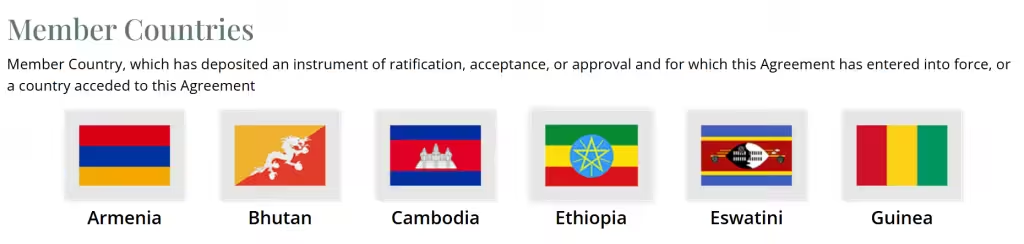
There are 95 range countries (falling within the natural distribution of a species) for the big cats, including Canada, China, Congo, Ghana, Brazil, Iran, Nepal, Pakistan, Russia and the United States.Twenty-Eight countries have consented to be members of the IBCA, as of now, including Bangladesh, Nigeria, Egypt, Suriname, Ecuador, Peru, Kenya and Rwanda.
All UN member countries can become members after the framework agreement is signed and conveyed through a Note Verbale, a method of formal diplomatic communication.
Even Non-range countries become member of IBCA that are interested in supporting global conservation of big cats.
India has employed and is in the process of acquiring advanced decoy systems across its military branches to enhance its defensive capabilities especially after successful performance of decoys in Operation Sindoor.
UPSC Relevance
Questions have been repeatedly asked in UPSC Prelims about Defense technologies.
PYQ
2025
With reference to Unmanned Aerial Vehicles (UAVs), consider the following statements:
I. All types of UAVs can do vertical landing.
II. All types of UAVs can do automated hovering.
III.All types of UAVs can use batteries only as a source of power supply.
How many of the statements given above are correct?
(a) Only one
(b) Only two
(c) All the three
(d) None
What is a Decoy in Warfare?
In contemporary warfare, a decoy is a form of military deception designed to confuse, mislead, or overwhelm an enemy’s sensors and targeting systems. The primary purpose of decoys is to create doubt, causing the enemy to waste valuable munitions on false targets and buying crucial time for real assets to evade or retaliate. By doing so, decoys transform deception into a strategic asset.
Early and Physical Decoys – Historically, militaries have used decoys to achieve surprise and conceal their true intentions. A notable example is the Soviet Union’s use of maskirovka (camouflage and deception) during World War II.
Modern Land-Based Decoys – Today, decoys on the ground are more advanced, designed to fool modern intelligence, surveillance, and reconnaissance (ISR) assets like drones.
Air and Naval Decoys – Modern aerial and naval decoys are often electronic, using technology to mimic a target’s signature on radar or other sensors.
Air-Based Decoys: Operation Sindoor and the X-Guard FOTD
Operation Sindoor: During this operation, the Indian Air Force (IAF) is believed to have deployed the Israeli-developedX-Guard Fibre-Optic Towed Decoy (FOTD) system on its Rafale fighters.
Physical Characteristics: The X-Guard FOTD is a lightweight (30 kg), retractable, and reusable system. It is generally towed behind the aircraft hence the name.
Replication of Signatures: The core function of the decoy is to mimic the target aircraft’s signatures. This includes:
Radar Cross-Section (RCS): It replicates the size and shape of the aircraft as seen by enemy radar.
Doppler Velocity: It matches the speed of the host aircraft.
Spectral Signature: It mimics the specific electromagnetic emissions across multiple radar bands.
Electronic Countermeasures (ECM): The system can also replicate the Rafale’s onboard electronic countermeasures, creating a more convincing false target for enemy tracking systems.
Seamless Integration: The X-Guard’s 360-degree jamming signal capability integrates seamlessly with the Rafale’s SPECTRA EW suite.
Multi-Layered Defense: The combined system creates a multi-tiered defensive shield. SPECTRA detects threats and provides onboard protection, while the X-Guard adds an expendable, following layer of deception, attracting radar-guided missiles away from the main aircraft.
Reported Success: Analysts believe that during the operation, the Pakistan Air Force’s (PAF) J-10C fighters, armed with PL-15E missiles, were unable to differentiate between the decoys and the real aircraft. Several missiles reportedly locked onto the X-Guards, leading to premature claims of shootdowns by PAF pilots.
Future Acquisition: Following this reported success, the IAF is fast-tracking the acquisition of additional X-Guard units via emergency procurement.
Comparable systems :Leonardo UL’s BriteCloud, deployed on Eurofighter Typhoons, Sweden’s Gripen-Es, and certain F-16 variants; and the AN/ALE-50/55 series from Raytheon/BAE Systems used on the F/A-18E/F Super Hornet.
Land-Based Decoys: The Indian Army’s Strategy
Request for Information (RFI): In April 2025, the Indian Army issued an RFI to domestic vendors for physical decoys of its Russian-origin T-90S/SK main battle tanks.
Sophisticated Simulation: The decoys are not just intended to replicate the dimensions of the tanks but also their thermal and acoustic signatures to deceive enemy drones and munitions.
Strategic Importance: This move highlights the army’s recognition of the growing threat from modern battlefield intelligence, surveillance, and reconnaissance (ISR) assets, such as drones and loitering munitions. The decoys are intended to bait enemy strikes and conserve actual assets.
Russia’s Inflatech decoys can simulate entire armoured formations within minutes. Ukraine has deployed wooden and 3D-printed fakes to exhaust Russian drone and missile stocks. The U.S. Army too has trialled decoy vehicles to fool top-attack weapons like Javelin anti-tank guided missiles. China has also invested in camouflage and deception technologies across its ground forces.
Naval Decoys
Navies too employ a layered suite of countermeasures, ranging from floating chaff and acoustic decoys to offboard active deception systems, to protect warships from missile and submarine threats.
Among the most effective is the self-propelled Nulka active missile decoy, jointly developed byAustralia and the U.S., that operates independently of its launch platform and mimics the radar signature of a much larger vessel, drawing radar-guided missiles away from their real target.
The INS Karanj submarine is equipped with a state-of-the-art torpedo decoy system – Maareech Advanced Torpedo Decoy System (ATDS) designed by DRDO.
Several firms have started accepting crypto payments. Millions of people, including in India, are in-vesting in crypto coins. Moreover, Hong Kong is taking a decisive step forward in regulating certain types of cryptocurrencies, by enforcing the Stablecoins Ordinance.
UPSC relevance: GS3, Prelims
PYQ :
Prelims 2016
With reference to ‘Bitcoins’, sometimes seen in the news, which of the following statements is/are correct?
Bitcoins are tracked by the Central Banks of the countries.
Anyone with a Bitcoin address can send and receive Bitcoins from anyone else with a Bitcoin address.
Online payments can be sent without either side knowing the identity of the other.
Select the correct answer using the code given below:
a) 1 and 2 only
b) 2 and 3 only
c) 3 only
d) 1, 2 and 3
Answer: D
Prelims 2024
Consider the following statements in respect of the digital rupee:
It is a sovereign currency issued by the Reserve Bank of India (RBI) in alignment with its monetary policy.
It appears as a liability on the RBI’s balance sheet.
It is insured against inflation by its very design.
It is freely convertible against commercial bank money and cash.
Which of the statements given above are correct?
a) 1 and 2 only
b) 1 and 3 only
c) 2 and 4 only
d) 1, 2 and 4
Answer: D
Cryptocurrencies
Cryptocurrency, often called “crypto,” is a form of digital money that uses cryptography for security. Its name is derived from the Greek word “kryptos,” meaning “hidden” or “secret,” which reflects the use of encryption to secure transactions and conceal the identities of users.
Key Characteristics of Cryptocurrency
Digital: Cryptocurrencies are not physical coins you can see or touch.
Decentralized: They are not controlled by any single institution, such as a central bank or government. Instead, they operate on a decentralized network of computers called nodes.
No intrinsic value : It is not backed by any commodity or valuable item that can be redeemed and has no inherent value of its own.
Cryptography: Transactions are secured through multiple layers of encryption, algorithms, and codes.
Transaction Process: Transactions happen without the need for a bank. Nodes on the network verify and record each transaction, ensuring transparency and security.
Understanding Blockchain
Blockchain is the digital ledger that records all cryptocurrency transactions. You can think of it as a combination of a traditional accountant’s notebook and a globally shared Google Sheet.
Blocks as Pages: In a blockchain, each “page” of transactions is called a block.
Chaining Blocks: Once a block is full of transactions, it’s permanently sealed with a timestamp and linked to the next block using a unique code called a hash. This process creates a continuous, chronological chain of blocks, which is why it’s called a blockchain.
Immutability: Once a block is sealed and added to the chain, its entries cannot be altered or erased. The transaction history is recorded forever, ensuring data integrity.
Transparency: Unlike a traditional ledger, which is only accessible to a few people, a blockchain is like a shared Google Sheet. Everyone in the network has access to it and can view the entries, but they can’t delete or tamper with past records.
How a Blockchain Transaction Works?
Transaction Creation: When someone sends crypto to another person (e.g., Ram sends a coin to Shyam), this transaction is added to a new, unsealed block.
Block Filling: More transactions are added to this block until it’s full.
Sealing the Block: Once full, the block is sealed and linked to the previous block in the chain using a unique hash code.
Network-wide Visibility: Every time a new transaction is made, everyone in the decentralized network can see the updated record. This shared visibility ensures transparency, security, and trust without the need for a central authority or intermediary.
Crypto mining
Crypto mining is the process of validating and adding new transactions to a blockchain ledger. It’s how new coins are released into circulation and how the network is secured.
Crypto mining is a “Proof-of-Work” (PoW) system, where miners compete to solve a complex mathematical puzzle.
This requires a significant amount of computing power and electricity.
The first miner to find the correct solution is rewarded.
Proof-of-Stake (PoS) on the other hand, secures the network by requiring participants to stake a certain amount of cryptocurrency as collateral. It’s a “capital-based” system rather than an “energy-based” one and is thus more energy efficient.
Stablecoins
Stablecoins are a class of cryptocurrencies, with their values linked to assets.
Unlike normal cryptocurrencies, whose values can wildly rise and fall due to investor sentiments and other factors, stablecoins are designed to maintain relatively steady prices. Hence, their name.
This stability is achieved through the process of “pegging” the stablecoin to an asset such as fiat currency (like U.S. Dollars, EU Euros, Hong Kong Dollars, etc.), a commodity (like gold), other cryptocurrencies (such as Bitcoin), by regulating their value via computer algorithms, or by mixing multiple strategies. While the price of Bitcoin might rise or fall in the coming years, a USD-pegged stablecoin should ideally remain around $1.
Stablecoins can also exhibit volatility. In response to both technical factors and world events, stablecoins sometimes come unpegged and their prices may rise or fall beyond the usual range, with sudden drops triggering panic amongst investors. Stablecoins have also collapsed entirely.
Example – In May 2022, Terra’s cryptocurrency LUNA and its linked algorithmic stablecoin UST both lost most of their value in a matter of hours. Panicking investors who no longer trusted these assets quickly sold them off to minimise losses, and the prices fell close to zero.
Virtual Digital Assets
Virtual digital assets (VDAs) are broadly defined as any information, code, or token generated through cryptographic or other means, which can be used as a store of value or unit of account, and can be transferred, stored, or traded electronically.
Includes cryptos and non fungible tokens.
Excludes CBDC or Digital Rupee.
Non-fungible tokens (NFTs)
Non-fungible tokens (NFTs) are assets like artworks, digital content, or videos that have been tokenized via a blockchain.
NFTs cannot be replicated, divided or replaced. Cryptocurrencies are fungible, or interchangeable. While there’s no significant difference between one bitcoin and another, no two NFTs are identical.
NFTs can represent digital collectibles or real-world items like artwork, real estate, individuals’ identities, property rights, and more.
“Tokenizing” these real-world tangible assets makes buying, selling, and trading them more efficient and makes counterfeiting more difficult.
Difference between Crypto, CBDC and Stablecoin
Feature
Cryptocurrency (e.g., Bitcoin, Ethereum)
Central Bank Digital Currency (CBDC)
Stablecoins (e.g., Tether, USDC)
Issuer
Decentralized; not issued by any government or central bank.
Central bank of a country.
Private companies or entities.
Regulation & Control
Largely unregulated and decentralized. No central authority controls the network or supply.
Centralized and fully regulated by the issuing government/central bank.
Privately issued but subject to increasing government oversight and regulation.
Value & Volatility
Highly volatile; value is determined by market supply and demand. Not backed by any asset.
Stable; its value is pegged 1:1 to the country’s fiat currency or other valuable assets.
Designed to be stable; value is typically pegged to a fiat currency (e.g., USD) or other assets. Stability depends on the effectiveness of its backing.
Purpose
Often used for speculation, investment, and as a store of value. Also functions as a decentralized medium of exchange.
A digital form of a country’s fiat currency, intended for everyday transactions and payments. Aims to complement the existing financial system.
Serves as a bridge between the volatile cryptocurrency market and traditional fiat currencies, often used for trading and cross-border payments.
Technology
Typically built on public, permissionless blockchain technology.
Can be built using blockchain or distributed ledger technology, but often on a private, permissioned system controlled by the central bank.
Built on various blockchain technologies.
Liability
No central liability. Users are not protected from price volatility or firm collapses.
A direct liability of the central bank, just like physical cash. It is considered a safer form of digital money than commercial bank-issued digital money.
A liability of the private issuer. The level of protection for users depends on the issuer’s reserves and regulatory framework.
Privacy
Transactions can be pseudonymous, but all are recorded on a public ledger.
Privacy features vary by design. Authorities may have a degree of access to monitor for financial crimes.
Privacy varies depending on the specific stablecoin and the underlying blockchain.
Status of Crypto currencies in India:
Not legal tender: In India, cryptocurrencies or virtual digital assets are not recognized as legal tender unlike CBDC.
Legal to own and trade: Buying, selling, mining, and holding crypto or any virtual digital asset is legal.
Union Budget 2022 has also clarified on following points :
The government officially categorised digital assets, including crypto assets, as “Virtual Digital Assets”.
Income from the transfer of virtual digital assets such as crypto and NFTs will be considered capital gain and taxed at 30%.
No deduction, except the cost of acquisition, will be allowed while reporting income from the transfer of digital assets.
Loss from digital assets cannot be set off or carried forward of loss against any other income.
Losses incurred from one virtual digital currencycannot be set off against income from another digital currency.
Gifting digital assets will attract tax in the receiver’s hands.
From 1 July 2022, 1% TDS will apply to all sell transactions of Virtual Digital Assets (VDAs), including cryptocurrencies and NFTs.
Prevention of Money Laundering Act (PMLA): In 2023, the Ministry of Finance brought cryptocurrency-related businesses under the purview of the Prevention of Money Laundering Act (PMLA). This requires Virtual Asset Service Providers (VASPs) and exchanges to:
Comply with KYC norms: Perform “Know Your Customer” (KYC) procedures for all users.
Maintain Records: Keep transaction records for a period of at least five years.
Report Suspicious Activity: Report suspicious transactions to the Financial Intelligence Unit – India (FIU-IND).
A new study by an international team of researchers has said damage from non-native plants and animals expanding into new ecosystems has cost society more than $2.2 trillion worldwide.
UPSC Relevance:
GS 3, Conservation, Environmental Pollution and Degradation, Environmental Impact Assessment
Questions have been asked on various environmental threats.
PYQ:
2024
Industrial pollution of river water is a significant environmental issue in India. Discuss the various mitigation measures to deal with this problem and also the government’s initiatives in this regard.
2022
Explain the causes and effects of coastal erosion in India. What are the available coastal management techniques for combating the hazard?
Invasive Species
Invasive Alien Species – An invasive alien species refers to an alien species whose introduction and/or spread threatens the biological diversity of the region/habitat (CBD, 2002).
Following framework has been laid down by Government of India to identify and invasive alien species :
Drivers of Invasion: Invasive species, such as Japanese knotweed and common lantana, primarily spread to new ecosystems through trade and travel, which are facilitated by globalization and bilateral agreements.
Threat to biodiversity as the invasive species reduce the chances of survival of other species in the ecosystem by modifying their habitats at times. This has a cascading effect as the species dependent on vulnerable species are also impacted.
Ludwigia peruviana, a fast-growing invasive aquatic weed, threatens elephants by destroying their food sources and displacing them from their natural habitats, leading to potential conflict with humans.
Affects food security as agricultural production and soil fertility is affected.
Invasive parthenium weed outcompetes crops by consuming water and nutrients, and by releasing allelopathic chemicals that inhibit crop growth, directly impacting agricultural output and food security and calling for more weedicides.
Affects the livelihood of communities due to change in landscape.
Prosopis juliflora has negatively impacted the Maldhari tribe by degrading native Banni grasslands essential for their traditional cattle and buffalo rearing, but it has also provided new income opportunities through the sale of fuelwood and charcoal, particularly during droughts.
Maldharis are caught between the need for ecological sustainability and the economic necessity of utilizing this invasive species for survival.
Impacts Hydrology of the region by affecting water table and quality of water.
Eucalyptus trees can impact water tables by significantly increasing water consumption through high transpiration rates, leading to decreased groundwater recharge and lowered water levels.
Spread diseases by acting as a reservoir and vector for pathogens.
The invasive Asian ladybug Harmonia axyridis carries the microsporidia Nosema fungi, which can infect and kill native ladybugs.
Forest Fires and risk of other disasters may increase.
A large portion of Bandipur National Park is covered by the lantana weed, which is highly combustible when dry.
Economic Impact – cost of eliminating them from ecosystem and management to avoid their harmful impacts.
This recent study highlighted in the article has found out Japanese knotweed (Reynoutria japonica) and common lantana (Lantana camara) to be among the costliest to manage per square kilometre.
Economic Impact of Invasive Species – highlighted in article.
Global Costs: A new study, published in Nature Ecology & Evolution and based on the InvaCost database, estimates that non-native plants and animals have cost the world more than $2.2 trillion since 1960. This figure is 16 times higher than previous estimates.
Costliest Invaders:
Plants are the most economically impactful group, costing $926.38 billion between 1960 and 2022.
Arthropods are the second costliest, at $830.29 billion.
Mammals follow with costs of $263.35 billion.
Geographical Discrepancies:
Europe has the highest total economic impact at $1.5 trillion, which is 71.45% of the global cost. Researchers speculate this is due to the higher value of goods and management costs in the region.
North America is second with $226 billion, followed by Asia ($182 billion), Africa ($127 billion), and Australia and Oceania ($27 billion).
Unreported Costs and India’s Situation
Underreported Management Costs: The study found a significant global discrepancy between the actual and reported costs of managing invasive species, with a median discrepancy of 3,241% among assessed countries.
India’s “Hidden” Costs:
India had the highest percentage discrepancy in management expenditure at 1.16 billion percent.
This suggests a substantial amount of spending on invasive species management in India has been unrecorded or underreported.
Researchers note this gap could be due to India’s limited resources or a recording bias in the InvaCost database, which may overlook reports in certain languages.
According to S. Sandilyan, a former fellow on Invasive Alien Species, India is “falling short in documenting, reporting, and strategically funding” management efforts, which is made worse by a lack of centralized data and inter-agency coordination.
Management Strategies and Policies
Control Measures: Management strategies for invasive species include prevention, eradication, control or suppression, biologically , chemically and mechanically and efforts to slow their spread. However,experts caution against a simple blanket eradication, as many agricultural products that are essential to global food systems are not native to the regions where they are grown.
Dedicated Biosecurity Infrastructure : Scanning and regulation of trade and movement of organisms on ports, airports etc.
Early Warning System must be developed to identify and respond to new sightings of invasive alien species.
Creating a legal framework to hold people and organisations accountable for the impacts caused by these species.
Creating awareness and promoting Research in invasive species across sectors.
International Efforts: Several international policies are in place to address the issue:
The Ballast Water Management Convention helps prevent the spread of harmful aquatic organisms via ships’ ballast water.
The Convention on Biological Diversity urges member nations to prevent, control, or eradicate alien species that threaten ecosystems.
Reconciling Goals: There is a complex challenge in balancing the need to mitigate economic losses from invasive species with the desire to foster globalization. According to researchers, efforts must simultaneously be made to curtail the spread of invaders while addressing other global issues like climate change by increasing vegetation.