
Opens in a new tab
Join Anantam IAS Channel on Telegram

Daily Digest · Monday

27 April 2026 Current Affairs for UPSC

4 current affairs published on Monday, 27 April 2026

27 April 2026 Current Affairs for UPSC — every Why-in-News article AnantamIAS published on Monday, 27 April 2026, broken down with Why in News?, the exact GS paper it feeds, sub-topic mapping, MCQ-ready facts and a UPSC-style practice question. 4 articles in total, covering Polity, Economy, Environment, S&T, IR, Geography, History, Society and Internal Security — the same Why-in-News + GS-paper-mapping + practice-question format the Compass uses across every daily digest on the site.

Daily current affairs for UPSC is where new material enters your prep stream. Read this 27 April 2026 digest end-to-end in 25–35 minutes, attempt the practice question at the foot of each article (it's MCQ for some, 10/15-marker for others), then bookmark the entries that fall inside your active revision window. Everything stays cross-linked: tap any subject pill to jump to that subject's hub, or use the table of contents above to skip straight to a specific story.

Use this page three ways. Read sequentially for a one-sitting scan of everything that mattered on 27 April 2026. Download the 27 April 2026 PDF below for offline study or print revision. Or use the April 2026 Current Affairs compilation to see this day in the month's full context. For the previous day's reading, see 26 April 2026 Current Affairs; the next day's is 28 April 2026 Current Affairs.

Why we publish daily current affairs separately from the monthly compilation: daily is learning, monthly is revision. Use the daily page to add fresh material to your notes the day it breaks; come back to the April 2026 compilation 60 days before Prelims when the noise has settled and only the lasting takeaway is worth re-reading.

Bengal SIR: Told Tribunals are ‘not functioning’, Supreme Court seeks report from Calcutta HC Chief Justice

Open article →Download PDF

Why in News?

The Supreme Court has sought a report from the Chief Justice of the Calcutta High Court regarding the functioning of Appellate Tribunals handling disputes arising out of the Special Intensive Revision (SIR) of electoral rolls in West Bengal.

UPSC Relevance

GS-II: Elections, Electoral Reforms, Judiciary, Representation of People, Constitutional Principles, SIR

Background: Electoral Roll Revision and SIR

Electoral rolls form the backbone of democratic participation. Periodic revision is undertaken to:

  • Include newly eligible voters
  • Remove ineligible or duplicate entries

A Special Intensive Revision (SIR) is a more exhaustive exercise, often conducted before major elections, where the entire roll is re-verified.

However, given the scale of such exercises in a country like India, errors of inclusion and exclusion are almost inevitable, which makes grievance redressal mechanisms crucial.

Institutional Mechanism: Role of Appellate Tribunals

To address disputes arising from revision:

  • Appellate Tribunals act as quasi-judicial bodies
  • They hear appeals of individuals:
    • Wrongfully excluded
    • Objecting to wrongful inclusion

These bodies are essential because the right to vote, though statutory, is central to democratic participation, and denial without proper hearing undermines electoral legitimacy.

Role of the Supreme Court: Ensuring Electoral Fairness

The Supreme Court stepped in primarily to ensure that the process remains fair, accessible, and constitutionally compliant.

Use of Article 142

The Court invoked Article 142, which allows it to pass orders necessary for “complete justice”.

  • It permitted individuals cleared by Tribunals to vote
  • Their names could be added through supplementary electoral rolls

This reflects a pragmatic approach—balancing:

  • Timely elections
  • Inclusion of eligible voters

Clarification on Voting Rights

The Court clearly distinguished between:

  • Pending appeals → No automatic right to vote
  • Successful appeals → Eligible for inclusion

This ensures that the process is not misused while still protecting genuine voters.

What are the Key Issues and Concerns?

1. Effectiveness of Appellate Tribunals

The credibility of the entire revision process depends on how effectively Tribunals function.

If these bodies are:

  • Inaccessible
  • Procedurally restrictive
  • Unable to dispose of cases in time

then the consequence is not merely administrative inefficiency, but denial of voting rights in a time-bound electoral process.

In elections, delay is not neutral — it effectively becomes disenfranchisement.

2. Scale of Errors: A Structural Concern

The fact that over 34 lakh appeals have been filed is significant.

This indicates:

  • The issue is not limited to isolated mistakes
  • There may be systemic gaps in enumeration, verification, or data handling

Such large-scale disputes can:

  • Overburden adjudicatory mechanisms
  • Reduce public confidence in electoral rolls

3. Balancing Inclusion and Electoral Integrity

Electoral systems must strike a delicate balance:

  • Over-inclusion risks allowing ineligible voters
  • Over-exclusion denies legitimate citizens their rights

Issues like bulk applications (e.g., through Form 6) highlight the challenge of maintaining:

  • Accuracy
  • Transparency
  • Timely verification

4. Administrative Capacity vs Electoral Timelines

Elections operate on strict timelines, whereas:

  • Verification processes
  • Appeals and hearings

require time and institutional capacity.

When large-scale revisions are conducted close to elections, it creates pressure on institutions, increasing the risk of errors and incomplete adjudication.

Whar are the Broader Constitutional Principles Involved?

This issue goes beyond procedural lapses and touches core democratic values:

  • Free and fair elections (basic structure doctrine)
  • Rule of law (decisions based on due process)
  • Natural justice (right to be heard)
  • Judicial review (courts as guardians of fairness)

Way Forward:

Strengthening Tribunal Capacity

Appellate Tribunals must be adequately staffed and accessible, with both physical and digital modes of hearing. Time-bound disposal of cases is essential so that eligible voters are not excluded due to delays.

Improving Electoral Roll Management

Instead of relying heavily on last-minute revisions, there should be continuous updation of electoral rolls using technology, Aadhaar-based verification (with safeguards), and field-level checks. This reduces large-scale disputes during elections.

Ensuring Transparency in Inclusion/Deletion

Clear and publicly accessible procedures for:

  • Inclusion (Form 6)
  • Deletion
  • Objections

will enhance trust and reduce litigation. Transparency is key to electoral legitimacy.

Better Synchronisation with Election Cycle

Major revision exercises like SIR should ideally be conducted well before election schedules, allowing sufficient time for appeals and corrections without affecting electoral timelines.

Role of Judiciary as a Corrective, Not Routine Mechanism

While judicial intervention is essential in exceptional cases, over-reliance on courts indicates administrative weakness. Strengthening institutions at the ground level is the long-term solution.

Conclusion

The episode highlights that accurate electoral rolls and effective grievance redressal are as important as the act of voting itself. In a large and complex democracy like India, ensuring both inclusiveness and integrity of electoral processes requires strong institutions, robust procedures, and timely intervention where necessary. Strengthening these mechanisms is crucial to uphold the constitutional mandate of free and fair elections.

Practice Questions

  1. Discuss the challenges associated with electoral roll revision in India. How can institutional mechanisms be strengthened to address them?
  2. Examine the role of quasi-judicial bodies in ensuring fairness in electoral processes.
  3. “Judicial intervention ensures fairness but cannot substitute administrative efficiency.” Analyse in the context of electoral governance.
Right to Safe Travel on Highways is part of Article 21: SC

Open article →Download PDF

Why in News?

The Supreme Court of India has ruled that the Right to Safe Travel on National Highways is integral to the Fundamental Right to Life (Article 21). The Court has issued a series of nationwide directions to strengthen highway safety. 

UPSC Relevance: GS-2 Polity and Governance: Fundamental Rights 

Prelims: Right to Safe Travel on Highways; Key facts about Article 21.
Mains: Expanding horizons of the right to life and personal liberty.

Right to Safe Travel on Highways is part of Article 21: 

Key Aspects of the landmark ruling: 

  • Expanding the scope of Article 21, the bench clarified that:
    • Right to Life is not merely a negative guarantee against unlawful deprivation of life but imposes a positive mandate upon the State to ensure a safe environment where human life is preserved and valued. 
    • The safety of the commuter is an integral facet of the Right to Live with Dignity, and hence, the State must take proactive steps to eliminate risks that endanger road users. 
  • The ruling highlights that accidents caused by illegal parking, improper design, and preventable hazards reflect a failure of the State’s constitutional obligation to protect life. 

Key Directions issued by the Supreme Court: 

SC issued a series of nationwide directions aimed at strengthening highway safety mechanisms: 

  • Regulation of Roadside Commercial Activities: 
    • Prohibition on unauthorised construction or operation of dhabas, eateries, and commercial establishments within the Right of Way (ROW) of national highways.
    • Licensing authorities must not grant or renew licences/NOCs for such establishments without prior clearance from NHAI/PWD. Existing licences in violation must be reviewed within 30 days.
  • Parking and Traffic Discipline: No heavy/commercial vehicle shall park/stop on any national highway carriageway or paved shoulder, except at a designated bay, lay-bye, or wayside amenity.
  • Institutional Enforcement Mechanism: District Magistrates (DMs) are designated as the nodal enforcement authority. Directions include:
    • Removal/demolition of unauthorised structures within a specified period (60 days), under the Control of National Highways (Land and Traffic) Act, 2002.
    • Constitution of a District Highway Safety Task Force comprising: District administration, Police, NHAI / highway authority, PWD and Local bodies. 
  • Technology-driven Enforcement: Enforcement through the use of Advanced Traffic Management System (ATMS) real-time alerts to State Police, GPS-timestamped photographic evidence, and integrated e-Challan generation. 
  • Compliance and Monitoring: Ministry of Road Transport and Highways (MoRTH) to compile data from states and agencies and submit a compliance report to the SC within a fixed timeline (75 days). 

National Highways represent only 2% of India’s road network, but they account for roughly 30% of all road fatalities. Constitutional governance requires more than reactive measures after accidents occur; it demands anticipatory action to remove known dangers from public infrastructure.

Article 21: Right to Life and Personal Liberty:

  • Article 21 (Protection of life and personal liberty): No person shall be deprived of his life or personal liberty, except according to procedure established by law. This protection applies to any person within India, including non-citizens, tourists, and immigrants. 

Interpretation of Right to Life and Personal Liberty:

  • Narrow Interpretation: In A.K. Gopalan v. State of Madras (1950):
    • The SC held that “personal liberty” meant only freedom from physical detention or imprisonment. Fundamental Rights (FR) were seen as isolated compartments, i.e., each FR in Part III operated independently of the others.
    • The procedure established by law was interpreted literally. Any law enacted by the legislature, even if arbitrary, was considered valid. 
  • Landmark Shift: Maneka Gandhi v. Union of India (1978):
    • Established that Fundamental Rights (Article 14, 19, and 21 → Golden Triangle doctrine) are interconnected, not mutually exclusive.
    • Expanded the meaning of personal liberty beyond mere physical restraint.
    • Introduced the concept of “just, fair and reasonable” procedure. Substantive due process was introduced in India. 

Expansion of Rights under Article 21: Living Constitution in Action

Post-Maneka Gandhi case, the SC treated the Constitution as a living document responsive to the evolving needs of human dignity. The following rights were progressively recognised:

Landmark Rulings Expansion of Rights under Article 21
Right to Livelihood: Olga Tellis v. Bombay Municipal Corp. (1985) Eviction of pavement dwellers without due process violates Article 21, as livelihood is inseparable from life.
Right to Health and Medical Care: Paschim Banga Khet Mazdoor Samity (1996)The State must provide adequate medical facilities; denial of emergency treatment violates Article 21.
Right to Education: Mohini Jain v. State of Karnataka (1992)Right to life under Article 21 includes the right to education, as education is essential for human dignity.

Later codified by the 86th Amendment (Article 21-A).
Right to Clean Environment: Subhash Kumar v. State of Bihar (1991)Right to life includes the right to live in a pollution-free environment. 
Right to Privacy: K.S. Puttaswamy v. Union of India (2017)Privacy is a fundamental right intrinsic to life and personal liberty.
Right to Speedy Trial: Hussainara Khatoon v. State of Bihar (1979)Prolonged undertrial imprisonment violates the right to personal liberty; speedy trial is a constitutional mandate.
Right to Die with Dignity: Common Cause v. Union of India (2018)Passive euthanasia and advance medical directives recognised; right to a dignified death is part of Article 21.

    UPSC Mains PYQ 2021 

    Q. “The Constitution of India is a living instrument with capabilities of enormous dynamism. It is a constitution made for a progressive society.” Illustrate with special reference to the expanding horizons of the right to life and personal liberty.

    UPSC PYQ 2018

    Q. Right to Privacy is protected as an intrinsic part of Right to Life and Personal Liberty. Which of the following in the Constitution of India correctly and appropriately imply the above statement?

    (a) Article 14 and the provisions under the 42nd Amendment to the Constitution

    (b) Article 17 and the Directive Principles of State Policy in Part IV

    (c) Article 21 and the freedoms guaranteed in Part III        

    (d) Article 24 and the provisions under the 44th Amendment to the Constitution

    Answer: (c) 

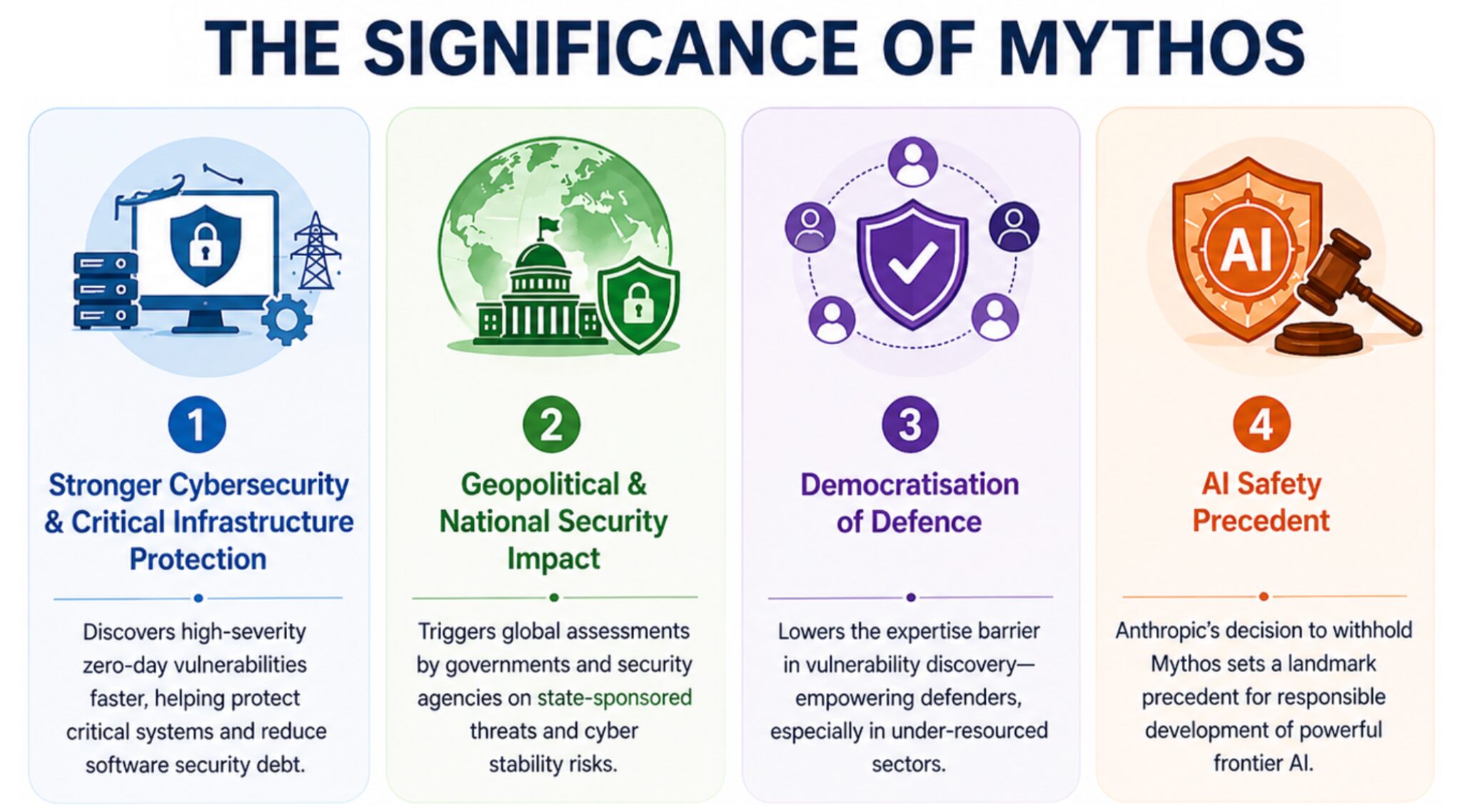
    What is Anthropic’s Mythos?

    Open article →Download PDF

    Why in News?

    Recently, Anthropic has announced that its most capable AI model to date, “Claude Mythos Preview”, would not be made publicly available. 

    UPSC Relevance: GS-3 Science and Technology: Artificial Intelligence; GS-3 Internal Security: Cybersecurity

    Prelims: Anthropic’s Mythos; Project Glasswing.  
    Mains: New Emerging Threats associated with Artificial Intelligence. 

    What is Anthropic’s Mythos?

    • Mythos (formally ‘Claude Mythos Preview’) is a general-purpose AI Model with exceptional cybersecurity capabilities. 
    • Developed by: Anthropic (San Francisco, USA) 
    • Mythos is the first AI model trained on next-generation Graphics Processing Units (GPUs).

    The AI-based system has demonstrated extraordinary capabilities in software code analysis, reasoning, and vulnerability exploitation. 

    How does Mythos work?

    • Vulnerability discovery: Mythos analyses software codebases to detect ‘zero-day vulnerabilities’ (previously unknown bugs). E.g., identified a 27-year-old bug in OpenBSD. 
    • Autonomous Exploit Construction: Once a flaw is identified, it can help generate possible exploit methods, i.e., ways the vulnerability could be used to compromise the system.
    • Exploit Chaining: It can combine multiple vulnerabilities to simulate more complex attack paths, helping researchers understand how small vulnerabilities can lead to major breaches.

    What is Project Glasswing?

    Anthropic launched Project Glasswing as the primary framework for deploying Mythos responsibly. 

    • Project Glasswing is a defensive cybersecurity initiative that provides access to Mythos to only a select group of partners. 
    • Aim: 
      • Defensive Cybersecurity: Enable partner organisations to use Mythos to scan their software systems and infrastructure for zero-day vulnerabilities. It aims to secure critical infrastructure before malicious actors can exploit it.
      • Demonstrate Responsible AI Deployment rather than being released publicly at risk of misuse.

    Challenges Associated with Mythos: 

    • Dual-Use Dilemma: Mythos can be used in both defence and offence. It can enable attackers to exploit vulnerabilities in critical infrastructure.
    • Proliferation Risk: Capabilities similar to Mythos are unlikely to remain limited to a single company. Other AI firms and even malicious actors will race to develop such capabilities. Mythos could be used to aid cyberattacks such as ransomware, deepfakes, and automated attacks.
    • Patching Asymmetry: Mythos can find more vulnerabilities than defenders can deal with (It is generally faster to find and exploit vulnerabilities than to fix them). Small Enterprises and under-resourced public agencies are particularly vulnerable.
    • Governance Vacuum: There is no international treaty or binding framework governing the development or deployment of offensive-capable AI models, or regulating dual-use AI systems.
    • Transparency: Only limited information has been publicly disclosed about the vulnerabilities identified by Mythos. Questions arise whether such disclosures are fully driven by safety concerns or influenced by commercial interests.

    UPSC Mains PYQ 2023

    Q. Introduce the concept of Artificial Intelligence (AI). How does Al help clinical diagnosis? Do you perceive any threat to the privacy of the individual in the use of AI in healthcare? 

    Basavanna and the Lingayat Movement: Social Reform and Ethical Philosophy

    Open article →Download PDF

    Why in News?

    Basava Jayanti, commemorating the birth anniversary of Basavanna, was celebrated across Karnataka, highlighting his contributions to social reform, equality, and ethical governance.

    UPSC Relevance

    GS-I: Medieval Indian History, Bhakti Movement, Social Reform Movements
    GS-IV: Ethics (Equality, Integrity, Work Culture)

    Who was Basavanna?

    • A 12th-century philosopher, statesman, and social reformer.
    • Served as a minister in the court of King Bijjala II (Kalachuri dynasty).
    • Founder of the Lingayat (Veerashaiva) movement.

    His movement is often described as a “social revolution (Kalyana Kranti)” in medieval India.

    Core Philosophy of Basavanna

    1. Equality and Anti-Caste Ideology

    Basavanna strongly opposed:

    • Caste hierarchy
    • Untouchability

    He advocated a society based on equality and dignity of labour, rejecting birth-based discrimination.

    2. Kayaka and Dasoha (Ethical Economic Ideas)

    • Kayaka (Work as Worship):
      Every individual must engage in productive work; dignity lies in labour, not status.
    • Dasoha (Sharing of Wealth):
      Surplus wealth should be shared with society, promoting social justice and redistribution.

    These ideas have strong relevance to inclusive growth and ethical economics.

    3. Rejection of Ritualism

    • Opposed elaborate rituals, priesthood dominance, and temple-based hierarchy.
    • Promoted direct personal devotion to God (Ishtalinga).

    This aligns with the broader Bhakti movement’s emphasis on personal spirituality.

    4. Anubhava Mantapa: Early Democratic Space

    • Established a spiritual-discursive forum called Anubhava Mantapa.
    • It functioned like an open assembly, where people from all backgrounds:
      • Discussed philosophy
      • Questioned social norms

    Often described as one of the earliest forms of participatory democracy in India.

    5. Vachana Literature

    • Basavanna expressed his ideas through Vachanas (short poetic compositions in Kannada).
    • These were:
      • Simple
      • Direct
      • Accessible to common people

    Played a key role in spreading reformist ideas beyond elites.

    Basavanna and the Bhakti Movement

    FeatureBasavanna’s Contribution
    Social ReformStrong attack on caste and inequality
    Religious ReformRejection of ritualism and priesthood
    LanguageUse of vernacular (Kannada)
    InclusivityParticipation of women and marginalised groups

    His movement represents the radical and reformist strand of the Bhakti tradition.

    Relevance in Modern India

    1. Social Justice and Equality

    Basavanna’s ideas resonate with:

    • Constitutional values of equality (Article 14)
    • Social justice and inclusion

    2. Ethical Governance

    His emphasis on:

    • Integrity
    • Public service
    • Welfare orientation

    Connects with modern ideas of good governance and ethical leadership.

    3. Inclusive Economic Thought

    • “Kayaka” aligns with dignity of labour
    • “Dasoha” aligns with redistributive justice and welfare state

    4. Gender and Social Inclusion

    • Women saints like Akka Mahadevi participated in the movement.
      Indicates early advocacy of gender inclusion.

    5. Democratic Values

    • Anubhava Mantapa reflects:
      • Dialogue
      • Debate
      • Participation

    Core to modern democratic functioning.

    Critical Perspective

    • Despite its radical vision, the movement:
      • Faced resistance from orthodox structures
      • Gradually evolved into a distinct religious identity (Lingayatism)

    Shows limits of social reform movements in deeply stratified societies.

    Conclusion

    Basavanna’s philosophy represents a powerful blend of spirituality, social reform, and ethical living. His emphasis on equality, dignity of labour, and participatory dialogue continues to hold relevance in addressing contemporary challenges of inequality, governance, and social justice. His ideas bridge medieval reform movements with modern constitutional values.

    Previous Year Question:

    With reference to the cultural history of medieval India, consider the following statements:

    1. Siddhas (Sittars) of Tamil region were monotheistic and condemned idolatry.
    2. Lingayats of Kannada region questioned the theory of rebirth and rejected the caste hierarchy.

    Which of the statements given above is/are correct?

    1. 1 only
    2. 2 only
    3. Both 1 and 2
    4. Neither 1 nor 2

    Answer: c) Both 1 and 2

    Consider the following statements about the Lingayats:
    1. They bury their dead.
    2. They are great believers in the caste system, especially in the theory of purity and pollution.
    3. They are against child marriage and favour widow remarriage.

    Which of the statements given above is/are correct?

    1. 1 and 2
    2. Only 1
    3. 2 and 3
    4. 1 and 3

    Answer: a) 1 and 2

    Practice Questions

    With reference to Basavanna, consider the following statements:

    1. He was associated with the Bhakti movement in North India.
    2. He advocated the concept of Kayaka and Dasoha.
    3. He established Anubhava Mantapa as a platform for discussion.

    Which of the statements given above is/are correct?
    (a) 1 only
    (b) 2 and 3 only
    (c) 1 and 3 only
    (d) 1, 2 and 3

    Answer: (b) 2 and 3 only.

    Mains

    1. Discuss the role of Basavanna in challenging caste hierarchy and promoting social equality in medieval India.
    2. Examine the relevance of Basavanna’s ideas of Kayaka and Dasoha in contemporary governance.
    3. “Bhakti movement was both a spiritual and social reform movement.” Analyse with reference to Basavanna.