
Opens in a new tab
Join Anantam IAS Channel on Telegram

Daily Digest · Thursday

28 August 2025 Current Affairs for UPSC

5 current affairs published on Thursday, 28 August 2025

28 August 2025 Current Affairs for UPSC — every Why-in-News article AnantamIAS published on Thursday, 28 August 2025, broken down with Why in News?, the exact GS paper it feeds, sub-topic mapping, MCQ-ready facts and a UPSC-style practice question. 5 articles in total, covering Polity, Economy, Environment, S&T, IR, Geography, History, Society and Internal Security — the same Why-in-News + GS-paper-mapping + practice-question format the Compass uses across every daily digest on the site.

Daily current affairs for UPSC is where new material enters your prep stream. Read this 28 August 2025 digest end-to-end in 25–35 minutes, attempt the practice question at the foot of each article (it's MCQ for some, 10/15-marker for others), then bookmark the entries that fall inside your active revision window. Everything stays cross-linked: tap any subject pill to jump to that subject's hub, or use the table of contents above to skip straight to a specific story.

Use this page three ways. Read sequentially for a one-sitting scan of everything that mattered on 28 August 2025. Download the 28 August 2025 PDF below for offline study or print revision. Or use the August 2025 Current Affairs compilation to see this day in the month's full context. For the previous day's reading, see 27 August 2025 Current Affairs; the next day's is 29 August 2025 Current Affairs.

Why we publish daily current affairs separately from the monthly compilation: daily is learning, monthly is revision. Use the daily page to add fresh material to your notes the day it breaks; come back to the August 2025 compilation 60 days before Prelims when the noise has settled and only the lasting takeaway is worth re-reading.

PM SVANIDHI Scheme:

Open article →Download PDF

image 83

WhatsApp Image 2025 08 28 at 11.09.48 244c24ba

Why in news:

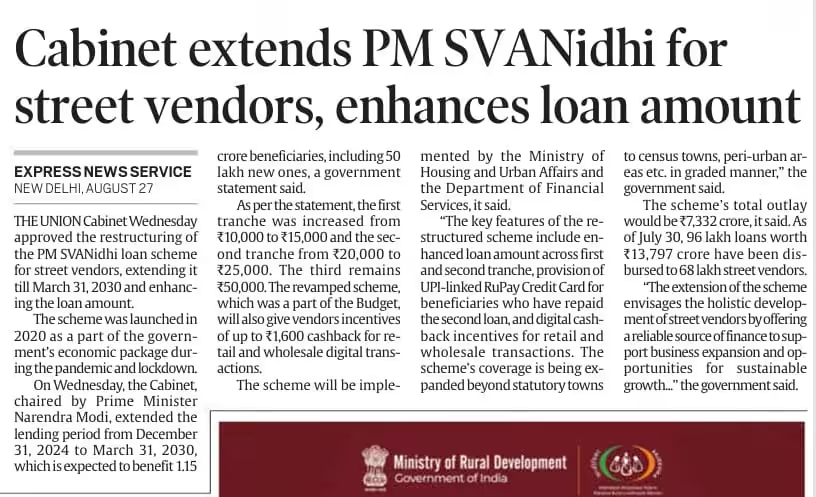
The Union Cabinet has extended the PM SVANidhi Scheme until March 31, 2030, and enhanced the loan limits to support street vendors.

UPSC Relevance:

UPSC has been continuously asking questions based on various Govt. scheme in news. for example-

UPSC PYQ 2016:

Q. With reference to ‘Pradhan Mantri Fasal Bima Yojana’, consider the following statements:

  1. Under this scheme, farmers will have to pay a uniform premium of two percent for any crop they cultivate in any season of the year.  
  2. This scheme covers post-harvest losses arising out of cyclones and unseasonal rains.  

Which of the statements given above is/are correct?  

(a) 1 only   

(b) 2 only   

(c) Both 1 and 2   

(d) Neither 1 nor 2 

PM SVANIDHI Scheme:

  • PM SVANidhi is a central-sector micro-credit scheme launched on 1st June 2020
  • Ministry of Housing & Urban Affairs launched a scheme PM Street Vendor’s AtmaNirbhar Nidhi (PM SVANidhi) to empower Street Vendors by not only extending loans to them, but also for their holistic development and economic upliftment. 
  •  The scheme initially facilitated a working capital collateral-free loan of ₹10,000, with subsequent loans of ₹20,000 and ₹50,000 with a 7% interest subsidy. The scheme focuses on increasing the digital footprint in India by promoting the use of digital transactions among street vendors. To incentivize the adoption of digital transactions, a cashback of up to ₹100 per month is given to Street Vendors.

New Cabinet Decisions (August 2025):

Extension of Scheme:

  • Expected to benefit 1.15 crore vendors, including 50 lakh new entrants.
  • New deadline: March 31, 2030 (from previous March 2024).

Enhanced Loan Amounts:

  • Introduced in Union Budget 2024-25
  • First tranche: ₹10,000 → ₹15,000
  • Second tranche: ₹20,000 → ₹25,000
  • Third tranche: Remains at ₹50,000

New Incentives:

  • Digital Rupay Credit Card for vendors who repay loans on time.
  • Up to ₹1,600 cashback for digital transactions in retail and wholesale.

Implementation:

Jointly by:

  • Ministry of Housing and Urban Affairs
  • Department of Financial Services

Aim:

The scheme aims to formalize the street vendors and open up new opportunities for this sector to move up the economic ladder. Street vendors represent a very important constituent of the urban informal economy and play a significant role in ensuring availability of the goods and services at affordable rates at the doorstep of the city dwellers. They are known as vendors, hawkers, thelewala, rehriwala, theliphadwala, etc. in different areas/ contexts. The goods supplied by them include vegetables, fruits, ready-to-eat street food, tea, pakodas, bread, eggs, textile, apparel, footwear, artisan products, books/ stationary, etc. The services include barber shops, cobblers, pan shops, laundry services, etc.

 Benefits:

  • Financial assistance of up to ₹15,000 is provided to street vendors to help them restart and expand their businesses.
  • The loan is provided at a low-interest rate of 7%, making it easier for street vendors to repay the loan.
  • No collateral is required to avail of the loan, making it more accessible to street vendors.
  • There is no processing fee to apply for the scheme, making it cost-effective for street vendors.
  • The loan amount can be used for any purpose related to the street vending business, such as buying raw materials, paying rent, or purchasing equipment.
  • The scheme provides financial stability to street vendors and helps them to become self-reliant.
  • The loan repayment period is one year, which gives street vendors sufficient time to repay the loan.
  • The scheme encourages entrepreneurship and helps to create employment opportunities.
  • The scheme is aimed at providing financial assistance to street vendors affected by the COVID-19 pandemic, helping them to recover from the economic impact of the pandemic.
  • The scheme is implemented at the national level and is available in all States and Union Territories, making it accessible to street vendors across the country.
image 82

Eligibility Criteria:

  • Street vendors in possession of Certificate of Vending / Identity Card issued by Urban Local Bodies (ULBs).
  • The vendors, who have been identified in the survey but have not been issued Certificate of Vending / Identity Card.
  • Street Vendors left out of the ULB-led identification survey or who have started vending after completion of the survey and have been issued a Letter of Recommendation (LoR) to that effect by the ULB / Town Vending Committee (TVC).
  • The vendors of surrounding development/ peri-urban/rural areas vending in the geographical limits of the ULBs, who have been issued a Letter of Recommendation (LoR) to that effect by the ULB / TVC.
Purchasing Power Parity

Open article →Download PDF

image 83

WhatsApp Image 2025 08 28 at 11.16.52 9ca142bc

Why in news:

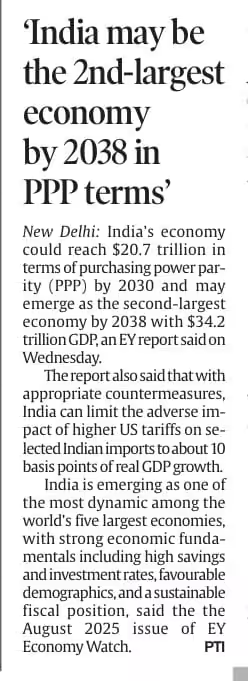
According to the EY Economy Watch (August 2025 edition), India is projected to become the second-largest economy in the world in Purchasing Power Parity (PPP) terms by 2038, with a GDP of $34.2 trillion. By 2030, India’s GDP in PPP terms is expected to touch $20.7 trillion.

UPSC Relevance:

UPSC asks key terminologies in economy.

UPSC PYQ 2019:

Q. Consider the following statements:

  1. Purchasing Power Parity (PPP) exchange rates are calculated by comparing the prices of the same basket of goods and services in different countries.
  2. In terms of PPP dollars, India is the sixth largest economy in the world.

Which of the statements given above is/are correct?

(a) 1 only
(b) 2 only
(c) Both 1 and 2
(d) Neither 1 nor 2

About PPP:

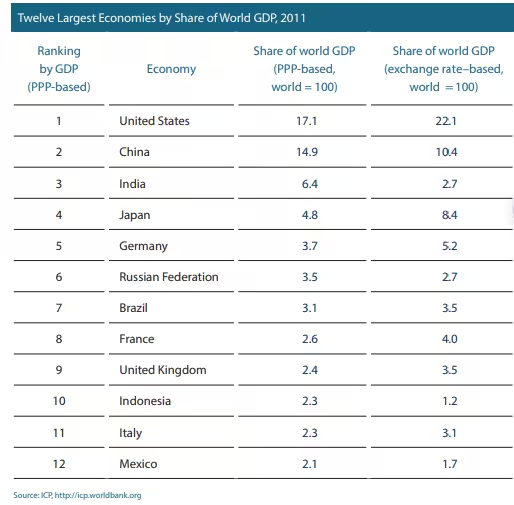
  • PPPs are the rates of currency conversion that equalize the purchasing power of different currencies by eliminating the differences in price levels between countries. 
  • In their simplest form, PPPs are simply price relatives that show the ratio of the prices in national currencies of the same good or service in different countries.

How PPPs are calculated?

 First stage:

It is at the product level, where price relatives are calculated for individual goods and services.

A simple example would be a litre of Coca-Cola. If it costs 2.3 euros in France and 2.00$ in the United States then the PPP for Coca-Cola between France and the USA is 2.3/2.00, or 1.15. This means that for every dollar spent on a litre of Coca-Cola in the USA, 1.15 euros would have to be spent in France to obtain the same quantity and quality – or, in other words, the same volume – of Coca-Cola.

Second Stage:

The second stage is at the product group level, where the price relatives calculated for the products in the group are averaged to obtain unweighted PPPs for the group. Coca-cola is for example included in the product group “Softdrinks and Concentrates”.

Third stage

It is at the aggregation levels, where the PPPs for the product groups covered by the aggregation level are weighted and averaged to obtain weighted PPPs for the aggregation level up to GDP (in our example, aggregated levels are Non-alcoholic beverages, Food…). The weights used to aggregate the PPPs in the third stage are the expenditures on the product groups as established in the national accounts. 

Uses of PPPs?

The major use of PPPs is as a first step in making inter-country comparisons in real terms of gross domestic product (GDP) and its component expenditures.

What are the products included in the basket of goods and services used for the calculation of PPPs:

The basket of goods and services priced for the PPP exercise is a sample of all goods and services covered by GDP. The final product list covers around 3,000 consumer goods and services, 30 occupations in government, 200 types of equipment goods and about 7 construction projects.

image 84

Inventory led Model

Open article →Download PDF

WhatsApp Image 2025 08 28 at 11.12.33 f7e9b0bb

Why in news:

The Commerce and Industry Ministry has begun consultations with stakeholders (Amazon, Flipkart, small-scale manufacturers, MSMEs, etc.) to explore models for boosting e-commerce exports. MSMEs are pushing the government to allow FDI (Foreign Direct Investment) in the inventory-led model of e-commerce.

UPSC Relevance:

CSE in prelims as well as in mains examination has focused on FDI. A case in point is a following PYQ

Mains PYQ 2014:

Q1: Foreign direct investment in the defence sector is now set to be liberalized. What influence this is expected to have on Indian defence and economy in the short and long run?

Mains PYQ 2013:

Q2: Though India allowed foreign direct investment (FDI) in what is called multi brand retail through joint venture route in September 2012, the FDI ,even after a year, has not picket up. Discuss the reasons.

Prelims PYQ:

Consider the following:(2021)
Foreign currency convertible bonds
Foreign institutional investment with certain conditions
Global depository receipts
Non-resident external deposits
Which of the above can be included in Foreign Direct Investments?
A 1, 2 and 3 only
B 3 only
C 2 and 4 only
D 1 and 4 only

About Inventory led model:

Inventory based model of ecommerce refers to the model where e-commerce marketplaces store inventory from brands, merchants, and sellers and sell the products directly to the consumers. Marketplaces following the inventory model manage the stocks from their sellers, thus helping them in order fulfillment.

Examples:

The most common example of brands following the inventory model is Amazon FBA. Amazon FBA sources the inventory from the sellers and manufacturers, stores it, and dispatches the orders.

E-commerce- E-commerce means buying and selling of goods and services including digital products over digital & electronic network.

E-commerce Models in India:

  • Marketplace based model of e-commerce- 
    • Marketplace based model of e-commerce means providing of an information technology platform by an e-commerce entity on a digital & electronic network to act as a facilitator between buyer and seller.
    • FDI allowed: 100% under automatic route.
  • Inventory based model of e-commerce- 
    • Inventory based model of e-commerce means an e-commerce activity where inventory of goods and services is owned by e-commerce entity and is sold to the consumers directly.
    • FDI is not allowed in this model as per present rules.

why India does not allow FDI in the inventory-led e-commerce model?

  • India’s retail sector is dominated by kirana stores, small shopkeepers, and MSMEs. If foreign players were allowed to own inventory and sell directly to consumers, they could use their financial muscle to dominate the market. This would displace millions of small trader.
  • Global giants like Amazon or Walmart could use their deep pockets to sell at very low prices (below cost) to capture market share. This practice, known as predatory pricing, would hurt domestic retailers and reduce competition.
  • Retail trade in India employs over 50 million people directly and indirectly. An inventory-led FDI regime could lead to job losses, as foreign e-commerce firms rely on large warehouses, automation, and fewer intermediaries.

Read more about FDI.

Counting PVTGs

Open article →Download PDF
AD 4nXfdUyCXaCYkwFpIPMtc0I4 ELI9VHEkJN29BwoHOq HCsGyh1gjixMgGN0v0Y QjbVtSFF48 NSPB0w9Xaq9TU3An6B7kIqB FL8lRboYpHwtZ8W62mfLbtDuxwA7hVj01DtUKVhA?key=ZJ4 hOWpdUjdRL4uLBcNLQ

Why in News?

The Ministry of Tribal Affairs (MoTA) has asked the Registrar General and Census Commissioner of India (RGI) to separately count Particularly Vulnerable Tribal Groups (PVTGs) in the upcoming Census.

UPSC Relevance

UPSC frequently asks questions about tribal issues in society in GS1 which mentions, Salient features of Indian Society, Diversity of India, Social Empowerment.

PYQ

2022 – Given the diversities among the tribal communities in India, in which specific contexts should they be considered as a single category?

bhumias tr

Who are Particularly Vulnerable Tribal Groups?

The concept of PVTGs evolved over time. It is a sub group within the larger group of tribes.

  • Origin: The Dhebar Commission (1961) first identified inequalities within tribal groups, which led to the creation of the category.
  • Initial Name: Originally called “Primitive Tribal Groups (PTGs)” in 1973. The name was changed to PVTGs in 2006 because “primitive” was considered derogatory.
  • Criteria: The definition of PVTGs is based on 4 criteria under the Pradhan Mantri Janjati Adivasi Nyaya Maha Abhiyan (PM JANMAN) scheme launched in 2023.
    • Pre-agricultural level of technology.
    • Low level of literacy.
    • Economic backwardness.
    • Declining or stagnant population.
  • Current Status: There are currently 75 PVTGs spread across 18 states and one Union Territory in India.
  • State with most number of PVTGs – Odisha – 13 PVTGs 
  • State with highest population of PVTGs – Madhya Pradesh 
  • Which PVTG has the most members? – Saharias found in Madhya Pradesh 
AD 4nXeTmk JGAN2g i3j2uMq4tYNkoTuF9RKOOb0cu0 dDU8GIDnqLnFnLCUs1eSnihFm7HAXd0O uue2CpRWq5TR1kholoelo2oLHqUgWATSdSposV ouBeokWOiSst4MuBipkvczf?key=ZJ4 hOWpdUjdRL4uLBcNLQ

Request to count PVTG’s separately in Census

The request from the MoTA to the RGI on July 17 is aimed at getting a detailed count of PVTGs, including:

  • The number of households and individuals.
  • Their distinct cultural, demographic, and socio-economic characteristics.

This is a significant move because it’s the 1st time PVTGs would be counted separately since the category was created.

Goal

  • This separate enumeration is intended to help the government formulate targeted policies for the uplift and redress of these marginalized groups.

The Registrar General and Census Commissioner of India (RGI) 

  • It is a permanent office under the Ministry of Home Affairs, responsible for a number of crucial functions that have a significant impact on India’s governance and policy.
  • The primary role of the RGI is to conduct the decennial Census of India.

Multifaceted Challenges faced by PVTG’s

Health and Nutritional Challenges

  • PVTGs suffer from poor health and nutrition, largely due to a lack of access to basic healthcare, sanitation, and clean drinking water.
  • Their remote locations make it difficult for government health services and professionals to reach them. 
  • Many communities still rely on traditional healthcare practices, which may not be effective against modern diseases.
  • Malnutrition is a severe problem, especially among pregnant women and young children.
    • A study on the Kutia Kandha tribe in Odisha, for example, found that 70.54% of adolescents had moderate anemia, and 21.09% had severe anemia.
  • Due to poor sanitation and a lack of health education, PVTGs have a high incidence of infectious diseases, gastrointestinal issues, and micronutrient deficiencies.

Educational Challenges

  • Low Literacy Rates: The literacy rate among PVTGs is significantly lower than the national average.
    • For instance, the literacy rate of the Mankirdia tribe in Odisha is only 21.14%, and this is even lower for women.
  • Language and Cultural Barriers: The curriculum and medium of instruction in government schools often don’t align with the local dialects and cultural practices of these groups, making it difficult for children to learn.
  • High Dropout Rates: Many children, particularly girls, drop out of school to help with household chores or to earn a livelihood.

Economic Challenges

  • Livelihood Issues: The traditional way of life for PVTGs, which often involves hunting and gathering, is being threatened by a variety of external factors, leading to economic marginalization. Shrinking forests and changes in environmental laws have impacted their ability to collect non-timber forest produce. This has forced some to become laborers, where they are often exploited by middlemen and do not receive fair wages. 
  • Land and Displacement: PVTGs have faced systematic displacement from their traditional lands due to developmental projects like dams, mining, and the creation of reserved forest areas.
    • For example, some Baiga families were forced out of the Achanakmar Tiger Reserve in Madhya Pradesh.

Legal Procedural Challenges

  • Need for Redefinition: The existing criteria for defining PVTGs are decades old and may not be accurate today due to changing ground realities.
    • For example, some communities now use more advanced technology, which might exclude them from the “pre-agricultural technology” criterion.
  • Lack of Data: A major challenge is the lack of precise data on PVTGs. The 2011 census, for instance, didn’t collect data on all 75 PVTGs separately, making it difficult to formulate effective, targeted welfare schemes.

PM-JANMAN – 2023

  • Target Group: The scheme is exclusively for the 75 PVTG communities living in 18 states and one Union Territory of Andaman and Nicobar Islands.
  • Mission: It aims to provide basic facilities and services to PVTG households and habitations to improve their quality of life and bring them into the mainstream.
  • Key Focus Areas: The mission focuses on 11 critical interventions, implemented by nine different ministries, covering:
    • Housing: A significant number of houses have been sanctioned under the Pradhan Mantri Awas Yojana-Gramin (PMAY-G) with the objective of providing safe housing to PVTG families. As of July 2025, over 1.36 lakh houses have been completed.
    • Connectivity: Projects are underway to construct roads under the Pradhan Mantri Gram Sadak Yojana (PMGSY) and to install mobile towers to improve road and telecom connectivity in remote PVTG habitations.
    • Health: The scheme includes the deployment of Mobile Medical Units (MMUs) to provide primary healthcare services to these communities. As of June 2025, 694 MMUs were operational.
    • Electrification: The Ministry of New and Renewable Energy is providing solar power systems for households and Multi-Purpose Centres (MPCs) where grid electricity is not feasible. The target is to provide solar lighting for 100,000 households and 1,500 MPCs.
    • Livelihood: The scheme supports the establishment of Van Dhan Vikas Kendras (VDVKs) to promote economic empowerment through value addition and marketing of forest produce.
  • Budgetary Outlay: The total outlay for PM-JANMAN is ₹24,104 crore for a three-year period, from 2023-24 to 2025-26. This includes a central share of ₹15,336 crore and a state share of ₹8,768 crore.
  • Implementation: The scheme is a combination of Central Sector and Centrally Sponsored Schemes. Its implementation is a coordinated effort between the Ministry of Tribal Affairs, nine other ministries, and the respective state governments.
  • Data Collection: A crucial step in the scheme is the use of the PM Gati Shakti mobile application to conduct a habitation-level data collection exercise. This is to accurately identify PVTG habitations and infrastructure gaps, ensuring the right beneficiaries are reached.

A careful approach for identifying and addressing the needs of these groups is necessary for their social inclusion, not assimilation. Therefore, the recent step is in the right direction.

H-1B Visa

Open article →Download PDF
AD 4nXeOju4YGEYrsYoLZ1KcinBxWhgek8z9FOVUiTQFYY avOIGRiP bJA v8O7bk mkeO2pq fytH1oyF8MgjZSPGgC yJmBmxyY y r5vNxtQDDnosX8WPvNeQKuBzGzqIq8jeLin1Q?key=ZJ4 hOWpdUjdRL4uLBcNLQ

Why in News?

USA’s Commerce Secretary Howard Lutnick on Tuesday called the H-1B visa program a “scam” and asked “all great American businesses” to “hire Americans”.

UPSC Relevance

UPSC has shown. Interest in prominent international economic trends and issues affecting India.

PYQ

2022

Consider the following statements

  1. Vietnam has been one of the fastest growing economies in the world in the recent years.
  2. Vietnam is led by a multi-party political system.
  3. Vietnam’s economic growth is linked to its integration with global supply chains and focus on exports.
  4. For a long time Vietnam’s low labour costs and stable exchange rates have attracted global manufacturers.
  5. Vietnam has the most productive e-service sector in the Indo-Pacific region.

Which of the statements given above are correct?

A 2 and 4 only

B 3 and 5 only

C 1, 3 and 4 only

D 1 and 2 only

Background and Purpose of the H-1B Visa Program

  • Created under the Immigration Act of 1990 to help employers hire highly skilled immigrants when US workers with necessary skills are unavailable.
  • Targets occupations requiring at least a bachelor’s degree and specialized skills.
  • Designed to temporarily fill talent gaps in the US workforce, especially in technology and specialized fields.
  • Big Tech companies (Microsoft, Oracle, Google, Amazon) heavily utilized the program to address domestic talent shortages in the 1990s and beyond.
  • Companies recruited large numbers of highly educated immigrants, mainly from India and China, to sustain technological innovation and growth.

Impact on Indian and Chinese Immigrants

  • Indians dominate the program, accounting for over 70% of approved petitions since 2015; Chinese make up about 12-13%.
  • Most Indian H-1B workers earn under $100,000/year, below the US IT median salary ($105,990 in 2023).
  • Average American wage ($75,000) is higher than average green card recipients ($66,000).

How the H-1B VISA works? 

  • CAN BE ISSUED for a maximum 6 years at a stretch, after which the visa holder has to either leave the US for at least 12 months before returning, or apply for and receive permanent residence (green card).
  • ANNUAL NUMERICAL LIMIT (regular cap) of 65,000 new statuses/visas each fiscal year, with an extra 20,000 visas available to those with a Master’s degree or higher from a US university
  • NOT ALL H-1B PETITIONS are subject to the annual cap. 
    • Petitions for “continuing employment”, do not fall under the cap, neither do those seeking employment at higher education institutions or nonprofit entities affiliated to such institutions, nonprofit research organisations, or government research or organisations.