Opens in a new tab
Join Anantam IAS Channel on Telegram

Daily Digest · Friday

28 November 2025 Current Affairs for UPSC

2 current affairs published on Friday, 28 November 2025

28 November 2025 Current Affairs for UPSC — every Why-in-News article AnantamIAS published on Friday, 28 November 2025, broken down with Why in News?, the exact GS paper it feeds, sub-topic mapping, MCQ-ready facts and a UPSC-style practice question. 2 articles in total, covering Polity, Economy, Environment, S&T, IR, Geography, History, Society and Internal Security — the same Why-in-News + GS-paper-mapping + practice-question format the Compass uses across every daily digest on the site.

Daily current affairs for UPSC is where new material enters your prep stream. Read this 28 November 2025 digest end-to-end in 25–35 minutes, attempt the practice question at the foot of each article (it's MCQ for some, 10/15-marker for others), then bookmark the entries that fall inside your active revision window. Everything stays cross-linked: tap any subject pill to jump to that subject's hub, or use the table of contents above to skip straight to a specific story.

Use this page three ways. Read sequentially for a one-sitting scan of everything that mattered on 28 November 2025. Download the 28 November 2025 PDF below for offline study or print revision. Or use the November 2025 Current Affairs compilation to see this day in the month's full context. For the previous day's reading, see 27 November 2025 Current Affairs; the next day's is 29 November 2025 Current Affairs.

Why we publish daily current affairs separately from the monthly compilation: daily is learning, monthly is revision. Use the daily page to add fresh material to your notes the day it breaks; come back to the November 2025 compilation 60 days before Prelims when the noise has settled and only the lasting takeaway is worth re-reading.

India must Exorcise Macaulay’s Ghost v/s Mahatma Macaulay

Open article →Download PDF

image 57 1

WhatsApp Image 2025 11 28 at 11.05.58 9a21a60e

Context:

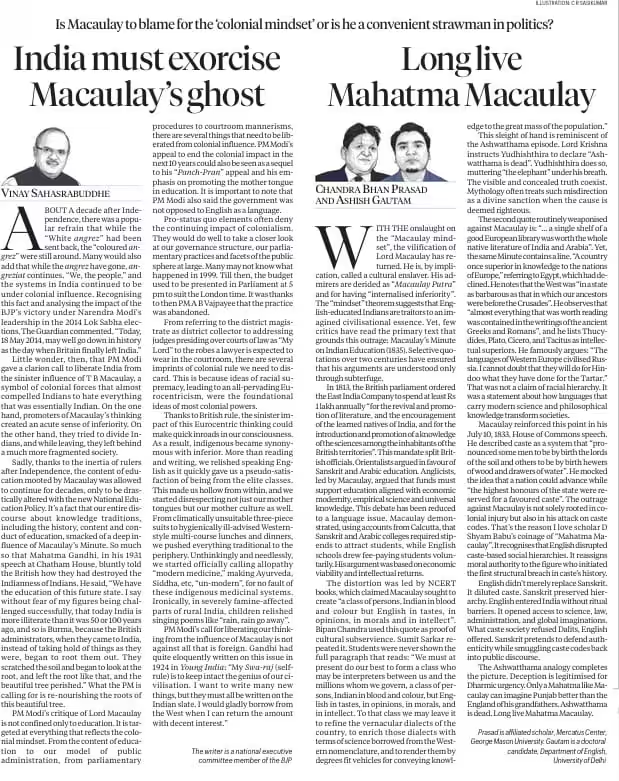
  • One article — “India must exorcise Macaulay’s ghost” — argues that Macaulay’s influence still shapes Indian culture and education.
  • The other — “Long Live Mahatma Macaulay” — counters that Macaulay is unfairly blamed and in fact played a role in expanding modern, liberal education.

UPSC Relevance:

Modern Indian History, Governance & Education, Social Justice and Ethics

UPSC PYQ:

Q. With reference to Lord Macaulay’s Minute on Education (1835), consider the following statements:
1.It advocated the use of English as the medium of instruction for teaching Western sciences and literature in India.
2.It led to the establishment of a large number of elementary schools to promote mass education.
3.It introduced the idea of educating a small elite class to act as a bridge between the British administration and Indian society.
Which of the above statements is/are correct?

[A] 1 and 2 only

[B] 1 and 3 only

[C] 2 and 3 only

[D] 1, 2 and 3

About Lord Macaulay:

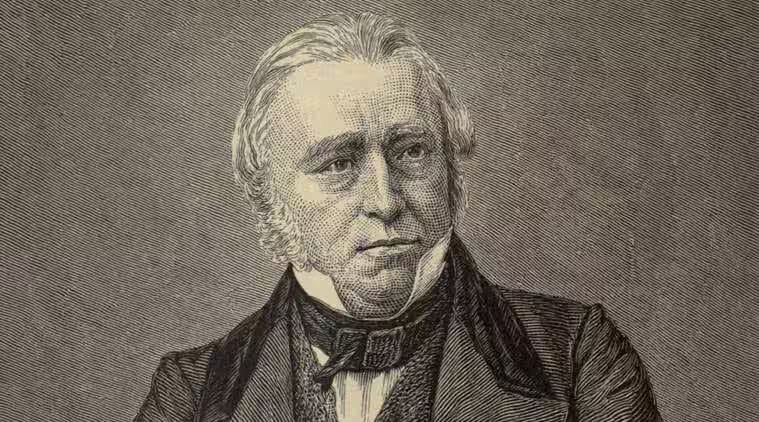
  • William Babington Macaulay was a British Whig politician and historian who lived from 25 October 1800 to 28 December 1859. He is credited as being the main architect of India’s shift to a Western-style educational system.
  •  A single shelf of a decent European library was worth the entirety of the native literature of India and Arabia, according to Macaulay, who stated this in his February 1835 Minute on Indian Education. 
  • Lord Macaulay put forth the Downward Filtration Theory in his renowned Macaulay’s Minutes of 1835, which were delivered to the then Governor General of British India. The difficulty British India encountered implementing the new educational system was addressed by the downward filtration theory. It implied that the solution lay in educating a select number of people who would subsequently inform the larger populace. The individual who will disseminate the knowledge to the general public would be provided it in this way.

The 1835 Macaulay Minute:

  • Indian languages such as Sanskrit, Arabic, Persian, Hindi, Tamil, and Telugu were deemed useless.
  • English was presented as the only medium for “high knowledge.”
  • Government funds were proposed to be spent exclusively on English education.
  • Indian literature, philosophy, medicine, mathematics, and sciences were depicted as inferior to Western knowledge.
  • A “mediating class” was envisioned: “Indian in blood and colour, but English in tastes, opinions, morals and intellect.”

Arguments claiming Macaulay’s negative legacy continues?

  • British left behind a psychological hierarchy: Western over Indian.
  • English-medium education privileged the “brown sahib”; Indian languages sidelined.

Persistence of colonial hangover:

  • The “white approval syndrome”
  • Obsession with English speech & mannerisms
  • Bureaucratic red tape built on colonial practices

Arguments defending or reinterpreting Macaulay?

  • Critics often misquote or selectively quote Macaulay’s Minute.
  • Macaulay advocated liberal, modern education:
    • Science, mathematics, analytical thinking.
  • Sanskrit and Persian systems were exclusionary and accessible only to upper castes; Macaulay believed English would democratize learning.
  • Macaulay’s views have been simplified for ideological battles rather than examined historically.

Reforms after independence?

critical of continuing colonial influence:

  • Post-1947, India’s education system remained English-heavy.
  • PM Modi’s BHASHA initiative & NEP attempt to promote Indian languages.

Colonial legacy continues through:

  • Classroom: exam-centric rote learning
  • Judiciary: language & dress codes
  • Administration: hierarchical attitudes

Positive reinterpretation:

Macaulay introduced:

  • Modern sciences
  • Constitutional principles
  • Secular liberal values

Education in English enabled:

  • Pan-Indian communication
  • Access to modern global ideas
  • Social mobility for lower castes

Caste Dimension?

  • Pre-colonial education was dominated by upper castes.
  • Access to knowledge in Sanskrit was limited.
  • English education opened gates for:
    • Dalits
    • Backward castes
    • Social reformers (Ambedkar, Phule, etc.)
  • Macaulay’s framework ironically assisted democratization of learning.

Contemporary Policy:

1. NEP 2020

  • Revival of Indian languages.
  • Reducing English dominance.
  • Promotion of mother-tongue education.

2. Judiciary Reforms

  • Language of courts still English.
  • Colonial etiquette persists.

3. Administrative Reforms

  • Reducing colonial legacy in governance.
  • Citizen-centric vs. bureaucratic-centric administration.

4. Culture Wars

  • Contestations over historical narratives and decolonisation.
  • Identity politics over “authentic Indian tradition.”

Practice Question:

Q: Analyse how the colonial education system reshaped Indian society’s class and caste hierarchies.

GM v/s Genome editing Crop

Open article →Download PDF

image 57 3

image 57 2

Context:

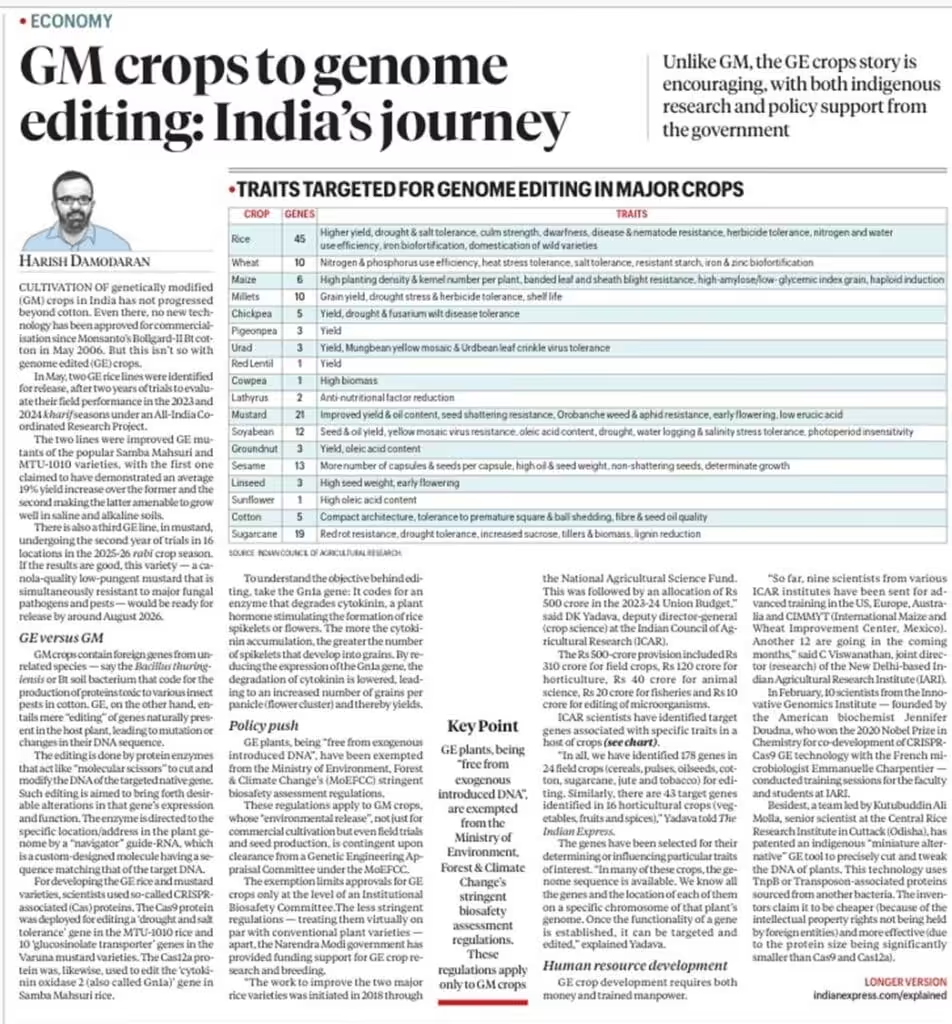
India’s GM (Genetically Modified) crop adoption has stagnated, while Genome Editing (GE)—especially CRISPR-based technologies—is advancing rapidly.

UPSC Relevance:

Science and Technology

UPSC PYQ:

Q. What are the research and developmental achievements in applied biotechnology? How will these achievements help to uplift the poorer sections of society? (2021)

GM Crops v/s Genome Editing Crops:

image 57 4

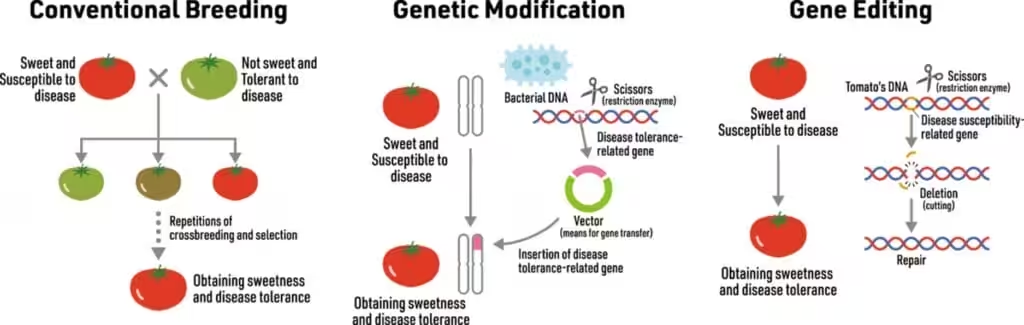
GM crops contain foreign genes from unrelated species – say the Bacillus thuringiensis or Bt soil bacterium that code for the production of proteins toxic to various insect pests in cotton.

GE, on the other hand, entails mere “editing” of genes naturally present in the host plant, leading to mutation or changes in their DNA sequence.

  • The editing is done by protein enzymes that act like “molecular scissors” to cut and modify the DNA of the targeted native gene. Such editing is aimed to bring forth desirable alterations in that gene’s expression and function.
  • The enzyme is directed to the specific location/address in the plant genome by a “navigator” guide-RNA, which is a custom-designed molecule having a sequence matching that of the target DNA.

For developing the GE rice and mustard varieties, scientists used so-called CRISPR-associated (Cas) proteins. The Cas9 protein was deployed for editing a ‘drought and salt tolerance’ gene in the MTU-1010 rice and 10 ‘glucosinolate transporter’ genes in the Varuna mustard varieties. The Cas12a protein was, likewise, used to edit the ‘cytokinin oxidase 2 (also called Gn1a)’ gene in Samba Mahsuri rice.

image 57 5

Policy push?

  • GE plants, being “free from exogenous introduced DNA”, have been exempted from the Ministry of Environment, Forest & Climate Change’s (MoEFCC) stringent biosafety assessment regulations.
  • These regulations apply only to GM crops, whose “environmental release”, not just for commercial cultivation but even field trials and seed production, is contingent upon clearance from a Genetic Engineering Appraisal Committee under the MoEFCC.
  • The above exemption – as per an MoEFCC office memorandum, dated March 30, 2022 – limits approvals for GE crops only at the level of an Institutional Biosafety Committee. This committee, comprising scientists from the institution engaged in the GE crop development and the Department of Biotechnology, only has to certify that the edited plant has no foreign DNA.

GM CropsGE Crops
High regulationLow regulation (if no foreign DNA)
Public protestsBroad acceptability
Slow trialsFast trials
TransgenicNon-transgenic
GEAC approvals requiredOnly institutional approvals

Advantages:

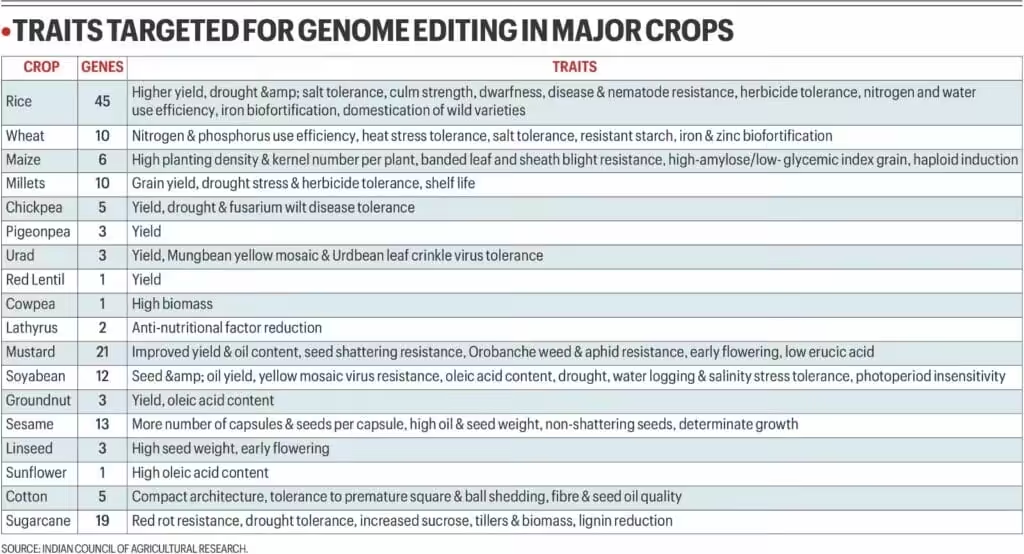
Across rice, wheat, maize, pulses, cotton, oilseeds:

  • Higher yield
  • Drought/salt/heat tolerance
  • Nitrogen & phosphorus-use efficiency
  • Biofortification (iron, zinc)
  • Disease & insect resistance
  • Reduced anti-nutritional factors
  • Better oil content/fiber quality
  • Improved architecture, fewer shattering losses

👉 GE supports both climate resilience & nutrition security.

Implications:

Economic

  • Higher productivity
  • Climate-resilient crops → stable farmer incomes
  • Import reduction (oilseeds, pulses)

Environmental

  • Lower pesticide use
  • Better nutrient efficiency

Social

  • Helps address malnutrition
  • Enhances food security

Scientific

India emerging as a global leader in GE crops.

India’s Achievements?

✔ GE Rice (Samba Mahsuri)

  • Edited Gn1a gene using Cas12a
  • Increases cytokinin → more spikelets → 19% higher yield.

✔ GE Rice (MTU-1010)

  • Edited drought & salt tolerance gene using Cas9
    → Tolerance to saline/alkaline soils.

✔ GE Mustard (Canola-quality)

  • Edited glucosinolate transporter genes
  • → Disease-resistant, pest-resistant, high-quality oil.
  • → Trials across 16 locations; may be released by 2026.

Why are GE crops advancing fast:

GE plants contain no foreign DNA

→ They are not transgenics.
→ Hence treated like conventionally bred varieties.

2022 Regulatory Reform (MoEFCC)

GE crops (SDN-1 & SDN-2 categories) require only:

  • Institutional Biosafety Committee certification
    → No GEAC approval needed.

This is the biggest reason for GE acceleration.

Government Funding

  • National Agricultural Science Fund
  • ₹500 crore in 2023–24 Budget
    → Explicit push for GE research.

Indigenous & Global collaboration

  • India’s own TnpB-based genome editing tool developed at CRRI Cuttack.
  • IARI, ICAR, CRRI developing GE technologies
  • Training by Innovative Genomics Institute (IGI)