
Opens in a new tab
Join Anantam IAS Channel on Telegram

Daily Digest · Wednesday

29 July 2026 Current Affairs for UPSC

2 current affairs published on Wednesday, 29 July 2026

29 July 2026 Current Affairs for UPSC — every Why-in-News article AnantamIAS published on Wednesday, 29 July 2026, broken down with Why in News?, the exact GS paper it feeds, sub-topic mapping, MCQ-ready facts and a UPSC-style practice question. 2 articles in total, covering Polity, Economy, Environment, S&T, IR, Geography, History, Society and Internal Security — the same Why-in-News + GS-paper-mapping + practice-question format the Compass uses across every daily digest on the site.

Daily current affairs for UPSC is where new material enters your prep stream. Read this 29 July 2026 digest end-to-end in 25–35 minutes, attempt the practice question at the foot of each article (it's MCQ for some, 10/15-marker for others), then bookmark the entries that fall inside your active revision window. Everything stays cross-linked: tap any subject pill to jump to that subject's hub, or use the table of contents above to skip straight to a specific story.

Use this page three ways. Read sequentially for a one-sitting scan of everything that mattered on 29 July 2026. Download the 29 July 2026 PDF below for offline study or print revision. Or use the July 2026 Current Affairs compilation to see this day in the month's full context. For the previous day's reading, see 28 July 2026 Current Affairs; the next day's is 30 July 2026 Current Affairs.

Why we publish daily current affairs separately from the monthly compilation: daily is learning, monthly is revision. Use the daily page to add fresh material to your notes the day it breaks; come back to the July 2026 compilation 60 days before Prelims when the noise has settled and only the lasting takeaway is worth re-reading.

Rupee Valuation: Why the RBI Sees the Currency as Undervalued

Open article →Download PDF

Why in News?

On July 26, 2026, Reserve Bank of India Governor Sanjay Malhotra reiterated that it was reasonable to regard the Indian rupee as undervalued in both nominal and real effective exchange-rate terms. The Hindu reported the remarks on July 29 as an unusual public assessment of whether a currency’s market price matches its underlying economic fundamentals.

The Governor paired that assessment with an important qualification: the RBI does not target a fixed rupee-dollar rate or an exchange-rate band. Its foreign-exchange operations are intended to contain excessive volatility and preserve orderly market conditions, not guarantee a permanently strong or weak rupee.

  • The rupee had depreciated about 5.8% during 2026 by the time of the reported remarks, amid elevated crude prices, geopolitical tension, a stronger dollar and intermittent foreign portfolio outflows.
  • The Governor referred to both the nominal exchange rate and the Real Effective Exchange Rate, or REER, rather than relying only on the bilateral rupee-dollar quotation.
  • The assessment rests on a possible gap between the rupee’s market value and India’s growth, inflation, reserves and external-sector fundamentals.
  • The Hindu noted that India’s foreign-exchange reserves still offered roughly 11 months of import cover, providing a buffer against external shocks.
  • An undervaluation judgment is an economic assessment, not a promise that the currency will appreciate immediately or that the RBI will defend a particular level.

The development matters in the context of:

  • Currency valuation matters in the context of export competitiveness, because a cheaper rupee can reduce the foreign-currency price of Indian goods if firms pass the change through.
  • It also matters for imported inflation: India pays for crude oil, fertilisers, electronics and several industrial inputs in foreign currency.
  • Sharp currency moves affect the Balance of Payments, foreign portfolio flows, external debt servicing and the RBI’s use of reserves.
  • The issue tests the policy trade-off between allowing a market-determined adjustment and preventing a disorderly loss of confidence.

Rupee Valuation: Why the RBI Sees the Currency as Undervalued — quick facts

UPSC Relevance

Prelims Relevance

  • NEER is a trade-weighted geometric average of bilateral nominal exchange rates; it does not adjust for inflation differences.
  • REER adjusts NEER for relative prices or costs between India and its trading partners, giving a broader measure of external price competitiveness.
  • In the RBI’s published indices, an increase in NEER or REER indicates appreciation of the rupee, while a decrease indicates depreciation.
  • The RBI publishes a 40-currency trade-weighted basket with 2015-16 as its stated base, alongside a narrower six-currency series.
  • An index base of 100 is a comparison point, not an immutable fair value; the basket, weights, price index and base period shape the reading.
  • India moved to a market-determined unified exchange rate in March 1993 after the transitional Liberalised Exchange Rate Management System.
  • Under Section 40 of the RBI Act, 1934, the RBI may buy or sell foreign currency to authorised persons.
  • When the RBI buys foreign exchange, it normally injects rupee liquidity; when it sells foreign exchange, it absorbs rupee liquidity, unless the liquidity effect is offset.
  • Foreign-exchange reserves include foreign currency assets, gold, Special Drawing Rights and India’s reserve-tranche position with the IMF.
  • Read REER with the current account, capital flows, reserves and productivity; it cannot by itself predict the next movement of the rupee.

Mains Relevance

GS Paper 3

  • Exchange-rate valuation, external-sector stability, inflation, trade competitiveness and the management of foreign-exchange reserves.
  • Transmission of crude-oil prices, dollar strength and foreign portfolio outflows to the rupee, the current account and domestic prices.
  • Limits of central-bank intervention under a market-determined but actively managed exchange-rate framework.

GS Paper 2

  • Institutional credibility and transparent communication by an independent central bank during episodes of global financial stress.

Essay

  • A nation’s currency is an economic price, not a badge of national strength.
  • Resilience lies in absorbing shocks without allowing temporary volatility to become lasting instability.

Background and Context

What Currency Undervaluation Means

Undervaluation describes a market exchange rate that is weaker than an estimated equilibrium value supported by economic fundamentals.

  • The relevant benchmark is not simply yesterday’s rate or a politically preferred number; it is an estimated equilibrium exchange rate consistent with sustainable growth, inflation, productivity and external balances.
  • A rupee can weaken in the market because demand for dollars rises during an oil shock or because investors reduce emerging-market exposure, even when India’s domestic fundamentals have not worsened to the same degree.
  • The gap between market price and equilibrium is model-dependent. Different assumptions about productivity, capital flows, fiscal policy and the sustainable current-account balance can yield different estimates.
  • Undervaluation is also distinct from depreciation: depreciation describes a fall in market value, while undervaluation judges whether the resulting level is weaker than fundamentals warrant.
  • A currency judged undervalued can stay weak for months if global risk aversion, dollar demand or geopolitical uncertainty persists; valuation is not a short-term forecast.
  • The Governor’s language should be read as a macro-financial diagnosis, not as a guaranteed trading signal or a formal exchange-rate target.
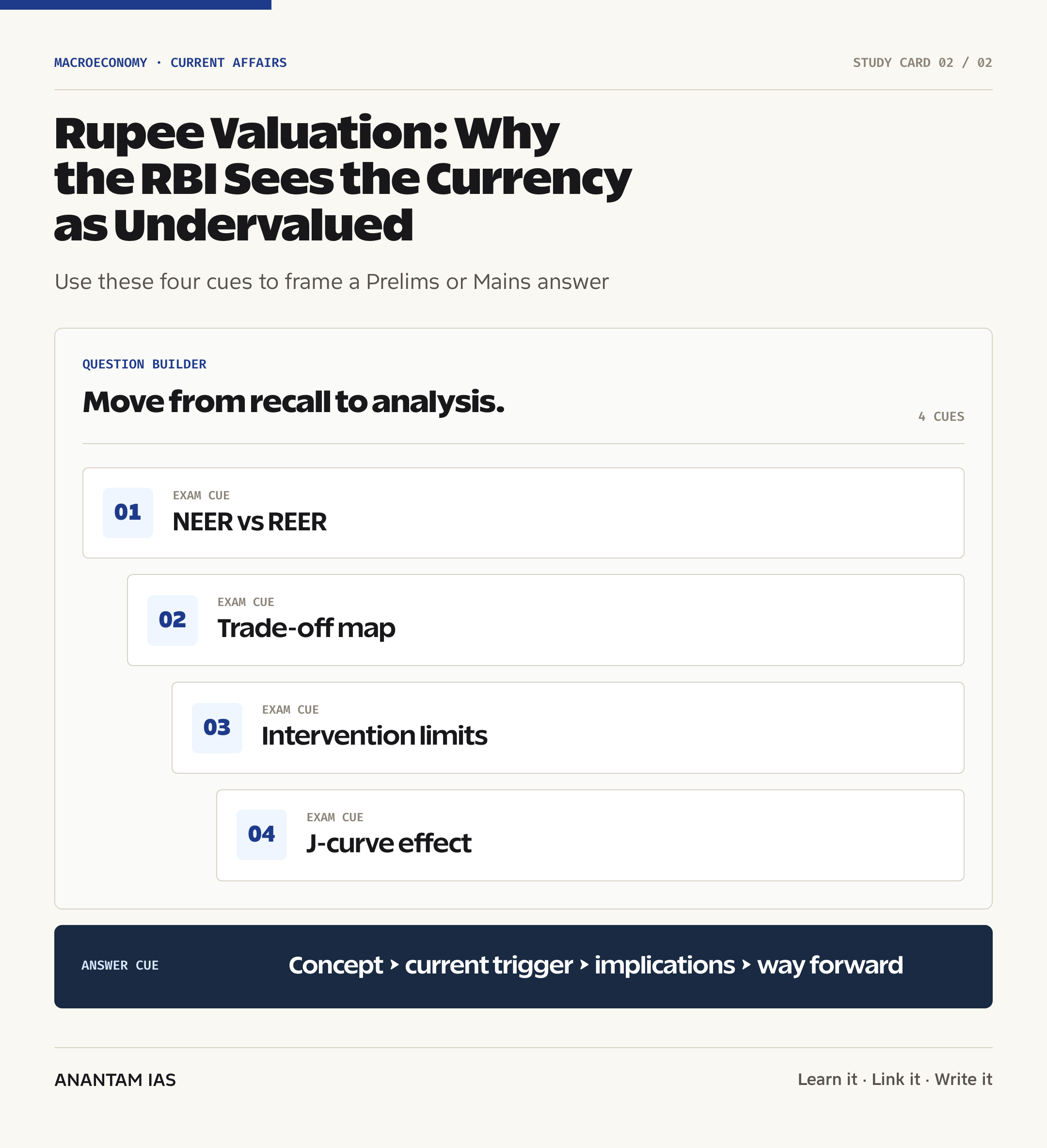
Rupee Valuation: Why the RBI Sees the Currency as Undervalued — exam lens

Nominal Rate, NEER and REER

The three measures answer different questions about the rupee’s external value.

  • The bilateral USD/INR rate answers how many rupees buy one US dollar; it is highly visible but says nothing directly about movements against the euro, yen, pound or renminbi.
  • NEER combines bilateral rates against a currency basket using trade weights, reducing the risk of mistaking a dollar-specific move for a broad-based rupee move.
  • REER then adjusts NEER for the inflation differential between India and its trading partners. If Indian prices rise faster, part of a nominal depreciation may be offset in real competitiveness terms.
  • The Bank for International Settlements describes REER as NEER adjusted for relative consumer prices and notes that a rising real index represents appreciation and weaker international price competitiveness.
  • The RBI states that REER is better suited to tracking currency movement over time than declaring a precise fair-value level at one point because the base year, weights, basket and price measure involve judgment.
  • This caution prevents a common error: a reading below the base value of 100 shows depreciation relative to that base under the chosen construction, but does not mechanically prove a specific percentage of fundamental undervaluation.

Why the RBI's Assessment Is Plausible

The RBI appears to see temporary external pressures as larger than the deterioration, if any, in India’s underlying economic capacity.

  • India remained among the faster-growing major economies, with growth above 6%, while inflation had moderated from recent highs; these conditions do not by themselves point to a deep loss of currency value.
  • Foreign-exchange reserves offering about 11 months of import cover gave the country capacity to meet external payments and smooth disorderly market moves.
  • The rupee nevertheless faced pressure from elevated crude-oil prices, geopolitical risks, broad dollar strength and intermittent FPI outflows, all of which raise spot demand for foreign currency.
  • Portfolio flows can reverse much faster than domestic output or productivity. A risk-off episode may cause a temporary overshoot, where the exchange rate moves farther than medium-term fundamentals justify.
  • India’s services exports and remittances support the current account even when the merchandise trade account is in deficit; see the broader Balance of Payments framework for how these flows interact.
  • The RBI’s view is still contestable because the equilibrium rate also depends on oil dependence, trade deficits, global interest-rate differentials and the durability of FDI and FPI inflows.

Trade Competitiveness and Its Limits

A weaker real exchange rate can aid exporters, but the benefit is neither automatic nor costless.

  • Exporters receiving dollars may earn more rupees per unit of foreign revenue, while a lower REER can improve price competitiveness against firms in partner economies.
  • The gain depends on price elasticity of demand: foreign buyers must respond to lower relative prices by purchasing enough additional Indian output.
  • Many exporters import energy, machinery, electronics or intermediate goods. A weaker rupee raises these input costs and can reduce the apparent export advantage.
  • Firms may keep the currency gain as margin instead of lowering foreign-currency prices, and supply constraints, logistics costs and product quality can matter more than exchange rates.
  • The J-curve effect explains why the trade balance may initially worsen after depreciation: import contracts and quantities adjust slowly while the rupee cost of imports rises immediately.
  • Sustained export performance needs productivity, reliable infrastructure, trade facilitation and market access; an undervalued currency cannot replace structural competitiveness.

Imported Inflation and Balance-Sheet Risks

The same depreciation that may support exports can transmit external costs into households, firms and government finances.

  • Crude oil and other dollar-priced imports become more expensive in rupees, creating imported inflation through fuel, freight, fertiliser and production costs.
  • Higher import values can widen the merchandise trade deficit and add pressure to the current account, especially when export volumes respond slowly.
  • Companies or governments with unhedged foreign-currency debt face a larger rupee repayment burden, a channel known as the balance-sheet effect.
  • Inflation can erode the real depreciation that initially improved competitiveness: if domestic prices rise, REER may appreciate even without a stronger nominal rupee.
  • Currency weakness can influence inflation expectations and constrain monetary easing, connecting the foreign-exchange market with the Monetary Policy Committee.
  • For the inflation channel in a recent Indian setting, compare the note on wholesale and imported inflation.

How and Why the RBI Intervenes

India’s exchange rate is market-determined, but the RBI can act when market functioning becomes disorderly.

  • The RBI can sell dollars in the spot market to meet temporary excess demand, or operate through forwards and swaps to influence liquidity and future dollar availability.
  • A dollar sale reduces foreign assets and absorbs rupee liquidity; a dollar purchase adds reserves and injects rupees unless the RBI conducts sterilisation through separate liquidity operations.
  • Intervention can slow panic, reduce one-way speculation and buy time for price discovery, but persistent defence of an arbitrary level can deplete foreign-exchange reserves.
  • The RBI’s official position is to maintain orderly conditions and curb excessive volatility rather than fix a rate. This preserves the exchange rate’s role as a shock absorber.
  • Raising interest rates solely to support the currency can attract capital at the cost of domestic credit and growth; using reserves too aggressively can weaken the external buffer.
  • India’s reserve position and import cover are examined in the RBI external-sector buffer note, while remittances are covered in this current-affairs explainer.

Capital Flows and Exchange-Rate Overshooting

Financial flows can move the rupee more rapidly than trade quantities or domestic productive capacity can adjust.

  • Foreign portfolio investment responds quickly to global interest rates, dollar funding costs, risk appetite and relative asset returns; withdrawals create immediate demand for foreign currency.
  • Foreign direct investment is usually more stable because it is tied to factories, businesses and long-term ownership, but net FDI can weaken when outward investment and repatriation rise.
  • A narrower interest-rate differential with advanced economies may reduce the reward for holding rupee assets, while a broad safe-haven dollar move can pressure many emerging-market currencies together.
  • Exchange rates are asset prices and incorporate expectations. When investors anticipate continuing outflows, they may demand dollars early, causing overshooting beyond the adjustment required by current trade flows.
  • Remittances and services-export receipts provide recurring dollar supply, but their stabilising effect can be temporarily outweighed by large portfolio sales or an abrupt increase in the oil import bill.
  • A sound assessment separates a temporary liquidity shock from a structural loss of competitiveness. The policy response to the first is market smoothing; the response to the second requires productivity and external-balance reform.

Way Forward

Keep the Exchange Rate Flexible

  • Allow the rupee to reflect changing trade and capital-flow conditions while intervening against abrupt, illiquid or speculative moves.
  • Avoid communicating a precise defence line that invites markets to test the RBI’s commitment and reserves.
  • Publish clear data on intervention, forward positions and reserve adequacy with appropriate lags to strengthen policy credibility.

Reduce External Vulnerabilities

  • Diversify energy sources, raise domestic renewable capacity and improve efficiency to reduce the exchange-rate sensitivity of the oil import bill.
  • Deepen export capabilities in manufacturing and services through logistics reform, quality standards and participation in global value chains.
  • Prefer stable, long-horizon FDI and deepen domestic financial markets so temporary FPI exits cause less disruption.
  • Encourage prudent hedging of foreign-currency liabilities by banks and companies to contain the balance-sheet channel.

Use a Dashboard, Not One Indicator

  • Assess valuation through NEER, REER, the current account, capital flows, reserves, inflation and productivity rather than a bilateral exchange rate alone.
  • Compare alternative baskets and equilibrium models because a base-year index cannot independently reveal a currency’s exact fair value.
  • Coordinate monetary, fiscal, trade and energy policy so the response addresses the source of pressure without sacrificing price stability or growth.

Conclusion

The RBI’s description of the rupee as undervalued is best understood as a judgment that recent nominal and real depreciation has overshot India’s medium-term fundamentals. It does not turn a weak rupee into an unqualified advantage, nor does it commit the central bank to a particular reversal.

For policy, the objective is an orderly and credible adjustment. A flexible exchange rate can absorb global shocks, while reserves, sound inflation management, stable capital inflows and stronger trade capacity keep that flexibility from becoming instability.

UPSC Practice Questions

Prelims MCQ 1

With reference to effective exchange rates, consider the following statements:

  1. NEER adjusts a trade-weighted basket of nominal exchange rates for inflation differentials.
  2. REER incorporates relative prices or costs between the home economy and its trading partners.
  3. In the RBI’s published indices, an increase in REER indicates real appreciation of the rupee.

How many of the above statements are correct?

(a) Only one (b) Only two (c) All three (d) None

Answer: (b) Only two

Explanation:

Statements 2 and 3 are correct. NEER is the nominal trade-weighted measure; REER, not NEER, makes the relative-price adjustment. A rise in the RBI’s REER index indicates real appreciation.

Prelims MCQ 2

Which one of the following best describes the RBI’s stated objective in the foreign-exchange market?

(a) Maintaining a permanently undervalued rupee to subsidise exports (b) Fixing the rupee-dollar rate at a pre-announced level (c) Containing excessive volatility and preserving orderly market conditions (d) Keeping the REER index exactly at its base value

Answer: (c) Containing excessive volatility and preserving orderly market conditions

Explanation:

India has a market-determined exchange rate. The RBI may intervene in spot, forward or swap markets to smooth disorderly movements, but it says it does not defend a fixed rate or band.

UPSC Mains Questions

  1. The Real Effective Exchange Rate is useful for reading currency competitiveness, but it cannot by itself establish a currency’s fair value. Explain the construction and limitations of REER and show how it should be combined with other external-sector indicators. (250 words)
  2. A weaker rupee can improve export competitiveness while worsening imported inflation and corporate balance-sheet risks. Analyse these competing channels in the Indian context and identify the conditions under which depreciation may improve the trade balance. (250 words)
  3. The RBI seeks orderly foreign-exchange markets rather than a fixed exchange rate. Discuss the instruments, liquidity effects and policy trade-offs involved in intervention under India’s market-determined exchange-rate framework. (250 words)

Sources: Reserve Bank of India and The Hindu.

Frequently Asked Questions

What does an undervalued rupee mean?

It means the rupee’s market exchange rate is judged weaker than an estimated equilibrium level supported by growth, inflation, productivity and external balances. The judgment is model-dependent. It does not mean the currency must appreciate immediately, because oil prices, dollar strength, capital outflows and risk aversion can keep it weak.

How is REER different from USD/INR?

USD/INR is one bilateral nominal rate. REER combines the rupee’s movement against a trade-weighted basket of partner currencies and adjusts it for relative inflation. It gives a broader view of price competitiveness, but its reading depends on the basket, weights, base period and price index selected.

Does REER below 100 prove undervaluation?

No. A value below 100 shows real depreciation relative to the chosen base period under that index’s methodology. The BIS and RBI both caution that the base value is not an automatic fair-value threshold. A valuation judgment needs equilibrium models and evidence from the current account, capital flows, productivity and reserves.

Why can a weaker rupee raise inflation?

India pays for crude oil, fertilisers, electronics and many industrial inputs in foreign currency. Depreciation raises their rupee cost, which can pass through to fuel, freight, farm inputs and manufactured goods. This imported inflation can also erode the initial competitiveness gain from the weaker nominal exchange rate.

Does the RBI target a rupee level?

The RBI says it does not target a specific exchange rate or band. It intervenes to contain excessive volatility, correct temporary demand-supply mismatches and maintain orderly markets. Defending an arbitrary level for long periods could consume reserves, distort price discovery and complicate domestic liquidity and monetary policy.

Can undervaluation automatically boost exports?

No. Export gains depend on foreign demand, domestic supply capacity, imported-input content and whether firms pass currency gains into prices. Contracts adjust with a lag, so the trade balance may first worsen through the J-curve effect. Productivity, logistics, quality and market access remain more durable sources of competitiveness.
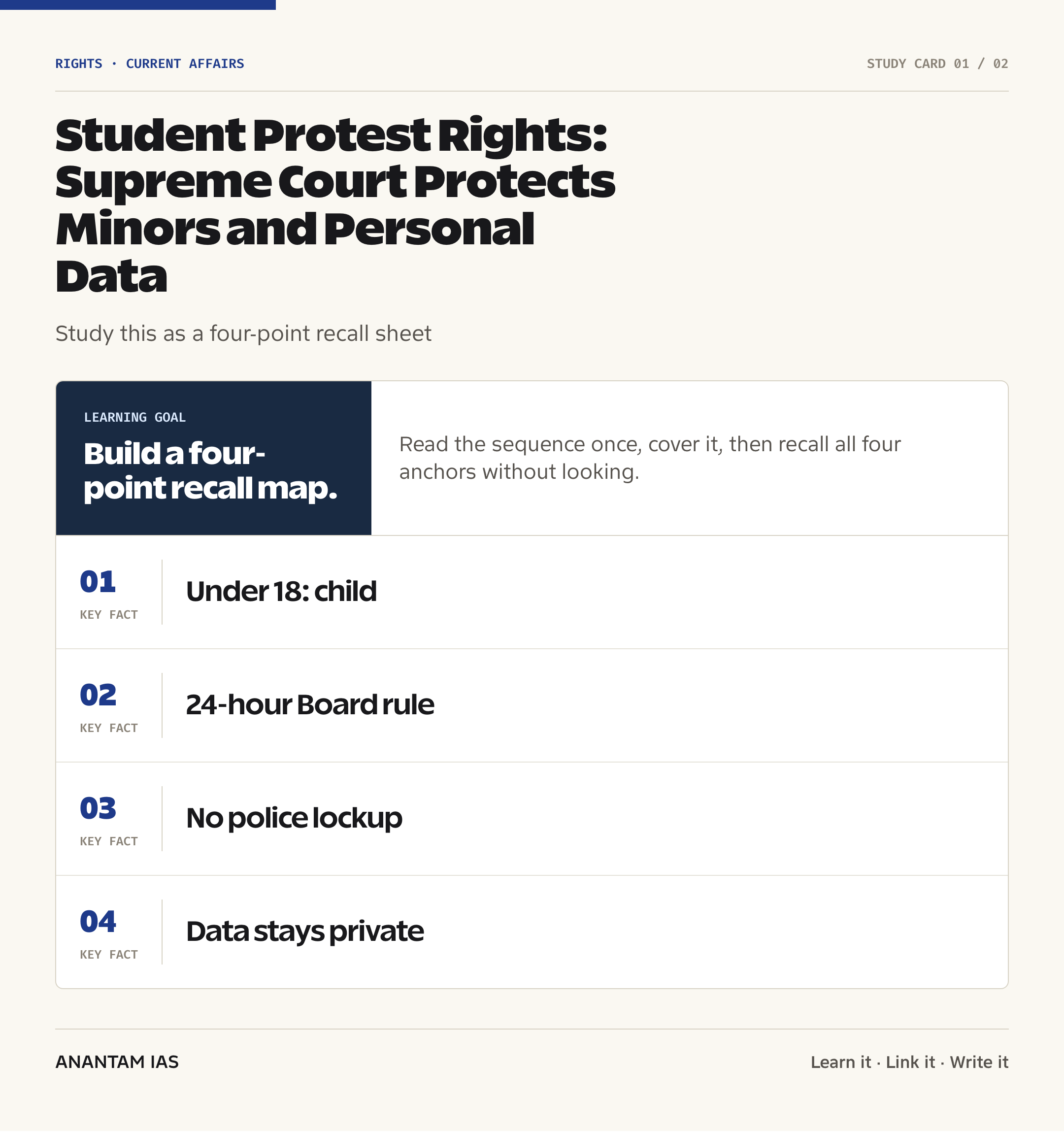
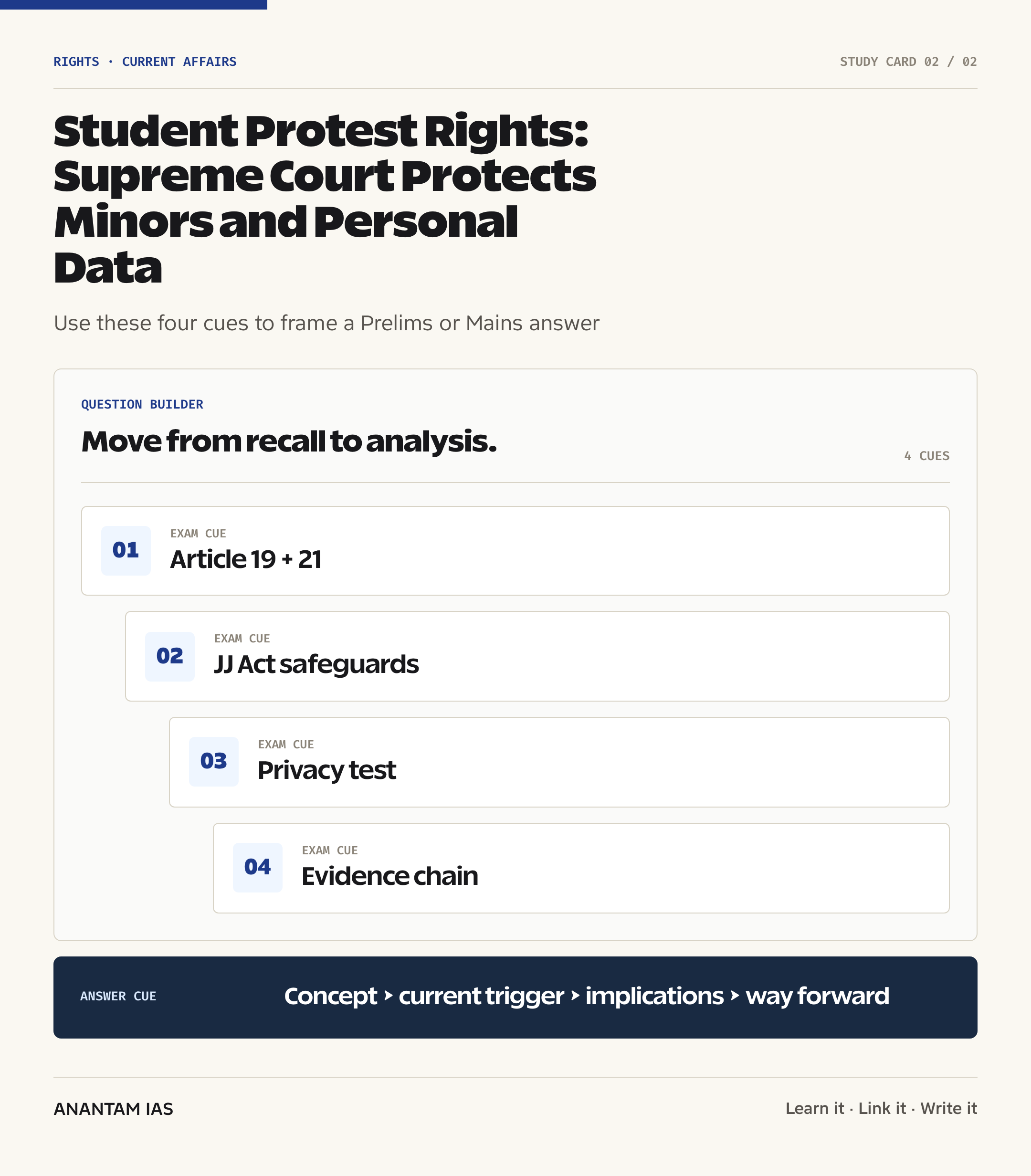
Student Protest Rights: Supreme Court Protects Minors and Personal Data

Open article →Download PDF

Why in News?

On 28 July 2026, a three-judge Supreme Court Bench led by Chief Justice Surya Kant issued interim directions in petitions alleging excessive police action during student protests over examination irregularities. The Court treated the allegations against protesters and police personnel as matters requiring an independent, evidence-based examination rather than a one-sided conclusion.

The reported order directed the release of eligible children below 18 years, restrained coercive measures against protected protesting students, required preservation of surveillance and police records, and barred publication of protesters’ personal information. The directions are interim safeguards; they don’t decide the truth of every allegation or terminate lawful investigation.

  • Authorities may continue investigating registered FIRs, but the reported order bars coercive measures against protesting students covered by its protection; persons with criminal antecedents were excluded.
  • States were directed to release arrested or detained children below 18 years who lacked criminal antecedents, with a simple bond by the child or family if a bond was required.
  • The Court ordered preservation of CCTV footage, drone footage, body-worn-camera recordings, videography, wireless communications and police control-room records connected with the protests.
  • Police and respondent authorities must preserve protesters’ personal information and digital data and keep it out of the public domain for the time being.
  • Notices were issued to the Union, the National Capital Territory of Delhi and several States; the next hearing was reported for 3 August 2026.

The development matters in the context of:

  • The directions connect the freedom of peaceful assembly under Article 19(1)(b) with life, dignity, fair procedure and informational privacy under Article 21.
  • A child apprehended in connection with an alleged offence enters a special statutory system under the Juvenile Justice Act, 2015, not the ordinary adult custodial track.
  • Protest surveillance can serve a legitimate evidentiary purpose, but uncontrolled identification or publication may chill lawful participation and expose students to stigma or retaliation.
  • Preserving official and citizen-generated records protects both sides: it can test allegations of police excess and claims that violent actors infiltrated an otherwise peaceful gathering.
Student Protest Rights: Supreme Court Protects Minors and Personal Data — quick facts

UPSC Relevance

Prelims Relevance

  • Article 19(1)(a) protects speech and expression; Article 19(1)(b) protects citizens’ right to assemble peaceably and without arms.
  • Article 19(3) permits reasonable restrictions on assembly in the interests of India’s sovereignty and integrity or public order.
  • Article 21 protects life and personal liberty; its guarantees include dignity, fair procedure and informational privacy.
  • Justice K.S. Puttaswamy v. Union of India (2017) recognised privacy as a fundamental right and made legality, legitimate State aim and proportionality central to review.
  • The Juvenile Justice Act, 2015 defines a child as a person below 18 years and gives the Act overriding application to apprehension and detention of children in conflict with law.
  • Under Section 10 of the Juvenile Justice Act, an apprehended child must be placed with the Special Juvenile Police Unit or designated Child Welfare Police Officer and produced before the Juvenile Justice Board within 24 hours, excluding journey time.
  • A child alleged to be in conflict with law cannot be kept in a police lockup or jail; Sections 12 and 13 address bail and prompt information to parents or guardians.
  • Under the BNSS, 2023, an arrested person must be informed of the grounds of arrest, a relative or friend must be told about the arrest and detention place, and detention beyond 24 hours requires judicial authority.
  • The Digital Personal Data Protection Act, 2023 supplies a statutory data-governance framework, but its phased commencement must be checked before treating every substantive duty as presently enforceable.

Mains Relevance

GS Paper 2

  • Fundamental Rights: balancing peaceful expression and assembly with public order through legality, necessity, proportionality and procedural safeguards.
  • Vulnerable sections: applying child-specific apprehension, bail, production, confidentiality and rehabilitation rules when minors enter the criminal-justice system.
  • Governance and accountability: judicial supervision, preservation of digital evidence, police record-keeping and remedies for unlawful detention or excessive force.

GS Paper 4

  • Public-service ethics: restraint, impartiality, truthfulness in official records and protection of both peaceful participants and police personnel.
  • Technology ethics: distinguishing evidence preservation from mass exposure, profiling or punitive publication of personal data.

Essay

  • A democracy’s commitment to dissent is tested when public order is under pressure.
  • Childhood changes the State’s duty from ordinary control to protective justice.
  • Digital memory can protect truth, but public exposure can punish before trial.

Background and Context

What the Interim Directions Actually Do

The order creates temporary protection while keeping the underlying investigation and fact-finding open.

  • The Court did not quash every FIR or declare every protest participant innocent; investigation can continue subject to the stated protection from coercive measures.
  • The protection was not framed as universal immunity: the reported text excludes persons with criminal antecedents, making accurate individual identification important.
  • A claim of criminal antecedents should come from verified judicial or police records and remain open to challenge; an allegation, social-media post or facial match isn’t a lawful substitute.
  • Release of children below 18 years is immediate protective relief, not a final ruling on whether any child committed an offence.
  • The reported direction permits a simple bond by the child or family where surety is insisted upon, reducing the risk that inability to furnish demanding conditions prolongs detention.
  • The Court found the allegations sufficient at a prima facie stage to consider an independent and fair probe, while giving governments an opportunity to place their version on record.
  • A useful companion is Anantam IAS’s note on peaceful protest, police force and accountability, which explains the separate use-of-force questions raised a day earlier.
Student Protest Rights: Supreme Court Protects Minors and Personal Data — exam lens

Constitutional Space for Peaceful Protest

India protects dissent through linked freedoms, but the Constitution protects peaceful assembly rather than an unrestricted claim over every place and method.

  • Article 19(1)(a) protects expression, while Article 19(1)(b) protects citizens assembling peaceably and without arms.
  • Restrictions under Article 19(2) and Article 19(3) need legal authority, a constitutionally permitted objective and substantive reasonableness.
  • Public order permits time, place and manner regulation; it doesn’t convert criticism, inconvenience or mere presence at a gathering into proof of violence.
  • Article 14 opposes arbitrary or selectively punitive State action, while Article 21 requires a fair, just and reasonable procedure before liberty is taken away.
  • Article 22(1) requires that an arrested person be informed of the grounds and not be denied the right to consult and be defended by a legal practitioner of choice.
  • Article 32 empowers the Supreme Court to enforce Fundamental Rights, allowing urgent interim relief while disputed facts await affidavits, investigation and final adjudication.
  • The constitutional task is individualisation: isolate persons credibly linked to violence without treating an entire student gathering as one undifferentiated suspect.

Why Minors Require a Separate Justice Track

The Juvenile Justice framework replaces the punitive assumptions of adult custody with protection, inquiry and reintegration.

  • The Juvenile Justice Act, 2015 defines a child as anyone below 18 and applies to all matters concerning apprehension, detention, prosecution, rehabilitation and social reintegration of children in conflict with law.
  • Section 10 requires transfer to the Special Juvenile Police Unit or designated Child Welfare Police Officer and production before the Juvenile Justice Board within 24 hours, excluding journey time.
  • The Act expressly says an alleged child offender must never be placed in a police lockup or jail; if release isn’t granted, the lawful alternatives are child-specific facilities and Board-supervised arrangements.
  • Under Section 12, bail is the statutory starting point even for a non-bailable accusation, subject to recorded grounds involving association with known criminals, danger to the child or defeat of justice.
  • Section 13 requires early information to a parent or guardian and involvement of a probation or child-welfare officer, preventing custodial invisibility.
  • Section 3 directs decision-makers to apply principles of presumption of innocence, dignity, participation, privacy, safety and institutionalisation as a measure of last resort.
  • Confidentiality protects rehabilitation: Section 74 restricts disclosure of identifying particulars of a child in conflict with law or a child in need of care and protection.
  • The wider child-rights framework is reviewed in Anantam IAS’s guide to children’s rights and the Juvenile Justice system.

Ordinary Arrest Safeguards Still Matter

Child-specific law adds protection, while general criminal procedure supplies a baseline against secret or undocumented custody.

  • The BNSS, 2023 requires an arrested person to be told the full grounds of arrest and, where applicable, the right to bail.
  • The arresting authority must promptly tell a nominated relative or friend about the arrest and the place where the person is held.
  • The arrested person has a right under BNSS Section 38 to meet an advocate of choice during interrogation, although not throughout the interrogation.
  • An arrested person cannot be subjected to more restraint than needed to prevent escape, and the authority responsible for custody must protect the person’s health and safety.
  • The ordinary rule against detention beyond 24 hours without judicial authority prevents a police station from becoming an unreviewed site of punishment.
  • The D.K. Basu safeguards add arrest documentation, identification of officers, custody records, medical examination and communication with family as practical checks on abuse.
  • Calling a person for questioning cannot be used as a verbal label to evade the legal consequences of actual restraint; courts examine the substance of control over liberty.

Privacy, Surveillance and the Chilling Effect

Recording a protest for security or evidence is legally different from exposing, profiling or informally punishing everyone captured.

  • In Puttaswamy (2017), the Supreme Court recognised informational privacy as part of the fundamental right to privacy under Article 21 and other freedoms.
  • State intrusion needs legality, a legitimate aim and proportionality; a rational security purpose doesn’t remove the need to consider less restrictive means and safeguards.
  • Proportionality asks whether collection is suitable for the aim, whether an equally effective but less intrusive option exists, and whether the benefit justifies the impact on the right-holder.
  • Publishing names, photographs, contact details or biometric profiles can create a chilling effect: citizens may avoid lawful assemblies because participation leaves a permanent, searchable trail.
  • The Court’s direction separates preservation from disclosure: authorities must retain relevant digital evidence while keeping personal information outside the public domain.
  • The DPDP regime helps frame purpose limitation, security and accountability, but students should distinguish the constitutional rule from provisions whose phased commencement may not yet be complete.
  • For the broader statutory architecture, see Anantam IAS’s analysis of the DPDP Act and privacy.

Evidence Preservation as Police Accountability

A credible inquiry depends on a complete record that can test the conduct of protesters, commanders and field personnel alike.

  • CCTV and drone footage can establish location, sequence, warnings, crowd movement and the identity of persons linked to specific acts.
  • Body-camera recordings, wireless traffic and PCR logs can reveal who ordered an operation, what threat was reported and when force or detention occurred.
  • Preservation should include metadata, access logs and tamper-evident copies so investigators can prove authenticity and chain of custody.
  • A preservation direction should trigger an immediate litigation hold: routine deletion schedules must pause, custodians must be identified and every later transfer should be logged.
  • Police deployment records, general diaries, arrest memos and medical reports should be compared with videos rather than treating any single clip or official denial as conclusive.
  • Access must be role-based: evidence can remain available to a court or inquiry without being circulated publicly or repurposed for unrelated profiling.
  • A symmetrical inquiry protects police personnel too, because verified footage can identify actual assailants and rebut false attribution to a unit or officer.

Rights, Public Order and Individual Responsibility

The strongest constitutional answer rejects both blanket impunity and blanket suspicion.

  • Peaceful students retain Fundamental Rights; participation in an agitation isn’t by itself evidence of conspiracy, violence or criminal antecedents.
  • A person who commits violence can be investigated under ordinary law, but responsibility should rest on specific conduct and evidence, not proximity, age group or political opinion.
  • Organisers should maintain liaison channels, communicate lawful routes, discourage weapons and create exits so peaceful participants can separate from emerging disorder.
  • Police should use warning, negotiation, barriers, targeted intervention and the least harmful effective response before escalating against a mixed crowd.
  • Courts supply emergency safeguards and independent review, but lasting reform requires clear statutes, protocols, trained child-welfare personnel and auditable police systems.

Way Forward

Make Child Safeguards Operational

  • Deploy trained Child Welfare Police Officers at major demonstrations where minors are expected and create a direct handover protocol to Special Juvenile Police Units.
  • Digitally record age verification, family notification, time of apprehension, place of custody and production before the Juvenile Justice Board.

Separate Evidence from Public Exposure

  • Store protest footage in a secure evidence repository with role-based access, retention rules, audit trails and a prohibition on unofficial circulation.
  • Use facial or biometric identification only under clear legal authority, demonstrated necessity and independent review; don’t turn a crowd archive into an open-ended watchlist.

Individualise Police Action

  • Require a documented basis linking each proposed coercive step to a person’s specific conduct, with special scrutiny when the person is a student or child.
  • Give written grounds, access to counsel, prompt family information and a usable complaint route instead of informal summons, pressure through relatives or undocumented restraint.

Preserve a Verifiable Record

  • Issue immediate litigation-hold notices covering footage, wireless logs, deployment orders, arrest records and medical material, backed by checksums and chain-of-custody documentation.
  • Let an independent inquiry examine injuries to both protesters and police so accountability rests on verified sequence, command and individual action.

Design Safer Protest Management

  • Create announced protest spaces, liaison teams, audible warnings, open exit routes and child-sensitive dispersal plans before a large gathering begins.
  • Train personnel in de-escalation, juvenile justice, privacy and evidence handling, and publish anonymised after-action findings for institutional learning.

Conclusion

The Supreme Court’s interim directions don’t grant immunity from lawful investigation. They insist that investigation occur without turning student status, childhood or digital visibility into a shortcut around constitutional procedure.

The durable lesson is that rights and accountability reinforce each other. Release and child-specific process protect minors; privacy safeguards prevent punishment by exposure; preserved evidence allows an impartial inquiry to identify both unlawful force and actual violence. Democratic policing succeeds when the State can maintain order and still remain visibly bound by law.

UPSC Practice Questions

Prelims MCQ 1

With reference to the Juvenile Justice (Care and Protection of Children) Act, 2015, consider the following statements:

  1. A child means a person who has not completed 18 years of age.
  2. A child alleged to be in conflict with law cannot be placed in a police lockup or lodged in a jail.
  3. An allegation of a non-bailable offence automatically excludes the child from bail.

How many of the above statements are correct?

(a) Only one (b) Only two (c) All three (d) None

Answer: (b) Only two

Explanation:

Statements 1 and 2 are correct. Section 12 makes release on bail the starting rule even for a bailable or non-bailable accusation, subject to limited, recorded exceptions; so statement 3 is incorrect.

Prelims MCQ 2

Which one of the following best states the constitutional test for an invasion of informational privacy?

(a) Administrative convenience alone (b) Prior publication of the information by any private person (c) Legality, a legitimate State aim and proportionality (d) Approval by the investigating police station alone

Answer: (c) Legality, a legitimate State aim and proportionality

Explanation:

The Puttaswamy privacy jurisprudence requires a legal basis, a legitimate need and a proportionate relationship between the State’s objective and the means used, supported by safeguards.

UPSC Mains Questions

  1. The release of detained minors and protection of protesters’ personal data show that public-order administration must remain child-sensitive and privacy-respecting. Examine the constitutional and statutory safeguards that should govern police action against students during mass protests.
  2. Preserving protest footage can advance accountability, while publishing or repurposing the same data can chill democratic participation. Discuss how legality, proportionality, purpose limitation, chain of custody and independent oversight can reconcile these competing concerns.

Sources: Supreme Court of India and India Code and The Hindu and The Indian Express.

Frequently Asked Questions

What did the Supreme Court direct?

The reported interim order allowed investigation of protest-related FIRs to continue but restrained coercive measures against protected students, excluded persons with criminal antecedents, directed release of eligible children below 18, required preservation of police and surveillance records, and barred protesters’ personal data from being placed in the public domain.

Did the Court cancel all FIRs?

No. The Court reportedly permitted Delhi and other States to continue investigating registered FIRs. Its immediate intervention concerned coercive measures, release of eligible minors, evidence preservation and data protection. A temporary safeguard doesn’t decide guilt, innocence or the final legality of every police or protest action.

Can police keep a minor in lockup?

No. Section 10 of the Juvenile Justice Act says a child alleged to be in conflict with law cannot be placed in a police lockup or jail. The child must be placed with the designated child-welfare police machinery and produced before the Juvenile Justice Board within 24 hours, excluding journey time.

Why preserve data but restrict publication?

Preservation keeps evidence available for a court or independent inquiry. Publication exposes individuals beyond the needs of the case and may cause stigma, harassment or a chilling effect on lawful protest. Secure retention, limited access and non-disclosure can protect evidentiary value and informational privacy at the same time.

Is peaceful protest an absolute right?

No. Articles 19(1)(a) and 19(1)(b) protect expression and peaceful, unarmed assembly, but Articles 19(2) and 19(3) permit reasonable restrictions for specified interests, including public order. Regulation must still be lawful and proportionate, and isolated violence should be attributed through evidence rather than collective suspicion.

Does the DPDP Act alone govern protest surveillance?

No. Constitutional privacy under Article 21 and Puttaswamy applies independently of the DPDP Act. The Act adds a data-governance framework, but its provisions commenced in phases. Any answer should check which duties are operational and also examine criminal procedure, juvenile justice, police rules and the Court’s case-specific directions.