3 current affairs published on Monday, 3 November 2025
3 November 2025 Current Affairs for UPSC — every
Why-in-News article AnantamIAS published on Monday, 3 November 2025, broken down with
Why in News?, the exact GS paper it feeds, sub-topic mapping, MCQ-ready facts and a
UPSC-style practice question. 3 articles in total, covering Polity, Economy, Environment, S&T, IR, Geography, History, Society and Internal
Security — the same Why-in-News + GS-paper-mapping + practice-question format the Compass uses across
every daily digest on the site.
Daily current affairs for UPSC is where new material enters your prep stream. Read this
3 November 2025 digest end-to-end in 25–35 minutes, attempt the practice question
at the foot of each article (it's MCQ for some, 10/15-marker for others), then bookmark the entries
that fall inside your active revision window. Everything stays cross-linked: tap any subject pill to jump
to that subject's hub, or use the table of contents above to skip straight to a specific story.
Why we publish daily current affairs separately from the monthly compilation: daily is learning,
monthly is revision. Use the daily page to add fresh material to your notes the day it breaks;
come back to the November 2025 compilation 60 days before Prelims when the
noise has settled and only the lasting takeaway is worth re-reading.
ISRO Successfully Launches India’s Heaviest Communication Satellite GSAT-7R from Indian soil.
UPSC Relevance
Prelims, Latest space technologies and Related developments
PYQ
Consider the following Space missions :
I. Axiom-4
II. SpaDeX
III. Gaganyaan
How many of the space missions given above encourage and support micro-gravity research?
(a) Only one
(b) Only two
(c) All the three
(d) None
Launch Details
The Indian Space Research Organisation (ISRO) successfully launched the Indian Navy’s advanced communication satellite, GSAT-7R (also known as CMS-03), on Sunday.
The launch took place from the Satish Dhawan Space Centre in Sriharikota at about 5:26 p.m.
It was launched aboard ISRO’s most powerful launch vehicle, the LVM3 (M5 mission).
Satellite Significance & Specifications
Weighing approximately 4,400 kg (or 4,410 kg), it is the heaviest Indian-built communication satellite launched from Indian soil to date.
The previous heavier satellite (GSAT-11, 5,800 kg) was launched using a European Ariane-5 rocket.
Its launch demonstrates the heavy-lift capability of the LVM3 rocket, the same vehicle used for the Chandrayaan-3 mission.
The satellite was successfully placed into a Geosynchronous Transfer Orbit (GTO).
Purpose and Benefits for the Indian Navy
It is the most advanced satellite serving the needs of the Indian Navy, replacing the GSAT-7 satellite launched in 2013.
It will provide robust, secure telecommunication coverage across the Indian Ocean Region.
The satellite will augment the Navy’s space-based communications and maritime domain awareness capabilities.
Its advanced payload supports voice, data, and video links across multiple bands, ensuring seamless connectivity between Navy ships, submarines, aircraft, and Maritime Operations Centres.
Technological Milestones & Future Implications
The launch highlights India’s growing self-reliance (“Atmanirbhar Bharat”) and technological independence in space.
The LVM3 rocket’s performance was improved, and its payload capacity was enhanced by 10% for this mission.
A key experiment was successful: the re-ignition of the thrust chamber of the indigenous C25 cryogenic stage after injecting the satellite, which will enable flexibility for placing multiple satellites in various orbits in the future.
This success is an important step toward reducing foreign dependence and supporting future missions like Gaganyaan and the Bharat Antariksh Station, which require heavy-lift capability.
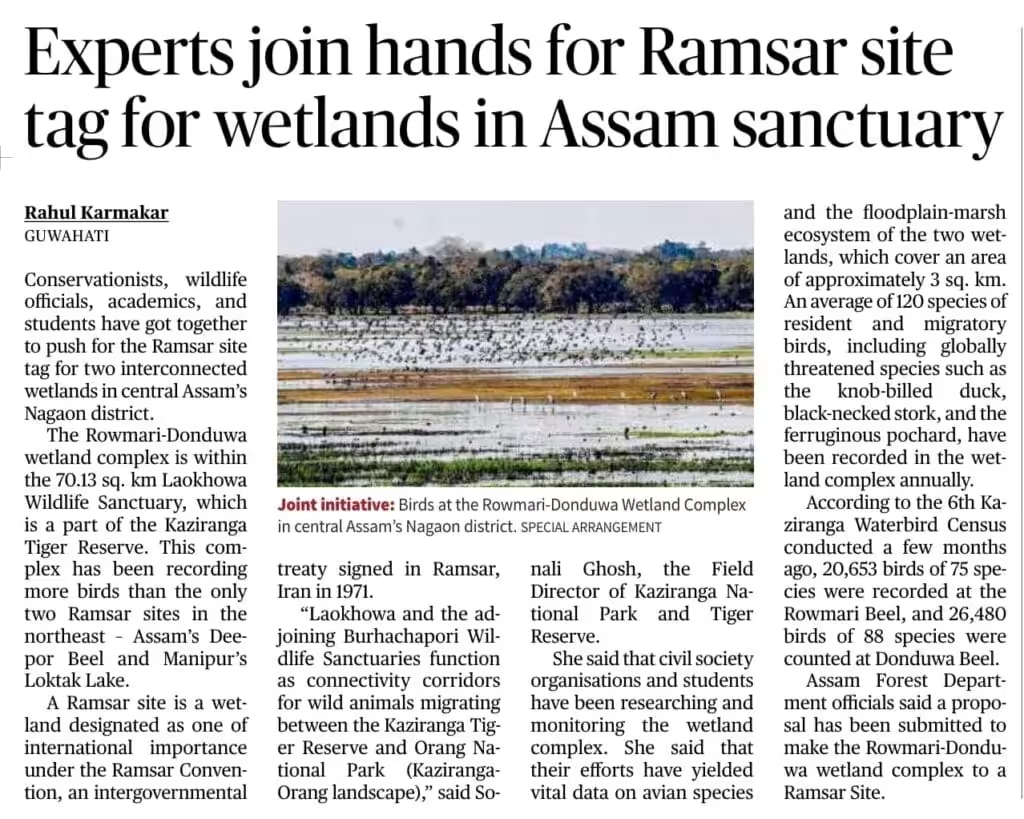
Experts, conservationists, and wildlife officials have come together to push for Ramsar site recognition for the Rowmari-Donduwa Wetland Complex located within the Laokhowa Wildlife Sanctuary in Nagaon district, Assam.
Wetland Complex:
The Rowmari-Donduwa complex lies within the 70.13 sq. km Laokhowa Wildlife Sanctuary, which forms part of the Kaziranga Tiger Reserve.
Ecological Importance:
The wetlands form a floodplain-marsh ecosystem covering nearly 3 sq. km.
Home to over 120 bird species, including migratory and globally threatened species like:
Knob-billed Duck
Black-necked Stork
Ferruginous Pochard
Acts as a connectivity corridor for wildlife moving between Kaziranga Tiger Reserve, Orang National Park, and other protected areas (Kaziranga-Orang landscape).
UPSC Relevance:
Environment(GS3)
UPSC PYQ:
Mains:
Q. What is wetland? Explain the Ramsar concept of ‘wise use’ in the context of wetland conservation. Cite two examples of Ramsar sites from India.
Prelims:
Q. Consider the following statements
Under Ramsar Convention, it is mandatory on the part of the Government of India to protect and conserve all the wetlands in the territory of India.
The Wetlands (Conservation and Management) Rules, 2010 were framed by the Government of India based on the recommendations of Ramsar Convention.
The Wetlands (Conservation and Management) Rules, 2010 also encompass the drainage area or catchment regions of the wetlands as determined by the authority.
Which of the statements given above is/ are correct?
(a) 1 and 2 only
(b) 2 and 3 only
(c) 3 only
(d) 1, 2 and 3
About Ramsar Convention:
The ‘Convention on Wetlands’, signed in Ramsar, Iran in 1971 is an intergovernmental treaty which provides the framework for national action and international cooperation for the conservation and wise use of wetlands and their resources.
Wetlands are the only ecosystem to have a dedicated multilateral environmental agreement of their own, the Ramsar Convention.
Under the “three pillars” of the Convention, the Contracting Parties commit to:
work towards the wise use of all their wetlands.
Designate suitable wetlands for the list of Wetlands of International Importance (the “Ramsar List”) and ensure their effective management.
Co-operate internationally on trans-boundary wetlands, shared wetland systems and shared species.
The Convention’s mission is “the conservation and wise use of all wetlands through local and national actions and international cooperation, as a contribution towards achieving sustainable development throughout the world”.
What is Wetland:
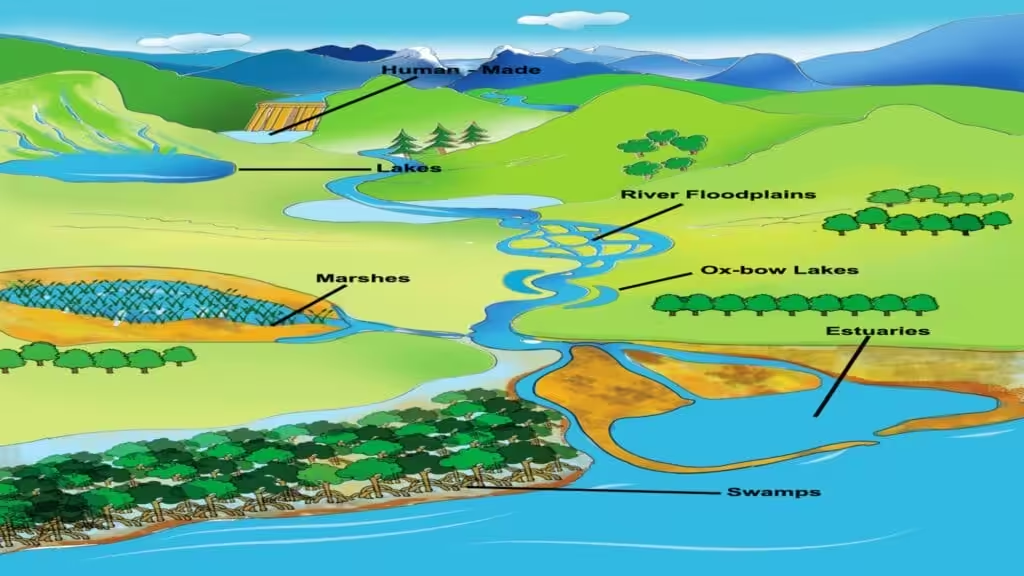
The Convention uses a broad definition of wetlands. It includes all lakes and rivers, underground aquifers, swamps and marshes, wet grasslands, peatlands, oases, estuaries, deltas and tidal flats, mangroves and other coastal areas, coral reefs, and all human-made sites such as fish ponds, rice paddies, reservoirs and salt pans.
Wise use of wetland:
Developing integrated management plans at wetland sites.
Adopting national wetland policies, either separately or as a component of wider initiatives such as national environmental action plans;
Developing programmes covering wetland inventory, monitoring, research, training, education and public awareness;
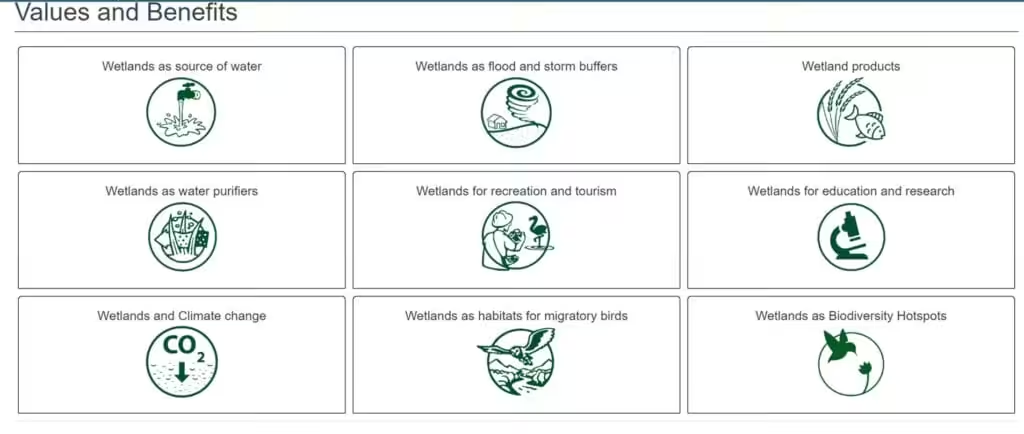
Valuable Benefits of Wetland:
Montreux Record:
The Montreux Record is a register of wetland sites on the List of Wetlands of International Importance where changes in ecological character have occurred, are occurring, or are likely to occur as a result of technological developments, pollution or other human interference.It is maintained as part of the Ramsar List.
India and the Ramsar Convention:
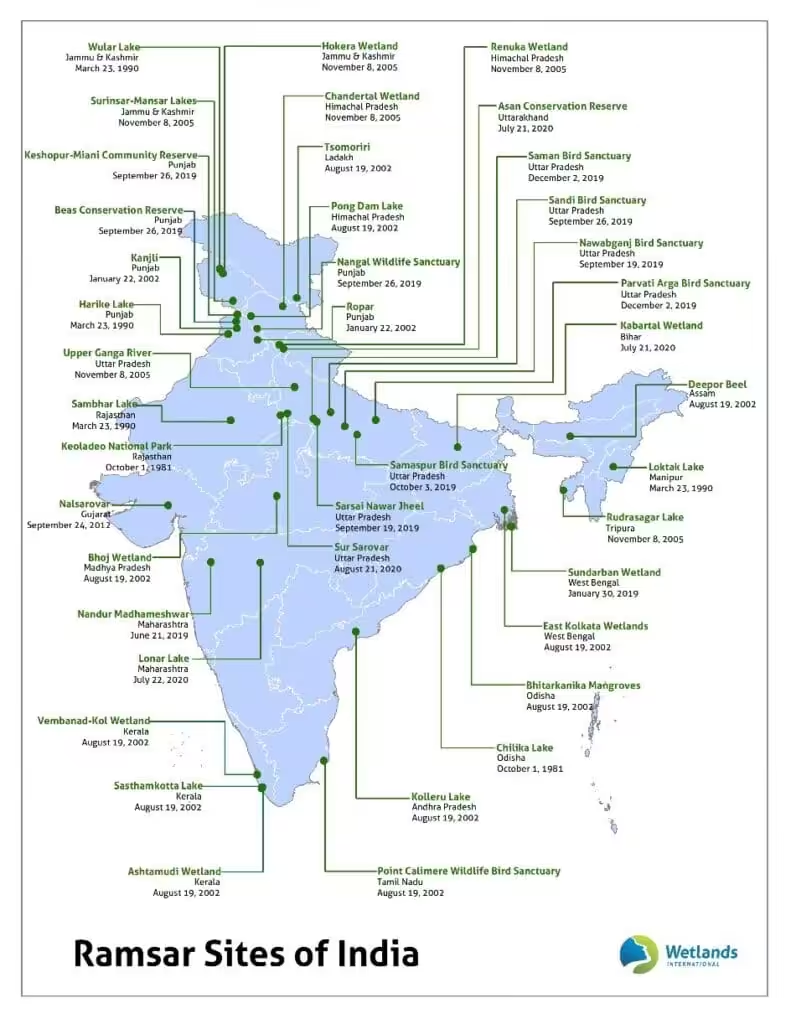
India became a party to the Convention on 01.02.1982 and has so far designated more than 41 wetlands.
Challenges:
Siltation – Each year, approximately 3 million tonnes of silt are deposited in Chilika Lake.
Pollution – These issues are especially severe in urban wetlands such as Hussain Sagar (Hyderabad, Andhra Pradesh), Lower Lake (Bhopal, Madhya Pradesh), Dal Lake (Srinagar, Kashmir), and others.
Urbanization
Encroachment – Because wetlands contain different value systems, parts of them have been changed for agriculture and other development purposes.
Eutrophication: Except for high altitude transHimalayan glacial lakes, the process of water quality degradation caused by excessive nutrients is a severe challenge that all wetlands in India face.
Wetlands (Conservation and Management) Rules, 2017:- Sustainably conserve and manage wetlands in India by shifting management from a central authority to decentralized, state-level authorities, enforcing the principle of “wise use,” and prohibiting activities like encroachment and industrial discharge.
Action Plan of MoEFCC: The Ministry of Environment, Forest and Climate Change (MoEFCC) supports the implementation of management action plans for over 250 wetlands under schemes such as National Plan for Conservation of Aquatic Ecosystems, Mangroves and Coral Reefs, and Integrated Development of Wildlife Habitats.
Mission Participation: Effectively manage 75 wetlands of national and international importance by 2022, Ministry of Environment, Forest and Climate Change.
National Wetland Committee: To advise the Central Government on proposals received from States/Union Territories for removal of prohibited activities. To lay down guidelines for integrated management of wetlands based on the principle of wise use.
The government aims to conserve wetlands to avoid the impact of natural disasters, it emphasizes its preservation due to the role wetlands play in reducing the impact of floods and storms. It stresses the need to integrate state participation in policy, planning, and regulation of wetlands and highlights the importance of including the local communities in the effort to preserve the wetlands which includes undertaking awareness.
Context: In the context of recent crackdown on Naxalite and subsequent surrender in increasing number has led the authors of the editorial to analyse the root sensitivity of Naxalism and India’s strategy in dealing with it as we aim at a Naxal Mukt Bharat till 31st March 2026.
UPSC Relevance
As far as UPSC CSE mains is concerned, “naxalism” has been a recurring theme.
GS paper III, Linkages between development and spread of extremism.
PYQ: 2022
Naxalism is a social, economic and development issues manifesting as a violent internal security threat. In this context, discuss the emerging issues and suggest a multilayered strategy to tackle the menace of Naxalism.
PYQ: 2018
Left Wing Extremism (LWE) is showing a downward trend, but still affects many parts of the country. Briefly explain the Government of India’s approach to counter the challenges posed by LWE.
PYQ: 2015
The persisting drives of the Government for development of large industries in backward areas have resulted in isolating the tribal population and the farmers who face multiple displacements. With Malkangiri and Naxalbari foci, discuss the corrective strategies needed to win the Left Wing Extremism (LWE) doctrine affected citizens back into the mainstream of social and economic growth.
Insights in the editorial
India’s Contradiction: The Naxalite Challenge
India’s Moral Identity: India is the cradle of four major religions (Hinduism, Buddhism, Jainism, Sikhism) and has historically stood for peace, compassion, non-violence, and dialogue.
The Internal Conflict: The Naxalite movement presents a severe contradiction by pursuing its goals through violence and bloodshed within this same land.
National Cost: This internal insurgency drains India’s moral and material strength, multiplying the costs of peace in financial terms and eroding human confidence and national cohesion.
Challenging the Poverty Narrative on Naxalism
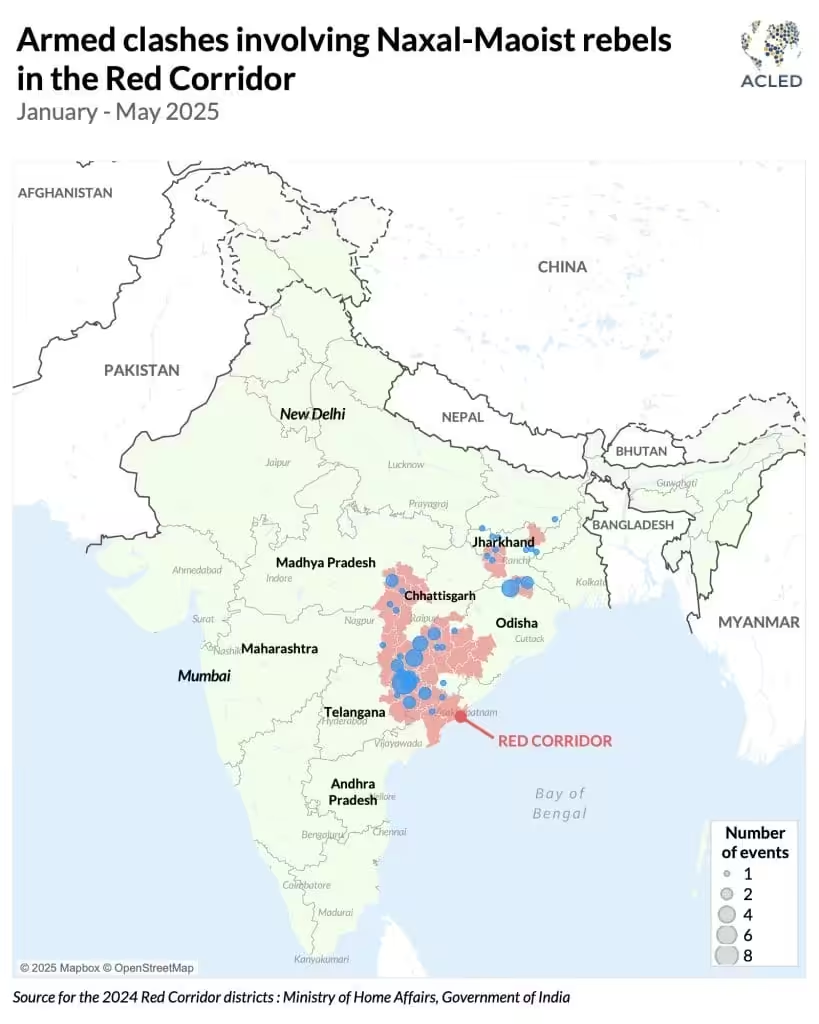
Geographic Pattern: The insurgency is largely confined to the “Red Corridor” (Jharkhand, Chhattisgarh, parts of Odisha, and Bihar), while other states with comparable or worse poverty levels remain largely unaffected, suggesting deeper issues are at play.
The Flawed Explanation: The dominant, yet convenient, narrative that Naxalism is simply a byproduct of poverty and underdevelopment is contradicted by evidence.
Destruction of Development: Naxalites routinely destroy schools, railway tracks, and telecom towers—the very infrastructure intended to alleviate poverty. Such acts reset development and worsen unemployment.
Empirical Evidence: Studies show that economic indicators like poverty or unemployment are weak predictors of political violence. Instead, ideology, state capacity, and identity-based grievances are more influential.
Actual Root Causes: The core issue is identified as a governance challenge, rooted in local governance deficits, historical neglect, poor law enforcement, and political manipulation. Extremism finds no audience where the state is visible, accountable, and responsive.
What does Naxalism mean?
Naxalism, which is also known as Left Wing Extremism (LWE), is a violent movement based on Maoist ideas that wants to use armed revolution to bring down the Indian government. At first, it was a fight for land rights and justice for the impoverished and indigenous people, but it later escalated into an armed uprising.
Rise of Naxalism
The Naxalbari Uprising in 1967 was the beginning of it all.
In 1967, a handful of extreme Communists spearheaded a violent demonstration by landless farmers against landowners in Naxalbari, a small village in West Bengal.
Charu Majumdar, Kanu Sanyal, and Jangal Santhal were the leaders. They were inspired by Mao Zedong’s revolution in China and thought that armed resistance was the best way to get justice.
Their slogan, “Land to the tiller,” was similar to the call for poor farmers to own the land they work on. The movement suddenly became violent, and the police had to step in. The movement fell apart for a while after Charu Majumdar died in 1972.
The Movement Grows After Charu Majumdar(1970s–2000)
After the first phase, Naxalism broke up into a lot of little groups all over India. Vinod Mishra (Liberation group) and Kanhai Chatterjee (Dakshin Desh) are two new leaders who came to power.
People’s War Group (PWG) and Maoist Communist Centre (MCC) have grown in power in Bihar and Andhra Pradesh. There were a lot of violent fights between Naxalites and private armies, such Ranvir Sena, especially in areas of Bihar where there were caste conflicts.
A New Force: The Rise of CPI (Maoist) from 2004 on
The Communist Party of India (Maoist) was formed in 2004 after two big groups, the PWG and the MCC, joined forces. It is the strongest Naxal group thus far. They put together a military group named the People’s Liberation Guerrilla Army (PLGA).
Their aim: to create a “Red Corridor” from Nepal to South India by controlling tribal and forest regions through violence and intimidation.
Maoist Strategy and Tactics
They have a three-stepplan for war:
Set up a base in distant tribal areas
Grow your power and focus on government infrastructure
Finally, start a full-scale fight to take over.
They kill people who disagree with them, tear down schools and roads, and tax local contractors.
Maoist ideas praise violence and say they are fighting for the rights of the impoverished and indigenous people.
Factors leading to rise of Naxalism
1. Land-Related Factors
Failure of land reforms & evasion of ceiling laws
LWE traces its roots to agrarian inequality—beginning with the 1967 Naxalbari uprising when land reforms failed in West Bengal (failure to redistribute excess land led to tribal revolt).
Special exemptions & encroachments on government/community lands
Studies have shown widespread alienation of government land by powerful local elites. In Odisha’s Koraput region (Maoist‑affected), lands meant for tribal cultivation were encroached, stoking grievance-driven rebellion.
Lack of title/public land rights & non-regularization of traditional rights
Despite the Forest Rights Act, 2006 (FRA), millions of claims are pending. In Kerala’s Muthanga incident (2003), tribals occupied sanctuary land demanding promised pattas. The state forcibly evicted them, leading to conflict and loss of trust in governance.
Eviction from traditionally used tribal land
At Niyamgiri (Odisha), Vedanta’s proposed bauxite mining was only blocked after Gram Sabhas (under FRA and PESA) refused consent, asserting ancestral rights. The case highlights how forcible displacement fuels tribal solidarity—often mobilized politically.
2. Displacement & Forced Evictions
Major infrastructure projects causing displacement
The Rihand Dam in Singrauli displaced over 50,000 people across multiple phases, with no resettlement. Research highlights repetitive displacements and lost livelihoods—breeding resentment and support for insurgents.
Mining in forested regions
In Chhattisgarh’s Hasdeo Arand, massive coal mining has displaced Adivasi communities, degraded environment, and fueled local opposition—often leading to Maoist influence in protest zones.
3. Livelihood-Related Causes
Food insecurity and corruption in PDS
Studies corroborate that poor PDS functioning in LWE zones worsens food insecurity, making deprived families susceptible to extremist appeals.
Disruption of traditional occupations & lack of alternative livelihoods
In Koraput and other districts, traditional livelihoods (like gathering forest produce) have declined without replacement jobs. Disengaged youth become easier to recruit for extremist cadres.
Deprivation from common property resources
The sanctioned establishment of tiger corridors (e.g. Telangana) has threatened grazing and forest access—stirring tribal resistance. These conflicts amplify perceptions of denial of customary rights
4. Social Exclusion & Denial of Rights
Untouchability & caste-based exclusion
While less directly documented, multiple reports point out that exclusion of SC/ST communities—e.g., denial of entitlements and representation—feeds into LWE recruitment by portraying the state as indifferent or hostile.
Poor implementation of special protections
Even after laws like SC/ST (PoA) Act and Bonded Labour Abolition, many victims remain unprotected due to weak enforcement. Academic reviews show rising distrust in state machinery in tribal districts.
5. Governance Deficit and Public Service Failure
Corruption and non-availability of services
In districts under LWE influence, governance indices are poor. Delineations reveal absenteeism and incompetence of public officials in health, education, and welfare delivery.
Misuse of police powers & lack of justice
Reports of fake encounters, arbitrary detentions, and rights violations (especially during Operation Kagar or Salwa Judum) have deepened alienation. Salwa Judum, a state-supported militia in Chhattisgarh, led to displacement of tribals, human rights abuses, and strengthened Naxal narratives of state oppression.
Electoral distortions & poor Panchayat governance
Tribal regions often fail to gain real voice despite PESA and FRA. Gram Sabhas are bypassed or intimidated—weakening participatory decision-making and reinforcing distrust in institutional democracy.
Cause Category
Case Study / Region
Core Finding
Land Rights
Naxalbari / Koraput / Muthanga / Niyamgiri
Denied land rights ignite tribal instability and revolt
Displacement
Rihand Dam, Hasdeo Arand
Repeated displacement without compensation fuels dissent
Livelihood & Food Security
Koraput, PDS failures, loss of forest income
Loss of traditional livelihoods leads to radicalisation
Social Exclusion
Failures in SC/ST Act enforcement
State inaction exacerbates exclusion
Governance Deficit
Salwa Judum, absenteeism, lack of public services
Failures of justice and administration strengthen extremism
Dealing with Naxalism
India’s Multi-Pronged Strategy for Naxal-Mukt Bharat
The Government of India believes in a holistic long-term policy in the areas of security, development, ensuring rights and entitlements of local communities, improving governance and perception management to combat LWE.
Collaborative Security Approach
The Central Government, recognizing that insurgency ignores administrative boundaries, has adopted a collaborative approach, providing intelligence coordination, logistical/financial aid, and deploying Central Armed Police Forces.
Most of the security related measures, apart from deployment of CAPFs, are aimed at assisting capacity building by the State forces.
‘Police’ and ‘Public Order’ being State subjects, action on maintenance of law and order lies primarily in the domain of the State Governments. The Central Government closely monitors the situation and supplements and coordinates their efforts in several ways. The underlying philosophy is to enhance the capacity of the State Governments to tackle the Maoist menace in a concerted manner.
These include:
Providing Central Armed Police Forces (CAPFs) and Commando Battalion for Resolute Action (CoBRA); Sanction of India Reserve (IR) battalions, setting up of Counter Insurgency and Anti-Terrorism (CIAT) schools
Modernisation and upgradation of the State Police and their Intelligence apparatus under the Scheme for Modernization of State Police Forces (MPF scheme)
Reimbursement of security related expenditure under the Security Related Expenditure (SRE) Scheme
Providing helicopters for anti-naxal operations, assistance in training of State Police through the Ministry of Defence, the Central Police Organisations and the Bureau of Police Research and Development; Sharing of Intelligence
facilitating inter-State coordination; assistance in community policing and civic action programmes etc.
Undermining Ideology through Development
The strategy focuses on undermining Naxalite social and ideological roots by:
Establishing Skill Development Centres, ITIs, and Eklavya Model Residential Schools to provide youth with alternatives to militancy.
Massive infrastructure development (roads, telecom towers) to extend the reach and legitimacy of the state into isolated regions.
On the development front, an Integrated Action Plan (now called Additional Central Assistance to LWE affected districts) covering 88 affected districts aims at providing public infrastructure and services and is under implementation since 2010. Further, an ambitious Road Development Plan has been envisaged for LWE areas.
An Empowered Group of Officers closely monitors the progress of flagship schemes. Special emphasis is being laid on the implementation of the Forest Rights Act and ensuring entitlement of local communities over Minor Forest Produce.
The government uses the ‘Clear, hold and develop’ strategy as a tool to win back the support of the tribal population, who overwhelmingly appear to sympathize with the extremists.
Review and Monitoring Mechanisms
To give special focus to development in the LWE affected areas, MHA has been reviewing the LWE situation regularly through a number of review and monitoring mechanisms. Reviews cover operational and developmental issues including those of other Ministries of the Government of India.
The Union Home Minister convenes the meetings of Chief Ministers of LWE affected States.
The Union Home Minister and the Minister of States (Home) visit LWE affected States to review the LWE situation. Review Group Meeting under the chairmanship of the Cabinet Secretary.
Meetings by Union Home Secretary with Secretaries of Central Ministries and Chief Secretaries of the LWE affected States and Central Ministries.
Empowered Committee under Additional Secretary (LWE) to review the progress of various developmental schemes/projects.
Important Schemes for LWE Affected States
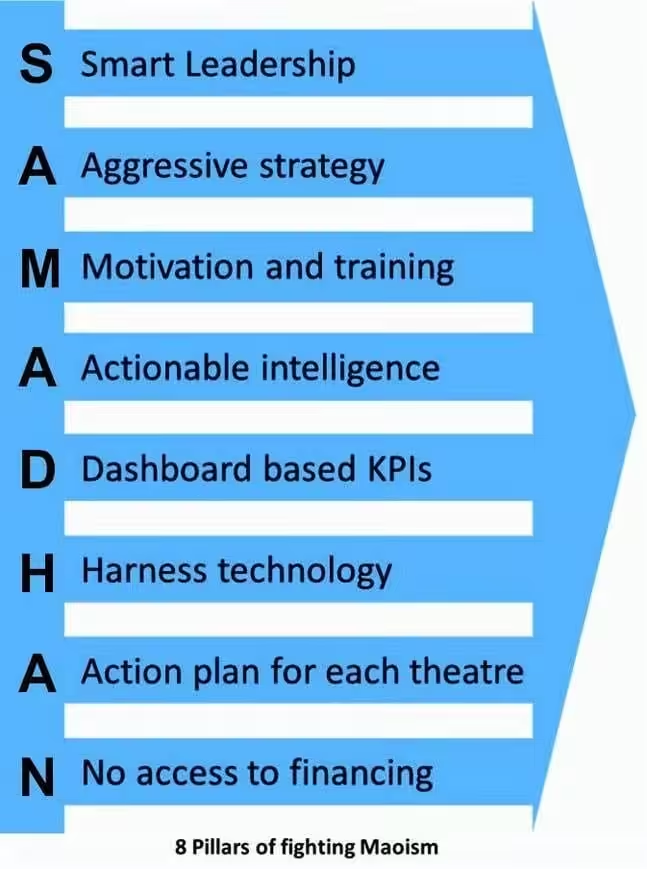
SAMADHAN Scheme: During a review meeting of the Chief Ministers of the LWE affected States in May, 2017, the Union Home Minister enunciated an integrated strategy through which the LWE can be countered with full force and competence. The new strategy is called SAMADHAN, which is a compilation of short term and long term policies formulated at different levels.
Offensive strategy: In 2022, security forces have achieved unprecedented success in Operation Octopus, Operation Double Bull, and Operation Chakrabandha in fight against LWE.
Security Related Expenditure (SRE) Scheme: Under the Security Related Expenditure (SRE) Scheme, the Central Government reimburses security related expenditure for LWE affected districts and districts earmarked for monitoring. The reimbursement includes training and operational needs of security forces, ex-gratia payment to the family of civilians/security forces killed/injured in LWE violence, compensation to Left Wing Extremist cadres who surrendered in accordance with the surrender and rehabilitation policy of the concerned State Government, community policing, Security related infrastructure for village defence committees and publicity materials.
Special Central Assistance (SCA) for 30 most LWE affected districts: The main objective of the Scheme is to fill the critical gaps in Public infrastructure and Services, which are of emergent nature. Special Infrastructure Scheme, along with Construction of Fortified Police Stations in the LWE affected States. The Ministry had sanctioned 400 police stations in 10 LWE affected States. Of these 399 of PSs have been completed.
Assistance to Central Agencies for LWE management Scheme: Under the Scheme, assistance is provided to Central Agencies (CAPFs/IAF etc.) for strengthening of infrastructure and hiring charges for Helicopters.
Civic Action Programme (CAP): CAP in LWE affected areas has been implemented since 2010-11 to bridge the gaps between Security Forces(SFs) and local people through personal interaction and bring the human face of SFs before the local population. Under the Scheme, funds are released to the CAPFs, deployed in LWE affected areas, for conducting various civic activities for the welfare of the local people.
Media Plan: The Maoists have been misguiding and luring the innocent tribals/ local population in LWE affected areas by their So-called poor-friendly revolution through petty incentives or by following their coercive strategy. Their false propaganda is targeted against the security forces and the democratic setup. Therefore, the Government is implementing this Scheme in LWE affected areas.
Under the scheme activities like Tribal Youth Exchange programmes organised by Nehru Yuva Kendra Sangathan (NYKS), radio jingles, documentaries, pamphlets etc. are being conducted.
Road Requirement Plan-I (RRP-I and RRP-II) for LWE affected areas: This Scheme is being implemented by Ministry of Road Transport & Highways for improving road connectivity in 34 LWE affected districts of 8 States i.e. Andhra Pradesh, Bihar, Chhattisgarh, Jharkhand, Madhya Pradesh, Maharashtra, Odisha and Uttar Pradesh.
LWE Mobile Tower Project: To improve mobile connectivity in the LWE areas, the Government approved installation of mobile towers in LWE affected States and 2335 mobile towers have been installed in Phase-I. Phase-II of the project has been approved by the Government of India, under which 4072 mobile towers, will be installed in LWE affected States.
Aspirational District: The Ministry of Home Affairs has been tasked with the monitoring of Aspirational districts programme in 35 LWE affected districts. GIS Mapping: The project has been initiated for mapping of financial services, school, post offices, health facilities, mobile towers, PDS services, roads and security features etc. in a time bound manner. This will help the stakeholder to make informed decisions on developmental and security related issues.
Unified Command: A Unified Command has been set up in the States of Chhattisgarh, Jharkhand, Odisha and West Bengal. The Unified Command has officers from the security establishment, besides civilian officers representing the civil administration and it will carry out carefully planned counter LWE measures.
PESA implementation: The Left Wing Extremism affected States have been asked to effectively implement the provisions of the Panchayats (Extension to the Scheduled Areas) Act, 1996 (PESA) on priority, which categorically assigns rights over minor forest produce to the Gram Sabhas. Skill Development in 34 Districts of LWE under the ‘Pradhan Mantri Kaushal Vikas Yojana’ (PMKVY).
Reasons behind decline of Naxalism
The insurgency has been significantly hurt by a mix of better efforts by the government, changes in the political economy, and internal problems inside the group. The main causes for the drop in violence are:
More security personnel are present in the LWE-affected States.
Loss of leaders and cadres due to arrests, surrenders, and desertions.
Loss of strongholds, ideology losing its attractiveness, and a crisis in leadership
The government is working on a rehabilitation program, and the states that were harmed are doing better on social and economic issues.
Better keeping an eye on development programs in communities that have been affected
Maoist leaders are tired of the insurgency.
Not enough money, weapons, and ammo
Encouraging Outcomes and The Path Forward
Dramatic Decline in Violence: The number of civilians killed by Left Wing Extremists has dropped significantly from an annual average of 480 (2004-2013) to just 152 (2014-2024).
Contracting Footprint: The number of Naxal-affected districts has dramatically contracted from 126 in 2014 to just 18 in 2024, with only six severely affected.
Long-Term Goal: To permanently eradicate extremism, India must continue to focus on good governance, justice, inclusion, and opportunity. The ultimate battle is about reclaiming faith in the rule of law, demonstrating that transformation comes through trust, not terror.