Opens in a new tab
Join Anantam IAS Channel on Telegram

Daily Digest · Tuesday

5 May 2026 Current Affairs for UPSC

3 current affairs published on Tuesday, 5 May 2026

5 May 2026 Current Affairs for UPSC — every Why-in-News article AnantamIAS published on Tuesday, 5 May 2026, broken down with Why in News?, the exact GS paper it feeds, sub-topic mapping, MCQ-ready facts and a UPSC-style practice question. 3 articles in total, covering Polity, Economy, Environment, S&T, IR, Geography, History, Society and Internal Security — the same Why-in-News + GS-paper-mapping + practice-question format the Compass uses across every daily digest on the site.

Daily current affairs for UPSC is where new material enters your prep stream. Read this 5 May 2026 digest end-to-end in 25–35 minutes, attempt the practice question at the foot of each article (it's MCQ for some, 10/15-marker for others), then bookmark the entries that fall inside your active revision window. Everything stays cross-linked: tap any subject pill to jump to that subject's hub, or use the table of contents above to skip straight to a specific story.

Use this page three ways. Read sequentially for a one-sitting scan of everything that mattered on 5 May 2026. Download the 5 May 2026 PDF below for offline study or print revision. Or use the May 2026 Current Affairs compilation to see this day in the month's full context. For the previous day's reading, see 4 May 2026 Current Affairs; the next day's is 6 May 2026 Current Affairs.

Why we publish daily current affairs separately from the monthly compilation: daily is learning, monthly is revision. Use the daily page to add fresh material to your notes the day it breaks; come back to the May 2026 compilation 60 days before Prelims when the noise has settled and only the lasting takeaway is worth re-reading.

Did PM Modi’s broadcast violate the MCC?

Open article →Download PDF

Why in News?

Prime Minister’s April 18, 2026, address broadcast live on Doordarshan, Sansad TV, and All India Radio has triggered debate over a possible violation of the Model Code of Conduct (MCC) during the election period.

It raises a foundational question: Can the party in power use publicly funded media for partisan messaging while the Model Code of Conduct is in force?

UPSC Relevance: GS-2 Polity and Governance: Election Commission; Model Code of Conduct

Prelims & Mains: Model Code of Conduct; Representation of the People Act, 1951 (key provisions and limitations).

Evolution of the Model Code of Conduct:

Historical Development: 

  • The Model Code of Conduct was first drafted by the Kerala government in 1960 for use in state elections. 
  • The Election Commission of India formalised it in 1968, revised it in 1974, and, crucially, added Part VII, “The Party in Power,” in 1979. 
  • The MCC was long viewed as a “gentlemen’s agreement” or voluntary. It was former Chief Election Commissioner T.N. Seshan who, from 1991 onwards, enforced it with unprecedented rigour and transformed it into a credible regulatory instrument.

Constitutional Foundation:

  • Mohinder Singh Gill v. Chief Election Commissioner (1978) case: The Supreme Court described Article 324 as a “reservoir of power” that allows the EC to act where Parliament has not legislated. This judgment remains the constitutional anchor for MCC enforcement.
  • Harbans Singh Jalal v. Union of India (1997) case: The Punjab and Haryana High Court held that the Code comes into effect automatically from the moment the election schedule is announced. Sanctions range from censure letters to the suspension of party recognition under Paragraph 16A of the Election Symbols Order, 1968.

Did PM Modi’s broadcast violate the MCC?

The broadcast raises distinct questions both under Part VII of the MCC and the Representation of the People Act, 1951.

1. Part VII of the MCC: 

Part VII of the MCC: 
Clause 1(a): Prohibits combining official visits with electioneering or using official machinery for campaign work. 
Clause 1(b): Prohibits the use of government machinery or personnel for party/candidate work.
Clause 4: Prohibits the misuse of publicly funded mass media for partisan coverage or publicity to further the ruling party’s prospects. 

The PM, in his address, named four Opposition parties and urged women voters in Tamil Nadu and West Bengal to punish them at the polls for defeating the 131st Constitution Amendment Bill in the Lok Sabha. The speech was political in nature and was delivered through a public broadcaster — something not permitted when the Model Code is in operation.

2. Representation of the People Act, 1951:

(a) Section 123(3): The Corrupt Practice of Identity-Based Appeals:

  • It is a corrupt practice for a candidate or his agent to appeal to voters on the grounds of “his” religion, race, caste, community, or language. The provision is defined by two key features: a pronoun (“his”) and five enumerated nouns. 
Abhiram Singh v. C.D. Commachen (2017) case: The Supreme Court held that “his” in the provision extends to the voter as well as the candidate — significantly widening the section’s reach.
Loophole: The PM’s broadcast does not fit within Section 123(3)’s framework. The axes of the appeal were gender (women voters) and party affiliation (opposition parties) — neither of which is one of the statute’s five enumerated nouns. 

(b) Section 123(7):

  • This provision makes it a corrupt practice to obtain or procure the assistance of government servants (including gazetted officers) and official machinery for furthering a candidate’s electoral prospects.

A writ petition pending before the Supreme Court argues that the use of Doordarshan and Sansad TV (fully publicly funded and operating under government control), along with Prime Minister’s Office personnel, to prepare and disseminate a partisan broadcast falls within this prohibition. 

Associated Challenges and Controversy: 

  • Perceived Inaction by the Election Commission: Despite formal complaints and a writ petition in the Supreme Court, the ECI has not issued a formal order in the public domain. The absence of a timely and transparent response raises concerns about its institutional responsiveness and weakens public confidence in electoral oversight. 
  • Allegations of partisan use of Public Broadcasters:  During the 2019 General Elections, Doordarshan’s coverage of the PM’s Kedarnath visit just before polling drew criticism. Critics have argued that Public broadcasters such as All India Radio and Doordarshan have effectively been converted into the ruling party’s official broadcasters.
  • MCC as a Non-Statutory Code: The MCC is not a law and lacks statutory backing. Violations do not automatically attract penal consequences. Enforcement depends on the Election Commission’s discretion under Article 324, as recognised in Mohinder Singh Gill v. Chief Election Commissioner. The EC may interpret whether the broadcast is Legitimate official outreach or Political campaigning in disguise. 
  • Absence of a Statutory Equal Airtime Rule: India does not have a legally enforceable “equal time rule” or fairness doctrine for public broadcasters during elections. There exists a convention of providing airtime to parties based on their Lok Sabha seat share, but this is not codified in law.
  • Gender as an Electoral Axis: The broadcast sought to mobilise women voters specifically — a category not enumerated in Section 123(3)’s five nouns. This reveals a gap in the statute: it was written for the sectarian politics of 1961.
  • Constitutional Dimension: Free and fair elections have been recognised by the Supreme Court as part of the basic structure of the Constitution. This principle is rooted in Article 14 (equality before law) and Article 19(1)(a) (freedom of speech and expression). The use of state-controlled media for potentially partisan messaging during elections may distort the level playing field and undermine electoral fairness. 

The Supreme Court writ petition characterises the EC’s inaction as an abdication of its constitutional mandate under Article 324. If the Supreme Court admits the petition and requires the EC to respond, the Commission will face a rare instance of judicial scrutiny of its own inaction.

UPSC Mains 2025:

Q. Discuss the ‘corrupt practices’ for the purpose of the Representation of the People Act, 1951. Analyse whether the increase in the assets of the legislators and/or their associates, disproportionate to their known sources of income, would constitute ‘undue influence’ and consequently a corrupt practice. 

UPSC Mains 2020:

Q. “There is a need for simplification of procedure for disqualification of persons found guilty of corrupt practices under the Representation of the People’s Act.” Comment.

UPSC Mains 2019:

Q. On what grounds a people’s representative can be disqualified under the Representation of the People Act, 1951? Also mention the remedies available to such person against his disqualification.
India’s new Naval Anti-Ship Missile: NASM-SR Missile

Open article →Download PDF

Why in News?

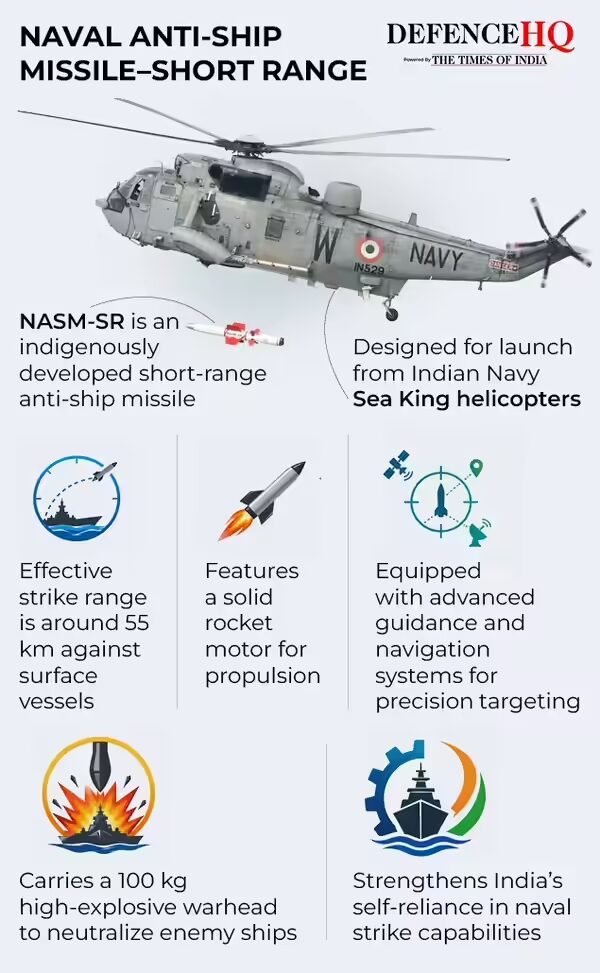
Defence Research & Development Organisation (DRDO) and the Indian Navy have successfully conducted the maiden salvo launch of Naval Anti-ship Missile-Short Range (NASM-SR) from a naval helicopter platform off the coast of Odisha in the Bay of Bengal. 

  • Two missiles were fired in rapid succession from a single helicopter, marking India’s first successful salvo launch of an advanced air-launched anti-ship missile system. 
  • All test objectives were fully met, as confirmed by data captured through tracking instruments deployed by the Integrated Test Range (ITR), Chandipur.
UPSC Relevance: GS-3 Science and Technology: Defence Technology

Prelims: NASM-SR Missile: Key Features & Significance. 

Background & Context: 

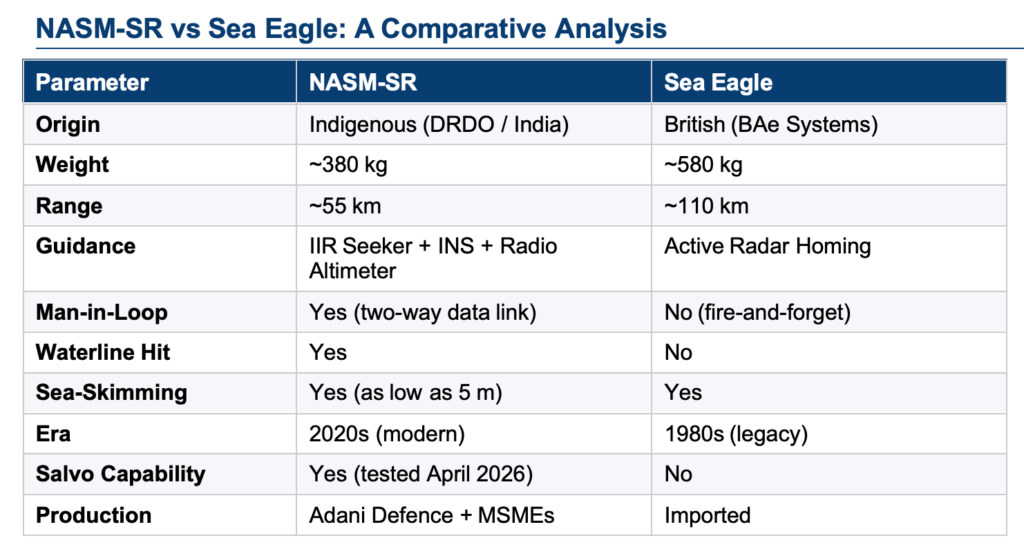
  • Since the 1980s, the Indian Navy has relied on the British-origin Sea Eagle anti-ship missile, deployed on Westland Sea King Mk42B helicopters. 
  • While effective in its era, the Sea Eagle, weighing approximately 580 kg per missile, imposed significant load constraints and lacked modern guidance capabilities. 

As these systems aged and newer maritime threats evolved, the need for a lighter, smarter, and indigenously developed replacement became pressing.

India’s new Naval Anti-Ship Missile: NASM-SR Missile

Specifications:

  • Indigenously developed by: DRDO (Research Centre Imarat, Hyderabad)
  • Weight: ~380 kg (200 kg lighter than Sea Eagle)
  • Range ~55 km
  • Speed ~Mach 0.8 (high subsonic)
  • Launch Altitude: Up to 3 km (drops to ~5 m in terminal phase)
  • Propulsion: Solid propulsion rocket booster that gives the missile its first thrust and a long-burning sustainer engine that keeps it flying for longer.
  • Guidance (Mid-course): Fibre-optic gyroscope-based Inertial Navigation System + Radio Altimeter
  • Launch Platforms: Sea King 42B, MH-60R, HAL Dhruv helicopters
  • Warhead: 100 kg omni-directional multi-EFP (explosively formed penetrator) warhead designed for high damage impact on naval targets. 
image 11

What makes NASM-SR Missile unique?

1. Man-in-the-Loop (MITL) Guidance:

  • Unlike conventional ‘fire-and-forget’ missiles (such as the Sea Eagle), the NASM-SR allows a human operator aboard the helicopter to update the missile’s flight path in real time via a high-bandwidth two-way data link. This critical feature:
    • Enables mid-flight target re-designation for evasive or moving vessels and enhances accuracy and adaptability. 
    • Reduces the risk of collateral damage in crowded or contested maritime environments. 

2. Waterline Hit Capability: 

  • The missile is precision-guided to strike a ship at or just above the waterline (the most structurally vulnerable point of any vessel). This targeting strategy:
    • Causes catastrophic structural damage and rapid flooding
    • Maximises the probability of disabling or sinking the target vessel

3. Sea-Skimming Trajectory: 

  • The NASM-SR follows an extremely low-altitude flight profile — descending to as low as 5 metres above the sea surface during the terminal phase. This makes it:
    • Exceptionally difficult to detect on radar
    • Highly survivable against enemy air defence systems
    • Capable of exploiting blind spots in shipborne close-in weapon systems (CIWS)

4. Anti-Jamming Imaging Infra-Red (IIR) Seeker:

  • The missile’s onboard seeker uses an indigenous Imaging Infra-Red (IIR) sensor. It is immune to electronic countermeasures and jamming, operating effectively in all-weather, day-or-night conditions.

5. Salvo Launch Capability: 

  • The latest test demonstrated the ability to fire two missiles in rapid succession from a single helicopter. This tactic is designed to:
    • Saturate and overwhelm shipborne Close-In Weapon Systems (CIWS)
    • Maximise strike probability against heavily defended targets
    • Replicate the saturation-attack doctrine of modern naval warfare
image 10

Strategic & Geopolitical Significance: 

  • Maritime Security in the Indian Ocean Region (IOR): NASM-SR directly enhances the Navy’s ability to enforce sea denial, protect sea lanes, and conduct anti-surface warfare in the IOR.
  • Transition to MH-60R Platform: NASM-SR will be integrated onto India’s newly acquired MH-60R ‘Romeo’ Seahawk naval helicopters (developed by Lockheed Martin, the US) and act as a versatile force multiplier for Anti-Submarine Warfare and Anti-Surface Warfare. 
  • Atmanirbhar Bharat in Defence: NASM-SR exemplifies the government’s push for defence self-reliance. It is manufactured by Adani Defence & Aerospace under the Development-cum-Production Partner (DcPP) framework, with active participation of MSMEs and start-ups.
  • Potential Induction of NASM-SR by IAF onto its own helicopter platform, thus broadening the missile’s multi-service operational scope.

Practice MCQ:

Q. With reference to the Naval Anti-Ship Missile-Short Range (NASM-SR), consider the following statements:

1. It is an indigenously developed missile by the Defence Research and Development Organisation.

2. It follows a supersonic flight profile throughout its trajectory to evade radar detection.

3. It is equipped with a Man-in-the-Loop guidance system enabling real-time target updates.

4. It uses an Imaging Infra-Red (IIR) seeker that is resistant to electronic jamming.

Which of the statements given above are correct?

(a) 1 and 3 only

(b) 1, 3 and 4 only

(c) 2 and 4 only

(d) 1, 2, 3 and 4

Answer: (b) 

INS Mahendragiri: Sixth ship of the Nilgiri-class

Open article →Download PDF

Why in News?

Recently, the Indian Navy took delivery of INS Mahendragiri, the sixth ship of the Nilgiri-class (Project 17A) and the fourth constructed by Mazagon Dock Shipbuilders Limited in Mumbai.

UPSC Relevance: GS-3 Science and Technology: Defence Technology

Prelims: INS Mahendragiri; Nilgiri-class frigates; Project 17A 

About INS Mahendragiri: 

  • INS Mahendragiri is a state-of-the-art stealth guided-missile frigate designed as a versatile multi-mission platform to tackle contemporary and future maritime challenges. 
  • Designed by the Warship Design Bureau (Indian Navy’s in-house design organisation) and built by Mazagon Dock Shipbuilders Limited, Mumbai.
  • The ship displaces approximately 6,670 tonnes and represents a generational leap in indigenous naval architecture. 

The frigate is named “Mahendragiri” after the mountain range Mahendragiri, a prominent peak in the Eastern Ghats.

Project 17A (Nilgiri-Class Frigates): 

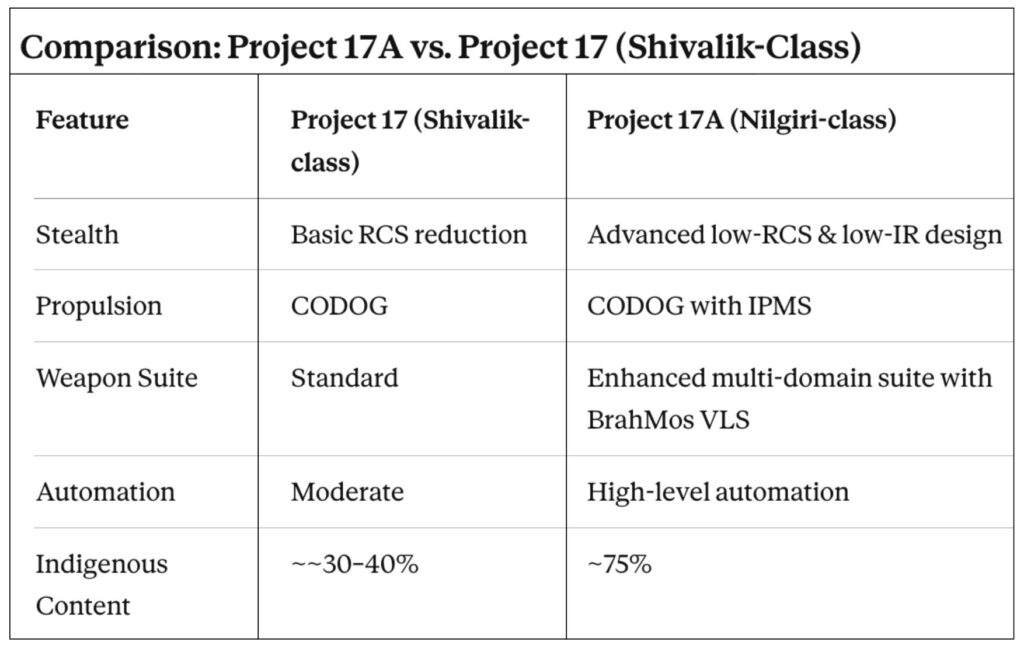
  • Project 17A is the follow-on programme to the earlier Shivalik-class frigates (Project 17). 
  • In 2015, the Cabinet Committee on Security (CCS) approved the project at a total cost of over ₹45,300 crore to induct seven vessels. 
    • MDSL (Mumbai): Contracted to build four frigates
    • GRSE (Kolkata): Contracted to build three frigates
  • The seven ships of this class include: INS Nilgiri, INS Himgiri, INS Udaygiri, INS Dunagiri, INS Taragiri,, INS Mahendragiri, and INS Vindhyagiri. 

Key Features and Capabilities of Project 17A:  

  • Stealth Design: The Nilgiri-class frigates are built with low radar cross-section (RCS) and reduced infrared signature, making them significantly harder to detect by adversary sensor systems compared to the Shivalik-class.
  • Propulsion: P17A ships are configured with Combined Diesel or Gas (CODOG) propulsion plants, comprising a diesel engine and a gas turbine, and are managed through an integrated platform management system. 
  • Automation and Survivability: High levels of automation reduce crew requirements and improve operational efficiency. Enhanced damage-control and survivability systems ensure better resistance in combat scenarios. 
image 12

Weapon Systems in INS Mahendragiri: 

The frigates carry a potent multi-domain weapon package: 

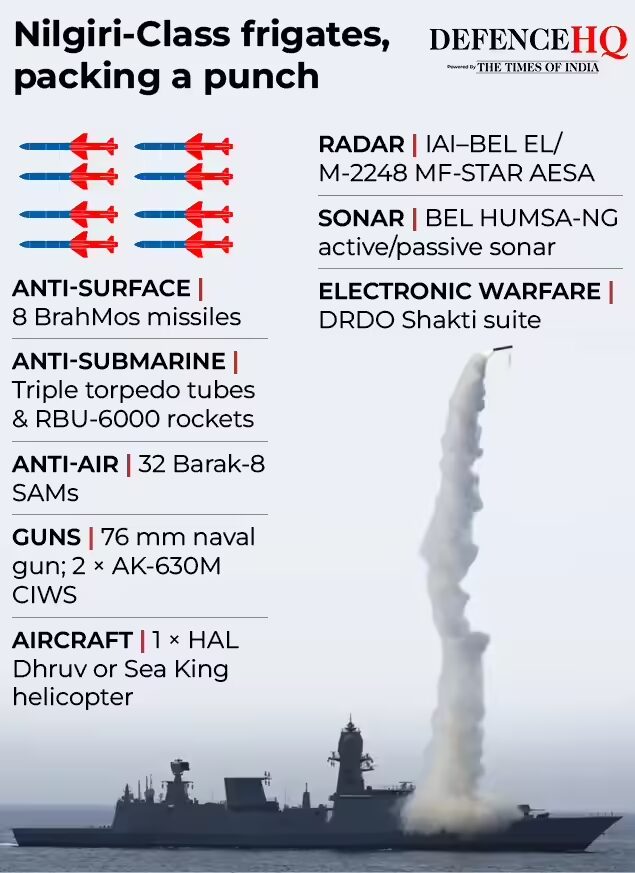
  • Anti-Ship & Land Attack: 8 BrahMos supersonic cruise missiles housed in a vertical launch system (VLS), capable of striking targets with extreme precision and speed.
  • Air Defence: 32 Barak-8 (LR-SAM) missiles in 4 × 8-cell VLS configurations. These missiles provide a 360-degree protective shield against aircraft, cruise missiles, and ballistic threats at ranges up to 100 km.
  • Main Artillery: 1 × BHEL-manufactured OTO Melara 76 mm Super Rapid Gun Mount (SRGM) for surface and air targets.
  • Close-In Weapon System (CIWS): 2 × AK-630M 30 mm rapid-fire guns for “last-ditch” defence against incoming missiles and aircraft. 
  • Anti-Submarine Warfare (ASW):
    • Triple-tube torpedo launchers for firing indigenously developed Varunastra or TAL Shyena lightweight torpedoes. 
    • RBU-6000 (Rocket Launchers) for firing ASW projectiles to depths of 1000 meters. 
image 11 1

Sensor Suite & Electronics in INS Mahendragiri: 

  • Primary Radar: EL/M-2248 MF-STAR AESA radar, an advanced S-band system capable of simultaneous tracking and missile guidance for multiple air and surface threats. 
  • Sonar Suite: BEL HUMSA-NG bow-mounted active/passive sonar, often complemented by a towed array sonar for detecting deep-water or stealthy submarines. 
  • Electronic Warfare (EW): Shakti EW suite (developed by DRDO/BEL) for electronic support, interception, and jamming, alongside Kavach decoy launchers for missile defence. 
  • Combat Management System: CMS-17A, which integrates all onboard sensors and weapons into a unified command-and-control interface. 

Significance: 

  • Aatmanirbharta (Self-Reliance): 75% indigenous content across all P17A ships. Over 200 MSMEs involved in construction at MDSL alone. Direct employment of approximately 4,000 personnel and indirect employment of over 10,000 personnel.
  • Strategic Importance: The Nilgiri-class frigates are slated to form part of the Eastern Fleet as well as the Carrier Battle Group (CBG) of INS Vikrant, India’s first indigenous aircraft carrier. Their induction significantly enhances India’s:
    • Maritime surveillance capabilities across the Indian Ocean Region (IOR)
    • Blue-water deterrence against surface, sub-surface, and aerial threats
    • Rapid power-projection capacity in the Indo-Pacific. 

The navy is working on the Next Generation Frigates (NGF), under Project 17B, a follow-on for the Nilgiri-class. 

Practice MCQ:

Q. Consider the following statements regarding INS Mahendragiri and Project 17A:

1. INS Mahendragiri is a stealth guided-missile frigate designed for multi-mission roles.

2. It has been constructed by Mazagon Dock Shipbuilders Limited in Mumbai.

3. Project 17A is a continuation of the Shivalik-class frigates programme.

4. INS Mahendragiri is equipped with ballistic missiles capable of carrying nuclear warheads.

Which of the statements given above are correct?

(a) 1, 2 and 3 only

(b) 1, 3 and 4 only

(c) 2 and 4 only

(d) 1, 2, 3 and 4

Answer: (a)