Why in News?
Defence Research & Development Organisation (DRDO) and the Indian Navy have successfully conducted the maiden salvo launch of Naval Anti-ship Missile-Short Range (NASM-SR) from a naval helicopter platform off the coast of Odisha in the Bay of Bengal.
- Two missiles were fired in rapid succession from a single helicopter, marking India’s first successful salvo launch of an advanced air-launched anti-ship missile system.
- All test objectives were fully met, as confirmed by data captured through tracking instruments deployed by the Integrated Test Range (ITR), Chandipur.
| UPSC Relevance: GS-3 Science and Technology: Defence Technology Prelims: NASM-SR Missile: Key Features & Significance. |
Background & Context:
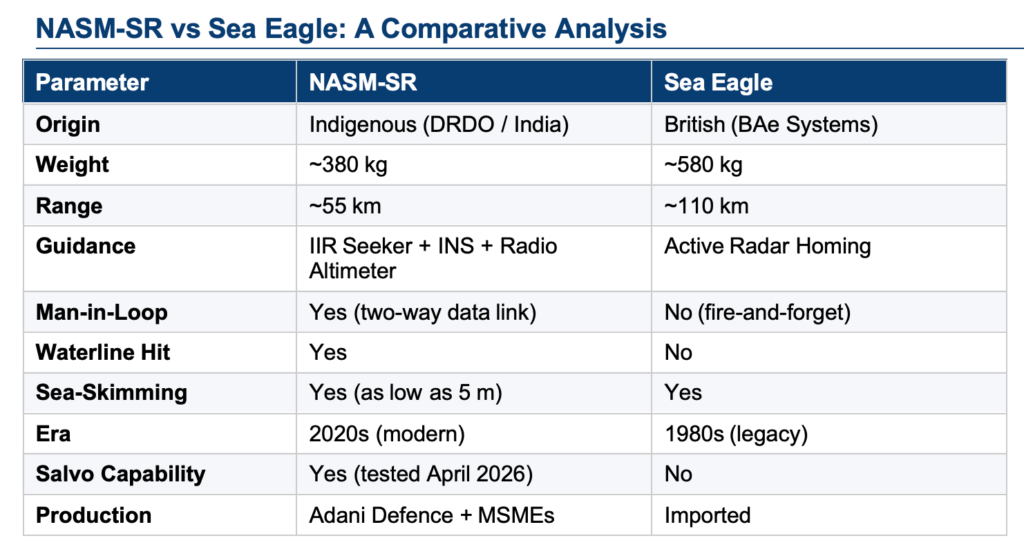
- Since the 1980s, the Indian Navy has relied on the British-origin Sea Eagle anti-ship missile, deployed on Westland Sea King Mk42B helicopters.
- While effective in its era, the Sea Eagle, weighing approximately 580 kg per missile, imposed significant load constraints and lacked modern guidance capabilities.
As these systems aged and newer maritime threats evolved, the need for a lighter, smarter, and indigenously developed replacement became pressing.
India’s new Naval Anti-Ship Missile: NASM-SR Missile
Specifications:
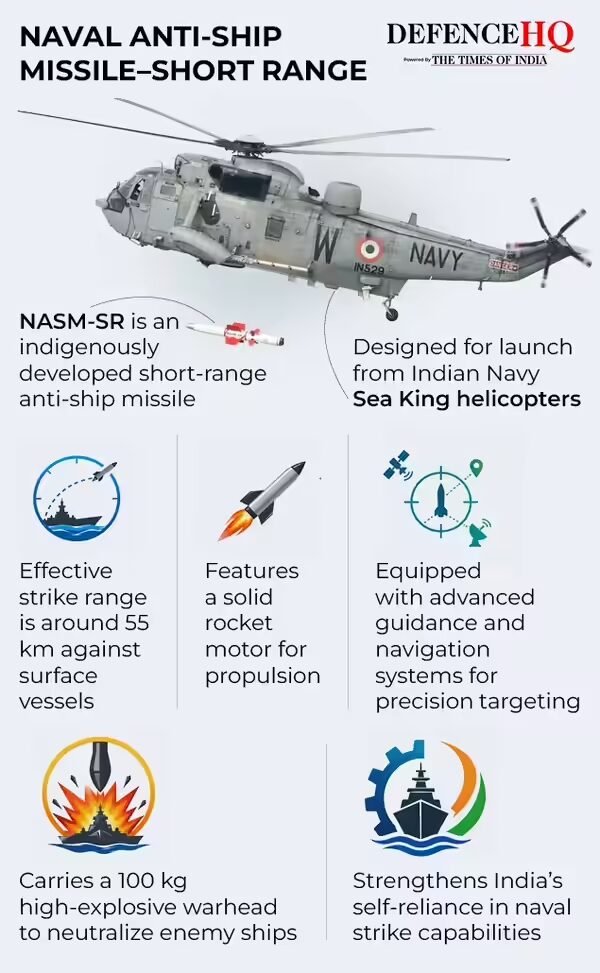
- Indigenously developed by: DRDO (Research Centre Imarat, Hyderabad)
- Weight: ~380 kg (200 kg lighter than Sea Eagle)
- Range ~55 km
- Speed ~Mach 0.8 (high subsonic)
- Launch Altitude: Up to 3 km (drops to ~5 m in terminal phase)
- Propulsion: Solid propulsion rocket booster that gives the missile its first thrust and a long-burning sustainer engine that keeps it flying for longer.
- Guidance (Mid-course): Fibre-optic gyroscope-based Inertial Navigation System + Radio Altimeter
- Launch Platforms: Sea King 42B, MH-60R, HAL Dhruv helicopters
- Warhead: 100 kg omni-directional multi-EFP (explosively formed penetrator) warhead designed for high damage impact on naval targets.
What makes NASM-SR Missile unique?
1. Man-in-the-Loop (MITL) Guidance:
- Unlike conventional ‘fire-and-forget’ missiles (such as the Sea Eagle), the NASM-SR allows a human operator aboard the helicopter to update the missile’s flight path in real time via a high-bandwidth two-way data link. This critical feature:
- Enables mid-flight target re-designation for evasive or moving vessels and enhances accuracy and adaptability.
- Reduces the risk of collateral damage in crowded or contested maritime environments.
2. Waterline Hit Capability:
- The missile is precision-guided to strike a ship at or just above the waterline (the most structurally vulnerable point of any vessel). This targeting strategy:
- Causes catastrophic structural damage and rapid flooding
- Maximises the probability of disabling or sinking the target vessel
3. Sea-Skimming Trajectory:
- The NASM-SR follows an extremely low-altitude flight profile — descending to as low as 5 metres above the sea surface during the terminal phase. This makes it:
- Exceptionally difficult to detect on radar
- Highly survivable against enemy air defence systems
- Capable of exploiting blind spots in shipborne close-in weapon systems (CIWS)
4. Anti-Jamming Imaging Infra-Red (IIR) Seeker:
- The missile’s onboard seeker uses an indigenous Imaging Infra-Red (IIR) sensor. It is immune to electronic countermeasures and jamming, operating effectively in all-weather, day-or-night conditions.
5. Salvo Launch Capability:
- The latest test demonstrated the ability to fire two missiles in rapid succession from a single helicopter. This tactic is designed to:
- Saturate and overwhelm shipborne Close-In Weapon Systems (CIWS)
- Maximise strike probability against heavily defended targets
- Replicate the saturation-attack doctrine of modern naval warfare
Strategic & Geopolitical Significance:
- Maritime Security in the Indian Ocean Region (IOR): NASM-SR directly enhances the Navy’s ability to enforce sea denial, protect sea lanes, and conduct anti-surface warfare in the IOR.
- Transition to MH-60R Platform: NASM-SR will be integrated onto India’s newly acquired MH-60R ‘Romeo’ Seahawk naval helicopters (developed by Lockheed Martin, the US) and act as a versatile force multiplier for Anti-Submarine Warfare and Anti-Surface Warfare.
- Atmanirbhar Bharat in Defence: NASM-SR exemplifies the government’s push for defence self-reliance. It is manufactured by Adani Defence & Aerospace under the Development-cum-Production Partner (DcPP) framework, with active participation of MSMEs and start-ups.
- Potential Induction of NASM-SR by IAF onto its own helicopter platform, thus broadening the missile’s multi-service operational scope.
Practice MCQ:
Q. With reference to the Naval Anti-Ship Missile-Short Range (NASM-SR), consider the following statements:
1. It is an indigenously developed missile by the Defence Research and Development Organisation.
2. It follows a supersonic flight profile throughout its trajectory to evade radar detection.
3. It is equipped with a Man-in-the-Loop guidance system enabling real-time target updates.
4. It uses an Imaging Infra-Red (IIR) seeker that is resistant to electronic jamming.
Which of the statements given above are correct?
(a) 1 and 3 only
(b) 1, 3 and 4 only
(c) 2 and 4 only
(d) 1, 2, 3 and 4
Answer: (b)
Tell Google you want more of this.
Add Anantam IAS as a preferred sourceOne tap, and this site shows up more often in your own Top Stories, AI Overviews and AI Mode. Remove it any time.