
Opens in a new tab
Join Anantam IAS Channel on Telegram

Daily Digest · Saturday

7 February 2026 Current Affairs for UPSC

3 current affairs published on Saturday, 7 February 2026

7 February 2026 Current Affairs for UPSC — every Why-in-News article AnantamIAS published on Saturday, 7 February 2026, broken down with Why in News?, the exact GS paper it feeds, sub-topic mapping, MCQ-ready facts and a UPSC-style practice question. 3 articles in total, covering Polity, Economy, Environment, S&T, IR, Geography, History, Society and Internal Security — the same Why-in-News + GS-paper-mapping + practice-question format the Compass uses across every daily digest on the site.

Daily current affairs for UPSC is where new material enters your prep stream. Read this 7 February 2026 digest end-to-end in 25–35 minutes, attempt the practice question at the foot of each article (it's MCQ for some, 10/15-marker for others), then bookmark the entries that fall inside your active revision window. Everything stays cross-linked: tap any subject pill to jump to that subject's hub, or use the table of contents above to skip straight to a specific story.

Use this page three ways. Read sequentially for a one-sitting scan of everything that mattered on 7 February 2026. Download the 7 February 2026 PDF below for offline study or print revision. Or use the February 2026 Current Affairs compilation to see this day in the month's full context. For the previous day's reading, see 6 February 2026 Current Affairs; the next day's is 8 February 2026 Current Affairs.

Why we publish daily current affairs separately from the monthly compilation: daily is learning, monthly is revision. Use the daily page to add fresh material to your notes the day it breaks; come back to the February 2026 compilation 60 days before Prelims when the noise has settled and only the lasting takeaway is worth re-reading.

Interim India-US Trade Agreement Framework Signals Fresh Trade Momentum

Open article →Download PDF

Why in News?

On 7 February 2026, Interim India-US Trade Agreement Framework Signals Fresh Trade Momentum emerged as an important current-affairs theme through an official communication linked to Prime Minister's Office. For UPSC aspirants, the topic is valuable not only because it marks a specific event, but because it opens a wider window into how policy, institutions, and development processes are evolving in India.

The official anchor for the topic is Interim India-US Trade Agreement Framework Signals Fresh Trade Momentum. That matters because serious preparation requires moving beyond headlines and asking three connected questions: what happened, why now, and what deeper historical, economic, political, or governance trend this event reflects.

UPSC Relevance

  • Prelims: countries, joint statements, high-level visits, agreements, and strategic locations
  • Mains: GS II on bilateral relations, diplomacy, strategic partnerships, and foreign policy signalling
Easy to Remember
  • The Prime Minister welcomed a framework for an interim trade agreement with the United
  • The development was linked to Make in India, employment, and trusted supply chains
  • Trade diplomacy was presented as part of a wider strategic and technology partnership

What Happened?

The Prime Minister, Narendra Modi, today welcomed the agreement on a framework for an Interim Trade Agreement between India and the United States, terming it great news for both nations. The Prime Minister thanked Donald Trump for his personal commitment to strengthening ties between the two countries and said the framework reflects the growing depth, trust and dynamism of the India-US partnership.

The Prime Minister noted that the agreement will strengthen ‘Make in India’ by opening new opportunities for farmers, entrepreneurs, MSMEs, start-up innovators and fishermen, while generating large-scale employment for women and youth. He further said that the framework will deepen investment and technology partnerships, strengthen resilient and trusted supply chains, and contribute to global growth.
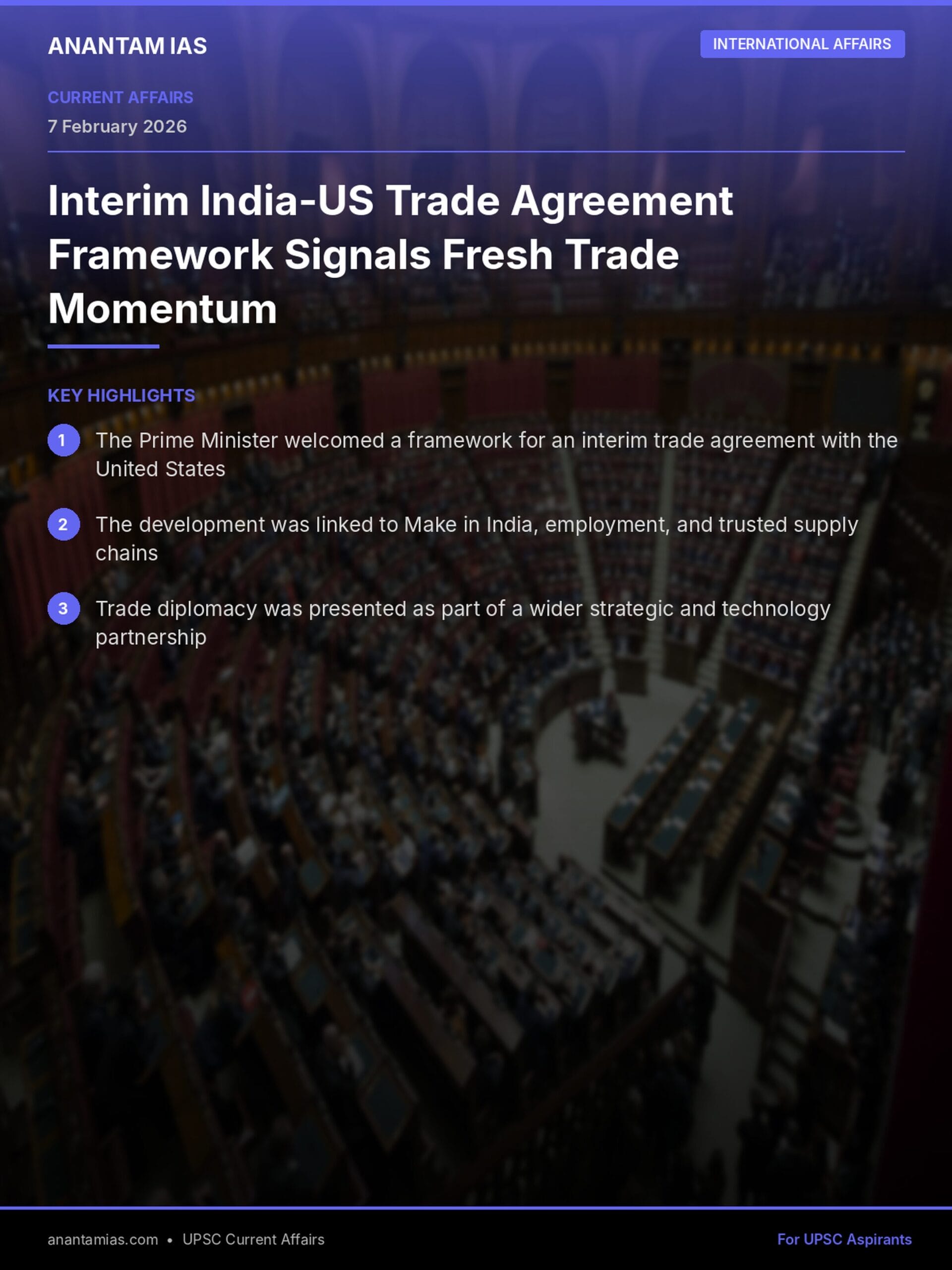
Interim India-US Trade Agreement Framework Signals Fresh Trade Momentum infographic

Read together, the event can be understood through three immediate takeaways: The Prime Minister welcomed a framework for an interim trade agreement with the United States, The development was linked to Make in India, employment, and trusted supply chains, and Trade diplomacy was presented as part of a wider strategic and technology partnership. These are the factual anchors, but the real UPSC value lies in connecting those facts with the broader story behind them.

Why it Matters

For UPSC, the significance of this topic lies in the fact that it sits at the intersection of current developments and structural change. Whether one looks at it from the lens of governance, economy, diplomacy, social policy, or strategic planning, the topic shows how day-to-day announcements often reveal larger shifts in India's state capacity and developmental priorities.

In answer writing, this makes the topic especially useful. It can serve as a factual illustration in Prelims preparation and as a layered example in Mains where the examiner expects candidates to connect institutions, outcomes, and wider policy direction.

What You Must Learn

0/5 completed

Bottom Line

Interim India-US Trade Agreement Framework Signals Fresh Trade Momentum is important because it allows aspirants to move from a narrow event-based reading of current affairs to a broader understanding of how history, institutions, economy, politics, and governance intersect in contemporary India.

Exam Strategy

Use the topic to show how diplomacy now blends trade, security, technology, and mobility.

Related Current Affairs

Exam Oriented Questions

Why is this topic in the news?

It is in the news because an official development related to **Interim India-US Trade Agreement Framework Signals Fresh Trade Momentum** was recorded on 7 February 2026.

Which official institution or source is associated with this topic?

The topic is anchored in an official source associated with **Prime Minister's Office**, and aspirants should remember the source title **Interim India-US Trade Agreement Framework Signals Fresh Trade Momentum**.

What is the core issue involved here?

The core issue revolves around the prime minister welcomed a framework for an interim trade agreement with the united states, along with its wider institutional and policy implications.

How is this topic relevant for UPSC Prelims?

It is relevant for Prelims because it covers countries, joint statements, high-level visits, agreements, and strategic locations.

How is this topic relevant for UPSC Mains?

It is relevant for Mains because it can be used in GS II on bilateral relations, diplomacy, strategic partnerships, and foreign policy signalling.

What wider context should aspirants connect with this topic?

Aspirants should connect this event with the wider context of historically, indian foreign policy has drawn strength from combining civilisational links with contemporary strategic interests.

Does this topic have an economic, political, or social angle?

Yes. Economically and strategically, external partnerships now shape trade, technology access, investment flows, mobility, and supply-chain resilience. Politically, these developments reveal how diplomacy increasingly overlaps with domestic priorities such as jobs, innovation, and national security.

How can this topic be used in answer writing?

It can be used as a recent example to strengthen analytical arguments, especially where the question asks how policy intent translates into institutional or developmental outcomes.

What factual points should be revised first?

Revise the event date, the official source, and these quick points: The Prime Minister welcomed a framework for an interim trade agreement with the United States, The development was linked to Make in India, employment, and trusted supply chains, Trade diplomacy was presented as part of a wider strategic and technology partnership.

What is the one-line exam takeaway?

Interim India-US Trade Agreement Framework Signals Fresh Trade Momentum is important because it combines current relevance with a larger story about institutions, development, and public policy.
UPSC Extends Call Centre Operations to Improve Candidate Support

Open article →Download PDF

Why in News?

On 7 February 2026, UPSC Extends Call Centre Operations to Improve Candidate Support emerged as an important current-affairs theme through an official communication linked to Press Information Bureau. For UPSC aspirants, the topic is valuable not only because it marks a specific event, but because it opens a wider window into how policy, institutions, and development processes are evolving in India.

The official anchor for the topic is UPSC Extends Call Centre Operations to Ensure Greater Ease and Convenience for Students. That matters because serious preparation requires moving beyond headlines and asking three connected questions: what happened, why now, and what deeper historical, economic, political, or governance trend this event reflects.

UPSC Relevance

  • Prelims: institutions, administrative mechanisms, schemes, regulations, and delivery platforms
  • Mains: GS II on governance, reforms, public administration, and institutional capacity
Easy to Remember
  • The Union Public Service Commission has extended the operational hours of its call
  • The call centre will remain operational on all days, including Saturdays, Sundays, and
  • It will function in two shifts, from 7:00 am to 9:00 pm, enabling candidates to seek

What Happened?

The Union Public Service Commission has extended the operational hours of its call centre to provide enhanced support and guidance to aspirants, ensuring greater ease and convenience during the ongoing application process. The call centre will remain operational on all days, including Saturdays, Sundays, and holidays, till the submission of application forms for the Civil Services Examination (CSE) 2026 and the Indian Forest Service (IFoS) Examination 2026.

It will function in two shifts, from 7:00 am to 9:00 pm, enabling candidates to seek assistance beyond regular working hours. In addition, the strength of the call centre has been doubled to significantly reduce waiting time for applicants seeking inputs or guidance related to the application process and examination-related queries.

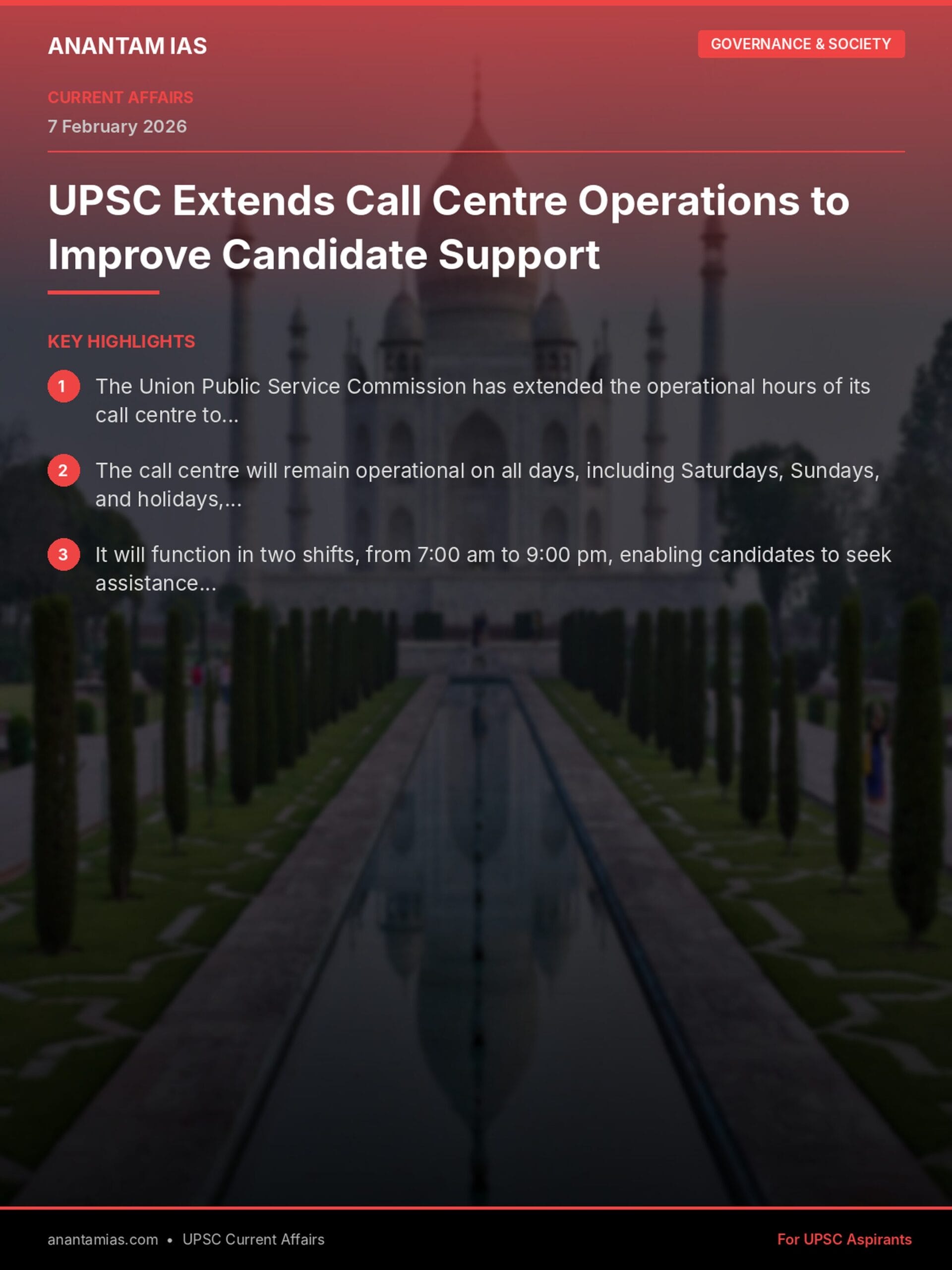
UPSC Extends Call Centre Operations to Improve Candidate Support infographic

Read together, the event can be understood through three immediate takeaways: The Union Public Service Commission has extended the operational hours of its call centre to provide enhanced support and guidance to aspirants, ensuring greater ease and convenience during the ongoing application process., The call centre will remain operational on all days, including Saturdays, Sundays, and holidays, till the submission of application forms for the Civil Services Examination (CSE) 2026 and the Indian Forest Service (IFoS) Examination 2026., and It will function in two shifts, from 7:00 am to 9:00 pm, enabling candidates to seek assistance beyond regular working hours.. These are the factual anchors, but the real UPSC value lies in connecting those facts with the broader story behind them.

Why it Matters

For UPSC, the significance of this topic lies in the fact that it sits at the intersection of current developments and structural change. Whether one looks at it from the lens of governance, economy, diplomacy, social policy, or strategic planning, the topic shows how day-to-day announcements often reveal larger shifts in India's state capacity and developmental priorities.

In answer writing, this makes the topic especially useful. It can serve as a factual illustration in Prelims preparation and as a layered example in Mains where the examiner expects candidates to connect institutions, outcomes, and wider policy direction.

What You Must Learn

0/5 completed

Bottom Line

UPSC Extends Call Centre Operations to Improve Candidate Support is important because it allows aspirants to move from a narrow event-based reading of current affairs to a broader understanding of how history, institutions, economy, politics, and governance intersect in contemporary India.

Exam Strategy

Use the topic to highlight the importance of institutions, procedural reform, and administrative accountability.

Related Current Affairs

Exam Oriented Questions

Why is this topic in the news?

It is in the news because an official development related to **UPSC Extends Call Centre Operations to Improve Candidate Support** was recorded on 7 February 2026.

Which official institution or source is associated with this topic?

The topic is anchored in an official source associated with **Press Information Bureau**, and aspirants should remember the source title **UPSC Extends Call Centre Operations to Ensure Greater Ease and Convenience for Students**.

What is the core issue involved here?

The core issue revolves around the union public service commission has extended the operational hours of its call centre to provide enhanced support and guidance to aspirants, ensuring greater ease and convenience during the ongoing application process, along with its wider institutional and policy implications.

How is this topic relevant for UPSC Prelims?

It is relevant for Prelims because it covers institutions, administrative mechanisms, schemes, regulations, and delivery platforms.

How is this topic relevant for UPSC Mains?

It is relevant for Mains because it can be used in GS II on governance, reforms, public administration, and institutional capacity.

What wider context should aspirants connect with this topic?

Aspirants should connect this event with the wider context of historically, many of india's reform efforts have succeeded or failed depending on the quality of institutional design and administrative follow-through.

Does this topic have an economic, political, or social angle?

Yes. Economically and socially, governance reforms matter because they determine how effectively public resources translate into outcomes on the ground. Politically, such developments illustrate the constant negotiation between central direction, state-level implementation, and citizen expectations.

How can this topic be used in answer writing?

It can be used as a recent example to strengthen analytical arguments, especially where the question asks how policy intent translates into institutional or developmental outcomes.

What factual points should be revised first?

Revise the event date, the official source, and these quick points: The Union Public Service Commission has extended the operational hours of its call centre to provide enhanced support and guidance to aspirants, ensuring greater ease and convenience during the ongoing application process., The call centre will remain operational on all days, including Saturdays, Sundays, and holidays, till the submission of application forms for the Civil Services Examination (CSE) 2026 and the Indian Forest Service (IFoS) Examination 2026., It will function in two shifts, from 7:00 am to 9:00 pm, enabling candidates to seek assistance beyond regular working hours..

What is the one-line exam takeaway?

UPSC Extends Call Centre Operations to Improve Candidate Support is important because it combines current relevance with a larger story about institutions, development, and public policy.

Departure Statement Before Malaysia Visit Highlights India’s Act East Priorities

Open article →Download PDF

Why in News?

On 7 February 2026, Departure Statement Before Malaysia Visit Highlights India's Act East Priorities emerged as an important current-affairs theme through an official communication linked to Prime Minister's Office. For UPSC aspirants, the topic is valuable not only because it marks a specific event, but because it opens a wider window into how policy, institutions, and development processes are evolving in India.

The official anchor for the topic is Departure Statement Before Malaysia Visit Highlights India's Act East Priorities. That matters because serious preparation requires moving beyond headlines and asking three connected questions: what happened, why now, and what deeper historical, economic, political, or governance trend this event reflects.

UPSC Relevance

  • Prelims: countries, joint statements, high-level visits, agreements, and strategic locations
  • Mains: GS II on bilateral relations, diplomacy, strategic partnerships, and foreign policy signalling
Easy to Remember
  • PM’s departure statement ahead of his visit to Malaysia I am embarking on an Official
  • The historic ties between India and Malaysia have seen steadfast progress in recent years.
  • I look forward to my discussions with Prime Minister Anwar Ibrahim, and further

What Happened?

PM’s departure statement ahead of his visit to Malaysia I am embarking on an Official Visit to Malaysia at the invitation of my friend, Prime Minister Anwar Ibrahim today. The historic ties between India and Malaysia have seen steadfast progress in recent years.

I look forward to my discussions with Prime Minister Anwar Ibrahim, and further enhancing our Comprehensive Strategic Partnership. We will aim to deepen our defence and security ties, enhance our economic and innovation partnership, and expand our collaboration into new domains.

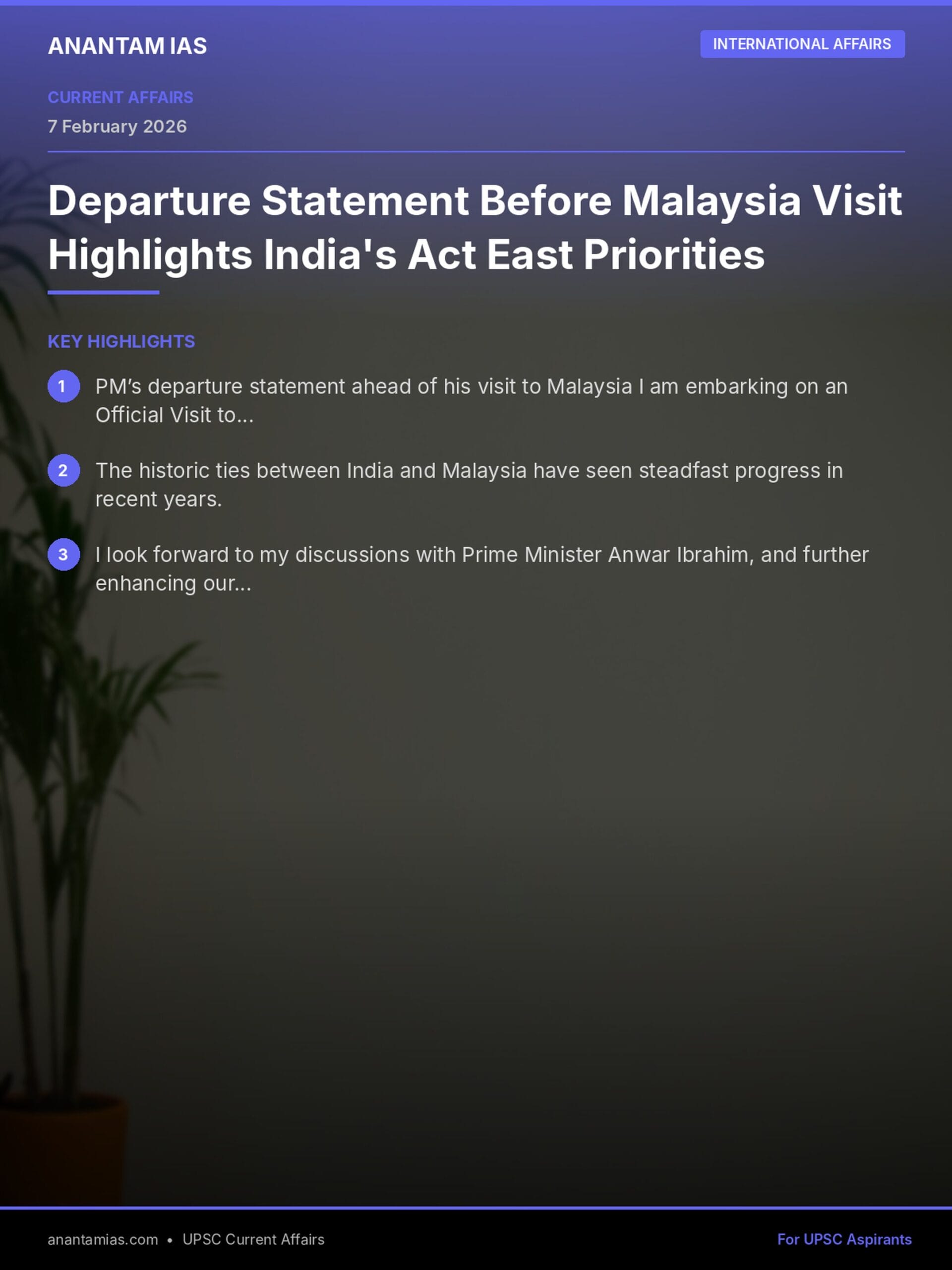
Departure Statement Before Malaysia Visit Highlights India's Act East Priorities infographic

Read together, the event can be understood through three immediate takeaways: PM’s departure statement ahead of his visit to Malaysia I am embarking on an Official Visit to Malaysia at the invitation of my friend, Prime Minister Anwar Ibrahim today., The historic ties between India and Malaysia have seen steadfast progress in recent years., and I look forward to my discussions with Prime Minister Anwar Ibrahim, and further enhancing our Comprehensive Strategic Partnership.. These are the factual anchors, but the real UPSC value lies in connecting those facts with the broader story behind them.

Why it Matters

For UPSC, the significance of this topic lies in the fact that it sits at the intersection of current developments and structural change. Whether one looks at it from the lens of governance, economy, diplomacy, social policy, or strategic planning, the topic shows how day-to-day announcements often reveal larger shifts in India's state capacity and developmental priorities.

In answer writing, this makes the topic especially useful. It can serve as a factual illustration in Prelims preparation and as a layered example in Mains where the examiner expects candidates to connect institutions, outcomes, and wider policy direction.

What You Must Learn

0/5 completed

Bottom Line

Departure Statement Before Malaysia Visit Highlights India's Act East Priorities is important because it allows aspirants to move from a narrow event-based reading of current affairs to a broader understanding of how history, institutions, economy, politics, and governance intersect in contemporary India.

Exam Strategy

Use the topic to show how diplomacy now blends trade, security, technology, and mobility.

Related Current Affairs

Exam Oriented Questions

Why is this topic in the news?

It is in the news because an official development related to **Departure Statement Before Malaysia Visit Highlights India's Act East Priorities** was recorded on 7 February 2026.

Which official institution or source is associated with this topic?

The topic is anchored in an official source associated with **Prime Minister's Office**, and aspirants should remember the source title **Departure Statement Before Malaysia Visit Highlights India's Act East Priorities**.

What is the core issue involved here?

The core issue revolves around pm’s departure statement ahead of his visit to malaysia i am embarking on an official visit to malaysia at the invitation of my friend, prime minister anwar ibrahim today, along with its wider institutional and policy implications.

How is this topic relevant for UPSC Prelims?

It is relevant for Prelims because it covers countries, joint statements, high-level visits, agreements, and strategic locations.

How is this topic relevant for UPSC Mains?

It is relevant for Mains because it can be used in GS II on bilateral relations, diplomacy, strategic partnerships, and foreign policy signalling.

What wider context should aspirants connect with this topic?

Aspirants should connect this event with the wider context of historically, indian foreign policy has drawn strength from combining civilisational links with contemporary strategic interests.

Does this topic have an economic, political, or social angle?

Yes. Economically and strategically, external partnerships now shape trade, technology access, investment flows, mobility, and supply-chain resilience. Politically, these developments reveal how diplomacy increasingly overlaps with domestic priorities such as jobs, innovation, and national security.

How can this topic be used in answer writing?

It can be used as a recent example to strengthen analytical arguments, especially where the question asks how policy intent translates into institutional or developmental outcomes.

What factual points should be revised first?

Revise the event date, the official source, and these quick points: PM’s departure statement ahead of his visit to Malaysia I am embarking on an Official Visit to Malaysia at the invitation of my friend, Prime Minister Anwar Ibrahim today., The historic ties between India and Malaysia have seen steadfast progress in recent years., I look forward to my discussions with Prime Minister Anwar Ibrahim, and further enhancing our Comprehensive Strategic Partnership..

What is the one-line exam takeaway?

Departure Statement Before Malaysia Visit Highlights India's Act East Priorities is important because it combines current relevance with a larger story about institutions, development, and public policy.