
Why in News?
The expiry of the New Strategic Arms Reduction Treaty (New START) in February 2026, followed by the absence of a successor agreement, has created a major gap in global nuclear arms control.
At the November 19, 2026, summit in Shenzhen, the leaders of the United States, Russia and China issued a joint declaration reaffirming that a nuclear war must never be fought and committed to dialogue on reducing nuclear risks and preventing proliferation. However, no binding agreement or verification mechanism has been established.
| UPSC Relevance: GS-2 International Relations: Global Agreements; GS-3 Internal Security Prelims: New START Treaty; Existing Global Nuclear Arms Control Framework Mains: Emerging Challenges to Global Nuclear Stability |
About New START Treaty:
- Signed: 2010 by the United States and Russia.
- Entered into force: 2011.
- Extended: 2021 for five years, until February 2026.
- Objective: To reduce and limit the strategic offensive nuclear arsenals of the two countries.
Key provisions:
- Limited each country to 1550 deployed strategic nuclear warheads.
- Capped deployed strategic delivery vehicles (ICBMs, SLBMs and heavy bombers) at 700.
- Limited deployed and non-deployed launchers and bombers to 800.
- Established verification mechanisms, including data exchanges, notifications and on-site inspections.
Significance of its expiry:
- For the first time since 1972, the US and Russia no longer have a bilateral treaty imposing legally binding limits on their strategic nuclear arsenals.
- It weakens transparency, predictability and confidence-building mechanisms.
- It increases the possibility of an unconstrained nuclear arms competition.
Russia suspended inspections under the treaty in 2023, but continued to observe its central numerical limits until the treaty expired.
Why is a New Nuclear Arms Control Framework difficult?
The three major nuclear powers have different strategic interests and concerns.
(i) United States:
- Wants China included in any future nuclear arms control agreement because of its rapidly expanding nuclear arsenal.
- Fears a two-front strategic challenge if Russia and China coordinate their nuclear capabilities.
- Seeks greater transparency regarding China’s nuclear weapons and military doctrine.
- Is concerned about the potential vulnerability of its nuclear deterrence.
(ii) Russia:
- Prefers maintaining bilateral nuclear parity with the United States, which reinforces its status as a major global power.
- Argues that the United Kingdom and France, both NATO nuclear powers, should eventually be included in broader arms control negotiations.
- Its suspension of New START inspections and revocation of its ratification of the Comprehensive Nuclear-Test-Ban Treaty (CTBT) have weakened confidence in its commitment to arms control.
(iii) China:
- Opposes joining a treaty that imposes equal numerical limits on countries with vastly different nuclear arsenals.
- Argues that its arsenal is considerably smaller than those of the US and Russia.
- Seeks to protect the credibility of its nuclear deterrence and its ability to retaliate against a first strike.
- Is concerned that US missile defence systems could undermine its second-strike capability.
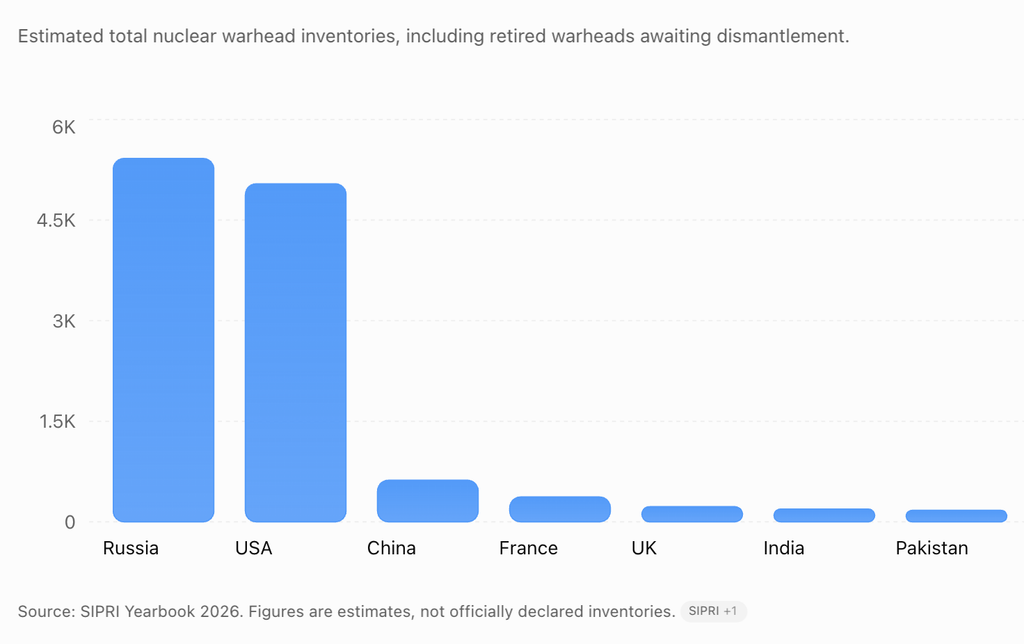
Emerging Challenges to Global Nuclear Stability:
The weakening of traditional arms control mechanisms is compounded by several emerging threats.
- Modernisation of nuclear arsenals: Major powers are investing in hypersonic weapons, multiple independently targetable re-entry vehicles (MIRVs), advanced delivery systems and nuclear-powered submarines.
- Artificial Intelligence in nuclear decision-making:
- Integration of AI into early-warning systems and military command-and-control networks could accelerate decision-making. Algorithmic errors, manipulated information or cyberattacks could trigger false alarms and unintended escalation.
- Reduced human intervention could increase the risk of accidental nuclear launches.
- Missile defence systems: Advanced missile defence capabilities can undermine the perceived effectiveness of an adversary’s retaliatory strike, encouraging further nuclear weapon development.
- Renewed nuclear testing: US allegations of secret nuclear testing by China and calls to resume US testing threaten the global moratorium on nuclear explosive tests. Such developments could trigger a wider testing race.
- Regional conflicts and escalation risks: Tensions surrounding Taiwan, the Russia-Ukraine conflict and West Asian instability increase the possibility of conventional conflicts escalating into nuclear confrontations.
- Erosion of multilateral arms control: The weakening of existing treaties and lack of progress in disarmament negotiations undermine international confidence in the nuclear non-proliferation regime.
Existing Global Nuclear Arms Control Framework:
| Treaty / Framework | Key objective |
| Nuclear Non-Proliferation Treaty (NPT), 1968 | Prevents proliferation, promotes peaceful nuclear cooperation and commits parties to nuclear disarmament negotiations. |
| Comprehensive Nuclear-Test-Ban Treaty (CTBT), 1996 | Prohibits all nuclear explosions for military or civilian purposes; not yet in force. |
| Treaty on the Prohibition of Nuclear Weapons (TPNW), 2017 | Prohibits the development, possession, use and threat of use of nuclear weapons for its parties. |
| New START, 2010 | Limited US and Russian strategic nuclear arsenals; expired in February 2026. |
| Outer Space Treaty, 1967 | Prohibits placing nuclear weapons or other weapons of mass destruction in orbit or on celestial bodies. |
Major Institutional Mechanisms:
- International Atomic Energy Agency (IAEA): Safeguards and verification to prevent diversion of nuclear material from peaceful uses.
- Comprehensive Nuclear-Test-Ban Treaty Organisation (CTBTO): Operates the International Monitoring System to detect nuclear explosions.
- United Nations: Provides a multilateral platform for nuclear disarmament and non-proliferation negotiations.
Way Forward: Towards a Practical Nuclear Risk Reduction Framework:
Rather than waiting for an elusive, comprehensive trilateral treaty, the U.S., Russia, and China should pursue phased, achievable confidence-building measures:
- Maintain Meaningful Human Control: Ensure final decisions concerning nuclear weapon launches remain strictly under human authority, backed by safeguards against automated or AI-driven escalation.
- Establish Crisis Communication Mechanisms: Strengthen military-to-military hotlines and direct communication channels to prevent misunderstandings and manage incidents rapidly during crises.
- Institutionalise Advance Launch Notifications: Make prior notifications of ballistic missile launches and major military exercises a regular norm to prevent false alarms and misinterpretation.
- Revive Nuclear Testing Restraint: Reaffirm the global moratorium on nuclear explosive testing, requiring Washington to step back from its testing order, and work toward bringing the Comprehensive Nuclear-Test-Ban Treaty (CTBT) into force.
- Restore Bilateral Arms Control: The U.S. and Russia should restore numerical limits and verification mechanisms on their own arsenals immediately, without making China’s participation a precondition.
- Build Transparency Gradually: Encourage China to join confidence-building initiatives, such as doctrinal dialogues, information exchanges, and crisis hotlines, without initially requiring equal numerical caps.
- Address Emerging Technologies: Develop international norms governing AI-enabled nuclear command systems, cyber vulnerabilities, and autonomous military technologies.
- Expand the Negotiating Framework Phasedly: Once foundational bilateral and trilateral trust is rebuilt, gradually involve other nuclear-armed states, particularly the UK and France, in broader discussions on strategic stability.
India’s Position and Significance:
India has consistently advocated universal, non-discriminatory and verifiable nuclear disarmament.
- India is not a signatory to the NPT, opposing its discriminatory division between nuclear-weapon and non-nuclear-weapon states.
- India maintains a declared No First Use (NFU) nuclear doctrine, alongside a policy of credible minimum deterrence.
- India has not signed the CTBT, citing concerns over its discriminatory provisions and the absence of a time-bound commitment to nuclear disarmament.
- India supports the goal of global nuclear disarmament through multilateral negotiations.
Implications for India:
- Regional security: China’s nuclear expansion and developments in Pakistan’s nuclear capabilities have implications for India’s strategic deterrence.
- Strategic stability: Weakening global arms control could accelerate nuclear competition in Asia.
- Emerging technologies: AI-enabled military systems, cyber threats and advanced missile capabilities could increase escalation risks in the region.
- Multilateral diplomacy: India can advocate universal, verifiable and non-discriminatory disarmament while promoting confidence-building measures among nuclear-armed states.
Conclusion:
The expiry of New START has created a dangerous gap in the global security architecture. A gradual framework based on transparency, communication and restraint is essential to prevent miscalculation and preserve global strategic stability.
Practice Mains Question:
Q. “The weakening of the global nuclear arms-control architecture has increased the risks of strategic instability.” Examine the challenges to nuclear risk reduction in the contemporary world. Suggest measures to strengthen global nuclear governance.
Practice Prelims MCQ:
Q. With reference to international nuclear arms-control agreements, consider the following statements:
- The New START Treaty imposed legally binding limits on the strategic nuclear arsenals of the United States and Russia.
- The Comprehensive Nuclear-Test-Ban Treaty (CTBT) has entered into force.
- The Nuclear Non-Proliferation Treaty (NPT) recognises five nuclear-weapon states.
- India is a party to the Nuclear Non-Proliferation Treaty.
Which of the statements given above are correct?
(a) 1 and 3 only
(b) 1, 2 and 3 only
(c) 2 and 4 only
(d) 1, 3 and 4 only
Answer: (a) 1 and 3 only
Explanation:
- Statement 1 is correct. New START imposed limits on U.S. and Russian strategic nuclear forces until its expiry in February 2026.
- Statement 2 is incorrect. The CTBT has not entered into force.
- Statement 3 is correct. The NPT recognises five nuclear-weapon states: the U.S., Russia, China, France and the UK.
- Statement 4 is incorrect. India is not a signatory to the NPT.
Tell Google you want more of this.
Add Anantam IAS as a preferred sourceOne tap, and this site shows up more often in your own Top Stories, AI Overviews and AI Mode. Remove it any time.