Why in news?
Nepal’s Prime Minister Balendra Shah’s first bilateral visit to India produced a 10-pillar joint vision and $1.6 billion economic package.
UPSC Relevance
Prelims – India–Nepal border, treaties, river projects, connectivity projects
Mains GS2 – India and its neighbourhood relations
Nepal’s political change
In September 2025, Nepal saw large youth-led (‘Gen Z’) protests against corruption, a social media ban and political stagnation, which brought down the government. In the elections that followed, the Rastriya Swatantra Party won a landslide and Balendra (Balen) Shah, the 36-year-old former Mayor of Kathmandu, became Prime Minister. He was known for his anti-India remarks on social media, which made New Delhi’s outreach a challenge. His decision to make India his first bilateral destination is therefore significant.
Key outcomes of the visit
- Joint vision ‘Viksit Bharat and Samunnat Nepal’ – A 10-pillar road map to take the partnership towards developed, middle-income status. The first three pillars are: developmental and economic ties, physical and digital connectivity, and energy and climate.
- New vocabulary – The document drops the old idea of a ‘special relationship’ and speaks of an ‘aspirational, modern and mutually beneficial partnership’ reflecting present-day political, economic and technological realities.
- Economic package – About $1.6 billion in grants and lines of credit to revive Nepal’s economy, along with steps on air connectivity, new railway links and hydropower investment.
- Monitoring – Revival of a High-Level Monitoring Group to track implementation.
- Style of the visit – Brief and work-oriented: no ceremonial side trips, little talk of civilisational ties, and a deliberate silence on contentious issues like the boundary dispute.
India–Nepal relations
| Area | Key facts |
|---|---|
| Border | About 1,750 km open border with five Indian States – Sikkim, West Bengal, Bihar, Uttar Pradesh and Uttarakhand. No passport or visa needed for citizens of either country. |
| Treaty framework | Treaty of Peace and Friendship, 1950 – gives national treatment to each other’s citizens in residence, property, trade and employment. Nepal has long sought its revision. |
| Trade and transit | India is Nepal’s largest trading partner, accounting for nearly two-thirds of its total trade, and provides transit for its trade with third countries. |
| Energy | Long-term agreement (2024) for India to import 10,000 MW from Nepal over 10 years; Nepal also exports power to Bangladesh through Indian grid. Mahakali Treaty, 1996 covers the Pancheshwar project. |
| Connectivity | Motihari–Amlekhgunj petroleum pipeline (2019, first cross-border petroleum pipeline in South Asia); Jaynagar–Kurtha railway; Integrated Check Posts at Birgunj and Biratnagar; Raxaul–Kathmandu rail line proposed. |
| People-to-people | Gorkha regiments of the Indian Army; around 30 lakh Nepali citizens work in India; shared religious sites like Janakpur, Lumbini and Pashupatinath. |
| Regional groupings | SAARC, BIMSTEC, BBIN |
Major irritants in the relationship
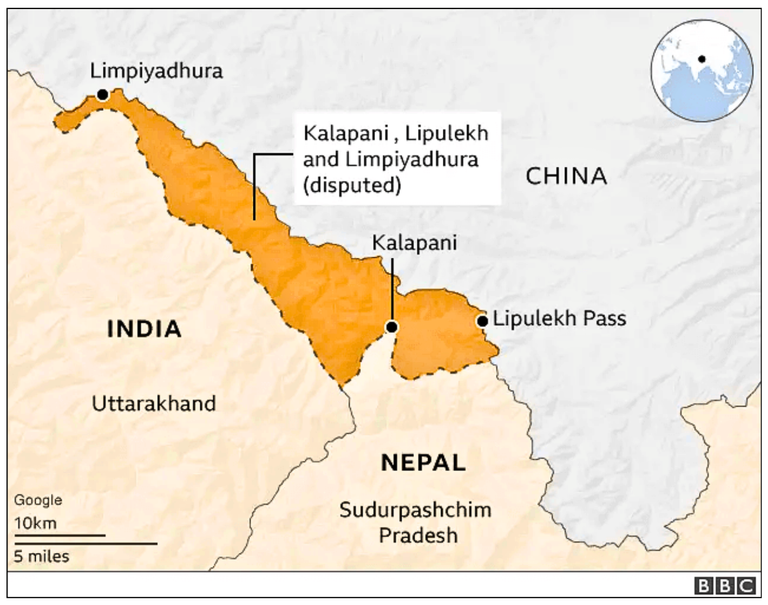
- Boundary dispute – In 2020, Nepal issued a new political map, backed by a constitutional amendment, showing Kalapani, Lipulekh and Limpiyadhura as its territory. Nepal has also objected to India–China trade through the Lipulekh pass.
- 2015 border blockade – The unofficial blockade after Nepal’s new Constitution created deep distrust and pushed Nepal to seek alternatives through China.
- 1950 Treaty and the EPG report – The Eminent Persons Group (2016–18) prepared a report on reviewing the treaty and other issues, but India has not formally received it.
- Agnipath and Gorkha recruitment – Nepal paused recruitment of its citizens into the Indian Army after the Agnipath scheme, as short-term service did not fit the 1947 tripartite agreement.
- China factor – Nepal signed the Belt and Road framework agreement in 2017 and a BRI cooperation framework in 2024. China has also offered transit through its ports.
- Delays in projects – Slow implementation of Indian projects like Pancheshwar has weakened India’s credibility, compared to quick Chinese deliveries.
- Perception of interference – A section of Nepal’s public sees India as a ‘big brother’ interfering in domestic politics.
Why the new model matters
| Older | New | |
| Basis of ties | ‘Special relationship’, culture and history | Aspirational, modern, mutually beneficial partnership |
| Focus | Security concerns, political management | Economic delivery and connectivity |
| Handling irritants | Long debates in negotiation rooms | Set aside; focus on what can be delivered |
| Implementation | Slow, scattered projects | Time-bound road map with monitoring group |
Challenges ahead
- Implementation gap – The real test is delivery on energy pipelines, railway links and hydropower. India’s past record of delays must not repeat.
- Political uncertainty in Nepal – Benefits depend on whether Mr Shah consolidates his position and his government remains stable.
- Geopolitical balancing – Nepal will continue to seek support from China and others. India must accept this without treating every such step as a threat.
- Security red lines – India has genuine concerns about the open border (counterfeit currency, cross-border crime, third-country nationals). The challenge is to enforce them without hurting economic engagement.
- Unresolved boundary issue – Silence works for now, but nationalist sentiment on Kalapani can resurface at any time.
A model for Bangladesh?
The article suggests that the Nepal template can help repair India–Bangladesh ties, where the stakes are higher.
- Irritants: The presence of former PM Sheikh Hasina in India and Dhaka’s demand for her extradition; Teesta water sharing; border killings; illegal migration; and Bangladesh’s growing closeness with China and Pakistan.
- Pending issue: The Ganga Water Treaty of 1996 runs for 30 years and is due for renewal in December 2026.
- What can work: Restarting a partnership based on trade, transport, energy and connectivity, which has transformed the region since 2009 – such as the Land Boundary Agreement (2015), Akhaura–Agartala rail link, Maitree power plant and transit through Chittagong and Mongla ports.
Way forward
- Deliver faster – Set clear timelines for each pillar of the road map and report progress publicly.
- Direct leader-level communication – Regular, even bimonthly, calls between the two Prime Ministers to prevent misunderstandings.
- Reciprocal high-level visits – A visit by the Indian PM to Kathmandu, the first in eight years, would maintain momentum.
- Respect for sovereignty – Avoid any perception of interference in Nepal’s domestic politics; keep engagement with all political parties.
- Energy as anchor – Use hydropower trade, including sub-regional trade with Bangladesh under BBIN, as the backbone of interdependence.
- Address irritants through dialogue – Use existing mechanisms like the Boundary Working Group and take a fresh look at the EPG report at the right time.
- People-centric connectivity – Easier digital payments (UPI linkage), more flights, education and health cooperation for young Nepalis.
The Shah visit shows that India’s neighbourhood policy works best when it is driven by delivery rather than history, and by partnership rather than pressure. It shows that despite political changes and occasional tensions, India remains the indispensable economic partner of its neighbours. If India can supply more, better and faster to meet the aspirations of a young and confident Nepal, the same model can help rebuild trust with Bangladesh and across South Asia.
Practice MCQs
Q1. Consider the following Indian States:
1. Sikkim
2. Himachal Pradesh
3. Uttarakhand
4. Assam
How many of the above States share a border with Nepal?
(a) Only one (b) Only two (c) Only three (d) All four
Answer: (b)
Explanation: Only Sikkim and Uttarakhand from this list border Nepal. The five Indian States bordering Nepal are Sikkim, West Bengal, Bihar, Uttar Pradesh and Uttarakhand.
Q2. Consider the following statements:
Statement I: The India–Nepal Treaty of Peace and Friendship, 1950 restricts the movement and employment of each other’s citizens.
Statement II: The India–Nepal border is an open border, and citizens of both countries do not need a passport or visa to cross it.
Which one of the following is correct in respect of the above statements?
(a) Both Statement I and Statement II are correct and Statement II explains Statement I
(b) Both Statement I and Statement II are correct but Statement II does not explain Statement I
(c) Statement I is correct but Statement II is incorrect
(d) Statement I is incorrect but Statement II is correct
Answer: (d)
Explanation: The 1950 Treaty does the opposite – it grants national treatment to each other’s citizens in residence, property, trade and employment. Statement II is correct.
Mains Practice Question
“India’s Neighbourhood First policy must move from security-centric engagement to strategic economic delivery.” Discuss with reference to India’s recent engagement with Nepal and Bangladesh. (250 words, 15 marks)
Tell Google you want more of this.
Add Anantam IAS as a preferred sourceOne tap, and this site shows up more often in your own Top Stories, AI Overviews and AI Mode. Remove it any time.