Why in News?
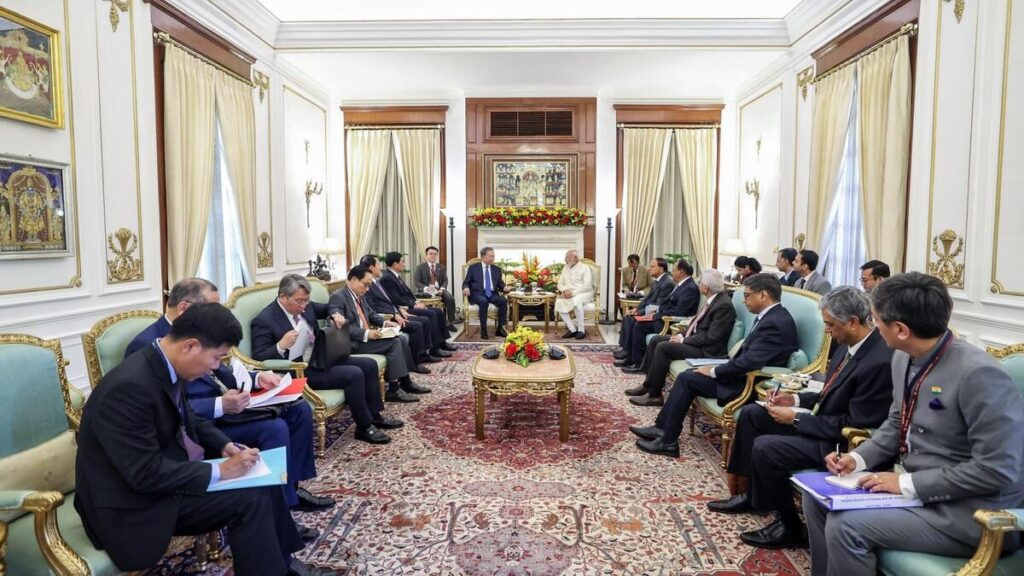
The state visit of To Lam to India from May 5–7, 2026 marked a major milestone in bilateral relations. Both countries elevated their ties to an Enhanced Comprehensive Strategic Partnership, accompanied by agreements in defence, maritime security, digital connectivity, finance, energy, critical minerals, and emerging technologies.
The visit reflects the growing strategic importance of the India–Vietnam relationship in the evolving Indo-Pacific geopolitical landscape.
UPSC Relevance
GS-II: India’s bilateral relations, ASEAN, Indo-Pacific diplomacy
GS-III: Maritime security, Defence cooperation, Supply chain resilience
Historical Foundations of India–Vietnam Relations
India and Vietnam share historically cordial relations rooted in:
- Anti-colonial struggles
- Shared support for sovereignty and strategic autonomy
- Civilisational and Buddhist linkages
- Cold War-era diplomatic cooperation
India supported Vietnam during its struggle against colonialism and later maintained close ties during Vietnam’s reconstruction phase.
Formal diplomatic relations were established in 1972.
Evolution of Bilateral Relations
Look East to Act East
India’s engagement with Southeast Asia accelerated through the Look East Policy launched in the 1990s, later upgraded into the Act East Policy.
Vietnam gradually emerged as one of India’s most important strategic partners in Southeast Asia.
Comprehensive Strategic Partnership (2016)
During the visit of Narendra Modi to Vietnam in 2016, ties were elevated to a Comprehensive Strategic Partnership.
This institutionalised cooperation in:
- Defence
- Maritime security
- Trade
- Connectivity
- Energy
- Capacity building
The 2026 upgrade further deepens this framework.
Strategic Significance of Vietnam for India
1. Centrality in Indo-Pacific Strategy
Vietnam occupies a strategically critical location along the South China Sea, one of the world’s busiest maritime trade routes.
For India, Vietnam acts as:
- A gateway to Southeast Asia
- A strategic balancing partner
- A maritime security partner in the Indo-Pacific
2. Counterbalancing Chinese Assertiveness
Both India and Vietnam have concerns regarding China’s growing assertiveness.
Vietnam’s Concerns
- Territorial disputes in the South China Sea
- Militarisation of artificial islands
- Maritime coercion
India’s Concerns
- Chinese activities in the Indian Ocean
- Border tensions along the Line of Actual Control (LAC)
- Strategic encirclement concerns
This convergence of strategic interests has strengthened bilateral trust.
Defence Cooperation: The Backbone of the Partnership
Defence Training and Capacity Building
India has consistently supported Vietnam through:
- Training submarine crews
- Aviation training
- Cybersecurity cooperation
- Military exchanges
Maritime Cooperation
Maritime cooperation has expanded significantly through:
- Naval exercises
- Port calls
- White shipping agreements
- Maritime domain awareness cooperation
The transfer of the missile corvette INS Kirpan in 2023 symbolised growing strategic trust.
BrahMos Missile Discussions
Ongoing discussions regarding export of the BrahMos missile system to Vietnam represent a major strategic development.
Significance
- Enhances Vietnam’s deterrence capabilities
- Expands India’s defence exports
- Signals India’s role as a regional security provider
The move also reflects India’s increasing willingness to engage in defence diplomacy in the Indo-Pacific.
Economic Relations
Bilateral Trade
India–Vietnam trade has crossed $16 billion, with a target of $25 billion by 2030.
Major sectors include:
- Pharmaceuticals
- Electronics
- Agriculture
- Machinery
- Chemicals
- Textiles
Supply Chain Diversification
The partnership gains importance amid global efforts to reduce excessive dependence on China-centric supply chains.
Vietnam has emerged as a major manufacturing hub in Southeast Asia.
India sees Vietnam as a critical partner for:
- Electronics manufacturing
- Semiconductor ecosystems
- Supply chain resilience
- Industrial diversification
Digital and Financial Connectivity
New initiatives include:
- Digital payment integration
- FinTech cooperation
- Digital public infrastructure collaboration
This aligns with India’s broader technology diplomacy strategy.
Critical Minerals and Energy Cooperation
Rare Earth Collaboration
Vietnam possesses substantial reserves of rare earth minerals essential for:
- Electric vehicles
- Renewable energy technologies
- Semiconductor manufacturing
- Defence industries
India seeks to diversify critical mineral sourcing amid global strategic competition.
Energy Cooperation
India’s involvement in offshore oil exploration projects in the South China Sea has been strategically significant.
Despite Chinese objections, India has maintained energy cooperation with Vietnam, reinforcing principles of maritime freedom and sovereign rights under international law.
ASEAN and the Indo-Pacific
Vietnam’s Importance within ASEAN
Association of Southeast Asian Nations (ASEAN) remains central to India’s Indo-Pacific vision.
Vietnam is among ASEAN’s most strategically assertive members and plays an important role in:
- Regional maritime security
- Economic integration
- Strategic balancing
Minilateral Security Architecture
India and Vietnam increasingly contribute to a broader Indo-Pacific strategic network involving:
- Japan
- Australia
- United States
Though not treaty allies, these partnerships collectively support:
- Freedom of navigation
- Rule-based maritime order
- Strategic stability
Emerging Areas of Cooperation
1. Semiconductor Ecosystems
Both countries are exploring cooperation in semiconductor manufacturing and resilient technology supply chains.
2. Cybersecurity
Cyber cooperation has become increasingly important due to growing digital vulnerabilities.
3. Artificial Intelligence and Emerging Technologies
Technology partnerships are expanding into advanced innovation sectors.
4. Blue Economy
Cooperation in marine resources, fisheries management, and sustainable maritime development is gaining momentum.
Challenges in the Partnership
Trade and Connectivity Constraints
Despite strong political relations, logistical and connectivity gaps continue to limit trade expansion.
Defence Export Challenges
Exporting sophisticated systems such as BrahMos involves:
- Financial negotiations
- Geopolitical sensitivities
- Technology transfer issues
China Factor
While both countries seek strategic autonomy, balancing relations with China remains a sensitive issue.
Vietnam carefully follows a policy of diversification and avoids formal alliance structures.
India’s Indo-Pacific Vision
India’s Indo-Pacific approach emphasises:
- Inclusivity
- ASEAN centrality
- Freedom of navigation
- Rule of law
- Respect for sovereignty
The India–Vietnam partnership aligns strongly with these principles.
Geopolitical Significance
The elevation of ties reflects broader transformations in Asian geopolitics:
- Shift from economic engagement to security cooperation
- Growing maritime competition
- Weaponisation of supply chains
- Rise of strategic minilateralism
- Emergence of technology-based geopolitics
India and Vietnam increasingly view each other as long-term strategic partners rather than merely diplomatic partners.
Way Forward
Deepening Defence Industrial Cooperation
Joint production, maintenance, and defence technology collaboration should be expanded.
Strengthening Maritime Security
Regular naval coordination and maritime domain awareness cooperation should be institutionalised.
Expanding Economic Integration
Efforts should focus on:
- Trade facilitation
- Port connectivity
- Supply chain integration
- Investment promotion
Enhancing Technology Partnerships
Cooperation in:
- AI
- Semiconductors
- Renewable energy
- Digital governance
can strengthen strategic resilience.
Strengthening ASEAN-Centred Engagement
India should leverage Vietnam’s regional influence to deepen engagement with ASEAN and the wider Indo-Pacific.
Conclusion
The elevation of India–Vietnam relations to an Enhanced Comprehensive Strategic Partnership marks the emergence of a mature and multidimensional strategic relationship. Driven by converging geopolitical interests, maritime concerns, economic diversification, and technological cooperation, the partnership is becoming an important pillar of the evolving Indo-Pacific order.
As strategic competition intensifies across Asia, India and Vietnam are likely to play increasingly significant roles in shaping a stable, rules-based, and multipolar regional architecture.
Prelims Practice Questions
1. Consider the following statements regarding India–Vietnam relations:
- Vietnam is a member of ASEAN.
- India and Vietnam upgraded their ties to a Comprehensive Strategic Partnership in 2016.
- BrahMos missile is jointly developed by India and Vietnam.
Which of the statements given above are correct?
(a) 1 and 2 only
(b) 2 and 3 only
(c) 1 and 3 only
(d) 1, 2 and 3
Answer:
(a) 1 and 2 only
2. The South China Sea is strategically important because:
- It is a major global maritime trade route.
- It contains significant hydrocarbon reserves.
- It is entirely governed by ASEAN maritime laws.
Which of the statements given above are correct?
(a) 1 only
(b) 1 and 2 only
(c) 2 and 3 only
(d) 1, 2 and 3
Answer:
(b) 1 and 2 only
Mains Practice Questions
- “India–Vietnam relations have evolved from diplomatic engagement to strategic convergence.” Discuss with reference to defence, maritime security, and economic cooperation.
- Examine the strategic significance of India–Vietnam relations in the context of the Indo-Pacific geopolitical architecture.
Tell Google you want more of this.
Add Anantam IAS as a preferred sourceOne tap, and this site shows up more often in your own Top Stories, AI Overviews and AI Mode. Remove it any time.