Why in News?
India opened the AgriVoltaics World Conference in New Delhi on 21 October 2026, launching decision resources and announcing plans for an agrivoltaics programme under the next phase of PM-KUSUM.
- MNRE launched an AgriPV Policy Handbook; the India Agrivoltaics Alliance launched a decision-making tool.
- The Agriculture Ministry emphasised continued cultivation, machinery access, crop choice and safe rainwater drainage beneath solar installations.
- The proposed next-phase programme remains an announcement; these releases do not establish notified subsidy rates, eligibility conditions or an implementation schedule.
- Agrivoltaics addresses competition between food production and renewable-energy land use, but its success depends on maintaining a workable farm.
- Small farmers need evidence about crop performance and net returns, alongside enforceable responsibilities for equipment, payments and eventual removal.
UPSC Relevance
Prelims Relevance
- Agrivoltaics: simultaneous agricultural production and solar-electricity generation on the same land.
- Photovoltaic panels convert sunlight into electricity; crops require light for photosynthesis.
- Panel height and spacing affect both cultivation access and the distribution of shade.
- Grid connection, electricity purchase and payment arrangements are distinct from installing panels.
Mains Relevance
GS Paper 3
- Reconciling renewable-energy expansion with agricultural productivity and smallholder livelihoods.
- Evaluating land-use efficiency alongside crop risk, electricity revenues and project lifecycle costs.
GS Paper 2
- Coordinating agriculture and energy policy with farmer protections in contracts.
Essay
- A technological transition succeeds when its design preserves the livelihoods it promises to improve.
Background and Context
What Makes a Solar Farm Agrivoltaic?
The defining test is whether meaningful agricultural production continues alongside electricity generation on the same land.
- Agrivoltaics combines crops and photovoltaic generation within one working farm. Installing panels on agricultural land while effectively excluding cultivation does not deliver the dual-use benefit that the conference sought to advance for farmers.
- Sunlight is a shared resource: panels intercept solar radiation to generate electricity, while crops need light for photosynthesis. A design that maximises panel coverage can compromise the agricultural activity it is supposed to retain.
- Partial shade changes the crop microclimate and may help under some growing conditions, but reduced light can also constrain growth. The relevant question is how a particular crop performs through its local growing season.
- Yield gains are not universal. Claims of better performance should be tested against comparable cultivation without panels, accounting for crop choice and weather; a promising result at one site cannot establish benefits for every farm.
- Dual output should be judged through both harvests and electricity earnings. A farmer needs to know whether additional power income compensates for changed cultivation costs and crop risks, rather than treating generation alone as success.
Design the Shared Field Around Cultivation
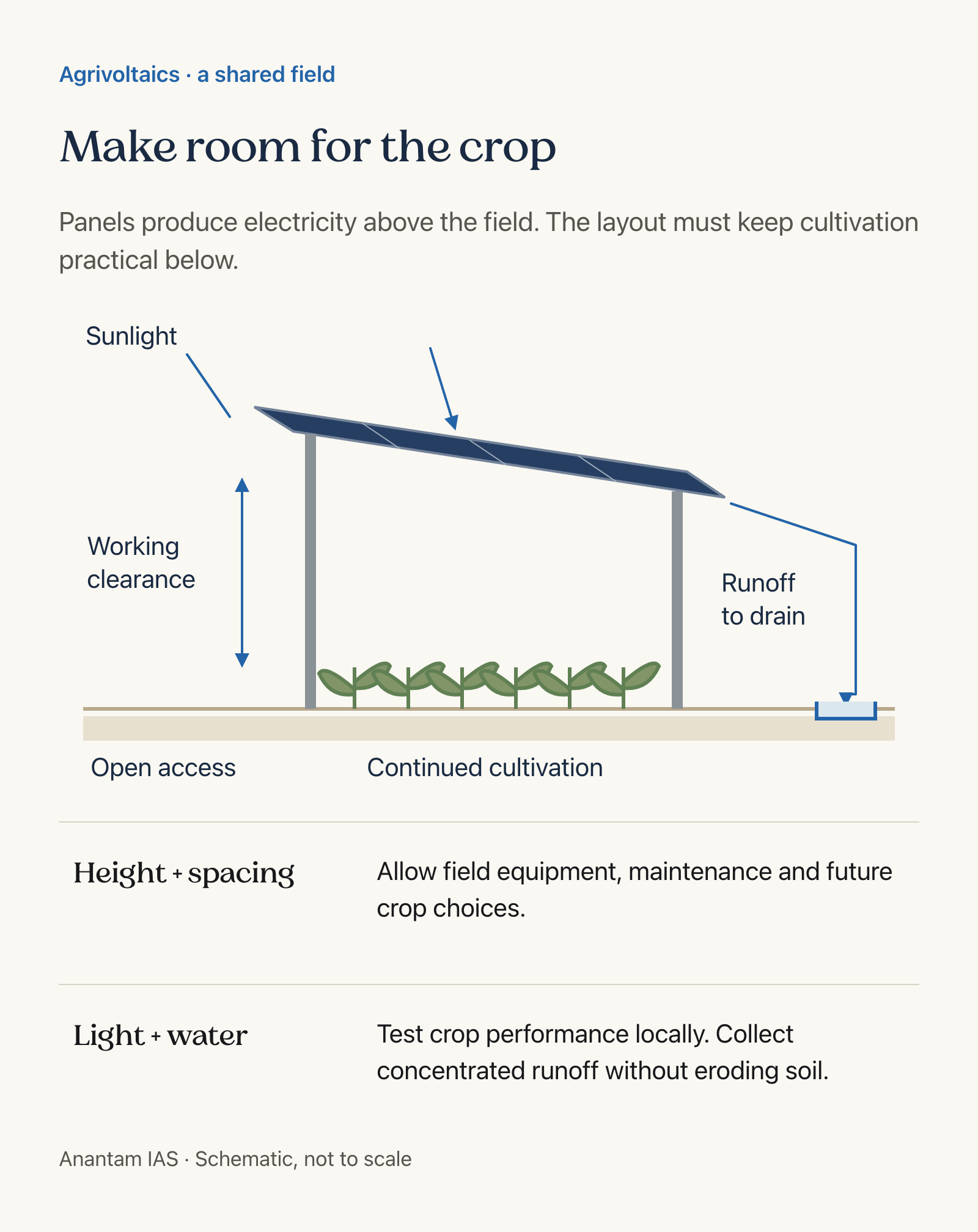
Panel geometry affects the space, light and water available to the farmer below.
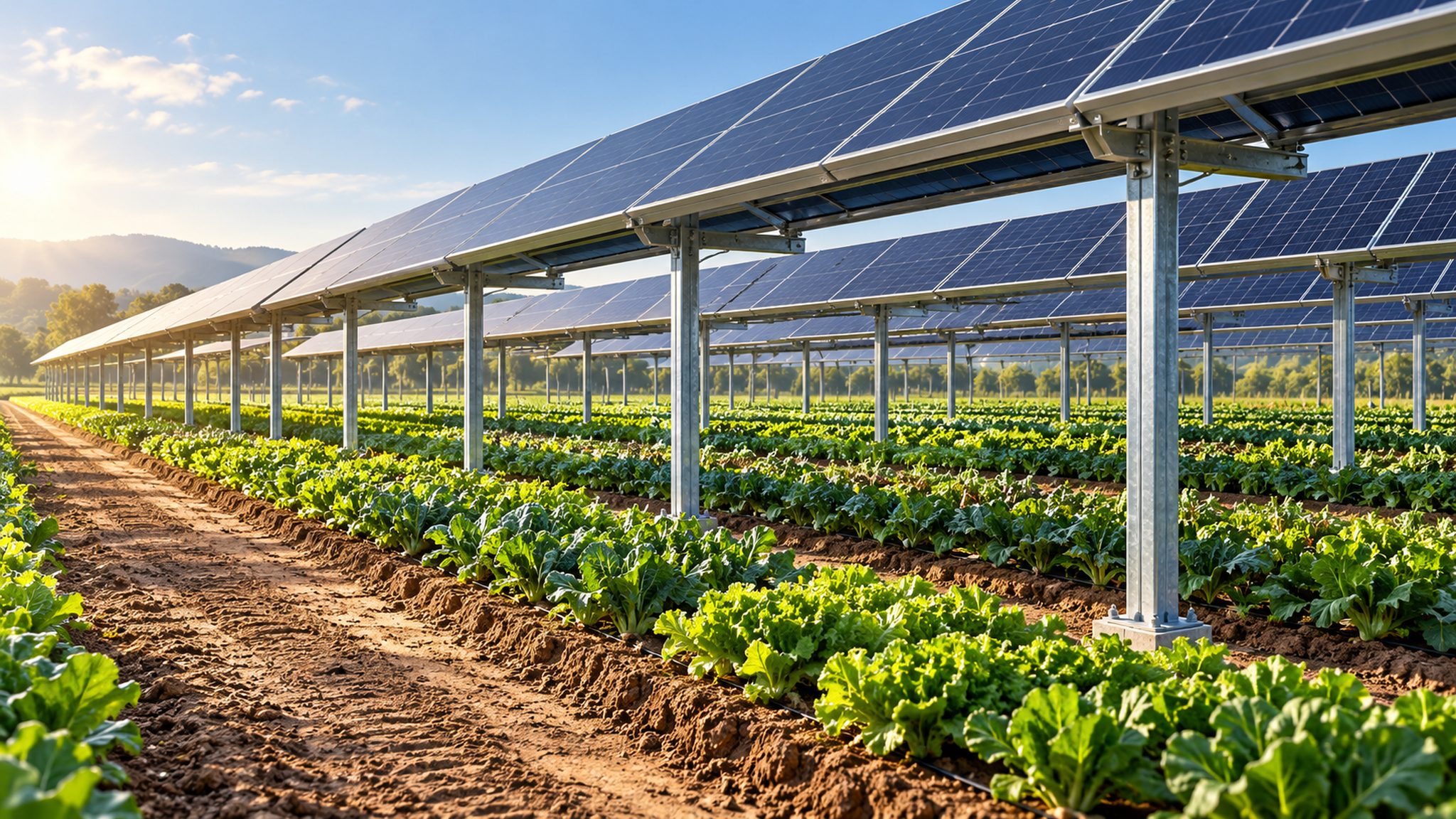
- Panel height and support spacing must allow ploughing and other field operations. Clearance should suit the actual equipment and crop, because nominally cultivable land is of little use if machinery cannot enter or turn safely.
- Row spacing and orientation shape where shade falls across the field. Layout decisions should consider crop-light requirements over the growing season, rather than assuming that every point beneath an installation receives the same sunlight.
- Crop rotation and farmer choice need room in the design. A structure suited to one short crop should not lock the farmer into that crop indefinitely or obstruct future cultivation choices as market conditions change.
- Panel runoff concentrates rainfall at particular edges instead of distributing it evenly across the ground. Drainage and collection arrangements should prevent erosion while keeping water available for productive use, as the Agriculture Ministry stressed.
- Access routes and working space must remain usable for cultivation and equipment maintenance. Planning these together reduces conflict between farm operations and electricity infrastructure; merely planting crops under panels cannot demonstrate that the layout works.
Protect the Farmer Across the Project Lifecycle
A technically workable installation still needs dependable commercial arrangements and clear responsibility when the project ends.
- Grid connectivity and power purchase require explicit arrangements before investment. Producing electricity does not by itself guarantee a buyer, timely connection or predictable revenue, so each link should be assessed separately in the farm business model.
- Payment terms should identify who pays, how generation is measured and when payments fall due. Transparent records matter because a farmer facing delayed electricity income still has seasonal cultivation expenses and continuing household needs.
- Farmer Producer Organisations were suggested as participants in the initiative. Collective involvement could support negotiation and technical services, but contracts must still specify individual farmers’ rights and responsibilities rather than assuming membership removes commercial risk.
- Operation and maintenance create recurring responsibilities, including access for repairs. The ministry proposed training rural youth and women; such employment possibilities should be assessed as practical service needs rather than promised automatically with every installation.
- Exit and removal obligations should be agreed at the outset. The Agriculture Ministry specifically warned against leaving farmers with financial or physical burdens if a company abandons a project or panels require removal after contract expiry.
Way Forward
Approve Farm Performance Alongside Power Performance
- Require local crop trials and transparent comparisons before presenting a layout as suitable for widespread farmer adoption.
- Make cultivation access, drainage and crop flexibility explicit design requirements, assessed with farmers before construction.
- Set enforceable payment, repair and removal obligations, with responsibility for company exit defined before farmers commit land.
- Distinguish the announced programme from future notified rules; assess eligibility and support only when official implementation details become available.
Conclusion
- Agrivoltaics is a joint land-use design problem: electricity generation, crop performance and daily farm operations must work together. Retaining cultivation in name alone cannot resolve competition between food production and renewable-energy infrastructure.
- For a balanced answer, connect physical design with farmer safeguards: light, access and drainage determine whether cultivation remains practical, while purchasing, payments and removal obligations determine who gains income and who carries long-term risk.
UPSC Practice Questions
Prelims MCQ 1
With reference to agrivoltaics, consider the following statements:
- It combines agricultural production and solar-electricity generation on the same land.
- Panel height and spacing can affect agricultural machinery access.
- Shade from panels necessarily raises yields for every crop.
How many of the above statements are correct?
(a) Only one (b) Only two (c) All three (d) None
Answer: (b) Only two
Explanation:
Statements 1 and 2 are correct. Crop responses depend on conditions and light requirements; universal yield gains cannot be assumed.
Prelims MCQ 2
Which arrangement most directly protects an agrivoltaic farmer against an abandoned installation at the end of a project?
(a) Maximising panel coverage irrespective of crop needs (b) Treating projected electricity generation as guaranteed income (c) Defining enforceable equipment-removal and site-restoration responsibilities in advance (d) Restricting farmers permanently to one crop
Answer: (c) Defining enforceable equipment-removal and site-restoration responsibilities in advance
Explanation:
Clear exit and removal obligations address the risk of leaving farmers responsible for unusable equipment and its removal. Panel coverage or generation projections do not allocate those obligations.
UPSC Mains Questions
- Agrivoltaics can reconcile renewable-energy expansion with agricultural land use only when farming remains viable. Discuss the design choices and safeguards required.
- Explain why grid connectivity, payment security and project-exit responsibilities matter as much as panel installation for small farmers adopting agrivoltaics.
Sources: PIB, Ministry of Agriculture and Farmers Welfare and PIB, Ministry of New and Renewable Energy.
Frequently Asked Questions
What is agrivoltaics?
Agrivoltaics combines agricultural production with solar-electricity generation on the same land. Its defining benefit requires cultivation to remain practical, with panel arrangements that accommodate crop needs and normal farm operations.
Does shade from solar panels always increase crop yields?
No. Crop performance depends on light requirements, local growing conditions and the installation layout. Any claimed benefit needs a suitable comparison with cultivation without panels, rather than assuming one result applies everywhere.
Has a new agrivoltaics subsidy been notified?
The cited October 2026 releases describe an announcement of a future programme under the next PM-KUSUM phase. They do not establish notified subsidy rates, eligibility rules or an implementation schedule.
Why do agrivoltaic contracts need removal clauses?
Contracts should allocate responsibilities if a company abandons the project or equipment must be removed after expiry. Clear obligations help prevent farmers from inheriting removal costs or installations that obstruct cultivation.
Tell Google you want more of this.
Add Anantam IAS as a preferred sourceOne tap, and this site shows up more often in your own Top Stories, AI Overviews and AI Mode. Remove it any time.