Why in News?
China announced export controls covering tunnel boring machines and related items on 19 October 2026, effective 18 November, raising procurement questions for Indian infrastructure projects.
- China’s Commerce Ministry says covered items have dual-use characteristics; compliant export licence applications will be approved after review.
- The Indian Express explains the implications for metro, highway and high-speed rail tunnelling, including the Mumbai–Ahmedabad corridor.
- The announcement creates a licensing requirement, not evidence that every proposed shipment to India has been prohibited.
- A delayed specialised machine can affect activities scheduled around its arrival, even when construction finance and civil permissions are available.
- Procurement resilience requires examining production location, components and maintenance, alongside the nationality of the company selling the equipment.
UPSC Relevance
Prelims Relevance
- Tunnel boring machine: mechanised tunnel excavation equipment.
- Dual-use items: items with civilian and military applications.
- Export licensing: authorisation by the exporting jurisdiction.
- Critical path: connected project activities determining completion time.
Mains Relevance
GS Paper 3
- Infrastructure procurement and supply-chain concentration.
- Technology absorption, equipment servicing and project execution risk.
GS Paper 2
- Trade diplomacy and regulatory predictability in cross-border supply chains.
Essay
- Interdependence delivers efficiency but requires institutions that manage vulnerability.
Background and Context
Why Tunnel Boring Machines Are Difficult to Replace
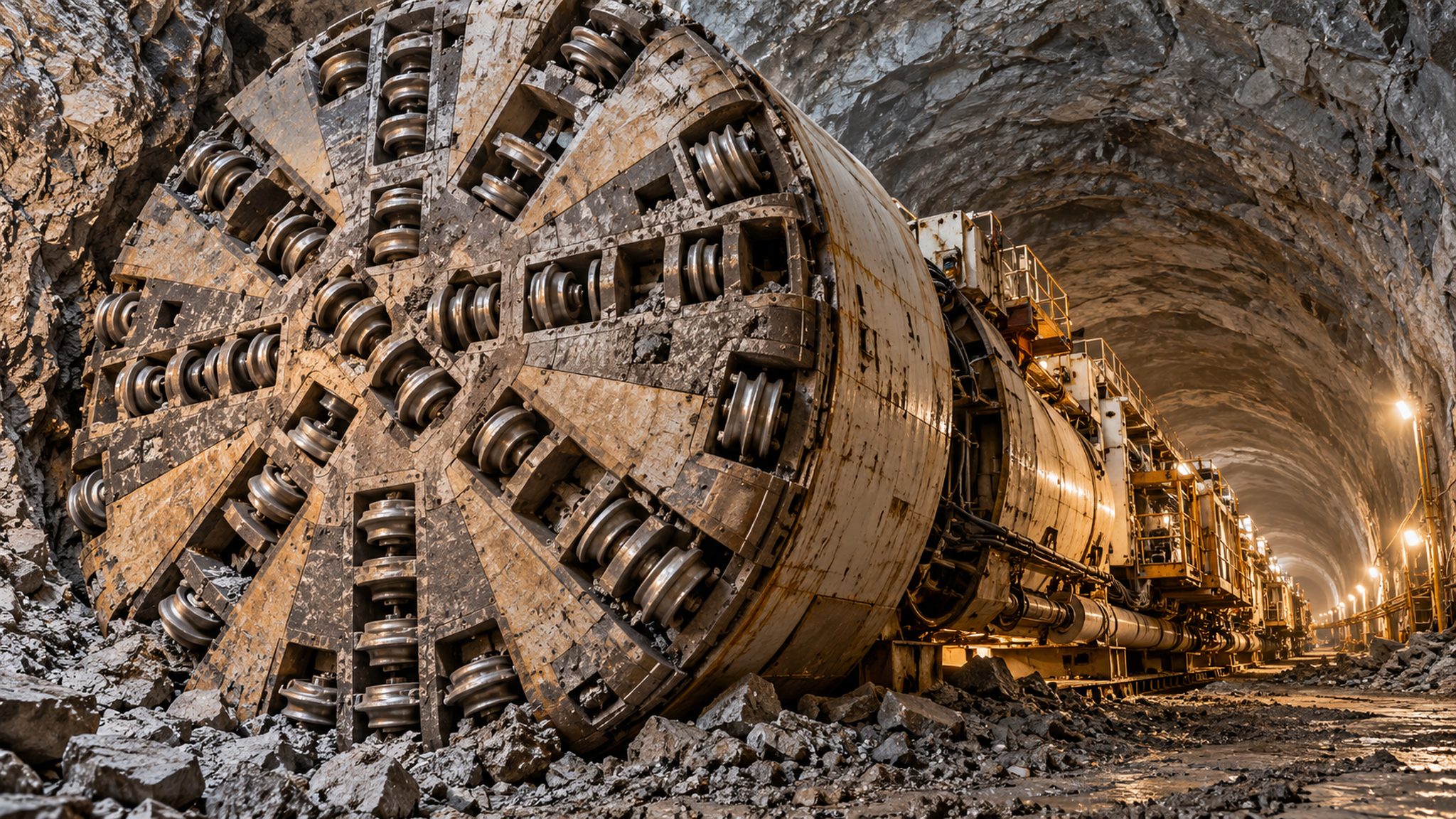
A tunnel boring machine is specialised excavation equipment; its suitability depends on the tunnel and the ground through which it must pass.
- A tunnel boring machine excavates underground passages using a rotating cutting head. Unlike buying ordinary construction vehicles, procuring a suitable machine begins with the tunnel’s dimensions and anticipated ground conditions, which constrain equipment selection.
- The useful distinction is mechanised excavation versus conventional blasting. Controlled excavation can be particularly valuable beneath built-up areas, but safe performance still depends on geological investigation, appropriate machine selection and disciplined operation at the site.
- Project-specific requirements limit interchangeability: a machine suitable for one tunnel cannot automatically replace another. Buyers must check dimensions and ground suitability before assuming equipment available elsewhere can meet a delayed project’s needs without redesign.
- A TBM operates within a wider construction system, including material removal, power, tunnel support and logistics. Delaying its arrival can disrupt prepared work fronts and contracts connected to the excavation sequence on a project.
- Machine weights and designs vary; one reported example should not become a universal definition. For UPSC analysis, the durable point is specialised capital equipment whose replacement requires technical matching, mobilisation and preparation before excavation.
How Export Licensing Becomes a Project Risk
The new measure concerns controlled equipment exports, making the timing and outcome of authorisation relevant to procurement.
- Export licensing adds an authorisation step before a covered shipment can proceed. A signed purchase contract does not itself establish that the exporter has completed every regulatory requirement needed to deliver the machine abroad.
- The Chinese ministry attributes the measure to dual-use characteristics and national security obligations. This is the government’s stated rationale; it does not establish that every civilian tunnel project is military or that every application fails.
- A licensing regime is not a blanket ban: the ministry explicitly says compliant applications will receive approval. The practical effect depends on coverage, processing time and licensing decisions rather than the announcement alone.
- Timing uncertainty can matter even when approval eventually arrives. If excavation lies on the project’s critical path, a delayed machine can postpone connected works; actual consequences depend on available alternatives and the construction schedule.
- Manufacturing location can matter independently of supplier nationality. The Indian Express recalls difficulties delivering China-made machines from a German supplier to India, illustrating why a foreign brand does not eliminate exposure to production-country controls.
What India Should Examine Before Inferring a Shortage
Risk assessment must distinguish a new regulatory requirement from demonstrated disruption to a particular project.
- Scope comes first: procurement teams must match equipment specifications against the control list. The announcement alone is insufficient to claim that every tunnelling machine, spare part or related service faces an identical legal restriction.
- Lifecycle dependence extends beyond delivery of the main machine. Buyers should assess spare parts, servicing and technical support separately, without treating those commercial dependencies as proof that every associated item is newly export-controlled.
- Substitution has costs: changing suppliers can require technical assessment, manufacturing time and revised logistics. A credible resilience strategy identifies workable alternatives in advance rather than assuming another machine can arrive immediately at the site.
- This development concerns physical equipment export controls; it should not be confused with a proposed technology-export catalogue. Restrictions on transferring know-how and restrictions on shipping machines require separate analysis of their legal scope and status.
- Evidence of disruption would require project-specific information such as an affected order, delayed clearance or revised construction schedule. A national infrastructure stoppage cannot be inferred merely from the existence of the new licensing requirement.
Way Forward
Build Resilience Into Procurement
- Require bidders to disclose manufacturing locations and licensing dependencies early enough to inform schedules, contract conditions and contingency planning.
- Assess alternative suppliers and domestic servicing capability against actual engineering requirements, including spare-part availability and technical training.
- Use regulatory dialogue and documented applications to clarify coverage and processing requirements; monitor actual shipment delays before revising project-wide risk estimates.
Conclusion
- The TBM case connects trade regulation with infrastructure execution: a specialised imported machine can become a scheduling vulnerability even when the project’s other inputs are ready. The strength of that vulnerability requires project-level evidence.
- An effective response combines predictable licensing, technically credible alternatives and lifecycle support. Distinguish exposure from realised disruption, and equipment ownership from the continuing ability to operate and maintain it throughout the construction programme.
UPSC Practice Questions
Prelims MCQ 1
With reference to tunnel boring machines and export licensing, consider the following statements:
- An export licensing requirement necessarily prohibits every export of the covered equipment.
- The country where a machine is manufactured can create regulatory exposure even when the supplier is headquartered elsewhere.
- Tunnel boring machines are automatically interchangeable between projects irrespective of tunnel dimensions and ground conditions.
How many of the above statements are correct?
(a) Only one (b) Only two (c) All three (d) None
Answer: (a) Only one
Explanation:
Only statement 2 is correct. Licensing can permit compliant exports. Machine suitability depends on project specifications and ground conditions.
Prelims MCQ 2
Which approach best assesses the infrastructure effect of a new export licensing requirement?
(a) Assume every project using imported equipment has stopped (b) Examine covered specifications, affected orders, approval timing and the construction schedule (c) Treat the supplier’s headquarters as the only relevant jurisdiction (d) Assume all machines can be replaced immediately
Answer: (b) Examine covered specifications, affected orders, approval timing and the construction schedule
Explanation:
Actual project risk depends on regulatory scope, procurement exposure and the scheduling consequences of a delay, not the announcement alone.
UPSC Mains Questions
- How can export controls on specialised construction equipment affect infrastructure delivery? Discuss measures to improve procurement resilience.
- Why should infrastructure procurement assess manufacturing location and lifecycle support alongside supplier nationality? Explain with reference to tunnel boring machines.
Sources: Ministry of Commerce, China and The Indian Express.
Frequently Asked Questions
What is a tunnel boring machine?
A tunnel boring machine is specialised equipment that excavates underground passages using a rotating cutting head. Its suitability depends on tunnel dimensions and ground conditions, so machines are not automatically interchangeable.
Has China announced a blanket ban on TBM exports?
The ministry describes export controls with licence review and approval for compliant applications. This should not be presented as a blanket ban, nor as proof that all Indian projects are affected.
Why can the manufacturing country matter?
A supplier headquartered in one country may manufacture equipment in another. Export authorisation at the production location can affect delivery, making the physical supply chain important alongside the supplier’s corporate nationality.
What should India prioritise in procurement?
Buyers should identify licensing exposure, assess technically suitable alternatives and secure maintenance support. Project schedules should reflect realistic delivery risks rather than assuming either uninterrupted supply or an inevitable stoppage.
Tell Google you want more of this.
Add Anantam IAS as a preferred sourceOne tap, and this site shows up more often in your own Top Stories, AI Overviews and AI Mode. Remove it any time.