Why in News?
The Assam Cabinet, on 13 June 2026, decided that fresh Aadhaar enrolment for residents above 18 years will face extra scrutiny and be screened against the state’s National Register of Citizens (NRC) data, a move the government framed as a tool to curb illegal immigration, as reported by the Indian Express.
The order does not make Aadhaar a citizenship document; it adds a verification layer at the enrolment stage, so adults whose details do not match NRC records may have new Aadhaar requests held for additional checks rather than issued routinely.
- Decision applies to fresh Aadhaar requests by adults above 18, not to existing Aadhaar holders.
- New applications to be cross-checked against NRC application data before generation is approved.
- Stated aim is to plug routes by which illegal immigrants allegedly obtain identity documents.
- Aadhaar remains, in law, proof of identity and residence, never proof of citizenship.
The development matters in the context of:
- Matters because identity documents like Aadhaar can become de-facto proof in welfare and service access, even though they confer no nationality.
- Sits at the intersection of centre-state roles: Aadhaar is a Union (UIDAI) subject, while citizenship determination and border management have strong Union mandates too.
- Raises the recurring tension between security screening and the risk of exclusion errors for genuine residents.
UPSC Relevance
Prelims Relevance
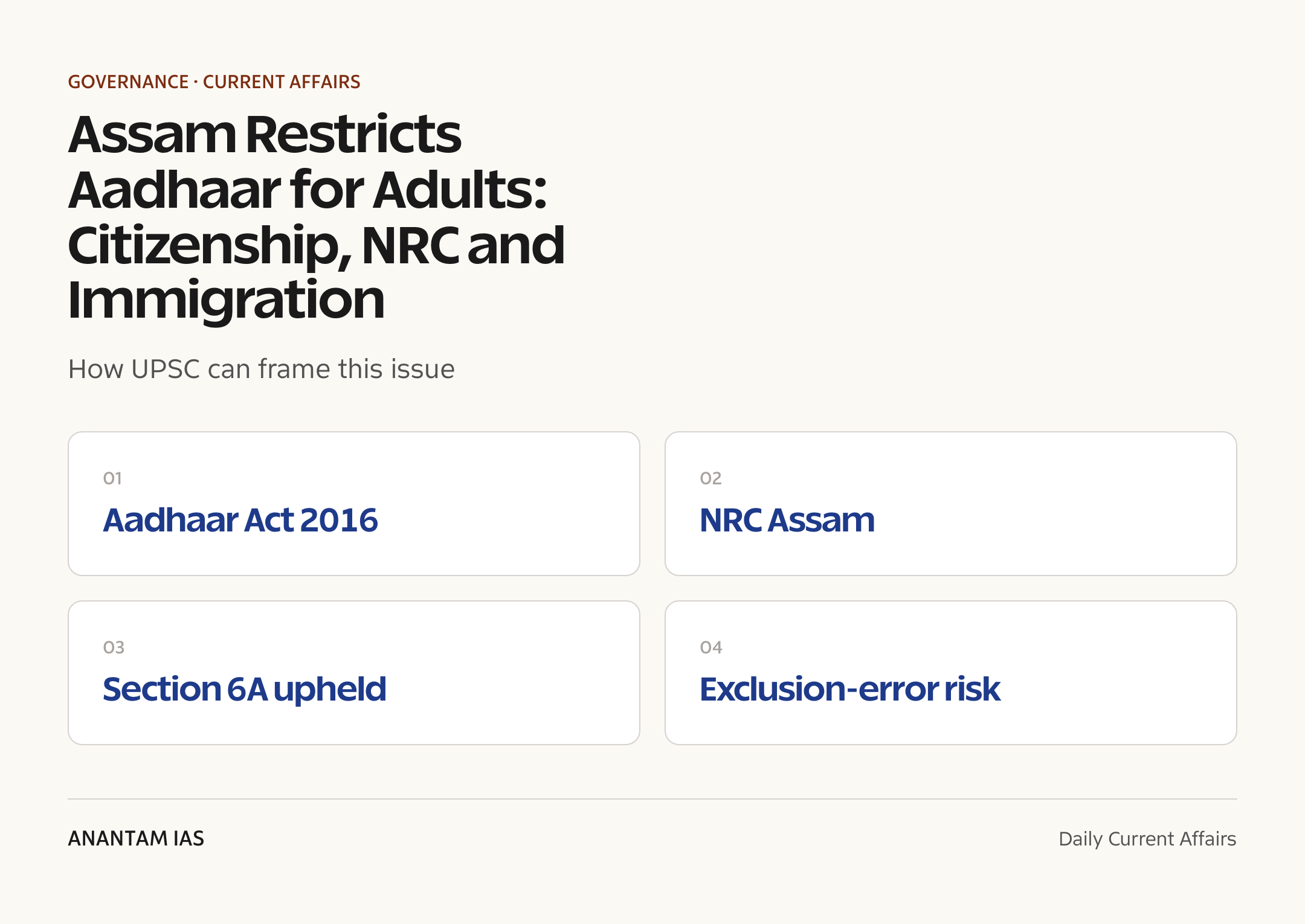
- Aadhaar (Targeted Delivery of Financial and Other Subsidies, Benefits and Services) Act, 2016 — Aadhaar is identity proof, not citizenship.
- UIDAI is a statutory authority under the Aadhaar Act, 2016, under the Ministry of Electronics and IT.
- National Register of Citizens (NRC) for Assam updated under the Citizenship Act, 1955 read with Citizenship (Registration of Citizens) Rules, 2003.
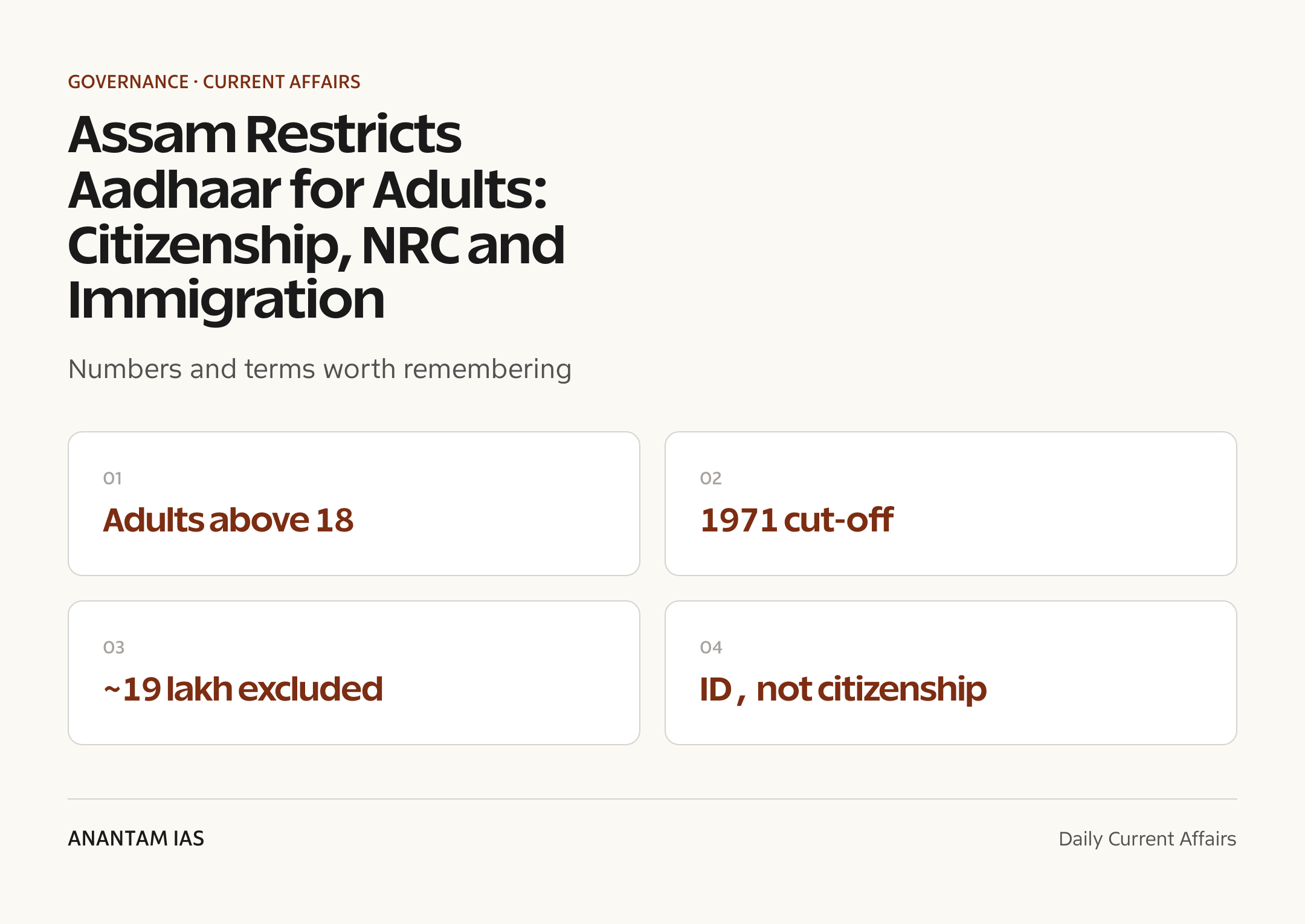
- Assam Accord, 1985 set 24 March 1971 (midnight) as the cut-off for detecting and deporting illegal migrants.
- Section 6A of the Citizenship Act gives special citizenship provisions for Assam; upheld by the Supreme Court (4:1) in 2024.
- Article 5–11 of the Constitution deal with citizenship; Parliament legislates citizenship under the Union List.
- Foreigners Act, 1946 and Foreigners Tribunals govern detection and adjudication of foreigners in Assam.
- Aadhaar is voluntary for residence-based identity but mandatory for many DBT subsidies under Section 7 of the Act.
- K.S. Puttaswamy (2017) recognised privacy as a fundamental right under Article 21, shaping Aadhaar’s limits.
Mains Relevance
GS Paper 2
- Governance challenge of using identity infrastructure to address an immigration and citizenship problem it was never designed to solve.
- Centre-state coordination: a state-level screening layer over a Union-run identity programme (UIDAI).
GS Paper 2
- Rights vs. security: balancing exclusion-error risk against the state’s interest in curbing illegal immigration.
GS Paper 3
- Internal security and border management dimension of identity-document misuse in border states.
Essay
- Identity, belonging and the state: who counts as a citizen and who decides.
- Technology of governance — when an ID system becomes a gatekeeper it was not meant to be.
Background and Context
What Aadhaar Is — and Is Not
The starting point is a legal distinction the headline tends to blur.
- Aadhaar is a 12-digit unique identity number issued by UIDAI under the Aadhaar Act, 2016.
- It certifies identity and residence in India, established through demographic and biometric data.
- Section 9 of the Act is explicit: Aadhaar is not proof of citizenship or domicile.
- Eligibility is based on residence (182+ days in the year preceding application), not nationality — which is why a screening overlay is legally delicate.
- Linking Aadhaar issuance to NRC status grafts a citizenship test onto a residence-based ID.
Assam's NRC and the 1971 Cut-off
Assam is the one state with a state-specific citizenship register, rooted in its migration history.
- The NRC lists Indian citizens in Assam; its 2019 final draft excluded about 19 lakh applicants.
- Inclusion turned on proving presence (self or ancestor) in India before the 24 March 1971 cut-off from the Assam Accord, 1985.
- Those excluded can contest before Foreigners Tribunals, with appeals to higher courts.
- The register has faced criticism for exclusion errors affecting genuine citizens, including women and the poor without documentary trails.
- Tying Aadhaar to NRC data imports those same data-quality and fairness concerns into the ID pipeline.
The Constitutional and Statutory Frame
Citizenship is a Union subject governed by a layered legal architecture.
- Articles 5–11 set out citizenship in India at commencement and empower Parliament to regulate it.
- The Citizenship Act, 1955 governs acquisition and termination; the NRC rests on it.
- Section 6A, inserted after the Assam Accord, creates the special 1971-based regime for Assam.
- In 2024, a Constitution Bench upheld Section 6A by 4:1, affirming the Accord’s constitutional validity (see the CAA 2019 and Section 6A verdict).
- The Foreigners Act, 1946 places the burden of proving citizenship on the person alleged to be a foreigner.
Why a State Acts on a Union ID
The move surfaces a federal fault line over who controls identity gatekeeping.
- UIDAI and the Aadhaar Act are Union instruments; enrolment is delivered through registrars, often state agencies.
- Assam has historically run Aadhaar enrolment with extra caution, pending NRC finalisation.
- A state-imposed scrutiny layer raises questions of uniformity across India for a national ID.
- It also tests the limits of executive (Cabinet) action versus what needs statutory or central sanction.
- Border management and immigration policy carry a strong Union mandate, complicating a purely state-led approach.
The Exclusion-Error Risk
Any screening layer carries a false-positive cost borne by real residents.
- Genuine residents whose names or spellings differ from NRC records may be wrongly held up.
- Aadhaar is a gateway to rations, pensions, bank accounts and DBT — delay can mean denial of entitlements.
- Marginalised groups — the poor, women, the displaced — are likeliest to lack clean documentary trails.
- The Puttaswamy (2017) right to privacy framework cautions against function creep in identity systems.
- An ID block that effectively penalises before adjudication risks treating residents as foreigners by default.
Way Forward
Keep the legal lines clean
- Reaffirm publicly that Aadhaar screening does not, and cannot, determine citizenship.
- Anchor any added scrutiny in clear, reviewable rules rather than discretionary holds.
Build a fair safeguard layer
- Provide a fast, low-friction grievance and appeal route for residents wrongly flagged.
- Pre-fill and reconcile NRC data to cut spelling and matching errors before it gates IDs.
Settle the federal question
- Coordinate with UIDAI and the Centre so a national ID is not applied unevenly across states.
- Address illegal immigration through the proper channels — Foreigners Tribunals, border management — not ID denial.
Conclusion
Assam’s decision restates an old anxiety in a new form: a border state trying to keep identity documents from becoming a backdoor to belonging. The legal core, though, is unchanged — Aadhaar proves who you are and where you live, not whether you are a citizen.
The test of the policy will be precision. If NRC-linked scrutiny catches only genuine misuse without stranding real residents from their entitlements, it strengthens governance. If exclusion errors multiply, it risks punishing citizens for a problem that belongs to immigration enforcement, not to the ID counter.
UPSC Practice Questions
Prelims MCQ 1
With reference to Aadhaar in India, consider the following statements:
- Aadhaar is statutorily recognised as proof of Indian citizenship.
- The Unique Identification Authority of India (UIDAI) is established under the Aadhaar Act, 2016.
- Eligibility for Aadhaar is based on residence in India, not on nationality.
How many of the above statements are correct?
(a) Only one (b) Only two (c) All three (d) None
Answer: (b) Only two
Explanation:
Statements 2 and 3 are correct. UIDAI is a statutory body under the Aadhaar Act, 2016, and eligibility rests on residence (182+ days), not nationality. Statement 1 is wrong — Aadhaar is proof of identity and residence, never of citizenship.
Prelims MCQ 2
The cut-off date for detection of illegal migrants under the Assam Accord, 1985 (reflected in Section 6A of the Citizenship Act) is:
(a) 26 January 1950 (b) 19 July 1948 (c) 24 March 1971 (d) 1 January 1966
Answer: (c) 24 March 1971
Explanation:
The Assam Accord set midnight of 24 March 1971 as the cut-off; entrants after this date are to be detected and deported. The Supreme Court upheld Section 6A, which embeds this date, by 4:1 in 2024.
UPSC Mains Questions
- Aadhaar was designed as proof of identity and residence, yet states increasingly treat it as a gatekeeper for citizenship-linked concerns. Examine the governance and federal challenges this creates, using Assam’s recent decision as a reference.
- “Screening identity-document issuance against citizenship registers risks converting administrative errors into denial of rights.” Critically analyse this statement in the context of the NRC and Aadhaar in Assam.
- Discuss the constitutional and statutory framework governing citizenship determination in Assam, and assess whether linking Aadhaar enrolment to NRC data is an appropriate tool to curb illegal immigration.
Sources: Indian Express and UIDAI.
Frequently Asked Questions
Does the new Assam rule make Aadhaar proof of citizenship?
No. Even after the new scrutiny, Aadhaar remains proof of identity and residence only. Section 9 of the Aadhaar Act, 2016 is explicit that Aadhaar is not proof of citizenship or domicile. The Assam decision adds a verification step at enrolment; it does not change what an Aadhaar number legally certifies.
Who is affected by the Assam Cabinet decision?
The decision targets fresh Aadhaar enrolment by residents above 18 years of age. Existing Aadhaar holders are not affected. New adult applications will be cross-checked against the state’s NRC data before generation is approved, so genuine residents with matching records should still be enrolled.
What is the National Register of Citizens (NRC) in Assam?
The NRC is a register of Indian citizens specific to Assam, maintained under the Citizenship Act, 1955 and the 2003 Rules. Inclusion requires proving presence in India before the 24 March 1971 cut-off from the Assam Accord. Its 2019 final draft excluded about 19 lakh applicants, who can contest before Foreigners Tribunals.
Why is Aadhaar based on residence rather than citizenship?
Aadhaar was built to deliver subsidies, benefits and services to all residents, regardless of nationality. The Aadhaar Act, 2016 keys eligibility to residence — typically 182 days or more in the preceding year — so it can reach the people who actually live in and use Indian public services.
What is the main risk of linking Aadhaar to NRC checks?
The chief risk is exclusion error. Residents whose names or spellings differ from NRC records may be wrongly delayed, and because Aadhaar gates rations, pensions and bank accounts, a delay can effectively deny entitlements. Marginalised groups without clean documentary trails are the most exposed.
Did the Supreme Court rule on Assam’s citizenship cut-off?
Yes. In 2024 a Constitution Bench upheld Section 6A of the Citizenship Act by a 4:1 majority. Section 6A embeds the Assam Accord’s 24 March 1971 cut-off and the special citizenship regime for Assam, affirming the constitutional validity of the Accord’s framework.
Tell Google you want more of this.
Add Anantam IAS as a preferred sourceOne tap, and this site shows up more often in your own Top Stories, AI Overviews and AI Mode. Remove it any time.