The Baiga of Madhya Pradesh have been in the news this month for the most ordinary of reasons. A district administration order in Dindori cleared the way for habitat rights recognition under the Forest Rights Act for several Baiga settlements. The order is technical, but it touches one of the longest-running tensions in Indian governance: how the state recognises tribes that the state itself has sometimes failed to see as full citizens.
The Baiga are listed as a Particularly Vulnerable Tribal Group, one of 75 such groups identified across India. The PVTG category was created to address communities whose populations, livelihoods, and social systems make them especially fragile in the face of mainstream development. Habitat rights, available only to PVTGs under the Forest Rights Act framework, are the most powerful protection the law offers them.
This article reads the Baiga tribe PVTG story with a UPSC tribal affairs lens. We trace the community’s history, decode the PVTG framework, examine the shifting cultivation debate, and ask what habitat rights actually mean on the ground.
Quick Facts
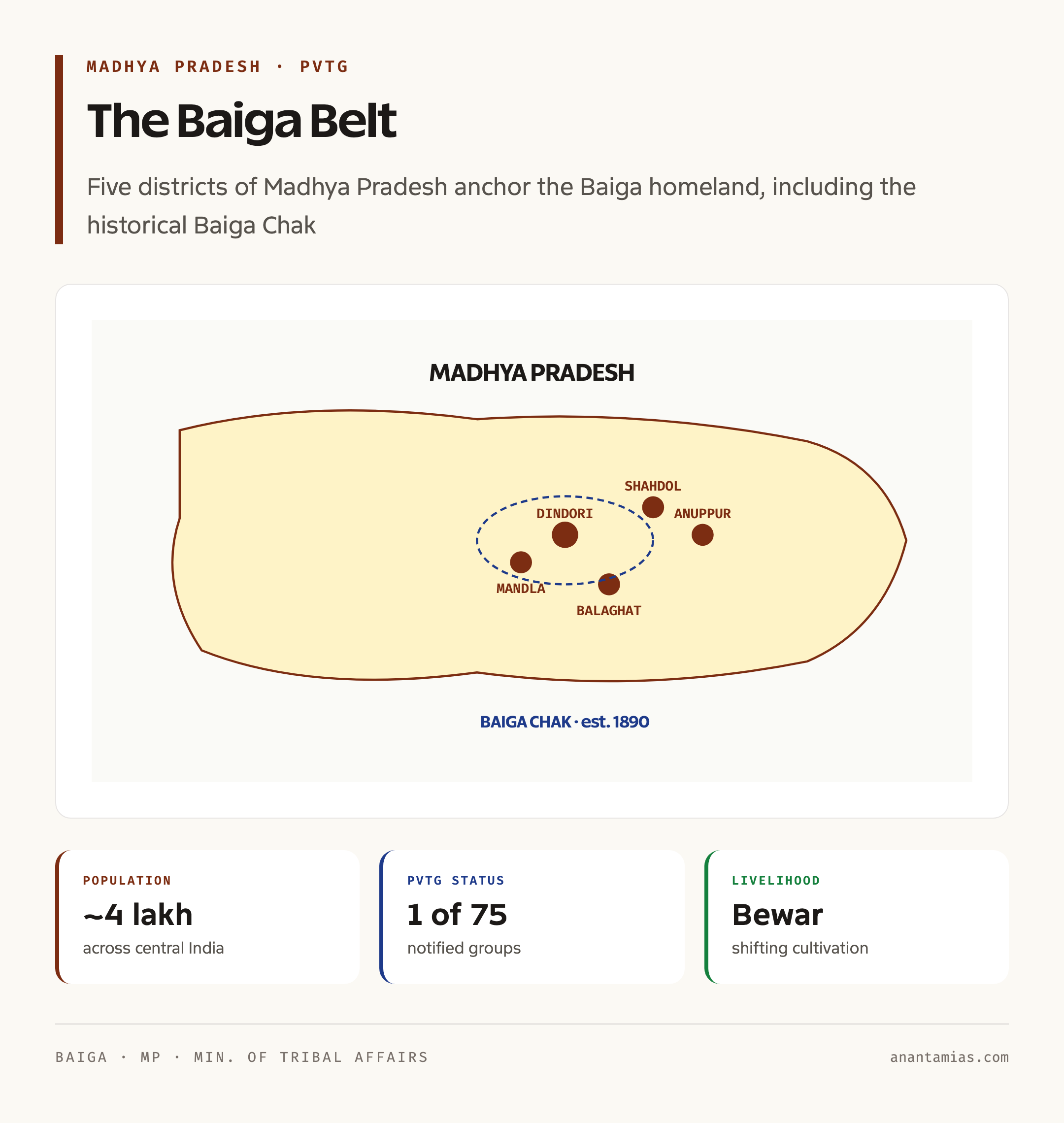
- Population: roughly 4 lakh Baiga across central India.
- Concentration: Madhya Pradesh, mainly Dindori, Mandla, Balaghat, Shahdol, and Anuppur districts.
- Also present in: Chhattisgarh, Jharkhand, Uttar Pradesh.
- PVTG status: notified by the Government of India.
- Total PVTGs in India: 75 communities, across 18 states and Union Territories.
- Traditional livelihood: bewar or dahiya shifting cultivation, forest gathering, beekeeping.
- Key legal anchor: Scheduled Tribes and Other Traditional Forest Dwellers (Recognition of Forest Rights) Act, 2006.
- Habitat rights provision: Section 3(1)(e) of the Forest Rights Act.
What Just Happened
In May 2026, the Madhya Pradesh tribal welfare department processed habitat rights claims for Baiga settlements in Dindori district, advancing one of the country’s most-watched habitat rights cases. The administrative file moved through district-level committees, state nodal verification, and forest department concurrence.
Habitat rights recognition is consequential. Where individual forest rights protect a single family’s claim to cultivated land, and community forest rights protect a village’s gathering and grazing rights, habitat rights protect a whole community’s relationship with its traditional territory. For a PVTG like the Baiga, the territory extends across forest patches, sacred groves, water sources, and cultivation sites that may straddle multiple revenue villages.
The 2026 movement was driven by three factors. State elections had reset political incentives. Civil society had finally translated a decade of documentation into legally usable evidence packages. And the central tribal affairs ministry had pushed states to clear pending PVTG habitat rights claims as part of the Pradhan Mantri Janjati Adivasi Nyaya Maha Abhiyan rollout.
Background and Historical Context
The Baiga have lived in the forest belt of central India for centuries. Colonial ethnographers, including Verrier Elwin in the 1930s, documented their society as bewar-based: a long-fallow shifting cultivation system in which patches of forest were cleared, sown for two or three seasons, and then left for the forest to reclaim over a decade or more. Elwin’s book The Baiga, published in 1939, remains a foundational text.
The colonial administration tried to settle the Baiga into permanent cultivation, both for forest conservation and for revenue. The community resisted, and the British eventually carved out the Baiga Chak in 1890, a reservation in the present-day Dindori and Mandla districts where bewar was permitted under specific conditions.
After independence, the conservation-versus-tribal-livelihood debate hardened. The Indian Forest Act of 1927 framework, inherited from the British, classified large parts of central India as Reserved or Protected Forest, restricting traditional access. The wider history of this legal framework is covered in our explainer on the Indian Forest Act 1927.
The 1976 Dhebar Commission first formalised the Primitive Tribal Group category, later renamed Particularly Vulnerable Tribal Group in 2006. The Baiga were among the early notifications. The PVTG framework recognises that some tribes require differentiated, intensified state support rather than blanket schemes designed for the broader scheduled tribe population.
The Forest Rights Act of 2006 was the next watershed. It recognised individual, community, and habitat rights of forest-dwelling Scheduled Tribes and other traditional forest dwellers. For PVTGs, Section 3(1)(e) created the habitat rights category. Implementation has been slow.
Key Features of the PVTG Framework
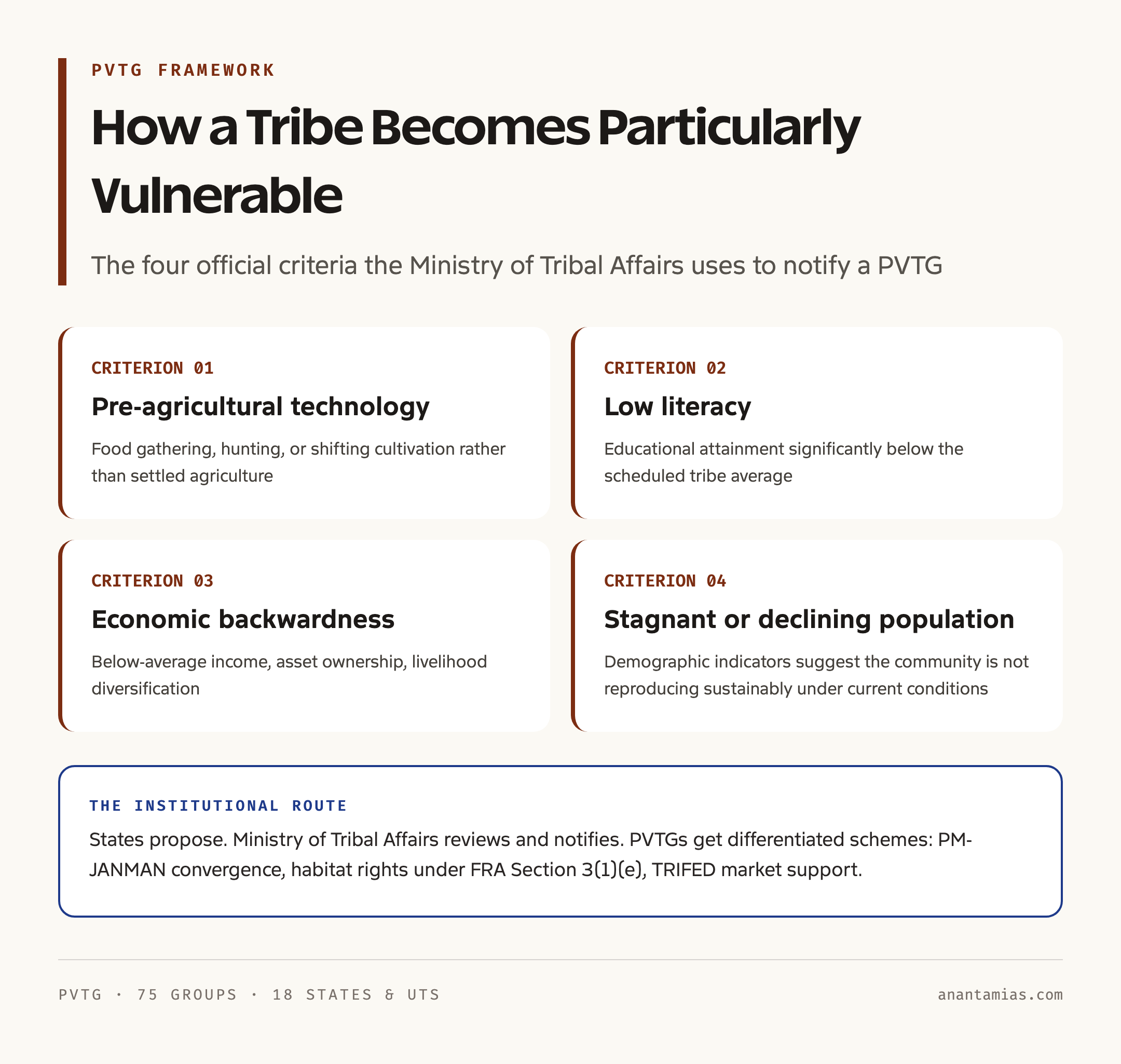
A tribe is classified as Particularly Vulnerable Tribal Group on four criteria.
- Pre-agricultural level of technology: Communities that practice food gathering, hunting, or shifting cultivation rather than settled agriculture.
- Low literacy: Educational attainment significantly below the scheduled tribe average.
- Economic backwardness: Below-average income, asset ownership, and livelihood diversification.
- Stagnant or declining population: Demographic indicators that suggest the community is not reproducing itself sustainably under current conditions.
States propose tribes for PVTG status. The Ministry of Tribal Affairs reviews and notifies. The list of 75 includes the Jarawa and Sentinelese in the Andaman and Nicobar Islands, the Toda in Tamil Nadu, the Kattunayakan in Kerala, the Birhor in Jharkhand, and the Baiga, Bharia, and Sahariya in Madhya Pradesh.
PVTGs are eligible for special support under the Pradhan Mantri PVTG Development Mission, launched in 2023, which is now folded into the broader PM Janjati Adivasi Nyaya Maha Abhiyan. The mission targets habitat development, road connectivity, housing, electrification, drinking water, mobile connectivity, and skill training across PVTG settlements.
Why the Baiga Case Matters
The Baiga tribe PVTG story matters at three levels.
It tests the operational depth of the Forest Rights Act. Habitat rights have been recognised for very few PVTGs in the two decades since the Act was passed. Each successful recognition adds case law and administrative practice.
It informs the shifting cultivation debate. Bewar has been treated by foresters as destructive and by the community as ecologically calibrated. Recent ecological studies suggest long-fallow shifting cultivation can be carbon-neutral or carbon-positive over a full cycle. Habitat rights recognition implicitly accepts the community’s framing.
It carries constitutional weight. Article 244 read with the Fifth and Sixth Schedules, Article 46 on educational and economic promotion of weaker sections, and the broader directive principles all converge on PVTG welfare. How the state delivers on these promises is a constitutional question, not just an administrative one.
Detailed Analysis: The Bewar System
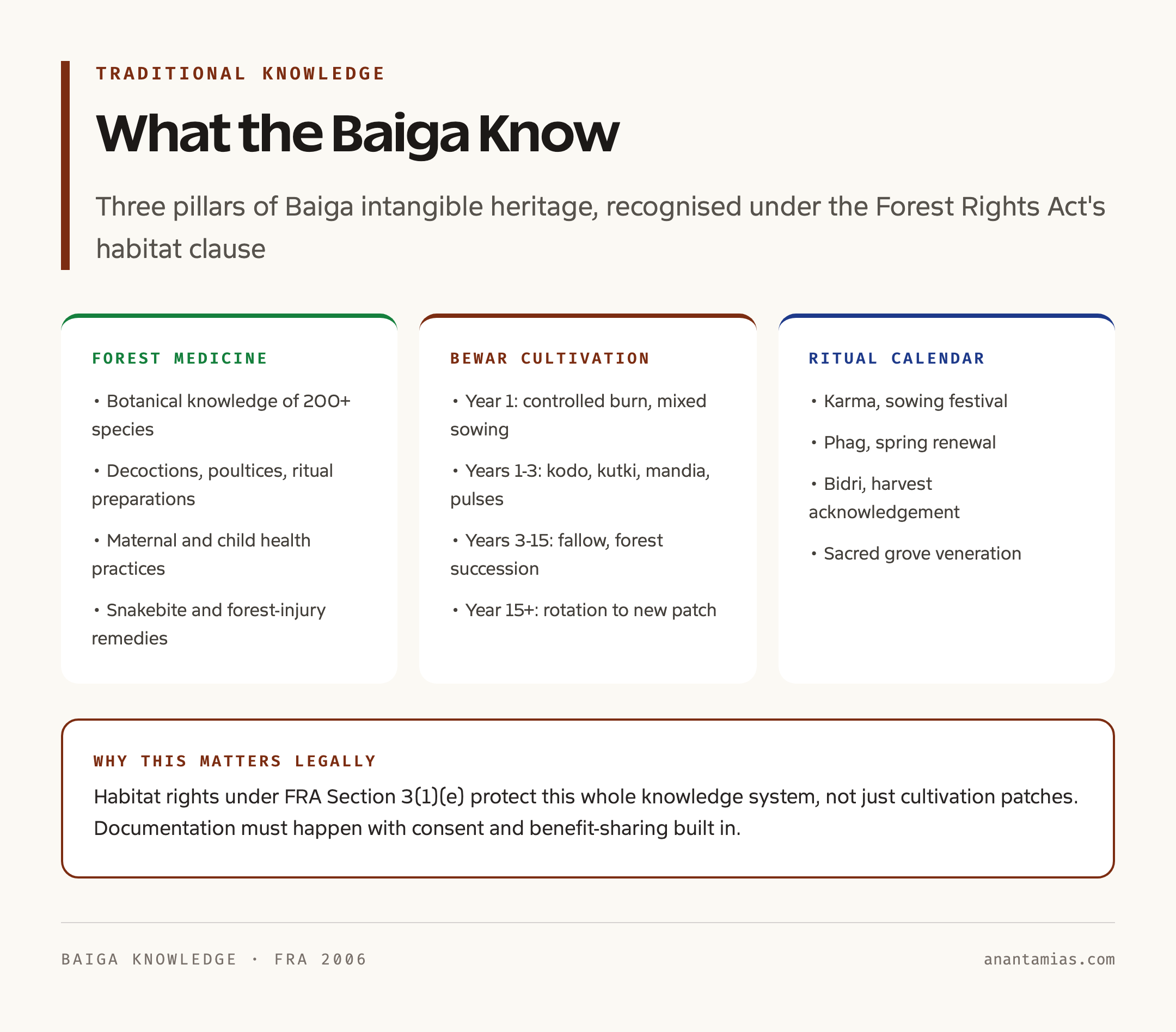
To understand the Baiga, you have to understand bewar, also called dahiya in some areas. The system has four phases across a typical 12 to 15 year cycle.
Year one: clearing. A forest patch is selected, the undergrowth cut and burned during the dry season. Ash returns nutrients to the soil. The burn is timed and controlled.
Years one to three: cultivation. Mixed cropping of kodo, kutki, mandia, and pulses. Yields are modest but reliable, and the soil retains fertility because of mixed planting and ash enrichment.
Years three to fifteen: fallow. The patch is left to regenerate. Forest succession returns, biodiversity recovers, soil carbon rebuilds.
Year fifteen or later: rotation. A new patch is cleared, and the cycle continues.
The system rests on three preconditions: enough land, enough time, and enough community discipline. All three eroded over the colonial and post-independence period as forest department restrictions, population pressure, and competing land use compressed the cycle.
When bewar is squeezed to short cycles of three or four years, the system collapses ecologically. The fix is not to ban bewar but to restore the conditions under which it works. That is precisely what habitat rights, applied with seriousness, can do.
Why It Matters for Indian Federalism
Tribal affairs sit at an awkward constitutional junction. The Fifth Schedule applies to scheduled areas in most states with significant tribal populations, including Madhya Pradesh. The Sixth Schedule covers the Northeast separately. Land, forests, and revenue administration are largely state subjects, while tribal welfare is on the Concurrent List in spirit if not in form.
The Forest Rights Act centralised the rights recognition framework but left implementation entirely to states. This produces wide variation. Odisha and Maharashtra have recognised community forest rights at scale. Madhya Pradesh and Chhattisgarh have moved more slowly. Habitat rights, the highest-stakes category, have been recognised for only a handful of PVTGs nationwide.
The Baiga case is consequential because Madhya Pradesh is the state with the largest PVTG presence after Odisha. Implementation momentum here radiates outward.
Comparative Perspective
Three reference cases sharpen the Baiga picture.
- Jenu Kuruba and Soliga of Karnataka: Habitat-style rights inside tiger reserves have been litigated through community-forest-rights routes. Outcomes mixed. Wider issues of tribal relocation are discussed in our piece on relocation of tribals from tiger reserves.
- Dongria Kondh of Odisha: The Niyamgiri gram sabha verdict in 2013, where local councils rejected bauxite mining on sacred hills, was a landmark in habitat-style protection through indirect means.
- Hill Korwa of Chhattisgarh: Another PVTG with extensive shifting cultivation history. Habitat rights work in Chhattisgarh has been slower than in Madhya Pradesh, even though the population overlap is similar.
The point is that habitat rights work as both a legal claim and a political instrument. The legal claim sets the floor. The political instrument depends on administrative will.
Challenges
The Baiga tribe PVTG and the broader habitat rights agenda face real obstacles.
- Forest department resistance. Foresters often see habitat rights as a threat to conservation mandates and revenue collection from non-timber forest produce.
- Documentation gaps. Establishing customary boundaries requires oral history, GPS mapping, and inter-village agreement. The process is slow and expensive.
- Conflicting land claims. Other communities, including non-tribal cultivators, may have overlapping claims that must be reconciled.
- Implementation capacity. District administrations are often understaffed for the technical work habitat rights require.
- Scheme fragmentation. PMJ-AYUSH lines up with multiple ministries. Convergence on the ground is uneven.
- Climate vulnerability. Forest-dependent livelihoods are exposed to drought, fire, and changing rainfall patterns.
- Education and health metrics. Even with PVTG-specific schemes, indicators lag the scheduled tribe average.
Prelims Pointers
- 75 PVTGs in India across 18 states and Union Territories, notified by the Ministry of Tribal Affairs.
- Forest Rights Act, 2006: Section 3(1)(e) covers habitat rights for PVTGs.
- Baiga Chak: established 1890 in present-day Dindori and Mandla districts.
- PMJ-AYUSH or PM Janjati Adivasi Nyaya Maha Abhiyan: launched 2023 for PVTGs.
- TRIFED: under Ministry of Tribal Affairs, supports tribal commerce.
- Bewar or dahiya: shifting cultivation practised by the Baiga.
- Verrier Elwin’s The Baiga, 1939: foundational ethnographic text.
- Dhebar Commission, 1961: recommended the Primitive Tribal Group category.
- PVTGs include Jarawa and Sentinelese (Andaman), Toda (Tamil Nadu), Kattunayakan (Kerala), Birhor (Jharkhand).
Mains Questions
- The Particularly Vulnerable Tribal Group category creates a differentiated welfare regime for the most fragile tribal communities. Critically examine its effectiveness with reference to the Baiga of Madhya Pradesh. (GS Paper II, 250 words)
- Habitat rights under the Forest Rights Act have been recognised for very few PVTGs in two decades. What explains the implementation gap, and how can it be closed? (GS Paper II, 250 words)
- Shifting cultivation has historically been treated as ecologically destructive. Discuss the ecological case for long-fallow shifting systems like bewar and the policy implications. (GS Paper III, 250 words)
- Tribal traditional knowledge constitutes a significant intangible heritage of India. Discuss with examples how the state can protect and integrate this knowledge into mainstream development. (GS Paper I, 150 words)
Way Forward
Five directions matter for the Baiga and the wider PVTG framework.
Operationalise habitat rights at scale. Madhya Pradesh’s current momentum should be backed by dedicated administrative capacity in Dindori, Mandla, Balaghat, Shahdol, and Anuppur. Each habitat rights file should have a named officer accountable for end-to-end processing.
Rebuild the bewar policy framework. Where habitat rights are recognised, foresters should treat the community as partners in landscape management. Burn permits, fallow protection, and seed banks for traditional grains should follow.
Document and protect traditional knowledge. The Baiga’s botanical knowledge, especially for forest medicine, is one of India’s underrated intangible heritages. Documentation must happen with consent and with benefit-sharing built in.
Invest in convergence. PM Janjati Adivasi Nyaya Maha Abhiyan brings together health, education, connectivity, and livelihoods. The Baiga case can pilot full convergence in a measurable cluster of villages.
Centre tribal voice in implementation. Gram sabhas in PVTG areas need real authority, not advisory roles. This is the test the Forest Rights Act framework set itself, and habitat rights are where it must be passed.
For wider context on the institutional landscape, see our piece on the Forest Rights Act 2006, and the broader policy frame in tribal issues in India.
The Baiga have lived with the forest longer than the Indian state has existed. Habitat rights are not a gift from the state. They are an overdue recognition.
Frequently Asked Questions
Who are the Baiga and where do they live?
The Baiga are an Adivasi community of about four lakh people, concentrated in Madhya Pradesh, with presence in Chhattisgarh, Jharkhand, and Uttar Pradesh. Their core area is the Baiga Chak across Dindori, Mandla, Balaghat, Shahdol, and Anuppur districts.
What does PVTG status mean for a tribe?
Particularly Vulnerable Tribal Group is a sub-classification of scheduled tribes, created to identify communities that need intensified, differentiated state support. PVTGs are eligible for special schemes including the PM Janjati Adivasi Nyaya Maha Abhiyan and habitat rights under the Forest Rights Act.
How many PVTGs are there in India?
There are 75 notified PVTGs across 18 states and Union Territories. The list includes the Baiga of Madhya Pradesh, the Jarawa and Sentinelese of the Andaman and Nicobar Islands, the Toda of Tamil Nadu, and the Birhor of Jharkhand, among others.
What are habitat rights under the Forest Rights Act?
Habitat rights, recognised under Section 3(1)(e) of the Forest Rights Act 2006, protect the customary territory of a PVTG, including forest patches, water sources, sacred sites, and cultivation areas. They are stronger than individual or community forest rights because they cover whole landscapes.
What is bewar or dahiya cultivation?
Bewar is the Baiga’s traditional shifting cultivation system. A forest patch is cleared and burned, then cultivated for two or three years with millets and pulses, before being left fallow for a decade or more. When the cycle is long, the system is ecologically sustainable.
Why is the bewar system under threat?
Forest department restrictions, population pressure, and competing land use have compressed the fallow cycle. Short-cycle bewar is ecologically destructive, but the fix is to restore the conditions for long-fallow practice, not to ban bewar.
Who classifies a community as a PVTG?
State governments propose communities for PVTG status. The Ministry of Tribal Affairs at the Centre reviews and notifies. The four criteria are pre-agricultural technology, low literacy, economic backwardness, and stagnant or declining population.
What is the PM Janjati Adivasi Nyaya Maha Abhiyan?
PM-JANMAN is a Government of India scheme launched to deliver convergent development to PVTG households across housing, road connectivity, electrification, drinking water, mobile connectivity, education, and health. It absorbed and expanded the earlier PVTG development mission.
How has the Forest Rights Act performed since 2006?
Implementation has been uneven. Individual rights and community rights have been recognised in many states, but habitat rights for PVTGs remain rare. Odisha and Maharashtra have moved fastest. Madhya Pradesh is now picking up pace.
Where can students read more about Baiga ethnography?
Verrier Elwin’s The Baiga (1939) remains the foundational text. Recent scholarship includes work by Madhu Ramnath, Felix Padel, and reports from the Ministry of Tribal Affairs, the Tribal Cooperative Marketing Development Federation (TRIFED), and state tribal research institutes.
Tell Google you want more of this.
Add Anantam IAS as a preferred sourceOne tap, and this site shows up more often in your own Top Stories, AI Overviews and AI Mode. Remove it any time.