A second tranche of Viability Gap Funding for grid-scale Battery Energy Storage Systems VGF support has cleared the cabinet, and it changes the speed at which India can absorb its own renewable power. The Union Cabinet, on 14 May 2026, approved a fresh outlay of Rs 5,400 crore from the Power System Development Fund to bankroll 30 gigawatt-hours of new storage capacity over the next financial years. The scheme is meant to bridge the cost gap that has, so far, kept storage projects from being bankable at tariffs that distribution companies are willing to sign.
The push matters because India is already running into a duck-curve problem. Solar generation peaks at midday, drops to zero by evening, and demand surges right when generation collapses. Without storage, gigawatts of solar capacity get either curtailed or backed up by expensive thermal ramping. The latest Battery Energy Storage Systems VGF round is the most concrete attempt yet to fix that mismatch.
This piece walks through what the scheme covers, how it builds on earlier rounds, which technologies are likely to dominate, what it means for the renewable-energy transition, and the trade-offs every UPSC aspirant should be ready to debate in the exam hall.
Quick Facts
- Approval date: 14 May 2026 by the Cabinet Committee on Economic Affairs.
- Capacity supported: 30 gigawatt-hours of new Battery Energy Storage Systems capacity.
- Outlay: Rs 5,400 crore from the Power System Development Fund.
- Mode: Viability Gap Funding, paid in five tranches over project life.
- Earlier round: First BESS VGF scheme of September 2023 supported about 4 GWh.
- Target horizon: Builds toward National Electricity Plan’s 47 GW or 236 GWh storage need by 2031-32.
- Implementing agency: Ministry of Power, with bidding through SECI and NTPC.
What Just Happened
The cabinet decision on 14 May 2026 sets the second and far larger phase of India’s storage push in motion. The first BESS VGF scheme, notified in September 2023, sanctioned roughly 4 GWh of projects and proved that auctions could discover tariffs below the discom willingness-to-pay line once VGF closed the gap. With those early projects now under construction in Gujarat, Maharashtra, Karnataka, and Chhattisgarh, the government has scaled up the ambition by an order of magnitude.
The fresh allocation will flow as a capital subsidy paid in installments tied to commissioning, dispatch availability, and storage-cycle benchmarks. State distribution companies that procure storage capacity at discovered tariffs will not have to absorb the full project economics; the VGF pays the difference between bid tariff and the project’s revenue-requirement.
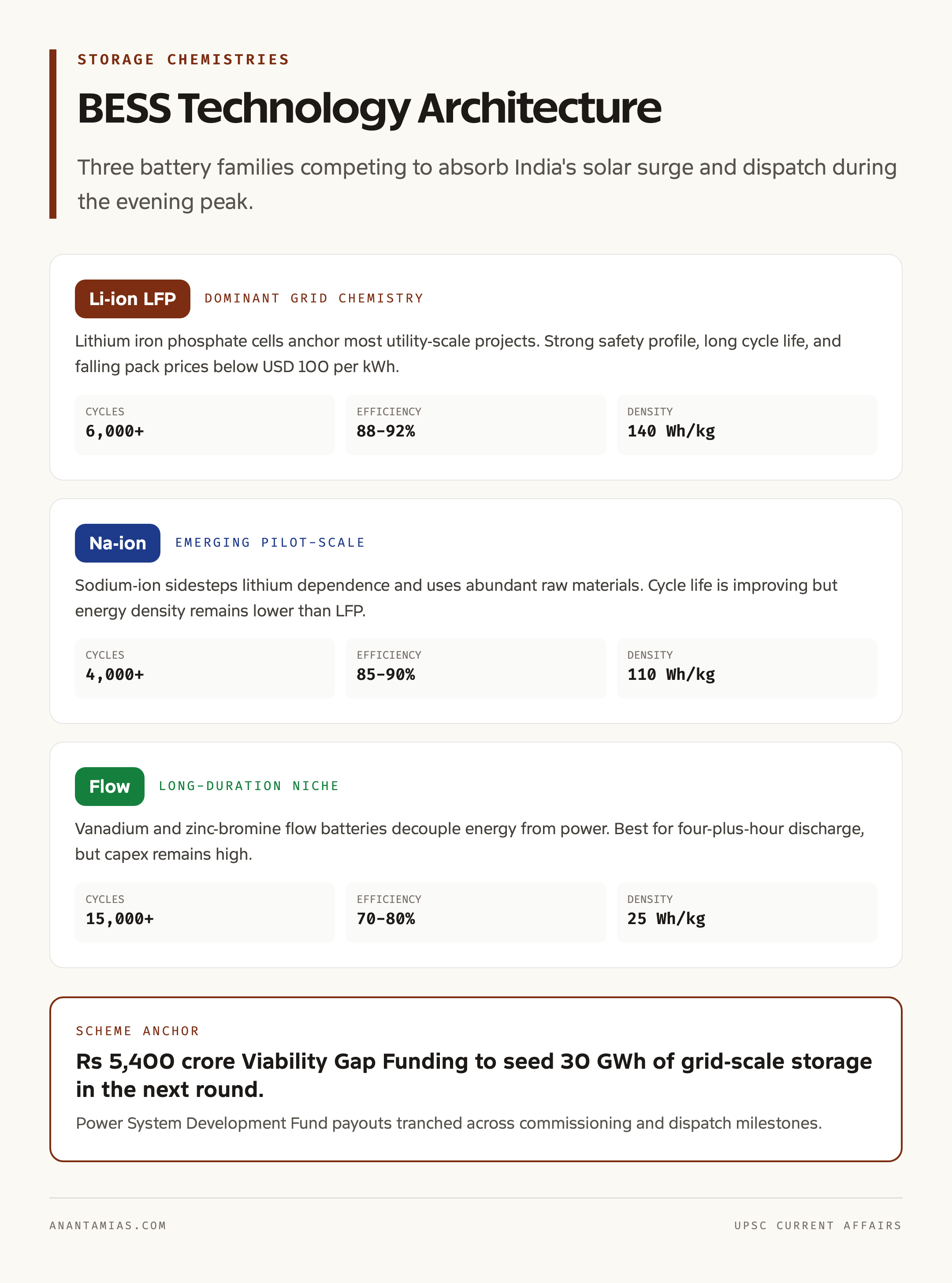
The scheme is technology-neutral on paper. In practice, lithium-iron-phosphate chemistry is expected to dominate the 30 GWh build-out, with smaller pilots for sodium-ion and flow batteries. Power Ministry guidelines also require local manufacturing content to ramp up over the project timeline, dovetailing with the Advanced Chemistry Cell Production-Linked Incentive scheme.
Background and Historical Context
India’s grid storage story is still young. Pumped-storage hydro projects, classified separately from battery storage, have been the dominant balancing tool for decades, with installed capacity of roughly 4.7 GW. Battery storage at grid scale only entered the conversation seriously after the 2018-19 SECI tenders for renewable-plus-storage hybrids, and even those were small. The need for a storage architecture that could ride out the evening peak became urgent only after solar additions crossed 60 GW.
The first organised policy response came in 2022 when the Ministry of Power notified the National Framework for Promoting Energy Storage Systems. The framework exempted storage projects from inter-state transmission charges till mid-2025, allowed open-access procurement, and classified BESS as a separate generation-cum-transmission asset class. The September 2023 VGF scheme then operationalised the framework by tendering 4 GWh through SECI.
Key Provisions of the Battery Energy Storage Systems VGF Scheme
The 2026 scheme has four pillars. First, it earmarks Rs 5,400 crore as capital support, drawn from the Power System Development Fund, a corpus financed by surcharges on inter-state transmission and held by the Central Electricity Regulatory Commission. Second, it sets a capacity target of 30 GWh, an eightfold jump over the first round.
Third, the scheme uses competitive bidding under tariff-based reverse auctions. Developers bid the lowest tariff at which they can deliver storage services, and VGF is calibrated to the gap between the discovered tariff and the project’s revenue requirement. Fourth, the funding is tranched: developers get a fraction on commissioning, with the bulk released against dispatch and cycle performance over the project life. That discipline is meant to prevent the kind of stranded-asset risk seen in early renewable bids.
The scheme also mandates a minimum local-content trajectory aligned with the Advanced Chemistry Cell PLI. Cell-level domestic manufacturing must scale from initial assembly to deeper localisation by year five. Battery management systems, power conversion equipment, and balance-of-plant procurement get separate domestic-content benchmarks.
Why It Matters
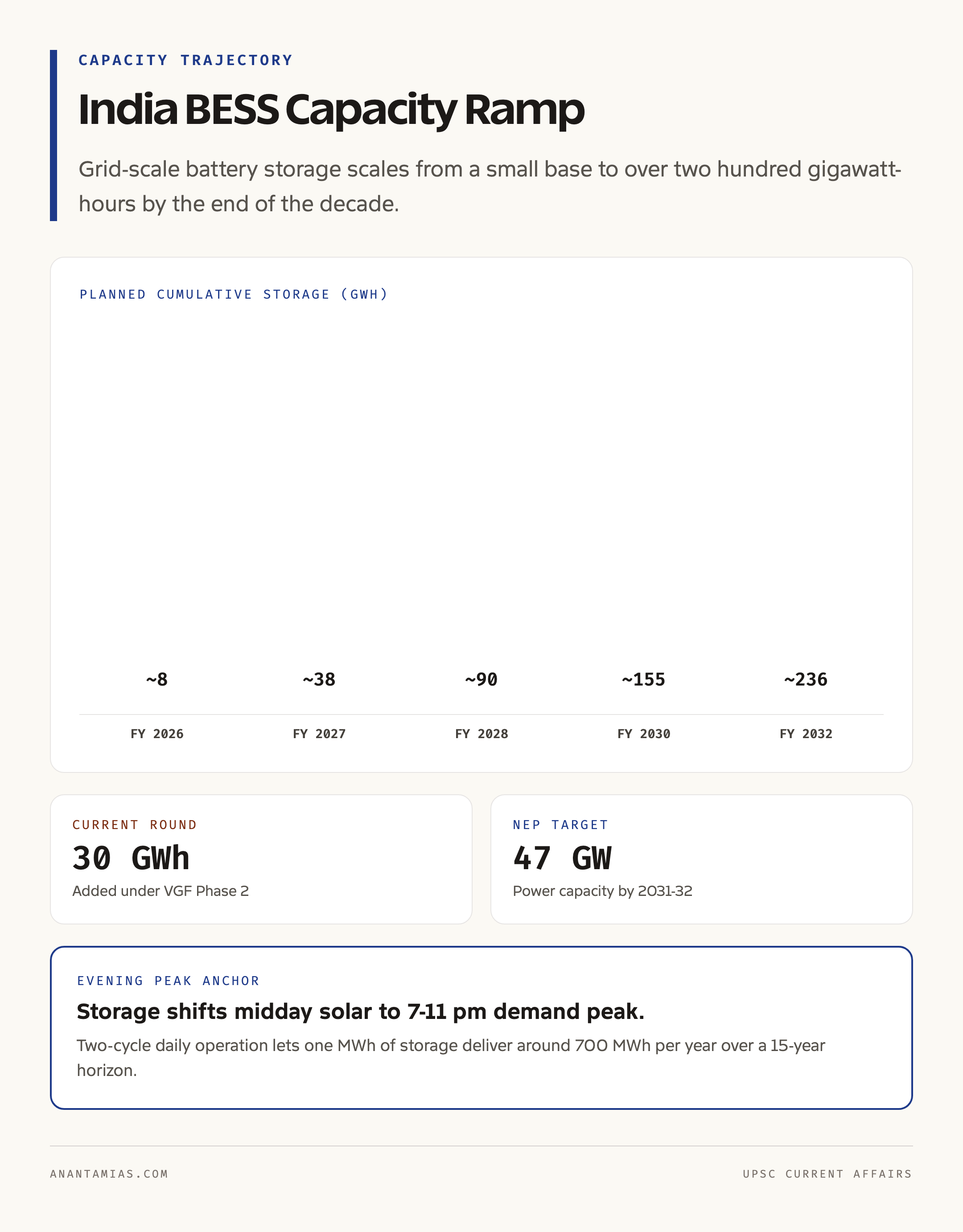
The Battery Energy Storage Systems VGF scheme is the closest India has come to a credible answer for the evening-peak problem in a renewables-heavy grid. Without storage, every additional gigawatt of solar after a certain point starts displacing less coal and triggers more curtailment. With 30 GWh of dispatchable battery storage in the pipeline, distribution companies finally get a way to lock in solar power generated at midday and release it at 7 to 11 pm when household demand peaks.
The scheme also has an industrial dimension. The Advanced Chemistry Cell PLI scheme already nudges domestic cell manufacturing, but without a guaranteed domestic offtake market, manufacturers were nervous. A 30 GWh storage pipeline anchored by VGF creates predictable demand and lowers the risk premium for setting up giga-factories. That has spillover benefits for electric mobility, where the same cell chemistry is needed.
There is a strategic angle too. India imports the bulk of its lithium and cell components from a handful of countries, and the lithium-ion battery supply chain is concentrated. Anchoring large domestic demand makes it easier to justify upstream investments in lithium processing, cathode-active material plants, and recycling infrastructure.
Detailed Analysis: How the Battery Energy Storage Systems VGF Scheme Will Work
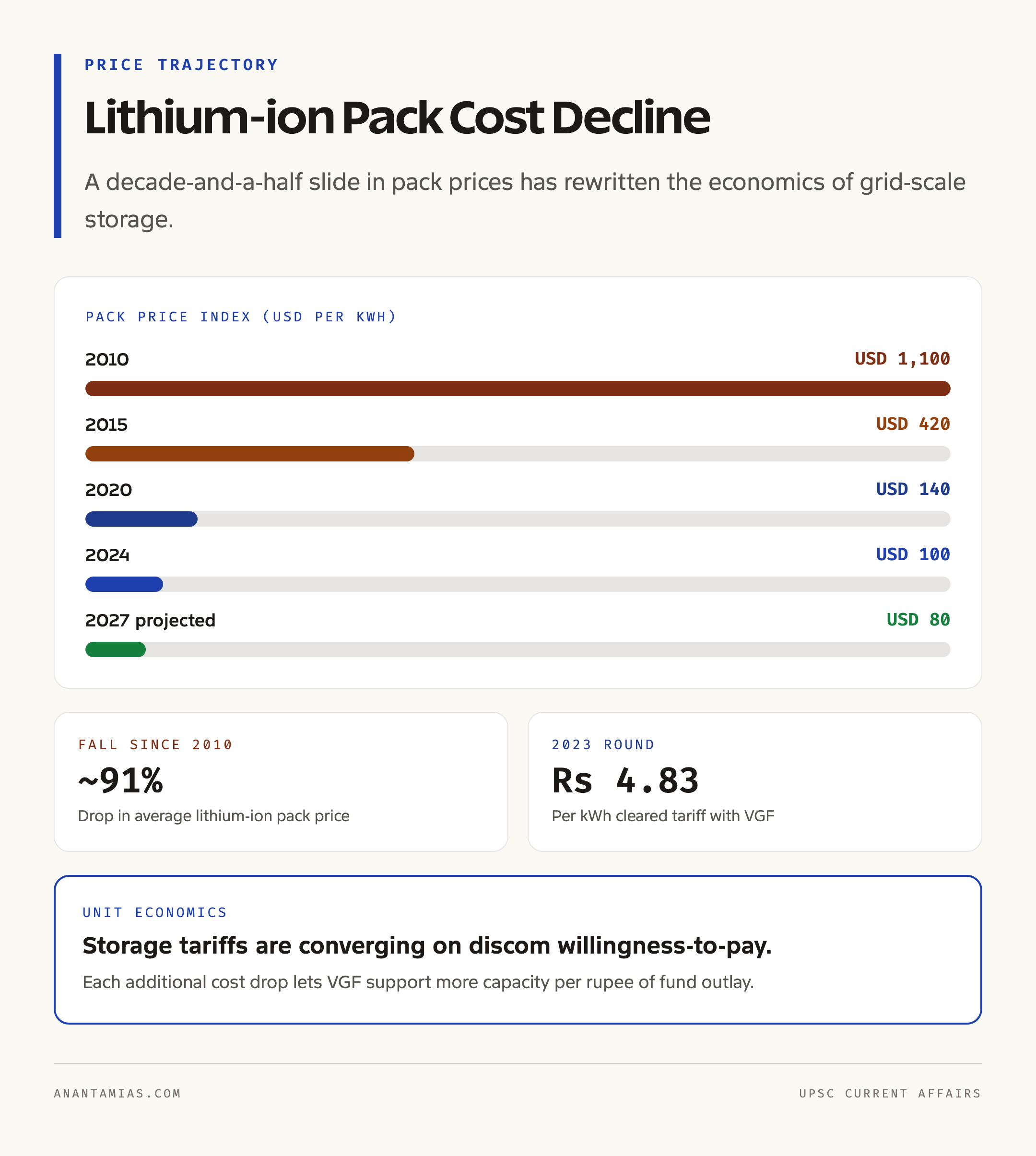
The economics of grid-scale storage hinge on three numbers: the discovered tariff in rupees per kilowatt-hour delivered, the round-trip efficiency of the battery, and the capacity utilisation factor over the contract life. VGF cushions the first by closing the gap to discom-acceptable tariffs. In the 2023 round, tariffs cleared around Rs 4.83 per kWh for two-cycle daily operation, helped by capital subsidy of about Rs 27 lakh per MWh.
In the 2026 round, the bid quantum is much larger, and the global cell price has dropped further. Lithium-iron-phosphate cell prices fell from about USD 156 per kWh in early 2022 to under USD 100 per kWh by mid-2024, and most forecasts see prices stabilising near USD 80 per kWh through 2027. That should pull discovered storage tariffs below Rs 4 per kWh in many bids, reducing the per-MWh VGF needed.
Round-trip efficiency for modern lithium-iron-phosphate systems sits at 88 to 92 percent, and degradation curves now allow 6,000 to 8,000 deep cycles. Two-cycle daily operation under the Battery Energy Storage Systems VGF scheme implies roughly 15 to 20 years of useful life, which lines up with the typical 25-year power purchase agreement horizon, with augmentation costs factored in.
Comparative Perspective
Most major economies that have moved fast on renewables now have an equivalent storage push. California’s Self-Generation Incentive Program and the federal Investment Tax Credit treat storage similarly to a generation asset and have unlocked over 13 GW of battery storage in the United States. The United Kingdom uses capacity-market auctions plus contracts-for-difference. Australia leans on direct state-government underwriting of mega-batteries such as the Hornsdale Power Reserve.
China dominates the global cell supply and is also building enormous storage parks under provincial mandates. Europe’s approach mixes the Innovation Fund with national capacity payments. India’s Battery Energy Storage Systems VGF scheme borrows the capital-subsidy logic from these models but pairs it with a domestic-content trajectory tied to the Advanced Chemistry Cell PLI to avoid the import-dependence trap.
Challenges in Scaling Battery Energy Storage
Several headwinds remain. Cell-level domestic manufacturing is still nascent, and most projects under the first VGF round used imported cells assembled into modules within India. Until cathode-active material and electrolyte production scale up, deep localisation is a stretch.
Critical-mineral access is the next hurdle. India has secured offtake agreements in Argentina and Australia and has begun lithium exploration domestically, but processing capacity is thin. Cobalt, nickel, manganese, and graphite face similar issues. A battery storage scheme is only as resilient as the upstream supply chain that feeds it.
Safety and standards are catching up but not fully there. Thermal-runaway events at battery storage sites elsewhere in the world have prompted stricter fire-suppression and siting norms. The Central Electricity Authority’s draft technical regulations on grid-scale storage will need rapid finalisation before the 30 GWh pipeline matures. End-of-life recycling rules under the Battery Waste Management Rules, 2022 are in place, but enforcement infrastructure is uneven.
Prelims Pointers
- The Power System Development Fund is administered by the Central Electricity Regulatory Commission and financed primarily by inter-state transmission surcharges.
- The Battery Energy Storage Systems VGF scheme is technology-neutral but expected to be dominated by lithium-iron-phosphate chemistry.
- The Advanced Chemistry Cell Production-Linked Incentive scheme has an outlay of Rs 18,100 crore for 50 GWh of cell manufacturing capacity.
- The Battery Waste Management Rules, 2022 mandate extended producer responsibility for battery recyclers and producers.
- Pumped-storage hydro and battery energy storage together form the bulk of utility-scale storage classifications under Indian grid codes.
- BESS projects under the scheme are required to support frequency regulation and reactive-power services beyond pure energy arbitrage.
Mains Questions
- Discuss the role of the Battery Energy Storage Systems VGF scheme in enabling India’s renewable energy targets. What are the structural barriers that capital subsidy alone cannot fix? (GS Paper III, Energy)
- Examine the trade-offs between technology-neutral and technology-specific support for grid storage in India. How should policy balance lithium-ion dominance against emerging chemistries like sodium-ion and flow batteries? (GS Paper III, Science and Technology)
- Critical-mineral security has become inseparable from energy security. Suggest a framework for India to build resilient supply chains for battery raw materials. (GS Paper II, International Relations and GS Paper III, Economy)
- Battery storage is often presented as a substitute for thermal back-up. Critically assess this claim with reference to grid reliability, fiscal cost, and decarbonisation goals. (GS Paper III, Environment and Economy)
Way Forward
The Battery Energy Storage Systems VGF scheme is necessary but not sufficient. A complementary policy push has to deepen domestic cell manufacturing, finance critical-mineral processing, and modernise the grid to handle high-ramp storage dispatch. The Central Electricity Authority needs to publish binding technical and safety standards, and discoms need standardised storage power purchase agreements to cut transaction time on each bid.
Recycling cannot remain an afterthought. With 30 GWh entering the system, India will have several million tonnes of spent cells to handle by the mid-2030s. A national recycling cluster, anchored by extended producer responsibility revenue, would convert that waste stream into a domestic supply of lithium, cobalt, and nickel. Combined with sustained R and D in alternative chemistries, this would let India lead, rather than follow, on grid storage.
Frequently Asked Questions
What is the Battery Energy Storage Systems VGF scheme?
It is a Viability Gap Funding scheme approved in 2026 to support 30 GWh of grid-scale battery storage capacity. The scheme provides Rs 5,400 crore as capital subsidy from the Power System Development Fund to bridge the gap between bid tariffs and project economics.
Why does India need grid-scale battery storage?
Solar and wind generation is intermittent and concentrated during the day. Demand peaks in the evening. Storage shifts surplus midday solar to evening peak hours, reduces curtailment, lowers thermal back-up needs, and helps stabilise the grid as renewable share rises.
Which technology will dominate the 30 GWh pipeline?
Lithium-iron-phosphate cells are expected to dominate because of their lower cost, better safety profile, and longer cycle life compared with nickel-rich chemistries. Sodium-ion and flow batteries are likely to feature in smaller pilots.
What is the Power System Development Fund?
The Power System Development Fund is a corpus administered by the Central Electricity Regulatory Commission, financed largely from surcharges on inter-state transmission. It funds power-sector reforms, transmission strengthening, and now grid storage.
How does VGF actually flow to developers?
The VGF is paid in tranches tied to project milestones. A portion is released on commissioning, with the bulk linked to dispatch availability and round-trip efficiency benchmarks over the project life, ensuring sustained performance.
Will the scheme reduce electricity tariffs?
By replacing expensive evening-peak thermal ramping with stored solar, the scheme can lower the average cost of supply for distribution companies. End-consumer tariff impact depends on how state regulators pass through the savings.
How does this link to electric vehicles?
Both grid storage and electric vehicles depend on the same cell chemistries and supply chains. Anchoring a large domestic storage market makes giga-factory investments easier to justify, lowering cell costs for the EV sector too.
Is local manufacturing mandatory?
The scheme mandates a domestic-content trajectory aligned with the Advanced Chemistry Cell PLI. Cell-level localisation must deepen over the project life, starting with module assembly and moving toward full cell manufacturing.
What about recycling old batteries?
The Battery Waste Management Rules, 2022 require extended producer responsibility. Recyclers must register, and producers must take back end-of-life cells. A larger domestic storage fleet creates the volume needed to make recycling economically viable.
How does the scheme compare with pumped-storage hydro?
Pumped-storage hydro offers very long-duration storage at low marginal cost but takes years to build and requires specific topography. Battery storage is faster to deploy, modular, and better suited to short-duration peak shifting. The two are complementary.
Tell Google you want more of this.
Add Anantam IAS as a preferred sourceOne tap, and this site shows up more often in your own Top Stories, AI Overviews and AI Mode. Remove it any time.