Why in News?
On 30 October 2026, Digital Bharat Nidhi, Tamil Nadu and TANFINET signed a BharatNet utilisation agreement to support rural household fibre connections under the State-led Amended BharatNet Program.
- PIB reports subsidy support expected to facilitate more than five lakh rural home fibre connections; this is an expected expansion, not a count of installed connections.
- The announcement also provides for on-demand connectivity to 4,767 villages in Tamil Nadu.
- The agreement concerns utilisation of the existing BharatNet framework, rather than the launch of a new national broadband programme.
- A network asset produces public value when people can obtain a working, affordable service and get faults repaired.
- The agreement connects Centre-funded support with State-level delivery, making implementation responsibilities as important as physical coverage.
UPSC Relevance
Prelims Relevance
- Digital Bharat Nidhi: universal-service support administered under the Department of Telecommunications.
- FTTH: fibre-to-the-home, connecting the access network to a subscriber’s premises.
- Middle mile: shared network connectivity between upstream capacity and local access points.
- Last mile: the final connection serving a household, institution or enterprise.
- Utilisation: active service and network use, distinct from the length of fibre installed.
Mains Relevance
GS Paper 3
- Infrastructure investment versus service delivery in rural broadband.
- Public support, local maintenance and commercial sustainability.
GS Paper 2
- Centre-State coordination and accountability for digital public-service access.
Essay
- Public infrastructure succeeds when people can depend on it.
Background and Context
What the Utilisation Agreement Changes
The new development is an arrangement for putting broadband infrastructure to use, with Tamil Nadu’s delivery institutions participating in implementation.
- Digital Bharat Nidhi supports access to telecommunications in underserved areas. In this agreement, national financial support is linked to rural household connectivity, while the State government and TANFINET participate in delivery.
- TANFINET is Tamil Nadu FibreNet Corporation. Its presence in the agreement gives the State network institution a direct role; the announcement should not be read as a transfer of every retail connection to one operator.
- The Amended BharatNet Program seeks to upgrade, consolidate and expand the existing network. An agreement within that framework addresses implementation in a particular State; it does not establish a separate national programme or entitlement.
- Expected connections describe the reach envisaged from subsidy support. Installation, activation and continued use are later stages, so a signed agreement cannot establish that homes already receive broadband or that projected service benefits have occurred.
- On-demand provision links network expansion to requests for service. It should not be treated as evidence that every listed village already has an active connection, or that all households automatically receive an individual subscription.
How Backbone Capacity Reaches a Household
The service chain has distinct network and customer-facing tasks; capacity at a village access point does not complete the connection inside a home.
- Middle-mile infrastructure carries shared connectivity towards Gram Panchayats and local access points. BBNL’s service description distinguishes this network from the last mile that a service provider extends to end customers in the served area.
- A last-mile connection carries service from that local network to the subscriber’s premises. In FTTH, the final access uses optical fibre; the household still needs installation, activation and appropriate terminal equipment to receive service.
- Network availability and household service answer different questions. A nearby fibre route can make provision possible, while the customer still awaits a feasible connection and an activated plan from the selected service provider.
- Public subsidy can lower the cost of extending service where commercial returns are weak. It does not by itself remove recurring service charges; the official BharatNet service information distinguishes installation support from monthly subscription payments.
- Digital access depends on usable service throughout this chain. A school’s application or a home’s subscription can remain ineffective if the local connection fails, even when the wider backbone has spare carrying capacity available.
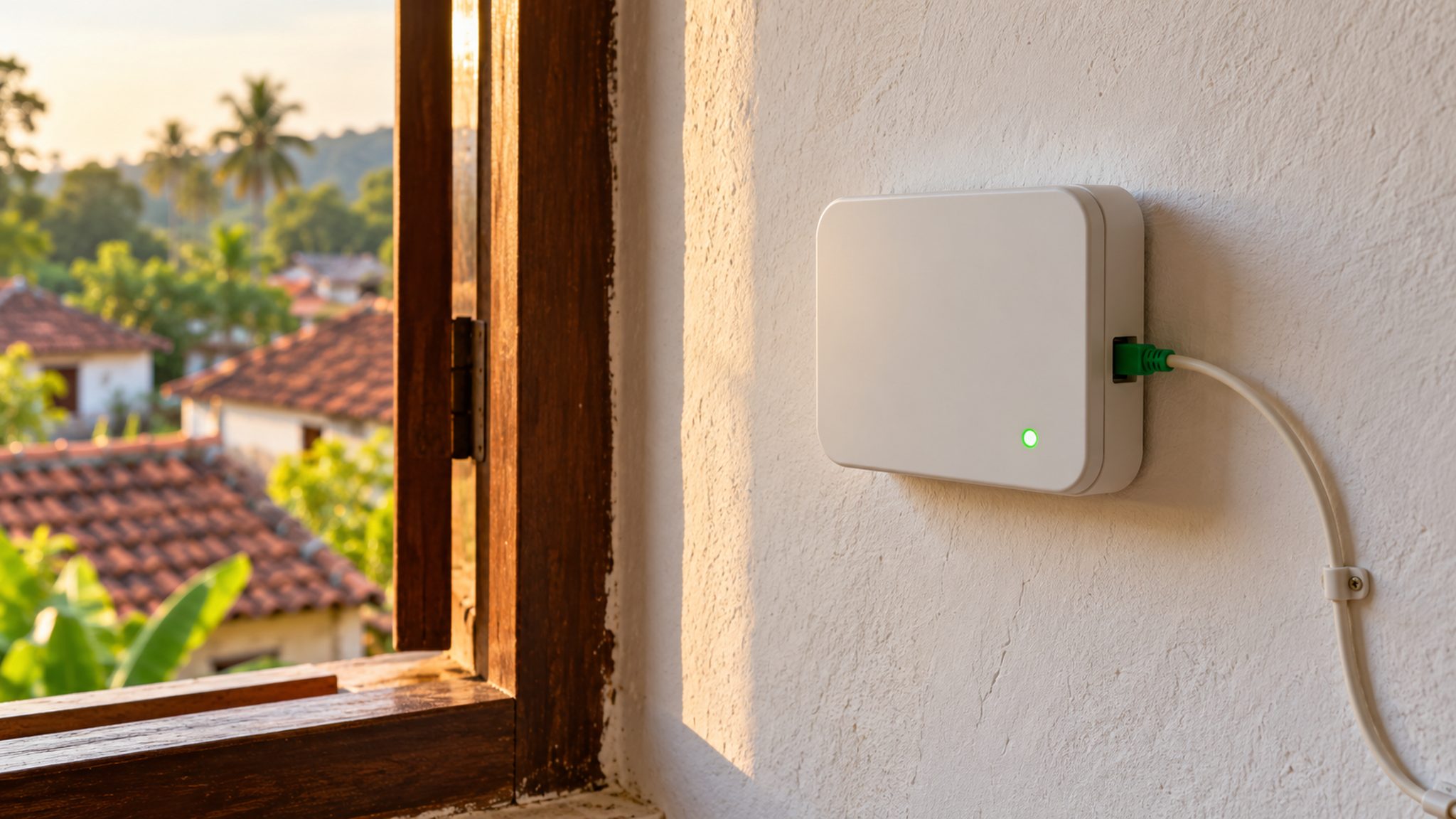
Judge Service Delivery Beyond Fibre Coverage
For public policy, the useful comparison is between completed physical assets and services that remain active and dependable for their intended users.
- Coverage indicators show where infrastructure exists, while active subscriptions and sustained use reveal whether it serves people. Neither a cable-length total nor an agreement’s projected reach can establish household adoption without separate evidence of use.
- Maintenance responsibility should follow each network segment. Fault reporting, local repair capability and coordination with the upstream provider determine restoration; an unresolved break in the last mile can isolate customers from a functioning backbone.
- Service quality needs assessment over time. A successful installation test cannot show that a connection stays reliable during ordinary use; monitoring should track interruptions and repair performance alongside activation and continued subscription, with clear ownership.
- Affordability concerns the household’s ability to keep using service, not only the initial connection. Useful public-service applications and accessible support can encourage uptake, but the announcement does not demonstrate improved learning, health or income outcomes.
- Accountability requires distinguishing funding, infrastructure and retail-service responsibilities. The same asset-to-service concern appears in rural water maintenance, while payment-system resilience illustrates why continued operation matters after digital infrastructure has been established.
Way Forward
Link Support to Dependable Service
- Publish separate figures for feasible requests, activated connections and continued use, so announced reach is not confused with delivery.
- Assign repair responsibilities across backbone and access providers, with a clear customer complaint route.
- Assess recurring affordability and service reliability before treating installation numbers as evidence of digital inclusion.
Conclusion
- The Tamil Nadu agreement advances BharatNet utilisation: converting shared network capacity into household access. Its educational value lies in separating a funding arrangement, a completed connection and a service people continue to use.
- For a Mains answer, connect infrastructure finance to last-mile responsibility and maintenance. Evaluate the initiative through verified activation and dependable service, while retaining the distinction between announced expectations and demonstrated outcomes.
UPSC Practice Questions
Prelims MCQ 1
With reference to BharatNet and rural broadband, consider the following statements:
- Availability of a middle-mile network necessarily means that every nearby household has an activated broadband subscription.
- Last-mile connectivity connects the local access network to end users.
- An expected connection figure in a utilisation agreement is proof of completed household installations.
How many of the above statements are correct?
(a) Only one (b) Only two (c) All three (d) None
Answer: (a) Only one
Explanation:
Only statement 2 is correct. Shared network availability, a household’s activation and projected programme reach are distinct. A utilisation agreement does not establish that all expected connections are installed.
Prelims MCQ 2
Which indicator most directly helps assess whether a rural broadband network is delivering an ongoing service?
(a) The date on which the funding agreement was signed (b) The total planned length of fibre cable (c) The number of officials present at the signing (d) Active subscriptions considered alongside service uptime and repair performance
Answer: (d) Active subscriptions considered alongside service uptime and repair performance
Explanation:
Active subscriptions and service performance assess actual delivery. An agreement or planned cable length records an input or intention, not dependable customer service.
UPSC Mains Questions
- Explain why building broadband backbone infrastructure may not ensure meaningful rural digital inclusion. Discuss the role of last-mile connectivity and maintenance.
- How can Centre-State utilisation agreements improve accountability for rural broadband delivery? Suggest indicators that distinguish infrastructure creation from sustained service.
Sources: PIB, Ministry of Communications and Department of Telecommunications, BharatNet.
Frequently Asked Questions
What was signed in Tamil Nadu on 30 October 2026?
Digital Bharat Nidhi, the Tamil Nadu government and TANFINET signed a BharatNet utilisation agreement under the State-led Amended BharatNet Program. It supports the expansion of rural household fibre connections.
Does the agreement mean the expected home connections are already installed?
No. The release describes connections expected from financial support. Installation, activation and continued use require separate evidence; signing the agreement does not establish that the projected households already receive service.
What is the difference between the middle mile and last mile?
The middle mile provides shared connectivity towards local access points. The last mile connects that local network to a household or other end user, allowing backbone capacity to become an individual service.
Does subsidy support mean free internet forever?
No. Support for establishing connections does not automatically eliminate recurring charges. Official BharatNet service information distinguishes installation assistance from monthly subscription payments; the Tamil Nadu announcement does not promise universally free ongoing service.
How should BharatNet utilisation be evaluated?
Assess activated connections, continued subscriptions and actual service performance alongside physical coverage. Repair times and clear responsibility for network faults help show whether households can depend on the connection after installation.
Tell Google you want more of this.
Add Anantam IAS as a preferred sourceOne tap, and this site shows up more often in your own Top Stories, AI Overviews and AI Mode. Remove it any time.