Why in News?
On 22 October 2026, the Department of Drinking Water and Sanitation discussed convergence between Jal Jeevan Mission 2.0 and Finance Commission grants, focusing on Panchayat budgets for rural water maintenance.
- The consultation covered permissible expenditure, grant release conditions and reporting requirements; it did not announce a new law or establish that fresh grants had already been disbursed.
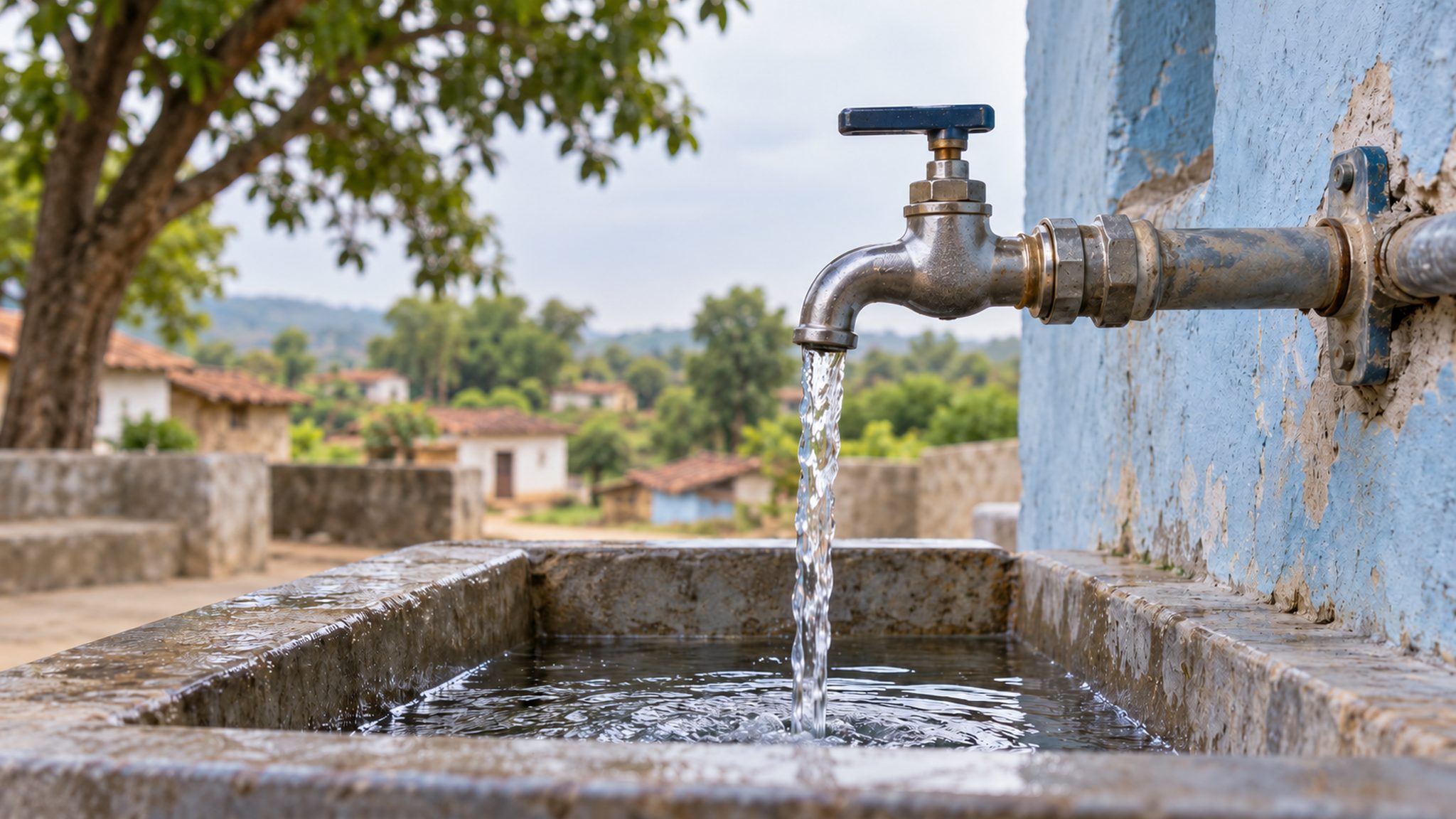
- The maintenance priorities included repairs, pump upkeep, chlorination, water-quality surveillance, electricity expenses and staffing needed to sustain existing drinking-water infrastructure.
- Officials called for annual O&M plans, interdepartmental coordination and stronger local revenues; the release did not impose a new universal water tariff.
- A capital asset brings continuing expenditure: financing construction without budgeting for its operation leaves the local service vulnerable to unpaid bills and delayed repairs.
- Convergence works only when each expenditure has an eligible funding source, an accountable implementing body and a clear reporting trail.
UPSC Relevance
Prelims Relevance
- Tied grants and untied grants: restrictions on expenditure purposes.
- Operation and maintenance: recurring requirements of existing water assets.
- Gram Panchayat Development Plan: integration of local annual priorities.
- Own Source Revenue: resources raised by the local body.
- Grant allocation, release and utilisation are different financial stages.
Mains Relevance
GS Paper 2
- Fiscal decentralisation and Panchayat capacity to manage basic services.
- Accountability when several departments finance one local service.
GS Paper 3
- Lifecycle budgeting and sustainable financing of public infrastructure.
Essay
- Public investment succeeds when maintenance receives the same institutional attention as construction.
Background and Context
Match the Funding Restriction to the Expense
The first budget question is whether a funding stream can legally support the proposed expense, rather than whether money appears available in a local account.
- Tied grants reserve money for specified purposes. A Panchayat must test a proposed water expense against applicable grant conditions; a general local need does not automatically make spending from that grant permissible.
- Untied grants allow greater local discretion within their governing rules. They are not unrestricted cash: local priorities, approved budgets and applicable financial procedures still determine how the money should be spent and recorded.
- Capital expenditure creates or substantially improves infrastructure; recurring O&M keeps it working. A pump installation and its subsequent electricity bills illustrate different funding requirements, even though both relate to the same water system.
- The official conference account prioritised existing-asset maintenance where systems need support. This is a planning emphasis, not evidence that every kind of new construction is prohibited under every relevant financing instrument.
- Source sustainability and water-quality management also need budget attention. Eligibility must be checked activity by activity; labelling an expense a water project cannot replace the prescribed conditions for using a particular grant.
Build an Annual Maintenance Budget
The conference linked requirements, resources and responsibilities: a realistic annual plan must connect the work needed, the money available and the institution answerable for delivery.
- Requirements begin with the assets already operating and the service gaps identified locally. Routine inspections, likely repairs and running costs should become costed tasks, rather than an undifferentiated request for additional village funds.
- Resources mean usable funding, not merely a headline allocation. Panchayats should distinguish expected grants from released money and identify which recurring obligations can be supported by eligible grants, State resources or local revenues.
- Responsibilities specify who arranges maintenance, provides technical support, authorises payment and records completion. Where departments share functions, a written division reduces the risk that each assumes another will repair a failed component.
- The Gram Panchayat Development Plan can bring these tasks into local budgeting. Preventive maintenance should be scheduled alongside repairs, with expenditure estimates linked to actual assets rather than copied from last year without review.
- User charges were discussed as one revenue mechanism, alongside other resources. Any local approach must follow applicable arrangements and consider affordability; the consultation itself does not create a uniform compulsory charge across rural India.
Converge Funds Without Losing Accountability
Pooling planning effort does not erase separate funding rules; coordination should make expenditure easier to trace from a local requirement to the completed maintenance task.
- Convergence assigns complementary eligible activities to available programmes and resources. As a budgeting principle, the same repair bill should not be charged twice merely because two schemes both support the wider water service.
- Release conditions and reporting requirements affect when funds become usable. The conference urged completion of pending compliance; its account does not supply every condition, so officials must consult the applicable detailed framework before expenditure.
- Expenditure reporting should connect the approved task, payment and asset concerned. Digital records support oversight, but an uploaded entry alone cannot establish that a repaired pump works or that a maintenance contractor completed the job.
- Capacity building is part of financial sustainability. Local-language maintenance manuals and training can help Panchayat personnel understand permissible activities, reporting duties and when specialist support is needed instead of relying on informal interpretations.
- Assessment should distinguish an allocation from a release, and a release from verified use. Conference presentations and State examples explain approaches; they are not proof that every Panchayat has received funds or adopted them.
Way Forward
Make the Budget Executable
- Publish a costed maintenance schedule assigning each task an eligible funding source, responsible official and expected completion period.
- Reconcile payments and asset records across departments to prevent duplicate claims and expose unfunded recurring obligations.
- Pair financial reporting with physical checks of completed work, and resolve compliance problems before they delay essential maintenance.
Conclusion
- Rural water financing requires matching permissible expenditure to recurring needs, rather than treating every available grant as interchangeable. A costed local plan helps translate fiscal transfers into maintenance work with identifiable responsibility and evidence of completion.
- For a governance answer, connect fiscal decentralisation with administrative capacity: Panchayats need predictable resources, understandable spending rules and technical support. The October consultation offers implementation guidance, not proof of a new law, universal tariff or completed nationwide disbursement.
UPSC Practice Questions
Prelims MCQ 1
With reference to financing rural water services, consider the following statements:
- A tied grant restricts expenditure to specified purposes.
- A grant allocation is necessarily proof that the recipient has received the money.
- Annual maintenance planning should identify resources as well as responsibilities.
How many of the above statements are correct?
(a) Only one (b) Only two (c) All three (d) None
Answer: (b) Only two
Explanation:
Statements 1 and 3 are correct. Allocation and release are separate financial stages; allocation alone does not establish receipt.
Prelims MCQ 2
Which approach best illustrates accountable convergence in a Panchayat water budget?
(a) Charging the same repair invoice to two schemes (b) Treating every grant as unrestricted local revenue (c) Assigning eligible expenses to distinct funding sources and recording responsibility (d) Treating projected grants as money already received
Answer: (c) Assigning eligible expenses to distinct funding sources and recording responsibility
Explanation:
Convergence coordinates complementary funding while retaining eligibility checks, expenditure records and responsibility for delivery.
UPSC Mains Questions
- Explain how tied grants and annual maintenance planning can strengthen rural drinking-water services. What administrative safeguards are needed?
- Discuss the challenges of converging multiple funding streams at the Gram Panchayat level without weakening financial accountability.
Source: PIB, Ministry of Jal Shakti.
Frequently Asked Questions
What is a tied grant?
A tied grant reserves funding for specified purposes. A Panchayat must check whether its proposed expense is permissible under the governing framework; the availability of money alone does not establish eligibility.
Why does water infrastructure need an annual maintenance budget?
Water assets generate continuing expenses such as electricity, repairs, pump maintenance and treatment supplies. An annual budget identifies these requirements, matches eligible funding sources and assigns responsibility for carrying out the work.
Did the consultation introduce a universal water charge?
No. The release encouraged stronger local revenues and user-charge mechanisms as part of sustainable financing. It did not announce a new uniform compulsory water tariff applicable to every rural household.
What does convergence mean in this context?
Convergence coordinates programmes, departments and local resources around an approved service plan. Each expense still needs an eligible funding source, clear responsibility and reporting; the same bill should not be funded twice.
Tell Google you want more of this.
Add Anantam IAS as a preferred sourceOne tap, and this site shows up more often in your own Top Stories, AI Overviews and AI Mode. Remove it any time.