Why in News?
The Delhi High Court has directed the Copyright Office to decide on the application filed by an American computer scientist seeking authorship rights for an “autonomous” AI system (DABUS) he has developed.
DABUS (Device for the Autonomous Bootstrapping of Unified Sentience) is claimed to independently generate creative outputs through artificial neural networks.
| UPSC Relevance: GS-3 Science and Technology: Internet & Communications Technology Prelims and Mains: AI & Copyright issue (Concerns associated with AI). |

Copyright law in India:
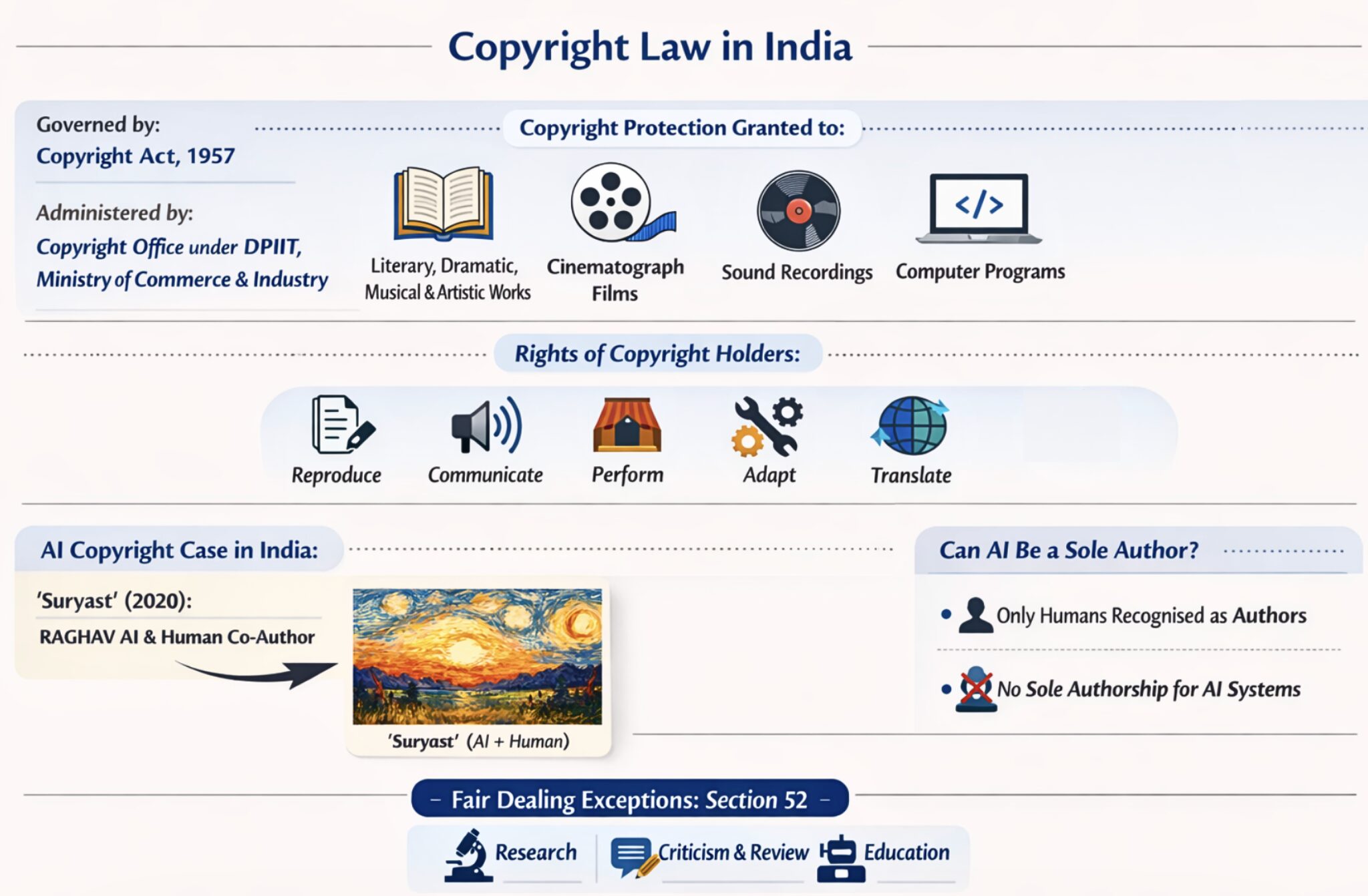
- The Copyright Act, 1957, governs India’s copyright regime. The Copyright Office functions under the Department for Promotion of Industry and Internal Trade, Ministry of Commerce and Industry.
- The Act grants copyright protection to:
- Original literary works, Dramatic works, Musical works and Artistic works
- Cinematograph films
- Sound recordings
- Computer programs
- Copyright holders have exclusive rights over their works, including the right to reproduce, communicate to the public, perform, adapt, and translate the work. Section 52 of the Copyright Act provides exceptions such as fair dealing (allows the use of copyrighted works) for research, criticism and education.
AI Copyright Case in India: Co-authorship
- In 2020, the Copyright Office granted copyright registration for an AI-assisted artwork titled “Suryast”. The AI tool RAGHAV AI was listed as a co-author along with a human author.
Can an AI system claim sole authorship of an Artwork?
- The Copyright Act currently recognises only human authors (natural persons) for copyright protection. As per the current provisions, there is no way a non-human can be granted sole authorship or copyright protection.
Global Legal Position on AI Authorship:
- United States: The US Copyright Act requires human authorship for copyright protection.
- United Kingdom & Ireland: Copyright law recognises authorship either as a natural person or the person making necessary arrangements for computer-generated works.
Practice MCQ:
Q. With reference to copyright protection for AI-generated works in India, consider the following statements:
1. Under the Copyright Act, 1957, copyright protection is granted to original literary, artistic, musical and computer-generated works.
2. Indian copyright law explicitly recognises Artificial Intelligence as a legal person capable of holding authorship rights.
Which of the statements given above is/are correct?
(a) 1 only
(b) 2 only
(c) Both 1 and 2
(d) Neither 1 nor 2
Answer: (a)
Tell Google you want more of this.
Add Anantam IAS as a preferred sourceOne tap, and this site shows up more often in your own Top Stories, AI Overviews and AI Mode. Remove it any time.