In December 2025 a quiet line in a recruitment-rules amendment turned into a major policy signal. The Ministry of Home Affairs, which runs India’s internal-security forces, raised the share of constable vacancies reserved for former Agniveers in the Border Security Force from 10 per cent to 50 per cent, and said the other Central Armed Police Forces would follow in a phased way. It was the most concrete answer yet to a question that has hung over Indian defence policy since 2022 — what happens to the three out of four soldiers who leave the armed forces after just four years. The government’s reply is now plain: a large slice of them should put on a second uniform in the paramilitary forces.
This matters far beyond a single recruitment notice. CAPF stands for Central Armed Police Forces — the constabularies under the Home Ministry that guard India’s borders, factories, airports and disturbed districts. By reserving seats in them for ex-Agniveers, age relaxation included and the standard physical test waived for the first batch, the Centre is trying to solve two problems with one stroke: give a re-employment pathway to short-service soldiers, and hand the paramilitary a steady supply of trained, disciplined recruits. But it also reopens the larger Agnipath debate about force composition, training continuity and the bargain young Indians are being offered. For a UPSC aspirant, this sits squarely in the internal-security and human-resource territory of GS Paper 3.
Why It’s in the News
The trigger is the December 2025 amendment to the BSF’s General Duty cadre recruitment rules. Until then, the reservation for ex-Agniveers across the Central Armed Police Forces had stood at 10 per cent of constable vacancies, the figure the government had announced in mid-2024. The new rules lift that to 50 per cent of vacancies each recruitment year in the BSF — a fivefold jump — while keeping a separate 10 per cent for ex-servicemen and a small share for absorbing serving combatised constables. The Home Ministry has said the same enhancement will be extended to the other forces gradually.
The timing is not accidental. The first batch of Agniveers, enrolled from late 2022, completes its four-year tenure around 2026, so the first cohort of ex-Agniveers becomes available for CAPF recruitment from 2026. The reservation had to be in place before that wave arrived, and the jump to 50 per cent shows the government wants the paramilitary to absorb a serious chunk of departing soldiers rather than a token few. So a measure that began as a reassurance in 2024 has hardened, just as it is about to be tested, into a structural channel from the army to the police forces.
The Agnipath Scheme and the 75 Per Cent Question
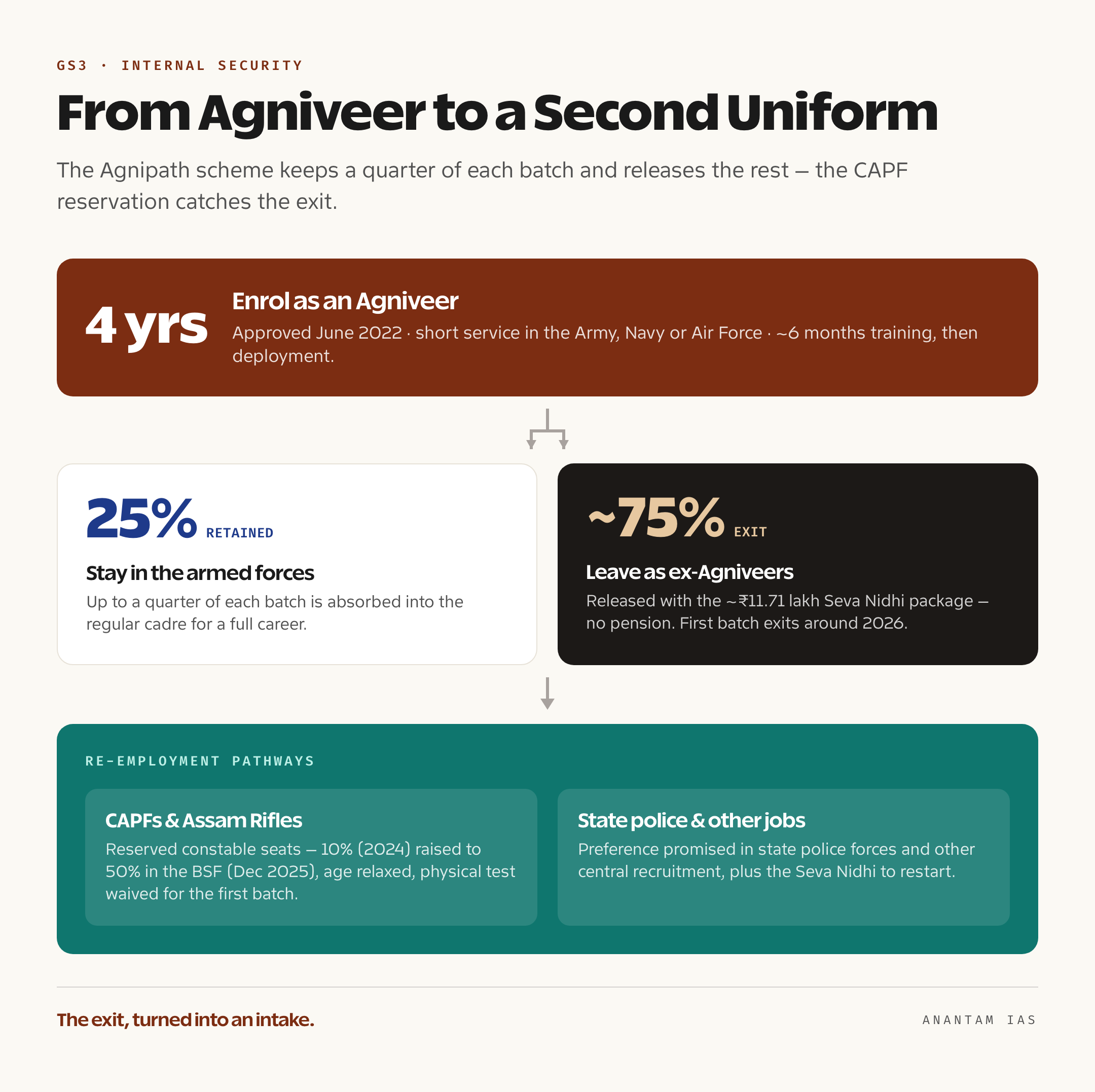
To see why this reservation exists, you have to start with the scheme that created the need for it. The government approved the Agnipath scheme on 14 June 2022 and rolled it out that September. It changed how India recruits soldiers below officer rank. Instead of joining for a full career of fifteen-odd years with a pension at the end, new entrants — called Agniveers, literally “fire warriors” — sign up for a short tour of just four years across the Army, Navy and Air Force. They are recruited young, originally in the 17.5-to-21 age band, given about six months of training and then deployed for the rest of the term.
Here is the design that makes everything else follow. At the end of the four years, only up to 25 per cent of each batch is retained in the regular forces to serve a full career. The other roughly 75 per cent are released back into civilian life. They leave with a tax-free lump sum, the Seva Nidhi package of about 11.71 lakh rupees, but no pension and no gratuity. The government’s stated aims were to lower the average age of the forces, cut the long-term pension bill that eats into the defence budget, and create a pool of trained, disciplined young citizens. The scheme drew sharp protests in 2022, and the central worry was always the same one parents asked at recruitment rallies: a 25-year-old, trained to fight and then sent home without a pension — then what?
The CAPF reservation is the government’s answer to that “then what.” If three out of four Agniveers must leave the armed forces, the state can at least steer many of them into other uniformed jobs where their training is an asset rather than a wasted investment. The Central Armed Police Forces, which recruit constables in large numbers every year, are the obvious destination. So the reservation is best understood not as a stand-alone perk but as the second half of the Agnipath bargain — the off-ramp built for the majority who exit.
The Reservation, the Forces and the Relaxations
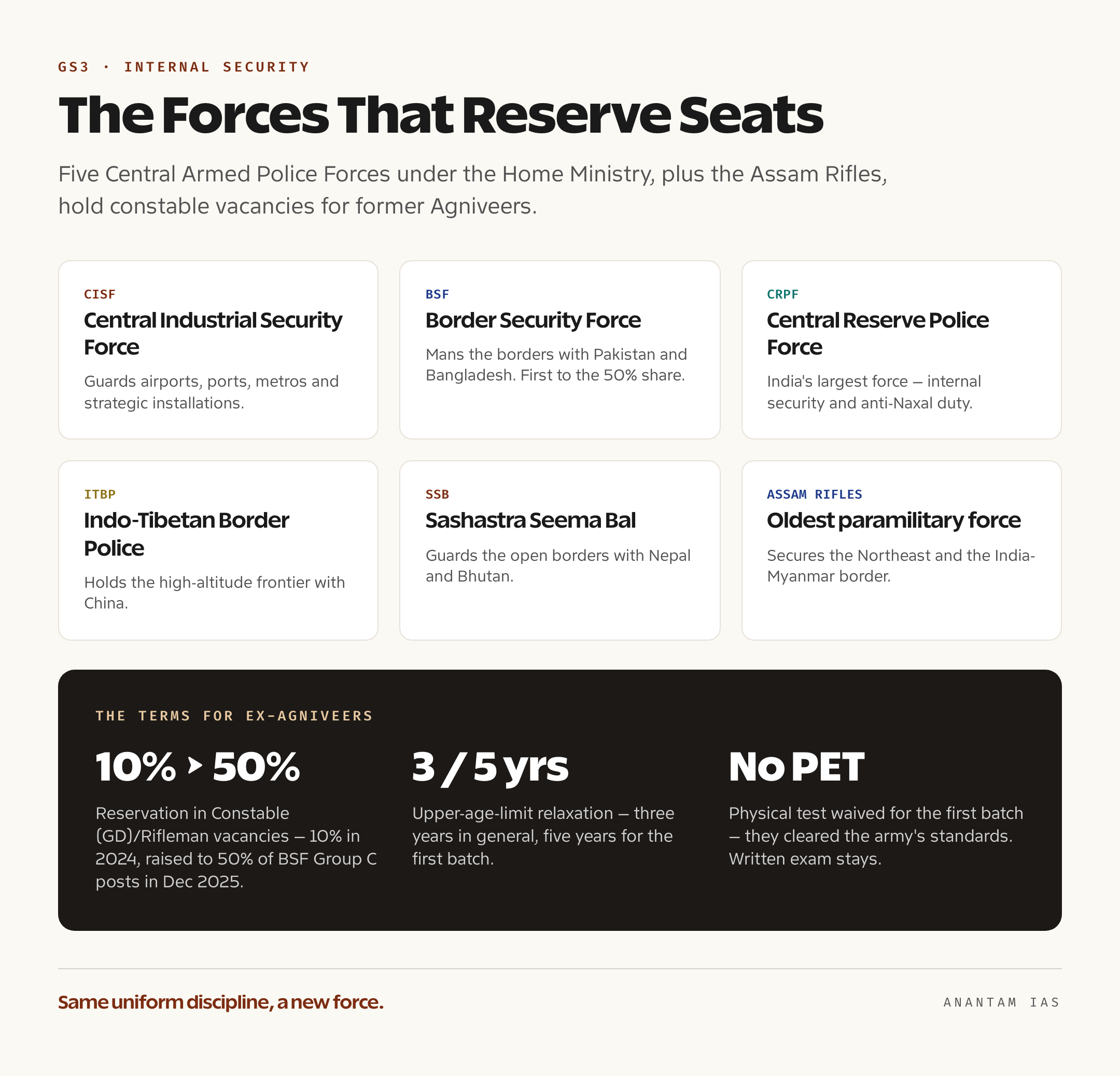
The policy first took clear shape in July 2024. The Ministry of Home Affairs decided to reserve 10 per cent of vacancies for the post of Constable (General Duty) and Rifleman for ex-Agniveers in the Central Armed Police Forces and the Assam Rifles. The forces it covers are the five CAPFs under the Home Ministry — the Central Industrial Security Force (CISF), which guards airports, ports, metros and strategic installations; the Border Security Force (BSF), which mans the borders with Pakistan and Bangladesh; the Central Reserve Police Force (CRPF), the country’s largest force, used for internal security and anti-Naxal operations; the Indo-Tibetan Border Police (ITBP), which holds the high-altitude frontier with China; and the Sashastra Seema Bal (SSB), which guards the Nepal and Bhutan borders. Alongside them sits the Assam Rifles, the oldest paramilitary force, which secures the Northeast and the India-Myanmar border under a dual command of the Home and Defence Ministries. The directors-general of CISF, BSF, CRPF and others confirmed the move in July 2024.
Two relaxations sweeten the entry, and the distinction between them matters for an exam answer. The first is age. Ex-Agniveers get relaxation in the upper age limit — three years for normal recruitment, but five years for the very first batch, since those candidates had no chance to apply earlier and would otherwise age out. The second is the physical test. The standard CAPF recruitment runs candidates through a Physical Standard Test and a Physical Efficiency Test before a written exam; for the first batch of ex-Agniveers, the physical efficiency test is waived. The logic is straightforward — these candidates have already cleared the army’s tougher physical standards and served four years, so re-testing their fitness adds little. They still sit the written examination like everyone else, so the merit gate stays in place even as the physical and age barriers come down.
Then came the December 2025 escalation. Through an amendment to the BSF’s recruitment rules, the Home Ministry raised the reserved share from 10 per cent to 50 per cent of Group C constable vacancies, exempted ex-Agniveers from both the physical standard and physical efficiency tests, and signalled the same change for the other forces. Read together, the 2024 and 2025 steps show a clear trajectory: from a cautious 10 per cent foothold to a commitment that, in the BSF at least, half of new constables could be former soldiers.
What It Means for the CAPFs and for Ex-Agniveers
For the paramilitary, the upside is real. The Central Armed Police Forces hire tens of thousands of constables a year, and training a raw recruit from scratch is slow and expensive. An ex-Agniveer arrives already drilled in weapons, discipline, physical conditioning and the habits of a chain of command. Plugging that person into a BSF or CRPF battalion shortens the training pipeline and, in principle, raises the baseline quality of the intake. For forces that operate in hard terrain — the Line of Control, the high Himalaya, Naxal-hit forests — a steady feed of fitness-tested, service-hardened recruits is a genuine asset.
For the ex-Agniveer, the reservation converts a feared dead-end into a visible career ladder. A young person can now enlist at eighteen, serve four years as a soldier, and step into a permanent paramilitary job with pay scales, pension under the applicable rules, and decades of service ahead — the security the Agnipath scheme itself does not offer. That changes the calculation for families weighing whether to let a child join. And because the reservation runs across six forces with the prospect of the 50 per cent share spreading, the pathway is wide, not a narrow door for a lucky few. State police forces and other central jobs have also been promised preference, so the CAPF route is the centrepiece of a broader re-employment net rather than the whole of it.
There is a fiscal and strategic logic on top of the human one. The whole point of Agnipath was to keep the armed forces young and to ease the pension burden. By catching the exiting 75 per cent in the CAPFs, the government keeps trained manpower inside the security system instead of losing it, while still meeting the army’s goal of a leaner, younger fighting force. So the reservation is the hinge that lets the upstream scheme work without simply dumping trained youth into unemployment.
The Concerns and the Way Forward
But the policy carries genuine worries, and a balanced answer has to name them. The first is force composition and culture. The CAPFs are police forces with their own ethos, command structures and ways of working with civilians; the army trains for war. Critics ask whether absorbing large numbers of ex-soldiers, especially at a 50 per cent share, will reshape the character of a paramilitary force in ways that don’t fit policing and crowd control. There is also a track-record problem: an earlier reservation for ex-servicemen in CAPF posts was filled only thinly in practice, which raises a fair question about whether these new quotas will actually be taken up or will sit unfilled.
The second cluster of concerns is about the Agniveers themselves. Four years, of which the first six months are training, is a short window to build deep soldiering skill, and some veterans argue it leaves recruits less seasoned than the long-service personnel they replace. Waiving the physical test for the first batch is reasonable, but it also means a force is taking fitness partly on trust from a different service. And the deeper anxiety, raised since 2022, is societal — that releasing large cohorts of weapons-trained young people every year, even with a CAPF off-ramp for some, needs careful management so that those who don’t get absorbed are not left adrift.
The way forward is mostly about execution and honesty. The reservation should be genuinely filled, not announced and forgotten, with the recruitment cycles aligned to when each batch exits. The forces will need a short bridging module to convert a soldier’s mindset into a policeman’s, so that the cultural mismatch is managed rather than ignored. The skills Agniveers gain should be certified and portable, so the 75 per cent who don’t make even the CAPF cut have other doors open in the civilian economy. And the government has said it is open to reviewing the scheme’s parameters — including the retention ratio — which suggests the design is still settling. Handled well, the CAPF reservation can turn the Agnipath scheme’s biggest weakness, the mass exit, into a strength for India’s internal-security workforce. Handled carelessly, it risks unfilled quotas and a paramilitary uneasy with its new intake.
For Your Mains Answer
This is a strong GS Paper 3 topic under internal security — the role of various security forces and agencies, security challenges and their management, and the human-resource and capacity side of the security architecture. It also touches GS Paper 2 on government policies and welfare measures, and it gives the Essay paper a concrete case on youth, employment and national service. The examiner rewards the same skill this article uses: link the downstream measure (the CAPF reservation) to the upstream scheme (Agnipath), carry exact figures, and end with a fair, two-sided judgement.
How to Build the Answer
Move in a clean chain. Define Agnipath and the 25/75 split → identify the problem it creates (the exiting 75 per cent) → present the CAPF reservation as the answer (10 per cent in 2024, raised to 50 per cent in the BSF in December 2025) → list the relaxations (age: three years, five for the first batch; physical test waived for the first batch) → weigh benefits for both the forces and the soldiers → name the concerns (force culture, low past uptake, short training) → close with a balanced way forward. That arc fits almost any question on Agniveers and the paramilitary.
Common Mistakes to Avoid
Don’t muddle the forces — the CAPFs are the five Home Ministry constabularies (CISF, BSF, CRPF, ITBP, SSB) plus Assam Rifles, not the army. Don’t say Agniveers join the CAPFs automatically; they get reserved seats and relaxations but still clear the written exam. Don’t forget the distinction between the general three-year age relaxation and the five-year one for the first batch. And don’t present the policy as purely positive — the unfilled-quota record and the force-composition worry are what lift an answer from average to analytical.
A Compact Answer Spine
Agnipath (2022): four-year service, up to 25% retained, ~75% exit with the ~11.71 lakh Seva Nidhi and no pension → problem: re-employing the 75% → MHA reservation in CAPFs and Assam Rifles for Constable (GD)/Rifleman, 10% (July 2024) raised to 50% of BSF Group C vacancies (Dec 2025), other forces to follow → relaxations: age 3 years (5 for first batch), physical efficiency test waived for first batch, written exam retained → benefits: trained intake for forces, a career ladder for soldiers, pension burden eased → concerns: force culture, thin past uptake of ex-servicemen quotas, short training, societal effect → way forward: fill the quota, add a policing bridge module, certify skills, keep reviewing parameters.
Diagram or Flowchart Idea
Draw a simple funnel: a wide top labelled “Agniveer batch (4-year service)”, splitting into a thin 25 per cent arrow (“retained in armed forces”) and a thick 75 per cent arrow (“exit as ex-Agniveers”), with the thick arrow flowing into a box of six force icons — CISF, BSF, CRPF, ITBP, SSB, Assam Rifles — tagged “10% → 50% reservation, age relaxation, physical-test waiver”. One funnel captures the whole logic.
A Balanced-Conclusion Line
A line that lands the marks: “The CAPF reservation is the off-ramp the Agnipath scheme always needed — it can convert the army’s mass exit into trained manpower for India’s internal-security forces, provided the quotas are genuinely filled and the soldier’s mindset is bridged into a policeman’s.”
How to Use Data Without Cramming
You need only four anchors: the 2022 launch and four-year tenure, the up-to-25-per-cent retention with roughly 75 per cent exiting, the reservation moving from 10 per cent (2024) to 50 per cent in the BSF (December 2025), and the relaxations — three years of age (five for the first batch) plus the physical-test waiver. Attribute them plainly — “as the Home Ministry’s 2025 amendment to the BSF rules showed” — rather than scattering numbers loosely.
FAQ
What is the CAPF Agniveer reservation? It is a policy by which the Ministry of Home Affairs reserves a share of constable vacancies in the Central Armed Police Forces — CISF, BSF, CRPF, ITBP and SSB — and in the Assam Rifles for former Agniveers, the short-service soldiers who leave the armed forces after four years under the Agnipath scheme. The reservation began at 10 per cent of Constable (General Duty)/Rifleman vacancies in July 2024 and was raised to 50 per cent of Group C constable vacancies in the BSF in December 2025, with the other forces to follow.
What relaxations do ex-Agniveers get in CAPF recruitment? Two main ones. They get relaxation in the upper age limit — three years for regular recruitment and five years for the first batch, since that cohort had no earlier chance to apply. And they are exempted from the physical efficiency test (and, under the 2025 BSF rules, the physical standard test too) for the first batch, because they have already cleared the army’s physical standards. They still have to pass the written examination like all other candidates.
Why does the government need this reservation at all? Because the Agnipath scheme retains only up to 25 per cent of each batch in the armed forces and releases the remaining roughly 75 per cent after four years without a pension. The CAPF reservation gives that majority a re-employment pathway into permanent uniformed jobs, while supplying the paramilitary with recruits who are already trained and disciplined. It is the off-ramp built for the soldiers who exit.
Which forces are covered, and when does it take effect? The five CAPFs under the Home Ministry — CISF, BSF, CRPF, ITBP, SSB — plus the Assam Rifles. The first batch of Agniveers finishes its four-year term around 2026, so ex-Agniveers become eligible for CAPF recruitment from 2026. The BSF moved first with the 50 per cent share in December 2025, and the Home Ministry has said the other forces will be brought in line in a phased way.
Practice Questions
Prelims MCQs
- Which of the following are Central Armed Police Forces (CAPFs) under the Ministry of Home Affairs?
(a) CISF, BSF, CRPF, ITBP and SSB
(b) Indian Army, Navy and Air Force
(c) CRPF, NSG, RAW and IB
(d) BSF, Coast Guard and Territorial Army
Answer: (a) The five CAPFs are the CISF, BSF, CRPF, ITBP and SSB; the Assam Rifles is a separate paramilitary force under dual Home and Defence Ministry control. - Under the Agnipath scheme, what proportion of each Agniveer batch is retained in the regular armed forces after the four-year tenure?
(a) Up to 50 per cent
(b) Up to 25 per cent
(c) Exactly 75 per cent
(d) All who clear a fresh physical test
Answer: (b) Up to 25 per cent of each batch is retained for a full career, while roughly 75 per cent exit as ex-Agniveers. - With reference to the reservation for ex-Agniveers in the CAPFs, which statement is correct?
(a) Ex-Agniveers are recruited without any written examination
(b) The reservation applies only to officer ranks
(c) The first batch gets age relaxation and an exemption from the physical efficiency test
(d) The reservation was fixed permanently at 10 per cent for all forces
Answer: (c) The first batch gets a five-year age relaxation and a physical-test waiver, but candidates still clear the written exam; the BSF share was raised to 50 per cent in December 2025. - The age relaxation in the upper age limit for ex-Agniveers in CAPF recruitment is:
(a) Three years for all batches with no exception
(b) Five years for all batches
(c) Three years generally, and five years for the first batch
(d) Ten years for the first batch
Answer: (c) Ex-Agniveers get three years of age relaxation in general, raised to five years for the first batch, which had no earlier chance to apply. - The Agnipath scheme was approved by the Government of India in which year, and for what service tenure?
(a) 2020, for two years
(b) 2022, for four years
(c) 2019, for ten years
(d) 2024, for five years
Answer: (b) The scheme was approved on 14 June 2022 and recruits Agniveers for a four-year tenure in the Army, Navy and Air Force.
Mains Practice Questions
- The reservation for ex-Agniveers in the Central Armed Police Forces has been described as the “off-ramp” the Agnipath scheme always needed. Critically examine this view. (15 marks, 250 words)
- Discuss how the CAPF reservation for ex-Agniveers seeks to balance the goals of a younger armed force, fiscal prudence, and the re-employment of short-service soldiers. (15 marks, 250 words)
- Examine the concerns relating to force composition, training continuity and organisational culture when a large share of paramilitary recruits are former soldiers. Suggest measures to manage them. (15 marks, 250 words)
- Distinguish between the Central Armed Police Forces and the armed forces in terms of mandate and command, and explain why this distinction matters for the absorption of ex-Agniveers. (10 marks, 150 words)
- “The success of the Agniveer reservation will be judged not by the quota announced but by the seats actually filled.” In light of the experience with earlier ex-servicemen quotas, evaluate the implementation challenges of the policy. (15 marks, 250 words)
Tell Google you want more of this.
Add Anantam IAS as a preferred sourceOne tap, and this site shows up more often in your own Top Stories, AI Overviews and AI Mode. Remove it any time.