Why in News?
The Hindu reported on October 18 that experts warned of possible forest and wildlife stress in Kerala if dry conditions associated with the reported developing El Niño intensify.
- Expert warning: The report describes possible earlier drying of forest streams and waterholes, changes in wildlife movement and greater fire risk if dry conditions persist.
- Conditional assessment: Researchers stressed that local rainfall, temperature and the duration of dry spells would determine the ecological impact.
- Seasonal safeguard: The amount and distribution of northeast monsoon rainfall could influence water availability; the report does not establish observed forest damage caused by El Niño.
- Climate risk reaches wildlife through habitat processes: water availability, plant growth and seasonal food supplies, rather than through a single ocean indicator alone.
- Local monitoring matters because neighbouring forests can experience different stress depending on soils, elevation, forest type and rainfall distribution.
UPSC Relevance
Prelims Relevance
- El Niño as the warm phase of the El Niño–Southern Oscillation.
- Forest phenology: seasonal timing of flowering, fruiting, leaf shedding and growth.
- Soil moisture as a link between rainfall and plant water availability.
- Drought tolerance and differences in species response.
- Distinction between heightened fire risk and an observed fire occurrence.
Mains Relevance
GS Paper 3
- Climate variability, forest regeneration and biodiversity conservation.
- Water stress, wildlife movement and management of forest-fringe encounters.
GS Paper 1
- Regional rainfall variation and the limits of broad climatic associations.
Essay
- Visible ecological stability can conceal declining resilience.
Background and Context
From Ocean Conditions to Local Water Stress
An ocean-scale climate signal becomes a forest problem through local weather and the availability of water to plants and animals.
- El Niño is the warm phase of the tropical Pacific ocean–atmosphere cycle called ENSO. Its influence on atmospheric circulation can alter rainfall patterns, but it does not determine every forest’s seasonal conditions.
- Local rainfall provides the immediate link to forest water availability. Experts quoted by The Hindu emphasised rainfall distribution and dry-spell duration, rather than treating the reported ocean conditions as sufficient proof of drought.
- Soil moisture supports roots between rainfall events. When prolonged dry spells reduce this store, plants can experience water stress even before the canopy shows an obvious loss of leaves or widespread visible damage.
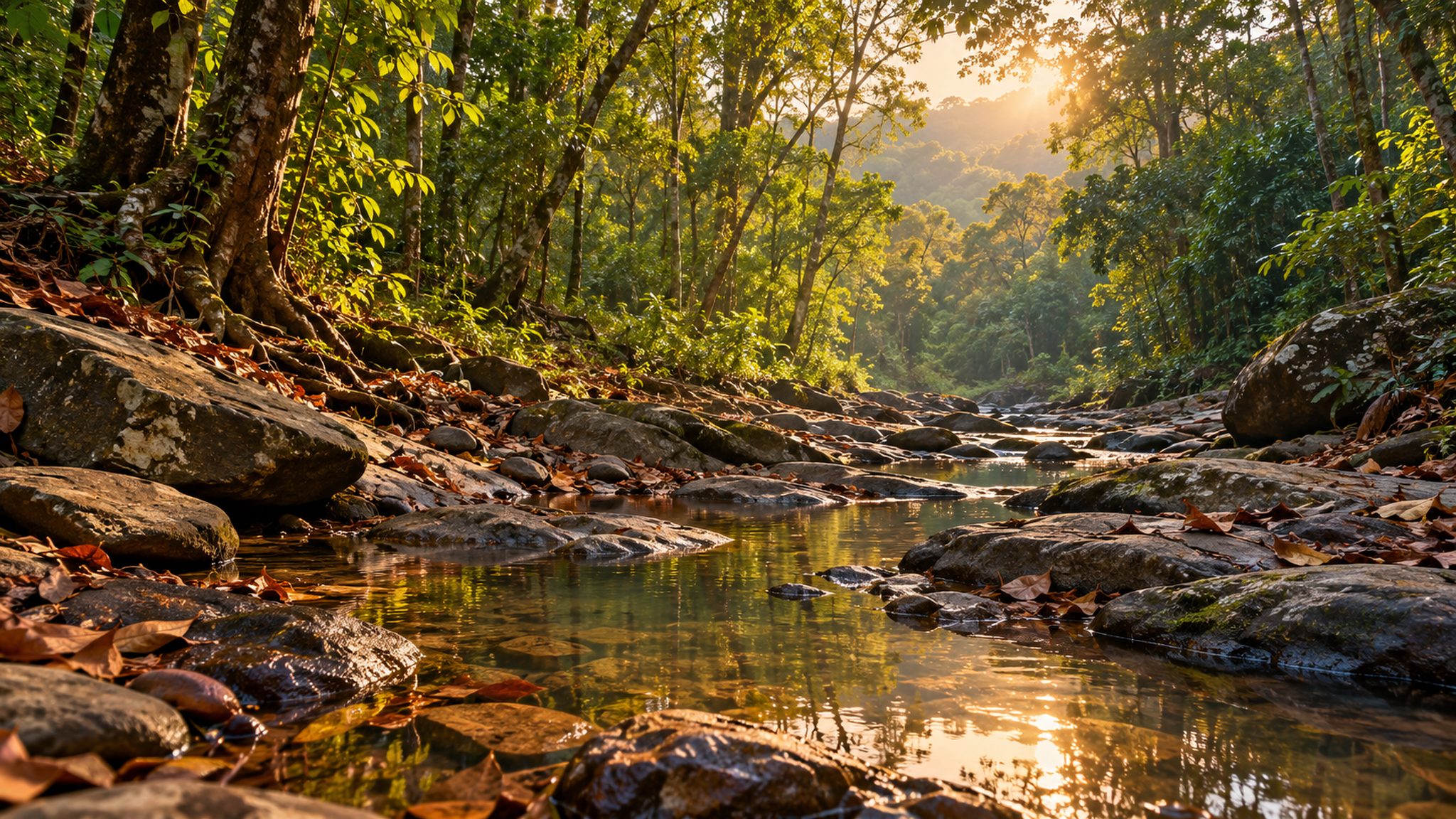
- Forest streams and waterholes may dry earlier if dry conditions intensify. That is a conditional ecological pathway in the report, requiring observations of local water sources before declaring that it has occurred.
- Scattered heavy showers do not necessarily replenish water sources across a wider forest landscape. Their spatial coverage matters: a downpour at one site cannot establish adequate water availability throughout neighbouring habitats or catchments.
How Water Stress Changes Forest Phenology
Forest phenology connects seasonal plant events with the timing of resources available to animals and the renewal of vegetation.
- Phenology means the seasonal timing of flowering, fruiting, leaf shedding and growth. Rainfall and temperature help shape these cycles; a change in timing differs from a simple reduction in total forest area.
- Seasonal food availability can change when flowering or fruiting shifts. Animals dependent on those resources may face altered feeding opportunities, linking plant responses to habitat quality even where the forest canopy remains present.
- Regeneration is another concern because persistent water stress can restrict the establishment and growth of young vegetation. A forest may retain mature trees while its capacity to replace them gradually becomes less secure.
- Drought tolerance varies among species, so identical dry conditions need not produce identical outcomes. The report warns that prolonged drought could disadvantage vulnerable trees and eventually favour species better able to withstand water shortages.
- Visible canopy cover is an incomplete measure of forest health. Researchers distinguish a forest’s outward appearance from its physiological condition, making repeated observations of growth, seasonal events and regeneration important for identifying emerging stress.
Wildlife Risk Requires Field Evidence
The same dry spell can create several risks, but each requires separate evidence before an ecological impact can be attributed.
- Wildlife movement may change when familiar water sources fail. Animals seeking alternatives could approach forest fringes and human-dominated areas, increasing encounters; the report presents this as a possibility rather than a measured statewide outcome.
- Heat and water shortage could affect animal physiology and behaviour. Experts explicitly said that field observations were needed to establish such effects, so a climatic warning cannot substitute for evidence about particular wildlife populations.
- Fire risk can rise as hot, dry conditions persist, but risk is different from an actual fire. A count of incidents alone cannot demonstrate that El Niño caused a particular fire or seasonal pattern.
- Forest type, elevation and soils influence exposure and sensitivity. Managers should assess individual landscapes instead of assuming that every forest in Kerala will experience the same degree, timing or combination of ecological stress.
- Historical phenology records provide a useful comparison with current observations. Researchers can examine whether seasonal plant events differ during El Niño years, while checking local rainfall and temperature before drawing conclusions about the observed association.
Way Forward
Track the Ecological Links
- Monitor streams, waterholes and soil moisture alongside rainfall and temperature, prioritising locations where persistent drying is observed.
- Maintain repeated flowering, fruiting and regeneration records so managers can distinguish seasonal variation from sustained ecological deterioration.
- Prepare fire prevention earlier where local conditions justify it; base timing on actual dryness and risk assessments.
- Track wildlife movement near forest fringes and coordinate local responses when water shortages increase encounters.
Conclusion
- El Niño is a risk signal, not a local ecological verdict. Forest impacts depend on rainfall, soil water, species characteristics and the persistence of stress, which must be assessed together.
- Follow the mechanism in an answer: climate variability can change water availability, plant seasonal cycles and wildlife resources. Keep projected risks separate from observed damage and demonstrated causes.
UPSC Practice Questions
Prelims MCQ 1
With reference to forest phenology, consider the following statements:
- It includes the seasonal timing of flowering and fruiting.
- An apparently intact canopy necessarily proves that trees are free from physiological water stress.
- Rainfall and temperature can influence seasonal plant events.
How many of the above statements are correct?
(a) Only one (b) Only two (c) All three (d) None
Answer: (b) Only two
Explanation:
Statements 1 and 3 are correct. Phenology concerns seasonal biological events, while an intact-looking canopy can conceal physiological stress.
Prelims MCQ 2
Which observation would most directly help assess the proposed link between dry conditions and altered wildlife movement?
(a) A national annual forest-cover total alone (b) The number of forest departments in the country (c) Repeated local records of water-source availability and animal movement (d) An ocean-temperature indicator without local observations
Answer: (c) Repeated local records of water-source availability and animal movement
Explanation:
Paired local observations examine the proposed ecological pathway. Broad indicators alone cannot establish how water availability affects wildlife in a particular landscape.
UPSC Mains Questions
- Explain how prolonged dry spells can affect forest phenology and regeneration. Why can canopy appearance provide an incomplete assessment of forest health?
- An El Niño warning does not establish local ecological damage. Discuss the evidence needed to assess risks to forest water availability, wildlife movement and fire occurrence.
Source: The Hindu.
Frequently Asked Questions
What is forest phenology?
Forest phenology is the seasonal timing of events such as flowering, fruiting, leaf shedding and growth. These events respond to environmental conditions and influence when food and other habitat resources become available.
Does El Niño prove that a particular forest will suffer drought?
No. El Niño can influence atmospheric circulation and rainfall patterns, but local outcomes depend on rainfall distribution, temperature, dry-spell duration and landscape conditions. Forest-level impacts need observations rather than inference from an ocean indicator alone.
Can a green-looking forest still experience water stress?
Yes. The report notes that forests can retain their overall canopy appearance while physiological health declines. Monitoring soil moisture, growth and regeneration can reveal problems that a visual assessment of canopy cover misses.
Why can forest water shortages increase human–wildlife encounters?
If familiar streams or waterholes dry early, animals may seek water closer to forest fringes and settlements. This is a possible response, not an automatic outcome; movement and water-source observations are needed locally.
Tell Google you want more of this.
Add Anantam IAS as a preferred sourceOne tap, and this site shows up more often in your own Top Stories, AI Overviews and AI Mode. Remove it any time.