Why in News?
The 49th Session of the Codex Alimentarius Commission, held in Geneva from July 6 to 10, 2026, adopted international commodity standards for large cardamom, coriander and vanilla. PIB announced the decision on July 16 and described it as a milestone in India’s participation in global food standard-setting.
All three texts had been finalised by the India-hosted Codex Committee on Spices and Culinary Herbs at its eighth session in Guwahati in October 2025. Their adoption creates common quality references for trade, but it does not automatically rewrite the food laws of India or any importing country.
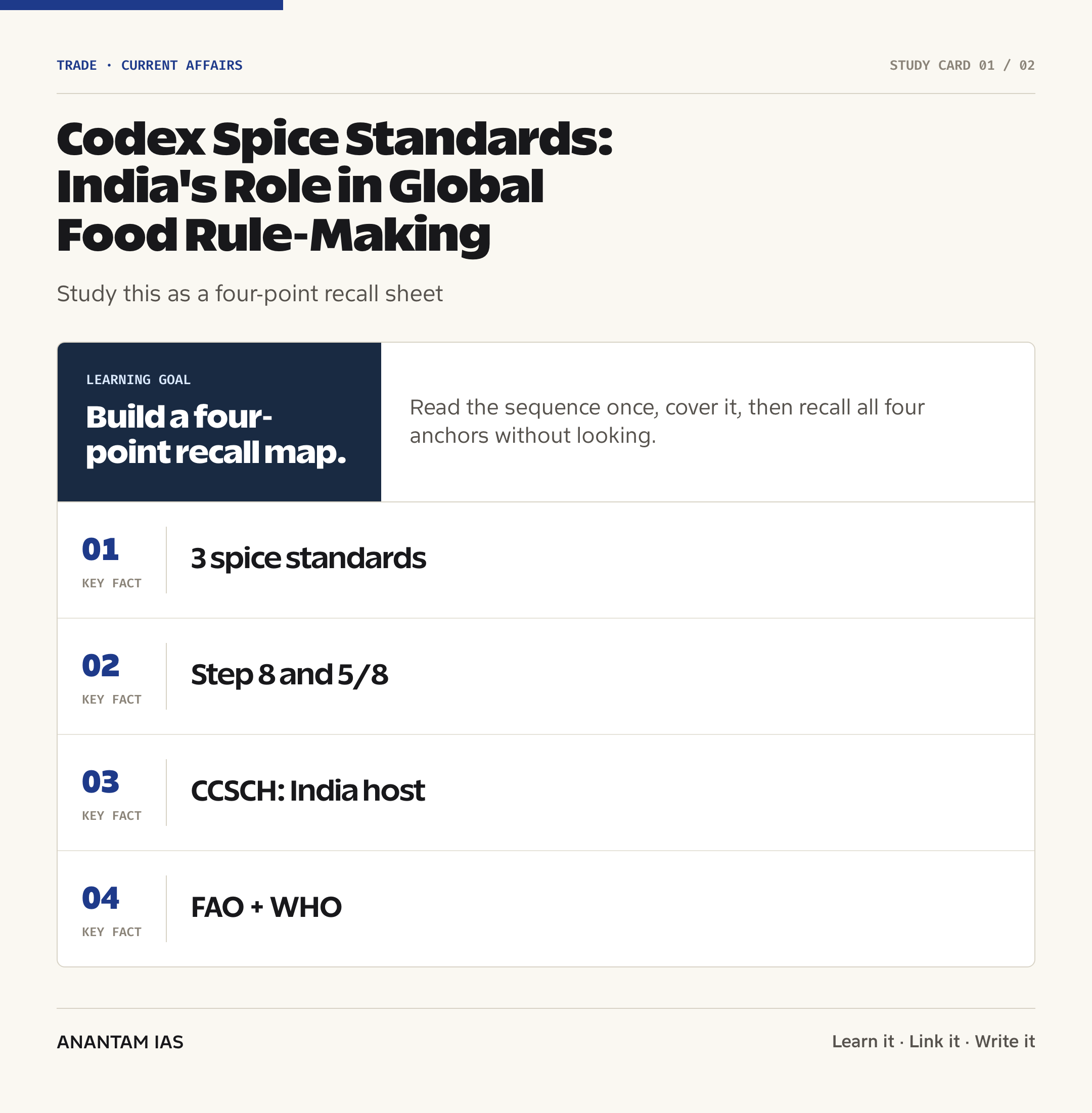
- Vanilla completed the normal procedure and was adopted at Step 8 under Codex job number N03-2021.
- Large cardamom and coriander were adopted at Step 5/8 under job numbers N03-2024 and N02-2024, respectively.
- Step 5/8 is a final adoption route in which the Commission accepts a committee recommendation to omit Steps 6 and 7; it is not a provisional standard.
- Relevant provisions had been examined by the Codex committees on methods and sampling, food additives and food labelling before Commission adoption.
- The Commission also accepted India as Co-Chair of an electronic working group on risk analysis for new food products, with the European Union as Chair.
The development matters in the context of:
- The development shows how technical diplomacy can influence the product definitions, quality parameters, sampling methods and labelling expectations used across markets.
- A common standard can reduce avoidable variation between buyer specifications, but exporters still have to meet the binding domestic rules of the destination market.
- The strongest Mains framing connects three levels: consumer health, fair food trade and India’s capacity to convert international standards into farm-level quality gains.
UPSC Relevance
Prelims Relevance
- The Codex Alimentarius Commission was established jointly by the Food and Agriculture Organization and the World Health Organization in 1963.
- Its two core purposes are protecting consumer health and ensuring fair practices in the food trade.
- The Commission is the decision-making body for the Joint FAO/WHO Food Standards Programme; Codex committees prepare specialised texts for its consideration.
- Codex texts include standards, guidelines and codes of practice covering food hygiene, additives, contaminants, pesticide and veterinary-drug residues, labelling, sampling, analysis and inspection.
- The CCSCH is an active commodity committee hosted by India. It develops worldwide standards for spices and culinary herbs in dried or dehydrated form, including whole, ground, cracked or crushed products.
- India’s Spices Board, under the Ministry of Commerce and Industry, serves as the CCSCH Secretariat.
- A normal Codex standard follows an eight-step process. Step 8 is final adoption; Step 5/8 allows the Commission to omit the second comment round at Steps 6 and 7 on a committee recommendation.
- Codex standards are recommendations for voluntary application. They do not substitute for national legislation or become binding domestic law merely because the Commission adopts them.
- Codex food-safety standards are recognised reference points under the WTO Agreement on the Application of Sanitary and Phytosanitary Measures.
- The three standards adopted at CAC49 cover large cardamom, coriander and vanilla; they should not be confused with one combined standard for every spice.
Mains Relevance
GS Paper 2
- India’s role in multilateral rule-making through an FAO-WHO institution and an India-hosted commodity committee.
- Technical standards as an instrument of economic diplomacy, coalition-building and representation of producer-country concerns.
- Relationship between voluntary international norms, national regulatory sovereignty and the rules-based trading order.
GS Paper 3
- Food-safety and quality infrastructure across farms, processing, laboratories, certification and export inspection.
- Standards as a means to reduce information gaps, improve market access and protect farmers from inconsistent buyer requirements.
- Limits of harmonisation where small producers face compliance costs, weak traceability or inadequate testing facilities.
Essay
- Rules written in technical rooms can shape livelihoods far beyond those rooms.
- Standards build trust only when producers have the capacity to meet them.
- Global harmonisation works best when it protects both consumers and diversity in production.
Background and Context
Codex Alimentarius: institution, mandate and texts
Codex is a global food-standard system, not a supranational food regulator.
- The Codex Alimentarius Commission is responsible for the Joint FAO/WHO Food Standards Programme and meets as a membership-based intergovernmental body.
- Its mandate combines two goals: food must be safe and wholesome for consumers, and food trade must follow fair practices rather than deceptive or arbitrary requirements.
- Codex relies on scientific advice from FAO-WHO expert bodies and on negotiation among members. This combination separates risk assessment, which evaluates evidence, from risk management choices made by governments and Codex bodies.
- A Codex standard usually gives requirements for a food or class of foods. Guidelines explain recommended approaches, while codes of practice set good practices for production, handling or control.
- The collection covers principal foods and cross-cutting subjects such as hygiene, residues, contaminants, additives, labelling, sampling and import-export inspection. See the published note on India’s food-safety governance for the domestic regulatory context.
CCSCH: why India hosts the spice committee
CCSCH turns producer, trader, regulator and consumer concerns into worldwide commodity standards for spices and culinary herbs.
- The committee’s formal terms cover spices and culinary herbs in dried or dehydrated form, whether whole, ground, cracked or crushed.
- India is the host country, and the Spices Board acts as Secretariat. Hosting includes administrative leadership and continuity; adoption authority still rests with the full Commission.
- Electronic working groups let members develop text between sessions. They compare national practices, scientific information, trade descriptions and technical parameters before a draft reaches the committee plenary.
- At CCSCH8 in Guwahati, held from October 13 to 17, 2025, members finalised the vanilla text and recommended final adoption of the large-cardamom and coriander texts.
- Other specialist committees then reviewed clauses within their mandates. CCMAS addressed analysis and sampling, CCFA addressed additives, and CCFL addressed labelling before CAC49 took the final decision.
How the three standards reached adoption
The three products reached the same legal status through different points in the Codex elaboration procedure.
- Vanilla was submitted as job N03-2021 at Step 8. That means it had completed the normal rounds of drafting, member comments, committee revision and final review before Commission adoption.
- Large cardamom, job N03-2024, and coriander, job N02-2024, were submitted at Step 5 with a recommendation to omit Steps 6 and 7. CAC49 adopted both at Step 5/8 as final texts.
- Step 5/8 should not be confused with the separate accelerated five-step procedure. In a Step 5/8 case, the subsidiary committee recommends omitting the second circulation and revision round after judging the text ready for final adoption.
- The three texts moved from commodity drafting to specialist endorsement and then to CAC49. This chain protects coherence: a commodity committee should not create additive, labelling or analytical provisions that conflict with Codex-wide rules.
- Once adopted by the Commission, a standard enters the Codex Alimentarius. National authorities and market actors can then refer to the final text, while later revision remains possible when science or trade conditions change.
What the standards do for each spice
The standards harmonise product identity and quality expectations without making every batch or origin identical.
- The large-cardamom standard is especially relevant to the North-Eastern Himalayan region, where the crop is indigenous. A shared reference can make product forms, quality classes and analytical results more comparable across buyers.
- The coriander standard covers the spice in the form of dried seeds. India’s scale as a producer and exporter makes predictable quality terminology important for contracts, inspection and dispute avoidance.
- The vanilla standard creates an accepted quality framework for international trade. PIB noted that India imports a substantial share of its vanilla requirement, so the standard matters to import consistency and consumer confidence as well as any future domestic production.
- The additive provisions allow relevant anticaking agents in ground or powdered forms in line with the Codex General Standard for Food Additives; the precise product standard, not a news summary, governs the applicable condition.
- Common standards can reduce transaction costs caused by incompatible descriptions. They do not guarantee a sale, a premium price or automatic acceptance of a consignment that fails the importing country’s legal or contractual requirements.
Voluntary standard, domestic law and private contract
The exam-critical distinction is between an international recommendation and a rule that a court or regulator can enforce.
- Codex standards are voluntary recommendations for members. The FAO-WHO Codex framework expressly says they are not a substitute for national legislation.
- A standard becomes binding inside a country only when its legislature or regulator incorporates relevant requirements into domestic law, or when an existing law independently imposes equivalent requirements.
- In India, binding food requirements arise under the Food Safety and Standards Act, 2006 and regulations, orders or directions made through the domestic system. CAC49 adoption alone does not amend those instruments.
- A buyer may also place Codex-aligned specifications in a private contract. Those terms can bind the contracting parties even when the Codex text itself remains voluntary.
- Exporters must check three layers: the Indian rules governing production and export, the destination country’s mandatory import rules, and the buyer’s contractual specification. Calling Codex either wholly non-binding or directly enforceable everywhere misses this layered effect.
Why voluntary Codex texts affect international trade
Codex gains practical force from regulatory adoption, buyer expectations and its benchmark role in the WTO system.
- The WTO SPS Agreement recognises Codex standards, guidelines and recommendations as international references for food-safety measures.
- A member may maintain a food-safety measure more stringent than the Codex baseline, but it may need scientific justification and a defensible risk basis if the measure restricts trade.
- Quality descriptions and labelling can also interact with the WTO Technical Barriers to Trade Agreement, depending on the measure. SPS and TBT disciplines are related but not interchangeable.
- Alignment can reduce avoidable testing duplication and make an exporter’s evidence easier for an importer to assess. But equivalence, inspection, certification and border control still depend on competent authorities and the applicable trade arrangement.
- For the wider trade setting, connect this topic to the published notes on the World Trade Organization and non-tariff barriers.
India's gains, limits and answer-building framework
International adoption is a diplomatic gain only if domestic producers can turn the benchmark into reliable quality and better market access.
- Representation gain: India can bring tropical producer conditions, product forms and smallholder realities into a process that might otherwise reflect large importing markets more heavily.
- Trade gain: agreed terminology and methods can lower uncertainty, support fair comparison and strengthen India’s case against arbitrary or disguised barriers.
- Consumer gain: better identity, hygiene, contaminant, additive and labelling controls can strengthen confidence in both imports and exports.
- Capacity limit: small growers and processors may struggle with drying, storage, traceability, laboratory testing and certification costs even when the standard is sound.
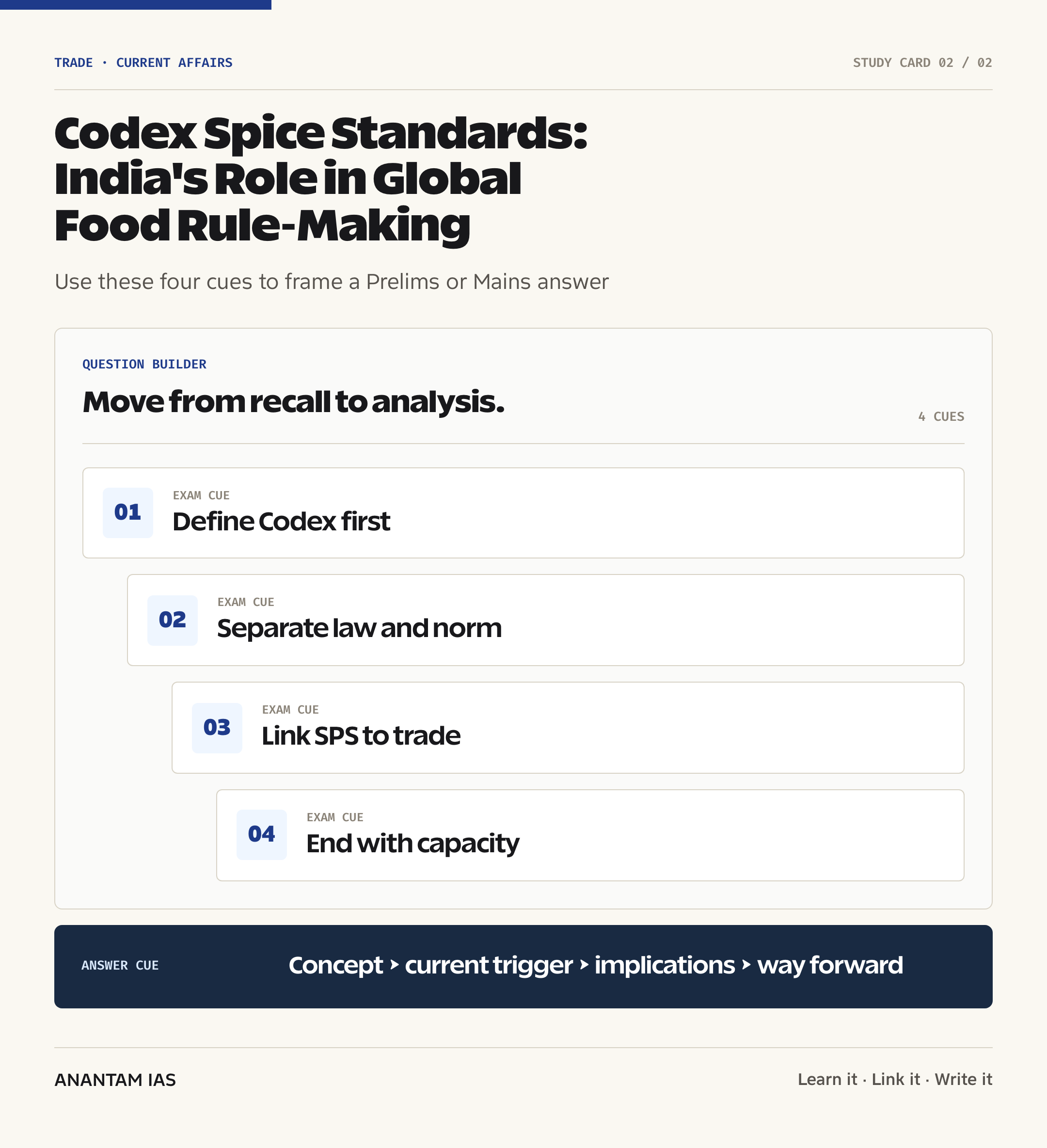
- Build a Mains answer in four moves: define Codex and CCSCH; cite the three standards and their adoption status; distinguish voluntary norms from domestic law while linking SPS effects; end with farm-level capacity, laboratories, traceability and inclusive participation.
- The economic objective is not standard-setting for its own sake. It is to connect credible rules with competitive agricultural exports and more predictable returns without shifting disproportionate compliance costs onto small producers.
Way Forward
Translate standards into producer guidance
- Publish crop-specific manuals in producer languages that convert the Codex text into practical steps for harvesting, drying, grading, storage and traceability.
- Use the Spices Board, State departments, cooperatives and farmer-producer organisations to reach small growers rather than relying only on exporter-level circulars.
Strengthen quality infrastructure
- Expand affordable access to accredited laboratories, validated methods, reference materials and proficiency testing near production clusters.
- Make certification and test results interoperable where possible so a producer is not forced to pay repeatedly for the same parameter.
Align domestic rules transparently
- Compare each final Codex provision with Indian regulations and publish a gap assessment before any domestic change.
- Use public consultation and transition periods when alignment would impose new costs, while retaining stricter measures where Indian risk evidence supports them.
Use standards diplomacy strategically
- Maintain scientific and trade teams across CCSCH, CAC and relevant WTO forums so India’s position remains consistent from drafting to dispute prevention.
- Use India’s co-chair role on risk analysis for new food products to support transparent evidence rules and meaningful participation by developing countries.
Measure outcomes, not attendance
- Track rejection rates, testing time, compliance cost, smallholder participation and price realisation after standards enter use.
- Treat a lower border-rejection rate and wider producer access as stronger evidence of success than the number of meetings hosted.
Conclusion
CAC49’s adoption of the large-cardamom, coriander and vanilla standards shows India moving from rule-taker to active rule-shaper in a specialised area of global governance. Hosting CCSCH and supplying its Secretariat gives India institutional influence, while final authority remains multilateral.
The balanced assessment is that Codex standards are voluntary but consequential. They guide domestic rules, contracts and WTO scrutiny without automatically becoming Indian law. India’s next task is to pair standards diplomacy with laboratories, traceability, producer support and transparent domestic alignment so that common rules improve both consumer trust and farm-export competitiveness.
UPSC Practice Questions
Prelims MCQ 1
With reference to the Codex spice standards adopted at CAC49, consider the following statements:
- The vanilla standard was adopted at Step 8 of the Codex procedure.
- The large-cardamom and coriander standards were finally adopted at Step 5/8.
- Step 5/8 means that the standards remain provisional until each member incorporates them into domestic law.
How many of the above statements are correct?
(a) Only one (b) Only two (c) All three (d) None
Answer: (b) Only two
Explanation:
Statements 1 and 2 are correct. Statement 3 is incorrect: Step 5/8 is final Codex adoption after omission of Steps 6 and 7 on a committee recommendation. National incorporation is a separate question because Codex texts are voluntary recommendations.
Prelims MCQ 2
Which one of the following best describes the legal and trade effect of a Codex food standard?
(a) It automatically overrides the food law of every Codex member. (b) It is voluntary internationally but may guide national law and serve as a WTO food-safety benchmark. (c) It binds only FAO employees and has no relevance to international trade. (d) It becomes enforceable only after approval by the United Nations Security Council.
Answer: (b) It is voluntary internationally but may guide national law and serve as a WTO food-safety benchmark.
Explanation:
Codex standards are recommendations and do not replace national legislation. Their practical influence comes from domestic adoption, contracts and recognition as international food-safety references under the WTO SPS framework.
UPSC Mains Questions
- Codex standards are voluntary in form but consequential in global food trade. Discuss this statement by distinguishing international standards from domestic law and examining the role of the WTO SPS framework, private contracts and national regulatory capacity. (250 words)
- India’s hosting of the Codex Committee on Spices and Culinary Herbs illustrates the growing importance of standards diplomacy. Assess the benefits and limits of such institutional leadership for consumer protection, small producers and agricultural export competitiveness. (250 words)
- The value of a global food standard depends on the domestic capacity to implement it. Suggest a framework linking producer guidance, traceability, laboratories, certification, regulatory alignment and outcome measurement for India’s spice sector. (150 words)
Sources: PIB, Ministry of Commerce and Industry and FAO-WHO Codex Alimentarius Commission.
Frequently Asked Questions
What is the Codex Alimentarius Commission?
The Codex Alimentarius Commission is the intergovernmental body responsible for the Joint FAO/WHO Food Standards Programme. It adopts food standards, guidelines and codes of practice designed to protect consumer health and ensure fair practices in food trade. Its committees prepare specialised texts, while the Commission takes final adoption decisions.
Which spice standards did CAC49 adopt?
CAC49 adopted standards for large cardamom, coriander and vanilla. Vanilla reached final adoption at Step 8. Large cardamom and coriander were adopted at Step 5/8, which allowed the Commission to omit Steps 6 and 7 on the committee’s recommendation and adopt the texts as final standards.
What is India’s role in CCSCH?
India hosts the Codex Committee on Spices and Culinary Herbs, and the Spices Board serves as its Secretariat. The committee develops worldwide standards for dried and dehydrated spices and culinary herbs. Hosting provides institutional leadership and continuity, but all members participate and the Codex Commission retains final adoption authority.
Are Codex standards legally binding in India?
No, Commission adoption alone does not make a Codex standard binding Indian law. Codex texts are recommendations for voluntary application. Binding Indian requirements arise through the Food Safety and Standards Act, regulations and other domestic instruments. A buyer may separately make Codex-aligned specifications binding through a private contract.
How can Codex affect WTO disputes?
The WTO SPS Agreement recognises Codex food-safety standards as international reference points. A country can adopt a stricter food-safety measure, but it may need a sound scientific and risk basis if that measure restricts trade. Codex can help evaluate whether a measure protects health or acts as an unjustified barrier.
How can spice farmers benefit?
Common quality descriptions and test methods can reduce uncertainty, support fair comparison and improve access to buyers. Benefits are not automatic. Farmers and small processors need practical guidance, suitable drying and storage, traceability, affordable laboratory access and proportionate certification so compliance costs do not absorb the gains.
Tell Google you want more of this.
Add Anantam IAS as a preferred sourceOne tap, and this site shows up more often in your own Top Stories, AI Overviews and AI Mode. Remove it any time.