Why in News?
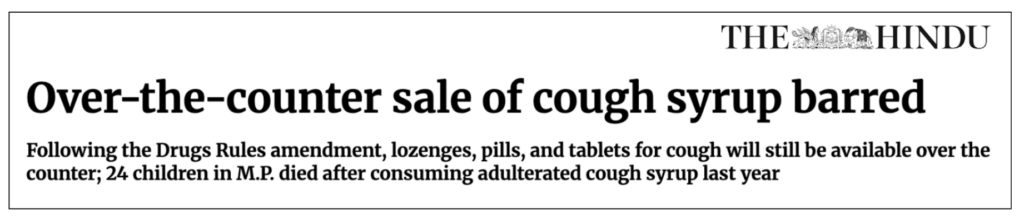
The Hindu reported that the Union government has barred the over-the-counter sale of cough syrup, making a registered doctor’s prescription mandatory for buying all medicinal syrups, including cough preparations. The move tightens how a widely self-medicated category of drugs reaches consumers.
An Indian Express explainer linked the decision to a string of child deaths connected to toxic or adulterated cough syrups contaminated with industrial solvents such as diethylene glycol (DEG), and to gaps in quality control and self-medication that regulators have moved to close.
- Cough syrups and other medicinal syrups can no longer be sold over the counter; a prescription from a registered medical practitioner is now required.
- The change is administered through India’s drug law — the Drugs and Cosmetics Act, 1940 and the Drugs and Cosmetics Rules, 1945 — which classify medicines into prescription schedules.
- The trigger was repeated child fatalities tied to syrups contaminated with toxic solvents, notably diethylene glycol and ethylene glycol.
- Regulators have flagged the misuse of cough syrups for self-medication and, in some preparations, for their psychoactive (codeine-type) content.
- Enforcement runs through the Central Drugs Standard Control Organisation (CDSCO), the Drugs Controller General of India (DCGI) and state drug controllers.
The development matters in the context of:
- This sits at the intersection of drug regulation, quality control and consumer protection — a recurring GS2 governance theme.
- It follows earlier global episodes in which India-made syrups were linked to deaths abroad, putting the spotlight on export quality and domestic oversight.
UPSC Relevance
Prelims Relevance
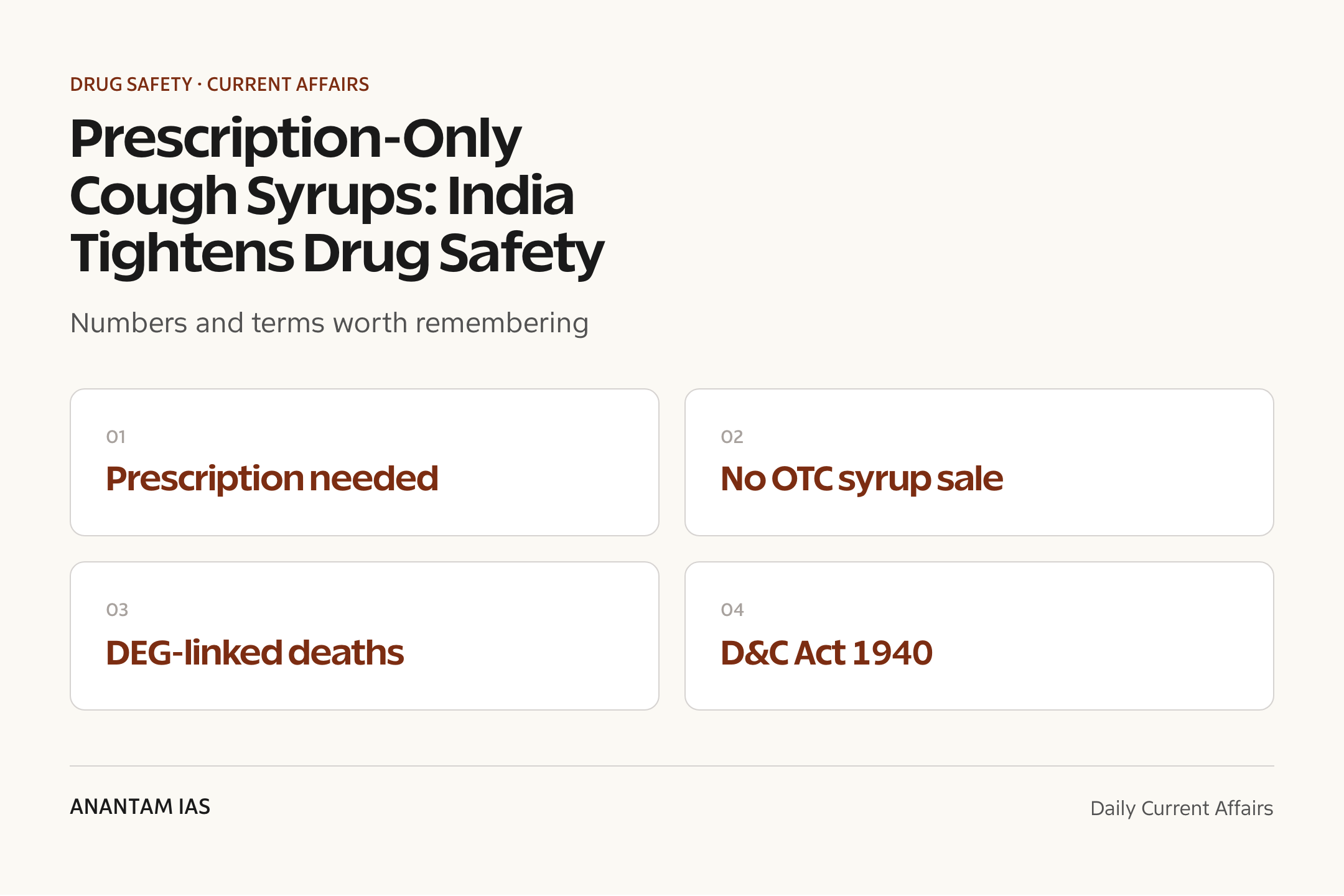
- Drugs and Cosmetics Act, 1940 — parent law regulating import, manufacture, and sale of drugs
- Drugs and Cosmetics Rules, 1945 — operational rules, including drug schedules
- Schedule H — prescription-only drugs sold against a doctor’s prescription
- Schedule H1 — restricted drugs (some antibiotics, habit-forming) needing extra record-keeping
- Schedule K — categories granted specified exemptions from certain provisions
- CDSCO — Central Drugs Standard Control Organisation, the national drug regulator
- DCGI — Drugs Controller General of India, heads CDSCO
- State Drug Controllers — license and inspect the manufacture and retail sale within states
- Diethylene glycol (DEG) / ethylene glycol — toxic industrial solvents found as contaminants
- Pharmacovigilance — monitoring adverse drug reactions; PvPI is India’s programme
- Antimicrobial resistance (AMR) — driven partly by over-the-counter self-medication
Mains Relevance
GS Paper 2
- Issues relating to the development and management of the health sector; regulation of drugs as a governance function.
- Government policies and statutory bodies (CDSCO, DCGI) for protecting consumers and ensuring drug quality.
GS Paper 3
- Pharmaceutical industry, quality control and the challenge of contaminated or substandard medicines.
- Antimicrobial resistance and the public-health costs of unregulated self-medication.
Essay
- When prevention fails: regulation as the last line of defence in public health.
- Trust in medicine begins with the safety of the smallest bottle.
Background and Context
What changed, and what the rule means
The core shift is from free retail sale to controlled, prescription-gated sale of all medicinal syrups.
- Earlier, many cough syrups sat in the over-the-counter grey zone and were sold without any prescription at chemist counters.
- The new requirement means a chemist can dispense a medicinal syrup only against a valid prescription from a registered medical practitioner.
- It applies broadly to medicinal syrups, not only branded cough formulations, closing routes for casual purchase.
- The aim is to insert a doctor’s judgement between the patient and a drug that is easy to misuse or over-consume.
- It strengthens the existing prescription-schedule architecture under the drug-regulation framework rather than creating a wholly new law.
The legal framework: Act, Rules and schedules
India regulates medicines through one parent statute and a set of rules that sort drugs into schedules.
- The Drugs and Cosmetics Act, 1940, governs import, manufacture, distribution and sale of drugs and cosmetics.
- The Drugs and Cosmetics Rules, 1945, operationalise the Act, including the drug schedules that set sale conditions.
- Schedule H lists prescription-only drugs that must be sold against a doctor’s prescription.
- Schedule H1 covers restricted drugs — certain antibiotics and habit-forming medicines — needing extra retailer record-keeping.
- Schedule K grants specified exemptions to certain drug categories from some provisions of the Rules.
- Tightening syrup sales works by moving such products firmly into the prescription-required zone.
Why the crackdown: the contamination crisis
The decision is a direct response to deaths caused by toxic adulterants in syrups, especially among children.
- Several tragedies were traced to syrups laced with diethylene glycol (DEG) or ethylene glycol, industrial solvents used illegally in place of pharmaceutical-grade glycerine or propylene glycol.
- These solvents are cheap but highly toxic, causing acute kidney failure and death, with children most vulnerable.
- India-made syrups were earlier linked to child deaths abroad, including reported cases in The Gambia and Uzbekistan, drawing WHO medical-product alerts.
- Such episodes exposed weaknesses in raw-material testing and batch quality control at some manufacturers.
- Beyond contamination, easy retail access encouraged self-medication and misuse of codeine-based syrups.
Who regulates drugs in India?
Drug oversight in India is shared between a central regulator and the states, a structure that shapes enforcement.
- The Central Drugs Standard Control Organisation (CDSCO) is the national regulator under the Health Ministry, setting standards and approving new drugs.
- The Drugs Controller General of India (DCGI) heads CDSCO and approves licences for new drugs and clinical trials.
- State Drug Controllers license and inspect manufacturing units and retail pharmacies within their states.
- This split means manufacturing-quality enforcement often depends on uneven state-level capacity.
- The Pharmacovigilance Programme of India (PvPI) tracks adverse drug reactions to flag unsafe products, complementing inspections by bodies like the WHO at the global level.
Self-medication, AMR and the public-health stakes
Restricting casual sale also targets the wider harms of unsupervised medicine use.
- Routine over-the-counter buying normalises self-medication, where people dose themselves without diagnosis.
- Unsupervised use of medicines, especially antibiotics, fuels antimicrobial resistance, a top global health threat.
- Cough syrups containing codeine can be misused for their psychoactive effect, creating a substance-abuse risk.
- Children are dosed by caregivers using easily bought syrups, raising the danger from any contaminated batch.
- A prescription gate restores a clinical check and supports a wider preventive-health culture.
Trade-offs and implementation concerns
A tighter rule brings real safety gains but also practical and access challenges.
- Access may suffer in rural areas with few doctors, where families rely on chemists for minor ailments.
- Enforcement depends on chemists actually demanding prescriptions and on inspectors auditing sales records.
- The bigger risk — contaminated raw materials — needs upstream testing, not only point-of-sale control.
- Over-restriction could push purchases toward informal or online channels that are harder to police.
- Genuine impact rests on pairing the rule with stricter manufacturing-quality checks and lab capacity.
Way Forward
Fix quality at the source
- Mandate testing of every batch of glycerine and propylene glycol for DEG and ethylene glycol before use.
- Expand accredited drug-testing labs and risk-based inspection of high-volume syrup manufacturers.
Strengthen the regulatory chain
- Build uniform capacity across state drug controllers so enforcement does not vary by geography.
- Use pharmacovigilance data to detect unsafe batches early and trigger fast recalls.
Protect access while controlling sale
- Pair the prescription rule with telemedicine and primary-care access so rural families are not stranded.
- Run awareness drives on the risks of self-medication and the importance of finishing prescribed courses.
Conclusion
Making cough syrups prescription-only is a sensible response to a grim pattern of preventable child deaths, inserting a clinical check into a category that had drifted into casual, unsupervised retail sale.
But the rule treats the symptom more than the disease. Lasting safety depends on testing raw materials, levelling up state-level enforcement and active pharmacovigilance — so that the smallest bottle on the chemist’s shelf can be trusted again.
UPSC Practice Questions
Prelims MCQ 1
With reference to drug regulation in India, consider the following statements:
- The Drugs and Cosmetics Act, 1940, is the parent law governing the manufacture and sale of drugs in India.
- Schedule H of the Drugs and Cosmetics Rules lists drugs that can be sold without a doctor’s prescription.
- The Central Drugs Standard Control Organisation is the national regulatory authority for drugs in India.
How many of the above statements are correct?
(a) Only one (b) Only two (c) All three (d) None
Answer: (b) Only two
Explanation:
Statements 1 and 3 are correct. Statement 2 is wrong — Schedule H lists prescription-only drugs that must be sold against a doctor’s prescription, not over the counter.
Prelims MCQ 2
The contamination of certain cough syrups that triggered child deaths in recent years was primarily caused by which of the following?
(a) Excess paracetamol content
(b) Diethylene glycol and ethylene glycol are used as cheap solvents
(c) Microbial contamination from poor packaging
(d) Overdose of codeine in standard formulations
Answer: (b) Diethylene glycol and ethylene glycol are used as cheap solvents
Explanation:
Toxic industrial solvents diethylene glycol (DEG) and ethylene glycol, used illegally in place of pharmaceutical-grade glycerine or propylene glycol, cause acute kidney failure and were behind the deaths.
UPSC Mains Questions
- “Restricting the over-the-counter sale of medicinal syrups addresses the symptom but not the disease of poor drug quality in India.” Critically examine in light of recent contamination episodes. (250 words)
- Discuss the structure of drug regulation in India under the Drugs and Cosmetics Act, 1940. What reforms are needed to prevent the recurrence of contaminated-medicine tragedies? (250 words)
- How does the easy over-the-counter availability of medicines contribute to self-medication and antimicrobial resistance in India? Suggest a balanced way forward. (150 words)
Sources: The Hindu and Indian Express.
Frequently Asked Questions
What did the new cough-syrup rule change?
The Centre barred the over-the-counter sale of all medicinal syrups, including cough preparations. A registered doctor’s prescription is now mandatory to buy them at a pharmacy. The aim is to insert a clinical check into a widely self-medicated category and reduce both misuse and exposure to unsafe batches.
Why did the government tighten the rules now?
The move followed repeated child deaths linked to cough syrups contaminated with toxic solvents such as diethylene glycol and ethylene glycol. These cheap industrial chemicals, used illegally instead of pharmaceutical-grade ingredients, cause acute kidney failure. The episodes exposed weak quality control and the dangers of unsupervised purchase.
What are Schedule H, H1 and K?
They are categories under the Drugs and Cosmetics Rules, 1945. Schedule H lists prescription-only drugs. Schedule H1 covers restricted drugs such as certain antibiotics and habit-forming medicines needing extra record-keeping. Schedule K grants specified exemptions from some provisions to certain drug categories. Together they set how different drugs may be sold.
Who regulates drugs and their quality in India?
The Central Drugs Standard Control Organisation, headed by the Drugs Controller General of India, is the national regulator that sets standards and approves new drugs. State drug controllers licence and inspect manufacturing units and retail pharmacies within their states. The Pharmacovigilance Programme of India tracks adverse drug reactions.
How is this linked to antimicrobial resistance?
Easy over-the-counter access encourages self-medication, where people take medicines, including antibiotics, without diagnosis or a full course. This misuse is a major driver of antimicrobial resistance. Requiring a prescription restores clinical oversight, helping curb the unsupervised use of drugs that breeds resistant infections.
Will the rule hurt access to medicines?
It can, especially in rural areas with few doctors, where families relied on chemists for minor ailments. Pairing the rule with telemedicine, stronger primary care and awareness drives can protect access. The deeper fix, however, lies in testing raw materials and improving manufacturing quality, not only controlling retail sale.
Tell Google you want more of this.
Add Anantam IAS as a preferred sourceOne tap, and this site shows up more often in your own Top Stories, AI Overviews and AI Mode. Remove it any time.