
Why in News?
Recently, in a landmark judgment, the Sessions Court in Madurai, Tamil Nadu, sentenced nine police personnel to death for the custodial torture and murder of a father-son duo.
| UPSC Relevance: GS-2 Polity and Governance: Human Rights Mains: Custodial Violence: Legal safeguards & Limitations. |
Custodial Violence in India:
- Custodial violence remains a significant issue in India’s legal system. In 2024 alone, the National Human Rights Commission (NHRC) reported over 2700 custodial deaths, a steep rise from the 2,400 cases in 2023.
- India has been ranked as “high risk” in the Global Torture Index 2025, a first-of-its-kind annual assessment developed by the World Organisation Against Torture (OMCT).
Mechanisms to Prevent Custodial Violence:
1. Constitutional Safeguards:
The existing legislative safeguards regarding custodial violence derive their authority from Articles 20, 21 and 22 of the Indian Constitution.
- Article 21: Right to life and personal liberty: No person shall be deprived of their life except according to the procedure established by law. It provides the right to live with dignity and free from any form of torture or cruel, inhuman, or degrading treatment.
- Article 22: Protection against arbitrary arrest and detention.
- No person who is arrested shall be detained in custody without being informed of the grounds for such arrest.
- Every person who is arrested and detained in custody shall be produced before the nearest magistrate within a period of 24 hours of such arrest.
- Article 20(3): Protection against self-incrimination: No person accused of an offence shall be compelled to be a witness against themselves.
2. Judicial Safeguards:
- D.K. Basu v State of West Bengal (1997): The SC held that custodial torture is a blatant violation of fundamental rights, particularly Article 21. It ruled that these rights are inviolable and cannot be suspended even during arrest or detention. The SC laid down 11 procedural safeguards to prevent custodial torture and deaths, which were later incorporated into the CrPC.
- Prakash Singh v Union of India (2006): The SC directed all states/UTs to establish independent Police Complaints Authorities (PCAs) led by retired judges, at the state and district levels, to investigate police misconduct.
- Paramvir Singh Saini v Baljit Singh (2020): The SC mandated that every police station be equipped with night-vision CCTV cameras, recording both audio and video, with a non-negotiable requirement to preserve footage for a minimum of one year, and ideally eighteen months. It affirmed the victims’ right to access the footage.
3. Statutory Safeguards:
- Section 41A of CrPC: Requires police to issue a Notice of Appearance to a person against whom reasonable suspicion exists, instead of making an immediate arrest.
- Section 176(1)of CrPC: Requires a Judicial Magistrate or Executive Magistrate to launch an investigation when a person passes away while in custody or any other location where the person is receiving institutional or state care.
- Section 25 of the Indian Evidence Act, 1872: A confession made to a police officer is prohibited and cannot be admitted in evidence. The fundamental principle underlying this is that a police officer may subject an arrested person to severe torture and force him to confess to the guilt of a crime that he may not have committed.
Challenges in Preventing Custodial Violence:
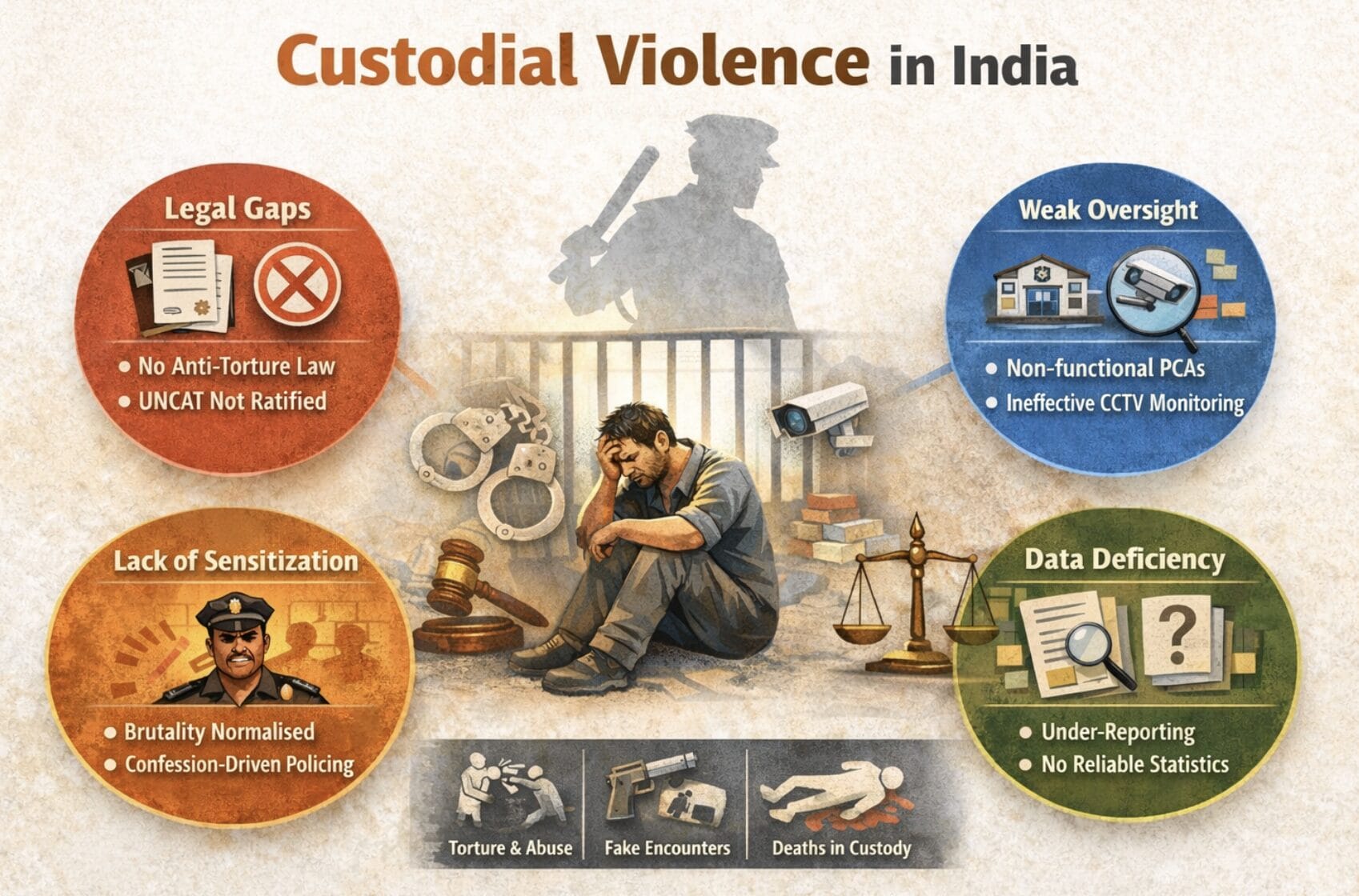
- Lack of Sensitisation: Custodial violence is often normalised as a tool for extracting confessions, especially due to low conviction rates in the formal legal process and pressure for quick results.
- No Stand-alone Anti-Torture Law: India lacks a specific domestic law criminalising torture despite repeated Law Commission recommendations (E.g., 273rd Report, 2017).
- UNCAT not Ratified: India has signed but not ratified the United Nations Convention Against Torture (UNCAT), weakening its commitment to global anti-torture standards.
- Section 27 of the Indian Evidence Act, 1872 (loophole): permits the use of material recovered (as evidence in the Court) as a result of confessions from the accused. This enables the continued use of custodial torture to extract information.
- Poor implementation of CCTV mandate: Limited compliance with the SC directions in Paramvir Singh Saini v. Baljit Singh (2020); the CCTV cameras are often non-functional, or footage is inaccessible.
- Absence of functional Police Complaints Authorities: Non-compliance with directives in Prakash Singh v. Union of India (2006); many states have not established independent bodies.
- Lapses in Magisterial Oversight: Magistrates often fail to fulfil their intended role (including scrutinising the grounds for arrest, physically examining the accused for signs of torture, and engaging meaningfully with them to uncover any evidence of mistreatment).
- Compromised Medico-legal examinations: Medical reports often lack detailed documentation of injuries. This systemic failure contributes to the abysmally low conviction rates in cases of custodial torture and deaths.
- Absence of authoritative data on custodial violence, in the absence of which, the accountability mechanisms remain weak.
Way Forward:
- Reforms in Police Training: Curriculum needs to be redesigned to include human rights sensitisation and trauma-informed investigation methods.
- Institutionalise Mental Wellness within Law enforcement: Set up district-level mental health units with mandatory quarterly counselling and refresher sensitisation courses for detainees and for officers.
- Enact a comprehensive Anti-Custodial Violence Law with time-bound investigation mechanisms, and mandatory video documentation of interrogations.
- Expedite setting up Police Complaints Authorities at all the State/UT and district levels, as per the judgment in Prakash Singh v Union of India, 2006. The status of compliance should be displayed on the websites of the Ministry and the State Home Departments.
- Add Section 114 B to the Indian Evidence Act, 1872, to ensure that if a person sustains injuries in police custody, it is presumed that the injuries were inflicted by the police, and the burden of proof lies on the authority concerned.
- Community Policing: Involvement of trained social workers and law students with police stations as part of community policing.
Every custodial death marks the failure of the state’s moral contract with its people. Structural reform of law enforcement is a major aspect in the prevention of custodial torture cases.
Tell Google you want more of this.
Add Anantam IAS as a preferred sourceOne tap, and this site shows up more often in your own Top Stories, AI Overviews and AI Mode. Remove it any time.